JF Ptak Science Books LLC Post 161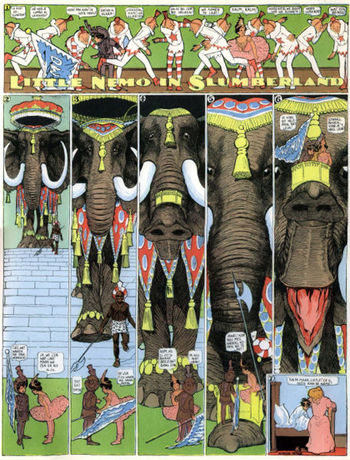
In a sub-sub-sub category of the sub-category of “Books that I Want to See” comes Dada-ist books for children, and less loosely, modernist books for kids. Or students. I’m not sure how close I can define this field because, well, I know basically nothing about it, but I am interested in how long it took for the bits of
created modernism (1895-1915 or so) to reach the level of publications intended for children. And by Modernism I’m talking about the epochal changes in nearly all disciplines brought about by people like Einstein, Ibsen, Klee, Kandinsky, Braque, Stravinsky, Woolf, and so on. (Nearly all disciplines, that is, except for politics—and then I guess too that if you included the concentration camp then it would join the modernist ranks, too.)
I’ve started thinking about this in Europe but the first thing that comes to my mind is Little Nemo (and Dreams of the Rarebit Fiend too, while we’re at it), the fantastic creation of Michigan-born (Ypsilanty-schooled) Windsor McKay (1867-1934), which I think is definitely modern but not at all related to Dada, and which came to life in the miracle year of 1905. McKay just happened to be years above and away from whatever his contemporaries were doing. No one came close to McKay, in my opinion, until Ignatz picked up his first brick, and George Herriman drew Krazy Kat for the first time in 1913. 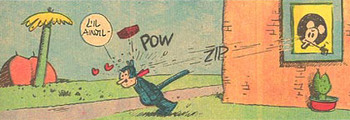
Still skirting the Dada part, I’d love to see Konvolut von 14 russischen Kinderbuchern der Jahre 1930-32, a spectacular constructivist work aimed at children and from what I can see is a treasure trove of Malevichian insight.
Andrew. Helle’s La Boite a Jouhoux, (“The Box of Toys”) Ballet pour enfants (Paris, 1913), is a beautiful composition, a modernist construction, using the idea and artwork of illustrator Helle and the music of Claude Debussy. The score is witty and has a very light touch, Debussy pleasingly borrowing from himself and his 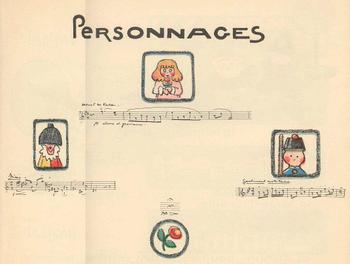
friends in a work partly inspired in a Milneian way by 7-year-old Chouchou Debussy (and her toys and dolls). It’s a beautiful work that I’d love to have in my hands. 
Another magnificent-looking object that I’d like to see is the box wooden Bauhaus-inspired shapes, pictured in Junge Menschen kommt ans Bauhaus//Werbeprospekt, published in Dessau in 1929 and featuring work by Klee, Kandinsky, Albers, Ridel and Meyer. The box of shapes is to die for, and it seems as though it offered new geometrical toys/tools for the inquiring mind in the last year of the ‘twenties.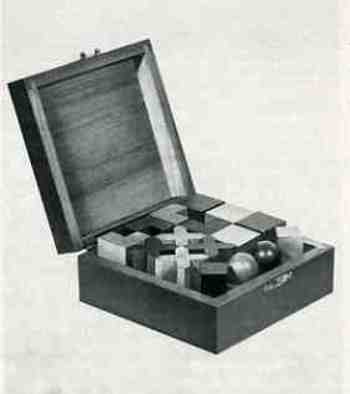
But I’m no closer to Dada for kids than at the beginning of this post, hoping as I was that something might shake loose if I thought about it some. Its an interesting question to me, and I’d really like to return to it when I actually know something.