A Daily History of Holes, Dots, Lines, Science, History, Math, Physics, Art, the Unintentional Absurd, Architecture, Maps, Data Visualization, Blank and Missing Things, and so on. |1.6 million words, 7500 images, 4.9 million hits| Press & appearances in The Times, Le Figaro, Mensa, The Economist, The Guardian, Discovery News, Slate, Le Monde, Sci American Blogs, Le Pont, and many other places… 5000+ total posts since 2008.

  • The Unbearable Wrightness of Being: the Wright Brothers Introduce Europe to FLying, 1908

    JF Ptak Science Books LLC  Post 329

    00-blog-Oct 22-farman904
    In early 1908 the future of aviation in
    Europe was tucked away in a crate in

    France

    .  The hommes oiseaux, the Wright Brothers, were
    about to show the Europeans what flying was—and flying was definitely not what
    the Europeans had been doing.  The
    difference between the Wrights and everyone else was obvious:  the Wrights were flying; they were elegant,
    crafted, flexible, viable, and their movements in their craft were convincing
    that they really did belong there.  The
    European efforts in the air to 1908 were heavy, big and box-y, forced; they
    made things try to fly, rather than fly.

    Henry Farman was perhaps the greatest of the
    early European aviators, owning several of the continental flight duration
    records, though no one in

    Europe

    had been in
    the air for more than one minute prior to 1908. 
    But Farman achieved a major success in January 1908 that was of a sort of
    monumental stature that is difficult to understand today.  And what he did was this:  for the first time in

    Europe

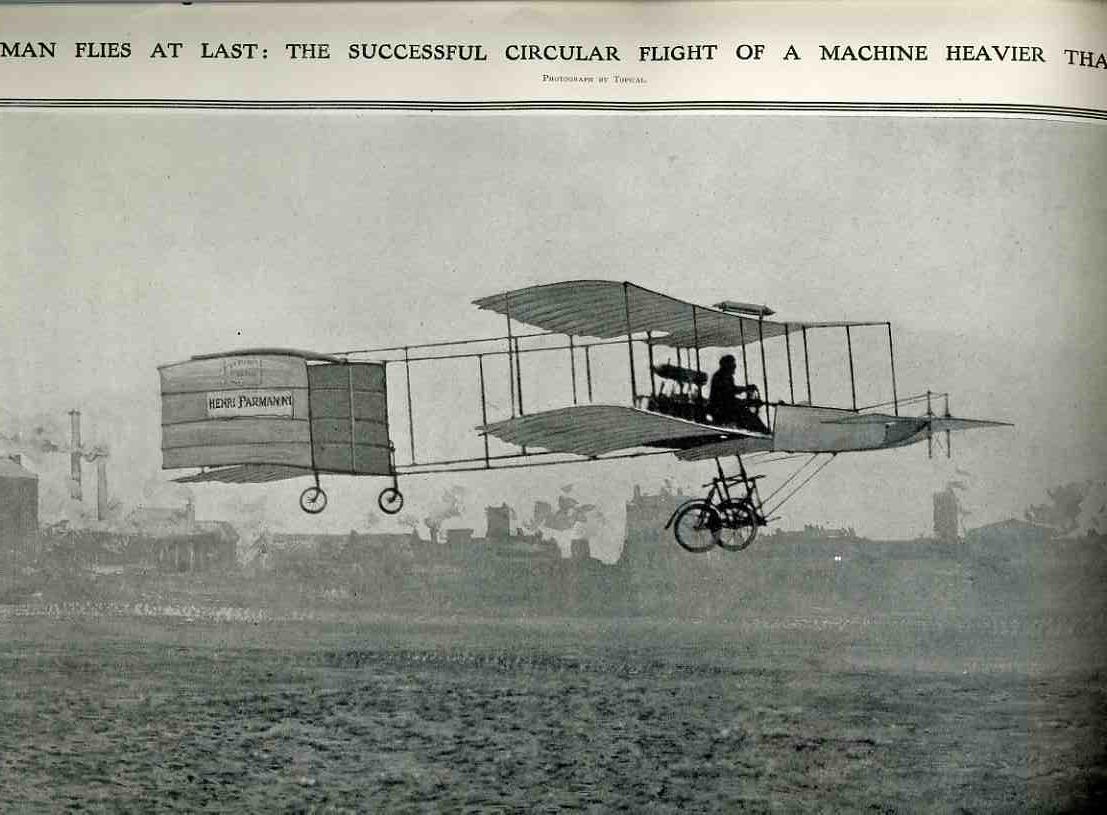
    he flew an aeroplane in a circle.  On 15
    January he was the only one top complete a one-kilometer circular course,
    taking with him the vaunted Deutsch-Archdeacon prize. What this meant though
    was a huge jump in the control of the flying machine; it became right there no
    longer a flying car, but an aeroplane with more

    00-blog-Oct 22-farman detail905
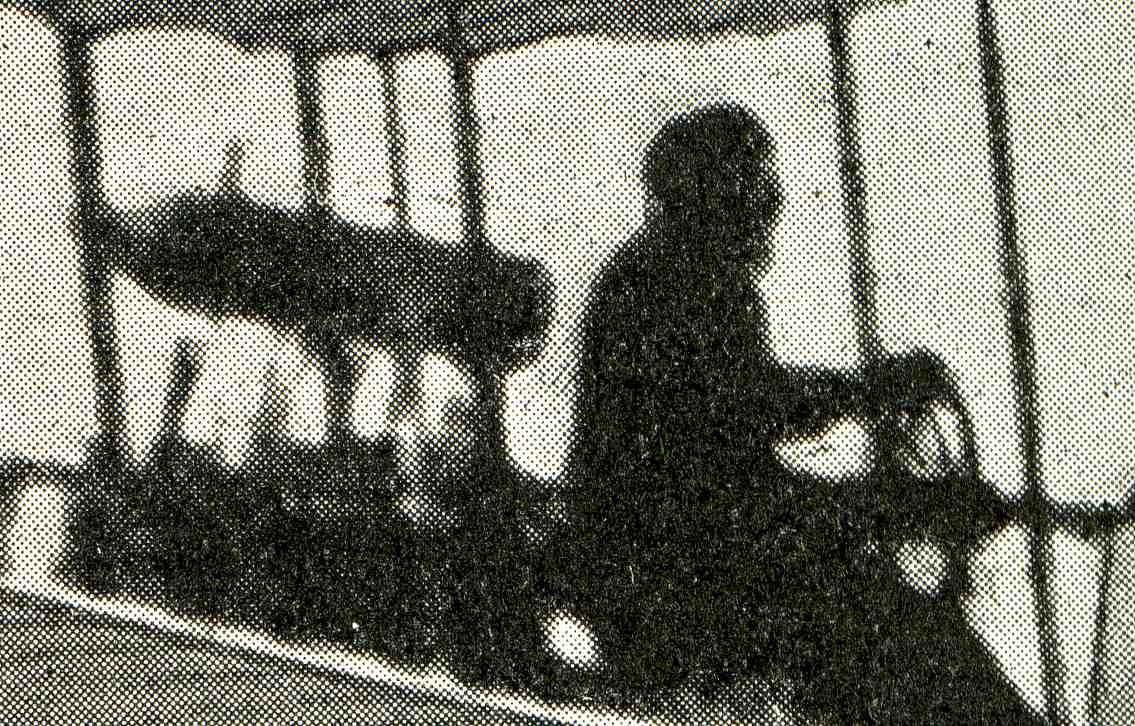
    delicate controls.  [The image above shows Farman in a photo from The Illustrated London News for 18 January 1908, just taking off.  I get the very definite sense of him leaning forward, feeling the tension of the moment.]

    But the Americans were masters of the air,
    having by far the most successes, and traveled further and faster and with
    more élan and capacity than anyone else anywhere—and by wide margins.   But to this point the Europeans had only
    read of their accomplishments, and had seen only still photos.  There was no way for them to appreciate the
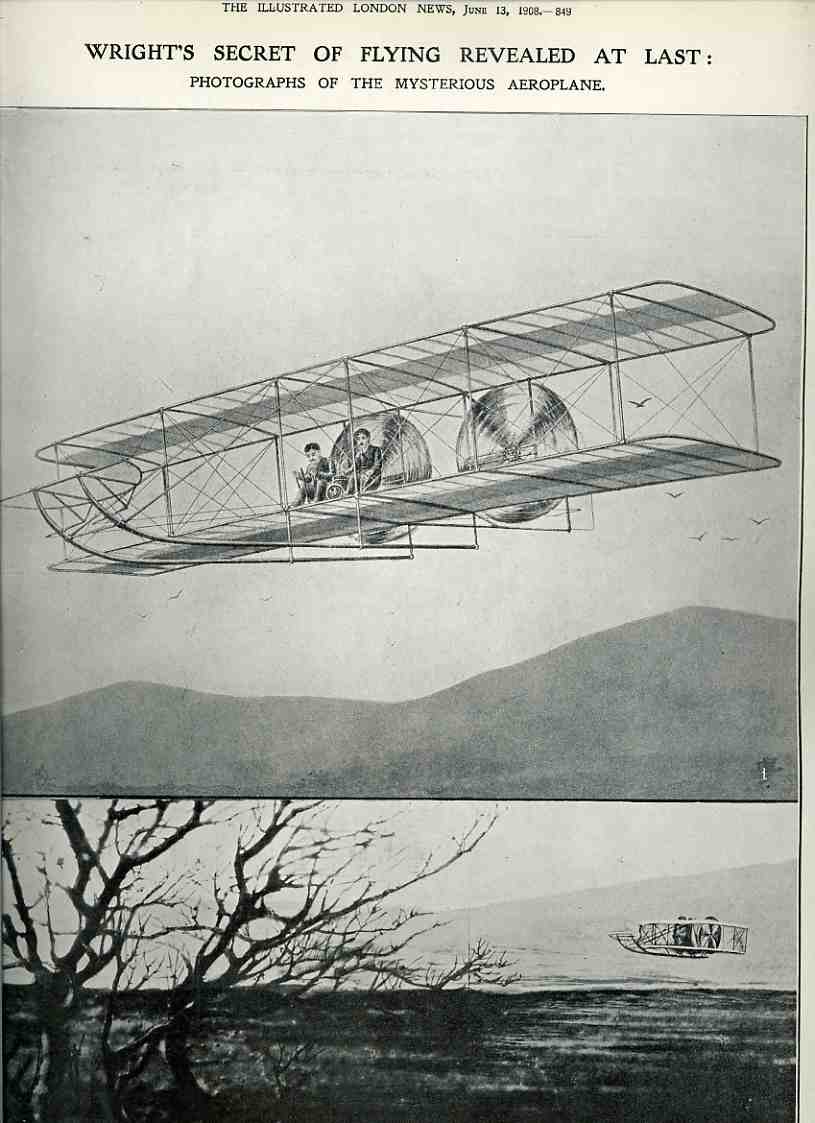
    magnitude of the Wrights’ accomplishments via those media.  Their frustration could be seen in this image
    from The Illustrated London News of 15 June 1908, which screamed “Wright’s
    Secret of Flying revealed at Last: Photographs of the Mysterious Aeroplane”.
    The big page showed an artist’s representation of the two-person flyer along
    with a smaller, smudgy photo of the great machine in flight.

    00-blog-Oct 22-farman wright 907

    This photo would have to suffice for the
    moment, as Wilbur Wright was busy trying to repair his crated plane, which was,
    incredibly, damaged by customs inspectors. 
    The plane was finally ready and on 8 August Wilbur flew—he made tight,
    effortless turns, demonstrated exceptionally able control, flew low and high,
    fast and slow, and made lovely landings. 
    His crowd included the most celebrated flyers on the continent—they were
    all uniformly astonished, leading some to say, for the record, that compared to
    the Wrights, the Europeans had done absolutely nothing.  Wilbur Wright was an enormous hero, feted far
    and wide, making some 200 flights over the next year.  The Wright Brothers’ plane was finally seen
    and inspected,. And all of the claims of greatness seemed to be surpassed by
    their physical demonstrations.

    The most interesting part for me is that, even five years following their first successful heavier-than-air flight in Kill Devil, North Carolina, the astonishing correctness of their accomplishment could not be fully appreciated without their flyer being seen in operation, and in person. 


    ·Posted by :

    ·in:

  • You are There: Dive Bombing Pilot, 1936.

    JF Ptak Science Books  Post 330

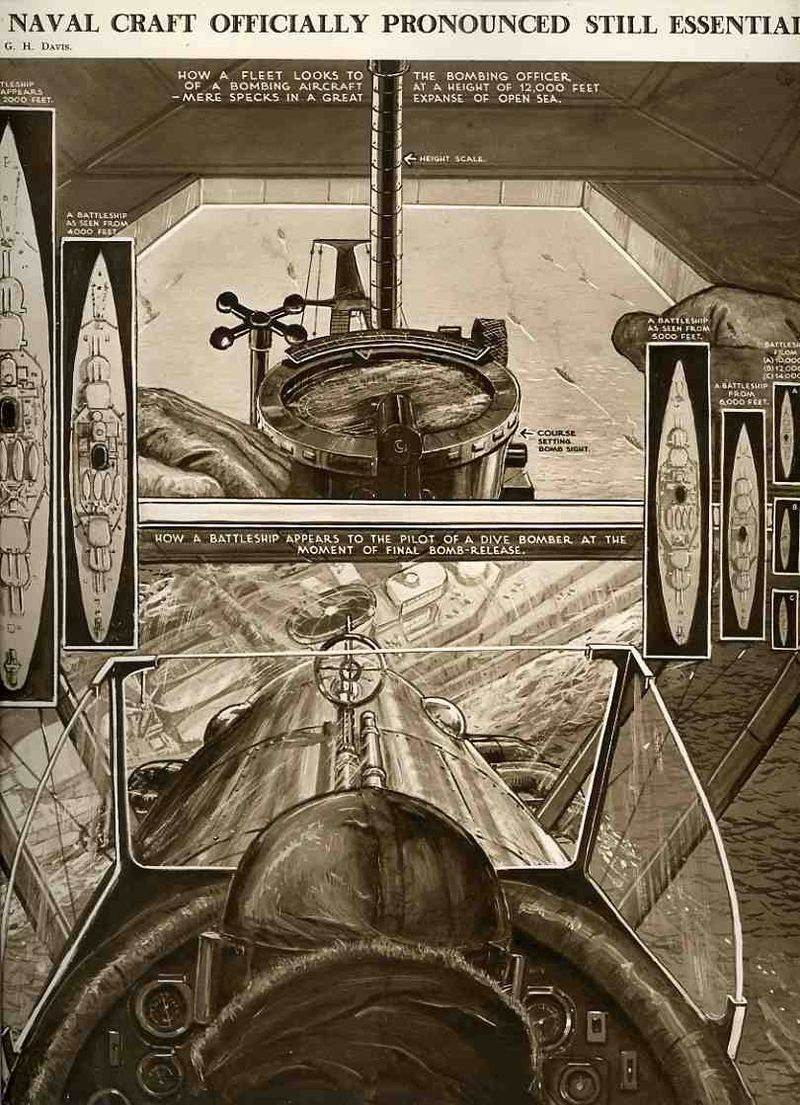
    In my experience popular images prior to WWII that put the reader inside of the picture– giving them the same view as the observing, principle member of the picture–are very uncommon.  Honestly, they just don’t happen very often, and I wish that I had paid more attention to them over the years before I realized they were as rare as they were. Such is the case with this extraordinary and action-packed picture in which the reader is hosted just behind and slightly above the head of the pilot of the aircraft dive-bombing the battleship.  It appears in The Illustrated London News for 7 November 1935, and it must have been captivating for the readers, being given the sense of closing in at great speed on the ship.  There are actually eight other smaller perspective images embedded in the image as well. The largest of these (at top) places the viewer directly inside the subject, giving them the feeling of how it looks like to the bombing officer of the aircraft as it approached the fleet. The other five images shows what the battleship looks like from different height from the inside of the aircraft.  Perhaps this doesn’t look like much to us today, but at the time, I can assure you, these images were exceptionally uncommon offerings of a personal perspective that few readers had ever experienced.

    00-blog-Oct 21--aircarft attack892

    ·Posted by :

    ·in:

    —
  • Duelling a Female Privateer at the Battle of the Mixed Yellow Mustard; Yazoo Pass, 1863

    JF Ptak Science Books LLC Post 331

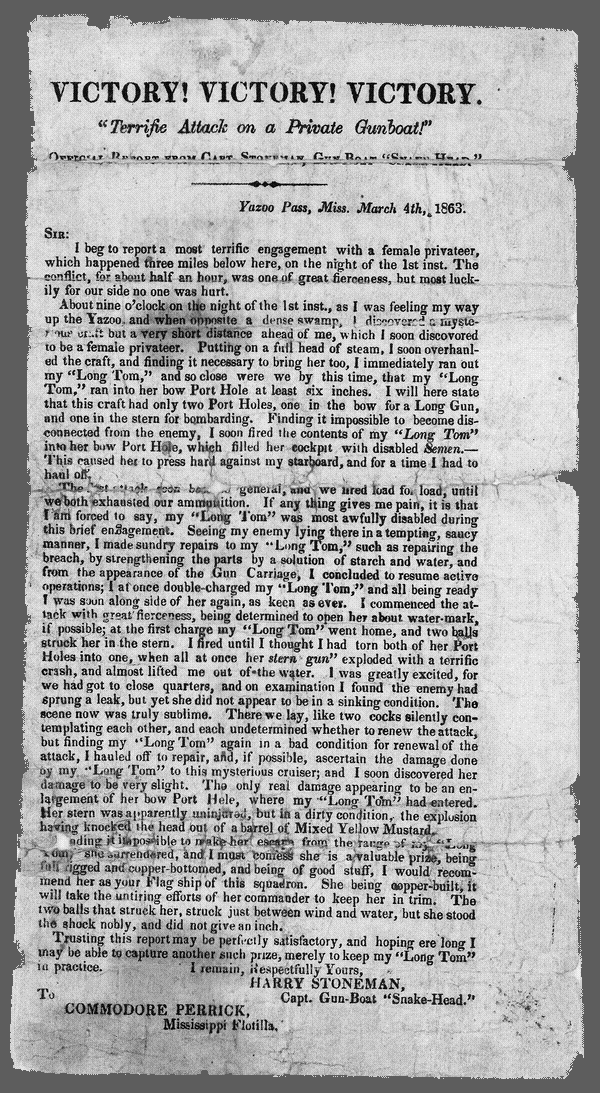
    Harry Stoneman, the commander of the U.S. naval vessel, the Gun Boat  Snake-Head, reported a battle in this broadside (found in the collection of the Library of Congress) fought between himself and a “female privateer” at the foggy Yazoo Pass in 1863.

    Blog--Snake HEad female pirate det

    I have little doubt that the battle was probably ferocious, but I do have some lingering doubt that it was more ferocious than the reporting of it.  There is much in Stoneman’s prose to suggest whistling canon balls and smoke and boardings and sinkings and such, but I have a feeling there was much fumbling between the wo ships, and that in the end, the “female privateer” surrendered.  Stoneman overtook the vessel and got so close to it that he rammed it somewhat, somehow getting  the end of his “Long Tom” into the forward port hole of the privateer.  After he repaired whatever he did to his canon (the “Long Tom” being in general the largest gun on the ship or boat, and probably mounted on a swivel or pivot, forward) fired it into the privateer, “filling up her cockpit with disabled Semen [sic]”.  There was an explosion of some sort with the privateers can–it either was fired or exploded–with the only resulting injury being to some (mixed) yellow mustard.

    Blog--Snake HEad female pirate det yellow

    But in the end all went well for the sweatty Harry Stoneman, taking the copper-bottomed enemy ship as a prize, and hustling back to whatever writing surface he had to record his victory and present it as a prize to the commodore Perrick  of the Mississippi floatilla.  Unfortunately I cannot find anything at all on the Snake-Head or Stoneman or for that matter Commodore Perrick (which is odd).  But most of all a quick search isn’t revealing anything on the most beguiling aspect of this whole story, the “female privateer”. 

    You can click on the image for a more readable version of the broadside; also, the full text of the broadside is provided below, thanks again to a terribly industrious library employee.)

    Blog--Snake HEad female pirate

    VICTORY! VICTORY! VICTORY.

    “Terrific Attack on a Private Gunboat!“

    Official Report from Capt. Stoneman, Gun-Boat “Snake-Head.”

    Yazoo Pass, Miss. March 4th, 1863.

    Sir:

    I beg to report a most terrific engagement with a female privateer,
    which happened three miles below here, on the night of the 1st inst.
    The conflict, for about half an hour, was one of great fierceness, but
    most luckily for our side no one was hurt.

    About nine o’clock on the night of the 1st inst., as I was feeling
    my way up the Yazoo, and when opposite a dense swamp, I discovered a
    mysterious craft but a very short distance ahead of me, which I soon
    discovered to be a female privateer. Putting on a full head of steam, I
    soon overhauled the craft, and finding it necessary to bring her too, I
    immediately ran out my “Long Tom,” and so close were we by this time,
    that my “Long Tom,” ran into her bow Port Hole at least six inches. I
    will here state that this craft had only two Port Holes, one in the bow
    for a Long Gun, and one in the stern for bombarding. Finding it
    impossible to become disconnected from the enemy, I soon fired the
    contents of my “Long Tom” into her bow Port Hole, which filled her cockpit with disabled Semen.— This caused her to press hard against my starboard, and for a time I had to haul off.

    The last attack soon became general, and we fired load for load,
    until we both exhausted our ammunition. If any thing gives me pain, it
    is that I am forced to say, my “Long Tom” was most awfully disabled
    during this brief engagement. Seeing my enemy lying there in a
    tempting, saucy manner, I made sundry repairs to my “Long Tom,” such as
    repairing the breach, by strengthening the parts by a solution of
    starch and water, and from the appearance of the Gun Carriage, I
    concluded to resume active operations; I at once double-charged my
    “Long Tom,” and all being ready I was soon along side of her again, as
    keen as ever. I commenced the attack with great fierceness, being
    determined to open her about water-mark, if possible; at the first
    charge my “Long Tom” went home, and two balls struck her in the stern.
    I fired until I thought I had torn both of her Port Holes into one,
    when all at once her stern gun” exploded with a terrific crash,
    and almost lifted me out of the water. I was greatly excited, for we
    had got to close quarters, and on examination I found the enemy had
    sprung a leak, but yet she did not appear to be in a sinking condition.
    The scene now was truly sublime. There we lay, like two cocks silently
    contemplating each other, and each undetermined whether to renew the
    attack, but finding my “Long Tom” again in a bad condition for renewal
    of the attack, I hauled off to repair, and, if possible, ascertain the
    damage done by my “Long Tom” to this mysterious cruiser; and I soon
    discovered her damage to be very slight. The only real damage appearing
    to be an enlargement of her bow Port Hele, where my “Long Tom” had
    entered. Her stern was apparently uninjured, but in a dirty condition,
    the explosion having knocked the head out of a barrel of Mixed Yellow
    Mustard.

    Finding it impossible to make her escape from the range of my “Long
    Tom,” she surrendered, and I must confess she is a valuable prize,
    being full rigged and copper-bottomed, and being of good stuff, I would
    recommend her as your Flag ship of this squadron. She being
    copper-built, it will take the untiring efforts of her commander to
    keep her in trim. The two balls that struck her, struck just between
    wind and water, but she stood the shock nobly, and did not give an inch.

    Trusting this report may be perfectly satisfactory, and hoping ere
    long I may be able to capture another such prize, merely to keep my
    “Long Tom” in practice.

    I remain, Respectfully Yours,

    HARRY STONEMAN,

    Capt. Gun-Boat “Snake-Head.”

    To

    COMMODORE PERRICK,

    Mississippi Flotilla

    ·Posted by :

    ·in:

  • A Little Lost Piece of Apollonius and von Neumann Less an “N”: Found Stuff

    JF Ptak Science Books LLC  Post 332

     00-blog-Oct 23 apollonius910 det 2

    I’ve long enjoyed paying attention to stray bits of paper, and books, and directions.  (My very first introduction to lovely lovely Ludwig (Wittgenstein) was by picking up his Tractatus from the floor of the library–I had never heard of him before that chance encounter.)  And so I’ve followed these threads for many years, pulling away at whatever was at their end–allot of times the only thing at the end of thread was the end of the thread.  On the other hand it has been a good practice and has led me far and wide.  This pursuit takes many other forms, but the finding-it-by-chance part can sometimes be exciting and extremely rewarding.

    00-blog-Oct 23 apollonius910 det
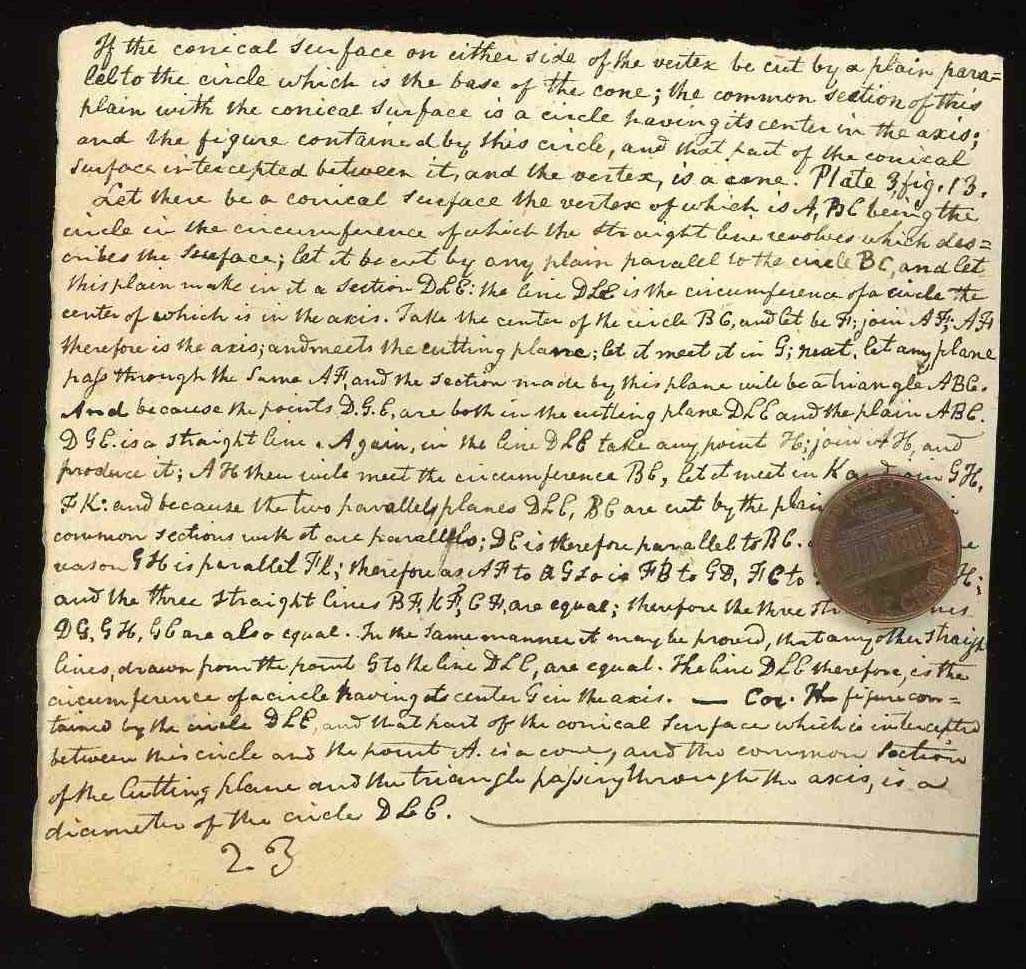
    Sometimes it is just satisfying to come to an end.  This is the case with this beautiful piece of paper which has come from god-knows-where.  Suddenly it was at the bottom of a box, and it didn’t even tug at a imitation of a lost memory as to how it got into that box in the first place.

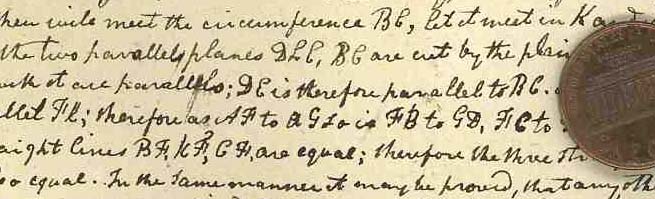
    It is very finely written in a strong hand.  30 lines, about 500 words, all on a 4×4.5 inch piece of paper, from about 1775 I reckon.  There are plenty of hints about the origins of the text, which I suspected to be a quote; I didn’t think it was Euclid, though perhaps an early book on conic sections?  Then I looked at the “23” at the bottom and searched in google under “Proposition 23” and Euclid, and then, on only my second try, I had my answer, all in under a minute: Apollonius, the massively important 2nd century BCE geometer and astronomer and namer of the parabola and ellipse and parabola, and whose significance reaches forward 20 centuries. Now having the answer and doing something with it are two different things, and in this case there was no where else for me to go.  Sometimes just finding out what something *is* is enough. 

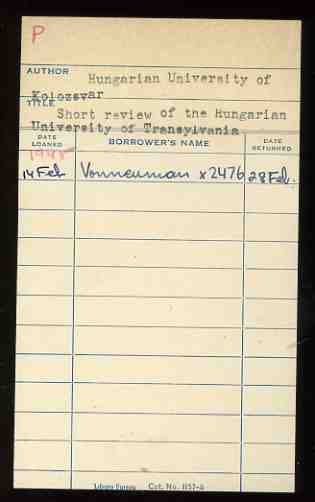
    Earlier this week I breezed through a pamphlet called A Short History of the Hungarian University of Transylvania (1943), published by the Hungarian University of Koloszvar, a thin, elegant and erudite work. It had been in the library of some offices of the old OSS (Office of Strategic Services), the forerunner to the CIA).  In the back was the borrower’s card, with a borrower’s name on it.  Generally when I find this stuff the card is almost always blank–but in this case, the little slip bore an important name:  “vonNeuman” it said.  The pamphlet was borrowed 14 Feb and returned 28 Feb, 1945.  It had von Neuman’s phone number on it too.  My initial reaction was fantastic--this was Johnny von Neumann’s name.  He defined “secret” work for the government during the war; he was Hungarian; I think he was with the OSS.  Von Neumann was probably the most fantastic mind of the century.  And here he was, in the back of this little pamphlet.
    00-blog-Oct 23 von neumann911

    And then it struck me. 
    This was von  Neuman, not von Neumann.  

    I was missing an “n”.  I wanted so badly for it to be there, but it just wasn’t going to happen.  In the small world category, I believe that this is Hans J. Neuman,  who worked at the OSS during the war and who went on to a distinguished career in computer science (and who made significant contributions to the creation of the first computer at the Moore School of Electrical Engineering at the University of Pennsylvania).  Some 20 years ago I appraised the library part of his estate.

    ·Posted by :

    ·in:

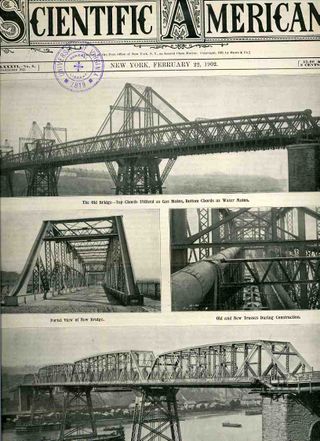
  • The Department of Understatement 2: the Wright Brothers in the 1902 Scientific American

    JF Ptak Science Books LLC  Post 333

    00-blog-Oct 24--wright bro913
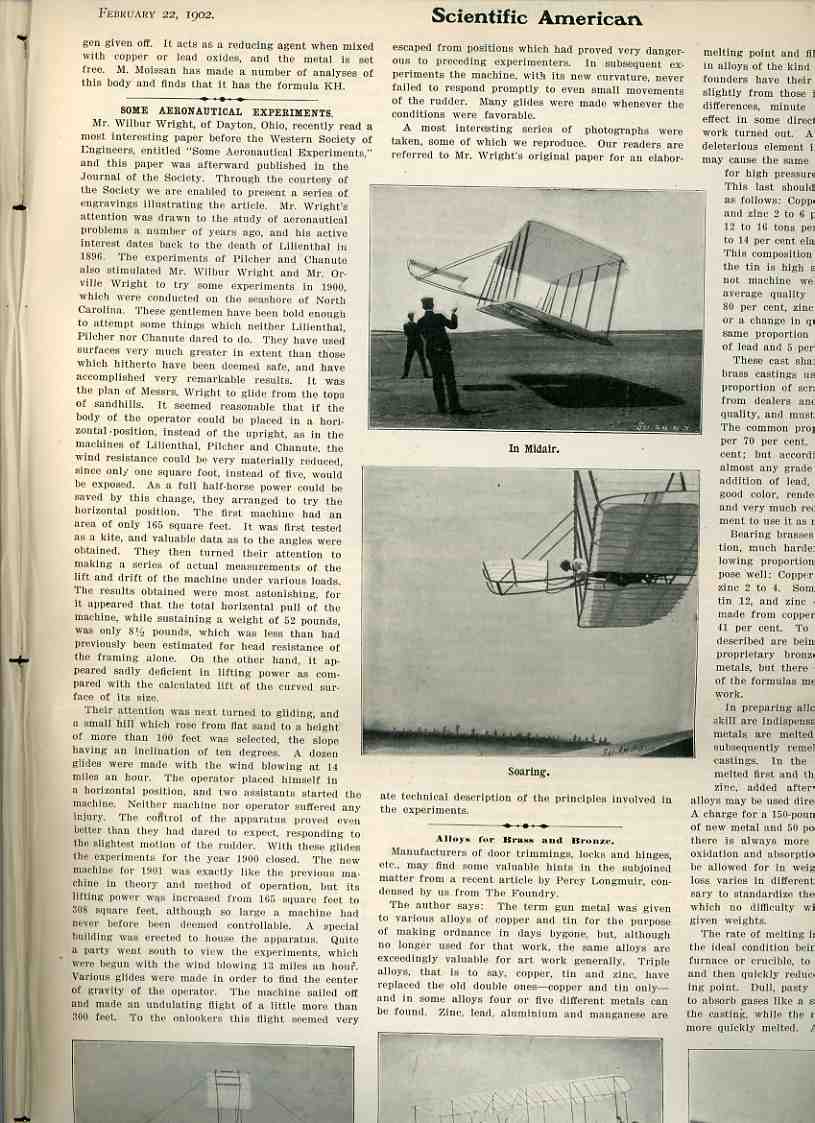
    I’m not
    sure why the Wright Brothers’ experimental gliding flight was so much in
    competition with other pressing scientific news of the day that reports on
    their progress was relegated to the middle of this issuer of Scientific
    American for
    22 February 1902. 
    The report is sandwiched in between “Winter Railroading in
    Alaska”, “Experiments of M.
    Moissan  with hybrids of potassium” and “A
    Garbage-Consuming plant” on the page opposite and “Alloys for Brass and Bronze
    “ just below it.  And as it turns out
    there are more words devoted to the
    Alaska railroading article than to the
    Wrights as well.  There are dozens of
    articles given better placement in this issue: steam boiler inspection, variable
    speed gears for pumps, making photographs with electric headlights, domestic
    manufacturing of Portland cement, assorted announcements of electrical
    progress, and other such stuff. The front page of the issue is
    dedicated to the new bridge of the
    Redheugh Bridge at Newcastle-on-Tyne; the Wright article follows on
    page 8.

    Even
    though the brothers had been experimenting with gliding flight at Kill Devil
    since 1900, reports of their activities had been under-reported, if popularly
    reported at all.  And this seems to have
    suited them—they seemed not to need publicity, or recognition.  After all, they had made incomparable strides
    since they first became interested in flight in 1896 following the failure of Samuel
    Langley and the
    Potomac River crash of his aerodrome. (Just for the record, Alex Bell also referred to
    his aircraft as aeromdomes.)

    00-blog-Oct 24--wright brosd cvr912

    This report
    for February seems to be the earliest of the 1902 flights in North Carolina,
    with the principle difference (from what I can see) is that this earlier glider
    didn’t yet have a tail which would make an appearance a little latter in the
    year (followed by a very critical discovery on the need for the maneuverability
    of the tail.) It also seems that the 1902 gliders were as different from the
    1901 gliders as the 1903 glider/plane would be from the 1902 model.

    Still,
    given the competing news of the day, and the importance of the Wrights’
    experiments, and the amount of interest in flight at this time,  it is a little mysterious to me why the report
    on their sandy accomplishments got so gobbled up in the nonchalant scientific
    bric-a–brac of 1902. 

    Notes:

    Since this is outside my area I
    quote liberally from the US Commission on the Centennial of Flight for a more
    exact description of the difference of the gliders between 1901 and 1902:

    “Their 1902 glider had a new wing with a shallow camber
    and high aspect ratio. It was a major departure from their earlier machines. It
    had roughly the same wing surface area as the 1901 machine, but the
    similarities ended there. The wingspan was ten feet (three meters) longer and
    the chord two feet (0.6 meter) shorter than the old machine, making the glider
    look larger and more graceful. It had an overall length of 16 feet (5 meters)
    and weighed 112 pounds (51 kilograms). The wing camber followed a shallow
    parabolic curve, and the elevator
    was extended farther out in front of the pilot. This gave it more leverage,
    which allowed better control. The 1902 glider also had a new rudder that consisted of two fixed vertical surfaces located
    behind the aircraft . Wilbur and Orville calculated that these would help
    prevent the skidding that had occurred when they warped the wings.”

     And the following on the 1902 flights from

    Orville Wright “How We Made the First Flight”:

    “The flights of the 1902 glider
    had demonstrated the efficiency of our system for maintaining equilibrium, and
    also the accuracy of the laboratory work upon which the design of the glider
    was based. We then felt that we were prepared to calculate in advan ce the
    performance of machines with a degree of accuracy that had never been possible
    with the data and tables possessed by our predecessors. Before leaving camp in
    1902 we were already at work on the general design of a new machine which we
    proposed to propel with a motor

    ·Posted by :

    ·in:

  • The History of Aerial Bombing 2: Zeppelins Attacking London, 1915

    JF Ptak Science Books LLC  Post 334

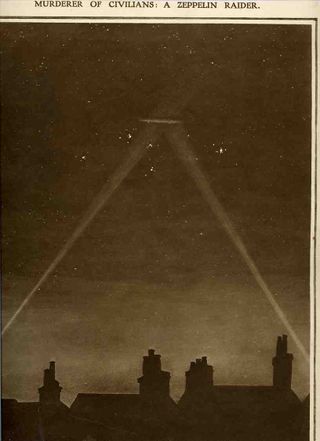
    Dropping bombs from flying machines had lost much of its newish noirness by 1915, even though the whole idea of the practical applications of  dropping explosives on people was only four years old. That sort of high explosive newness can be shed very quickly, given the immediacy of its action. But Londoners were outraged enough in 1915 to label the bombing of populated non-military targets as murder, as the title of this full-page print screams from the 23 October 1915 issue of The Illustrated London News in our second post on the history of aerial bombing.  The subtitle reads: “Like a thief in the Night:  One of the Fleet of Hostile Airships Which Raided this Country on October 13 Over the London Area—Shells from Anti-Aircraft Guns Bursting About It.”  It continues: “lives lost and damage done without the shadow of military excuse” is how it was quietly referred to in the text, the the subtle image is anything but–it is quiet, but it is also cold, and scary, the menacing zeppelin shown floating darkly deadly above the roofs and chimney tops of residential houses.  The point of the picture was crystal clear–the enemy was practicing something new, and that something new was directed at civilians, and that it could be crushing and deadly and a threat everywhere.

    00-blog-Oct 24--zepplin raider914


    The Zeppelins were new to war, having been first brought to development in 1900; by the beginning of the war, in 1914, the Germans had two operational airships that could reach an altitude of about 4500 feet and carry 4400 pounds of bombs.  Their first raid on England came on 31 May 1915 and within the year would kill 550 British citizens, though the costs to the Germans were so high (77 of 115 active Zeppelins would be either destroyed or damaged beyond repair by June 1917) that the air attacks would be suspended in July 1917.

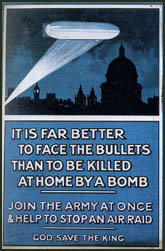
    Blog--zeppelin

    ·Posted by :

    ·in:

  • Balloon Bridges and 600-Foot-Long Airships, 1854

    JF Ptak Science Books  Post 335

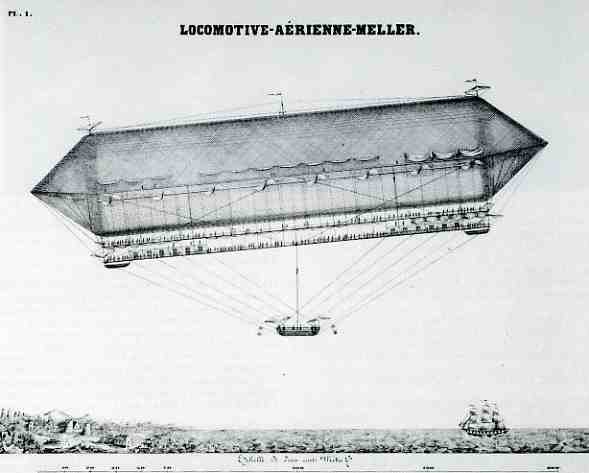
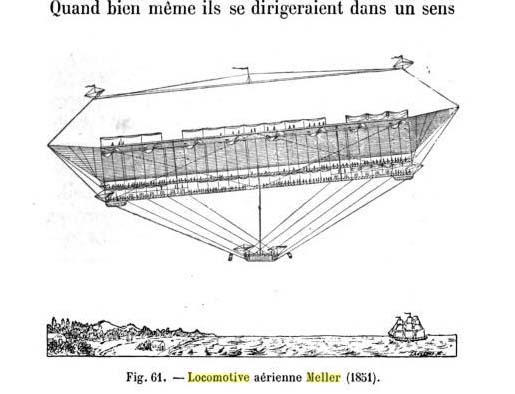
    00-blog-Oct 25 meller920Often
    the reproduction of a print for popular consumption just doesn’t come anywhere
    near expressing the flavor of the original. 
    This is definitely the case with Gaston Tissandier’s Bibliotheque des
    Merveilles la Navigation Aerienne, l’Aviation et la Direction des Aerostats

    (printed in

    Paris in 1886), in which enormity of Propser Meller’s (the younger) airship is
    almost entirely lost.  You do get the
    idea of the size of the ship, but “bigness” is a weak constant, especially when
    you look at the original print of the great ship, which turns that concept into
    a more flavorful enormity.

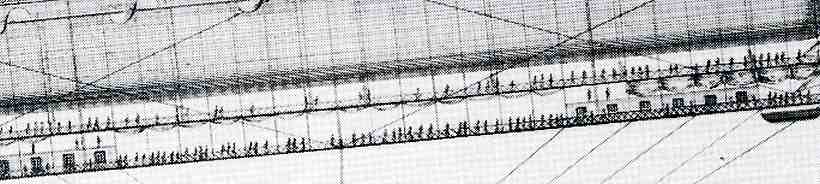
    The Meller balloon–according to the scale at the bottom of the image–would measure a truly spectacular 200 meters/650 feet or so, and when you zoom in on the detail of the people aboard the ship the size becomes overwhelming.  The print appears in Meller’s rare work Des Aerostats, NAvigation areieene, Chemin de fer aerostatique….printed in Bordeaux in 1851, and of course the ship was never built, but it did serve as an intellectual forerunner of the more modern zeppelin.

    00-meller balloon

    But the
    truth of the matter was that Meller was also very busy trying to figure out
    what balloons could actually do:  Planning
    600-foot-long airships (which would have been by far the longest vehicle of any
    sort ever built) is one thing, and one thing that was interesting but not
    terribly practicable in 1851; but he wrote elsewhere, in his   Phare aerostatique (1854) that balloons
    could definitely be employed more easily with lesser goals but greater
    utility.   For one thing a fixed balloon could be easily
    employed by the military of harbor control as a means for suspending artificial
    light sources.  More ingenious and
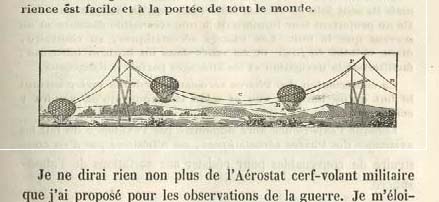
    eyebrow-raising was another idea for a balloon bridge, which would’ve guided
    balloons across unbridgeable waters, shore-to-shore.  It was certainly a bigger piece of thinking
    than a light source, but to me it sounds like a fairly plausible way of getting
    heavy loads and people across problematic bodies of water (and etc.) where
    bridges or boats would not work.  In any
    event it seemed doable; at least far more so than the giant airship

    As you can see, the miunutae detail of the original is lost in the
    reprint, and it is in the detail that the greatness of this airship can
    be found. .

    00-blog-Oct 25 meller det921


      The balloon bridge by Meller:

    00--meller bridge det


    Some other works by Meller:

    Projet de navigation aérienne  (Imprimerie de Pollet …, 1852)
    À la marine  (Typographie Plon frères, 1854)

    Phare aérostatique.Paris:
    Typographie Plon Frères, 1854.

    *From
    Chambers’ Edinburgh Journal,
    28 August 1852 describing his 600’ airship:

     Attempts are still being made towards aërial navigation. M.
    Prosper Meller, of Bordeaux,
    proposes to construct an aërial locomotive 200 mètres in length, 62 wide, and
    60 high, the form to be cylindrical, with cone-shaped ends, as best adapted for
    speed. The outer case is to be varnished leather, which is to be filled with
    gas, and to contain five spherical balloons. A net, which covers the whole, is
    to support sixteen helices by ropes, eight on each side; and to these two
    galleries are to be attached, one for the machinery, the other for passengers.
    The affair looks well on paper; but there is little risk in saying, that the
    days of flying machines are not yet come, neither is the scheme for aërial
    railways—a series of cables stretched from one high building to another—to be
    regarded as any more promising.  

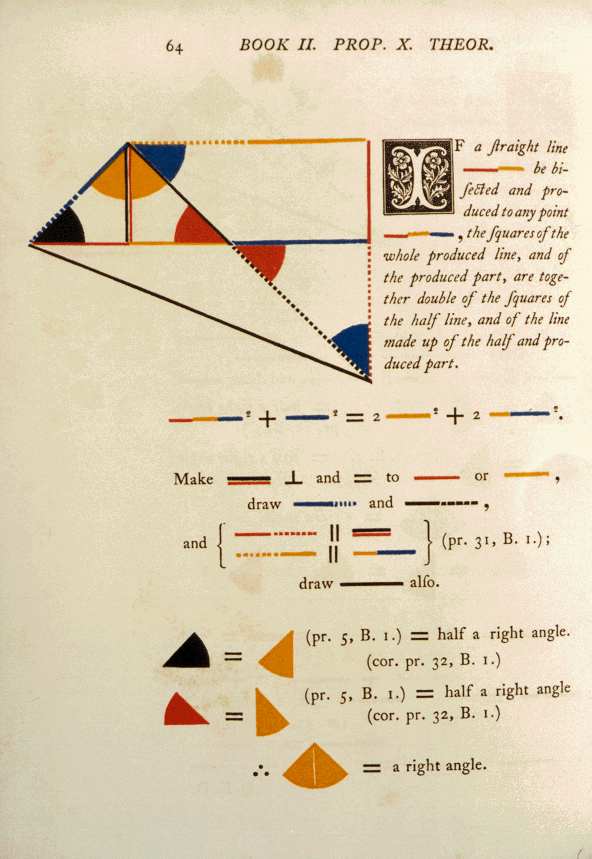
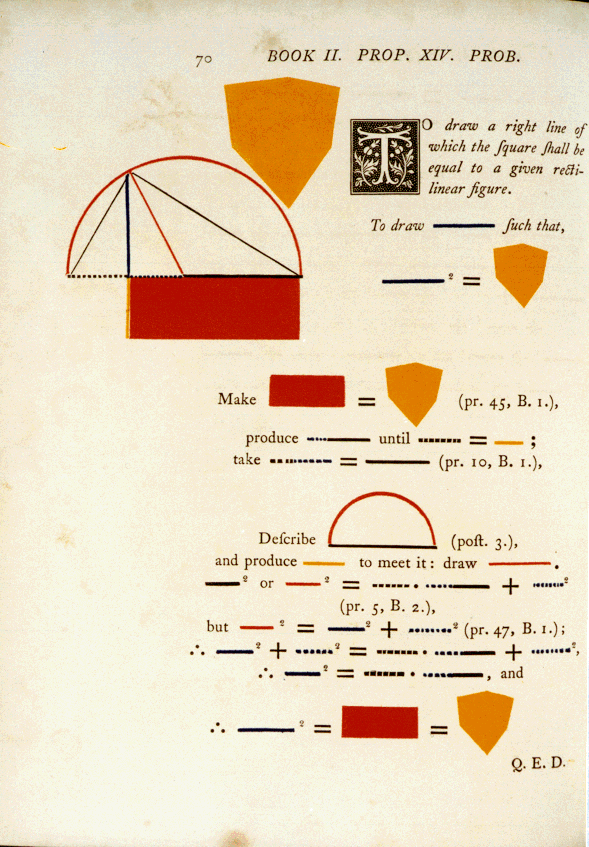
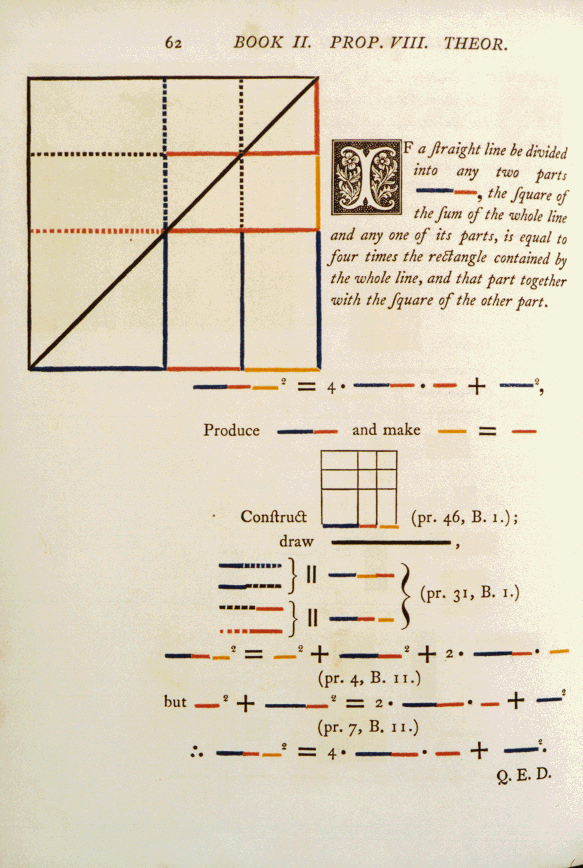
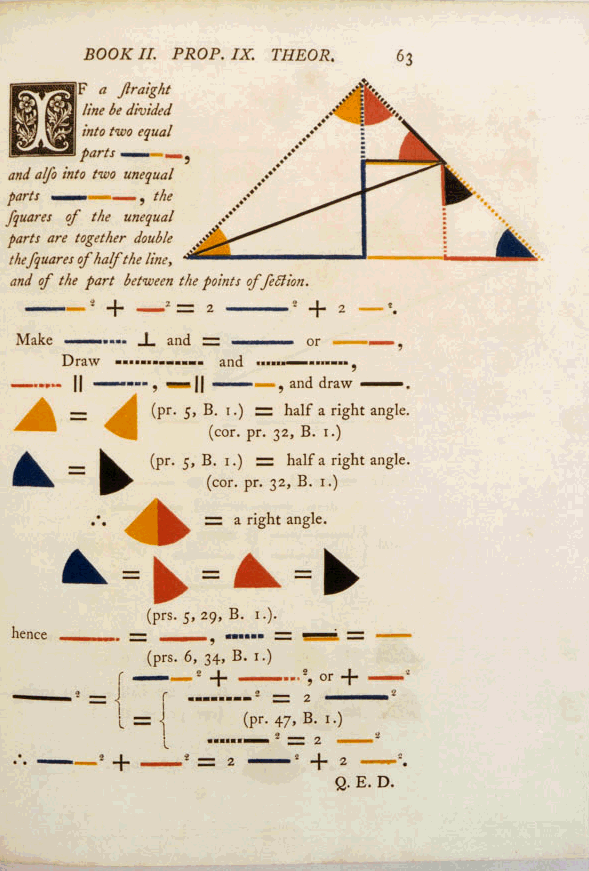
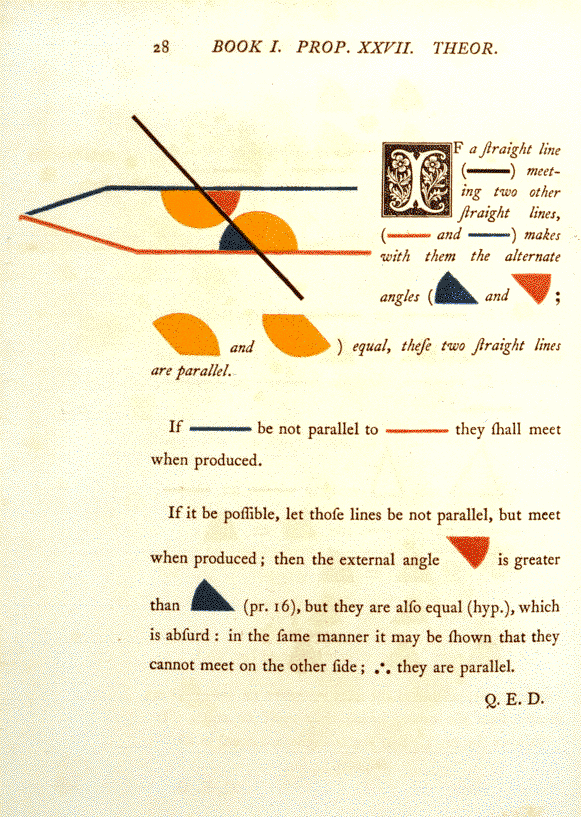
  • Oliver Byrne’s Euclid, (slightly) continued

    JF Ptak Science Books LLC

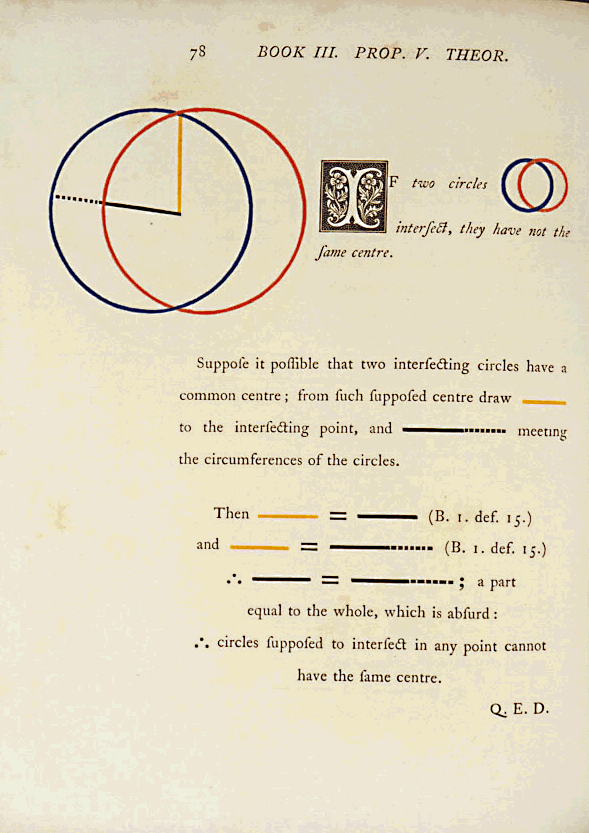
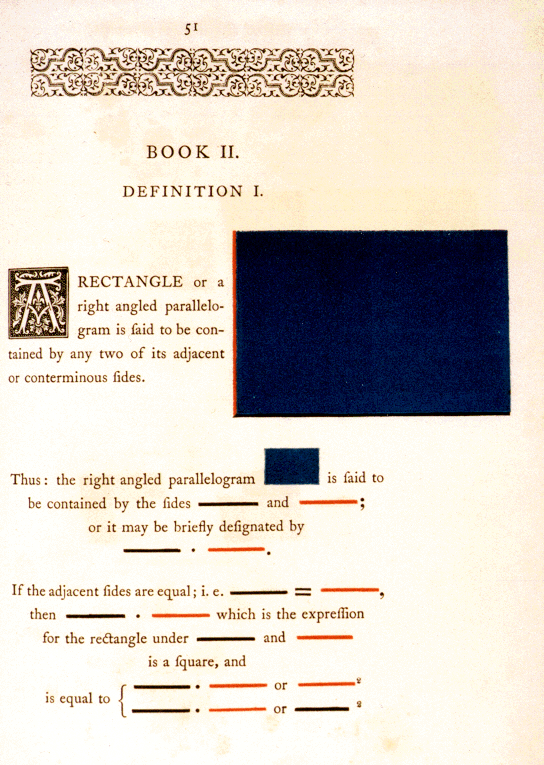
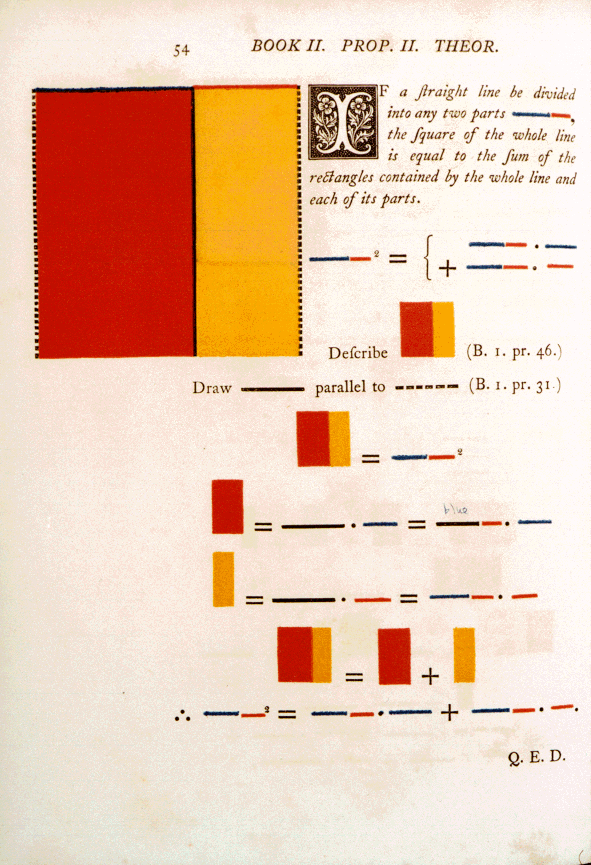
    Here’s a few more examples from Oliver Byrne’a unique attempt at transliterating the propositions of Euclid via color.  As I said in an earlier post  the attempt may not be a step in the right direction (and by “right” I mean “correct”) but it is, beyond doubt, beautiful–yet another example of Beautiful Wrongness.

    The entire work by Oliver Byrne’s may be found here

    Byrnews II.10

    Byrnes II.14

    Byrnes 11.8

    Byrnes II.9


    Bryne euclid i.27
     
    Byrne euclid iii.6

    Byrne euclid def


  • Blank and Empty People and Things: The Wobblies Protect their Own, 1906

    JF Ptak Science Books LLC Post 337

    Blog--blank--war prisoners
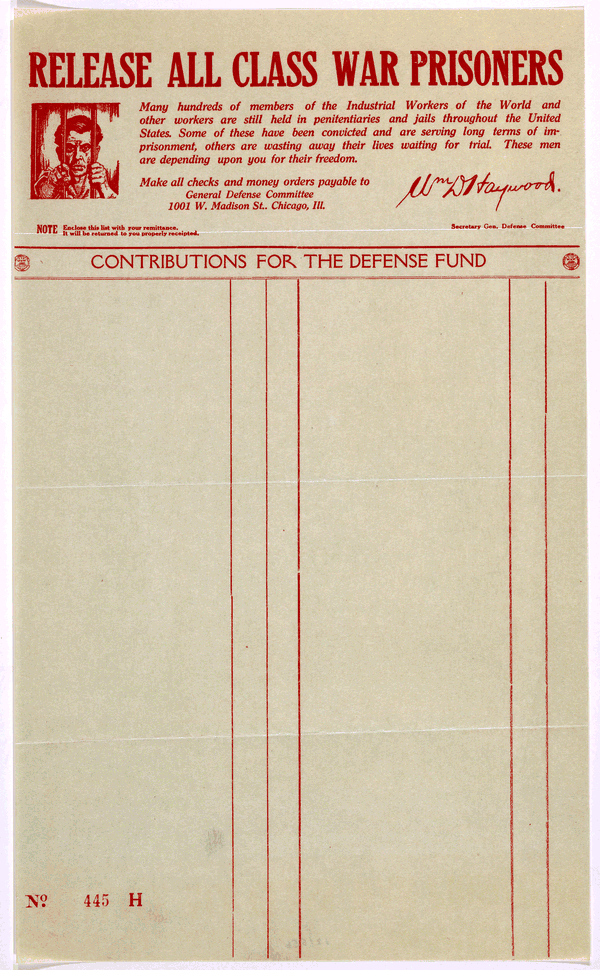
     This  IWW unused release form for political prisoners is yet another entry in
    our Blank/Missing People/Things category. 
    This was pretty radical envelope-edgy stuff for political liberalism in
    the U.S.
    in the early part of the 20th century, butt that was really the modus operandi
    of this group.  Founded in Chicago just a
    year or so earlier than this form was printed, the Industrial Workers of the World
    was an anarchist/socialist/radical and sprinkling of trade unions and
    organizations conglomeration organization as a general answer to a malaise and
    dissatisfaction with the policies of larger trade groups (mainly the American
    Federation of Labor (AFL)).  What it
    really was, or became, was the most important movement of the century for the protection
    of workers and unions, though it did bolster the underlying belief in
    overthrowing the ruling economic class for the benefit of all who labored to
    make that class even more wealthy and dominating. 

    I have no doubt that such a piece of propaganda was needed and necessary—labor
    workers, organizers, unionists and the like were granted little clemency by big
    business, and could be often treated with great brutality, not the least of
    which was physical.  It was not in the
    interest of the controllers of the means of production to allow such
    interference from labor groups such as the IWW, as they saw it as a diminishing
    assault on their source of revenue. 
    There was also another reason for fear and condemnation of this group—it
    was also about the only major group which allowed membership along all race and
    belief systems.  The possibility of a
    cohesive laboring class threatened the established (and still established)
    fracturing of the working classes by petty differences, fostering internecine
    warfare among the working classes and keeping them more divided and weak. 

    This broadside looks as though it is newer than what the Library of Congress
    guesses is 1906/7—the design, woodcut and typeface all look later—but the document
    does have the imprimatur of William D. (“Big Bill”) Haywood, which would make
    the date correct.  Still, the design
    doesn’t look quite right to me.

  • Blank and Disappeared Things Department: Confederate Oath of Allegiance and Loyalty

    JF Ptak Science Books LLC Post 338
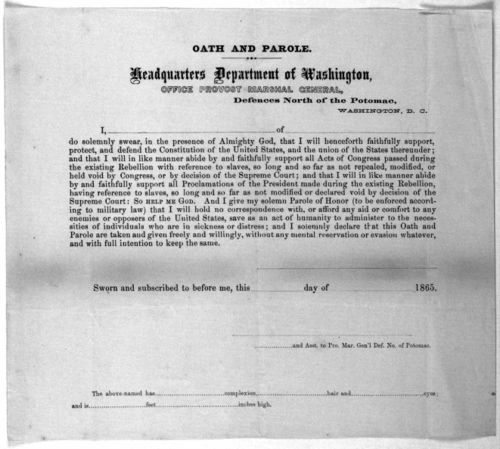
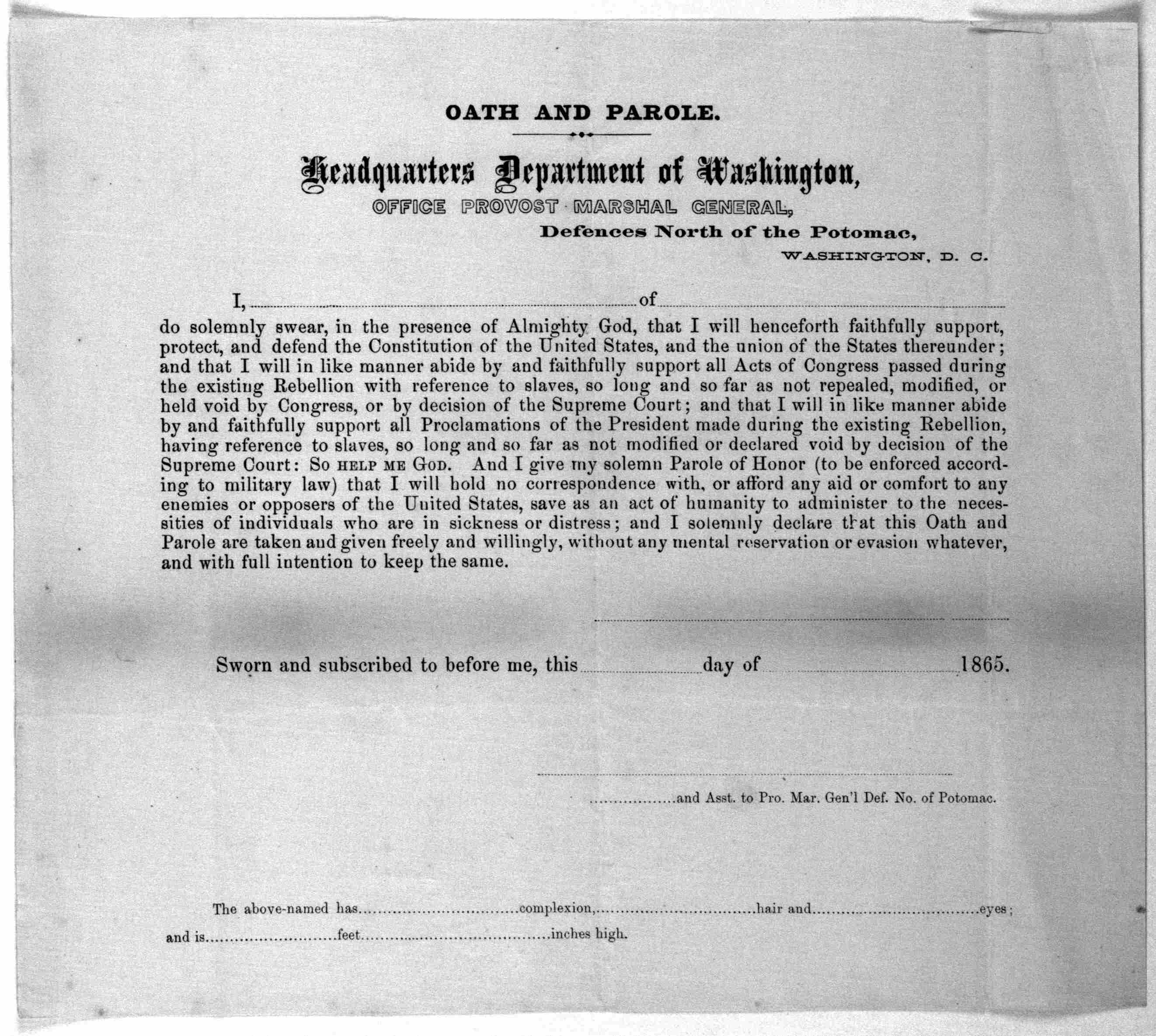
    Blog--blank--confeder oath
    The hundreds of thousands of soldiers who found themselves in Confederate homespun after years of fighting against “those people” of General Lee were offered a clemency at the end of the war by Abraham Lincoln.  Or rather it was the idea of Lincoln’s that survived the war as Lincoln didn’t.  

    Actually the idea of amnesty was granted as a presidential power via the Confiscation Act of 1862, which authorized the president of the United States to pardon anyone involved in the rebellion. This was done at a time when the outcome of the war was still nebulous and far from being decided, as Lincoln was suffering a crisis in his cabinet as well as on battlefields throughout the run of the nation.  This act was followed by the Amnesty Proclamation of 8 December 1863, which basically extended a pardon to anyone who was not a war criminal, was an officer, and who would sign an oath of allegiance.  This was followed by another proclamation in 1864 extending the privilege to Southern civilians as well.  And the sentiments were extended past Lincoln’s murder via the otherwise occupied third-worst president, resulting on 25 December 1865 with the unconditional pardon to all Civil War vets except for the high-ranking and monied officers—this is something that Johnson got absolutely right, and so right, as a matter of fact that even more liberally-minded northerners thought he was giving away the store.  Johnson didn’t follow his own deepest thoughts and dark angels on this issue, either:  right after becoming president (the first VP to ascend to the office during an active administration) in April, 1865 he was noted telling an Indiana delegation that, “Treason must be made odious… traitors must be punished and impoverished … their social power must be destroyed.”

    Within weeks his policy line had softened if not his reasoning than at least his rhetoric and action:  “I say, as to the leaders, punishment. I also say leniency, reconciliation and amnesty to the thousands whom they have misled and deceived.  These actions alienated many on all sides, but it was probably the highlight of his troubled four years or so in office, and more than likely was the only thing he got right in the Reconstruction policies through 1869. (I’d say that his allowance of the creation of Black Codes and the codification of sub-citizenship to the newly-freed slaves that created a still subjugated interior-nation for black people created more havoc and pain and discord than anything else anyone did in government in the immediate post-war period.)

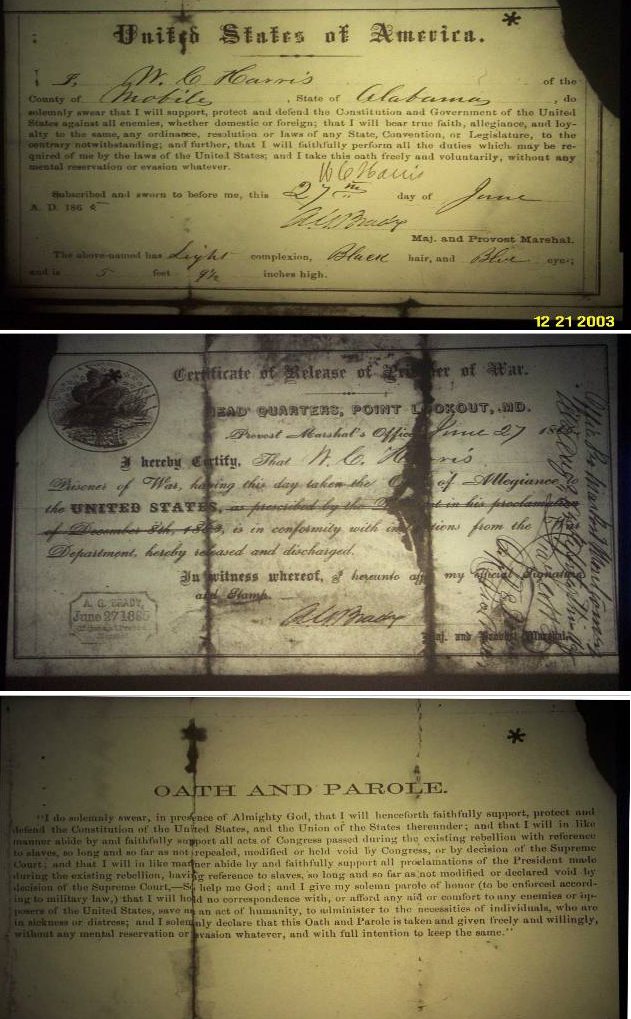
    So as part of the series of blank and empty things I’d like to include this unused oath of allegiance certificate.  There were perhaps hundreds of thousands of these sorts of bills-of-freedom distributed to Confederate veterans, who–whether they agreed or not, believed or not–filled them up with their information and pledged to be true to the Union, if for no other reason than to put the war as much behind them as possible and return to what might have been their lives.  I’ve also included three examples (relating to the same person) of filled-out pledges (at bottom).

    NOTES:

    The following first section is an appraisal and summation of the amnesty program appearing in Harper’s Weekly for May 15 1865:

    PRESIDENT LINCOLN’S AMNESTY.
    By his proclamation of the 8th of December, 1863, President LINCOLN granted a full pardon —with certain exceptions which we will presently state—to all who had been in rebellion, with a full restoration of all rights of property except in slaves and in cases where the rights of third parties had intervened, and upon condition of taking and subscribing and keeping in-violate an oath to support and defend the Constitution and the Union under it, and to abide faithfully by all the laws of Congress, and by the proclamations of the President in regard to slaves, so far as they are not repealed or declared void by the Supreme Court.
    The persons excepted from this amnesty were all who are or have been civil or diplomatic officers and agents of the rebel Government—all who have left judicial stations under the United States to aid the rebellion—all who are or have been military and naval officers above the rank of colonel in the army or lieutenant in the navy —all who left seats in the United States Congress, or resigned commissions in its army or navy, and afterward aided the rebellion—and all who have treated colored or white soldiers and sailors of the United States otherwise than as prisoners of war.

    On the 26th of March, 1864, President LINCOLN by proclamation defined that the amnesty was limited to those who were not prisoners of war, but who, being free from any arrest, voluntarily took the oath.
    On the 6th of December, 1864, in his last annual Message to Congress, the President said that when he issued the amnesty he stated that the excepted classes might still be within special clemency. ” During the year,” he continued, “many availed themselves of the general provision, and many more would, only that the signs of bad faith in some” led to precautions. Special pardons had also been granted to persons of the excepted classes. ” The door has been for a full year open to all.” But he adds, ” The time may come, probably will come, when public duty shall demand that it be closed, and that, in lieu, more rigorous measures than heretofore shall be adopted

    NOTES, Part II:
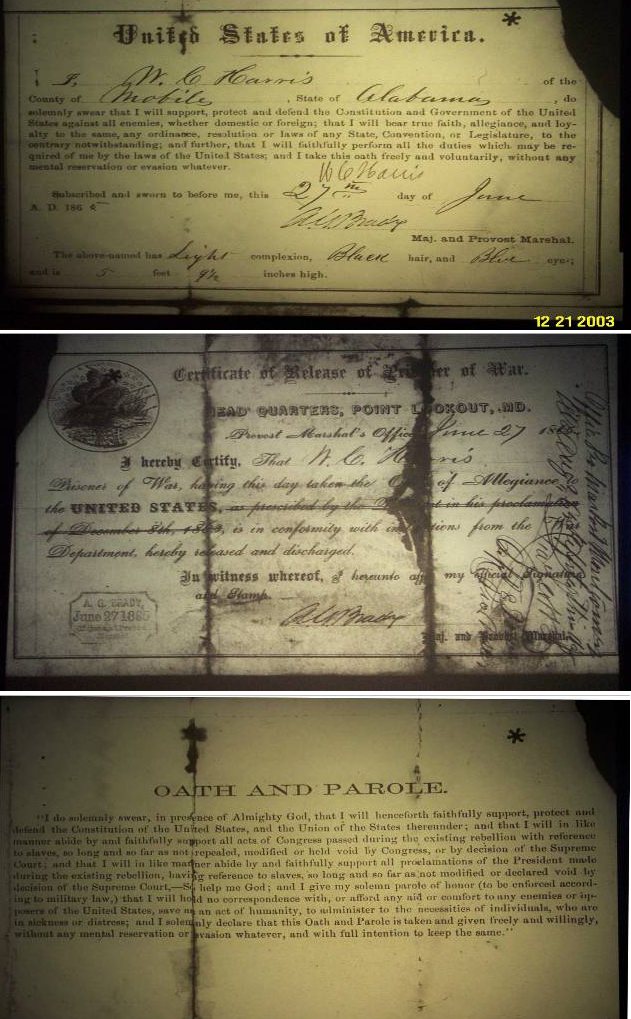
    Blog--empty--oath filled out

    Image 1
    UNITED STATES OF AMERICA

    I, W.C. Harris of the County of Mobile, State of Alabama, do solemnly swear
    that I will protect and defend the Constitution and Government of the United
    States against all enemies, whether domestic or foreign; that I will bear
    true faith, allegiance, and loyalty to the same, any ordinance, resolution
    or laws of any State, Convention, or Legislature, to the contrary
    notwithstanding; and further, that I will faithfully perform all the duties
    which may be required of me by the laws of the United States; and I take
    this oath freely and voluntarily, without any mental reservation or evasion
    whatever.

    W.C.Harris

    Sunscribed and sworn to before me, this 27th day of June A.D. 1865
    A.G. Brady
    Maj. and Provost Marshall
    The above-named has light complexion, Black hair, and Blue eyes; and is 5
    feet 9 1/2 inches high.

    Image 2
    CERIFICATE OF RELEASE OF PRISONER OF WAR
    Head Quarters, Point Lookout, Md.
    Provost Marshal’s Office  June 27, 1865

    I hereby certify, that W.C. Harris , prisoner of war, having this day taken
    the Oath of Allegiance to the United States is in conformity with the
    instructions from the War Department, hereby released and discharged.

    In Witness whereof, I hereunto affix my official signature and stamp.

    A.G.Brady,
    Maj. and Provost Marshal

    Image 3
    OATH AND PAROLE

    I do solemnly swear, in presence of Almight God, that I will henceforth
    faithfully support, protect and defend the Constitution of the United
    States, and the Union of the States thereunder; and that I will in like
    manner abide by and faithfully support all acts of the Congress passed
    during the existing rebellion with reference to slaves, so long and so far
    as not repealed, modified or held void by Congress, or by decision of the
    Supreme Court; and that I will in like manner abide by and faithfully
    support all proclaimations of the President made during the existing
    rebellion, having reference to slaves, so long and so far as not modified or
    declared void by decision of the Supreme Court,— So help me God; and I
    give my solemn parole of honor (to be enforced according to military law,)
    that I will hold no correspondence with, or afford any aid or comfort to any
    enemies or opposers of the United States, save as an act of humanity, to
    administer to the necessities of individuals, who are in sickness or
    distress; and I solemnly declare that this Oath and Parole is taken and
    given freely and willingly, without any mental reservation or evasion
    whatever, and with full intention to keep the same.
  • Atomic Bomb Darts–Kids’ Games from the 1950’s

    JF Ptak Science Books Post 339

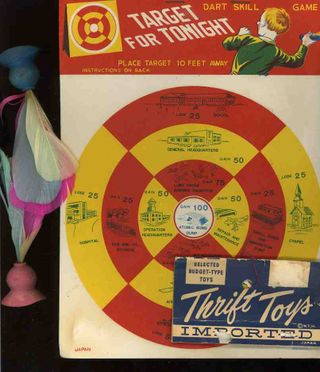
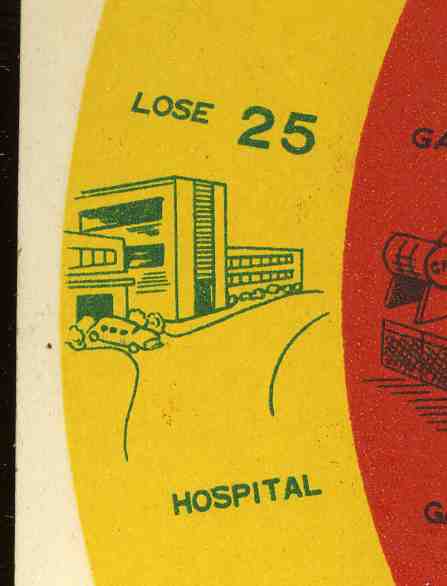
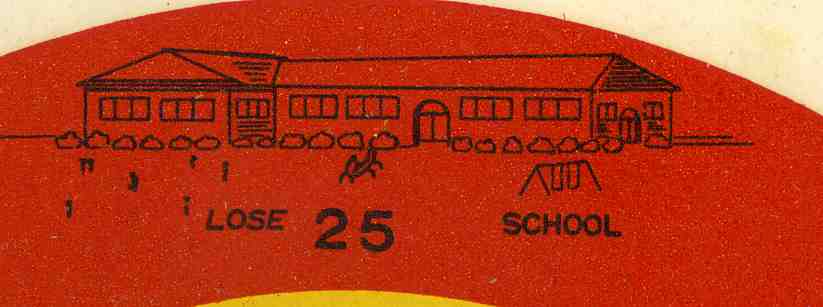
    Outside of duck-and-cover routines and other schemes for teaching children the survivability of nuclear holocaust, the approach for installing nuclear-think in the psyche of the young was through games. One such game was this cheap, affordable-by-all bombing game, “Target for Tonight” (a “Selected Budget-type Toy” by “Thrift Toys, Imported”), in which kids would use their “Atomic Darts” to reign terror over foreign lands.  But be careful!  Missing the primary targets and hitting something in the outside ring will cost you points!  If you bombed the hospital, school or chapel, you’d lose 25 points; if you hit the “civilian city” you’d get 50 points docked from your total.  Of course the game goes on no matter how many points you lose, just so long as you hit something positive and whose point add up to a total of 175. 

    00-blog-Oct 27 atomic926

    00-blog-Oct 27 atomic det hospital927

    The bullseye of the game is the “Atomic Bomb Dump” (an expression I’ve never seen before) at center.  Since it would be relatively easy to score 175–you could do it with four or five decent hits–the makers must’ve assumed that there would be plenty of collateral damage taking points from the total, otherwise the game would be over in two rounds and how much fun would that be?  So I guess that the message in this medium would be that into every winning effort some considerable unhappy rain must fall. 

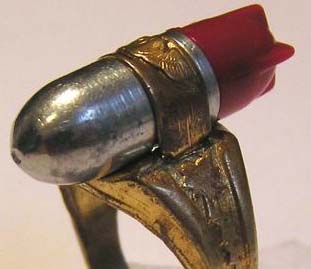
    00-blog-Oct 27 atomic det school928 I guess too that the kids playing this game could’ve been throwing their atomic darts wearing their Lone Ranger Atomic Bomb ring.  I’m no toy expert, but I cannot remember any other children’s jewelry from before 1960 (this ring is from 1946) using such a graphic depiction of The Bomb for casual wear.
      I’m also fairly positive that there must’ve been a good, causal bit to go along with “Atomic bomb” and “the Lone Ranger”, though I can’t think of what would connect the Western hero with the a-bomb.

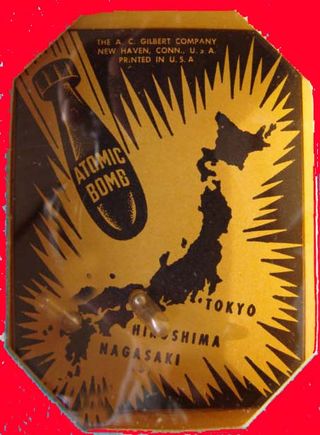
    Another no-holds-barred toy appears in the form of this manual dexterity game from the late 1940’s–the child was supposed to maneuver the three marbles into the hole/position at Hiroshima, Nagasaki and Tokyo.

    Did I mention that the “Target for Tonight” game was made in Japan?Lone_Ranger_Ring

    Atomic bomb marble
     

Recent Posts

Archives

Categories