JF Ptak Science Books LLC Post 333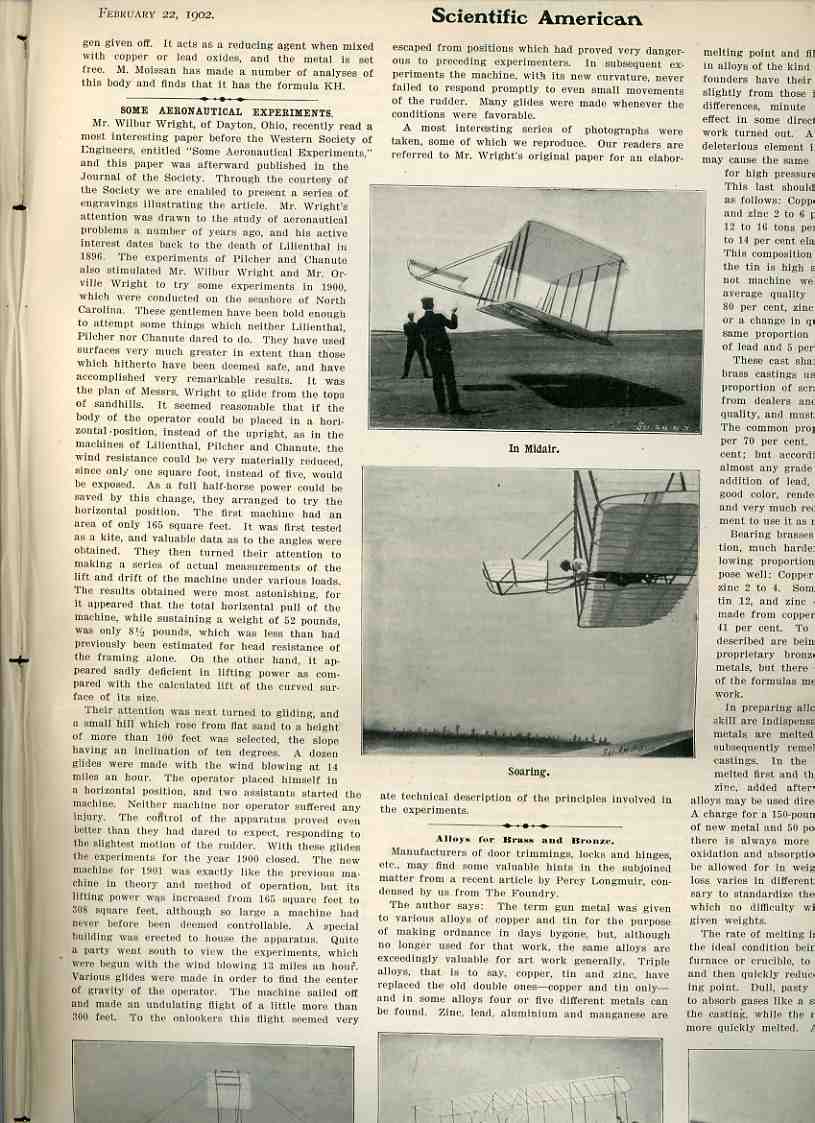
I’m not
sure why the Wright Brothers’ experimental gliding flight was so much in
competition with other pressing scientific news of the day that reports on
their progress was relegated to the middle of this issuer of Scientific
American for 22 February 1902.
The report is sandwiched in between “Winter Railroading in
Moissan with hybrids of potassium” and “A
Garbage-Consuming plant” on the page opposite and “Alloys for Brass and Bronze
“ just below it. And as it turns out
there are more words devoted to the
Wrights as well. There are dozens of
articles given better placement in this issue: steam boiler inspection, variable
speed gears for pumps, making photographs with electric headlights, domestic
manufacturing of Portland cement, assorted announcements of electrical
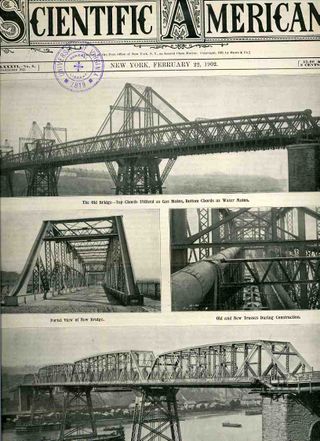
progress, and other such stuff. The front page of the issue is
dedicated to the new bridge of the
page 8.
though the brothers had been experimenting with gliding flight at Kill Devil
since 1900, reports of their activities had been under-reported, if popularly
reported at all. And this seems to have
suited them—they seemed not to need publicity, or recognition. After all, they had made incomparable strides
since they first became interested in flight in 1896 following the failure of Samuel
Langley and the
his aircraft as aeromdomes.)
for February seems to be the earliest of the 1902 flights in North Carolina,
with the principle difference (from what I can see) is that this earlier glider
didn’t yet have a tail which would make an appearance a little latter in the
year (followed by a very critical discovery on the need for the maneuverability
of the tail.) It also seems that the 1902 gliders were as different from the
1901 gliders as the 1903 glider/plane would be from the 1902 model.
Still,
given the competing news of the day, and the importance of the Wrights’
experiments, and the amount of interest in flight at this time, it is a little mysterious to me why the report
on their sandy accomplishments got so gobbled up in the nonchalant scientific
bric-a–brac of 1902.
Notes:
quote liberally from the US Commission on the Centennial of Flight for a more
exact description of the difference of the gliders between 1901 and 1902:
“Their 1902 glider had a new wing with a shallow camber
and high aspect ratio. It was a major departure from their earlier machines. It
had roughly the same wing surface area as the 1901 machine, but the
similarities ended there. The wingspan was ten feet (three meters) longer and
the chord two feet (0.6 meter) shorter than the old machine, making the glider
look larger and more graceful. It had an overall length of 16 feet (5 meters)
and weighed 112 pounds (51 kilograms). The wing camber followed a shallow
parabolic curve, and the elevator
was extended farther out in front of the pilot. This gave it more leverage,
which allowed better control. The 1902 glider also had a new rudder that consisted of two fixed vertical surfaces located
behind the aircraft . Wilbur and Orville calculated that these would help
prevent the skidding that had occurred when they warped the wings.”
And the following on the 1902 flights from
Orville Wright “How We Made the First Flight”:
“The flights of the 1902 glider
had demonstrated the efficiency of our system for maintaining equilibrium, and
also the accuracy of the laboratory work upon which the design of the glider
was based. We then felt that we were prepared to calculate in advan ce the
performance of machines with a degree of accuracy that had never been possible
with the data and tables possessed by our predecessors. Before leaving camp in
1902 we were already at work on the general design of a new machine which we
proposed to propel with a motor