A Daily History of Holes, Dots, Lines, Science, History, Math, Physics, Art, the Unintentional Absurd, Architecture, Maps, Data Visualization, Blank and Missing Things, and so on. |1.6 million words, 7500 images, 4.9 million hits| Press & appearances in The Times, Le Figaro, Mensa, The Economist, The Guardian, Discovery News, Slate, Le Monde, Sci American Blogs, Le Pont, and many other places… 5000+ total posts since 2008.

  • Allegory and Symbolism: the New Botany and a New Way of Classifying, 1737

    JF Ptak Science Books   Post 318

    Carl Linnaeus (1707-1787) was the father of modern botany–he was a Swedish zoologist, physician, and above all, way above all else, he was a botanist. He was also widely recognized  as an accomplished, applied polymath:  Rousseau said of him “Tell him I know no greater man on earth”, and Goethe, one of the greatest of all polymaths and an expert on recognizing another one,  wrote: “With the exception of Shakespeare and Spinoza, I know no one among the no longer living who has influenced me more strongly”.  Pretty strong stuff from giants.

    1blog_oc_t11_linnaus814

    In addition to much else, Linnaeus contributed a template, a grid for identification and discussion,  establishing conventions for the naming of living organisms that became universally accepted in the scientific world—the  the starting point of binomial nomenclature. 

    And perhaps it is small of me, but I concentrated a bit on the frontispiece to his greatest books (rather than on the writing)–it is truly a capstone of the botanical canon.  The book is Hortus Cliffortianus plantas exhibens quas in Hortus tam vivis quam siccis… and it was published in Amsterdam in 1737, and it was as beautiful as it was important. The book was basically the product of the desire of the entrepreneur and multiply-rich East India Company investor and Anglo-Dutch banker George Clifford, whose desire to catalog his massive and extraordinary gardens brought him to Linnaeus.  The partnership, or at least the bringing of Linnaeus on-board for this unique and monumental opportunity, was one of the most fortuitous in the history of 18th century science. 

    The fine, baroque frontispiece allegorical engraving by Jan Wandelaar pretty well drips symbolism and allegory–which is a good thing since that is what is was supposed to do.  The main figure in all of this is a crowned Europa, seated before the very gates of the Clifford garden, holding a set of keys (to the botanical kingdom).  She is surrounded by activity, including three people representing the continents (Africa, Asia and America) offering  her gifts of plants.  Europa is bathed in light, perhaps because the figure to her right, Apollo, is just now removing a drape or cloak from her (which I guess is the pre-Linnaean coverlet of incomplete  and incorrect botanical knowledge), and providing her with his own source of light (with the torch in his left hand).  Between Apollo’s legs we can see the arm/tentacle of some sort of beast/hydra/dragon, no doubt another representation of incomplete knowledge, or worse. 

    Around the edges of the print , beginning in the foregorund, we see a map (represnerting Clifford’s gardens, probably, or the general sense of planning an approrpiate way of growing and displaying plants); to the right of the map are two cherubs/imps sitting before a roaring brazier, one holding a staff of some sort and the other pointing to a (celsius) thermometerm which Linnaeus had a hand in invneting.  Moving up the side of the print we come to my favorite part, the producing banana tree (you can see the bananas if you look closely), which I imagine must’ve been a great rarity in Eruope in the 18th century).  All in all I’d say that the artist accomplished the task of allegorically depicting the importance of the pages that followed.
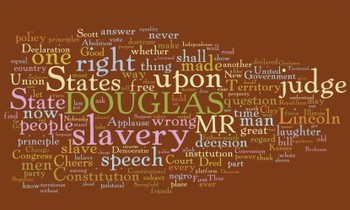
  • Another Debate: Lincoln Douglas Debate Wordle Word Cloud

    JF Ptak Science Books 

    Listening tonight to the McCain/Obama debate (nicely moderated by Bob Schieffer, Old School) reminds me of other political debates.  This one at least was not terrible (Dan Quayle, Sarah Palin [which is Latin for what exactly?], poor Jerry Ford and the Poland freedom question, and so on) and at least as good as most of these things have been during my lifetime (Kennedy Nixon).  [Click on the word cloud to enlarge.]
    Wordlelincoln_douglas

    It does put me in a longing piece of mind for Lincoln Douglas 1858, mainly because tonight’s debate was reasonably glib if not long in logic; Lincoln Douglas had it all, especially the logic bit.  If you read the 200,000-odd words of that six-debate series, (taking place from August through November 1858, located mainly around the perimeter of their battleground state, Illinois) you can’t help but be impressed by how long and deep and considered their memories and logical structures were as the two men fought over the morality and logical structure of slavery.  Of course they weren’t fighting over the prime 15 second spot the next day; their debate was covered in full in newspapers (on the front page even!), their constituents taking their time to read the exchanges, and then have the luxury of time to think about what had been said.

    So above is a word cloud brought to you via WORDLE.  There are a few repetitive words that were just part of the structure of the debate verbiage:  “Mr.”, “laughter”, “cheers” are the main examples.  Otherwise you can pretty well tell that t he broadest, most often used words in the debate reflected the slavery issue, though it doesn’t relate the sentiments to the contestants.  (It would be very interesting for someone to do two wordles, one for each man.)  But the overall patina of the debate was overwhelmingly slavery-related.  I’d particularly like to see the Douglas end of the debate, as he was pretty problematic on the slavery issue, and I’m not sure at all (even given where he was from) that the man actually was anti-slavery–he argued in the debates for instance that the founding fathers didn’t extend their thoughts on the Constitution to encompass minorities.   Or at least anti-slavery before the beginning of the war, as he was outspoken on what he saw was the “criminal” activity of the Southern secessionist states. But he was dead almost right away after the war started. 

    Douglas won the Senate seat but Lincoln won attention of the country; perhaps it was due to this that Lincoln defeated Douglas and the other two Democrats in such a spectacular (electoral) fashion in their rematch presidential race of 1860.  (Lincoln still trumps the badly divided Dems even if you cobbled together the votes of Douglas, Breckenridge and Bell.)  In any event, if you read through the Lincoln/Douglas debates. you can see right away that there was some pretty strong thinking going on…

  • Gulf Stream Wealth Predictor, 1939–Outsider Logic from the Inside

    JF Ptak Science Books  Post 320

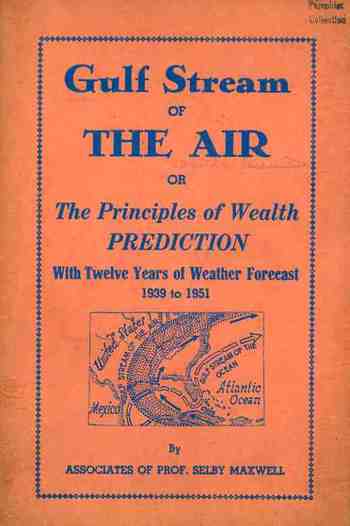
    00blogoct_15gulf_stream864 I’ve found many remarkable statements contributed by seekers and the curious whose efforts have found their way into print and then into my Naive Surreal and Outsider Logic pamphlet collections.  In the ungainly-titled Gulf Stream of the Air or the Principles of Wealth Prediction with Twelve Years of Weather Forecast 1939 to 1951 (printed in 1939), written by an unnamed group (!?) called the “associates of Prof. Selby Maxwell”, the title was good enough to guide this pamphlet to its just reward.  Just before adding it the the hoard I opened the pamphlet at random and found this sensational “what if” sentence: 
    “If the high Plateau and the Rocky Mountains did not exist there is little doubt that Mexico and our Western States would not differ appreciably…”

    Wow.

    Mr. Maxwell was indeed a real meteorologist, and perhaps this Bourbaki-like crew absconded with his good name into the bleak night of weather wealth, leaving sentence fragments like the one above in their wake.

    As bizarre as it is though this might be a fantastic way of getting the attention of a group of kids in a classroom.  Its all fine and well to classify this as “bizarre”, but what are the components that make it so?   Why is it bizarre to entertain such a thought, and how could it possibly be that it wouldn’t affect much and what would the other consequences be of not having the formation of the Rocky Mountains take place, and on and on.  It is junky in its way, thinking like this, but I’ve got to admit that I’ve  never thought about this situation before; and in its own way, the statement is fascinating in its turn-right-to-loosen-left -to-tighten way. 

    ·Posted by :

    ·in:

    —
  • Where is THE West? And: How to Find Nowhere.

    JF Ptak Science Books  Post 320

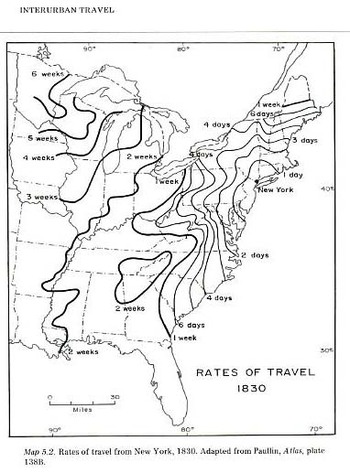
      This wonderful map is from Charles Paullin and John K. Wright Atlas of the Historical Geography of the United States, Washington, Carnegie Institution, and New York, American Geographical Society, 1932. It is just so very interesting and unusual–I’m not so sure that I’ve seen another map quite like this, illustrating travel time and difficulty..  One major stand-alone feature here for me is the distance from New York City to my own area of the U.S., the southern Appalachian region of western North Carolina: it took six days to get to Savannah from NYC and two weeks (!) to get up here in the mountains, which looks to be about the same amount of time it took to get to the Chicago area.  Of course once you got to Asheville in 1830 you were, well, probably looking to get somewhere else. I’d take it that the turkey population vastly outnumbered the people.  Maybe the horses did, too.  Getting back on track here though the West in the U.S. at the time began just on the other side of the state of Tennessee, and it wasn’t but a couple (?) of censuses before this that the West was right about at the Cumberland Gap/Ohio River basin region.

    File0844

    Perhaps this leads us to a more interesting if badly-asked question:  where does the American West begin? 

    This is an awfully tricky question, best left to the answer that pops into your mind the instant you hear the question, before the problems of what the sentence entails creep in.

    Locating where the West begins is a curious, personal adventure–is it on the other side of the Mississippi, or does it really start in Texas, and once in Texas does it start in Austin or the sleepy Brazos? Does it really begin where the sign says it did, at Meacham Field in Fort Worth?

    Blogoctlast_piovcture

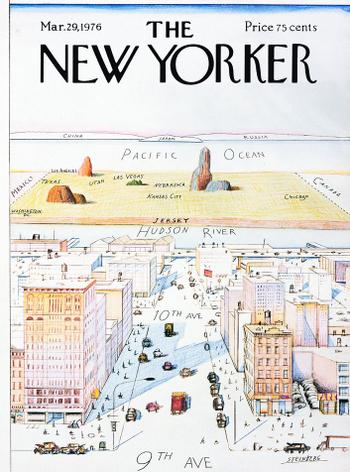
    It depends on the era, too, as we just said above; in the 18th century the American West was really out there with the makers of the martyr Bibles in Ephrata, which means that the rest of the  place was really very big.  And of course you can go all the way back to the beginning of European colonization here, all of North America was the West, at least to the people who were boarding the ships thousands of miles away across the Atlantic. And even once they got here the West was problematic–for the Spanish in the southlands there doesn’t really seem to be a “west”, only the northlands. In the 16th century the West was just creeping into Pennsylvania (Penn’s Forests), and the French and Indian War in the mid 18th century was fought over the control of “the West”, the crux of it all heading down to the forks of the Ohio at Pittsburgh.  Even in the late 18th century, the West was still not all that far away, relative to what we think of today, what with Kentucky being the first “Western” state admitted to the Union (in 1792).  It would probably be easiest just to say that the Mississippi River is the dividing line; after all, Lewis and Clark departed (in 1803) on their expedition from St. Louis (as did hundreds of thousands of other people later in the century who were seeking their new life in the West).  Then there’s the West of Saul Steinberg. who puts the whole thing on the other side of the Hudson…I’m not so sure if the West didn’t start for some people somewhere along 11th Ave.

    And where does the West “end”?  Does the West make it all the way to California coast, or does it stop in the desert, east of Sacramento?  Do people think of Oregon and Washington as the West; certainly they’re western, but are they The West?   To really complicate things, I guess you could define the middle of the West and look for the boundaries.  But the middle of the West usually seems to me to be flat and red and not terribly high; who’s to say that a nice town in Colorado (Salida?) might not be the middle of the West, even if it is 7,000 feet high?   

    Blogoct_18steinberg

    Its a tricky question and probably most people have a different answer for it.  For that matter, what about the South?  Where does that begin? I’m in a southernish state, but I hardly think of Asheville as being in The South per se. Maybe we’re too high; maybe the place over 2000′ in elevation that are south of Pennsylvania are just Appalachia, and actually not part of the South.  Scotland Neck over on the other part of my state is definitely the South to me, but perhaps it isn’t too much very Southern for someone in the high delta, or taking an easy afternoon in Oxford, Mississippi, or anywhere else in the Louisiana-Mississippi-Alabama-Georgia block.  I know that to Robert Johnson and Honeyboy Edwards and Son House and  Muddy Waters and anyone else in Coahoma county that the South didn’t go all that far north from where they were sitting. .In maps from sat 1850-1890 that area is called “the deep south”; seems to me that anytime you have a geographical location with a qualifying prefix, you’re actually dealing with the real thing, everyone else without the prefix being pretenders, or just something else. 

    Same too for the North–is everything above Washington D.C. northern?  I wouldn’t tell my father that, being a Berkshire Hills (MA) boy; but that’s another problem, especially to someone in Bangor.

    So somewhere in all of this, after figuring out where all of these places start, somewhere in  there is a place in this country that rejects these geographical delineations–that’s the place I’d like to find.  (When I was describing this idea yesterday to a friend, Renee, a Texan via way of Alabama–like many of the defenders of the Alamo–the answer came immediately:  “Kansas” she said.

    I’m not sure I agree.  But then once I get past my immediate response (Texas without Trees), I start to think of a 3-D representation, trying to accommodate time.  I don’t have answer for the place that isn’t anywhere, but once you start drawing enough circles to signify where The North South East West is/are, there is sure to be a little spot that gets overlapped by all of the circles more often than any other place–and that is where I think you’ll find Nowhere.


  • Naming Things; Names Good and Bad

    History of humans may boil all the way down to the history of
    naming things. Sometimes the naming is good, sometimes not. Moby-Dick sounds a
    whole lot better than The Whale; Ulysses and The Odyssey are not really
    inspired titles for fantastic books, nor is The Heart is a Lonely Hunter, or The
    Recongitions
    for that matter. The Bible doesn’t say much about the book, and
    Love in the Time of the Cholera does; why You Should Refrigerate Food does tell
    you what’s inside a basically empty book, and Catch-22 does not.

    Standard_model_chart

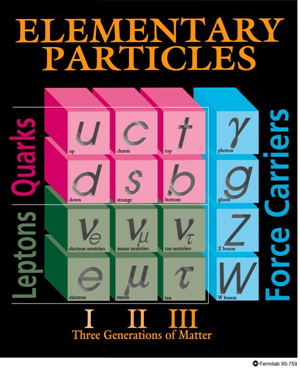
    The Standard Model (with quantum chromodynamics folded into
    it)  is a very bad name for something
    that describes the world of elementary particle physics;  Democritus’ “atom” has stood the test of 24
    centuries and is pretty, while muon (god help it) will survive by sheer fits of
    agony.  QED and ACD are good initials for
    big things, but big things like giant laboratories tend to have pretty bad acronymic
    names (SLC, CERN, DESY). 

    I just wrote a post about the creation of the binomial
    naming grid of Linnaeus, which was one of the greatest naming inventions of all
    time—it performs an organizing principle that created other organizing
    principles. 

    Sometimes the names of things outlive their usefulness, and
    come full circle, sometimes providing an unintended and ironic reminder of untimely
    pasts.  In

    India there’s   Lodhi Road,
    Mughal Gardens
    and Aurangabamnd; we have our own in this country in places like the Jefferson-Lee
    highway and Fort Myer’s
    (Virginia)
    Mosby Gate.

    The massiveness of this idea is just overwhelming—all I
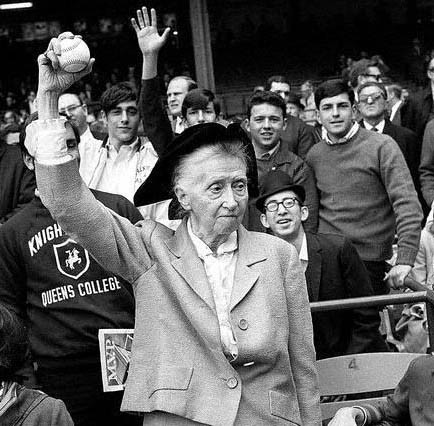
    really want to do here is get to the naming of a Ford Motor car.  And the namer, in this case, was the poet
    Marianne Moore.  (I’ve always liked her,
    and her poetry, and her love for Mickey Mantle and baseball and Muhammad Ali
    and so on)  Ford found itself a little behind
    the times back there in the autumn of 1955, trying to figure out a new,
    with-it, tiger-whipping name for its new $250 million dollar car from their
    Special Products Division  They had
    something like “Firebird” in mind—unfortunately for them the name was already
    taken.  David Wallace, the head of Ford,
    wanted something elegant and fleet, and to that end contracted with the great
    poet Ms. Moore to come up with one.

     Marianne_moore

    Ms. Moore had a dry sense of humor and did submit a number
    of entries, though none were successful, and probably none were intended to
    be.    After looking at sketches and drawings of the
    new car, she came up with “The Ford Silver Sword” almost right away (named
    after a flower she said that grew only on Mt. Haleakala
    above 10,000 feet or some such thing).  She then submitted a
    number of others  including the “Patelogram”,
    the “Mongoose Civique”, and the “Utopian Turtle Top”, and then many many more.

    Mr. Wallace came to realize that Ms.Moore was having a bit of fun with his
    company, and sought to terminate their relationship, with some aplomb.
    He wrote:

     Dear Miss Moore,

    Because you were so kind to us in our early days of looking
    for a suitable name, I feel a deep obligation to report on events that have
    ensued.

    And I feel I must do so before the public announcements of
    same come Monday, November 19.

    We have chosen a name out of more than six thousand-odd
    candidates that we gathered,  It fails
    somewhat for the resonance, gaiety, and zest we were seeking.  But it has a personal dignity and meaning to
    many of us here.

    Our name, dear Miss Moore—is Edsel.

    I’m sure that Ms. Moore must’ve had a good, solid laugh on
    that one.

    ·Posted by :

    ·in:

    —
  • Naming Things: Re-naming the Badly Named

    JF Ptak Science Books   Post 321

    Among the Ash-Heaps and Millionaires (some of the attempts at a title for what became The Great Gatsby) of novel titles great and small, I offer the following modest list of attempts at titles and what became the real title of the book.  Can you guess if the proposed title (in parentheses) is real or just a bad attempt at humor? (Hint:  they’re all real–not much of a quiz, is it?)  This is a follow up on the Marianne Moore/Edsel/Standard Model Naming Things post from yesterday, though this more about re-naming–in most of these cases though it is more like anti-naming, as the proposals for some of these titles are just so painfully bad.  I think that we can all be thankful that the editors, or the author, finally made a more correct decision on the titling of the work at hand.  

    (Naked Lust)
    Naked Lunch

    (Tomorrow is Another Day)
    Gone with the Wind

    (Army Post)
    Reflections in a Golden Eye

    (The High-Bouncing Lover)
    The Great Gatsby

    (The Exorcism)
    Who’s Afraid of Virginia Woolf

    (Something that Happened)
    Of Mice and Men

    (The Iron-Bound Bucket)
    Mr. Roberts

    (The Drunkards)
    Tender is the Night 

    (The Education of a Personage)
    This Side of  Paradise

    (The Inside of His Head)
    Death of a Salesman

    (O Lost)
    Look Homeward Angel
    (*Actually his bones are only about 1000 feet from we’re I’m writing)

    (Catch-18)
    Catch-22


    ·Posted by :

    ·in:

  • The History of Images of Aerial Bombing–First Images

    JF Ptak Science Books  Post 322

    I had written out a good, chunky post on the history of the images of aerial bombing; wrote it all down in my little notebook down at Tybee Island, and then promptly hopped into the hot tub fully clothed (for the benefit of our five-year old Tessie) and stayed there for a half-hour, with my notebook still in my pocket.  Of course once the thing sort of dried out all of the notes were just one blue stain, an Andy Warhol post.  I just can’t do the whole thing over again, but I can post about the one odd bit that was in there.  And it is this (very) minor bit that escaped Sven Lindqvist’s attention in his glorious A History of Bombing (printed in 2000 by The New Press), a book that is a chrono-intellectual historico-philosophical treatment of aerial bombing in general.

    1blog_oc_t11_robur810

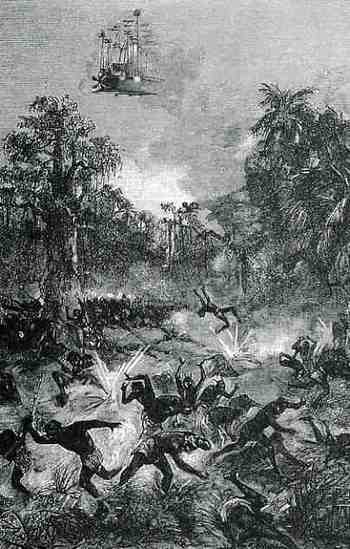
    One of the earliest illustrations of bombing from an airship (at left) occurs in the incomparable Jules Verne’s Roburs the Conquerer (also known as The Flight of Engineer Roburs) in 1886.  It turns out that this floating monstrosity (the Goahead) made its way slowly over Paris, illuminating the city with powerful lights, in a helpful, positive way; on the other hand, it confronts “dark criminals” with bullets, mowing them down.  Oddly enough, the book’s opening two words are “Bang Bang”.

    1blog_oc_t11_anti_ac813

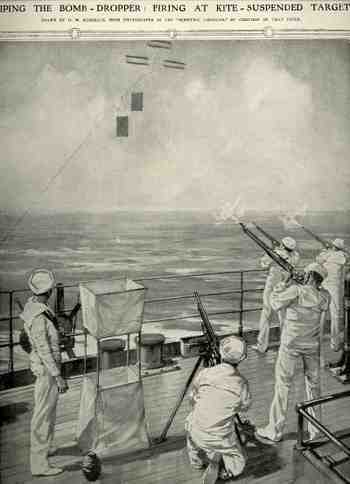
    This may well be the first anti-aircraft (and anti-bomber) image ever printed  in England–it comes from The Illustrated London News for 16 December 1911, just six weeks after this same magazine printed the first image of an aircraft dropping a bomb on a military target. (And it seems originally to have been first published weeks earlier in the U.S in the Scientific American.)  “Airman-shooting with Springfield Rifle; Aerial Gun Practice on a United States Battle-Ship” is the sub title to “Sniping the Bomb-Dropper:  Firing at Kite-Suspended Targets” .  The kites carried the targets up to a height of about 300 feet, and the navy let loose with “one-pounders and three-pounders” as well as rifles (?!) The text to the print continues the story: “The Springfield rifle…will afford no inconsiderable defense against any aeroplane that might attempt to execute feats of ‘bomb-dropping’.” I don’t know about that, though it may have been true that this 30-caliber weapon with a muzzle velocity of 2700’/sec might’ve done some damage to a 1911 aircraft….I guess they could have tracked it too, what with the plane moving 75 miles an hour or so.

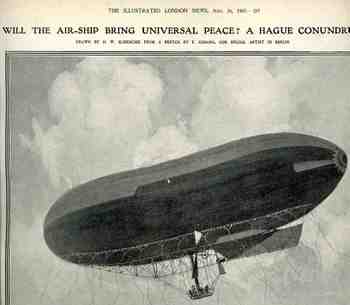
    It was just a few years earlier that in this same journal (for 4 August 1907) that the possibility of the air-ship being an instrument of peace was discussed.  It seems that this “peace” would come about in a sort-of MAD (mutually assured destruction) kind of way, stumbling its way to peace because of the difficulty in defining the terms of war–rather than obtaining a stalemate by the endgame of obliteration via inconceivable amounts of instantaneously-released energy, these folks thought that peace/stasis might come about simply because they weren’t able to fully outlaw reckless bombing because they couldn’t come to terms with what an “airship” actually *was*.    Bombing by airship was outlawed at the Hague Conference of 1899, and in 1907 it was argued that a five-year extension of that treaty should be enacted–again, mainly due to the ungentlemanly ungainliness of what it meant exactly to drop bombs from the air and what aspects of that action were illegitimate. 

    All sides would get over the definition issues pretty quickly, as 1912 comes up just a little short of the guns of November two years hence.  After all, we can’t have ill-defined terms in communication, can we?

    1blog_oct_13marconi_at_sea818

  • The Department of What Things Look Like: the Casualties of the Somme, Visualized

    JF Ptak Science Books LLC  Post 323

    00blogoct_16crowds865_2I wanted to return to a post for a few days ago on what victory looks
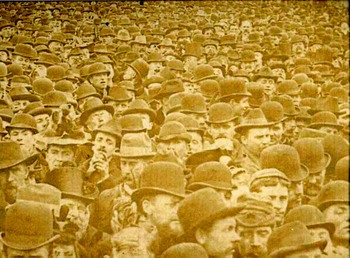
    like in relation to the sub-war/Battle of the Somme in 1916,tying to
    relate the staggering proportions of the 1.5 million casualties from
    that action to a photograph of a group of people.  This is not terribly
    easy to do, especially without using images that are iconic standards
    of “large crowds”, or even images that can be image-googled. I have
    found two interesting images, though—one real, and the other, well, the
    other one I made.  (This is the only image of the 1200 images that I
    have posted to this site that I have altered or created, just for the
    record,)

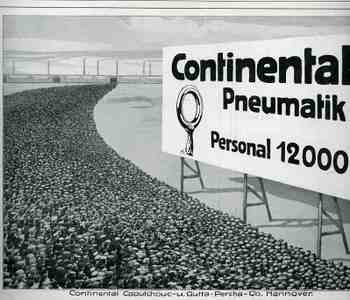
    The first image comes from the Illustrierte Zeitung (Leipzig),
    for October 1910.  It presumably shows the 12,000 employees emerging
    from the factory of Continental Pneumatic Tires, only I make the crowd
    out to be more like 40-50,000  That means that the casualties of the
    Somme would be thirty (30) of these crowd scenes, end-to-end.  30.

    00blogoct_16crowds866

    The next image is a montaged photo, a photo of hats, taken about 12
    feet off the ground or so, but a sea of hats that attaches faces to the
    hats, unlike the sea of hats in the image above it.  This is a sea of
    faces, giving a better sense of humanity to the sea of bodies.  There
    are perhaps 500 people in this photo, meaning you’d need 300 of them to
    illustrate the Somme casualties.

    It all still pales in comparison to the actual numbers.  Victory still looks not so victorious.

  • From the Department of Great Understatement: the Wright Brothers, 1903

    JF Ptak Science Books LLC   Post 324

    Blog--wright
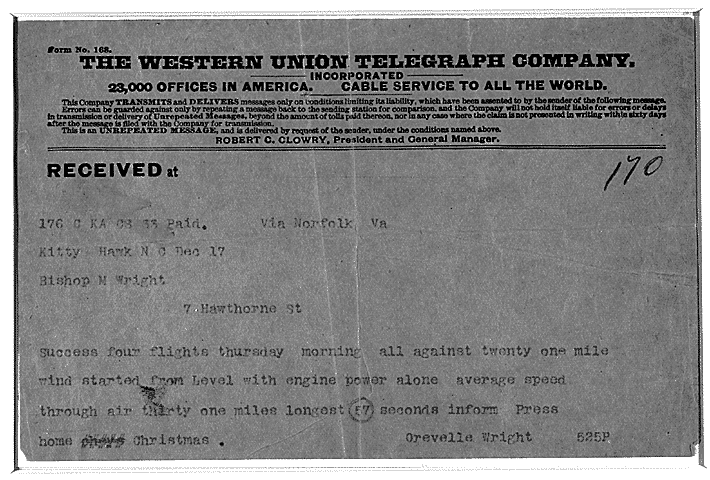
    Lorin Wright–the Zeppo and infrequently-heard-of brother of Orville (1871-1948)  and Wilbur (1867-1912) —was the one responsible for disseminating the information of the first successful heavier-than-air flight at Kitty Hawk in December 1903.  It was on the 17th of December that the brothers—following several incomplete attempts and a crash several days earlier—launched their plane and flew 852 feet, Wilbur staying aloft for 59 seconds.  They were going to try again but an errant gust of wind threw their aircraft and damaged so that there could be no further attempts.
    [CLICK on image to enlarge; courtesy of the Library of Congress]

    After literally chewing the matter over during lunch, and after several hours had passed, the brothers decided to release the news to the rest of humanity.  Their dad had prepared the text and Lorin was responsible for getting the message out. 

    This image of the telegram that the Wright brothers sent to their father for the go-ahead is incredible for its brevity, its understatement and its misspelling.  Of course sending a telegram was relatively expensive and the Wrights didn’t have very much money, so, perhaps the brevity can be sort of explained.  Sort of; after all, they did just become the first people to fly a  heavier-than-air aircraft, and perhaps a little excitement would be present.  But no, the Wright family had a plan and a plan well worked out, so the quick note would suffice, no matter how momentous the achievement.  I should also point out that the outcome was unexpected. 

    But the other bits about this telegram that make it so utterly delicious was the telegrapher’s misspelling of Orville’s name (“Orevelle”) and the two word summons to “inform Press” [sic].  And oh yes, “home Christmas” rounds out the momentous communication very nicely.

    As it turns out the local papers near the Wright community in Ohio gave the achievement scant notice.  (The reverential Scientific American by the way gave the Wright flight inside notice—it wasn’t front cover material for them.) The papers were a little shortered though because the results of the experiment were leaked to the local Norfolk paper, and the rest of the world got scooped. 

  • Advertising in 1568: Thongs, Shoes, Teeth and Urine

    JF Ptak Science Books LLC  Post 326

    00-blog-Oct 20--aman thong872
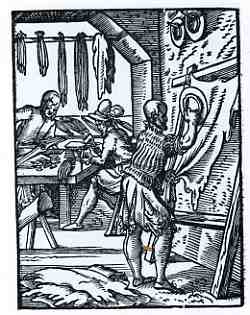
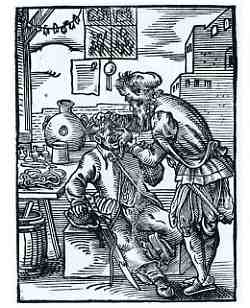
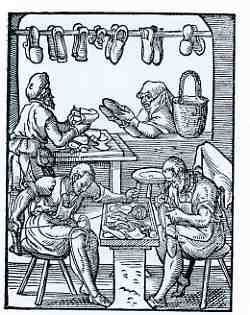
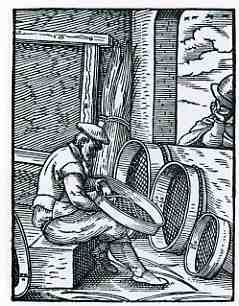
    I was much taken with the splendid woodcut illustrations by the prolific and erudite Jost Amman for one of a series of cycle books known as the Standebuch, or “Book of Trades”.  This work, printed in Nuremberg in 1568, contains 114 woodcut illustrations, and is one of at least fifty books illustrated by the (busy) artist.  Amman is particularly well known for his attention to detail  and factual portrayals–something that was not a particular characteristic of artists portraying the less-than-noble folks in the Northern high Renaissance–and especially for his attention to clothing and shoes. 

    At first what brought me to Amman for this post was listing the disappeared trades from his list of 114 different jobs–frankly, there weren’t all that many that have just completely disappeared, which i s a little surprising.  One example for this is found at left, with the thong maker–it is a little funny-sounding to today’s ears, but 450 years ago the thong was an essential piece of a man’s wardrobe.  00-blog-Oct 20--aman dentist876

    (The most obvious basically-gone professions included typefounder, block cutter, illuminator, glass painter, coin stamper, gold leaf maker, bag maker, miller, dyer,hatter, bath house proprietor (in the old sense), barber-surgeon, thimble maker, brush and comb maker, cloth shearer, spur maker, scythe maker, nail maker, basin maker, pewterer, armorer, needle maker, crossbow maker, lantern maker (for everyday lanterns, large artistic church lanterns, dark lanterns…), mirror maker,. grinder, joiner, wagonwright, cooper, parchment maker, sievemaker, rope maker, oil maker, wire maker and thong maker. That makes about a third of the professions that are now almost entirely gone; more significant though is that two-thirds of the jobs listed in 1568 are still around.)

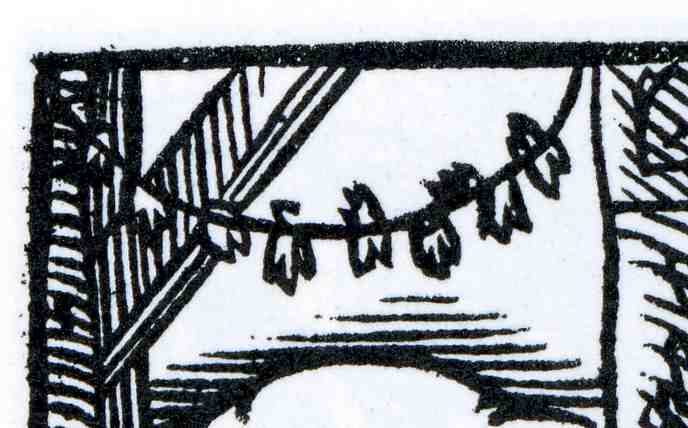
    Then I was drawn to the windows of the interior shops and the window design and glassware; and then from there I became interested in the goods that the tradesman hung in his open window as both finished product and advertising, a kind of calling card if you will.  So for example the thing maker of course had thongs hanging (like throttled chickens) in his window.   One particularly nice showing of goods was for the dentist (pictured at right)

    00-blog-Oct 20--aman dentist det877
     

    who even though he was operating  without walls hung up some teeth just to make sure that folks knew what he was doing, even though the “doing” stuff was happening right there in front of the casual passerby.

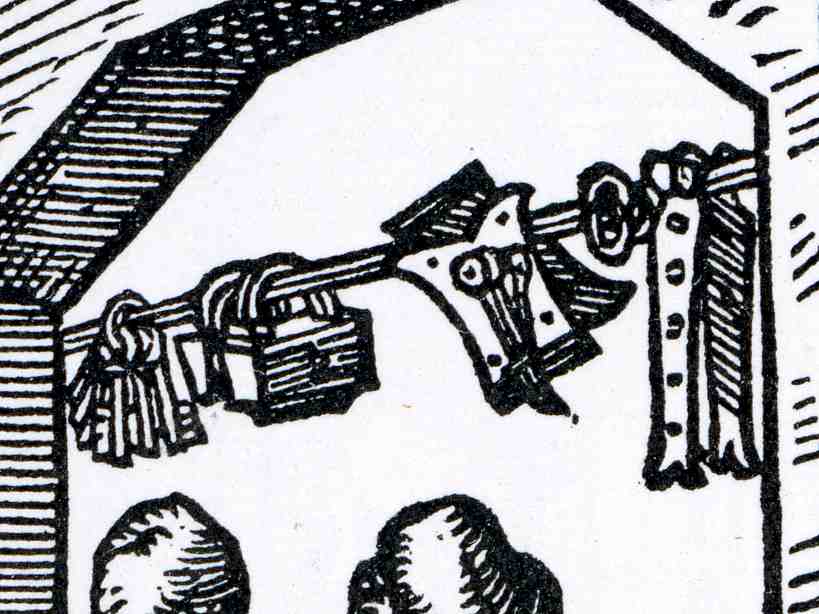
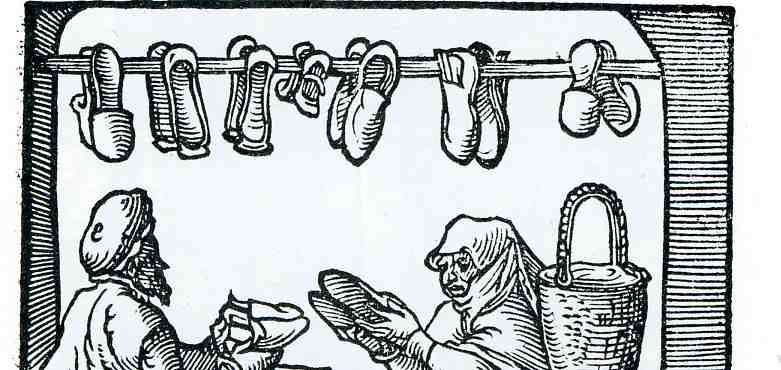
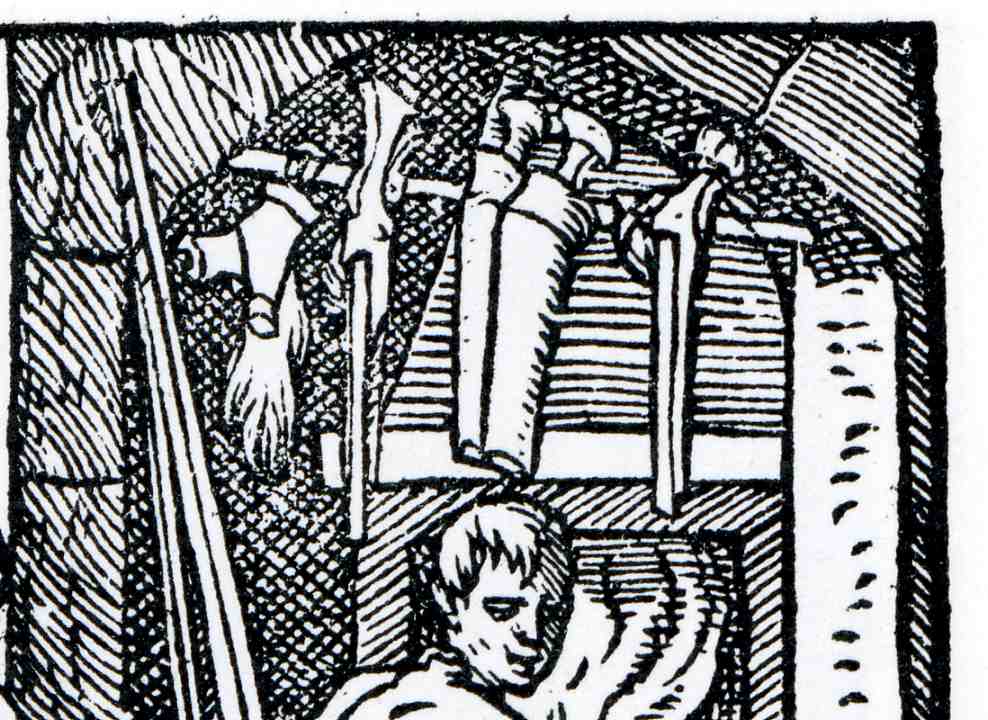
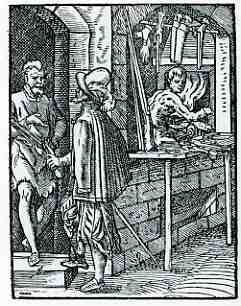
    The locksmith displayed hinges hinges and keys and locks from his rope00-blog-Oct 20--aman key det879, as did the shoe maker (fairly industrious with two helpers), who even displayed a pair of baby shoes.The image for the gunsmith is also interesting because of the detail of the front of the stall/window of the gunmaker–it has a fold-down ledge or table on retractable legs. 

                                                                                                                 00-blog-Oct 20--aman shoe873

    00-blog-Oct 20--aman shoe det874


    00-blog-Oct 20--aman gunsmith det881

    00-blog-Oct 20--aman gunsmith880

    And, well, I lied about the urine.  (Its not often you get to write a sentence like that, or, for that matter, say that you lied about it too.)
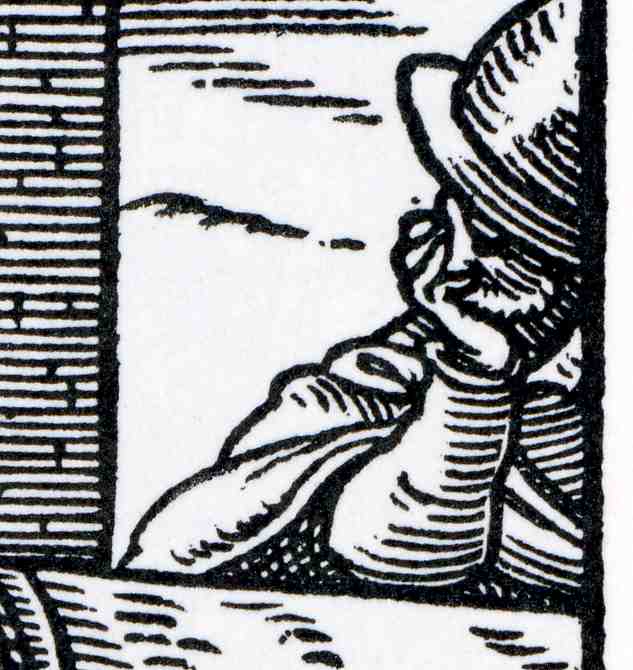
    Of the many images of physicians from this period that I have seen many do indeed show the doctor holding a flask of urine on high for inspection, but I never have seen one illustrating the flask for the doctor’s “offices”.  It was one of the principal duties of the Renaissance physician to inspect the urine of his patients, examining it for clues to ill humors and other persuasive unhealthy fortunes.

    One could put together the business section for a fair-sized Renaissance city with these images, assembling them side-by-side.  The Amman woodcuts even come with customers and layabouts–there are plenty of people who just “happen by” in these pictures, watching, passing the time of day, observing the tradesmen at work.  Much like today, these open windows beckoned o people in the streets much like a construction site calls out to old men, or an open car hood cries for its neighbors to come and take a peek.

    00-blog-Oct 20--aman basket882

    00-blog-Oct 20--aman basket883

    ·Posted by :

    ·in:

  • Amelia Earhart: Her Physical Disappearance vs. Lindbergh’s Moral Vanishing

    JF Ptak Science Books   Post 328

    Blog--earheart

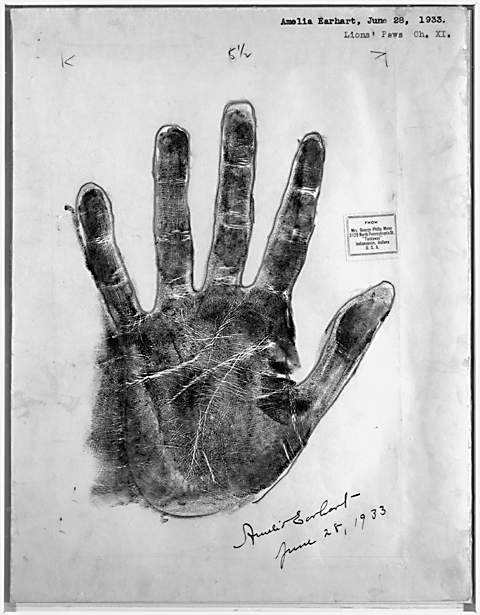
    [Image source: “Amelia Earhart’s palm print and analysis of her character prepared by Nellie Simmons Meier.” June 28, 1933. “Words and Deeds in American History: Selected Documents Celebrating the Manuscript Division’s First 100 Years”,  from the Library of Congress.]

    “KHAQQ calling Itasca. We must be on you but cannot see you…gas is running low…”

    This is I believe the last communication between Amelia Earhart and the rest of creation, as she went flying into the oblivion on low fuel, 2 July 1937.  She was 22,000 miles into her around-the-world trip with her engineer Fred Noonan in a Lockheed L10 Electra, with 7,000 more to go, almost all of which were over the Pacific. That was the last of her, forty years old and world-renowned, and then shrouded in a terrific mystery, and declared dead after massive searches two years later in 1939.  She owned many “firsts” for women in the field of aviation, but still couldn’t seemingly stake them to her own name, burdened with the sobriquet of “Lady Lindbergh”.  It was true enough that being historically coupled with Lindbergh, who was seen by many as the greatest aviator of his day, was a vast compliment; it would have been more complimentary yet to refer to Lindbergh as “Sir Earhart”.  Amelia did, after all, accomplish more overall than Mr; Lindbergh; plus Ms. Earhart did not philosophically spill over into the fascist sphere as did Lindbergh1, who was just a downright embarrassment with his opinions on the war, Hitler, National Socialism, fascism, and the like.

    But I digress.  This image2of her capable and attractive hand just has the quality of disappearing, even though it is right in front of your eyes.  Stare at it long enough and bits of it will go….

    Notes:


    1. Lindbergh’s story during the pre-war period to Pearl harbor is very problematic for people who admire the man for his aeronautical feats; I imagine that they separate his philosophy from his gained famed much in the same way that Poundians concentrate more on that fascist anti-semitic poet’s early years than his treasonous 1935-1945 decade.  It remains terribly visible though that the anti-intervention, America-Firster, race conscious, Germanophile Lindbergh had so much going on in his confused head that it lead even Franklin Roosevelt to think of him as a traitor. (
    Roosevelt said to Treasury Secretary Henry Morgenau in May 1940, “if I should die tomorrow, I want you to know this, I am absolutely convinced Lindbergh is a Nazi.” ) Once America did get into the war, finally, on 8 December 1941, Lindbergh wholeheartedly supported the war effort.  Still it is hard to forget his years of earlier actions and statements and political rallies that called for American appeasement with the Nazis and hi semi-blind admiration for the new Nazi nation.  He wasn’t a fan of Hitler’s, but he did have just very soft pre-1942 criticisms of his actions.  Kristallnacht, almost 70 years ago today, for example, brought out no condemnation from Lindbergh.   He confided to his diary: “I do not understand these riots on the part of the Germans,” he wrote. “It seems so contrary to their sense of order and intelligence. They have undoubtedly had a difficult ‘Jewish problem,’ but why is it necessary to handle it so unreasonably?”  It seems that there should have been a bit more than pursed lips coming from Lindbergh on this occasion, but there wasn’t, even to himself.  There would be another three years of anti-Jewish and other horrific and morally repugnant actions
    from the Nazis, but they all took a giant goosestep back from his principal aim of keeping  America out of the war and being strongly anti-Communist.  Pat Buchanan recently and bizarrely—even for him—defends Lindbergh’s stand during this period as being deeply patriotic.  It is a deeply unreasonable and a bloody mess of historical thinking.

    2. The photostat was made on behalf of a quack  palmist who did all sorts of interpretations of the philosophical chinks in her skin’s armor.  It isn’t worth talking about.


Recent Posts

Archives

Categories