JF Ptak Science Books Post 328
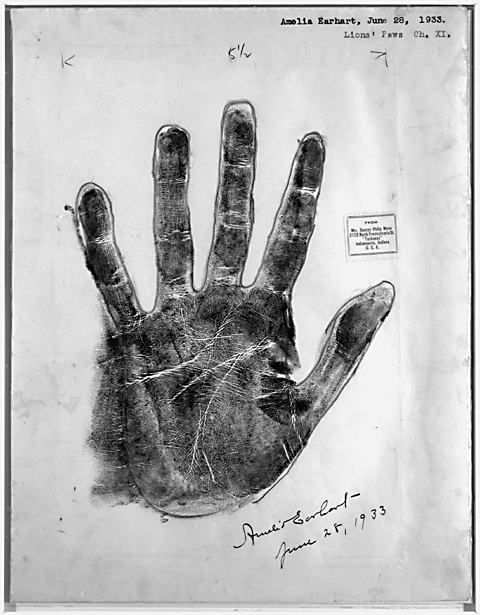
[Image source: “Amelia Earhart’s palm print and analysis of her character prepared by Nellie Simmons Meier.” June 28, 1933. “Words and Deeds in American History: Selected Documents Celebrating the Manuscript Division’s First 100 Years”, from the Library of Congress.]
“KHAQQ calling Itasca. We must be on you but cannot see you…gas is running low…”
This is I believe the last communication between Amelia Earhart and the rest of creation, as she went flying into the oblivion on low fuel, 2 July 1937. She was 22,000 miles into her around-the-world trip with her engineer Fred Noonan in a Lockheed L10 Electra, with 7,000 more to go, almost all of which were over the Pacific. That was the last of her, forty years old and world-renowned, and then shrouded in a terrific mystery, and declared dead after massive searches two years later in 1939. She owned many “firsts” for women in the field of aviation, but still couldn’t seemingly stake them to her own name, burdened with the sobriquet of “Lady Lindbergh”. It was true enough that being historically coupled with Lindbergh, who was seen by many as the greatest aviator of his day, was a vast compliment; it would have been more complimentary yet to refer to Lindbergh as “Sir Earhart”. Amelia did, after all, accomplish more overall than Mr; Lindbergh; plus Ms. Earhart did not philosophically spill over into the fascist sphere as did Lindbergh1, who was just a downright embarrassment with his opinions on the war, Hitler, National Socialism, fascism, and the like.
But I digress. This image2of her capable and attractive hand just has the quality of disappearing, even though it is right in front of your eyes. Stare at it long enough and bits of it will go….
Notes:
1. Lindbergh’s story during the pre-war period to Pearl harbor is very problematic for people who admire the man for his aeronautical feats; I imagine that they separate his philosophy from his gained famed much in the same way that Poundians concentrate more on that fascist anti-semitic poet’s early years than his treasonous 1935-1945 decade. It remains terribly visible though that the anti-intervention, America-Firster, race conscious, Germanophile Lindbergh had so much going on in his confused head that it lead even Franklin Roosevelt to think of him as a traitor. (Roosevelt said to Treasury Secretary Henry Morgenau in May 1940, “if I should die tomorrow, I want you to know this, I am absolutely convinced Lindbergh is a Nazi.” ) Once America did get into the war, finally, on 8 December 1941, Lindbergh wholeheartedly supported the war effort. Still it is hard to forget his years of earlier actions and statements and political rallies that called for American appeasement with the Nazis and hi semi-blind admiration for the new Nazi nation. He wasn’t a fan of Hitler’s, but he did have just very soft pre-1942 criticisms of his actions. Kristallnacht, almost 70 years ago today, for example, brought out no condemnation from Lindbergh. He confided to his diary: “I do not understand these riots on the part of the Germans,” he wrote. “It seems so contrary to their sense of order and intelligence. They have undoubtedly had a difficult ‘Jewish problem,’ but why is it necessary to handle it so unreasonably?” It seems that there should have been a bit more than pursed lips coming from Lindbergh on this occasion, but there wasn’t, even to himself. There would be another three years of anti-Jewish and other horrific and morally repugnant actions
from the Nazis, but they all took a giant goosestep back from his principal aim of keeping America out of the war and being strongly anti-Communist. Pat Buchanan recently and bizarrely—even for him—defends Lindbergh’s stand during this period as being deeply patriotic. It is a deeply unreasonable and a bloody mess of historical thinking.
2. The photostat was made on behalf of a quack palmist who did all sorts of interpretations of the philosophical chinks in her skin’s armor. It isn’t worth talking about.