A Daily History of Holes, Dots, Lines, Science, History, Math, Physics, Art, the Unintentional Absurd, Architecture, Maps, Data Visualization, Blank and Missing Things, and so on. |1.6 million words, 7500 images, 4.9 million hits| Press & appearances in The Times, Le Figaro, Mensa, The Economist, The Guardian, Discovery News, Slate, Le Monde, Sci American Blogs, Le Pont, and many other places… 5000+ total posts since 2008.

  • What Things Are Not Department: Life, Cityscapes, and the Virgin Mary in Stone.

    JF Ptak Science Books   Post 305
     1blog_oc_t_9_not_here791

    Stone has preserved the evidences of much of the life on Earth—in the fossil record (which happens to stretch some number of years back before 4004 BCE contrary to what one of the vice presidential candidate believes), or an arrested day in Pompeii; indeed the entire landscape shows the way life looked by filling in the negative of what you see today., a negative landscape in a way of what has come before. The City of Rocks, New   Mexico, for example, out there near  Silver City, is a wonderful example of trying to employ your imagination to render in your mind the massive volcano that once stood there, the “City” being the last remnant of its existence. Better yet is the great Ship Rock (hello Officer Jim Chee!), a massive 1,800 foot tall fractured volcanic breccia spire in Navajo Land (Tsé Bit’a’í, in Navaho, “rock with wings”), the internal remnant of yet another massive volcano, though in this case the enormous radiating dykes (igneous rock called “minette“.) exploding away from its base gives you a better idea of the footprint of the missing mountain. You can see this magnificent mountain from a great distance, and it is only when you start to get closer and drive through one of the dikes (that has been separated for the road) that is 20’ tall and still a long way from the base of the mountain that you get a =good appreciation of just how massive it all is. 1blog_oc_t_9_not_here792
     

    I cannot imagine the gargantuan profundity felt by the person who first realized that the Grand Canyon was formed by erosive forces over previously unimaginable long periods of time, its awesome and enormous silence a negative punctuation to the enormity of the idea.

    Prior to the major discoveries in geology in the 19th century, say from the mid-18th century and earlier, there were many “discoveries” of life in stone—they weren’t very useful and most often were very misleading, but they were, in two words, pretty and unusual.

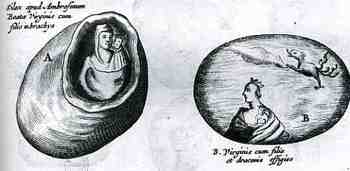
    The people who made and recorded these discoveries were often more circumspect about what they were finding than their readers; sometimes not. Jean-Baptise Robinet (1735–1820) was a French naturalist, Jesuit-philosopher and encyclopediaist (best  known for his five-volume work De la nature (1761-8)) who found all manner of interesting and scientifically-divergent items in stone—eyes, ears, skulls and occasionally an entire body. Antoine J.D. d’Argenville at about the same time in the 1750’s also uncovered silhouettes of dressed human,  birds, cityscapes, trees and the like in stones, which seeped its recordings of the animate into receptive fantasies.
    1blog_oc_t_9_not_here_kircher_793
    But these durable micro- explorations in agate go back thousands of years, expounded by Pliny and some of the other ancients, who followed the origins of humanity back into the rocks. This was a popular idea for the origin of animate beings, propounding itself for centuries, even winding up in the bony lap of Leibniz of all people, who wrote that “men derive from animals, animals from plants, plants from fossils, which in turn derive from bodies that the senses and imagination represent to us as being totally dead and formless”. Stoners therefore held the seeds of the formation of the world; all things living, breathing, and not.

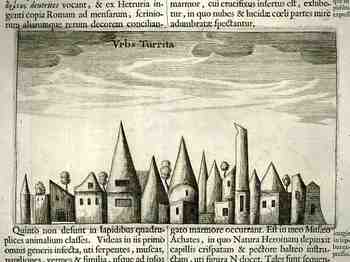
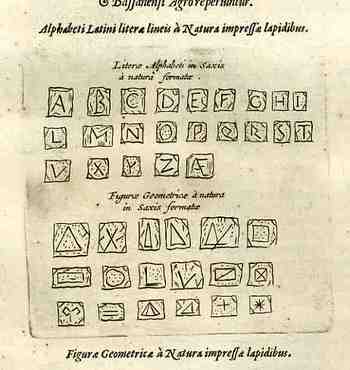
    Our own Athanasius Kircher, the definition of Polymathic ability and superior imagination was responsible for many such observations and discoveries. It seems to me that as much as Kircher gave, he took away, keeping ahead of his critics and the rest of the scientific community with tremendous output…people I think just couldn’t keep up with him. He found all sorts of things in stone: as early as 1619  he exhibited an image of   St. Jerome (in no less a place than the cave of the Nativity in Bethlehem!) that he found in agate. His Munduis Subterraneus (1661) is ahome to a wide range of these objects: quadrupeds of all shapes and descriptions, human full-length portraits, hands with jewels, and even the Virgin Mary and child. AS spectacular as these are there is always more: the magnificent cityscape (reproduced here) and the sublime discoveries of a full set of the alphabet and a series of 15 geometrical drawings, all naturally impressed in stone.
    1blog_oc_t_9_not_here_kircher_alpha

    Perhaps these men gave little more regard to the details in this stone than was necessitated by accepted theory; perhaps they added details to suit their observational needs, as they images were, after all, drawings of the susceptible and the fantastic, and were not photographs. Recording their record was as much open to interpretation as were the theories. I have no doubt that if you look hard enough at things you will at some point find what you are seeking. Only here it is by chance that these figures appeared, and not by the will of a divine creator placing a seed of potential in the stone.

    My five-year-old daughter, Tessie, asked me just the other day about where numbers and letters “came from”. She wanted to know “why are they here?”, which is a fabulous question with a long difficult answer. I do know though that they didn’t come to us from agate. 
  • Outsider Logic Series: the Humble Life vs. the Automatical Machine Age (?)

    JF Ptak Science Books LLC Post 306

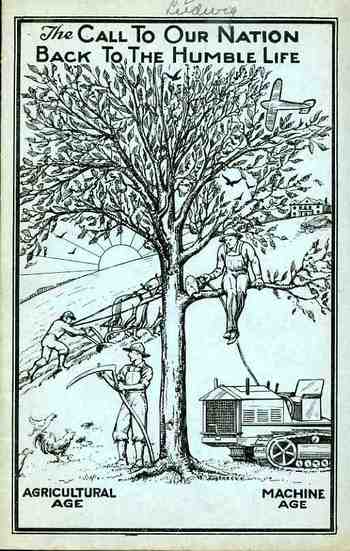
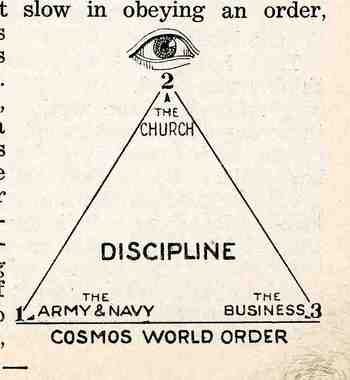
    1blog_oc_t_9_bizarree_closd798 “C. Ludwig”, the author of The Call of our Nation Back to the Humble Life a Sign in our Time of the Automatical [sic]Machine Age, published in St. Louis in 1935, has a somewhat impenetrable approach to a philosophy of development.  This of course is spotlighted quite brilliantly in the title of this work, especially –if you take quick notice–when you consider that the man in the tree with the electric saw is working at it like a cartoon character (unless the whole tree falls down and leaves him in mid-air on his special anti-gravity branch). Actually, I can’t spend the time with it, it is just too far into a personal, shadowy and self-anointing belief  system filled with paradox and the bizarre.  I’m really just after the pictures, which even though they are displayed here out of context, are indeed still out of context while in context.

    1blog_oc_t_9_bizarree_closd800

    The masonic-like all-seeing eye pyramid is another odd bit in a series of all-seeing-eye bits, none of which seem to follow the other and none of them make particular extended sense individually. There are five of them, and they seem to prove that 1+1+1+1+1 = 1.

    I could go on for some time about these singular illustrations, attempting to make graphical points for invisible reasoning in the text, but I won’t. I think that these stand quite well enough to represent the author’s straight-through-the-loop, singular, outsider-logic  reasoning.  In a way, they are of their own beauty.

    1blog_oc_t_9_bizarree_closd799

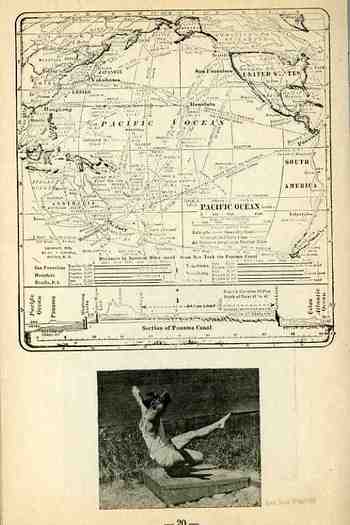
    (I just couldn’t resist this last one, featuring the Panama Canal and a balancing figure, having nothing whatsoever to do with the text or each other.)

    ·Posted by :

    ·in:

  • The “Tom Thumb”, Calves’ Foot Hair, Mrs May Wait, the Fridaire & General Foods Corp. Common Denominator: Jell-O.

    JF Ptak Science Books  Post 307

    As a vegetarian of 16 years living in a house of life-long vegetarians, the antiquarian recipe that I stumbled upon in a “Lady’s Book” (of 1885) called for scraping the hair from calves’ feet–it gave me consider pause.  But from such humble beginnings (like William S. Burroughs Naked Lunch grandfather’s small business bumping itself up and along to become IBM) are bigger things born.

    1blog_oc_t10_dessert802_2

    And that’s been the story of Jell-O, a product of extraordinarily modest and not-pretty means, morphing itself and the Postum Company over a relatively short period of time (from 1895 to1925) into the megamonolth:  the General Foods Corporation.  “America’s Most Famous Dessert” got its third (or better) start on life in Le Roy, New York, under the creative hands of Mr. & Mrs. Pearle B. & May Wait (true!), who took sugar, powdered gelatin and artificial fruit flavors to make a concoction May called “Jell-O”.  But her reach was none-too-grand compared to that of Frank Woodward, who bought the company from her and created the demand for this ‘food” and who ultimately created General Foods with it.  (Its an old story:  consumable and sellable product with no consumers:  Marlboro cigarettes started out as a specialized cig for “ladies” and failed; the same cigarette was then re-marketed as a testosterone-laden product and then succeeded beyond all wild expectation, killing millions of its consumers in the process.)  In any event Ms. Wait trumped another New York state resident, Charles Knox,  in the race to develop a pretty and tasty  granulated/[powdered gelatin desert mix.  “Knox’s Gelatine”, originally made with calves’-foot jelly, was a little earlier to the table than Mrs. Wait, but failed to properly develop his product. It also suffered its own “purity” by not having any sugar in it. 

    Jello

    Jell-O-like bits have been around for a long time—but creating this sort of  gelatin (and “delicacy”) was a time-consuming task, involving the above-mentioned scraping unpleasantness, long boiling of the scraped stuff, filtering and so on to achieve—once cooled and dried—sheets of clearish delight that would look like what we call Jell-O.  But as I said the history of this product is quite extended—for example there is a long Renaissance culinary sculpting history of gelatin, but that piece of history still awaits its vast chronicler.  And illustrator:  evidently the molds for the gelatin product were extensive and the creativity for its use boundless, with castles and communities and portraits being produced out of.  The use of gelatin as a binder and preservative is actually ancient, and finds itself at least as far back as ancient Greece. 

    Our Tom Thumb connection with Jell-O  comes in the form of Peter Cooper, who   is generally seen as the American manufacturer of the first steam locomotive (The engine ran successfully on the Baltimore and Ohio Railroad on August 28, 1830), and who (around 1845) was in fact very interested in processing different sorts of gelatin consumables in addition to creating the first locomotive, and also running for the presidency and many other things…the gelatin creation had to wait.

    But the broadest brushwork on the developing history of Jell-O is that same brush that basically closed the American West and ended the cattle drive and most of the great Lonesome Dove cowboy traditions.  No, not barbed

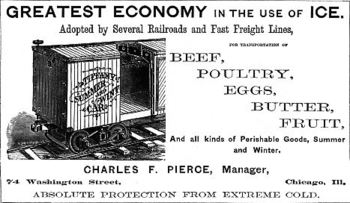
    Refrigerator_car wire—it was refrigeration.  The creation of refrigerated railroad cars meant that all that the cowboys needed to do was get their stock to a nearby railhead and modern technology would do the rest, the RR pulling the slaughtered stock to St. Louis or (more likely) Chicago, thus ending the Long Drive.  The home refrigerator enabled the creation of Jell-O much as we see it today.    (And I say that with as little inflection as possible, as hundreds of millions of people have enjoyed this sugary dried gelatin ensemble, so it must work to the good somewhere, at least as a cheap sugar delivery system)

    Homer_muumuu

    As for me, if it isn’t a liquid, I don’t want the food on my plate to continue on in its own expectant dance after I get through moving it myself. I also don’t want my food to behave like the coming-to-rest motion of a beloved (?) American TV icon.

    But that doesn’t mean that I can’t take a moment here to stop and appreciate the bizarre connections between Jell-O and the Outside World. 

    Visit the Jell-O Museum/Gallery HERE.

    ·Posted by :

    ·in:

  • Ships in the Skyline, Part V: Cities INSIDE of Ships

    JF Ptak Science Books  Post 308       

    1blog_oc_t10_ship_in_skyline_deta_2

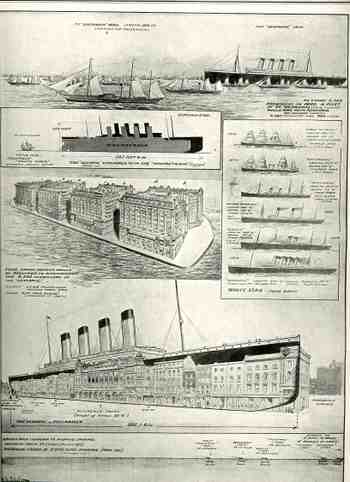
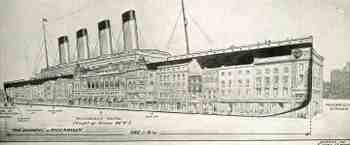
    In trailing some loose associative memories of ships being compared to skylines, and seeing he ships placed in the skylines, I was able to find four good samples.  This one is, in a way, the negative version of that, showing cities placed inside of the ships, the ship in this case being the White Star triple-screw Olympic–which at the time was the largest ship ever launched at 882′–and the image found in The Illustrated London News for 22 October 1910.  It was done in celebration of the launch of the ship from Belfast, which was also the heaviest transference of weight (27,000 tons) from land to water in history.   To illustrate the ship’s massiveness the picture editor placed a row of hotels and buildings bounded by the eastern end of Burlington House to the very edge of Piccadilly Circus, with the Piccadilly Hotel (height 77′ 6″) right there in the middle under the first three smoke stacks. 

    1blog_oc_t10_ship_in_skyline_deta_3

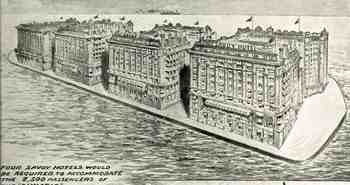
    The second image relates the passenger capacity of the Olympic to the Savoy Hotel, showing a floating platform with four of these massive hotels.  The Illustrated London News was making a real point about the Olympic and the Savoy, because at around this time smaller ships were referred to as “floating hotels”; the Olympic, on the other hand, was much more than that–it was four floating hotels, and big ones, at that, and the image captures that perfectly. 

    Truth be told, I really like the image of the floating hotels out of context and without a caption–it really makes the case for the idea of a Floating City in a Floating World. 

    1blog_oc_t10_ship_in_skyline803

    [CLick for a larger, clearer image]

  • “Getting it” Backwards: Sanctorius’ (1676) Medical Invention, Spongebob, and the Alaskan Bull Worm

    JF Ptak Science Books   Post 309

    Alaskanischer_stierwurm
    By virtue of my children I think that I can safely say that I am now a stone-cold expert on Spongebob Squarepants, and if I tried just a little I could use it to reference just about anything. (This is also the case with The Simpsons, though I really didn’t need much excuse from my older daughter, Emma, who was/is a fan, to watch them.)  In one episode of SBSP, Sandra “Sandy” Cheeks, the underwater deep-sea-diver-outfitted “land” squirrel and close friend of SB, decides that since she is from Texas she can do anything, and attempts to wrestle the enormous Alaskan Bull Worm which has invaded their home of Bikini Bottom and taken her tail.  (I’m horrified to find that someone has transcribed the hundreds of SB epsiodes, god help them. And just for the record and to show I might be as removed as these folks, I’ll point out that in addition to getting most of Sandy’s tail, the worm also eats the “Welcome to Bikini Bottom” sign, a wheelbarrow, the homework of two children, the butt of a fish (twice) and most of SpongeBob’s pineapple house. There.)  So yadda yadda yadda she finds herself wrestling the worm in a cave against SB’s ignored and interrupted warnings.  She subdues the huge beast, and announces her victory.  SB gently corrects her, saying that what she was wrestling was just the tongue of the worm, and that the cave was its mouth, and that it was waaaaay bigger than Sandy had ever imagined.  The whole thing dawns on her slowly, [Sandy: “Ohhhhhhhh. This is the tongue, and… (trailing off) the whole thing… is the… worm. (freaks out) RUN FOR YOUR LIFE!!! “(she and SB sprint away; the worm growls angrily, chomps down, and chases after them)]   SO.  So Sandy just misses the big picture that was staring her square in the face, concentrating on the one detail she thought she could recognize and handle.

    From recognized oversight comes epiphany!

    1blog_oc_t11sanctorious811

    And such is the case with my reaction to the wood engraving here, concentrating on the use of the apparatus and how out of proportion its physicality was with its function.  And until I started reading about it I missed its monumental importance completely, concentrating as I was on the thing I thought I knew. 

    I was having a wide swipe at a man who is seen by nearly all authorities as being the founder of the physiology of metabolism.  The man is Santorio Santorio* (1561-1636, and who was also known as Santorio Santorii, and Sanctorius of Padua), and the image is from his Medicina Statica, or, rules of Health, in eight Sections of Aphorisms…English’d by J[ohn] D[avies], printed in London for John Starkey in 1676. (this is a reprint of the fourth edition of 1737, following the first edition of 1614.)  For many years Sanctorius weighed and measured just about everything that went into his body and everything that came out of it.  One of the principle instruments used by him in this process is the famous weighing chair, which was (seemingly) laboriously suspended from a device in the floor above the dining room.  the net effect of all of this (as we see in the illustration) was that, after eating began, once the chair touched the floor it was the signal to stop.

    What I was missing in this, what I didn’t put together and what I didn’t ask myself was where did this apparatus fit in the history of this sort of thinking?  The more substantial question yet was what other sorts of machines were employed in determining metabolism in humans?  The answer to the second question is “none”–this is the first time that a machine was used in this sort of analysis. Actually, it is the FIRST man-machine interaction of any sort in the history of medicine. And the answer to the first question is that this was the first time that data had been collected and analyzed  such a longitudinal and coherent fashion. 

    So I missed the whole thing, making fun of this enormous piece of machinery that would be used to tell someone when to stop eating, wrestling the Alaskan Bull Worm’s tongue in my own little cave.

    * According to the great bibliography of Garrison and Morton on the history of medicine, “Sanctoris was the founder of the physiology of metabolism.  He introduced into physiology exact methods of measurement, pulse counting, temperature determinism, and weighing”.

  • A Short Note on Kit Carson: Heroic Beginning and His role in the Murder of the Navajos

    JF Ptak Science Books   Post 310


    Kit Carson (1809-1868) was an iconic American frontiersman and guide, a brevetted general as a result of soldiering in two wars, and lived with extreme fame for twenty-five years. He explored and was a guide through most of the western states and territories, and served a very significant role as a scout for the first three (1843-1846) of J.C. Fremont’s enormously important expeditions across the west, covering wide areas of the western country along the Oregon trail, across the Great Basin, through the Rockies and through the arid regions. As a guide with Stephen W. Kearney (1846-1848)

    Navajo

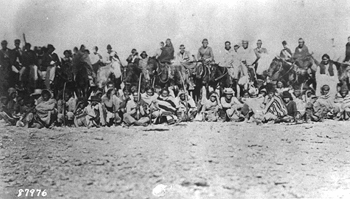
    At the end of the war, Carson returned to  New Mexico and took up ranching. By 1853, he and his partner were able to drive a large flock of sheep to California, where gold rush prices paid them a handsome profit. This same year  Carson was appointed federal Indian agent for Northern New Mexico, a post he held until the Civil War imposed new duties on him in 1861. Carson played a prominent and memorable role in the Civil War in New Mexico  He helped organize the New Mexico volunteer infantry, which saw action at Valverde in 1862. Most of his military actions, however, were directed against the Navajo Indians, many of whom had refused to be confined upon a distant reservation set up by the government. Carson’s eroding and toxic use of sheer military might and starvation tactics eventually brought the Navajos to submission, and he was not beyond bearing shock-and-awe techniques against women, children and the elderly. He began a military campaign against the Navajo Indians and their supposed impregnable Masada in the gorgeous Canyon de Chelly in the vicinity of Four Corners, Arizona. After revealing the myth of this fortress he waged a long and bitter campaign to bring the Indians—under any of (their) cost—to a reservation at Bosque Redondo, 200 miles away. After surrender, the Navajos, under Carson, were marched to their new lands, with fully one third of the 8,000 of their number dying along the way, succumbing to cold, malnutrition, incident raids by rival tribes, exhaustion and sheer brutality by the U.S.troops, who certainly treated the Indians as less than human. The experiment at Bosque Redondo was a total failure, with the Navajos suffering ever greatly at the hand its General Carleton, the imperious and misguided post commander. The Navajos were returned to their original lands 1300 days and 3000 lives later.

    Carson would survive this debacle by a few years, dying on a pile of buffalo robes at his doctor’s house, just a month after his wife succumbed to complications of childbirth. He was 58, and lived a little ten years too long.

  • No Room for Eden–Annotation of John R. Cash’s “The Man Comes Around”

    JF Ptak Science Books   Post 311

    Cash_2( No Room for Eden —notes on Johnny Cash and the biblical and classical references in the text of “The Man Comes Around”, by John R. Cash (2002).

    This song was written by Mr. Cash for his American series (IV), and released in 2002.  This is a simply superb series of recordings, mostly coming from Mr. Cash’s final time.  The quality of his voice and his humanity is astonishing.

    Listen HERE (with static images).

     *** = annotation

    [Cash’s lyrics in italics.] 

    The Man Comes Around

    “And I heard, as it were, the noise of thunder:
    One of the four beasts saying: “Come and see.”
    And I saw.
    And behold, a white horse.

    ***“”And I saw when the Lamb opened one of the seals, and I heard, as it were the noise of thunder, one of the four beasts saying, Come and see.  And I saw, and behold a white horse: and he that sat on him had a bow; and a crown was given unto him: and he went forth conquering, and to conquer.”–Revelations 6:1-2 On  the opening of the First Seal (one of the four beasts) bids the Christ to come and see what was inside; the conquering figure on the white horse being Jesus, the white horse being purity of faith, etc. ***Seals referring to the 7 seals binding the great book in Revelations

    “There’s a man goin’ ’round takin’ names.
    An’ he decides who to free and who to blame.
    Everybody won’t be treated all the same.
    There’ll be a golden ladder reaching down.

    *** Jacob’s ladder is probably the most famous ladder in symbolism. Its story is found in the Old Testament [Gen 28:10-17]. Jacob, fleeing from the wrath of his brother, lay down to sleep with a stone for a pillow. During the night he dreamed that he saw a ladder or stairway reaching up into the heavens upon which were angels ascending and descending. At the head of the ladder was God the Father confirming the Patriachal blessing upon him and promising to protect him on his journey….

    St. Augustine  wrote that Jacob’s ladder represented the Church and the angels the patriarch saw ascending and descending upon it represented the evangelists or preachers of the Gospel ***


    When the man comes around.

    “The hairs on your arm will stand up.
    At the terror in each sip and in each sup.
    For you partake of that last offered cup,
    Or disappear into the potter’s ground.
    When the man comes around
    .

    ***welcome to the apocalypse, friends; drink from the everlasting or disappear into an unmaked grave in the pauper’s burying ground***

    Hear the trumpets, hear the pipers.

    ***7 seals, 7 angels given 7 trumpets rev 8:1

    One hundred million angels singin’.
    Multitudes are marching to the big kettle drum.
    Voices callin’, voices cryin’.
    Some are born an’ some are dyin’.
    It’s Alpha’s and Omega’s Kingdom come

    .***the beginning of the end, trumpets of the angels revealed in the first seal calling to the faithful or not so…***

    And the whirlwind is in the thorn tree.

    ***no whirlwinds or thorn trees in the B (thorn bushes, etc) Judgment approaches.

    The virgins are all trimming their wicks

    .***referring to trimming and caring for a torch,and later to the economy of a lamp. J refers the virgins to their chaste ways***

    The whirlwind is in the thorn tree.
    It’s hard for thee to kick against the pricks

    .***referring to kicking clods/dirt from an early sort of plow, a prick. Straight and narrow, the righteous way…

    Till Armageddon, no Shalam, no Shalom

    ***Armageddon: the geographic location given in the book of Revelation (16:16) for the climactic battle between Christ and Antichrist, with Christ’s victory ushering in his thousand-year reign on earth. Named after the hill near the town of in Megiddo,  Palestine, which due to its strategic location overlooking major military and trade routes was the site of many ancient battles.

    ***Shalam Acquaint now thyself with him, and be at peace (shalam)”; Psalms 4:8. also, to complete, or to finish. (Isaiah 33:1), and shalam Psalms; Shalom, Hebrew, peace. Perhaps Shalam was meant as “Shalaam”, which in Arabi cmeans “peace”.

    Then the father hen will call his chickens home.
    The wise men will bow down before the throne.

    And at his feet they’ll cast their golden crown

    .*** Crown The Greek word is stephanos, a garland of victory. He had worn the crown of thorns and was awarded the crown of glory j. John 19:01

    When the man comes around.

    Whoever is unjust, let him be unjust still.
    Whoever is righteous, let him be righteous still.
    Whoever is filthy, let him be filthy still
    .

    **** Rev 22:11 “He who is unjust, let him be unjust still; he who is filthy, let him be filthy still; he who is righteous, let him be righteous still; he who is holy, let him be holy still.”

    Listen to the words long written down,
    When the man comes around.

    Hear the trumpets, hear the pipers.
    One hundred million angels singin’.
    Multitudes are marchin’ to the big kettle drum.
    Voices callin’, voices cryin’.
    Some are born an’ some are dyin’.
    It’s Alpha’s and Omega’s Kingdom come.

    And the whirlwind is in the thorn tree.
    The virgins are all trimming their wicks.
    The whirlwind is in the thorn tree.
    It’s hard for thee to kick against the pricks.

    In measured hundredweight and penny pound.

    ***hundrewweight is 100lbs; 20 pennys to the ounce…all things measured large and small…

    When the man comes around.

    ****

    And I heard a voice in the midst of the four beasts,
    And I looked and behold: a pale horse.
    And his name, that sat on him, was Death.
    And Hell followed with him.

    End.

     ****  And I looked, and behold a pale horse: and his name that sat on him was Death, and Hell followed with him. And power was given unto them over the fourth part of the earth, to kill with sword, and with hunger, and with death, and with the beasts of the earth. Rev 6:8 The next two verses from revelation:    9.   And when he had opened the fifth seal, I saw under the altar the souls of them that were slain for the word of God, and for the testimony which they held:  10.   And they cried with a loud voice, saying, How long, O Lord, holy and true, dost thou not judge and avenge our blood on them that dwell on the earth?

    Revelation, the last book of the Bible’s New Testament, is the only one which is an Apocalypse, in the sense of the Greek word for “revelation.” Its author, described in the title as “John the Divine,” has traditionally been identified with St. John the Apostle, who is believed to have written the book of Revelation during his exile on the Greek island of Patmos. 


    ·Posted by :

    ·in:

  • Lines that Closed the West: Wire, Rail, and Words

    JF Ptak Science Books  Post 314

    The story of the West getting filled up in the 1870s is a story of lines—railroad track, telegraph wires, barbed wire fences, and words on a page; big changes from disparate but related areas in technology and legislation, but when you looked at them from a distance and in the proper perspective, they all looked exactly  the same.

    Barbed_wire

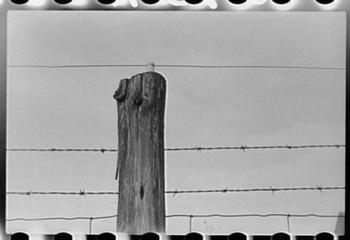
    The greatest of these lines may have been the invention of barbed wire in 1873, with Joseph Glidden, Jacob Haish and Isaac Elwood all managing to independently come upon the idea at about the same time.  What barbed wire brought to the West was control and settlement.  Prior to barbed wire there was open range grazing of cattle and extensive cattle drives, mainly because there was no fencing. There were also few farms due to this sort of grazing—the only thing a farm was here was in the way, and there was no recourse for the farmer to protect his

    lands from a grazing herd.  There was no fencing because there were no materials for the fence.  Fencing was made almost entirely with lumber and stone, and on the treeless plains and the vast non-New England tracts of land, it was simply an impossible task.  The introduction of barbed wire changed all of this very quickly, with thousands of miles of new fencing strung in the 1870’s alone.  Fencing meant control, restriction of the use of land, of access to water, and to a way of life.  It also meant that the farmer was now free to make a claim at a way of life on the plains, beginning a torrent of settlement and farms.

    Blogludlow

    Another big line element of settlement were the texts (lines-on-paper)  of three major acts of legislation which, over a period of just sixteen years, were responsible for moving more people than just about anything else in American history. The first of these was the Homestead Act of 1862. This was a revolutionary concept, legislated in 1358 words, effectively turning over 270 million acres, or about 8 percent of the country, of public lands to private citizens (“actual settlers of the public domain”).  A claim could be made for a farm of 160 acres, for free, provided a structure was built on the land and it was maintained for five years.  One could buy the parcel outright for $1.25 an acre as well.   Next was the Desert Land Act of 1877 which opened drier lands, selling 640 acres at $1.25 an acre with three years to pay, so long as the land was irrigated by the end of the three years.  Land that was deemed “unfit for farming” was sold to those who might want to “timber and stone” (logging and mining) upon the land with the third major piece of legislation, the Timber and Land Act of 1878. The act was used by speculators who were able to get great expanses declared “unfit for farming” allowing them to increase their land holdings at minimal expense.  The Homestead Act alone accounted for the creation of almost 400,000 farms in the West by 1890.  Farms meant parceling out land, “settling” it, having people on it, waiting when they weren’t working. 

    Blogpeopling_upmillions_acres

    Settlement was dramatically increased by the written and published promises and speculations of mineral wealth—not necessarily just by the introduction of miners, but by securing the lands from and removing its Indian owners.  The Custer expedition into the Black Hills in 1873, for example, reported some hope for finding gold in the sacred mountains of the Sioux. Thousands of miners responded to possibility of wealth, and Custer was again dispatched to secure safety for them in the restricted lands.  This in turn lead to more settlers and coincidentally to the debacle of the Little Big Horn, which was the beginning of the end of the Siouian control over vast amounts of land.  From prospectors to protection to conflict, ultimately making land more available for more people. 

    The spread of the railroads was also an enormous settlement factor, with the number of miles of track being laid in Texas and the Great Plains doubling in just 5 years.  Not only could you get West more easily, and quickly, and with less pain and suffering, but you could also be much more easily re-supplied.
    Blogwestward_the_course_2


    Telegraph wires tripled, making it easier to control events:  and this means from being able to respond to Indian attacks more quickly to ordering boxes of nails, or beer, or shipments of newly-invented canned food. 

    One of the greatest and most infamous of these lines-controlling-the-West concept were the pieces of legislation and agreements and other legal and binding documents, between the U.S. government and every Indian tribe in the U.S. Promises were made to the Indians and of course not one of these treaties were ever actually realized.  It was these written lines that even the greatest of Indian scouts could not track, mainly of course because they didn’t mean one bloody thing.  (The idea of words in a book, lines of words, being looked at as ‘tracks” to Indians belongs to Mr. Larry McMurtry, whose greatest of all Indian scouts, the Kickapoo Indian named Famous Shoes–from the Lonesome Dove tetralogy–could not ultimately track the words in a book as he was able to track everything else that lived in nature. Words/tracks of a treaty would’ve been ever more so impossible.)

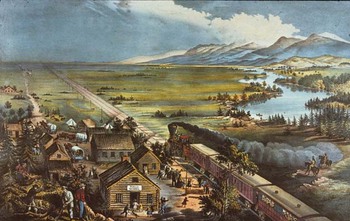
    Of course in the end all of the lines applied and enabling  the closing of the West were personified by smaller and more precise lines:  maps.

    ·Posted by :

    ·in:

  • The Color Blind Geometer and the Color-Coded Euclid

    JF Ptak Science Books Post  315

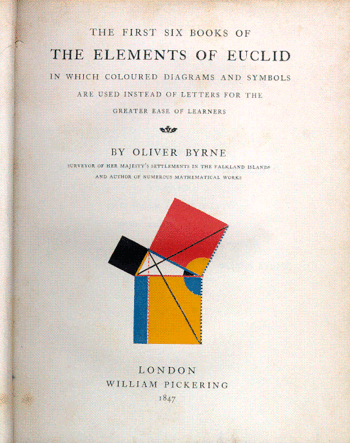
    Here’s a bit of a reach, a very-long-distanced connection, between to unrelated items sharing a similar design and operating at the zenith and nadir of color theory.  The first work is the great and nearly unusable work by Oliver Byrne on the first six books of Euclid (The First Six Books of Euclid in which coloured diagrams and symbols are used instead of letters for the greater ease of readers…, printed at the Chiswick Press by C. Whittingham for WIlliam Pickering in 1847).  The book is, well, unusual and probably not at all useful.  Bryne replaced all of the algebraic notation, identifying letters and almost all of the descriptive text with color and color codes, leaving Euclid mysterious, hidden, awkward, impervious, and, yes, beautiful.  as a matter of fact this work presages the cubists (and especially Piet Mondrian) by 60 years, and all by accident. 

    1blog_oc_t10_euclid_color_blindness Blogeuclide_byrne_2

    Augustus De Morgan, mathematician and logician, wrote a very highly critical book A Budget of Paradoxes in which he describes hubbub, fakirs, frauds, perpetual motion machines, squaring the circle efforts, millstones and other useless books in the maths, and in here he sniffily dismisses Byrne’s work. At best, to De Morgan, the Byrne book is “curious”. But useless and curious, as I have seen many thousands of times, does not mean that it can’t be attractive and beautiful, and the Byrne book is probably the leading candidate in the Bad & Beautiful category..In Victorian Book Design McLean calls the Byrne book “…one of the oddest and most beautiful books of the whole century…a decided complication of Euclid, but a triumph for Charles Whittingham [the printer]”.  (I should point out that the Chiswick press returned to Euclid again in 1893, publishing Gilbert Redgrave’s address on Erhard Ratdolt, who was the first scientific printer in history and also the first publisher of Euclid in 1482. See HERE for the digital record of Redgrave.)

    Curiously the Pythagorian theorem illustrated on the title page of Byrne’s book seems at a fast glance to appear on the front cover of Phillip S. Newton’s Color Blindness, Suggested Aids for Correcting 1946.  It really isn’t all that close except by fleeting recognition, but close enough to stop me in my tracks, to make me think of where my copy of Byrne was and put them side by side.  Curious doubly because in Byrne’s case color is used exclusively in place of numbers and words and is totally and completely dependent upon it. In Newton (who also has the same name as Sir Isaac, author not only of the Principia but also the second-best book of the 18th century, Opticks) we find the confusion of color and plans to correct the color vision, and in a twisty way, on the opposite end of the interests of Byrne. 

  • When Things ARE Better in Glorious Black & White: Color Detonation and the Invention of *More* Primary Colors, 1942

    JF Ptak Science Book Post 316

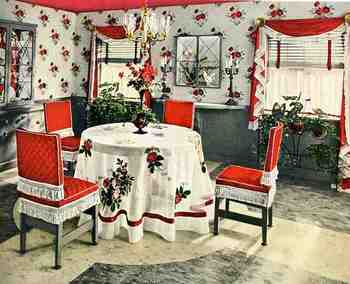
    Well: this is a variation of yesterday’s post on the two opposite edges of color in oddly-applied scientific/technical manners. In unwittingly responding to the question “when is color-use bad?”, the answers were found in these room decorations from 1942, all of which come from a pamphlet entitled Ideas for Old Rooms and New, extracted from the mind of  Hapel (?) Dell Brown.  It is a tidy book with ideas that are anything but tidy;and  as you scroll down you’ll see that the room solutions suggested by Hapel Del are anti-tidy; clutterous (no, not a word but could be).  Everything about these creations speaks to the annihilation of visual resting places; everything seems to be an affront to the concept of causal emptiness.  The weird thing is that there aren’t very many objects in these rooms at all (at least comparing these rooms from where I’m sitting)–the visual complaints seem all rocketing from the abuse of colors found in the fabric of the furniture and walls and floors and window treatments.  The eye gets no rest–and as a matter of fact, the cones of the eyeball are impaled on the rods as a result of the author/decorator  desperate attempts to invent three more primary colors. 

    00blogoct_14color848

    Believe it or not we don’t really get the full flavor of the color cacophony because the floors in these picture look sort of benign, fading away into themselves–which they are not, according to  the description in the text, because they are all high-gloss linoleum rolls or tiles (“efused [sic] with deep wondrous color”.  And that means not only are these floors adding sheen and color to the rest of the incredibly colorful–an effect fairly lost in these photos–they are also cold.

    One thing that I haven’t pointed out in this peon to syrupy/pastel-y/techno-gelatinous-chromodrama is that they were all done in response to a re-decoration of a perfectly nice-looking house, with all of the former “bland” colonial-style rooms presented in glorious black and white.  I’d rather live in Maison Noir than in this happy nightmare.

  • What Victory Looks Like: the Battle of the Somme and the Thin Line Between Winning and Losing

    JF Ptak Science Books  Post 317

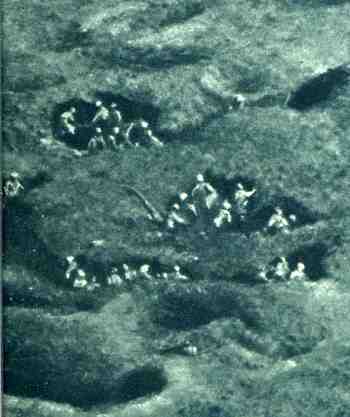
    In a play on the concept of the Powers of Ten, I had a look at a photograph depicting the French victory at the Somme; or was it a British victory?  Or German, via the lure of the others to a semi-victory?  Its hard to say who won, or if there really was a winner.  The Battle, which looks to me to be a sub-war within the war, occurred over the period of July through November 1916.  When the smoke settled, there were some 1.5 million casualties on both sides.It has long been held that the battle really was won by someone, the British, the French; but there was so little that was accomplished by the action that there probably wasn’t a winner, just losers. 

    00blogoct_14somme850_2

    And big losers, at that: Great Britain, Canada, Australia, New Zealand, Ireland, South Africa and Newfoundland lost 419,654 casualties, with 95,000 killed; the French lost 204,000 casualties and 50,000 killed.  That made a total of 623,000 casualties and 146,000 killed for the allies; Germany lost 465,000 casualties and 164,000 dead.  The advances made along the battle front went a few miles one way and then the other along a 12-mile stretch of battlefield, which four lives were traded for every inch gained along that porous front.

    The first image here (above)  is a very sharp detail from the overall picture published in The Illustrated London News for 6 January 1917, representing about 1% of the entire photo

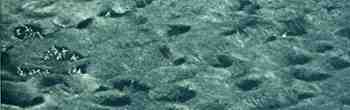
    The next image places the micro-detail in more context; this detail is itself about 5% of the main image, which is found just below this one.

    00blogoct_14somme849_2

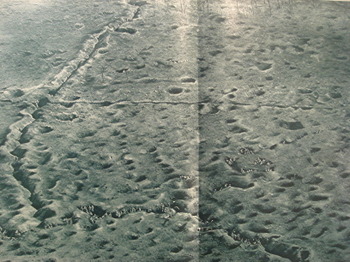
    The overall image from which these two details are removed is below. In turn, this large image is but a small detail of the greater overview of the battlefield, making up perhaps a few percent of the field of operations. 

    I’m trying to get a feel for the enormity of the battle, but I really can’t, not even via powers of ten, manipulating the idea of orders of magnitude.

    In one last try, I hypothesize that the 1.5 million casualties could not be displayed in 10 of these large images.  .

    That wouldn’t look like victory at all. 


    Ballistics_123


Recent Posts

Archives

Categories