JF Ptak Science Books Post 310
Kit Carson (1809-1868) was an iconic American frontiersman and guide, a brevetted general as a result of soldiering in two wars, and lived with extreme fame for twenty-five years. He explored and was a guide through most of the western states and territories, and served a very significant role as a scout for the first three (1843-1846) of J.C. Fremont’s enormously important expeditions across the west, covering wide areas of the western country along the Oregon trail, across the Great Basin, through the Rockies and through the arid regions. As a guide with Stephen W. Kearney (1846-1848)
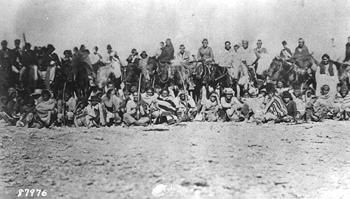
At the end of the war, Carson returned to New Mexico and took up ranching. By 1853, he and his partner were able to drive a large flock of sheep to California, where gold rush prices paid them a handsome profit. This same year Carson was appointed federal Indian agent for Northern New Mexico, a post he held until the Civil War imposed new duties on him in 1861. Carson played a prominent and memorable role in the Civil War in New Mexico He helped organize the New Mexico volunteer infantry, which saw action at Valverde in 1862. Most of his military actions, however, were directed against the Navajo Indians, many of whom had refused to be confined upon a distant reservation set up by the government. Carson’s eroding and toxic use of sheer military might and starvation tactics eventually brought the Navajos to submission, and he was not beyond bearing shock-and-awe techniques against women, children and the elderly. He began a military campaign against the Navajo Indians and their supposed impregnable Masada in the gorgeous Canyon de Chelly in the vicinity of Four Corners, Arizona. After revealing the myth of this fortress he waged a long and bitter campaign to bring the Indians—under any of (their) cost—to a reservation at Bosque Redondo, 200 miles away. After surrender, the Navajos, under Carson, were marched to their new lands, with fully one third of the 8,000 of their number dying along the way, succumbing to cold, malnutrition, incident raids by rival tribes, exhaustion and sheer brutality by the U.S.troops, who certainly treated the Indians as less than human. The experiment at Bosque Redondo was a total failure, with the Navajos suffering ever greatly at the hand its General Carleton, the imperious and misguided post commander. The Navajos were returned to their original lands 1300 days and 3000 lives later.
Carson would survive this debacle by a few years, dying on a pile of buffalo robes at his doctor’s house, just a month after his wife succumbed to complications of childbirth. He was 58, and lived a little ten years too long.