A Daily History of Holes, Dots, Lines, Science, History, Math, Physics, Art, the Unintentional Absurd, Architecture, Maps, Data Visualization, Blank and Missing Things, and so on. |1.6 million words, 7500 images, 4.9 million hits| Press & appearances in The Times, Le Figaro, Mensa, The Economist, The Guardian, Discovery News, Slate, Le Monde, Sci American Blogs, Le Pont, and many other places… 5000+ total posts since 2008.
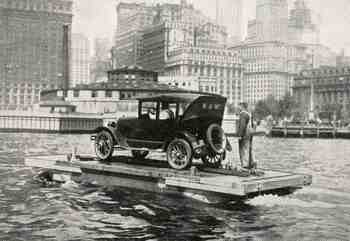
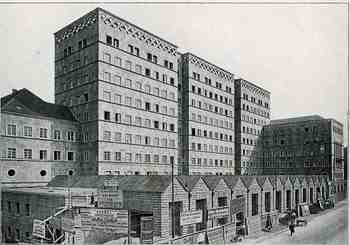
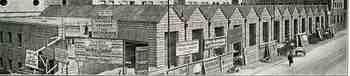
It is unusual in my experience to stumble upon three unusual, found-art images (as in the three below) that are found on one page of a magazine. In this case, it is the Illustriete Zeitung (Leipzig), issue 4299 (page 178) for 1915, and the three photographs are all quite atonal, somehow–they’re just not quite “right”, and all perhaps for different reasons.
The first image shows this unusual private ferry in New York City harbor–how this made any sense, I don’t know, especially since that water is pretty choppy and this vessel looks not terrifically seaworthy. The passenger (or driver at least) and the boatman are also very, very straight! I honestly just don’t know anything about single-car ferries in the harbor so late in the game as 1915.
I’m not sure why this image strikes me as being so peculiar in the second image–perhaps it is simply the retreating perspective, or the fact that it looks like a drawing, or the placards along the construction fence at the bottom of the photo; or maybe its the only solitary-looking figure set against all of those (strangely opened) windows. Whatever it is, that is odd or somewhat “off”, I like it.
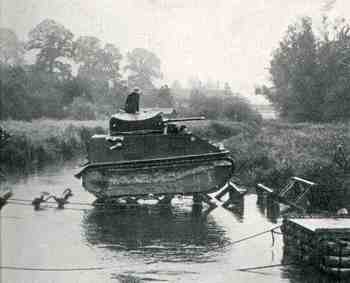
The third image is just quite and odd. Is that bridge portable and expandable? Is it actually supporting the tank and not failing? It is just a flat-out uncommon composition.
Perhaps the unifying factor here is the very apparent “quietness” of the pictures, and their solitude, even in the midst of the NYC harbor.
I’ve made several posts about Blank and Missing People and Empty Things which seem to me—having had long exposure to images over the last 30
years—to be quite unusual in the history of popular-published prints.
This may actually be a simple corollary to a wider category of Blank
Things, or Missing Things. Like Dark Matter. Or white, open, blank
spaces on early, honest, maps. (And this may be part of another larger
story on The Spaces in Between, (a concept in German known as Zwischenraum), but that’s another story, identifying where the missing stuff might actually “be”. Like the idea of “negative space”, or unused space, in, say, a Zen painting, or the sue of quiet in a musical composition–generally, it is a period of space or transition in thought, the distance between ideas….)
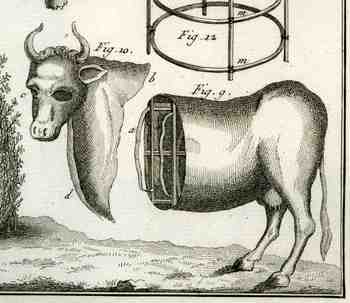
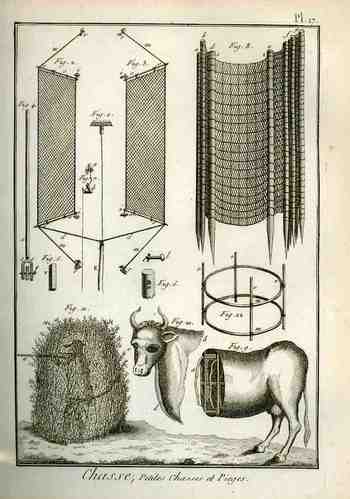
Since it really is so unusual to bump into these images I’ll just make a quick post on this one–it is simply (in a not-so-simple way) an illustration of a cow-blind from the wonderful and problematic masterpiece of Abraham Rees’ Encyclopedia, this print being completed in 1812. I should point out that the hunters–who would level their muskets through the empty eye socket–are not hunting cows; I’m not aware of what they would be hunting, but I know that it wasn’t Bessie. So the image is really just a relatively mundane hunting tool, though pretty elaborate, set among other hunting tools–there is nothing mundane whatsoever about its presentation, though.
I’ve felt that a great history lesson for school kids would be to make them keep a diary for some other kid from some other time, introduce them to the minutiae of life from another time and perhaps another place. With some guidance they could make interesting entries in their diary for, say, 15 June 1897, writing about chores, the daily schedule, what they studied in school, how they were dressed, how they got food on the table and kept the house clean, how they would spend 25 cents, what they would see from some given vantage point, and on and on. This could take place in their very own home town; it could be multi-generational, requiring them to talk to the scary white hairs, or it could reach far back into history and be of an entirely different place altogether. After they were assigned a particular place in time and space, you could give the kid subtle hints, like this one (below), asking them what they thought it might mean by dialing the phone number 200 80 in Warsaw in 1941. And what did that pair of lightning bolts mean, anyway? I think that once they were made to figure it out for themselves, as though they might’ve been there, and then could record their feelings and observations in a diary might actually bring history to life (especially once they had their “holy crap” (and probably worse) moment at what these numbers implied).
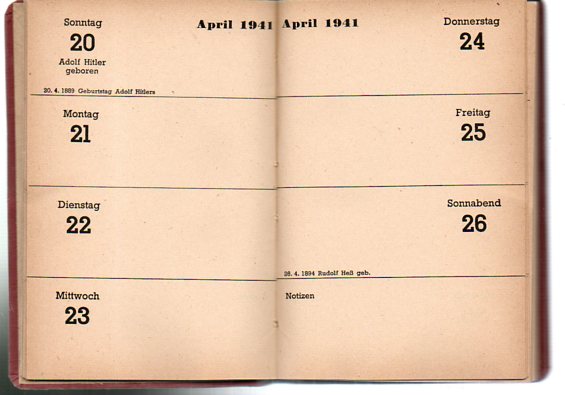
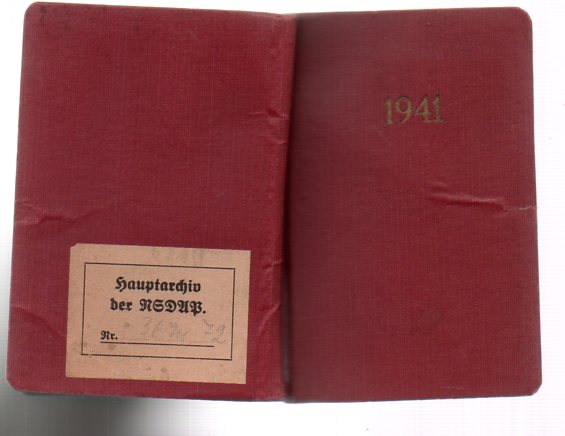
This is one of the ideas that came home again uncovering this odd booklet, which is a Nazi diary for those stationed in the Generalgouvernment (Tascehnjahrbuch 1941 fuer den Deutschen im Generalgouvernement) , for the year 1941. The General Government (or more fully the Generalgouvernement für die besetzten polnischen Gebiete) was one administrative section of occupied Poland, the country being divided in 1939 after the German invasion of 3 September 1939, with the western section being retained by the Germans and the Eastern given over to occupation by the Soviets via the Non-Aggression pact between the USSR and Germany.
This looks like an every day diary for the period, except for the Nazi (or NSDAP) regalia and German imprint of Generalgouvernment in Krakau. And, all of the annotated highpoints of the year for the most overly voracious parts of German militarism as well as for the hotpoints of Nazi history. Hitler, (above) Goering, Goebbels and other leaders’ birthdays are highlighted, not to mention seminal points in the development of the Nazi party and party-adoptees (Richard Wagner has a number of entries for suggested celebrations).
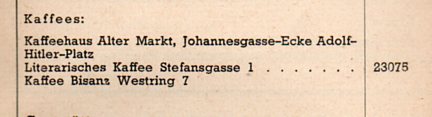
There are also helpful directories in the back pointing to any number of cafes located in a growing number of “Adolf Hilter Platz’s” throughout Poland (including three in Radom), as well as fares for the use of the railway and postal system.
We also see the following telephone number: 23075. That’s for the Literarische Kaffee Stefansgasse I, Krakau. This is the location that the Reichsminister and administrator Hans Frank (about whom we’ll read inb a moment) decided to hold a chess tournament in 1941, to satisfy his own need for chess while freshly in the pursuit of the murder of millions of people.
‘Frank was extremely interested in chess. He not only possessed an extensive library of chess literature but was also a good player, and he even “received” the Ukrainian chess master Bogoljubow at the castle. On 3 November 1940 he organized a chess congress in Cracow. Six months later he announced the setting-up of a chess school under Bogoljubow and the chess master Dr Alexander Alexandrovich Alekhine, and he visited a chess tournament in October 1942 at the “Literary Café” in Cracow.”–Hans Frank (subtitle: Hitlers Kronjurist und Generalgouverneur) by Dieter Schenk (Frankfurt am Main, 2006) “and quotes a reference to chess on page 177 (given below in our translation)…”[Source: Chesshistory.com., here.]
For the record, the Generalgouvernement was proclaimed in October 1939 just after the invasion of Poland and included most of what was left of Poland, which was gone again, barely 20 years after it returned to the map following WW1. In March 1941 Hitler made a decision to “turn this region into a purely German area within 15-20 years”. He also explained that “Where 12 million Poles now live, is to be populated by 4 to 5 million Germans. The Generalgouvernement must become as German as Rhineland”. Following the Wannsee conference of 20 January 1942, the Secretary of State of the Generalgouvernment, Dr. Josef Buhler (Warsaw # 222 05, a listed number in this book) began implementation if the Final Solution in Poland; by the time the Soviets entered and took control in late 1944, more than 4 million people—most of them Jewish—had been killed.
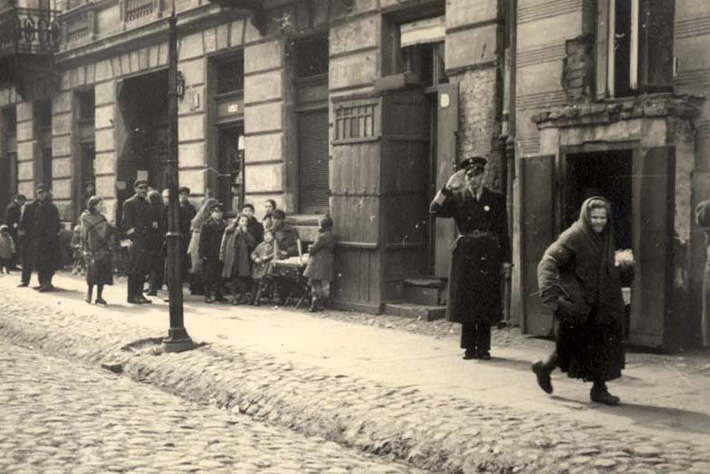
[Photograph of a Jewish policeman, from the Jost collection.1]
The man in charge of it all here in Poland, Hans Frank, has his photographic portrait as the frontispiece, and his number is listed, too. He was an horrendous butcher who was tried and convicted and executed for his crimes against humanity (at Nuremberg on 16 October 1946, aged 46–the decision of the court read, in part, that Frank was “…a willing and knowing participant in both the use of terrorism in Poland, as in the economic exploitation of Poland in a way that led to the starvation of a large number of people, also in the deportation of more than one million Poles as slave laborers to Germany and in execution of a program that had the murder of at least three million Jews. “). In a speech December 16, 1941, Hans Frank said:”We cannot shoot these 3.5 million Jews [in Poland], we cannot poison them, but we will take measures that will somehow lead to successful destruction; and this in connection with large-scale procedures which are to be discussed in the Reich, the Government-General must become as free of Jews as the Reich …..We must destroy the Jews wherever we find them and wherever it is at all possible, in order to maintain the whole structure of the Reich…” Frank did his share of annihilation of Polish Jews and Polish citizens–almost as much as any other Nazi official, government or military leader–over the six years (1939-1945) that he ruled over this territory.
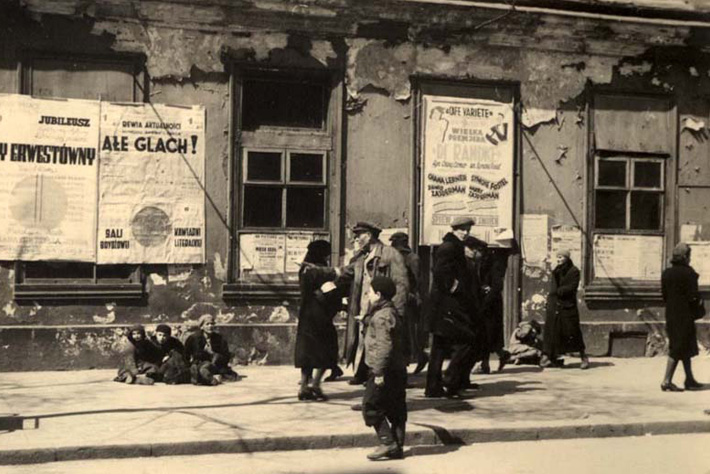
[Another image from the Jost collection.]
Josef Buhler, by the way, was tried after the war by the Supreme National Tribunal of Poland for crimes against humanity, condemned to death on July 10, 1948, and executed in Kraków.
This is really a fetid little booklet, its empty pages waiting for some sort of horror, all of which was actually taking place in real life, escaping their record.
Distribution of food in General Government as of December, 1941
Nationality
Daily calorie intake
Germans
2310
Foreigners
1790
Ukrainians
930
Poles
654
Jews
184
I wonder where all of those conversations went, exactly, after they were ended. Did they sink into the copper wire like auditory signals (very very slightly trapped) in clay pots? I think not of course. But all of those phone numbers in this book to all of the special police and propaganda police and racial police and SS and on and on, all of those calls and conversations about this horrific undertaking, just seem to me as though they should’ve gone somewhere, caught in the myth of the machine, somewhere in the electromagnetic world, like a primitive internet.
I really can’t stand what those simple phone numbers meant.
Footnotes:
1. The Generalgouvernement was the central part of three general districts of the divided Poland, and it proved to be the terminal for millions of people deemed as undesirable or threatening. It was particuarly impossible for Jews, the Generalgouvernement proving to be the place where they were collected in ghettos and housed under mniserable and starvation conditions until they began to be shipped out to concentration camps in early 1942. By 1944 all of the ghettos had been liquidated, and with them, their inhabitants. The Soviets did finally liberate the Generalgouvernement (from the Nazis) under delayed conditions in the winter of 1945, initiating Pogroms against the Jews by summertime.
Notes:
The Wannsee conference (I will not use a capital “C) was a meeting of leading Nazi officials and treacle who formed the decision to implement the Final Solution t the “Jewish problem” in Germany— it was the real beginning of the Holocaust.
The men who made this determination to begin with the wholesale destruction of human beings included:
SS-Obergruppenführer Reinhard Heydrich (Chief of the RSHA and Reichsprotektor of Bohemia-Moravia), presiding Dr Josef Bühler (Government of the General Government) Dr Roland Freisler (Reich Ministry of Justice) SS-Gruppenführer Otto Hofmann (Race and Resettlement Main Office, RuSHA) SA-Oberführer Dr Gerhard Klopfer (NSDAP Chancellery) Ministerialdirektor Friedrich Wilhelm Kritzinger (Reich Chancellery) SS-Sturmbannführer Dr Rudolf Lange (Commander of the SD for Latvia) Reichsamtleiter Dr Georg Leibbrandt (Reich Ministry for the Occupied Eastern Territories) Martin Luther (Foreign Office) Gauleiter Dr Alfred Meyer (Reich Ministry for the Occupied Eastern Territories) SS-Gruppenführer Heinrich Müller (Chief of Amt IV (Gestapo), Reich Security Main Office (RSHA)) Erich Neumann (Director, Office of the Four Year Plan) SS-Oberführer Dr Karl Eberhard Schöngarth (SD, assigned to the General Government) Dr Wilhelm Stuckart (Reich Ministry for the Interior) SS-Obersturmbannführer Adolf Eichmann (Head of Referat IV B4 of the Gestapo), minutes secretary
1. “German soldier Heinz Jost strolled through the Warsaw Ghetto taking illegal pictures. Almost 50 years later, they resurface in a disturbing exhibition.”
“An enfeebled urchin lies clutching the sidewalk like a breast. Three people pass by behind it; only one of them, a malnourished woman, looks down at the child. In a second or two, they will be gone and the child will be alone again, even more helpless, if that is possible. Did such dying children (there were thousands of them in the Warsaw Ghetto in 1941) know that something was horribly wrong with the world? Or did they think that squalid suffering is all that this disappointing life has to offer? wrote children, Mary Berg wrote in her diary of the ghetto, “no longer have a human appearance and are more like monkeys than children. They no longer beg for bread, but for death.” Terribly, the child on the sidewalk cocks its eye at the camera, unable to ward off the final cruelty of being photographed by a German soldier.
“Eerie approximation: Heinz Jost, a small-town hotelkeeper serving in the German Army, had the day off on Sept. 19, 1941. It was also his birthday. For reasons lost to history, Jost decided to spend the day inside the walls of the Warsaw Ghetto. He carried a camera and, contrary to regulations, took 129 photographs of the ghetto and its doomed inhabitants. The pictures lay unseen in a dresser drawer for four decades before Jost rediscovered them. He gave them to the German magazine Stern, which donated them in 1987 to the Yad Vashem Archives in Jerusalem.
“What Jost found in this neighborhood consecrated to death was an eerie approximation of normal daily life that only gradually (especially as the exhibition is arranged) reveals its ghastliness. At first, street life seems no more deprived than that in lower Manhattan earlier in the century. And the jackbooted soldiers relaxing in a touring car appear more arrogant than evil. But surely they must have known, as Chaim Kaplan recorded in his Warsaw diary, that “Anywhere a tree has been planted, or a bench has been placed, Jewish children are forbidden to derive enjoyment.” Elsewhere, peddlers hawk bread, grubby vegetables and coal by the individual lump, one woman sells Star of David armbands in varieties from printed paper to embroidered linen. “These armbands are very much in demand in the ghetto because the Germans arevery `sensitive’ on this score, and when they notice a Jew wearing a crumpled or dirty armband, they beat him at once,” Mary Berg observed. After these images, the pictures of gaunt bodies on morbid rickshaws, the merciless common graves and the catatonic attendants are but numbing epilogue.
“There are those who say that to measure any other barbarism against the Holocaust is to trivialize the unequaled tragedy that befell the Jews. Looking at these pictures, however, it is hard not to be struck by resemblances that suggest that the horror of the Holocaust has not been obliterated, but simply broken up, crushed into powder and raked into the soil of contemporary life. Even in our very rich country, the number of tattered beggars, slumped in despair on city streets, grows steadily greater. The bearded, skull-like heads of the Warsaw Ghetto’s interned are remindful of AIDS victims in the last stages of the plague. And it is almost impossible not to realize that we have seen, and still see, pictures of bodies of innocents lying dead under perversely meaningless advertising signs, at the feet of blase soldiers who think they’re just doing their jobs.”
And another, shorter review:
Heinrich Jöst’s Photographs. In the Ghetto of Warsaw: Heinrich Jost’s Photographs, edited by Gunther Scharberg, published by Scalo, distributed by D.A.P. 2001.
“Among the many books released on the Holocaust, the complete set of Jöst’s photographs of the Warsaw Ghetto is a valuable resource for scholars. Jöst, a hotel owner and sergeant in the Wehrmacht, took photographs of the Warsaw Ghetto in late 1941, which he shared with the journalist Schwarberg in 1982. Originally exhibited at Yad Vashem in Jerusalem, these photographs are now available, along with Jöst’s recollections, to a wide audience (Jöst died in 1983). Although the graphic nature of the pictures is disturbing they show, for instance, starving children dying in the streets they provide a record of the Warsaw Ghetto separate from official Nazi propaganda and as such are extremely valuable. Recommended for all libraries.” –By Frederic Krome, Jacob Rader Marcus Ctr. of the American Jewish Archives, Cincinnati.
The word”nuclear” has never had such a hard as it has during the past eight years or so. Mr. Bush has mispronounced it thousands of times, somehow; but I thought that with his leaving,, “nookuler” would seem like a lumpy bag of trash receding in the rear view mirror.
I thought this until two evenings ago during the cordials shared by two
vice presidential candidates. Gov. Palin, in trying to cozy up a
little to whatever is left of the 1980’s-ghost Ronald Wilson Reagan crowd with repeated allusions to the
old man bumped into that lumpy bag of useless Bush fat at least nine
times (not that I was counting), pronouncing “nuclear” in the old,
creative Bushian way, and then some. Though I have little doubt that
the governor can read the word, it leaves me cold that she can’t
actually pronounce the word on the great big red button that her finger
might actually touch some day.
I just very recently made a post about a sub-category of blank and empty
things: blank special-purpose
diaries. I didn’t think that there would
be much that would follow it, but already I’ve found several interesting relational
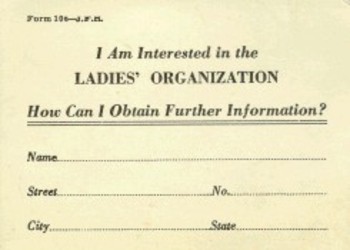
objects. This very understated and interesting object lacks the name of the organization for the ladies: and that name was the Ku Klux Klan, which changes everything about this innocuous-looking piece of ephemera.
How many of these forms for the Women’s branch of the Ku Klux
Klan (WKKK) were filled out in the 1920’s and 1930’s?
At least 500,000. And more, as this was the number of women members of the Klan, which was about a
quarter of the entire roll of the KKK.
Evidently the WKKK was one of the largest social organizations for women in
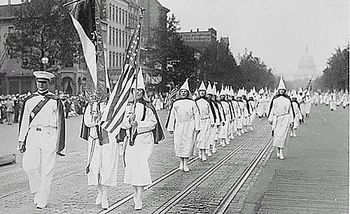
the U.S. in those decades. In 1925 more than
35,000 KKK members paraded down Pennsylvania
Avenue; three years later, another huge parade
took place, this time prominently featuring the WKKK. The KKK after all
supported women, after its fashion, and actively sought them as an auxiliary force,
seeking their right to vote as well. And
by the right to vote it meant literally RIGHT voting—no voting for anyone or
anything that was not “100% American”, which excluded everyone that was not
native-born, white and (sort of) Protestant, voting against anything that was in
any way in favor of Blacks or Jews or Catholics or immigrants and so on from a long
list of “undesirables”.
The emptiness of this application for possible membership has as much hope in its emptiness as its possibility of hate in its completion.
A few interesting works on this subject include:
Blee, Kathleen. Women of the Klan: Racism and Gender in the 1920s. Berkeley: University of California Press,
1991.
McGehee, Margaret T. “Beneath the Sheets: An Intellectual History of the
Women of the Ku Klux Klan (WKKK), 1923–31.” MA thesis, University of Mississippi,
2000.
Seaver, Darcy L. “Women in the Hood: Women in 1920s Ku Klux Klan
Publications.” MA thesis, University of Wisconsin–Madison,
1992.
For another project of mine I’ve been reading about the
Japanese internment camps (posting an earlier post here), and just started to
read some post war material on the interpretation of those actions. The first book I turned to is regarded as a
liberal (in the classic sense of the word) regard and homage to the Japanese in
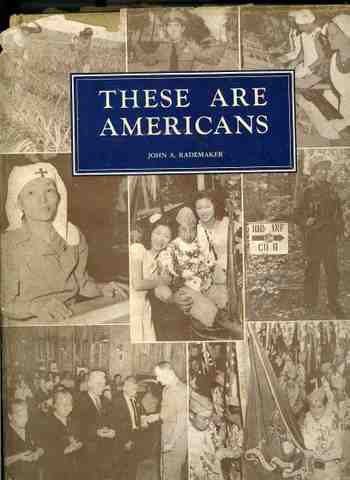
the Hawaiian Islands by John Adrian Rademaker, (a Professor of Sociology at the University of Hawaii 1944-1947), who in 1951
published These Are Americans: The Japanese Americans in Hawaii During
World War II . It documents the
contributions made to the war effort by of people of Japanese ancestry living
in Hawaii, including the Varsity
Victory Volunteers, the 100th Infantry Battalion, and the 442nd RCT, and so far
as I can determine is one of the earliest pioneering works to attempt to right
the significant wrong done to these people.
In the past I always thought of it as a photographic essay,
and I’m sure that I never actually read the thing., But this time I, I did, and I was stopped
almost immediately, half-way through the first sentence.
It reads:
“During World War II, I was one of a considerable number of
persons who were directly concerned with the care and re-establishment of the Japanese Americans in the continental United States.”
To be honest about it, I’m not sure what this means or where it came from. The rest of the sentences in the 277 pages of
this book are laudatory and informative and attempt to right the public opinion
wrongs of the wartime Japanese-American persona. But “care and re-establishment” is awful and
weird, and stupid—so much so I wonder if the phraselet was stuck in there by
some zealot editor. Removing 110,000
Americans from their lives and residences and families and communities and
businesses, stripping them ¾ of whom
were American citizens) of their rights, forcing them to sell whatever they
couldn’t carry at fire sale prices, and then sticking them all in horse stalls
or deeply removed and very difficult locations for three years is disgustingly-not
“care and re-establishment”.
Unless of course the author believed it, and if such is the
case then he really didn’t understand what happened to those 110,000 people, sociologist
or not; or at least didn’t get it in 1951.
He did make a strong case overall for the American Japanese
in Hawaii being loyal
citizens/ Rademaker points out that 1,440
Americans of Japanese Ancestry (AJA) who were detained by local authorities (excluding
Federal efforts) out of a population of over 150,000 AJA in Hawaii. They were nearly all Issei (first generation immigrants)
and Nisei (born in the USA)
From December 7, 1941till the end of the war, some 1,440 AJAs were
picked up by the authorities. This constituted nine-tenths of one percent of
the AJAs in Hawaii. 879 of those were Japanese Issei, first-generation immigrants. 534 were
Nisei. Nearly half of this number were
released after preliminary hearings, with the rest being “kept” for other
reasons, though they were simply community leaders (doctors, nurses, school teachers,
benign) and that sort of thing. He
states that no AJA in Hawaii was ever convicted or found to have committed any treasonable offense or
committed any sabotage whatsoever.
I’m just pointing out how odd this
first sentence is in the face of the rest of the book. Was it meant to diminish the American government’s
actions in rounding up and removing these people? (The government has had a very long history
of doing exactly this, and doing it deathly well—just look at the hundreds of Indian “removals”, the entire
institution of slavery, and many, many others, up to and including to a lesser
degree the displacement of Katrina refugees.) Arrest and disappearing people is
not “care and re-establishment”, period.
For the record, another truly
measurable aspect of AJA fortitude is their military participation during WWII
which stands as follows (presenting the 100 Battalion of the 442 and then the
442 as a unit):
The 100th Battalion and 442nd Combat
team:
Killed in action 569.
Died of wounds 81.
Missing in action 67.
Wounded in action 3,506.
Injured in action 177.
Total casualties 4,120.
The 100th Battalion and the 442nd
Combat Team won the following decorations:
1 Medal of Honor
1 Medal of Honor
47 Distinguished Service Cross
1 Distinguished Service Medal
12 Oak Leaf Cluster to Silver Star
350 Silver Star
18 Legion of Merit
16 Soldier’s Medal
41 Oak Leaf Cluster-to Bronze Star Medal
823 Bronze Star Medal
1 Air Medal
500 Oak Leaf Cluster to Purple Heart Medal
3600 Purple Heart Medal
2 Army Commendation Ribbon
40 Army Commendation
87 Division Commendation
1 brigade Commendation
12 Croix De Guerre (French)
2 Palm to Croix De Guerre (French)
2 Croce Al Merito Di Guerra (Italilan)
2 Medaglia De Bronzo Al Valor Militare (Italian)
Overall the 442—composed entirely of Japanese Americans, emerged
as the most decorated combat unit of its size in the history of the United
States Army —suffered an “unprecedented casualty rate of 314 percent and
received over 18,000 individual decorations. Many were awarded after their
deaths for bravery and courage in the field of battle. Among the decorations
received by the 100th/442nd soldiers were one Medal of Honor, 52
Distinguished Service Crosses, 560 Silver Stars, 28 Oak Leaf Clusters to the
Silver Star, 4,000 Bronze Stars and 1,200 Oak Leaf Clusters to the Bronze Star
and, perhaps most telling of the sacrifices made by these gallant soldiers,
9,486 Purple Hearts.” The 442nd Combat
Infantry group emerged as the most decorated combat unit of its size in the
history of the United States Army.
JF Ptak Science Books LLC Post 300
This installment on blank and
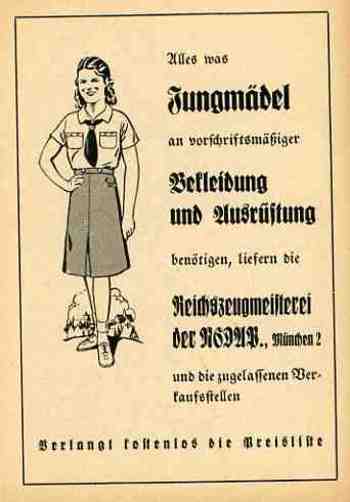
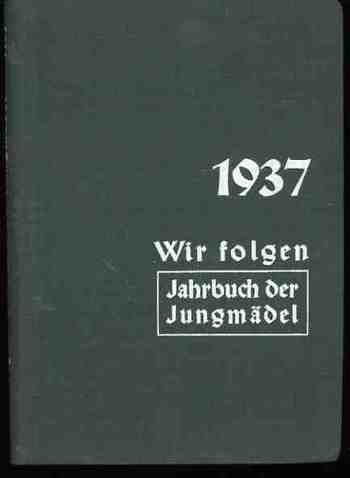
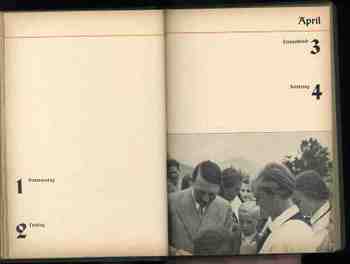
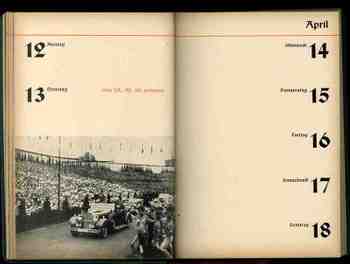
empty things is a continuation of the empty diary thread. The Jahrbuch der Jungmaedel
1937 is unsued and empty of unpublished thoughts; it was intended as a receptacle
for the girls who were accepted into the Jungmaedlbund (translatable as “Young
Girl’s League”), an extension of the Hitler Youth organization to female children
aged 10-14. Girls between the ages 14 and 18 were encouraged to be members of the Bund Deutsche Maedel (BDM), and finally, for the last stage of girlhood, there was the Glaube und Schoenheit section (“Belief and Beauty”) for girls 18 to 21, for grooming into the married and domestic (Nazi) life. The Jungsturm Adolf Hitler, the umbrella organization for all of this, began in 1922, soon after the creation of the NSDAP, and sought to develop the next generation of Aryan supermen, thoroughly indoctrinated in Nazism, and come their 18th birthday (or sooner) would become reliable and trusted soldiers. There were various subgroups in a web-y complication of organizations, all of which kept the minds of dozens of thousands of children under close control; and, by 1936, all German boys were compelled to become Hitler Youth.
The forward to this booklet was by
the leader of the Jungmaedel, Baldor von Schirach, who was later the head of the Hitler-Jugend
(HJ, Hitler Youth) and Gauleiter and Reichsstatthalter (“Reich Governor”)
of Vienna. He lived until 1974, ably surviving his
prosecution and conviction as a war criminal for his role in the deportation
of Viennese Jews. His work in shaping
the propaganda and the minds of children in Nazi Germany was so far as I can
see not an issue at his trial. He and
Albert Speer did denounce Hitler during their trials at Nuremberg—the only officials brought to justice who did so—and was
sentence to 20 years in Spandau
Schirach’s wife, Henriette, divorced him a few years into his retirerment. She lived until 1992. I wonder what Baldor and Henriette talked about at dinner? What was there pillow talk like? I
wonder what she was thinking in the years that she spent alone, or in
her final 37 days on earth? Did she wait for death’s embrace to take
her to some higher Aryan plane? Did she regret her own acquiesence of
what her husband was doing, or did she fool herself into believing
that nothing horrible was happening? Her husband gave some evidence
during his trial that he sent protesting notes to Martin Bormann about
the “bad” treatment of the Jews, and that he had no idea about the
exterminations. (He also claimed that the idea for the antisemitism
in Germany came from Henry Ford’s The International Jew. That Ford bears some responsibility for this and other pro-Fascist actions is correct and not debatable.) I’d like to see Henriette’s diary if she dared keep one. If there wasn’t a diary, it would be interesting to write it for her.
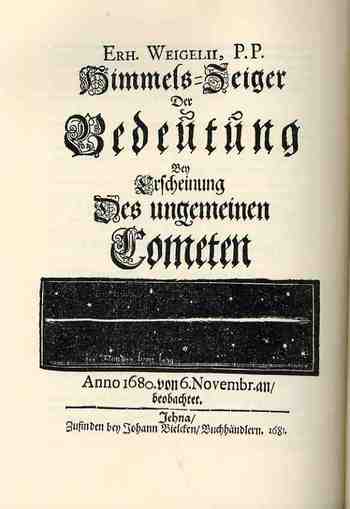
The comet tail in this beautiful title page woodcut is
hardly exaggerated—it was estimated that the tail was more than 30,000,000
miles long, or better than 70 degrees, at its highest and brightest. It illustrates the work on the Great Comet of 1680 by Erhard Weigel entitled Himmels-Zeiger der Bedeutung bey Erscheinung des ungemeinen Cometen , published in Jena by Bielcke in 1681. Weigel was a polymath (philosopher, astronomer, mathematician, logician and teacher ) who made minute and exact observations of this very famous comet in a micro- and macro-cosmic framework. He looked at the physical aspects of the comet (head and tail, brightness and shape, etc.) and described its path. He also wrote about the philosophical and relational aspects of the comet as well, bearing on its influence upon the weather and man, as well as its influence on the structure of astrology.
The comet was actually discovered in November 1680 by Gottfried Kirch, and it was discovered in a novel, unique way: via the use of a telescope. It was scientifically remarkable because it offered possibilities for the study of its path, which in turn could reveal the Larger Writ issues of teh clockwork universe in general. .
There were some earlier
sources—including Edmund Halley (who was inaccurately described as the
discoverer of the periodicity of comets)–that had this comet appearing in 44
ACE, another time in the consulate of Lampaduis and Orestes, and another time
in the reign of Henry I in 1106; that is, a period of 575 years. It was the
unfortunate estimate, or opinion, of William Whiston (who was chosen by
Isaac Newton to take over his chair of mathematics at Trinity College in
Cambridge when Newton dedicated himself more fully to his role as president of
the Royal Society**). that the
1680 Comet had caused the flood of Noah and, perhaps more disastrously, brushed
the Garden of Eden. Perhaps he was thinking of Cicero*, “from the remotest remembrance
of antiquity it is known that comets have always presaged disasters.” (See Whiston’s “The
Cause of the Deluge Demonstrated, being an Appendix to the 2nd edition of the New
Theory of the Earth” (London,
1708))
The Great Comet of 1680 was the most extraordinary in the bright-comet-filled period of 1680-1682, and there’s certainly more to write about–I really just wanted to write on the comet woodcut because I think that it is odd and beautiful.
Notes:
*Cicero, De Natura Deorum: “Ab ultima antiquitatis memoria notatum
cometas semper calamitatum praenuntios fuisse.” The Pythagoreans
believed that great comets appear at great intervals of time.
** For god only knows what reason(s) Whiston was later denied membership to
the Royal Society, I guess with the knowledge of Newton; so he was good enough
to teach in Newton’s eat but not good enough to be invited to the big boy table
to eat.
Descriptions from New York Stateand Manhattanof the Great Comet of 1680:
Excerpt
from The History of Kingston, by Marius Schoonmaker, 1888, at page 70
“On the
9th of December 1680, there appeared an extraordinary comet, which caused very great
consternation throughout the province, with forebodings of dreadful happenings
and divine punishments. It is described, in a letter dated January 1st, 1681,
as having �appeared in the Southwest on the ninth of December last,
about two o�clock in the afternoon, fair sunshine weather, a little above the
sun, which takes its course more northerly, and was seen the Sunday night, right after about
twilight, with a very fiery tail or streamer in the west, to the great
astonishment of all spectators, and is now seen every night with clear weather.
Undoubtedly, God threatens us with dreadful punishments if we do not repent.The letter then suggested the
propriety of proclaiming a day of humiliation and prayer. “
An excerpt from The
Encyclopedia of Geography, By Hugh Murray, Philadelphia., 1837, Vol 1 at page 115
describes the visit of this comet also;
“A
very remarkable comet was seen in the end of 1680 and beginning of 1681. Its
tail extended 70 degrees, and was very brilliant. This comet, of all those
which have been observed, approaches nearest to the sun. Descending with
immense velocity in a path almost perpendicular to his surface, it proceeded
until its distance from his centre was only about 540,000 miles. Sir Isaac
Newton computed that, in consequence of so near an approach to the sun, it must
have received a heat 2000 times greater than that of iron almost going into
fusion; and that if it was equal in magnitude to our earth, and cooled in the
same manner as terrestrial bodies, its heat would not be expended in less than
50,000 years.”
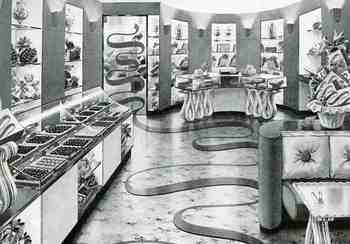
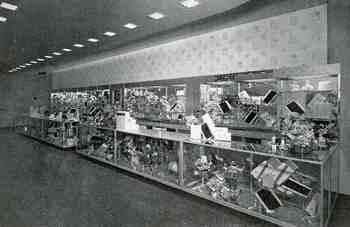
It is positively dripping with evil, its luscious display in a soft pre-chewed-like environment, as in a chocolate dream in someone else’s head. (Chocolate dreams are good to have, just ask poor old dead Hans Sloane, the man whose chocolate-based fortune and bequest formed the basis of the British Museum.) The ribbon design in the floor continuing up the wall just past the display is an invitation to getting totally lost in sugarly beauty, a swirling trail to a confectionary Ravena.
All of these images come from the pamphlet published by the Associated Retail Confectioners of the United States: Meet the Foods Candy is Made Of, made to accompany their annual meeting of 1946 at the Drake Hotel in Chicago. (There must’ve been an awful lot of these folks to book the Drake.) The cover does seem somewhat on the desperate side, trying to convince anyone who would have a look that candy–since it is made of all that good looking stuff–was indeed FOOD (“no wonder candy is so good to eat!”)
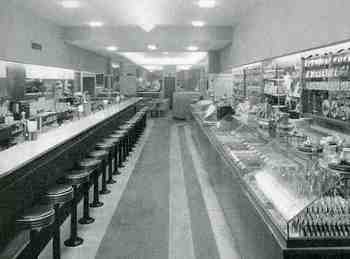
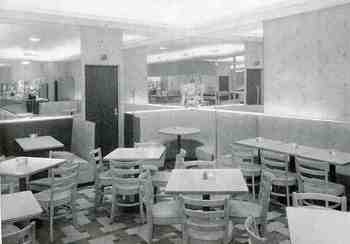
The next image is the “Table Service” area of Wieda’s Incoporated, (a fine, large candy store in Patterson, New Jersey) , “located in the rear”, where I guess the serious stuff is done, when you needed a table to consume your goodies with a wholesome cup o’ Joe.
The third image is again from Wieda’s–perhaps a little bit of payoff to Mr. Wieda for his (presidential) service to the association. The black and white image does absolutely nothing to address it fabulously colored interior, with its lemon yellow ceiling, with the upper walls and curtains a burnt orange and the lower walls “a soft light green”, all surrounding a terrazzo floor of maroon and gray. The woodwork was all walnut, and the mirrors were “tinted flesh color, which is more flattering to the customer than the usual untinted mirror”. Oh my.
There was all sorts of information-sharing in the conference, evidently: the best way to package and display candies, convincing mothers that candy was “food” after all and good for the kids, packaging candy so that it appealed to children, wrapping candy around other small gifts and trinkets, luring the customer into the candy store with more elaborate displays to pull you deeper inside, and so on. There was allot of thinking going on here about sweets, which seems pretty inconsequential until you think about the fortunes made by Hans Sloane and the Wrigleys and Mars, especially with the later too, what with the gum company being purchased by the Mars family for billions of dollars–which is a lot of money for gum, which of course is hardly a candy.
In any event these stores are just gorgeous, and gorgeous in a way that their gorgeousness can never again be achieved–and I’m not sure why. Maybe its because I’m not wearing one of those fabulous double-worsted suits that Bogey used to wear, not that he’d be found in one of these places.
“Nature’s object remains unstated” for us humans, writes Sir Henry Thompson (1820-1904, polymathic professor of clinical surgery, University College, London) in the March 1874 issue of Appleton’s Popular Science Monthly, or at least so in life. In his article “Disposal of the Dead”, Sir Henry finds at least an answer in death for Nature’s purpose for people: fertilizer. After birth, the process of decay is constant, until we all find ourselves broken down to our chemical and mineral elements in an nearly endless series of breakdown, failure and shortages until our cells decide to stop working. (Folks who wish for an eternal life should be careful: Tithonus, a mortal Trojan in love with Eros suffered from her wish to Zeus–the goddess of the dawn asked for Tithonius to be immortal just as she, but did not ask for him to stay the same age, which is very problematic. Just like in the story of the Struldbruggs, Jonathan Swift’s Gulliver found a people who were immortal but who also aged as time went by–they became more rickety and feeble and disabled and so on, right up to the point where they couldn’t even read anymore because their fingers were too brittle for page-turning and their minds so weak that they forgot the beginning of a sentence before they came to its end, which means I guess they didn’t need to turn pages anymore, because the same page was fresh to them, tirelessly and endlessly. Gulliver says that “no tyrant could invent a death into which I would not run with pleasure from such a life”. Amen. )
Full text via wikisource: https://en.wikisource.org/wiki/Popular_Science_Monthly/Volume_4/March_1874/Disposal_of_the_Dead
We do not have the problems of Tithonius and the Strudbruggs. decaying daily in our sprint to the Finish line (preferable to the “End”, as “Finish” implies that something has actually been done).
Dr. Thompson works out his inexorable logic of the most effective way of disposing of the dead with some noirsh dead-pan humor. He has a number of gems like “what is best to be done with the dead is then mainly a question for the living” sprinkled throughout this pretty mordant paper. What it all boils down to for Thompson is some rock-solid reasoning: humans have something to give back to the earth once they die in the forms of chemicals and nutrients. But this gift he says is needlessly strangled by our funerary practices (or at least Western funeral practices): embalming the dead and offsetting their decomposition and then enclosing them in wood and metal six feet down in the ground defeats the whole sense of fulfillment in death. Nothing could be worse (a “useless pollutant”). Not only that, the economic waste is a staggering fraud, Thompson computing that a million pounds are lost every year to the practice in London alone.
There are ways of doing this better, he argues, the result of “this question of vital economy to the country” would be like burying a million pounds a year “into the bosom of Mother Earth, who could give it back in huge returns at compound interest for the deposit”. He figures that it takes but a few hours of high heat in a furnace to reduce dead people into something “useful” that can be gathered in the furnace’s cauldron and distributed where needed. 150 pounds of wood (or about a pound per deadweight) would do the job of gaining the fertilizer, which would be not only far cheaper than burial (costing less than a pound sterling) but would reduce the cost of importing fertilizer from other countries.
He writes: “the necessary complement of this ceaseless waste of commodity most precious to organic life, and which must be replaced, or the population could not exist, is the purchase by this country of that =same material from other countries less populous than our own, and which can, therefore, at present spare it.” (I’m pretty sure he’s talking about non-human fertilizer. I think.)
Thompson continues his argument that cremation is actually much more agreeable process than the current attempts at salvaging dignity in the dead. The principle complaint against cremation (in a practice of the veneration of the dead that was thousands of years old) was, he says, “sentiment”. But he says that this same sentiment has nothing to urge in seen kindnesses in the present practices, and says that he would take a look at what that “pleasant process” actually looked like. “So far as I dare! For could I paint, in its true colors, the ghastly picture of what happens to mortal remains of the dearest we have lost, the page would be too deeply stained for publication”. The beauty of death (“she lay beautiful in death”) so squeezed of life by flower Victorian poets lasts, oh, not so long. Thompson doesn’t pursue in writing what he couldn’t do with paint, only to say that the process and the result “of Nature so ruthlessly and rapidly blight(ing) her own handiwork in furtherance of her own grand purpose” was revolting, and if that part was acknowledged, the sentimental grievances against his own proposal should slip away. This was all well and good, and an excellent argument, but it was hardly a topic for table talk in London at nearly the height of the Empire, nor is it today. People simply weren’t ready for burning up poor old Auntie Em and sprinkling her in the garden, 10 inches down. I do admire his argument and presentation, though. His general arguments though were much toned down from this, and as the organizer and first president of the Cremation Society of Great Britain he sought the use of cremation for economy and hygiene more so than anything else. It was still a hard go.
“The first re-emergence of interest in cremation in modern times was in 1658 in an essay Hydriotaphia: Urn Burial, by Sir Thomas Browne, a physician from Norwich, but it was in 1664 in a book entitled Philosophical Discourses of the Virtuosi of France that it was first advocated as an alternative to burial. During the next two centuries numerous other discussions on this question took place but the grand revival of the subject really occurred in 1869 when it was presented to the Medical International Congress of Florence by Professors Coletti and Castiglioni “in the name of public health and civilization”. 1872 saw more papers advocating cremation, the most important being that of Dr. Polli, as it contained results of the first experimental researches. The following year Professor Gorini of Lodi and Professor Brunetti of Padua also published reports or practical work they had conducted. A model of Professor Brunetti’s cremating apparatus, together with the resulting ashes, was exhibited at the Vienna Exposition in 1873 and attracted great attention, including that of Sir Henry Thompson, Bart., F.R.C.S., Surgeon to Queen Victoria, who returned home to become the first and chief promoter of cremation in England.”
There have been many Kings of the Hobos, and Emperor of the Hobos, in the history of American Hobodom. The most widely recognized of all this royalty is, probably, Mr. Jeff Davis, who was elected King of Hobos each year from 1908 to 1935, until in 1935 at the Pittsburgh meeting of the annual “Hobos of America” his minions gave up elected him King for Life. Of hobos, that is, the Knights of the Road; he was also a real hobo, unlike the pretenders, who in general were not. (Nels Anderson in his Men On The Move, written just as the Depression was broken, (1940) observed: “Whatever else may be said of King Jeff, his romanticizing the hobo is not without a basis in reality, and his poetic interest in the species arose from experience. But King Jeff has placed on a pedestal a man who belongs to the past. The hobo belongs with the pre-Hollywood cowboy and the lumberjacks of the Paul Bunyan legends.”)
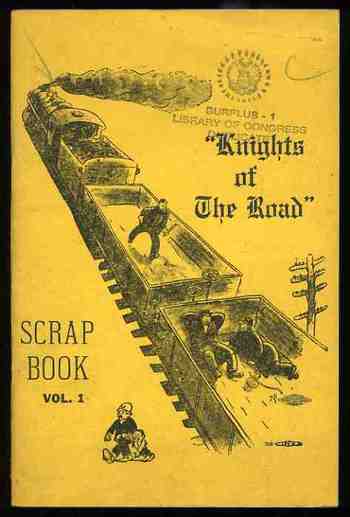
Mr. Davis was certainly very effective in getting the message out—on freedom and responsibility to irresponsibility—and was a great organizer and popularizer. He helped to establish hobo meetings, newspapers and literature (a sample of which is at left). He also had a few movie appearances: in The Arkansas Traveler, 1938 and The Bridge of Sighs, 1915, he ably played the role of a hobo.
And what about the missing counterpart of Jeff Davis–the Queen of the Hobos? There were certainly allot of women hobos during the Depression; Harry Hopkins estimated that there were something like 13,000 “sisters of the road” who were out and about in the 1930’s. I guess the most famous of them though was one who did not exist; and what parts of her that were real were mostly those of one man: Ben Reitman. Sister of the Road (1940) was supposed to be an autobiography of legendary Boxcar Bertha, but it was really an assimilation of Reitman’s own experiences sprinkled about those of women from his life. Reitman, who was described (by himself) as a “hobo, whorehouse physician, musician and tour manager/lover of Emma Goldman” (??) was probably not without enough experiences to float another character or two, had his story of Bertha wind up in the hands of exploitation movie maker Roger Corman. The good news about that though was that Corman gave the project to the very young Martin Scorcese who produced an odd and not bad film on no budget, and Boxcar got to live again.
But what brought me here to begin with was Davis’ breakdown of some very colorful hobo slang, all of which was found in the little yellow pamphlet (pictured above), and published as a “reference manual” in 1947. And so:
Gay Cat. Someone who “beats it from town”, settles down with a job and puts together some money so that he can get on the road again.
Gandy Dancer. “Is a hobo shovel stiff, a muck-stick artist”, a common laborer
Pearl Diver. A hobo dishwasher and who works for his meal.
Mush fakir. A hobo umbrella mender with a patch kit and a second-hand umbrella strapped to his back. (Evidently these guys were put out of business when larger stores began offering umbrella repair on their own.)
Bindle stiff. A hobo who carries his stuff in a sack on a stick, including toothbrush, “but he does NOT carry blankets”.
Kywah. An honest hobo pitchman peddling soap, perfume, jewelry, novelties, pens, knives and potatoes peelers.
Kewah. :Makes and sells articles such as willow stands…”
Scenery Bum. “A young tramp who bums it around the country, just for the fun of it.”
Ring-tail. “An ignorant, harmless tramp.
Fuzzy tail. “A smart aleck tramp, jack of all trades, a fourflusher, big bluff, false alarm, and piker of the worst sort, who most always carries a “punk kid” or “road kid” (a runaway boy).”
Dingbat. “An old tramp professional beggar who dings the main stem (begs on the main street).”
Stew bum. “An elderly tramp who wastes his time continually drinking rot booze.”
Jungle Buzzard. “A tramp who loves to eat but is too lazy to get the ingredients for a mulligan stew. He eats what is left when the gang leaves the jungle fire.” Yum.
Road Yegg. “A vicious tramp of the petty larceny type, a cheap crook.”
I like the collection—it has a high color, not terrible low cant at all.
Notes:
A Few Books on the History of Hobos:

Allsop, Kenneth  Hard Travellin': The Hobo and his History. 1967.
Black, Jack.  You Can't Win. 1926.
Bruns, A.  Knights of the Road. 1980.
Davies, W.H.  The Autobiography of a Supertramp. 1929.
Drew, Betina. The Texas Stories of Nelson Algren. 1995.
Etulain, Richard W.  Jack London on the Road: The Tramp Diary and Other
Writings. 1979
Flynt, Josiah. Tramping With Tramps. 1969 reprint.
Flynt, Josiah. My Life. 1908.
Graham,  "Steam Train" Maury   Tales of the Iron Road: My Life as King of the
Hobos. 1990.
Kemp, Harry.  Tramping On Life: An Autobiographical Narrative, 1922.
Kerr, Lenox.     Back Door Guest [Foreign Travelers in America
1810-1935].  1930
Kromer, Tom.  Waiting for Nothing. 1935.
Monkkonen, Eric H. Walking To Work: Tramps in America, 1790-1935.
Ormser, Richard.   Hoboes.1994.
Tully, Jim.  Beggars of Life: A Hobo Autobiography. 1924

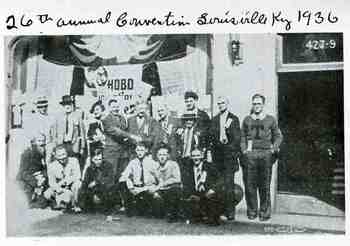
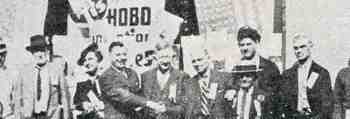
And, by the way, this detail of the photo in the Davis book for the 1936 Hobo meeting in Kentucky--
where, exactly, are the hoboes?  these people look pretty middle class.  And who is the lady?



 Evidently the WKKK was one of the largest social organizations for women in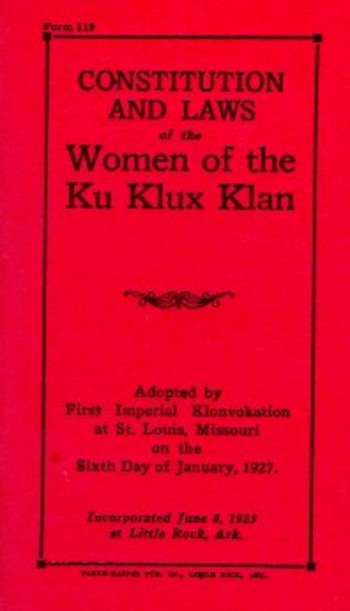
 Schirach’s wife, Henriette, divorced him a few years into his retirerment. She lived until 1992. I wonder what Baldor and Henriette talked about at dinner? What was there pillow talk like? I