JF Ptak Science Books LLC Post 301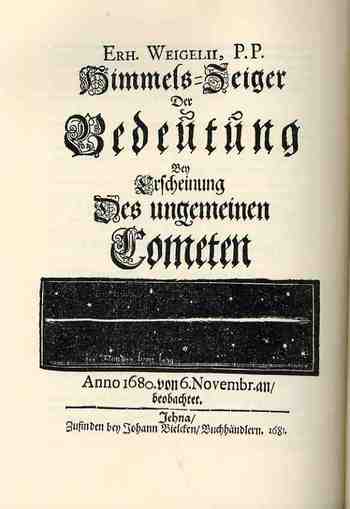
The comet tail in this beautiful title page woodcut is
hardly exaggerated—it was estimated that the tail was more than 30,000,000
miles long, or better than 70 degrees, at its highest and brightest. It illustrates the work on the Great Comet of 1680 by Erhard Weigel entitled Himmels-Zeiger der Bedeutung bey Erscheinung des ungemeinen Cometen , published in Jena by Bielcke in 1681. Weigel was a polymath (philosopher, astronomer, mathematician, logician and teacher ) who made minute and exact observations of this very famous comet in a micro- and macro-cosmic framework. He looked at the physical aspects of the comet (head and tail, brightness and shape, etc.) and described its path. He also wrote about the philosophical and relational aspects of the comet as well, bearing on its influence upon the weather and man, as well as its influence on the structure of astrology.
The comet was actually discovered in November 1680 by Gottfried Kirch, and it was discovered in a novel, unique way: via the use of a telescope. It was scientifically remarkable because it offered possibilities for the study of its path, which in turn could reveal the Larger Writ issues of teh clockwork universe in general. .
There were some earlier
sources—including Edmund Halley (who was inaccurately described as the
discoverer of the periodicity of comets)–that had this comet appearing in 44
ACE, another time in the consulate of Lampaduis and Orestes, and another time
in the reign of Henry I in 1106; that is, a period of 575 years. It was the
unfortunate estimate, or opinion, of William Whiston (who was chosen by
Isaac Newton to take over his chair of mathematics at Trinity College in
Cambridge when Newton dedicated himself more fully to his role as president of
the Royal Society**). that the
1680 Comet had caused the flood of Noah and, perhaps more disastrously, brushed
the Garden of Eden. Perhaps he was thinking of Cicero*,
of antiquity it is known that comets have always presaged disasters.” (See Whiston’s “The
Cause of the Deluge Demonstrated, being an Appendix to the 2nd edition of the New
Theory of the Earth” (
1708))
The Great Comet of 1680 was the most extraordinary in the bright-comet-filled period of 1680-1682, and there’s certainly more to write about–I really just wanted to write on the comet woodcut because I think that it is odd and beautiful.
Notes:
*Cicero, De Natura Deorum: “Ab ultima antiquitatis memoria notatum
cometas semper calamitatum praenuntios fuisse.” The Pythagoreans
believed that great comets appear at great intervals of time.
** For god only knows what reason(s) Whiston was later denied membership to
the Royal Society, I guess with the knowledge of Newton; so he was good enough
to teach in Newton’s eat but not good enough to be invited to the big boy table
to eat.
Descriptions from
Excerpt
from The History of Kingston, by Marius Schoonmaker, 1888, at page 70
“On
9th of December 1680, there appeared an extraordinary comet, which caused very great
consternation throughout the province, with forebodings of dreadful happenings
and divine punishments. It is described, in a letter dated January 1st, 1681,
as having �appeared in the Southwest on the ninth of December last,
about two o�clock in the afternoon, fair sunshine weather, a little above the
sun, which takes its course more northerly, and was seen the Sunday night, right after about
twilight, with a very fiery tail or streamer in the west, to the great
astonishment of all spectators, and is now seen every night with clear weather.
Undoubtedly, God threatens us with dreadful punishments if we do not repent. The letter then suggested the
propriety of proclaiming a day of humiliation and prayer. “
An excerpt from The
Encyclopedia of Geography, By Hugh Murray, Philadelphia., 1837, Vol 1 at page 115
describes the visit of this comet also;
“A
very remarkable comet was seen in the end of 1680 and beginning of 1681. Its
tail extended 70 degrees, and was very brilliant. This comet, of all those
which have been observed, approaches nearest to the sun. Descending with
immense velocity in a path almost perpendicular to his surface, it proceeded
until its distance from his centre was only about 540,000 miles. Sir Isaac
Newton computed that, in consequence of so near an approach to the sun, it must
have received a heat 2000 times greater than that of iron almost going into
fusion; and that if it was equal in magnitude to our earth, and cooled in the
same manner as terrestrial bodies, its heat would not be expended in less than
50,000 years.”