JF Ptak Science Books Post 335
 Often
Often
the reproduction of a print for popular consumption just doesn’t come anywhere
near expressing the flavor of the original.
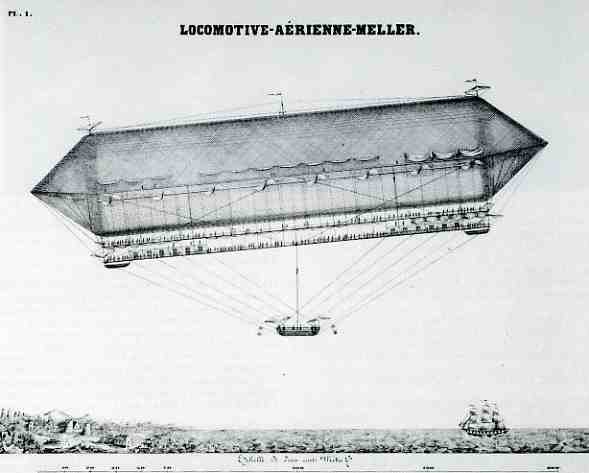
This is definitely the case with Gaston Tissandier’s Bibliotheque des
Merveilles la Navigation Aerienne, l’Aviation et la Direction des Aerostats
(printed in
Paris in 1886), in which enormity of Propser Meller’s (the younger) airship is
almost entirely lost. You do get the
idea of the size of the ship, but “bigness” is a weak constant, especially when
you look at the original print of the great ship, which turns that concept into
a more flavorful enormity.
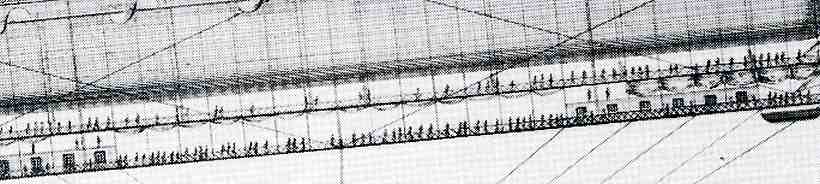
The Meller balloon–according to the scale at the bottom of the image–would measure a truly spectacular 200 meters/650 feet or so, and when you zoom in on the detail of the people aboard the ship the size becomes overwhelming. The print appears in Meller’s rare work Des Aerostats, NAvigation areieene, Chemin de fer aerostatique….printed in Bordeaux in 1851, and of course the ship was never built, but it did serve as an intellectual forerunner of the more modern zeppelin.
But the
truth of the matter was that Meller was also very busy trying to figure out
what balloons could actually do: Planning
600-foot-long airships (which would have been by far the longest vehicle of any
sort ever built) is one thing, and one thing that was interesting but not
terribly practicable in 1851; but he wrote elsewhere, in his Phare aerostatique (1854) that balloons
could definitely be employed more easily with lesser goals but greater
utility. For one thing a fixed balloon could be easily
employed by the military of harbor control as a means for suspending artificial
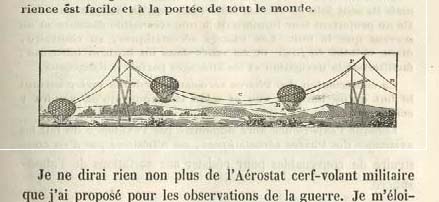
light sources. More ingenious and
eyebrow-raising was another idea for a balloon bridge, which would’ve guided
balloons across unbridgeable waters, shore-to-shore. It was certainly a bigger piece of thinking
than a light source, but to me it sounds like a fairly plausible way of getting
heavy loads and people across problematic bodies of water (and etc.) where
bridges or boats would not work. In any
event it seemed doable; at least far more so than the giant airship
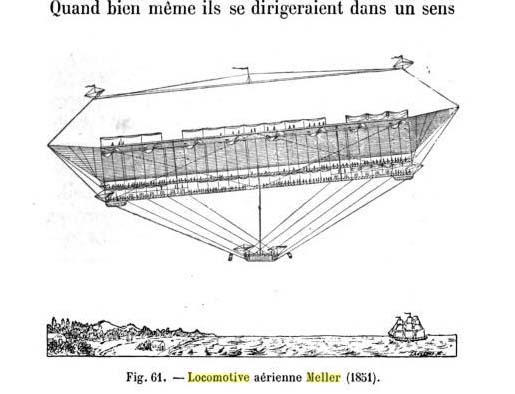
As you can see, the miunutae detail of the original is lost in the
reprint, and it is in the detail that the greatness of this airship can
be found. .
The balloon bridge by Meller:
Some other works by Meller:
Projet de navigation aérienne (Imprimerie de Pollet …, 1852)
À la marine (Typographie Plon frères, 1854)
Phare aérostatique.Paris:
Typographie Plon Frères, 1854.
*From
Chambers’ Edinburgh Journal, 28 August 1852 describing his 600’ airship:
Attempts are still being made towards aërial navigation. M.
Prosper Meller, of Bordeaux,
proposes to construct an aërial locomotive 200 mètres in length, 62 wide, and
60 high, the form to be cylindrical, with cone-shaped ends, as best adapted for
speed. The outer case is to be varnished leather, which is to be filled with
gas, and to contain five spherical balloons. A net, which covers the whole, is
to support sixteen helices by ropes, eight on each side; and to these two
galleries are to be attached, one for the machinery, the other for passengers.
The affair looks well on paper; but there is little risk in saying, that the
days of flying machines are not yet come, neither is the scheme for aërial
railways—a series of cables stretched from one high building to another—to be
regarded as any more promising.