JF Ptak Science Books Post 1466
Lots of these images have to do with walking and falling, walking and falling at the same time, walking and catching yourself from falling over and over again, but in general that walk is only one step, so far as parachutes go.
The parachute has certainly been around for a long time–from ancient times if you squint your eyes hard enough–though it appears that it was in the Renaissance that the idea was taken more seriously as a practicable thing: at least it was first depicted then. Here for example is a form of falling that was seen as flying (Homo Volens or Flying Man), in this depiction of parachute-use by Fausto Veranzio Fausto (1551–1617) in his book of technological marvels called Machinae Novae (1595). Of course Leonardo left a footprint here as well, and before Veranzio.

More convincing and potentially beneficial parachutes were constructed for balloon escapes/aviator descents in the 19th century, as seen with the work of André-Jacques Garnerin (1769-1823), who was the inventor of the frameless parachute (a framed version seen below).

And in all that time of development through the nineteenth century, it still took another eight or nine years or so after the Wright’s flights to have employed the idea for pilots of the modern airplane. There was a series of varied “firsts” of leaving an aeroplane by parachute in 1911 and 1912, the earliest of which involved the pilot of an aircraft to fly with his parachute in his lap, then throwing the whole thing from the plane with the pilot following. Parachute history during this time, like 1910-1920, is a little complicated, filled with fits and starts, mostly not very successful, and most of them of a quality and dependability to make you want to land your aircraft even if you were flying only smoke and flame.
The image below seems to depict the 1912 exploits of the American and British inventors who at about he same time developed a parachute that could be worn in a box on the aviator’s back, contained in a box with a removable panel. It was a very heady development, and the whole idea–seen here in the pages of The Illustrated London News for 28 September 1912–must have seemed like science fiction to the casual reader, the caption beginning
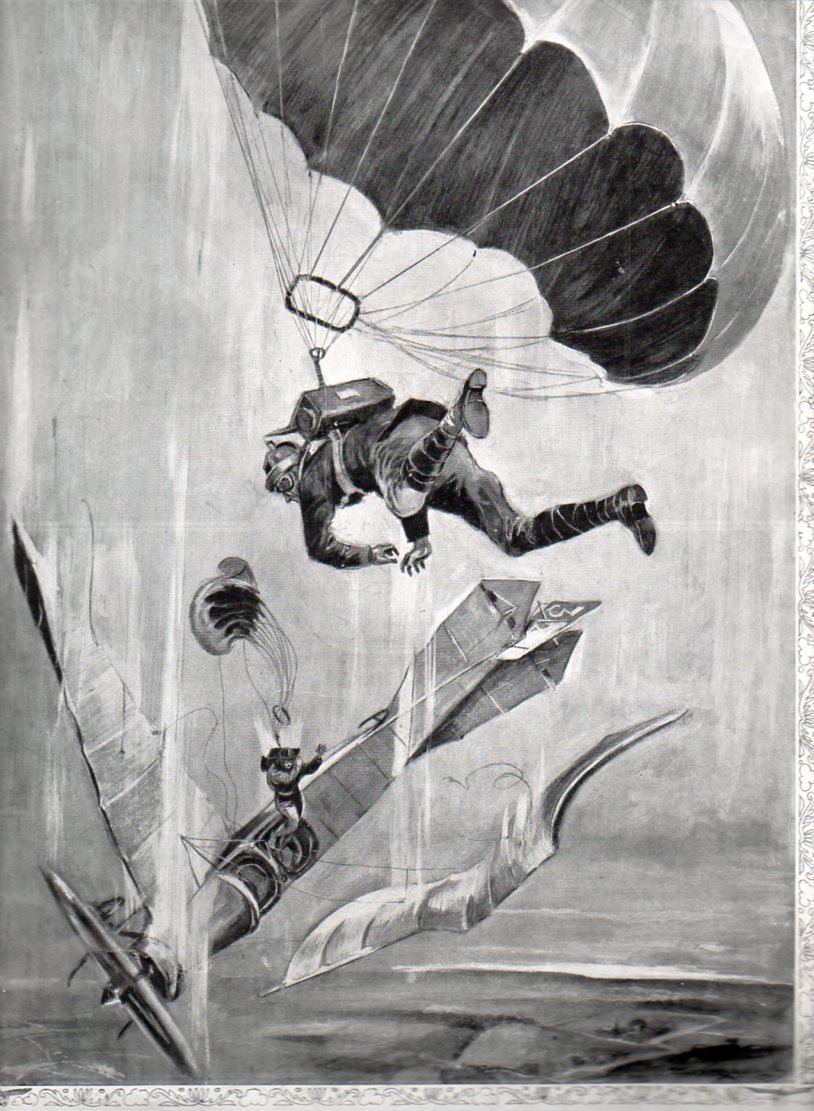
“…our illustration appears to be somewhat fantastic…” The ripchord, one of the most important elements of a parachute, didn’t get introduced into the fray until about 1916, and the real utility of the parachute doesn’t seem to be developed until 1920 or so. In the meantime, the whole business of flying was pretty much being done without a safety net, so to speak.
But what I realloy wanted to get to in this post is something that did look “somewhat fantastic” to the readers of its day, as it does to me now: parachute bombs. As a late-night, five-martini idea it looks great, especially in 1937. But the fact of the matter is that it does look like a bar stool plan similar to barrage balloons if barrage balloons were smaller, higher, fell and had bombs. One element of surprise though may have been what would happen to the great percentage of these bombs that were fired above and floated back down to Earth with their warhead still attache to the parachute and unexploded. The article states that the warhead would be disabled
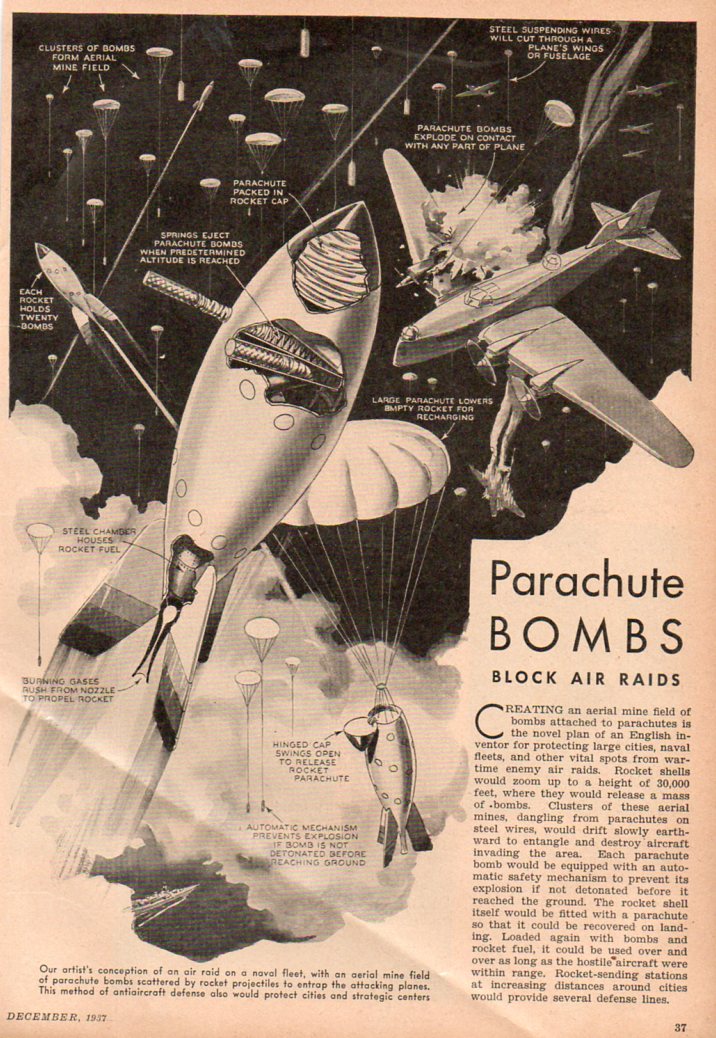
before it hit the ground, but then what? I suspect that there would be thousands of these buggers littering the land/cityscape, which means that there would have to be an equivalent of an ambulance corps riding around finding, collecting and hauling these things off. Seems like a non-started to me. Plus there would be far more effective anti-aircraft elements developed very soon after this, not to mention the terribly significant mathematical and technical developments that would go into the fire control issue of the weaponry. ( But that’s another story, another long story, dealing with how to get aircraft out of the air–there’s some very sophisticated AA weaponry produced during WWI, s decade and a half before these parachute bombs, that would seem to make these things a bad afterthought.)
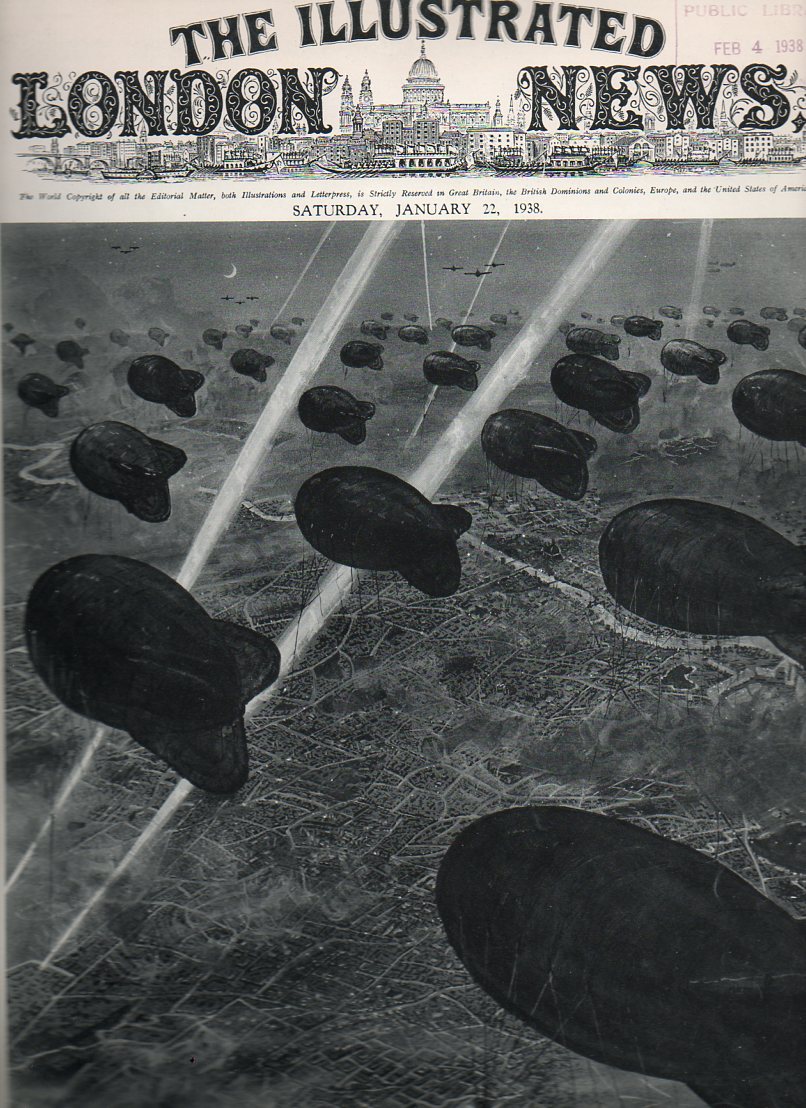
 I’m not terribly sure why the thinking was against low altitude attack, but my best guess is that the planners were thinking about the He-111Bs and Ju52s or other such aircraft that the Nazis checked and tested out against the Spanish Republicans during the Civil War. Perhaps freshest of all memories of the German operation Feuerzauber (Magic Fire) was the Guernica raid, just a year or so before the publication of these images, where that militarily insignificant town was attacked from the air in twenty minute intervals over three hours, destroying it in a terror blitz. If I was sitting around a big table at 10 Downing, I’d have that picture in my head. .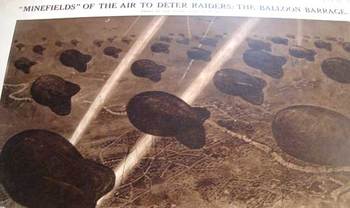
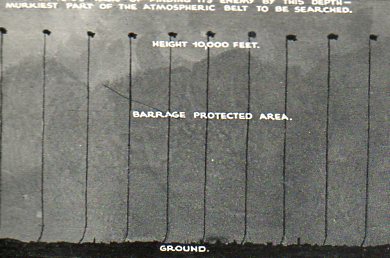
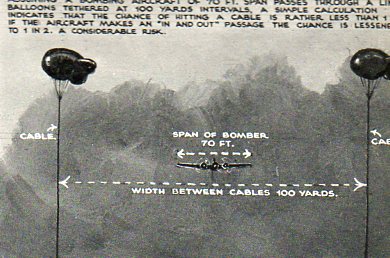
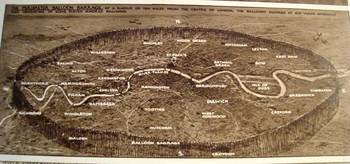
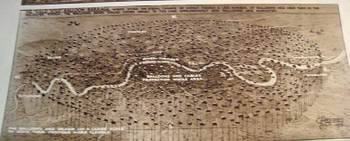
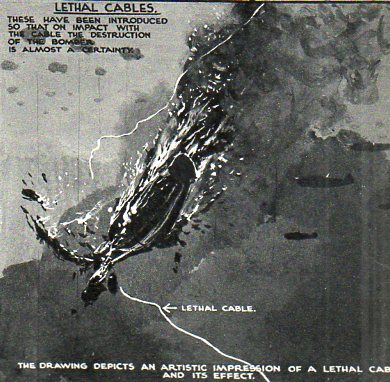
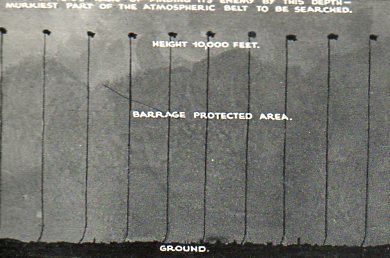
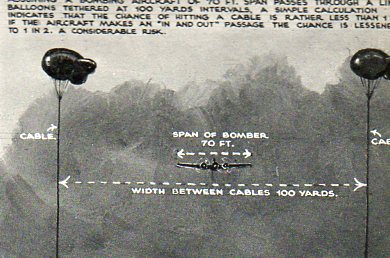
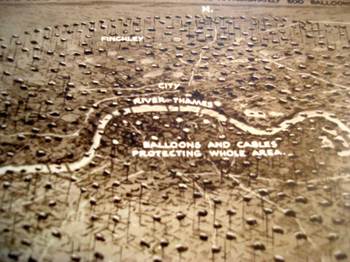 ncredible perimeter defense network, which extended ten miles around St. Paul’s; the balloons were moored at 100 yard intervals, making for 1100 or so balloons to “fence” the perimeter.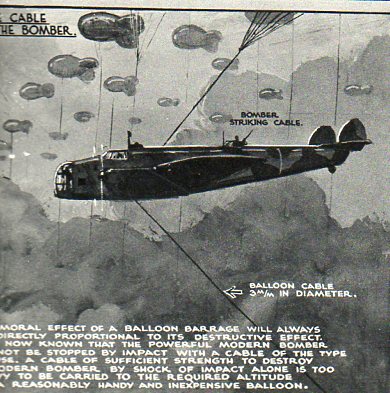
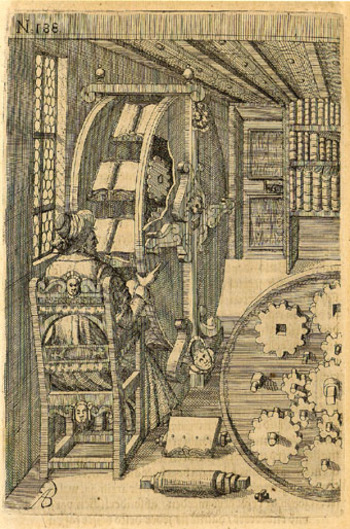 Okay, it wasn’t really the internet, or ARPANET1 or any of those things—the invention did however deliver reading material to a waiting reader/researcher in a novel way, bringing twelve already-opened books into the line of sight within seconds. And insofar as the internet delivers reading material in such a way, well, then, so does this, so long as you chose the right twelve books. This was a great innovation though I cannot say how many might have been constructed via the representation of this machine in Agostino Ramelli’s (1531-1600) :masterpiece Le diverse et artificose machine, which was published in 1588, the same year that England sent the Spanish Armada to Davy Jones’ locker.