A Daily History of Holes, Dots, Lines, Science, History, Math, Physics, Art, the Unintentional Absurd, Architecture, Maps, Data Visualization, Blank and Missing Things, and so on. |1.6 million words, 7500 images, 4.9 million hits| Press & appearances in The Times, Le Figaro, Mensa, The Economist, The Guardian, Discovery News, Slate, Le Monde, Sci American Blogs, Le Pont, and many other places… 5000+ total posts since 2008.

  • Titanic Understatement Department: The Trail of Tears and “Beneficial Exercise”, 1838

    JF Ptak Science Books   Post 1387

    “…strong men, women, boys and girls, not only capable of marching twelve or fifteen miles a day, but to whom the exercise would be beneficial.”  —General Winfield Scott, military leader in charge of the removal of the Cherokee nation, 1838, on the benefits of enforced marching of men, women and children over a thousand-mile course.

    Most people are familiar with the story of the Trail of Tears, the epic tragedy of the “removal” of a class of people—the Cherokee Indians in this case—from their homes in the east to a new land appropriated for them in Indian Territory (present-day Oklahoma). (In the Cherokee language, the event is called Nu na da ul tsun yi (the place where they cried), another term is Tlo va sa (our removal).) The Cherokees were given the ultimatum to leave their homes in Georgia, Texas, Tennessee, Alabama and North Carolina, doing so in the period from 1836 to 1839—the first part of the exodus was prompted by the U.S. Government but not necessarily enforced. The later part, however, in the spring of 1838, was absolutely enforced, with General Winfield Scott arriving on the scene with 7,000 U.S. Troops to round up the last of the remaining Cherokees and take them—by force if necessary—to Indian Territory.

    There were approximately 12,0001 Cherokees left in the east by the time of Scott’s arrival—by the time their enforced march to the west was completed, around 4,000 Cherokees would be dead.

    The ease with which this re-settlement was partially removed from the broader moral and ethical implications of marching 12,000 men, women and children a thousand miles west in the fall and winter of 1838/9 was accomplished with abstract language in the government reports describing the affair.

    For example, in the Executive Documents published by the U.S. Government printing office, 25th Congress, 3rd session, 1838, volume 1, documents #s1-9, part of the 609pp document #2, Message of the President of the United States to the Two Houses of Congress…., contains a 94-page section called “Report of the Commissioner of Indian Affairs” (occupying pp 410-506), and in that section is the compelling sub-document, “Emigration of Indians”. It is there that we find the clinical appraisals of the government efforts to scoop the Cherokees up and deposit them far west. For example, we are told that “(an) aggregate of 18,000 Cherokees…have ceased to live east of the Mississippi during the Spring, Summer and Autumn”, this after General Winfield Scott had “collected them”. Removing an entire Indian tribe had been a simple matter of that tribe no longer living there anymore, having been “collected” by the Army and “emigrated” to points west.

    The “collection” part is told elsewhere and often and more brilliantly than I can relate here—it is the material of a deep national tragedy. Suffice to say presently that 10,000+ people were herded together at bayonet and gunpoint, given scant opportunity to collect themselves, and then brought together in concentration camps to await the arrival of the last of their tribe. After that, most were marched in stages to Oklahoma, through bad weather of all descriptions—from drought to rain to high heat and bitter cold—sometimes encamped in stockades to wait for river levels to rise and fall, allowing dysentery and other diseases to come into the population and take hold.

    The section on the emigration of the Indians is alternately heart-breaking and infuriating. There is a series of correspondence between John Ross, representing the leadership of the Cherokees, and General Winfield Scott, regarding the mechanics and monetarization of removal. The Cherokees at this point make every attempt to accommodate their pending future with dignity and humility, acquiescing on almost all government points in what I think were the hopes of gaining a few extra necessities for the people making the trip. Generally, the requests were rejected. Coffee and sugar were at one point presented to Scott as a necessary—Scott refused, saying that the disbursements for the removal had already been made, even though all of the monies were coming from government funds allocated to the Cherokees for the lands they were having stolen on the heals of their exit.

    Another particularly infuriating example of misogynistic governmental neutral-speak—a towering example, really, an incredible, unspeakably-wrong statement—occurs on page 435 in a letter from Scott to John Ross et alia. In response to a request from Scott for extra wagons to help transport the young and the old and possessions and food, Scott refuses, saying that the allocated wagons were enough to carry food and belongs and provisions and 35 people. And for those who could not ride in the wagons, Scott said the following:

     “…strong men, women, boys and girls, not only capable of marching twelve or fifteen miles a day, but to whom the exercise would be beneficial.”3

     And just to set the record straight on this, we are talking about 1,000 miles of marching, in weather good and bad, over a period of many months (and sometimes extending to a year).

    There were allocated 50 wagons and teams for the journey for all of those thousands of people, the teams costing $28,000 in rent for the entire journey, ironically paid for by the Cherokees. The sugar and coffee which had not been provided for in the original rations list and which were excluded, would’ve raised the cost of the average daily ration allowance a few cents too many, exceeding the 16 cents per day/person for the journey.

    This of course was not the only Indian “removal”, not even the only removal for this year—it was the stage of affairs for many dozens of tribes over the course of two centuries, revisited and replayed and reprise d over and over again, with different actors, different agents, different tribes and different places—all with the similar result. (For example, even among just the Five Civilized Tribes, the Choctaw were the first to be removed in 1831, then the Seminoles in 1832, the Creeks in 1834, the Chickisaw in 1837, and then the Cherokees in 1838.)

    As awful as Scott’s correspondence reads to me I am reminded that among the general staff it was Scott who was seen as sympathetic to the Indians’ plight, that it was Scott who was ostracized for being too accommodating. This may have actually been the very best that the U.S. Government could offer, which is ____________________ .

    Notes:

    1. In the fall of 1835, a census was taken by civilian officials of the U.S. War Department to enumerate Cherokees residing in Alabama, Georgia, North Carolina, and Tennessee, with a count of 16,542 Cherokees, 201 inter-married whites, and 1592 slaves (total: 18,335 people).  The total number of casualties for the Removal is much studied and debated–estimates range from 2,000 to 6,000 people. 

    2.  Message of the President of the United States to the Two Houses of Congress…. page. 412 for both quoted phrases.

    3.  Ibid, Page 435.
  • The Weight of War–Bombing and Shelling During World War I and a Lesson in Orders of Magnitude

    JF Ptak Science Books  Post 1389

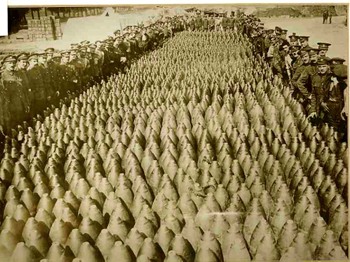
    Blogbomb_master This indelible image was made by an anonymous photographer for the Central News Service of New York City in 1918.  The Central News Service was a photographic supply house that would send requested photos to newspapers throughout the United States for publication as illustrations for  a story.  They would’ve been sent rolled in a tube  with a description of the image and with the stern warning to “Watch Your Credit Line”, making sure that once the newspaper had paid for the use of the photo that it also told its readers the source of the (agency) photographic.
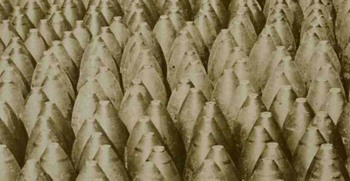
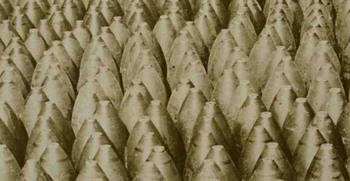
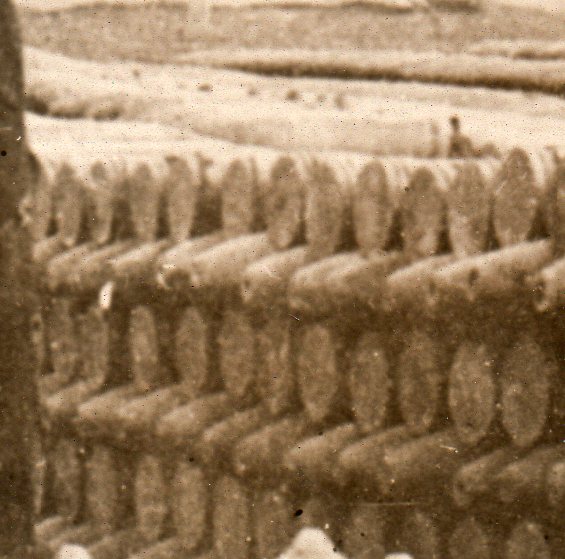
    The image is insatiable–it demands that you look at it and look at it long and hard, as it tries to give some sort of idea of the tremendous number of shells that were shot from canons by the just British against the Germans during the First World War..  There were something like one million tons of these fired against Germany; this picture represents about .001% ( of that total).  We see approximately 800 shells at two hundred pounds apiece, surrounded by a group of about 150 soldiers. 
    Blogbomb_detail_rear

    I looked very closely at this photograph.
    Of this single line of soldiers along the perimeter of the bomb cache, of the 150 of them, there are, it looks like, only five of them who have placed their hands on one of the bombs, and four of them are touching the fuse with just their middle finger.  It is an odd picture of restraint, these soldiers paying the weapons of mass destruction the respect of room.
    Blogbomb_detail_front

    I think that this is an extraordinary photograph of the testament of understatement and small, small percentages–even with this photo being so enormously graphic it still gives you absolutely no idea of how much explosive material was hurled back and forth, even knowing in your mind’s eye that this image represents something like FOUR ORDERS OF MAGNITUDE less than the total tonnage of bombs used.  By the British.
    Blogbomb_detail_front_2

    This difference in orders of magnitude is roughly equivalent to the difference in size between an ant and a human being, or between an amoeba and an ant, or between a human and one of the pyramids, or between the earth and the sun.  Basically, the shells in this photo meant nothing whatsoever to the total of shells used during the war.

  • Ephemeral Uniqueness in Large Crowds, 1917

    JF Ptak Science Books  Post 1390

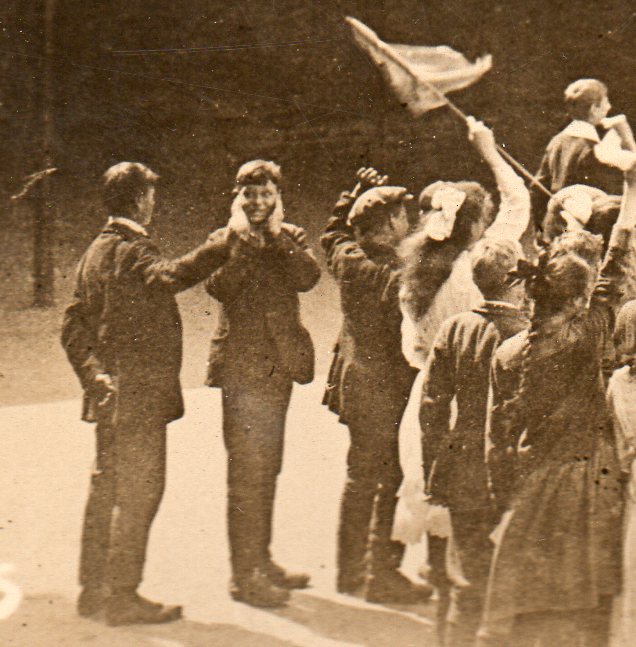
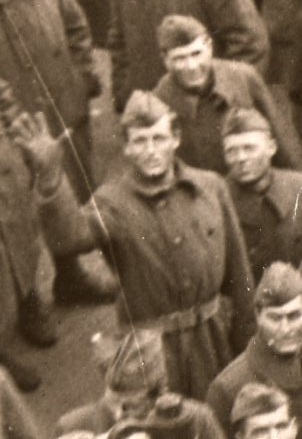
    There are 1500 or so of these news service war photographs here, and one of the remarkable things that I’ve discovered about them–trivial things to be sure compared with their overall message, ephemeral bits of semi-nothing–is that in many of the very-large-group images that there is sometimes just a single person who is doing something that no one else is doing, and it has been captured almost forever in the photo.  There are photos of thousands of troops, all facing east, with on solitary soldier facing west; there’s the solitary waver; there’s the one bare-headed man in  a sea of a thousand men with hats; there’s the one person raising his hat to the photographer in a sea of people looking at the camera but not raising their arms.  Then of course there’s the group photo of a mass of German WWI POWs, with only one soldier without a hat or helmet, and he looks just like me. 

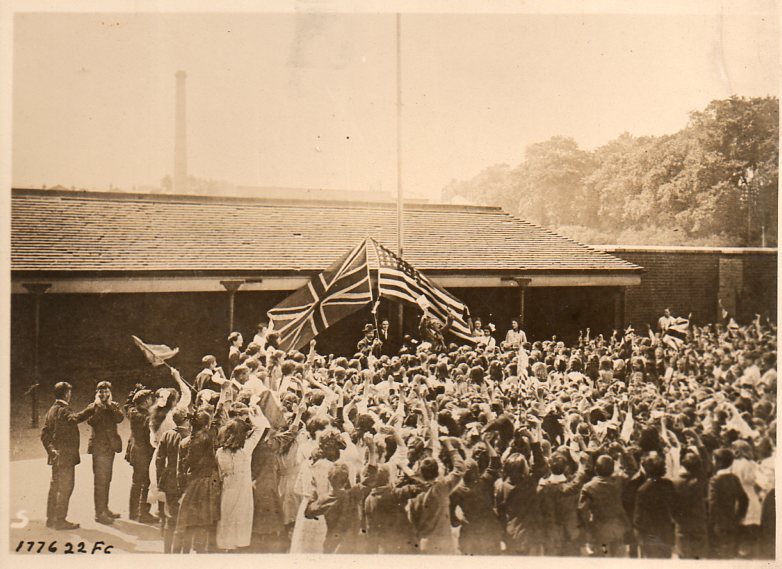
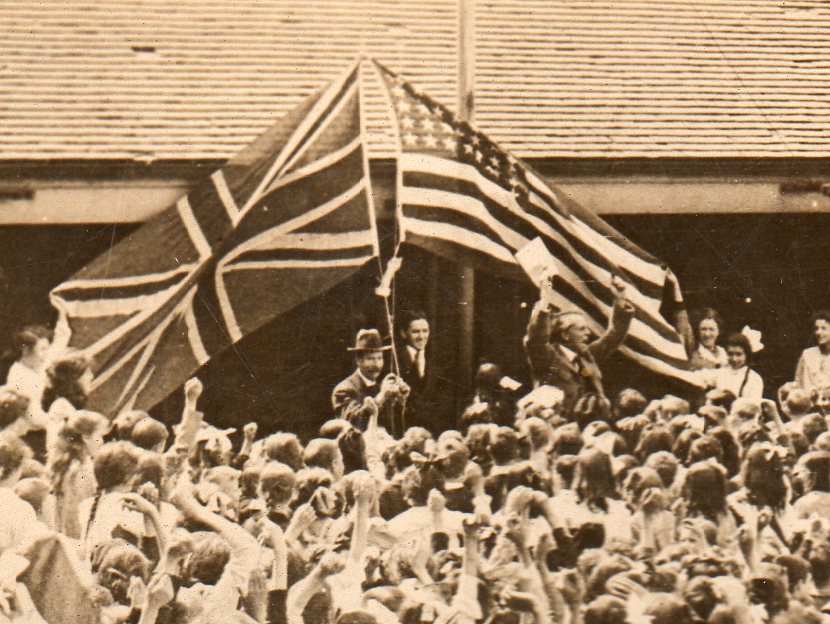
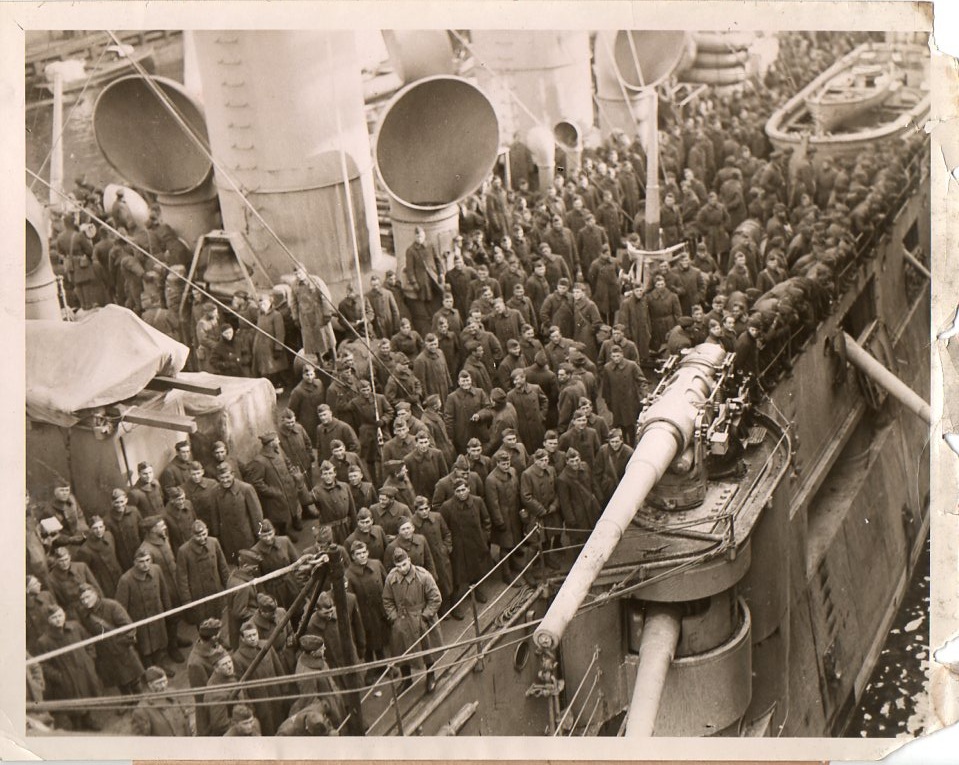
    Here are two other examples–the first is a detail from a photo showing British children cheering their American allies in 1917, showing one man clearly reacting to the hundreds of screams by covering his ears.  And is the only one doing so.  The second detail shows a large contingent of American soldiers leaving for Europe on a steamer–there is only one man  who turns to the camera and waves.

    Both original photographs are available from our blog bookstore, here.

    WWI troops ship171

    The second detail:

    WWI troops ship167
    The entire first image, showing the children cheering the raising of the two flags:

    WWI troops ship169

    And this:

    WWI troops ship170

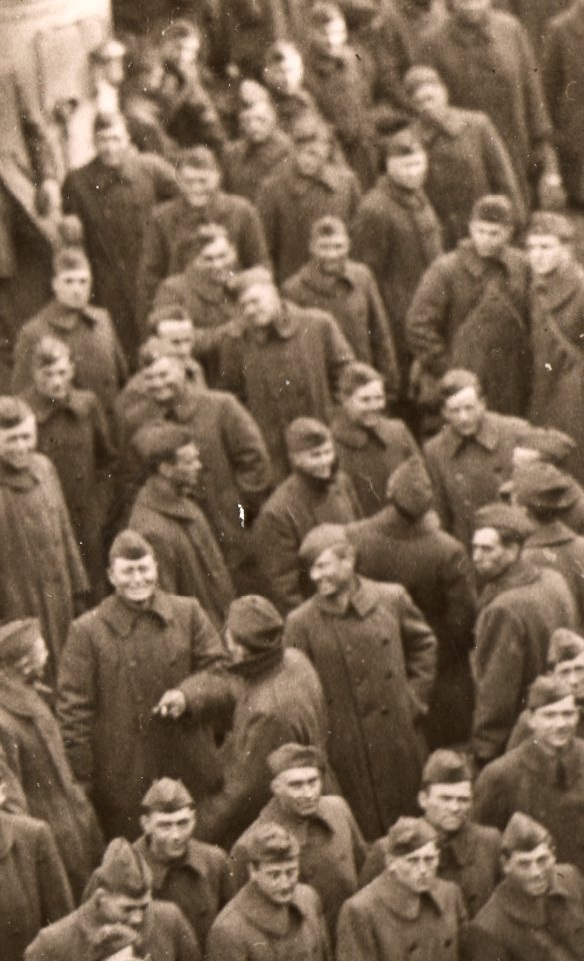
    And the second, showing a group of hundreds of soldiers waiting to leave Hoboken, New Jersey, for the fight in Europe, 1917.  Most are pulling themselves inside their coats as much as possible; I suspect being right there on the harbor–and seeing the floating bits of ice in the water–that it was wet and very cold.  Our one adventurous Doughboy gives the camera a spread-fingered wave….he also seems to be quite tall.  He is the lone waver.  There also seem to be a lot of smiles in the crowd. 

      WWI troops ship166

    WWI troops ship168

  • A Field of Artillery Shells–a Miniscule Sample of the 40,000,000 Shells Fired at Verdun, 1916

    JF Ptak Science Books  Post 1388 (out of order!)

    I just finished posting this from yesterday on a sea of shells and what those explosives meant in terms of overall destructive firepower for WWI.  This explosives image is a little easier, in a way, just showing hints of the vastness of what might be an acre of large ammunition.  

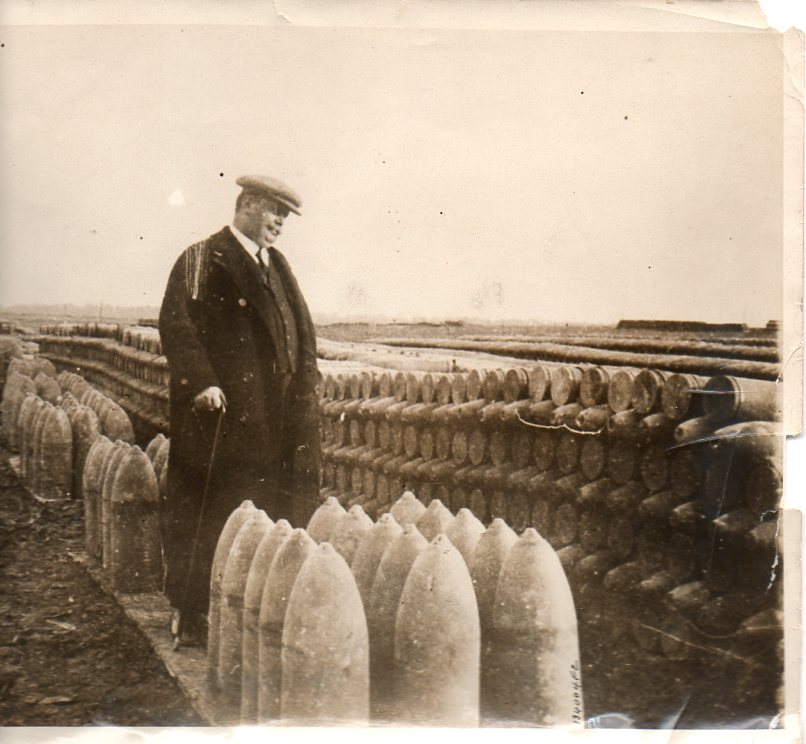
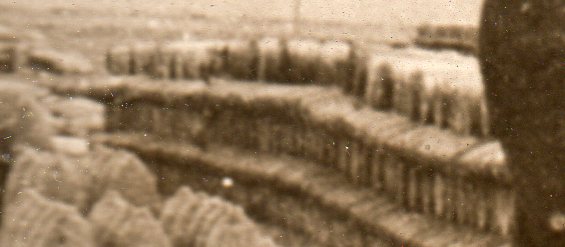
    This photo (dated 15 April 1916 by the news photo service of Underwood and Underwood) shows a French senator–H. Charles Humbert–viewing “a field literally covered with shells”,  the photo really only giving some glimpse of the extent of the palleted shells, which fade into the distance behind M. Humbert and extend deeply into the field in front of him.  (The original photo is available here at our blog bookstore.)

    WWI shells162

    M. Humbert (1866-1927) would’ve had more of an interest in this scene than most, as he represented the Meuse district, and at this point int he war the shells were headed to a part of that area, Verdun. Verdun of course was one of the major battles of WWI, fought from  21 February to 18 December 1916, in the hills and dales of north-eastern France, at Verdun-sur-Meuse. There were 306,000 battlefield deaths at Verdun, plus another 500,000 wounded, in what may have been one of the most gruesome battles of modern times. 

    Humbert was also an Army veteran and wrote on the military, and as it turns out, as the war approached he adopted a call to arms for more canons and more shells for the defense of France the inadequacy of the defenses of the French Army, and the insufficiency of officers and munitions  (“Des canons, des munitions!”).  He certainly would’ve been relieved with what he saw here.  Of course this is photo would represent a percentage well to the right of the decimal place of all those shells used at Verdun, which numbered an inconceivable 40 million.  When this photo was made in April the battle was already wicked and had been fought for two months–there were still eight months of gore to go. 

    WWI shells163
    WWI shells164

    ·Posted by :

    ·in:

    — —
  • Abe Lincoln in June, 1860

    JF Ptak Science Books   Post  1391

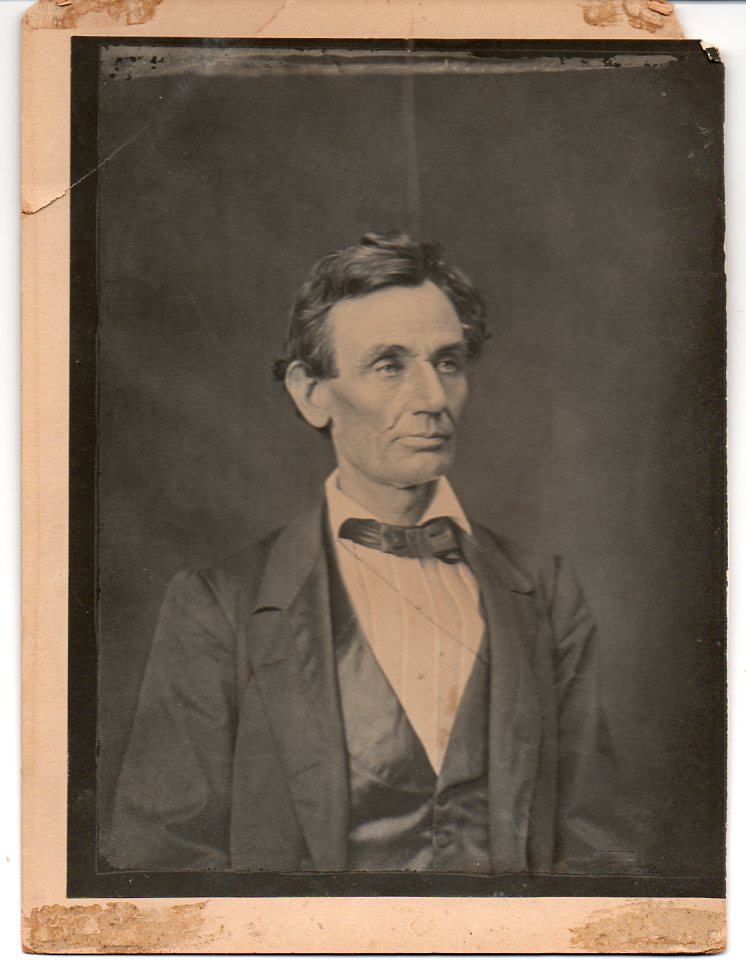
    Abe Lincoln, 1860.  I don’t know how he held everything together.  He was a master tactician, held conflicting and opposing thoughts in his mind and in his cabinet, was incredibly shrewd, and had a deep insight into the future.  He was still, even into 1862, a mocked character, even by his closest associates.  And generals–G.B. McClellan, for example, the general who never should have been actually in charge of an army outside of training it, never should’ve been in the field, never should have been given the opportunity to work more for the opposition than for the Union, saw Lincoln as a buffoon, a nuisance in his own supra-egotistical path to national office.  Lincoln not only survives all of this, but conquers .  I would love to see a two-person play of Lincoln at chess, from the point of view of the chess pieces. 

    I’m posting this as I am getting ready for a Civil War-in-the-newspapers, day-by-day, as we approach the 150th anniversary of what was the great defining moment in the history of the United States. (This image is offered for sale at our blog bookstore.)

    Lincoln--ayres big308

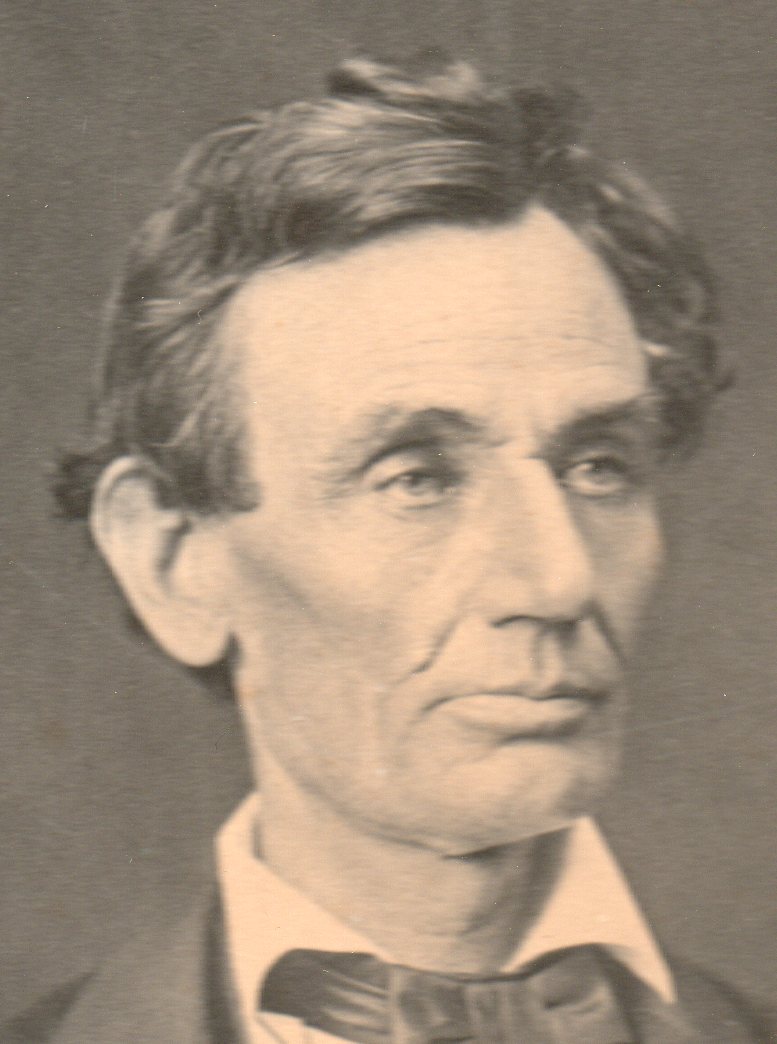
    THis 8.5×6.5 inch image was made in 1881 by George .B Ayres from the original glass negative made by Alexander Hesler’s photograph of Lincoln at Springfield, Illinois, 3 June 1860.  (Ayres had come into possession of Hesler’s studio and negatives after Hesler’s death.)

    And the detail:

    Lincoln--ayres big309

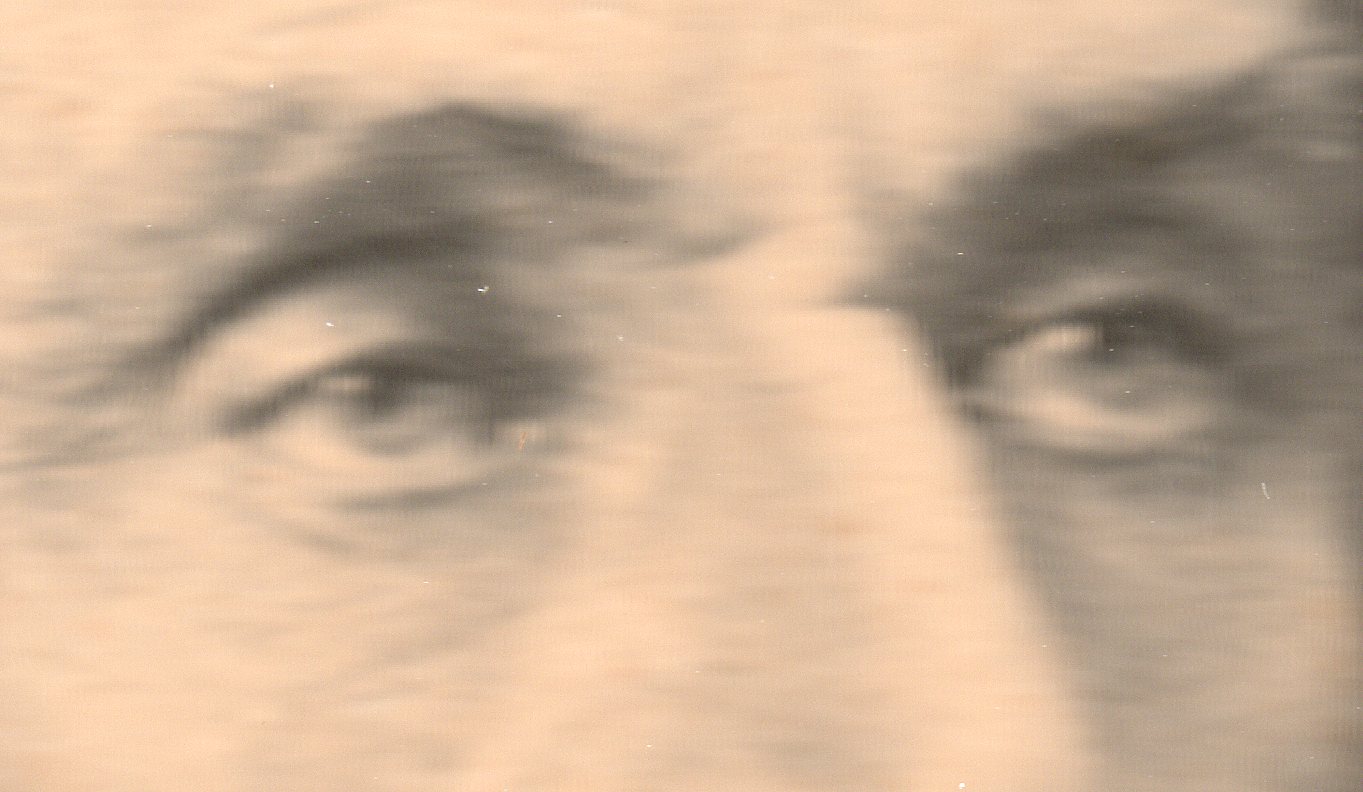
    And deeper:

    Lincoln--ayres big310


    ·Posted by :

    ·in:

    —
  • Cold and Understatement on the Western Front, 1916

    JF Ptak Science Books   Post 1392

    WWI cold173

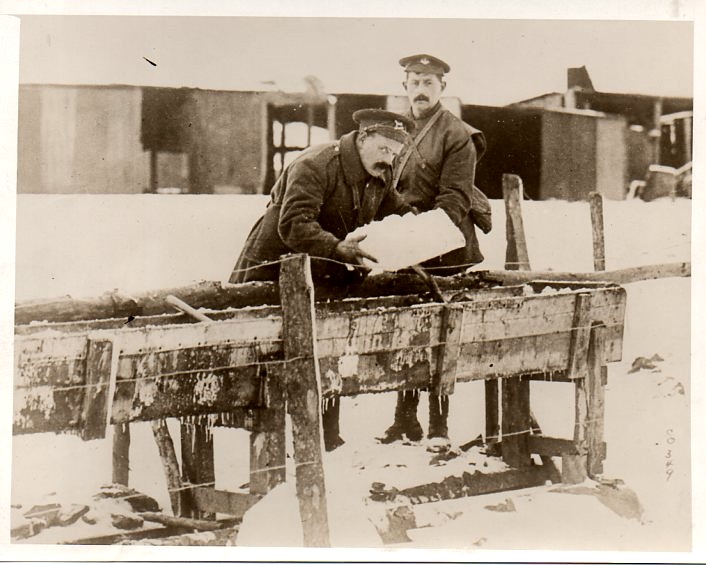
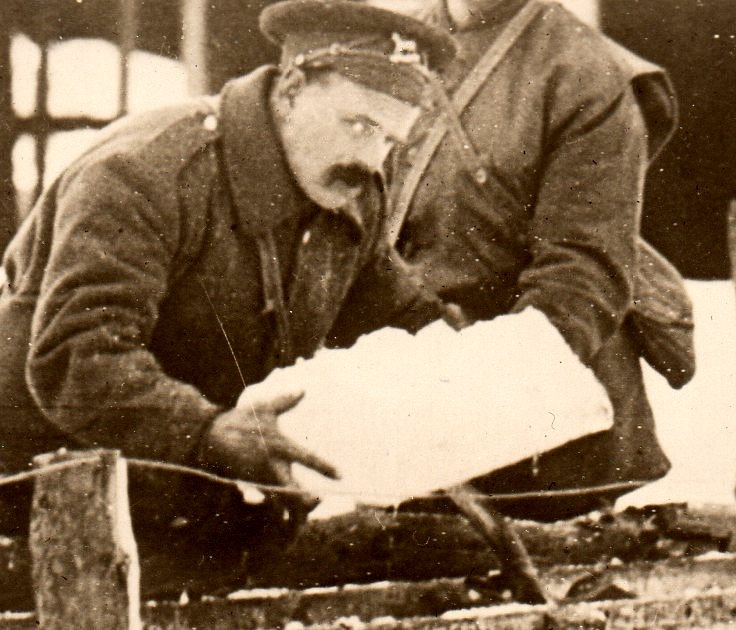
    The caption stamped on the back of the news photo service agency photograph (from the Western Newspaper Union) said that the bitter cold encountered by these Canadian soldiers on the Western Front in the winter of 1916 “was one of many difficulties encountered by the soldiers”.  “Great hardships have been caused by the frigid weather in this region” continues the caption.  Indeed.  Even for Canadians this was a cold winter, though not so cold that the Canadian trooper in the foreground stopped to put on his gloves to remove the ice from the water trough. These soldiers may have been cavalry, as there is a horse-like medallion on the front of their lids. (This photo is available for purchase from our blog bookstore, here.)

    Evidently the role of the cavalry in the BEF along the Western Front is an under-appreciated thing, or misunderstood, at least.  I’m not sure how they influenced the outcome of this stagnant section of the war, where the line of battle remained essentially unchanged throughout the duration of the war.  Millions of troops were deeply entrenched over hundreds of miles of battlefront, wailing away at one another with massive artillery barrages, countless machine gun nests, and then eventually tanks, planes and poison gas.  Back in February 1916 there weather was so tough and frigid that the battle of Verdun was postponed a bit, waiting for less intense weather conditions.  Dozens of millions of artillery shells and  billions of bullets later, in 1918, there was little change in the positions of the armies, except of course for the millions of casualties. 

    WWI cold174


    ·Posted by :

    ·in:

    — —
  • The Children’s Parade: Liberation of Ostende, 1918

    JF Ptak Science Books   Post 1393

    WWI children's parade175

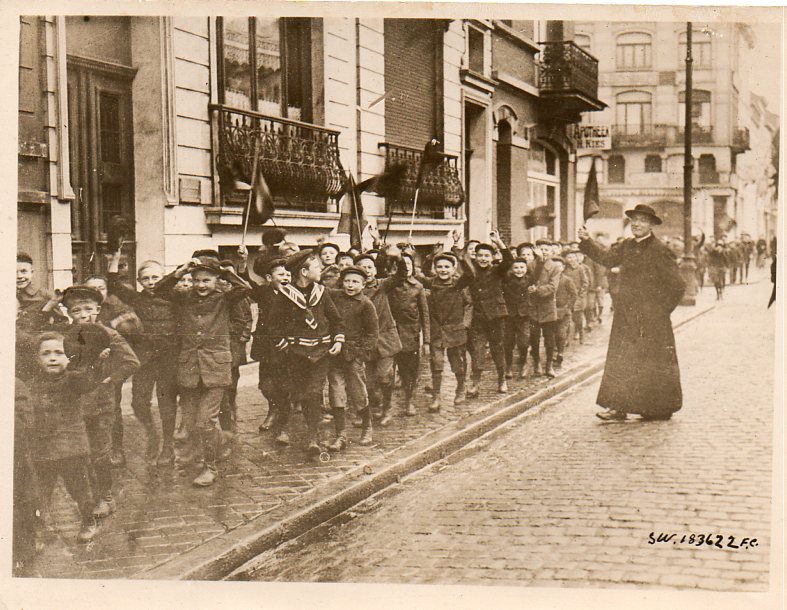
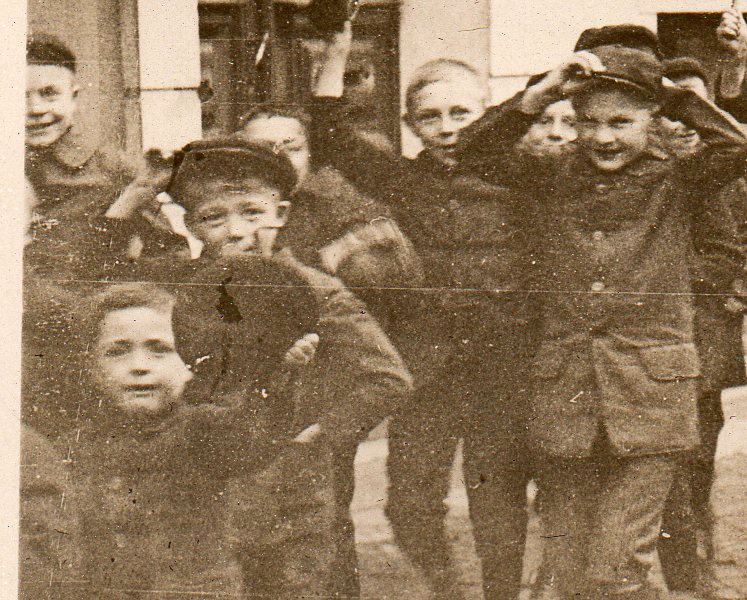
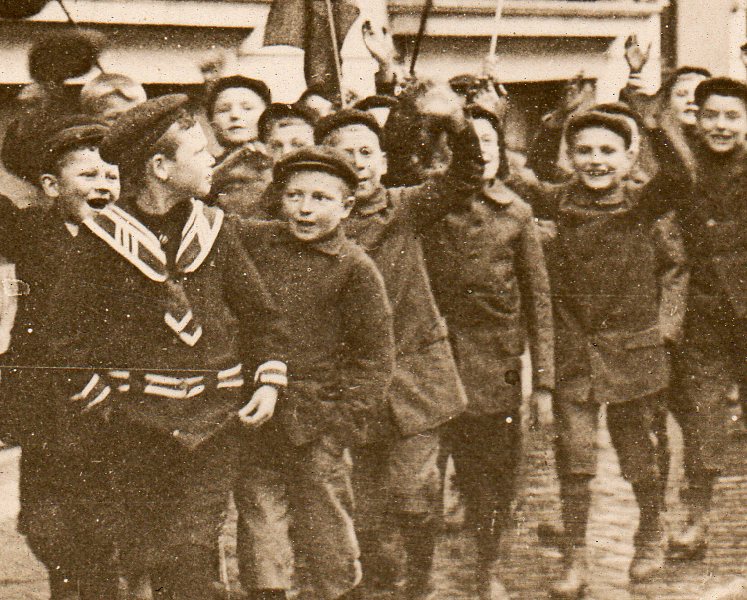
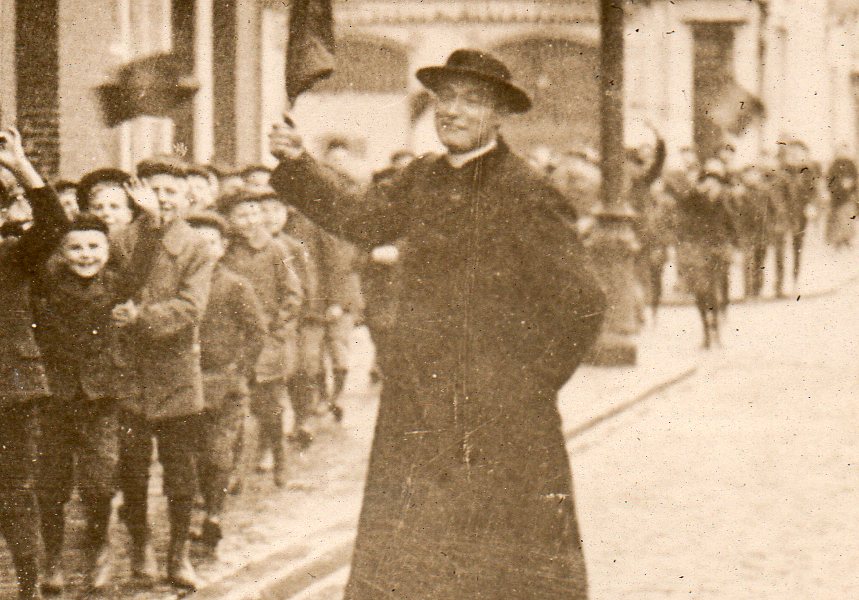
    Ostende, a port city of West Flanders on the North Sea in  northwestern  Belgium, was an important stronghold and also a  key to holding the inland port of Bruges, which is something that the Germany Army was able to do until the very end of World War I.  Under constant occupation by an invading force, the city was only liberated by the armistice signed two days before this photo was made, on the eleventh hour of the eleventh day of the eleventh month of 1918. (The original photo is available for purchase via our blog bookstore, here.)

    Some of these children might still be alive, though all but two of the soldiers of this war are all dead.  I remember talking to my grandmother ten years or so ago, asking her about what she did to celebrate the end of the war.  She laughed, and then told me that she and her sisters and brothers went out to the street (in their small town of Housatonic, Massachusetts) and danced and danced.  She then said that a few other children went to their kitchens to come out with pots to bang with wooden spoons–and then it struck me, taking away my breath, that what she was talking about was celebrating the end of WWI, not WWII, which is what I thought she was going to talk about. 

    WWI children's parade176
    WWI children's parade177
    WWI children's parade178

    ·Posted by :

    ·in:

    — —
  • Barbed Wire Cutting Device on the Mall, 1918.

    JF Ptak Science Books  Post 1394

    WWI barf wire cutter179
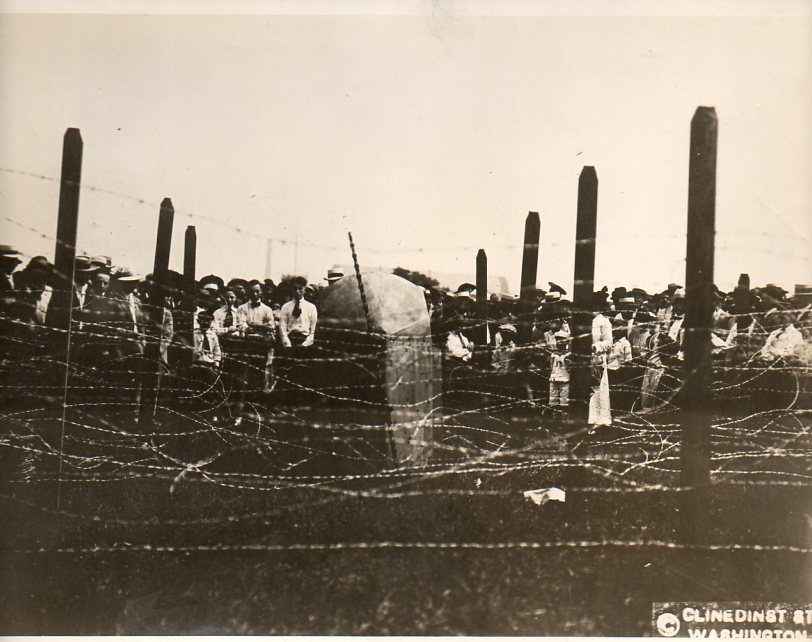
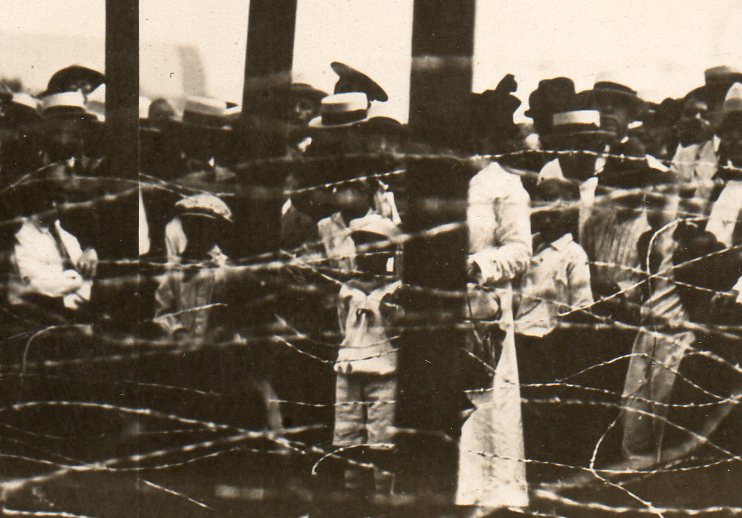
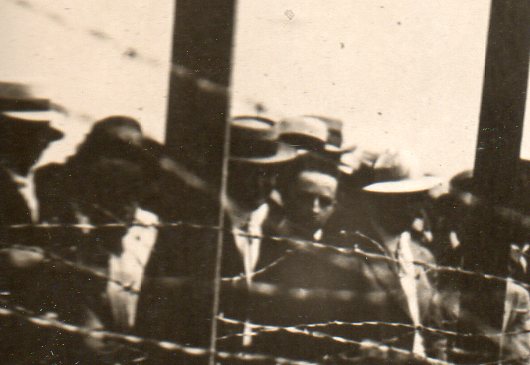
    “Will Cut its Way Through Hun Entanglements” reads the header to the caption for this new photo service war photo from the Central News Photo Service, published nearly at the end of 1918, just a few months before the end of the war. The inventor, John E. Logan, was demonstrating his invention “before senators and representatives of Congress” on a “miniature tank wire entanglement”.  The “entanglement” wire was much nastier than what you’d think of as the “barbed wire” of today–not concertina wire, but something small and nasty that was meant to catch soldiers, to pin them more deeply in the wire like a sharp metallic quicksand, stopping their advance and making them meat bait for machine gunners and everyone else. 

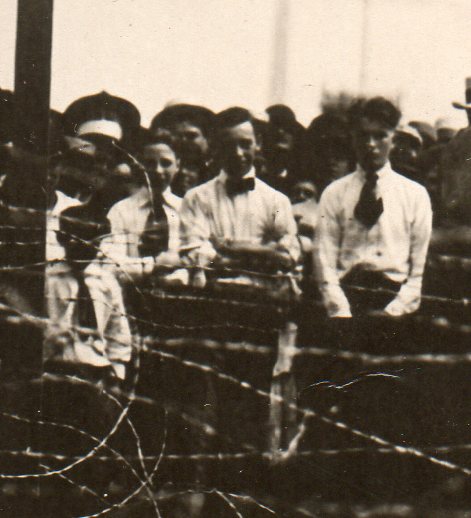
    Logan attracted a fair size crowd for his demonstration in the vicinity of the Capitol.  His machine seemed to work well, too, cutting through 72 strands of wire in about a half minute.  I’m not sure how many of these machines were produced (can’t find anything on them offhand)  but there would’ve been a need for a great number of them, given that since there was something like 12-25,000 miles of trenches dug during the war that there must’ve been millions of miles of barbed wire produced.  (That’s an off-hand guess, but it probably isn’t horribly wrong.)

    (The original photo is available for purchase from our blog bookstore, here.)

    WWI barf wire cutter180

    WWI barf wire cutter181
    WWI barf wire cutter182

    ·Posted by :

    ·in:

    — —
  • Revolutionary New Way of Astronomical Observation: Radio Astronomy, 1932.

    JF Ptak Science Books  Post 1395

    “At the age of just twenty-six, Karl Jansky had become the first person to detect and identify radio waves coming from outer space, a truly historic discovery… The true significance of Jansky’s breakthrough surpasses even the momentous discovery that the Milky Way emits radio waves. His accomplishment was to establish the science of radio astronomy and to demonstrate that astronomers could learn a huge amount about the universe by looking beyond the narrow band of electromagnetic wavelengths that are visible to the human eye… He announced his result in a paper entitled ‘Electrical Disturbances Apparently of Extraterrestrial Origin’ –Simon Singh, The Big Bang.

    “In conclusion, data have been presented which show the existence of elctromagnetic  waves in the Earth’s atmosphere which apparently come from a direction that is fixed in space.”  Karl Jansky, (1932), page 1398.

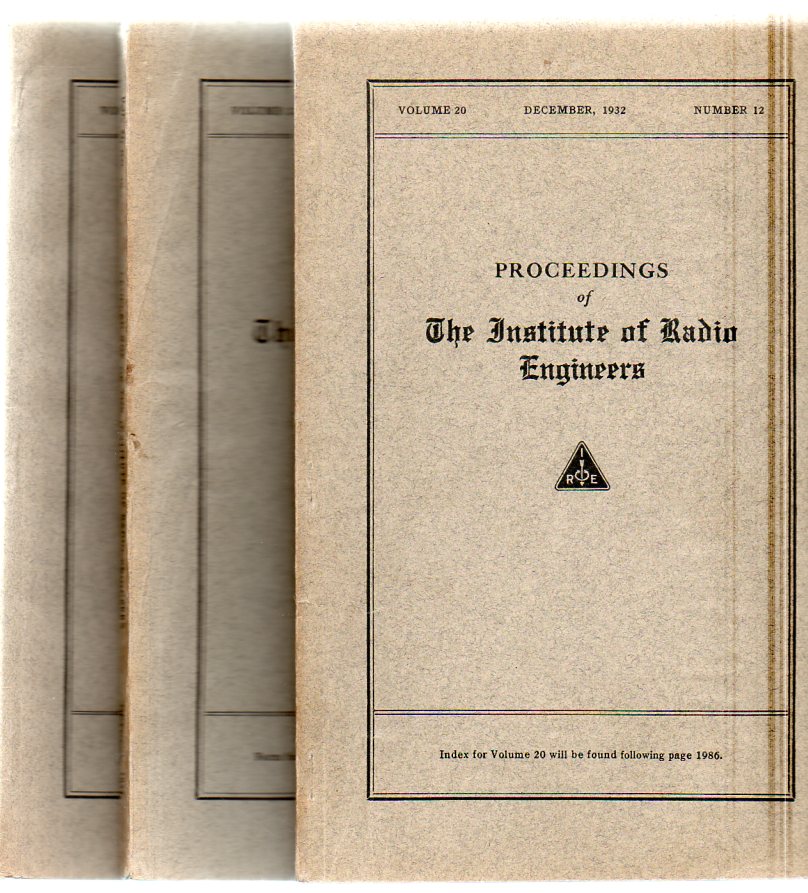
    Found in these three papers (below) is the description of the discovery of an entirely new astronomy, a brand new way of looking at the universe.  Instead of using telescopes operating at optical wavelength of about 10-5 cm and gathering information visible to the eye, Karl Jansky used a technology that had previously been employed in transoceanic communication.  It was in the communication field that Jansky was working (for Bell Labs), trying to identify an interfering hiss, in which he came to realize (and displayed in this series of papers) that this long radio wavelength interference was something extraordinary, publishing his first results in 1932.1  It was later in 1933 that he published his findings that this “hiss” was not “local”, and the serendipitous discovery came from a source outside our solar system, which was a tremendously significant finding2, “his revolutionary claim that the hiss static seemed to have its origin in our Milky Way galaxy, with a maximum in a direction that pointed close to the galactic center” (American National Biography). His third paper of 19373 discusses further problems of interference in the short-wave systems.   (These three papers are offered for sale at our blog bookstore, here.)

    Jansky183
    But it wasn’t so significant to most of the rest of the astronomy world, because, well, no one rushed out to replicate his findings.  At least no one until Grote Reber, who (necessarily) built his own equipment (a 9m parabolic  radio telescope ) and set up shop in his backyard around 1937, publishing his results and confirming Jansky’s efforts in the Astrophysical Journal in 1944.  Also it should be noted that J.S. Hey (a British Army officer) detected radio waves emitted from the sun for the first tome on 27 February 1942. 

    Jansky was interested in pursuing this work in astronomy, but Bell Labs took him away from this area, giving him other assignments, leaving the rest of the new world of radio astronomy for others to operate in.  Subsequently, radio sources were found in stars and galaxies, and were emitted from entirely new classes of objects like quasars, pulsars and radio galaxies.   And in fact the discovery of the cosmic microwave background radiation which came through a series of surprises to Penzias and Wilson and which offered compelling evidence in support of the Big Bang (the background radiation of which had earlier been theorized by Gamow and Alpher and Wilson but which was evidently not known to P+W and therefore not referenced), was made in a similar way, via sweet serendipity, while the pair was working on something else for Bell Labs. 

     Karl Guthe Jansky, born 22 October 1905, died of a heart condition at age 44, 22 October 1950. 

    Notes:

    1) “Directional Studies of Atmospherics at High Frequencies.” In: Proceedings of the Institute of Radio Engineers, vol.20, no.12 (Dec.1932), pp.1920-1932.

    In fact Nickola Tesla and Oliver Lodge had previously attempted to detect radio emissions coming from the sun, but both failed, mainly due to the inhibitions of their equipment.

    (2) “Electrical Disturbances Apparently of Extraterrestrial Origin.”. In:  Proceedings of the Institute of Radio Engineers, vol.21, no.10 (Oct.1933), pp.1387-1398.

    (3) “Minimum Noise Levels Obtained on Short-Wave Radio Receiving Systems.”  In: Proceedings of the Institute of Radio Engineers, vol.25, no.12 (Dec.1937), pp.1517-1530.

    All published in the Proceedings of the Institute of Radio Engineers, Menasha, Wisconsin. : Institute of Radio Engineers, the three papers published 1932-1937.  All in their original printed wrappers. Very nice copies.  Very scarce. 

    See also:  Lang and Gingerich, A Source Book in Astronomy and Astrophysics, 1900-1975, Harvard, 1979, pp 30-31, paper #6. (The authors use Jansky’s paper of 1935, “A Note on the Source of Interstellar Interference”, published in the Proceedings of the IRE as the chief paper, though noting that the 1932 paper was the “first report on these studies”.   In this 1935 paper Jansky of course references his “former papers” (our #s 1+2 above).


    ·Posted by :

    ·in:

  • The Taking of Pelham One Two Three– in 1909

    JF Ptak Science Books   Quick Post

    Pelham 123192
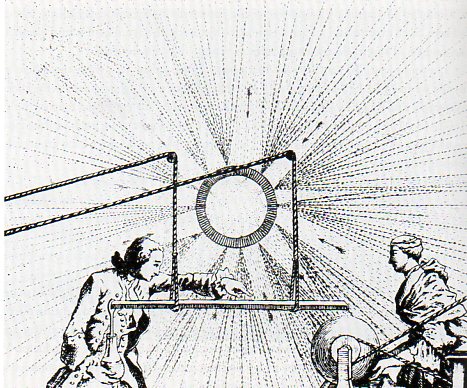
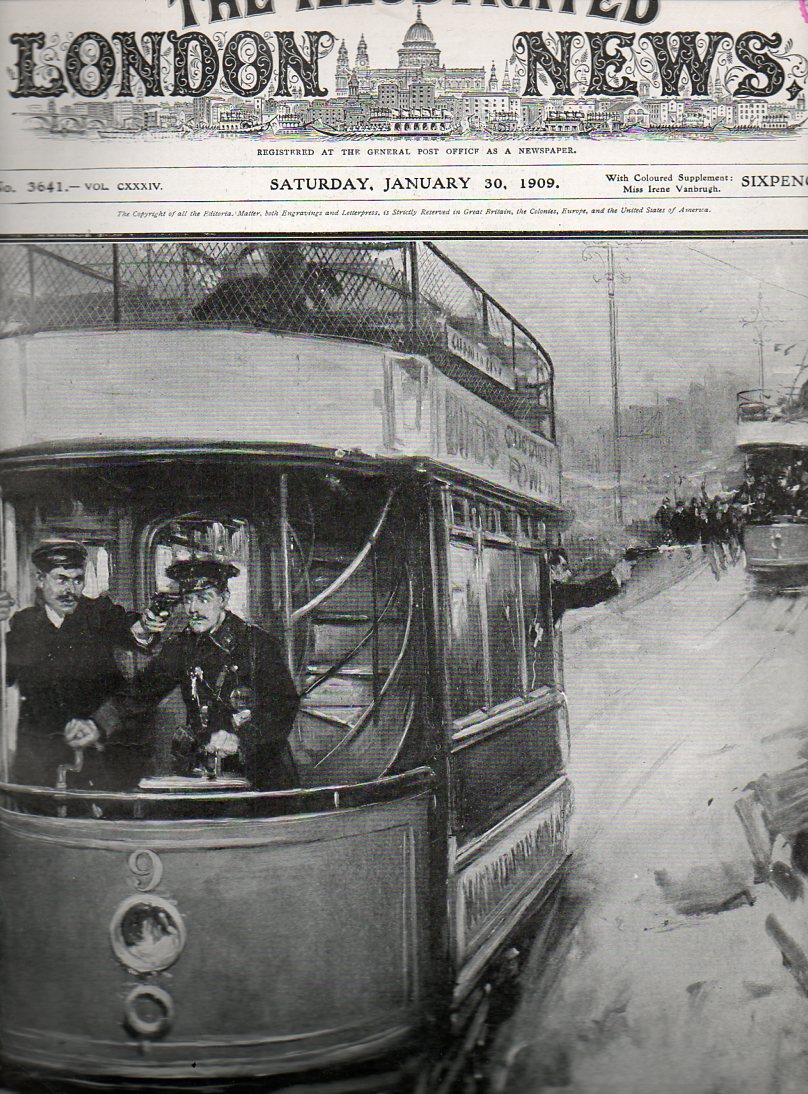
    No, this really isn’t a time tunnel to London in 1909 aboard the <6> train down Lexington Ave picking up speed from the Pelham Bay Park Station.  No, it didn’t travel back in time from the 1974 or from the great movie The Taking of Pelham One Two Three (and definitely not from 2009’s far-inferior John Travolta remake of that Walter Matthau/Martin Balsam classic). 

    Pelham 123191

    The Taking of Pelham One Two Three was a work of fiction, a book and movie about thugs hijacking a New York City subway train–complications ensue.  This image above shows a similar case, the Tottenham Affair, where robbing murderers–two “Russian Anarchists run amok”– hijacked an electric tram after their rampage, fending off the police, who pursued in another tram.  The episode lasted for a while, the two robbers winding up dead shortly thereafter.

    The image at top is not opening a hole in the space-time continuum–it was the illustration of a functioning Leyden jar, found in a work by Peter van Musschenbroek (1692-1761)  published in 1745. 

    ·Posted by :

    ·in:

  • A Peep into the History of the Future of Roads in Texas, 1938

    JF Ptak Science Books   Post 1396

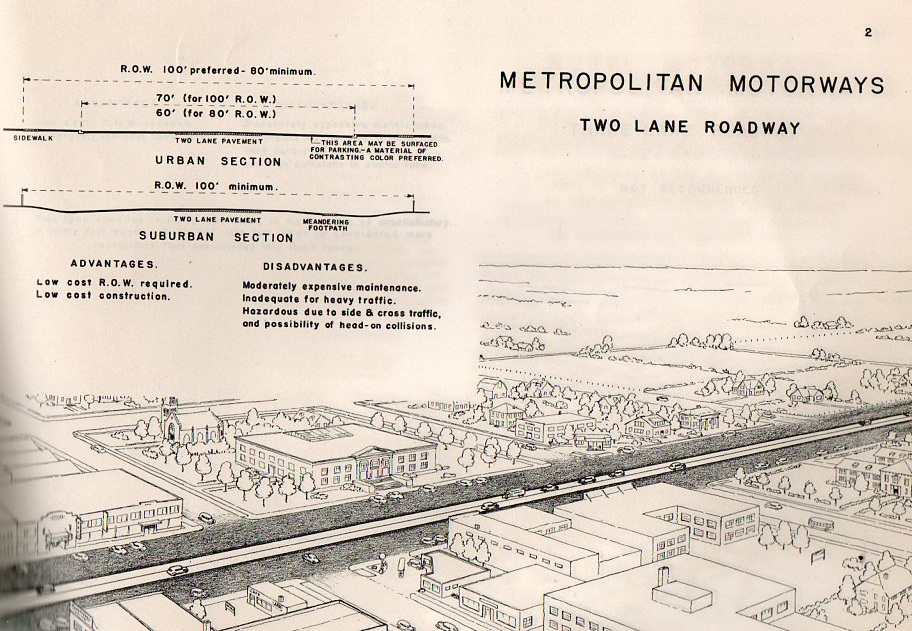
    The planners, designers, structural engineers and city planners in Texas felt the hot breath of the future on their necks in the summer of 1938, working their way to publish this futuristic emblemata book on the controlled motion of automobiles.  The Depression was coming to an end, access to money was loosening, automobiles were becoming cheaper and gasoline supplies were plentiful (even though during the crisis car sales fell though gas consumption increased), GDP was up by 1/3 from 1932, employment figures had gone up 25% since 1931, and of course there were projects of road-building got consider to put folks to work.  These figures were also a little problematic for Texas, given the huge percentages of farmers who were out of work (nationwide) and the preponderance of farming in the state of Texas. 

    But Jac L. Gubbels1, who copyrighted this work for the State Highway Department of Texas (Landscape Division) saw a prettier picture for the state in the near future, and what it had in it mainly were automobiles.  The highways proposed by Gubbels were remarkably wide given the number of lanes, particularly so for those roads that went through small towns. 

    Exas roads199 Notes

    1.  (From the Texas Centennial Archives:  “The harmonious integration of construction features and the natural environment was a popular trend during the Depression era. Called the "rustic style," this natural yet designed "rustic" landscaping of the early Texas roadside park system was largely planned by Jac L. Gubbels, landscape architect with the Texas Highway Department from 1933 to late 1930s. One of the first landscape engineers to be hired by a state highway department, Gubbels influenced the direction roadside parks were to take regarding landscaping, layout and style. His guidance set standards for construction elements and landscape design."

    8 other designs here:


Recent Posts

Archives

Categories