A Daily History of Holes, Dots, Lines, Science, History, Math, Physics, Art, the Unintentional Absurd, Architecture, Maps, Data Visualization, Blank and Missing Things, and so on. |1.6 million words, 7500 images, 4.9 million hits| Press & appearances in The Times, Le Figaro, Mensa, The Economist, The Guardian, Discovery News, Slate, Le Monde, Sci American Blogs, Le Pont, and many other places… 5000+ total posts since 2008.

  • At the Top of the World, 1851

    JF Ptak Science Books   Quick Post

    Finding the top of the world was easier in 1851–at least to this illustration, showing the Crystal Palace of the Great Exhibition of 1851 sitting firmly in place above all. I can imagine that if you were sitting in Hyde Park along with the 1851-foot long building, it would be easy to think that you were indeed at the top of the food chain.  The structure was the crowning achievement of the  Exhibition:  it was almost one million feet under iron and wood and glass, and could hold tens of thousands of people who could view the enormous gardens housed there. 

    Perhaps most astonishing of all was that the modular structure–design by Joseph Paxton–was moved three years later, in 1854, to Penge Place, where it stood until it was consumed by fire in 1936. 

    ·Posted by :

    ·in:

  • The History of Goodbye series: The Open Door in Eden

    JF Ptak Science Books   Post 1656   (Part of the History of Goodbye series)

    The idea of there being a door to Eden is an interesting one to me–not just for the view of Eden from the outside looking in, but really for the view of the Un-Eden seen through the open door, looking out. Its a curious thing to imagine what the first view of the rest of creation would have looked like–maybe curiouser to imagine why there was a door or gate there to begin with.  A door in Eden could’ve meant only one thing–the exit.  There wasn’t anyone there to enter Eden, and certainly Adam and Eve weren’t going to go out and come back, so I guess the door was the Ultimate Fail exit portal. Just waiting. (Also there doesn’t seem to be any mention of a door in Genesis, so this would just be further artistic spin on another version of the Fall of Man, a story which spins out from a place far older than the Old Testament.)

    [Image source:  Cornell University collections.]

    The door/gate doesn’t seem to appear very often (to my memory and experience, anyway) but this image–a rather famous one from the great Nuremberg Chronicle (printed in 1493 by Anton Koberger) offers us a little clue, as well as a mystery.  We see the temptation of Adam and Eve on the right, and their expulsion because of their inability to reconcile the threat of pleasure on the left.

    The open door doesn’t really reveal too much, from what I can see.  Those blobs might be smoke, or bushes, or something symbolizing The Dark and Disappointment. There are some bits of the Un-Eden looming above that could be above the walls–like the mountain that look like a person sitting back with a book with a head tilted towards the sky–making the life outside seem as though it might not be so pleasant.

    Adam and eve expulsion984
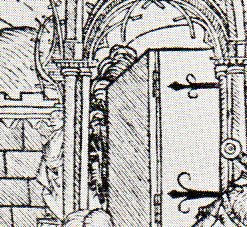
    And then there’s the mystery of the statue by the door–the statue of a figure holding a book or tablet and clothed in robes, standing on a pedestal by the door, in profile.  As Adam and Eve were the only people, its hard to imagine who that statue might represent, because all of those other people come later. 

    Perhaps it was just a little creative largess from a woodblock cutter practicing or showing of their perspective skills into a piece of the block’s image that is largely hidden.  Perhaps it was the same cutter who gave such great detail and belief to the flowing robes of the angel threatening Adam and Eve with a sword–there is certainly more skill involved there than anywhere else in the print, so much so that it makes me think that there was a truly accomplished hand brought in for that piece of flourish on the anonymously-produced image.

    In any event, a door in the walls of Eden seems to me a curious and taunting device–an exit door without an entrance.

    Here are some open-door/gate/portal examples, below, though none really show anything through the portal:

  • Dreaming of the 10-Ton Eiffel Tower Luxury Bullet–addendum

    JF Ptak Science Books  Post 736–addendum

     People find inspiration everywhere, insight to creativity in the obvious and not so.  Great statues have been envisioned in the depths of slabs of marble, solutions to mathematical problems in the step of a bus, the beginning of a new physics in the rolling ball in a wagon.  Its an old and very worn cliché, but the world can be seen in a grain of sand if you could just pieces together the bits of glass:  just as pointillism was seen in the not-simple intercession of two colors and cinematography in the latent image and the structure of the universe in a patch of dancing dust.

    ===blog==aug 30--eiffel

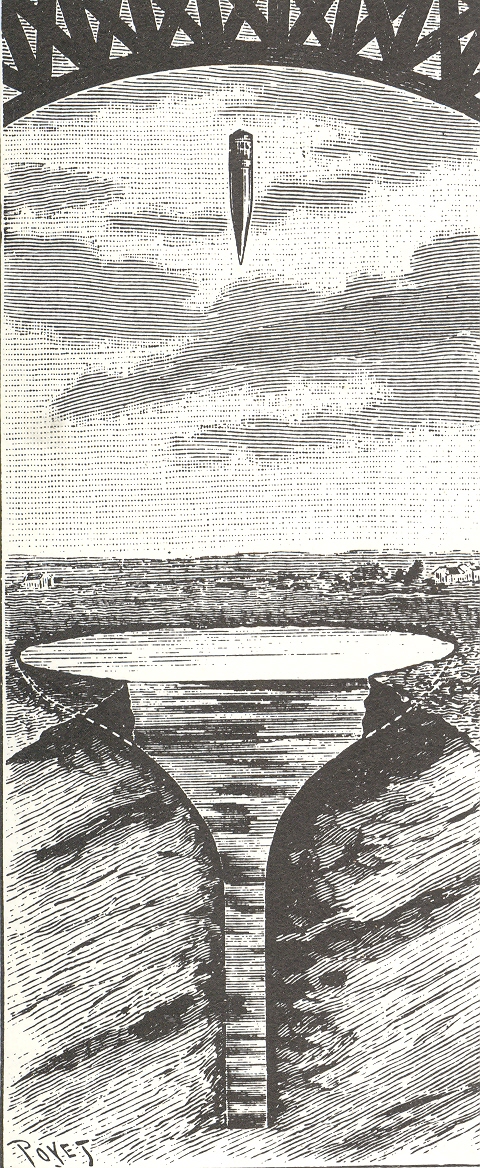
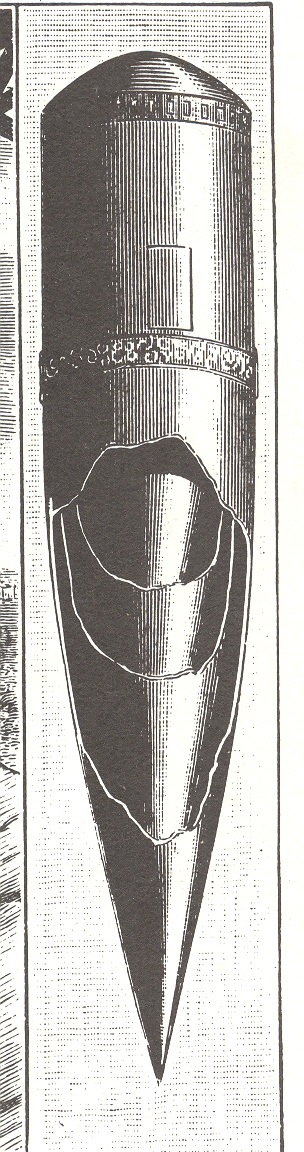
    The Eiffel Tower has had its own way with the visions of people, from it representing the birth of The Modern, to an icon of passion, to architecture and engineering innovation, and to general  adventure and the call of possibility.  It has moved other people to think “special” thoughts:  like, for example, what a lovely canvas it would be to place a 700’-tall electrified sign.  And to M. Carron of Grenoble, who may have the most unusual inspirations from M. Eiffel, the tower was the perfect place to drop a 40-foot tall, 20,000-pound bullet filled with 20 people in leather armchairs into a 200-foot deep champagne-glass pool.

    ===blog==aug 30--eiffelbullet

    This is certainly a singular insight.  But in 1891 it represented something a little more than just giving people a thrill ride.  Physics of impact aside for the moment, M.Carron’s bullet capsule would be released from the top of the interior of the Tower, about 900 feet above the ground, and released to fall into an excavated pool 150’ across and 200’ deep.  The idea was that in addition to the springs inside the capsule, the water would act as a “shock absorber”, and so “the shock felt by the occupants on landing will be in no way unpleasant”.  

    [Okay, so the thing would hit at 138mph or so, and, assuming that the whole thing wasn’t compromised on impact, I’m not so sure that 200’ of depth is very much wiggle room for the thing to come to a halt (if it didn’t deform).   Also it would have to not have any wind deflection so as to not veer off its perfect entry into the water.  And so on.]

    ===blog==aug 30--eiffelinside

    The thing is, though, the thing that made this so appealing, is that for the 20-francs that get a person a seat in the bullet, that they would each get to go twice as fast as any human had ever traveled before in a conveyance ( 65 miles per hour was about the speed of the fastest train constructed).  So it was an extraordinary claim, an done that doesn’t get made all that often in the history of locomotion.

    And so this wasn’t a practicable or workable idea; but, well, so what?  It was an unusual idea, inspired by some sort of different thinking, which are both good places to be in according to the Gazetteer & Atlas of Ideas.  Sometimes thinking like this is just prelude to something else, thought avenues that had to be explored before the real thinking could get done, introducing you to a new geography of thought.  That’s what M. Carron had going for him; the newness of his thinking was much more important than the wrongness of it.

    *This story comes at the end of a post called Bad Ideas Department:  the First Image of a Hypnotized Chicken, so in spite of the title you’ll wind up in Paris.

    ·Posted by :

    ·in:

    —
  • Big Numbers and WWII Aircraft–Artistic Displays of Quantitative Data

    JF Ptak Science Bools  Quick Post

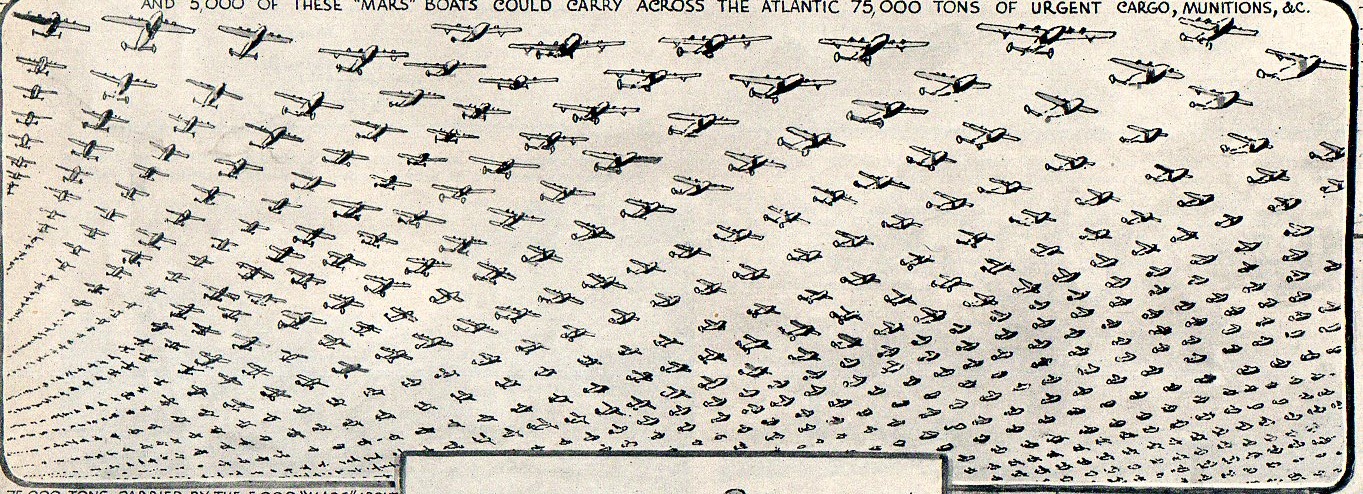
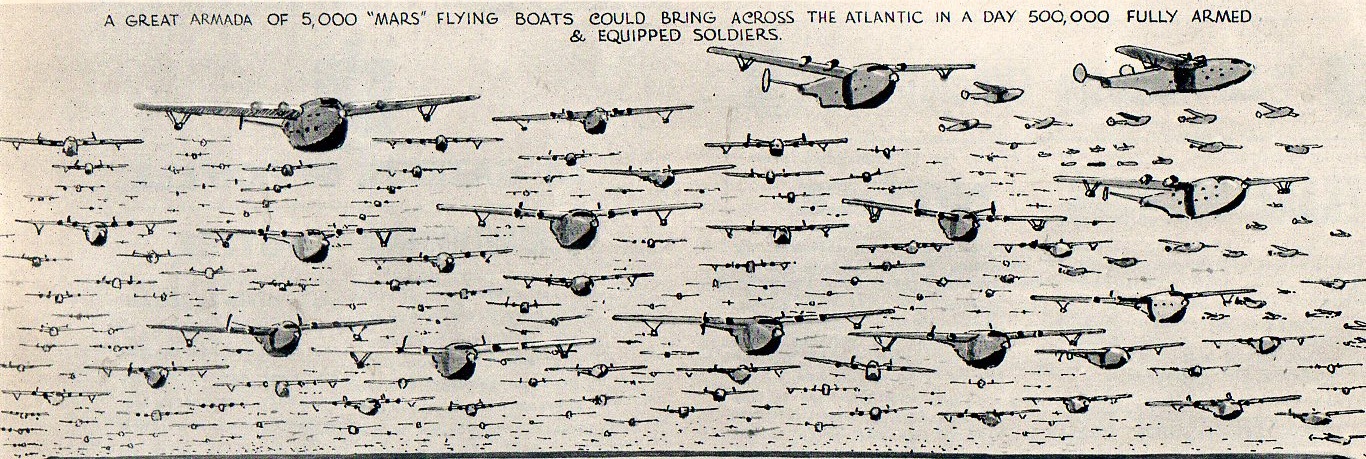
    This post continues an earlier series on the artistic display of quantitative data–putting a face on big numbers. In particular it extends a collection of images of Second World War airplanes, “A Big Sea of Planes:  Quantitative Display of World War II  Bombers. The images below appear in the 17 October 1942 issue of the Illustrated London News in an article about the possibility of replacing seaborne troop and materiel transport across the Atlantic from America with the big Martin JRM Mars aircraft, getting the troops there faster and safer and releasing at least part of the naval force for wartime activities.  The images are pretty compelling:

    Airport987

     The caption states that 5000 Mars planes could get 500,000 soldiers to Europe.

    Airport988

     These were big planes1 (200′ wingspan, 117′ long, 38′ high, more below) and could haul 130+ troops.  By the time though that the powers-that-be were figuring out who the main contractor would be for production (and those production numbers in early 1942 were about 500 per year, at that point, anyway) the Battle of the Atlantic was already–in 1943–fairly well decided.  The U-Boot problem was solved enough for a continuous flow of soldiers and supplies, though not without a high cost in the first half of the Atlantic campaign.  (Overall, from 1939 to 1945, some 3,500 Allied merchant ships  and 175 Allied warships were sunk, costing the lives of 72,200 Allied sailors and merchant seamen.  The Germans lost more than 780 submarines along with fully three-quarters of all sailors in the U-Boot fleet, making some 30,000 men.)

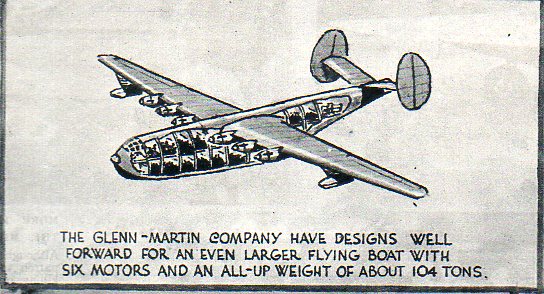
     Below, a cutaway for the Mars:

    Airport989

    Stats and Technical data on the Glenn-Martin(from Jane’s Fighting Aircraft of World War II, (1945):


  • An Episode in the History of Multiplication

    JF Ptak Science Books  Post 1657

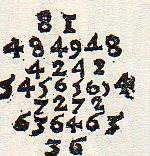
    Addition986


    Many thanks! to Ray Girvan and Thony Christie for solving this multiplication problem!

    Ray Girvan (JS Blog–Journal of a Southern Bookreader) http://jsbookreader.blogspot.com/2011/11/taglientes-multiplication-by-columns.html

    Thony Christie (Renaissance Mathematicus) http://thonyc.wordpress.com/2011/11/10/1202/

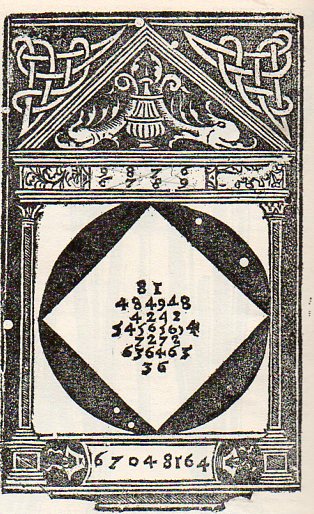
    Giovanni Tagliente was many things, though perhaps he wasn’t mathematically inclined, not really.  He was however a very capable putting together books and addressing some elementary needs of the working classes  that reached out into the mass of the great unwashed offering instructionals on how to do the basics of–in this case– applied mathematics, as with this book, Libro de abacho…1, this edition printed in Venice in 1564.    This was a  small, pocket-sized book2, a references on how to do the stuff of daily (and not so daily) calculations, and in principle was a concise, Humanist guideline for getting through the daily bits of the calculating and mercantile life.

    Addition985
    The above image is a woodcut diagram “explaining” how to do multiplication.

    To the 21st century eye however the actual explanations of how to conduct Tagliente’s approach to actually “doing” the math might not be so evident.  They seems to be inspired acts in helping the reader understand the process, say, of multiplication, though it does appear a little mysterious, and explanations for the actual process are–as the author(s) says–self-evident in the woodcut, and are not elaborated in the text. 

    I’ve been unsuccessful thus far in determining how the product to the problem of 9876 x 6789  (67.048,164) was reached via adding the individual results of the factors’ multiplications,  though seeing the individually parts of the calculation is apparent3 (explained below).

    I thought that this would be easier, because it was after all easier once upon a time, at least to people not me. 

    I think that I get a D+ on this one.  All I really wanted to say is that Tagliente’s diagrams are pretty. 

    ·Posted by :

    ·in:

  • 11 11 11: Veterans Day

    Veterans Day repost:
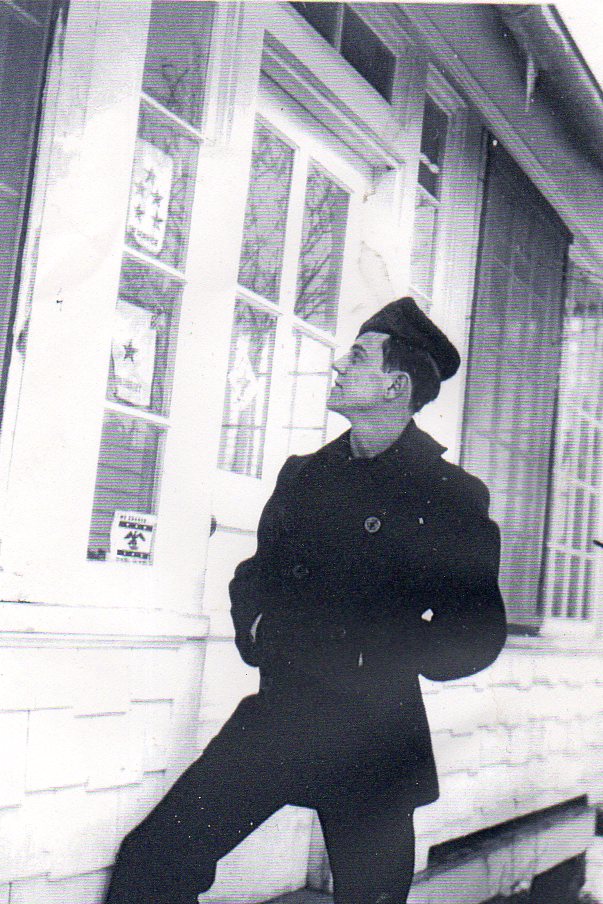
    I want to thank all Veterans today, all of our Veterans everywhere, for all of your sacrifices. I particularly want to say to say how much I appreciate the members of our family who have served: Uncle Pete (USMC, WWII), Uncle Ray (RCAF, RAF+USAAF, WWII), Uncle Stan (Navy, WWII), Uncle Alex (Army, WWII), Uncle Joe (Army, Korea), Uncle Jerry (Army, WWII), Uncle Frank (USAAF WWII), Uncle Walter (Navy WWII) and my other Uncle Stanley (Army, WWII), Uncle Francis (Army, WWII), Uncle Vincent (Army, WWII), cousin Billy (USMC, Vietnam) and Grandpa (Army, WWI); Patti’s father Melvin Lonnie (Navy, WWII) and stepfather Boyce (Army, 2nd US Cav WWII), Uncle Guy (USMC WWII), Uncle Max (Army WWII) and her four relatives in the CSA. Nearly everyone was in battle, and nearly everyone came home. [Image: Uncle Walter looking at the 5-star Blue Star flag, Housatonic, Mass, 1943.]

    Brothers 2990

    ·Posted by :

    ·in:

    —
  • Interesting Business Cards and Draft Registration Forms of Famous Folks

    JF Ptak Science Books   Quick (Fun) Post

    http://blog.psprint.com/wp-content/uploads/2010/06/einstein-business-card.jpg

    Curiously, this gives Einstein’s home address.

    Source:  PSPrint Blog

    http://marcird.com/images/Wile%20E%20Coyote.jpg

    ·Posted by :

    ·in:

  • Rockets to Outer Space, 1923

    JF Ptak Science Books    Post 1657

    http://www.rogersrocketships.com/UserFiles/Image/RRS_New_Docking_Bay_Images/DB_002_Die_Rakete_Book.jpg

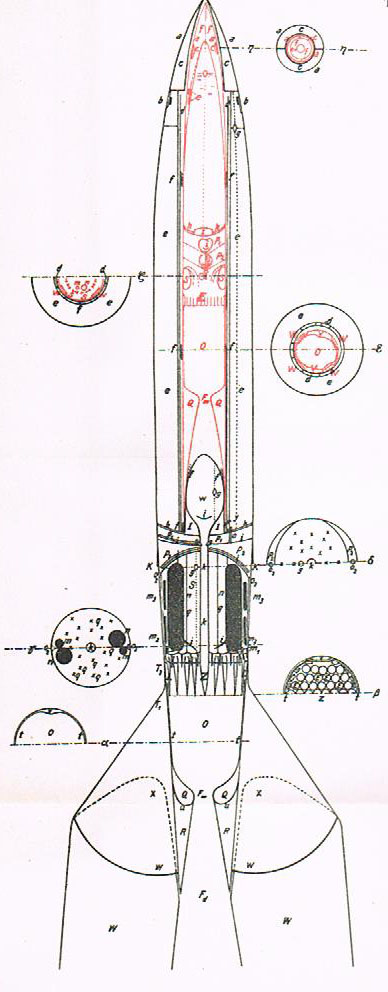
    This is some beautiful thinking and work by the rocket pioneer, Hermann Oberth (1894-1989)–the teacher of Wernher von Braun, a highly functioning leader at the Nazi V-1 and V-2 base of Peenemunde, and of course after the war working for various aeronautical/astronautical concerns in Switzerland, Italy, Germany and the United States. In America he would work for von Braun at Huntsville, Alabama from 1955-1959 on the Army’s ballistic missile program,  a late addition to the many German scientists scooped up right after the war in Project Paperclip and deposited in the Deep South. 

    The gorgeous design above is the front wrapper of his rejected doctoral dissertation, Die Rakete zu den Planetenbraeumen (“The Rocket Through Planetary Space” or “The Rocket to Interplanetary Space”), published in Oldenbourg in 1923.  Oberth’s work was printed in a very small edition and even at that he had to pay for part of the pamphlet’s printing–it turned out that the work was an instant success when issued, selling out quickly.  A second edition vastly expanded the original’s 92 pages into 429 in 1929. 


    Oberth
    In Old Testament vocabulary, Oberth’s work is Genesis for space travel and aeronautics–or at least he is one of two or three authors of Genesis, along with Goddard and Hohmann.

     
    The Modell B from The Rocket through Interplanetary Space -H. Oberth 1923

    As it turns out, in his extra moments, Oberth served as a technical advisor to Fritz Lang on his film, Frau im Mond, and his influence shows, even from cursory examination.

    Image

  • On What Cost What–Treating the Navy’s Sick and Injured, 1813-1817

    JF Ptak Science Books   Post 1659 (expanded)
    Us navy medical 1817683

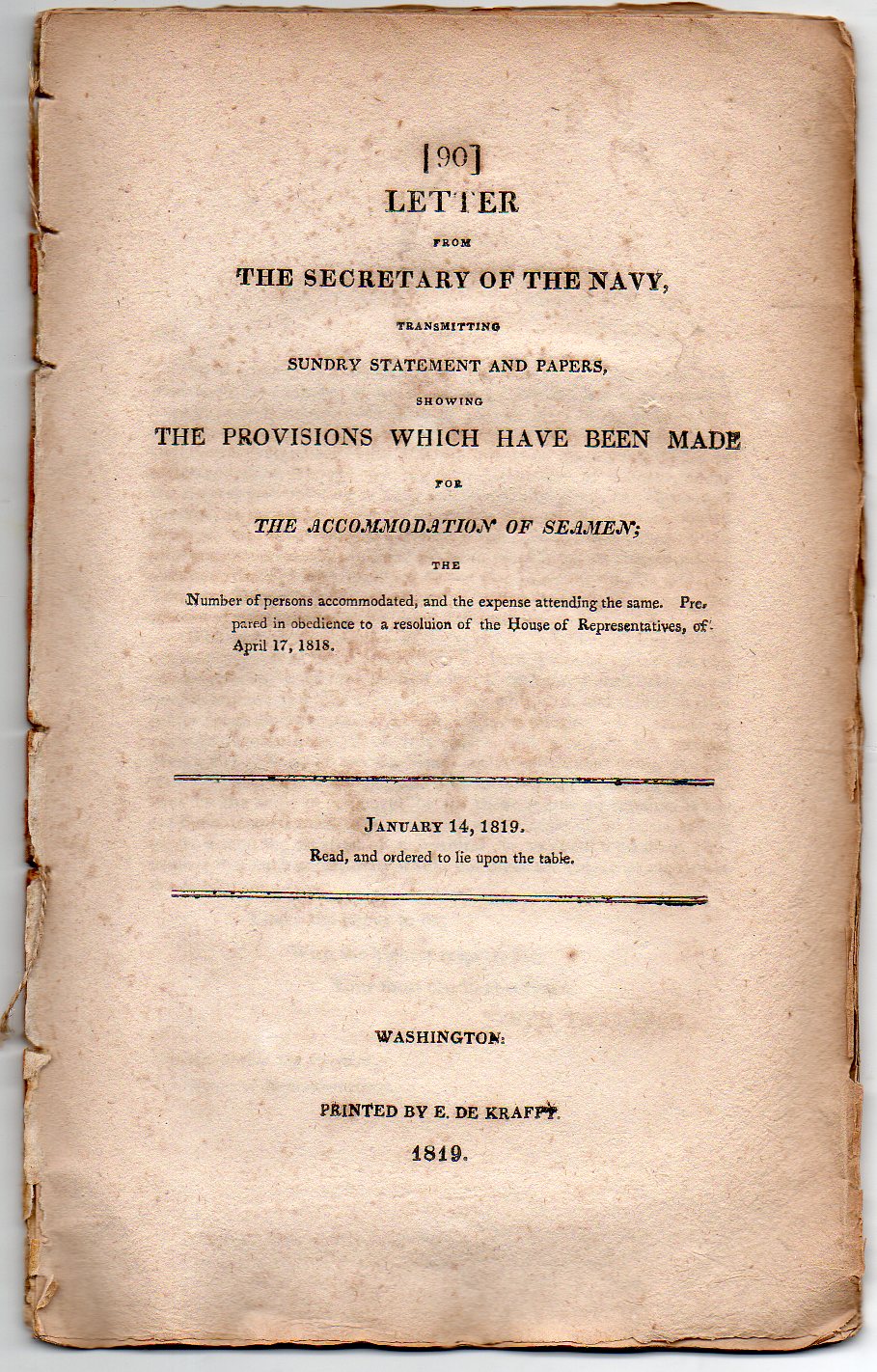
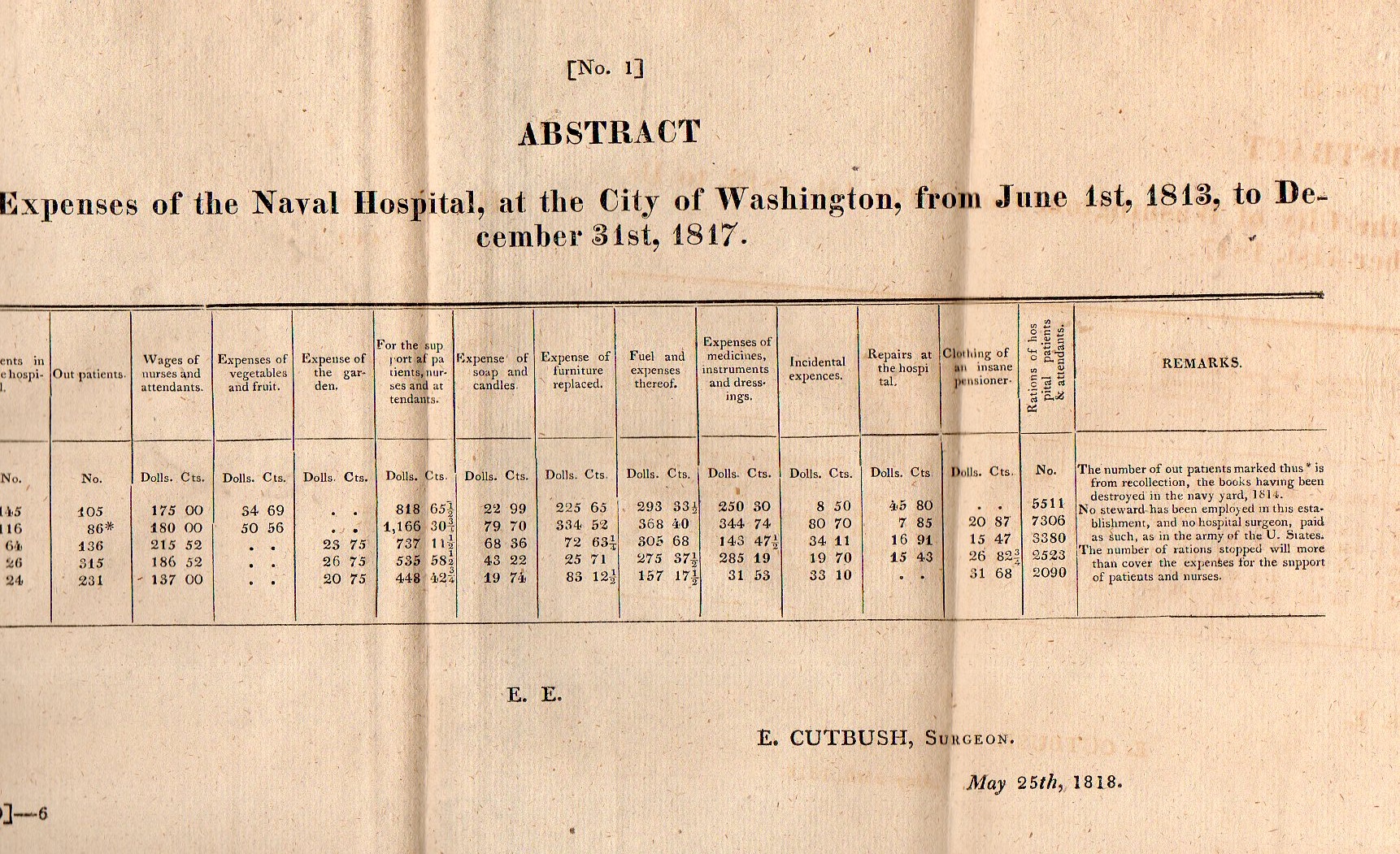
    Medical  expenses995When you think of expense and medical care, why on Earth should any of it cost so much?  Well, that question would make more sense if asked in the year 1819, because–according to the make-believe history of Medical Billing Capacity– the need for compensation for knowledge or spent stores or supplies or whatever was not very great, at all. 

    E(ward) Cutbush, a very capable naval surgeon (and noted as the father of modern American naval medicine) attests to this, and did so in this report on the status and expense of the hospitals and medical care facilities available to the U.S. Navy (and which was published in 1819). He didn’t of course know necessarily that health care wasn’t very expensive at all–especially if relation to the price of wine–Cutbush just reported the numbers. 

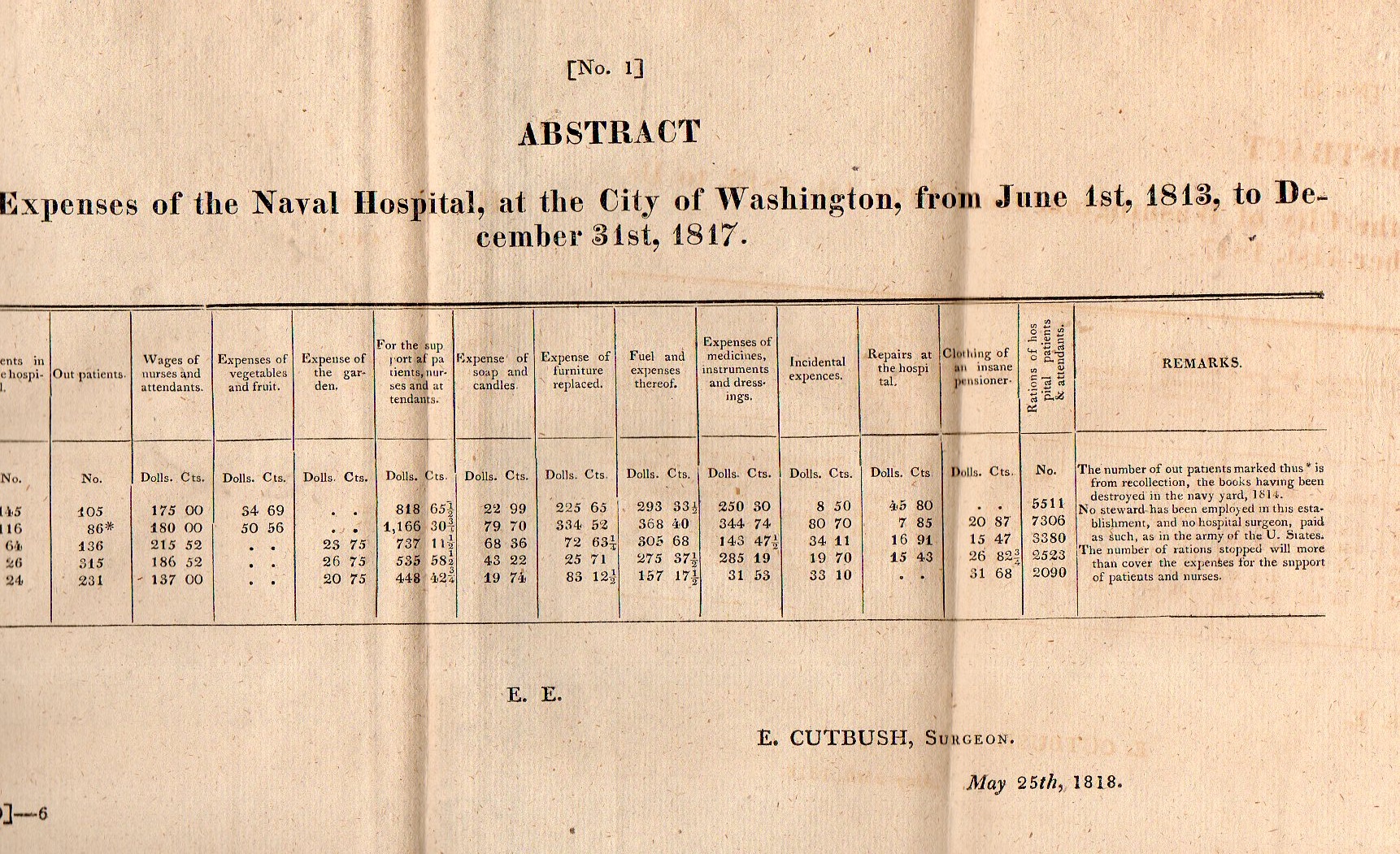
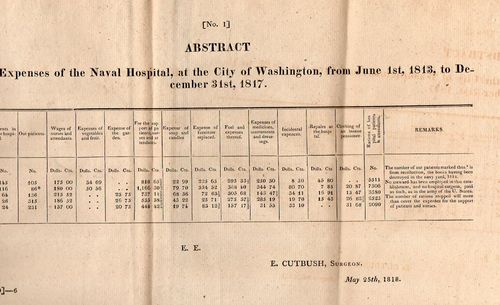
    And the numbers are interesting:  in 1814, for the U.S. Naval Hospital in Washington, D.C., for the 116 inpatients and 86 outpatients seen during the year, a total of $344.74 was spent on “medicines, instruments and dressings”, $1,166.30 on “support of patients, nurses and attendants” (which really meant food and sundries),  and another $180.00 in wages for  “nurses and attendants”.  By comparison, $79.70 was spent on soap and candles, $334.52 on replacement furniture, and $368.40 on fuel. $50.56 was spent of fruits and vegetables.

    And somewhere in there, we are shown that about $30 was spent on “clothing of an insane pensioner”, which I guess must mean that some old Seamen were judged to be “insane”, and needed clothing, before they were sent off and away from the hospital. 
    US navy medical spreadhseet

    [This image is clear once enlarged.]

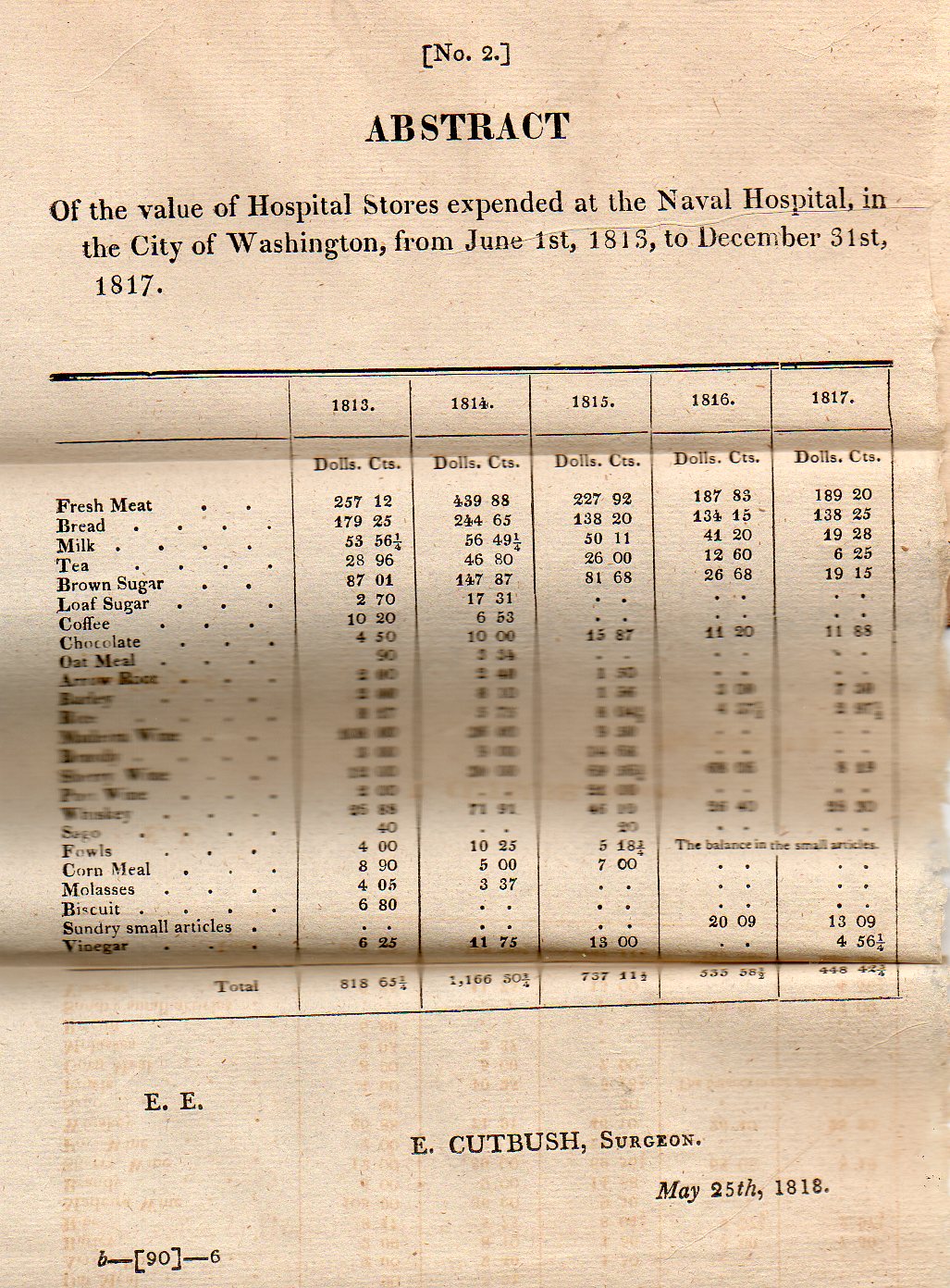
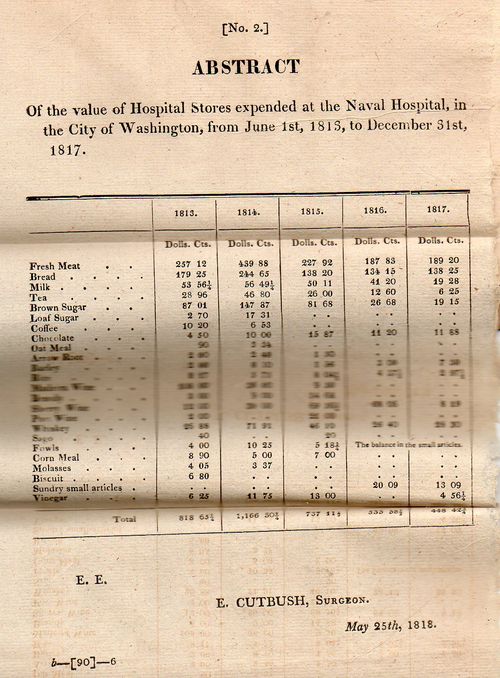
    A little bit further on, Cutbsuh tells of the more exact expenses on food/”support” for the folks at the  D.C. hospital  in 1814.  By far the leading expense (in the total of $1,166.30 3/4) was meat, meaty fresh meat, which accounted for nearly half of the total outlay ($439.88).  Bread was next ($179) followed by Madeira wine ($108).  Actually all of the alcoholic beverages–which included Madeira, brandy, sherry, port and whiskey) added up to $153.00, almost as much as bread.  Meat, bread and booze then accounted for $726, or 62% of the food budget (less the minimal cost of fresh veggies).  Milk, tea and coffee weighed in at $92, which means the drinking-goods totaled $245, or 21% of the food outlay.  Barley, rice, oat meal corn meal and “biscuit” came in at $24; vinegar, molasses and brown sugar surpassed those staples at $97.
    Medical  expenses993

    We don’t get any information on the surgeon’s pay, unless we look at the stats for the naval hospital at Baltimore.  There, for 1814, we see that $352.00 was spent on medicine, $80 on surgeon’s instruments, $231 on fuel, $1645 on provisions, $18 for nurses, $18 for cooks, and $1282 on surgeon pay.  Unfortunately, I cannot find how many surgeons were called to receive this compensation, but we can see that their pay consumed 26% of the hospital expenses while caring for a total of 244 sailors over the run of one year.  It is not impossible that there was one surgeon on hand, and one nurse.  So, each sailor getting care from Baltimore received about $1.44 worth of medicine for their stay; the nurse and cook each got about 7 cents for each of the patients receiving care there, and the doctor picked up about $5.25 per sailor.

    Of course there wasn’t much in the way of surgical tools when compared with even the late 19th century to spend money on–ditto medicine.  Stand-alone hospital machinery was virtually non-existent in 1814, and so the major factor upon which all hopes were laid was the surgeon, a sort of walking hospital–a job of superior messiness and long and lonely responsibility.

    These numbers were for the late period of the War of 1812, when more than 2,650 servicemen were killed and 4,500 wounded.I could not in a cursory effort find the number of surgeons serving or employed during 1814, nor an overall figure on total medical care cost for seamen.  But it does seem likely that more was spent on milk, bread and booze than on medicine and surgical instruments.  And certainly the doctor cost far more than any other single unit int he medical care scheme–and, given that the greatest part of all care necessary resided with the physician, it was probably worth every penny (or fourth thereof.)

    Notes:

    1.  Cutbush at this time was given the direction of the “Marine and Navy Hospital establishment and of the medical and hospital Stores, which may from time to time be required for the use of the hospitals, or for the vessels of the United States equipped at this place.”-–Dudley, William S.. The Naval War of 1812, a documentary history, Volume 3.. Naval Historical Center, 1985.


    ·Posted by :

    ·in:

  • A Curious Episode in the History of Sitting–Speed Chairs & Trainless Trains

    JF Ptak Science Books    Quick Post

    Sidewalk 997
    It may be that the history of human locomotion is the story of fast sitting.  Except for some of the earliest incarnations of powered movement, it seems one of the most significant engineering aspects moving a person forward is how that person should be carried in the vehicle.  And, well, it seems that in the vast majority of cases, the person is sitting. (There are of course exceptions, notably in say the standing of the engineer in the Tom Thumb when that locomotive set the land speed record;or the Wright Brothers’ powered aircraft, where the pilot was laying down; or say in a chariot powered by a team of horses. Even in some of the earliest versions of steam-powered tractors, the mammoths were steered by a standing operator. It seems though that in very quick order the operator in most of these vehicles find themselves in a seated position.)

    Sidewalk 998

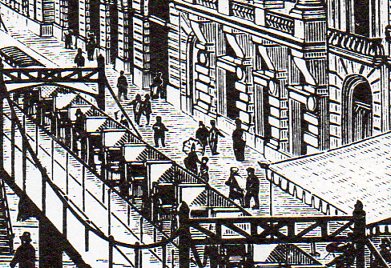
    A very curious application of moving seated humans is seen in this woodcut of a chaired walkway–for all intents and purposes, the pedestrians looking to use the moving sidewalk would have been offered a chair instead.  It seems as though as its base that this was a very simple form of an elevated subway or trolley, though without the train. 

    The moving seated sidewalk was the dreamchild of Alfred Speer (1823-1910), of Passaic, New Jersey, and it seems as though it might have been the first form of mass rapid transit in the city for which it was intended, which was NYC.  It stood fairly high in the opinions of some prominent New Yorkers (like Horace Greeley and Peter Cooper) when it was presented in the early 1870’s, and even passed the New York State Legislature in an act authorizing funding for the program in 1873 and 1874–but it was each time vetoed by Governor John Dix, and the people-moving dream ended there, right before the Centennial.  (See here for the New York Times obituary for Speer., and see All Ways NY blog for a longer look at Speer’s moving sidewalk, here.)

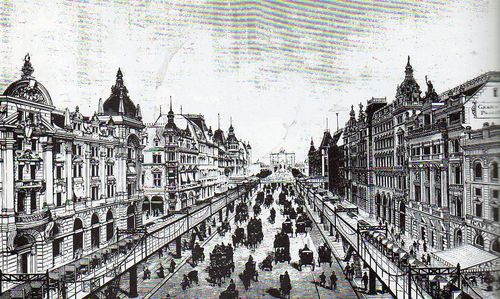
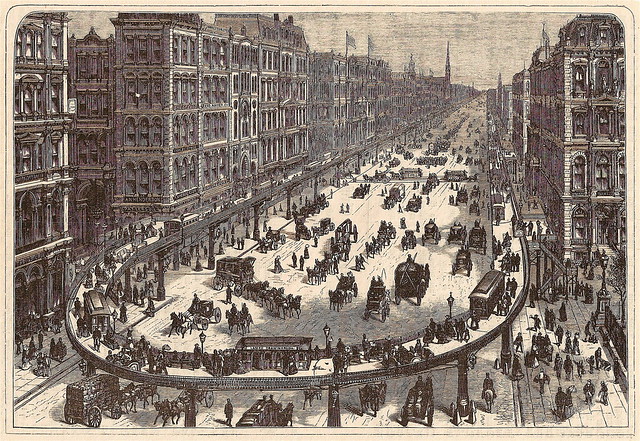
    Here’s another version of Speer’s idea, though this look more like a moving sidewalk, complete with trolley cars, all of which were stationary objects located on the moving walkway.  The idea of course was to free up the chaos and gridlock of the very busy areas of Broadway by placing a large chunk of the confusion on a moving second floor.  It seems as though it might have been a good half-year idea or so, and the $3.7 million dollar price tag might’ve been a hefty one if you calculated the cost per minute of relieved traffic. 

    photo

    [Picture source:  All Ways NY.]

    Mr. Speer seems to have let his vision go and settled down to a life of wine making.

  • Infographic Display of the Dead with the Living–1912 Aviation Losses

    JF Ptak Science Books Quick Post

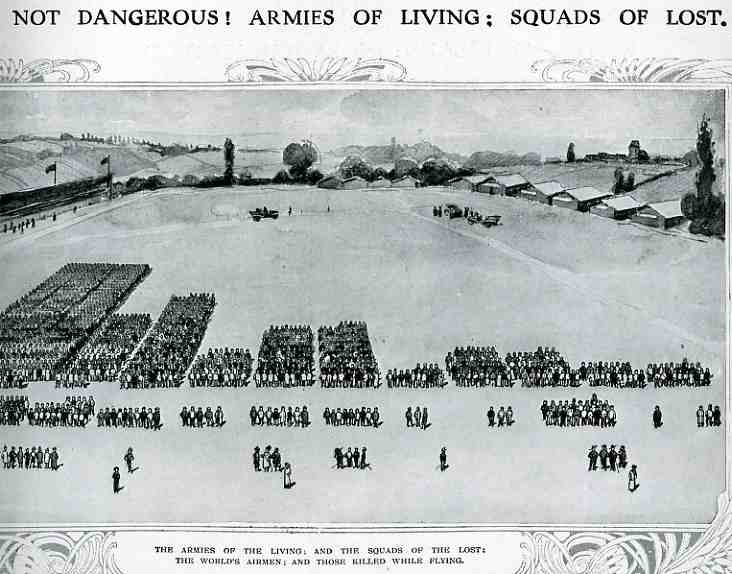
    Even though masses of people had been used in panoramic photography for some years (thousands of people, usually soldiers, gathered to form a living liberty bell, or portrait of George Washington, or some such thing) , I cannot recall the use of humans as a direct statistical aid as in this bio-bar graph, found in the pages of The Illustrated London News for 1912 (page 357). 

    000-ebay--Nov 7 air death005

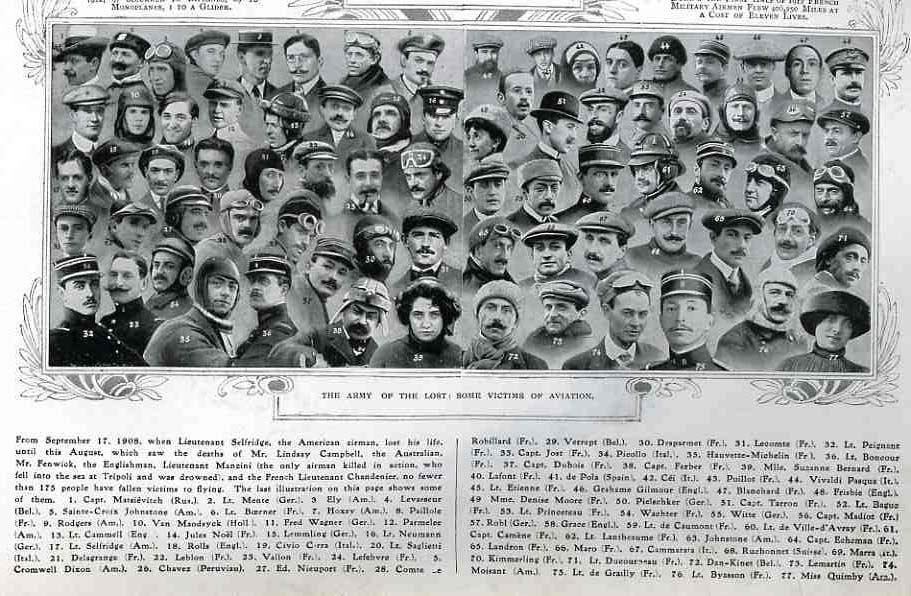
    The article asks the question of whether air travel (and flight in general) was “safe”, and responded by graphing its “yes” response with this image. The larger groups in the top half of the image represent the number of flyers flying for that particular country; the small groups below show the number of aviators killed.  (There is no date of reference in particular but it seems to me that these are total deaths since flying began in Europe in earnest in 1905.) The photo montage below shows a selection of some of the most famous dead aviators. The number of deaths as a percentage of those flying seemed quite acceptable in the year of publication (1912) ; however if these figures were iterated forward to 2011 the death rate would be staggering, sending many thousands of aviators (and crew and passengers) to their deaths each year.  In the United States we save that safety failure for deaths in automobile accidents, which still kill about the same number of Americans each year as were U.S. soldiers lost for the entire war in Vietnam.  In spite of this the odds for survival looked pretty good in 1912. 

    000-ebay--Nov 7 air death portrait006

Recent Posts

Archives

Categories