JF Ptak Science Books Post 736–addendum
People find inspiration everywhere, insight to creativity in the obvious and not so. Great statues have been envisioned in the depths of slabs of marble, solutions to mathematical problems in the step of a bus, the beginning of a new physics in the rolling ball in a wagon. Its an old and very worn cliché, but the world can be seen in a grain of sand if you could just pieces together the bits of glass: just as pointillism was seen in the not-simple intercession of two colors and cinematography in the latent image and the structure of the universe in a patch of dancing dust.
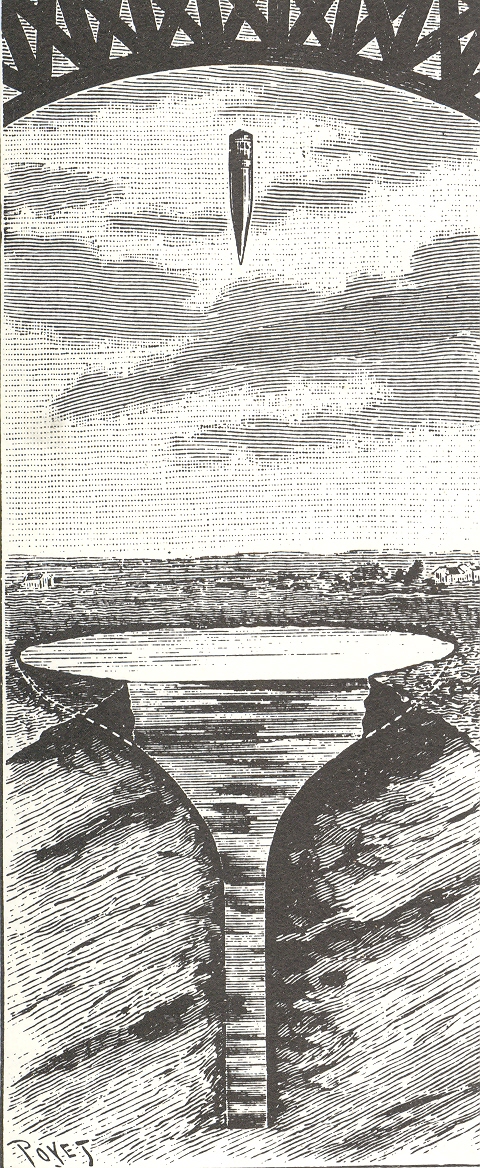
The Eiffel Tower has had its own way with the visions of people, from it representing the birth of The Modern, to an icon of passion, to architecture and engineering innovation, and to general adventure and the call of possibility. It has moved other people to think “special” thoughts: like, for example, what a lovely canvas it would be to place a 700’-tall electrified sign. And to M. Carron of Grenoble, who may have the most unusual inspirations from M. Eiffel, the tower was the perfect place to drop a 40-foot tall, 20,000-pound bullet filled with 20 people in leather armchairs into a 200-foot deep champagne-glass pool.
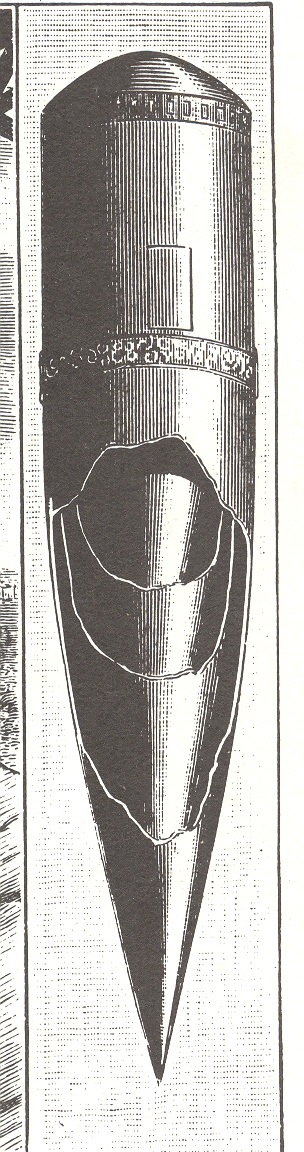
This is certainly a singular insight. But in 1891 it represented something a little more than just giving people a thrill ride. Physics of impact aside for the moment, M.Carron’s bullet capsule would be released from the top of the interior of the Tower, about 900 feet above the ground, and released to fall into an excavated pool 150’ across and 200’ deep. The idea was that in addition to the springs inside the capsule, the water would act as a “shock absorber”, and so “the shock felt by the occupants on landing will be in no way unpleasant”.
[Okay, so the thing would hit at 138mph or so, and, assuming that the whole thing wasn’t compromised on impact, I’m not so sure that 200’ of depth is very much wiggle room for the thing to come to a halt (if it didn’t deform). Also it would have to not have any wind deflection so as to not veer off its perfect entry into the water. And so on.]
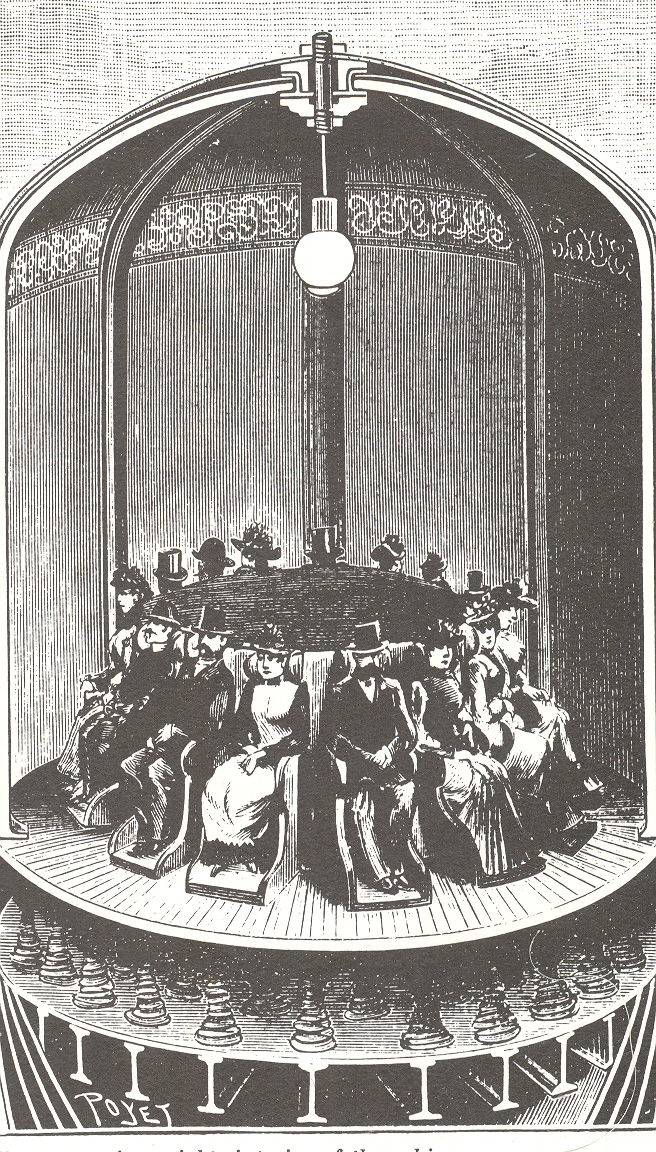
The thing is, though, the thing that made this so appealing, is that for the 20-francs that get a person a seat in the bullet, that they would each get to go twice as fast as any human had ever traveled before in a conveyance ( 65 miles per hour was about the speed of the fastest train constructed). So it was an extraordinary claim, an done that doesn’t get made all that often in the history of locomotion.
And so this wasn’t a practicable or workable idea; but, well, so what? It was an unusual idea, inspired by some sort of different thinking, which are both good places to be in according to the Gazetteer & Atlas of Ideas. Sometimes thinking like this is just prelude to something else, thought avenues that had to be explored before the real thinking could get done, introducing you to a new geography of thought. That’s what M. Carron had going for him; the newness of his thinking was much more important than the wrongness of it.
*This story comes at the end of a post called Bad Ideas Department: the First Image of a Hypnotized Chicken, so in spite of the title you’ll wind up in Paris.