A Daily History of Holes, Dots, Lines, Science, History, Math, Physics, Art, the Unintentional Absurd, Architecture, Maps, Data Visualization, Blank and Missing Things, and so on. |1.6 million words, 7500 images, 4.9 million hits| Press & appearances in The Times, Le Figaro, Mensa, The Economist, The Guardian, Discovery News, Slate, Le Monde, Sci American Blogs, Le Pont, and many other places… 5000+ total posts since 2008.

  • On the Social Bedrock of Poor London, 1854

    JF Ptak Science Books   Quick Post

    Reading Dickens now and stopping for a view of socially-conscious England via the excellent Victorian London website in the work of George Godwin’s  79-page critical exposition London Shadows, a Glance at the “Homes” of the Thousands (1854).  The images are awakening and abrupt–all the bitter observation of George Orwell, only told much more quickly, like a person trying to describe a raging house fire before the thing burned itself out.  Its a powerful work, and I can’t help but think that those reading it in 1854 must have been appalled not only by the deep visualization of the state of the working poor, but also by its scope, and the possible revelation of England’s basic bedrock.

    There are any more works to chose from at Victorian London–I decided to pry out the images from the Godwin work along with his commentary on them.  It is truly a stunning work.


    http://www.victorianlondon.org/publications4/shad-12.gif

    “When every man is his own end, all things will come to a bad end.”
                                                                                                        COLERIDGE.

  • Great Reads for Kids–and Adults–from the Library of Congress

    JF Ptak Science Books   Quick Post

    Here are some of my favorite (classic) books for children that I’ve culled from the lovely read.com pages at the Library of Congress.   The baseball alphabet book is fantastic (and from 1884 I believe).  The Peter Newell Rocket book is another marvelous thing (along with his Slant book, both of which sorta/kinda remind me of PEter Reynolds.)  You can follow the linkis to beautiful images of the texts and illustrations.  (All text below is from the LC site.)

    • “Baseball ABC”
      This guide to baseball literature features an illustrated paper cover and chromolithograph illustrations.
      Read This Book Now »

    • The Rocket Book “The Rocket Book,” by Peter Newell
      The upward progress of a rocket, lit in the basement by the janitor’s son, causes some strange situations as it passes through 20 floors of apartments!

      Read This Book Now »

    ·Posted by :

    ·in:

  • On the Intellectual Power of Bathrooms–the British Museum, Education & Poor People in the 19th c.

    JF Ptak Science Books     Post 1649

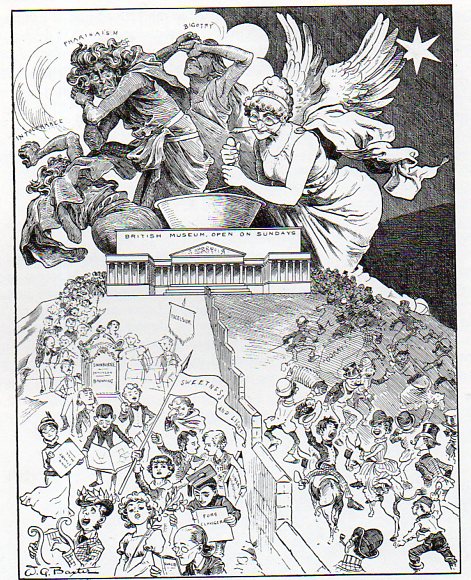
    People, working people, the so-called “vulgar classes”, sailors, unescorted women, married women with babies, people who worked with their hands, people who worked (in general), all began their assault on the previously-just-for-the-“correct”-classes knowledge base of England–the British Museum–in the first third of the 19th century.  It was a failed attempt, really, because the powers-that-be of the Museum were repulsed by the idea of the underclasses coming in to the place were the proper people came to learn, fearful that they would be repelled by their lowered and unfortunate brethren.

    Sunday975

    [“A Dream of the Future”–the Sunday Opening, from Judy, 1885.  Source: Lynn Barber, The Heyday of Natural History, Doubleday, 1980, page 166.]

    The Museum wasn’t open very much at all–only three days a week, receiving people between the hours of 10 and 4, restricting access to women with children, to women in general, as there weren’t any restrooms for females.   I’m not sure when the first women’s facilities came into being at the Museum, but it took them until 1879 before the place was opened daily.  And “daily” means every day, every day but Sunday, Sunday being a day not only of various religious obligations (which I think was the least of it), but also a day in which the greater percentage of the working class was not working ( which I think was the root of the issue).  That privilege of opening the Museum to the great unwashed, opening the place on Sunday, didn’t occur until 1896. I imagine even then that there was resistance to the innovation of reaching out to working people.

    The odd thing, now, is that many museums and libraries have been limiting their public hours, closing on Sundays, the day on which most people today find themselves not at work, restricting themselves to availability to a population of people who may mot be working a 5/6 day workweek. Plus ca change, plus c’est la meme chose.


  • Geography and Geology in Renaissance Art, #1–Rondo Island Earth and Eden

    JF Ptak Science Books   Post 1650   (Part of a series on the History of Blank, Empty and Missing Things.]

    [I wrote earlier in this blog on maps of the Garden of Eden, here.]

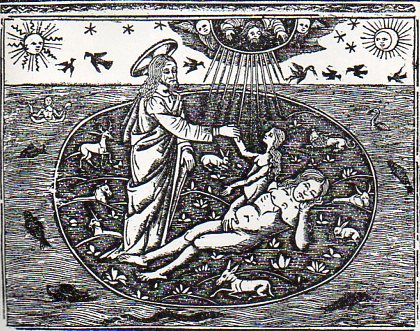
    This island is Island Earth, the chuchified beginnings of humanity, showing the creation of Woman from the rib of a sleeping Adam. I’m not referring to the 500-odd place names in the U.S. identified as “Eden”:  there are cities, towns, and villages named “Eden”, plus valleys, creeks, lakes, schools, shopping centers, malls, plazas, forests, and cemeteries–though I must say the though of an “Eden Cemetery” does sound appealing.  I’m talking about the Eden of Genesis–though Eden hardly makes an appearance anywhere else in the Bible.  Nor for that matter does the Fall of Man.  I’m also not talking about earlier references to Eden-like places, like Heden of the Persians, or the “Islands of the Blessed”/Elysium of the Greeks, or any of the other earlier versions of a paradise (some complete with a tree of knowledge/life guarded by a serpent/dragon) from which the Genesis version must surely have drawn.  This is strictly Old Testament, here.

    It is interesting that this image is a suggestion of the anatomical event, because Adam is shown whole and unmolested–I’ve seen many versions of this image showing Eve actually emerging from an opening in Adam’s side, but the artist here is content enough with the suggestion of the bio-event. 

    Islands977

    [Source: Jac. Phil. Foresti Bergomensis, SUpplementum supplementi chronicarum ab ipso mundi exordio…printed in VEnice, by G. de Rusconibus, 1510.  See the full image in the continue reading section.] 

    Eden seems set adrift in the sea of everything, floating there while the big change comes over Adam. (It is also fun to note that the hallow of the creator is given a three-dimensional affectation–perhaps later we’ll deal with the various shapes of hallos.)  Eden is supposed the perfect circle, held afloat by the great waters.

    Here’s another version, keeping somewhat within the Island Earth concept, but showing Eve emerging from a dourly distracted Adam–definitely this time connected to Adam in some way, though without any open cut.  (This image is from the great Bible of Anton Koberger, 1493. Picture source, here.)

    eve-koberger


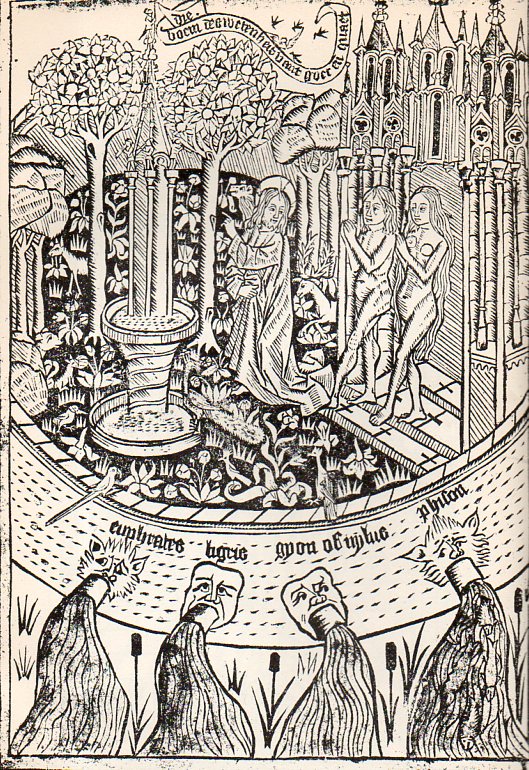
    Here’s nother image of the Garden of Eden as rondo, from Ludolphus de Saxonia (a Dominican for many years and a 14th c figure), Thoeck vanden leven ons heern ihesu christi (1487), which was I think the greatest Dutch achievement in the making of books in their history of early printing,  century, and in general one of the most beautiful woodblock books ever printed:

    Islands978
    Eden is again fortified, this time in stone, with the ornamental drainspouts of the four rivers making their exit in the foreground.  The glory of Eden abounds, but it is temptation that is presented them.

    Another version of Eden, this time in a rectangular configuration, is seen in this 17th c engraving, finding Eden on the map on lower Mesopotamia. 


    원본 크기의 사진을 보려면 클릭하세요


    There are other versions of Round THings that abound in Renaissance images, and we’ll get to them later, along with the depictions of caves, islands, and roads/paths meandering into infinity–those will come in just a little bit. 

  • The Weight of Humanity in Images on Book Covers

    JF Ptak Science Books  Post 1651
    Blogaugust_27_crowds_stand456

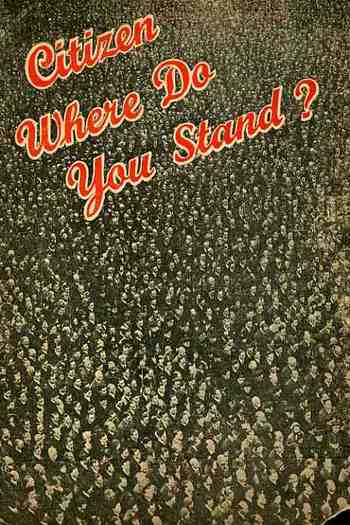
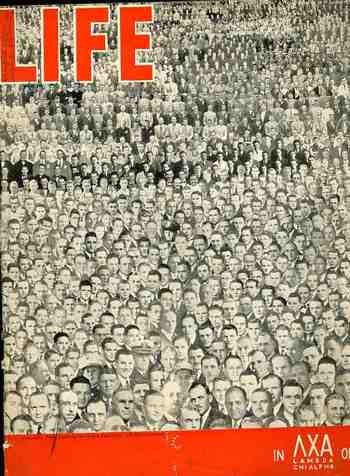
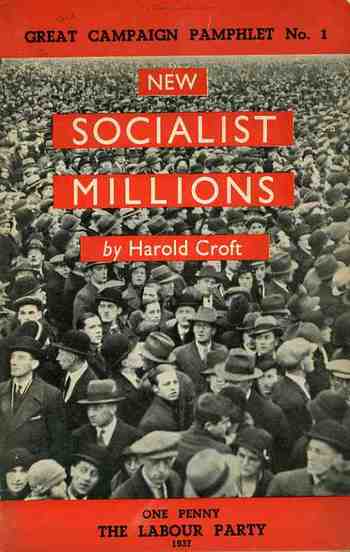
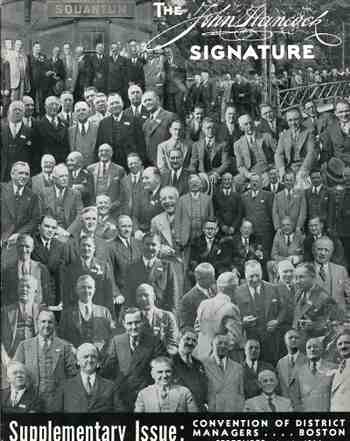
    I don’t often see covers of pamphlets featuring hundreds–or thousands–of people as a part of the design.  In my continuing role as finder and re-finder of things found I have re-surfaced four of these designs, and I feel I should post them before they’re captured in the un-finding process.  Again. Back to the design:  these are very striking, persuasive images, unavoidable in many ways, completely intriguing, beguiling.  People just have to look at these things.  Look:  I made a little experiment today placing ten  very interestingly-designed pamphlets on display, all with compelling and distinct merits, and including one with a big spread of humanity on the cover (the “Life” pamphlet. The very unscientific results is that people were generally first drawn to the complex people image, and stayed longer looking at it–by far–than any other image.  Perhaps its the same sort of reaction going on when you watch people walking in front of a mirror or reflective surface, with the vast majority of folks checking themselves out in it.  Maybe its just people looking for something familiar.  Maybe the faces are simply, strictly more interesting than just points o the page.  I’m not sure. 

    The first image is a one penny Labour Party publication coming from the National Executive Committee of the Labour Party, published in London in 1937; second is Life, the story of the fraternity lamda chi alpha, published around 1935; third, a program for the Liberal Party, published in London in c. 1938; lastly, fourth, a program for some course of semi-statistical study with the John Hancock life insurance company.  These beautiful designs were much more interesting than the very casual contents they covered, at least to me.

    Blogaugust_27_crowds_life459

    Blogaugust_27_crowds_socialist_mil4

    Blogaugust_27_crowds_hancock460

  • Floating River, Lonely Tree: a Little Bit on the Aloofness of Things in Renaissance Illustration

    JF Ptak Science Books   Post 1651
     
    Malory870  

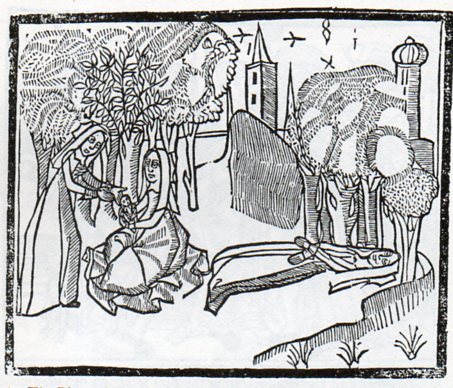
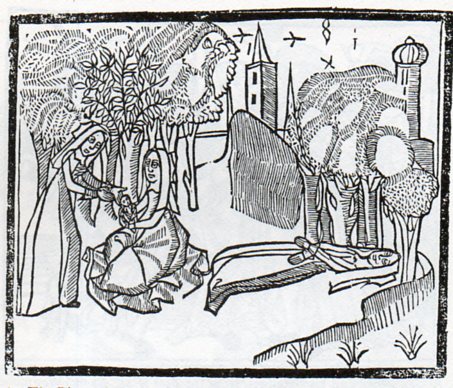
      Sir Thomas Mallory (c. 1405 – 14 March 1471), translated and compiled a collection of mostly 14th century romances regarding King Arthur known and published as the  Le Morte Darthur/Le Morte d’Arthur.  It  was first published by the great William Caxton in 14851and became quite popular,  being reprinted with additions and corrections in 1498 by William Claxton and then again by Wynkyn de Worde (in 1529). It is, in its way, beautifully illustrated, or at least interestingly illustrated–I can’t really say for sure if the woodcuts were done with great care or not.  But their effect is significant, and, whether naive or not or careless or not or simply at the artistic limit of its executor or not, the images do have their own peculiar beauty.  One that struck me in particular was this, 
     

    Malory869
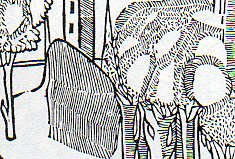
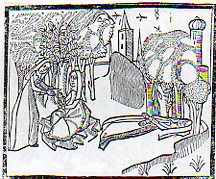
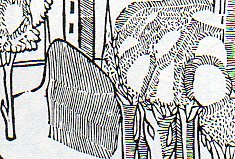
    the “floating river”, an out-of-perspective element of a very stationary world, a controlled chaos-ness in a static landscape.  I’m not sure what is going on with the trees, if the blankness is a part of reflected light, or if it is a representation of spaciousness between the limbs, or if they are simple wormholes in the woodblock.  Everything in the image seems to have its own sphere, locked into their own environment, existing apart from everything else.

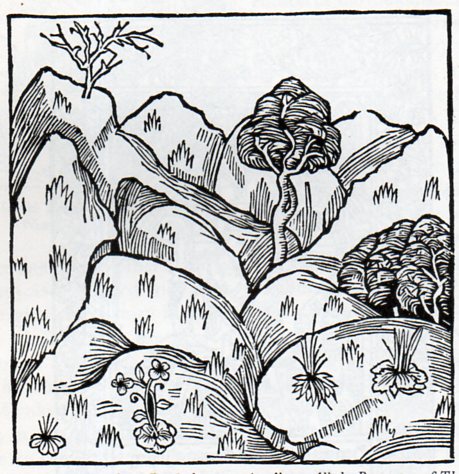
    I see the same issue with many other such works, bits dropped into place in a scene or landscape, all making their way into the viewer’s mind on their own, not really a part of a cohesive whole.  This may have been the intent, or again it may have rubbed up against the outer limit of what the artist (and their tools, and medium, etc.) was able to actually produce.  Here’s another example:
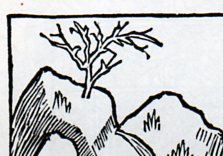
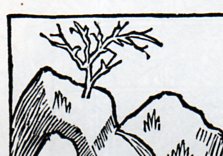
    Lonely tree872:

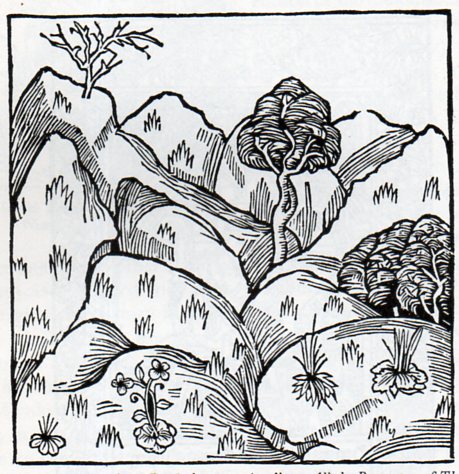
    Lonely tree871
    Its another lovely, lonesome image of separates from the beautifully-named book by Bartholomaeus Anglicus All the Properytees of Thyings, which was published in Westminster in 1495 (and also known as De proprietatibus rerum, also translated as On the nature of things, or On the properties of things), and which was originally written around 1225).  The book was a bestiary, a marvelous encyclopedia, a collection of all things as known in the 13th century–it would be interesting to represent all that is know today and compact it into a workable, logical, usable (printed !) book of a thousand pages.  The question of organization of knowledge would be the key, of course, and how to make one flow to another complementarily as practicable…it would be an interesting project (for someone else) to try and arrange the basis of human knowledge in a finite space like that.  The author of the book above organized his work as follows, in 19 books:  “god, angels, (including demons),   the human mind, or soul, physiology, of ages (family and domestic life), medicine, the universe and celestial bodies, time, form and matter (elements), air and its forms, water and its forms, earth and its forms including geography, gems, minerals,  and metals, animals, and color, odor, taste and liquids.”  The 2012 variety of categories would be somewhat different.

    Notes:

    1. This period, from say 1494 to 1525, was one of great creativity.  For example: 1494, Pacioli: Everything About Arithmetic, Geometry and Proportion; 1498,  Leonardo da Vinci: Last Supper; 1500, Michelangelo,  Pieta;  1504, Michelangelo: David and Bosch Garden of Earthly Delights; 1505, Leonardo Mona Lisa; 1506, work begun on St. Peter’s Basilica; 1508-1512 Michelangelo paints the Sistine Chapel; 1511, Erasmus, Praise of Folly;  1512: Erasmus, De Copia; 1513, Machiavelli  The Prince; 1516, More, Utopia; 1517, Start of the Reformation.

    Some samples of other bestiaries (compiled by The Medieval Bestiary):

    Hrabanus Maurus : De rerum naturis

    Isidore of Seville : Etymologies

    Lambert of Saint-Omer : Liber floridus

    Brunetto Latini : Li Livres dou Tresor

    Jacob van Maerlant : Der Naturen Bloeme

    Konrad von Megenberg : Das Buch der Natur

    Thomas de Cantimpré : Liber de natura rerum
  • Gigantic and Unbuildable Buildings, Part 2: Eiffel Out-Eiffled

    JF Ptak Science Books   Quick Post


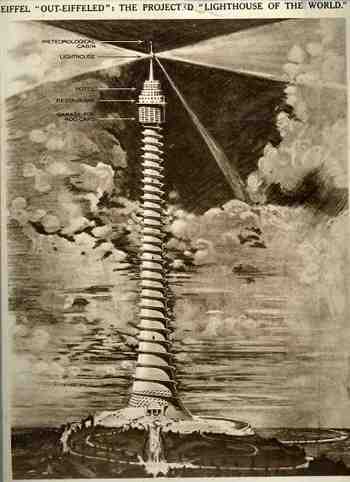
    Big_archout_eiffeled140
    This was the handiwork—that is really too demeaning—the inspiration, the dream, of Eugene Freyssinet (1879-1962), an accomplished French engineer turned architect, and widely viewed as the “father of reinforced concrete”.  Freyssinet graduated from two of the most prestigious French engineering institutions (the Ecole Polytechnique  and the Ecole Nationale des Ponts et Chaussees in Paris) and was really quite an innovative engineer—beautiful even.  His airship hangers at Orly airport are instantly recognizable as elemental design features of concrete—elegant, useful, practical, and huge. 

    I don’t know what happened exactly with his design for the Paris International Exposition of 1937.  The building just isn’t right—even the timing of its underlying deification of the automobile is off by decade, at least*.   His effort to construct a half-mile high reinforced concrete tower with an exterior corkscrewing road for autos climbing up the building to a parking lot is just, well, off.  Setting aside the difficulties in using this building material for a structure of this magnitude, there would’ve been an astonishing amount of vibration problems from the grueling efforts of the cars on the (probably) two miles of road to the top.  (The image comes from the Illustrated London News for 1 June, 1933.)

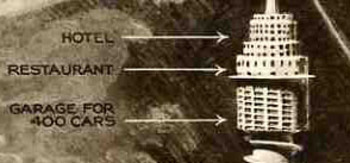
    And all of this effort for what was effectively the world’s most gigantic restaurant, because outside of the parking garage, that’s all this building was meant to be.  The eatery would’ve begun where the Eiffel Tower stacked on top of the Empire State building would end.   The room was big enough to accommodate 2000, who after eating could repair to the hotel upstairs, or who could’ve gone upstairs from there to take the rays in the solarium.

    Somehow this was all supposed to cost 500,000 pounds (about $75,000,000 in today’s currency, which might by you one or maybe two ultra-swanky pre-war condos in NYC…500k pounds was only about 2 million 1937 dollars, which would’ve paid for 5% of the Empire State Building), Freyssinet noting that it would cost less to build than the Eiffel Tower (which would’ve been true if you didn’t take inflation from 1889 into account). I have no idea how that would’ve worked out, given that the Eiffel was a steel skeleton and this would’ve been concrete.  All told, however, none of it made very much sense, and the structure wasn’t even very pretty. 
    Big_archout_eiffeled140_detail_

    *(Cars traveling up the outside of a building so that you can park your car in a lot 2000 feet in the air…certainly the car was king (and queen too for that matter) and that fact become new and abundantly clear, but it happened earlier, in the early 1920’s.  The need to drive a car into Jove’s lap just wasn’t necessary as the world nudged its way to war in 1937.) 

  • Rooftop & Floating Airports -and!- Rooftop Airports in a Levitating NYC, 1929

    JF Ptak Science Books   Post 1652  (Part II of an earlier post on Rooftop Airports, here.)  Part of this blog’s History of the Future series.

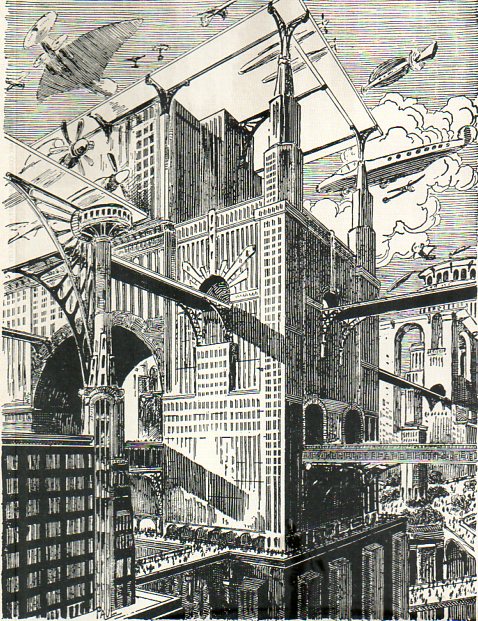
    I really just wanted to post these two images before I lost them again. I’ve written earlier here about high-rise, in-town/downtown airports settled on the tops of buildings (or loaded onto newly-constructed structures over rivers and etc.), but these two images offer a nice distinction on the height’s of elevated airports of the coming future.  The first is by the great Paul Frank, and appears in Amazing Stories for 1928:

    Airport981
    The taller of the two airports seems to be 75 stories above the ground, maybe more–its hard to tell.  It is interesting to see that there is another (of no small size) right next door, but not quite so high.  The 500′-tall elevated walkways/roads are impressive.

    In April, 1936 another artist saw an even taller airport, which caps off an enormous building that seems at least not only twice the height of the Empire State Building (just newly completed), but also far wider.  If you made the “…tropolis” airport signifier on top the midway of the landing field, I calculate the width of the building to be at least 600′, meaning it would be something like 250×600′, or about four acres (or more) per floor.  Big building, with an enormous volume. 

    [Picture source:Modern Mechanics, April 1935, as pictured in Dark Roasted Blend]


    [Picture source: Paleofuture.com]

    And here, another big rooftop creation of a 16×17 checkered grid, complete with, well, nothing at all, not even guard rails or fences–this would be rooftop-airport-landing Old School.  The runways aren’t even particularly long, though I have no doubt that the magazine’s cover space dictated most of the size, anyway. 

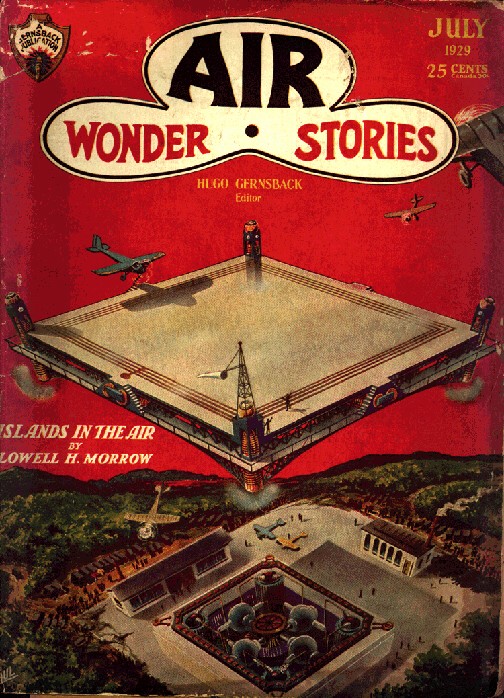
    Of course the idea of very-elevated high-rise airports become secondary when you introduce the idea of floating/flying airports, as we see in this fantastic idea by (again) Frank Paul in the July 1929 issue of Air Wonder Stories. (This image and next from frankwu.com website dedicated to the artwork of Frank Paul, a great and wonderful thing.)

    And of course when the idea of the flying airport fails, you can always go for the flying city, with airport:


    This is again Frank Paul, from November 1929’s Amazing Air Stories, and depicts–of course–New York City removed from the ground to levitate, above its former self. Luckily there isn’t just a hole in the ground where is used to be, the rock and bedrock picked up along with the buildings and the rest of the (non bridge) infrastructure.  It is still a busy place. I presume that given the crowding of the place that there are still high-elevation rooftop airports in the floating city. 

    There are other sorts of air-borne airports, though they are mainly built on/in large airplanes and airships, and really don’t qualify for a post on the simple rooftop airport.  Perhaps it is time now for an all-inclusive Odd Places for Airports post to appear here…

    For example:


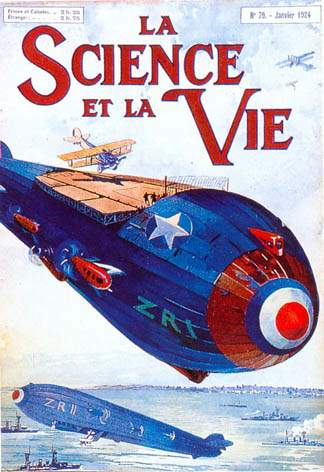
     The magnificent possible, 1924, saw another kind of airborne airport:

    https://historyofideasblog.com/a/6a00d83542d51e69e2012875ea3636970c-pi


  • Some Lincoln Ephemera: Audio of the Voice of J.W. Booth, the Last Man to See Lincoln Shot (& on TV), and the Last Man to See Lincoln Dead

    JF Ptak Science Books  Quick Post  

    What did the voice of John Wilkes Booth sound like?  There are certainly a  number of testimonies to what his voice was like, but since he died a dozen years before it was possible, really, to have his voice recorded, nothing exists for us to listen to of him.  One could though stretch credulity a bit and say that he perhaps sounded similar to his brother Edwin–another actor–and there are recordings of him speaking.  So, by long extension, this may be what John Wilkes sounded like. 

    Edwin Booth:

    Somewhat related is this, a 1956 appearance on the television program “I’ve Got a Secret” by Mr. Samuel J. Seymour, who’s secret was that he was a witness to John Wilkes Booth assassination of Abraham Lincoln.  He was five years old at the time and his abiding memory was being concerned for the man who fell onto the stage from the balcony. Seymour evidently died two months later from complications of a fall he took while traveling to appear on the show.

    In another vaguely related historical bit, the last person to see Abraham Lincoln did so in 1902.  There had been a number of attempts to steal the body of the president–one of which came very close to completion–and so in the final move of Lincoln’s body to a burglar-proof resting place on 20 September 1902 his coffin was opened.  John Bowlus was there, and he related what he remembered as a nine-year-old boy viewing Lincoln 37 years after his death.

    Bowlus stated:

    “I can see his face as if it were yesterday,” Bowlus recalled. “Even in death he was an awe-inspiring figure.” A boy of 14 at the time, Bowlus said he had stood on tiptoe and gazed, awestruck, on the majestic features of Lincoln, almost too afraid to peer into the glass-topped casket. “The body was almost perfectly preserved,” Bowlus remembered. “The face was darker… he lay with his head and shoulders and tips of his hands visible where they were crossed on his chest.” It was awe-inspiring, almost frightening,” he said. “The beard appeared to have grown longer, but the dignity of the great man could almost be felt through the air-tight casket which had preserved his body,” Bowlus said. –“The Last Man to See Lincoln”, by Lance J. Herdegen, [source].

    I looked for a recording of Robert Todd Lincoln (who died in 1926) but could not find none.

    And just for the sake of it, a list of early recordings of U.S. Presidents:

    ·Posted by :

    ·in:

    — —
  • A Map of Mother

    JF Ptak Science Books   Quick Post

    File:The story of a word.jpg

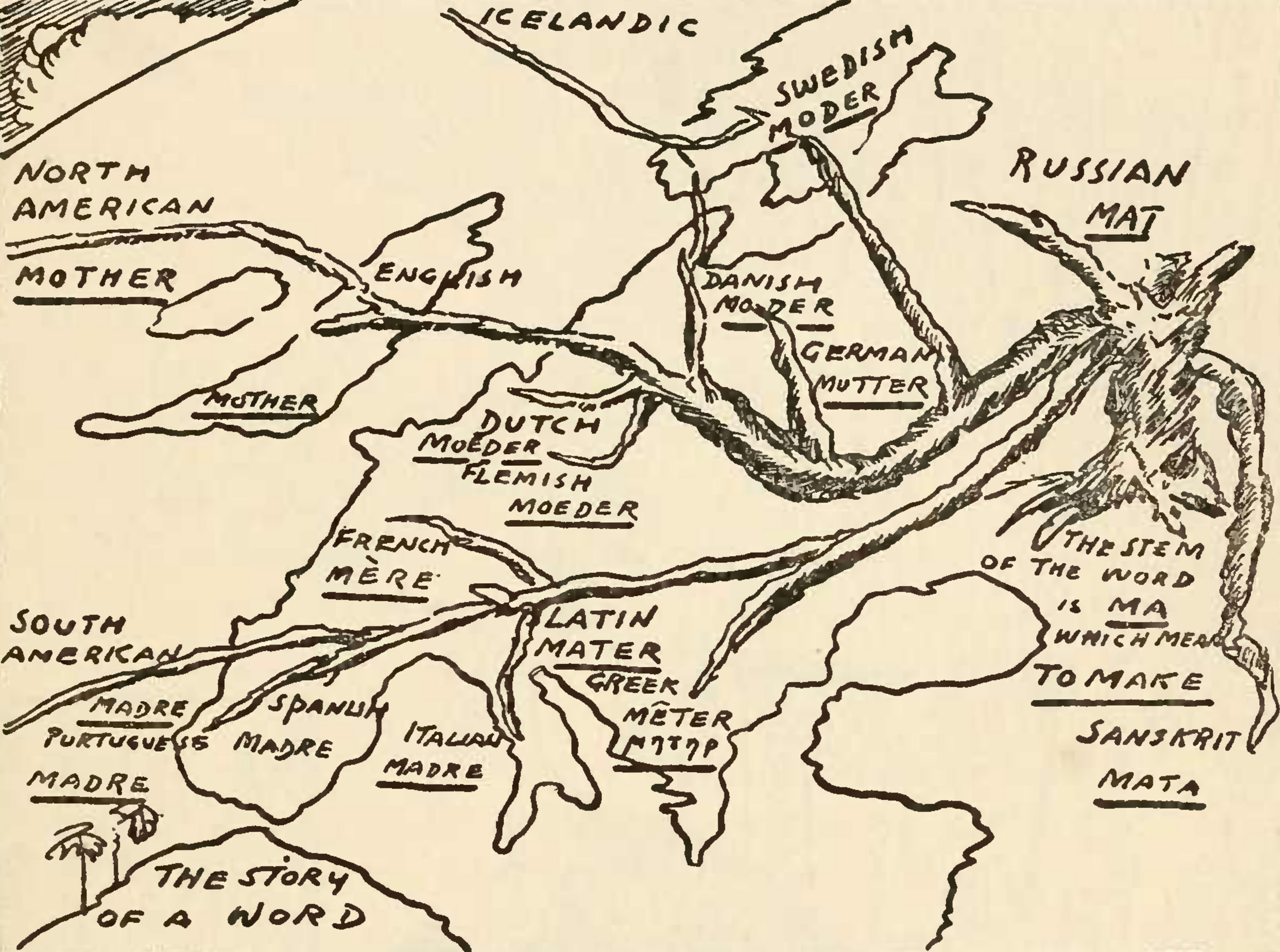
    Mother tongue, earth, lode…but the appearance of “mother” as “Mother” looks so pervasive, so wide-spread, that perhaps the reason for its worldwide similar appearance might be because it is so easy to say when an infant is learning to speak. The “m” and the “a” sounds are not challenging, and it might even be related to the sounds that an infant makes when being breast fed. 

    Map source: Hendrik van Loon (1882-1944), The Story of Mankind (1931, by Bon & Liveright).  In all of this time, over all these years, I believe that I’ve never once referenced this once-popular book.

    Others appearances of “mother” in different languages:

    Arabic oum
    Chinese ma
    French mère
    Greek meter
    Hawaian makuahine
    Hebrew em
    Icelandic modher
    Irish mathair
    German Mutter
    Latin mater Russian mate
    Sanskrit mata
    Swahili mama
      Welsh mam

    <

    ·Posted by :

    ·in:

  • WWII German Comic Book Propaganda

    JF Ptak Science Books   Quick Post

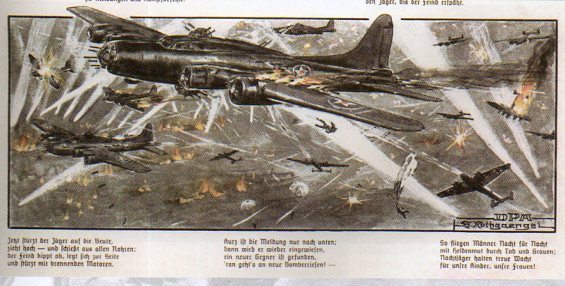
    The Bilderbogen vom Krieg–some examples of propaganda aimed at German children, efforts to convince them of the winning of the war, evidently a universal attempt….

    Source:  Deutschsprachige Comics und Romanhefte vor 1945 here.

    Nazi prop732

    ·Posted by :

    ·in:

Recent Posts

Archives

Categories