A Daily History of Holes, Dots, Lines, Science, History, Math, Physics, Art, the Unintentional Absurd, Architecture, Maps, Data Visualization, Blank and Missing Things, and so on. |1.6 million words, 7500 images, 4.9 million hits| Press & appearances in The Times, Le Figaro, Mensa, The Economist, The Guardian, Discovery News, Slate, Le Monde, Sci American Blogs, Le Pont, and many other places… 5000+ total posts since 2008.

  • Visualizing Depth: Thinking Deep on the Depths of the Oceans in Units of St. Paul’s Cathedral

    JF Ptak Science Books   Post 1660

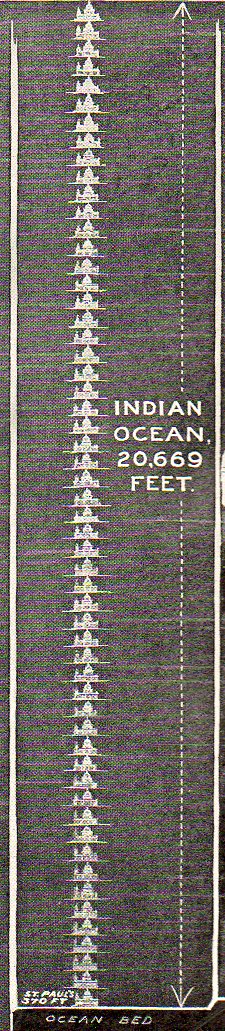
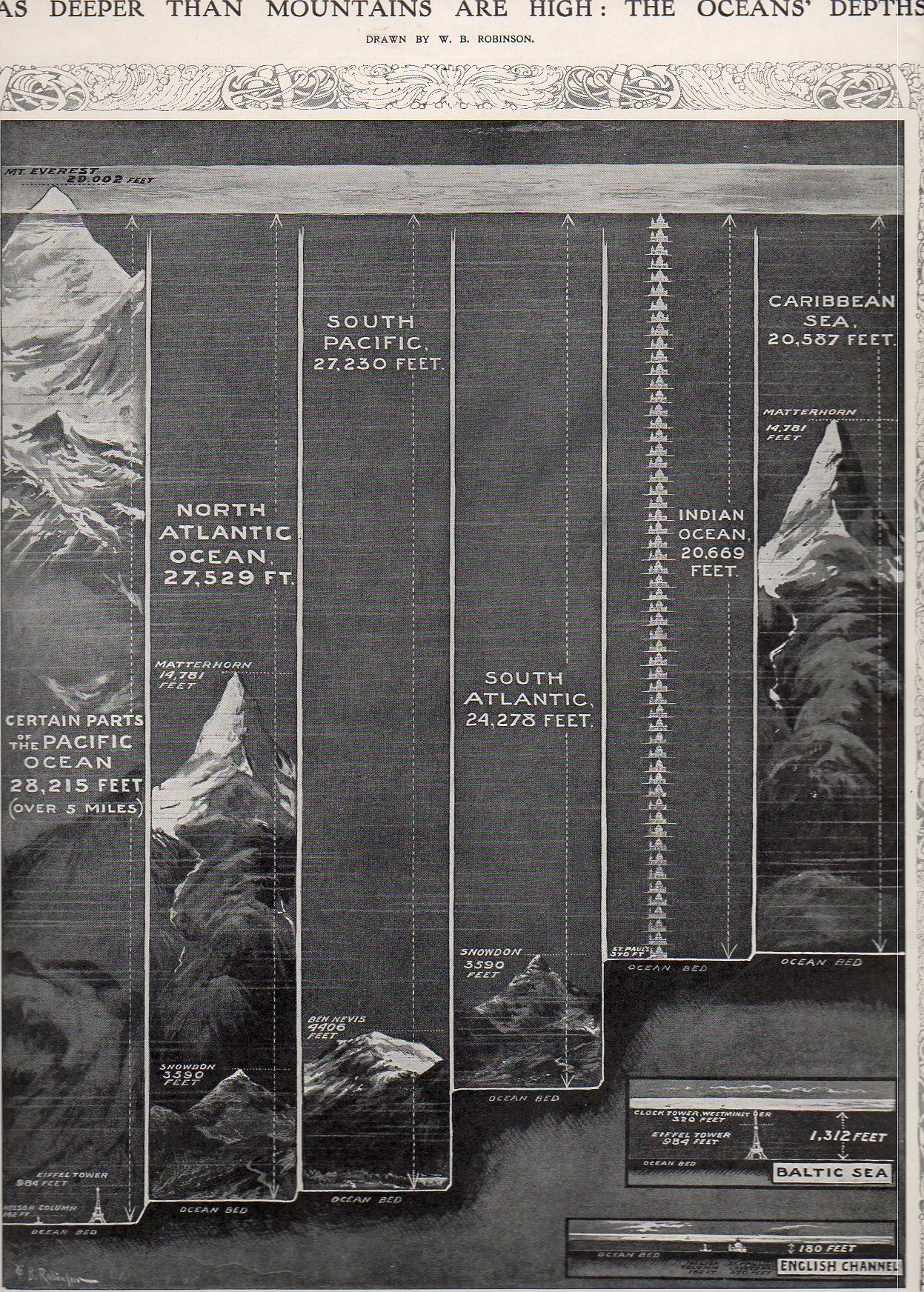
    Although maps showing the depths of the oceans existed from about the mid-19th century (through the pioneering work of the American father of oceanography, Virginia’s Matthew Fontaine Maury1) few casual readers would have ever seen a more approachable representation of information than what appeared in the Illustrated London News for 8 October 1910. Although Maury’s maps are elegant, they didn’t receive nearly as wide a distribution as this ILN image–also they weren’t nearly quite as relational as the 1910 version.

    Sea depths533

    Granted, the 1910 comparison chart only displays one statistic–the supposed greatest dept of five oceans, two seas and the English channel–it does so in such a way as to make those numbers immediately approachable to any reader, which is always an issue in relating scientific information to the general reader.

    Sea depths ist pauls537 {One of the standard unit of measurement for the purpose of this display was St. Paul’s Cathedral.]


     What W.B. Robinson presented was a way of looking at an invisible entity through very visible means–comparing depth to the heights of things that everybody in 1910 knew: the Eiffel Tower (relatively newly constructed out of 18,000 prefabricated highly-engineered pieces) and St. Paul’s Cathedral. So rather than stating that the Pacific Ocean is 28,000 feet deep, Robinson chose to replace feet with Nelson’s Column–174 of them. Or 29 Eiffel Towers. The 20,000-foot deep Indian Ocean was actually 56 St. Paul’s deep, while the Baltic Sea was deep enough to not quite cover one Eiffel Tower with one Westminster Bell Tower on top (ha!); and the English Channel at its deepest wouldn’t quite cover St. Paul’s.

    This is really the way to display data in my book, especially to kids.  This is one of the few ways of making the information accessible and understandable across almost all age ranges. 

    Notes:
    1.  Actually the work goes back a century before Maury with Buache, who produced this map of the English Channel in 1737–the data points are veyr numerous, but this is the very first time that such information was available on a map.

    Sea depths idouth pacific536 Sea depths indian535


    NOAA Photo Library Image - map00004

    And Maury again with this first map of an oceanic basin, published in 1853:

    NOAA Photo Library Image - map00001

     And in 1752, Philippe Buache produced this fantastic and first-of-its-kind map for the depths of the English Channel:

    NOAA Photo Library Image - map00186

    Here’s an extraordinary cross sectrion of a part of the ocean floor produced in 1857 by the HMS Cyclops in preparation for laying the Atlantic Cable:

    NOAA Photo Library Image - map00010


    Its also interesting to note here Buache’s work on this map of Antarctica, published in 1737.  Buache put together all of the known (to him) information about the mass in the South, bits taken from other maps, and accumulated them into what was the best-possible guess on what was down there in the Antiopode.  Pretty good detective work given the amount of material that he could work with.


  • Kolberg and Sachsenhausen, 1945–Visions of Fantasy and Reality

    JF Ptak Science Books Post 1661

    At the end of WWII there was a tale of two battles, both by the name of Kolberg.  One was a propaganda tool filmed in Agfacolor at the request of Josef Goebbels, a movie begun in 1944 about the mythically-endowed victory of Germany over Napoleon at Kolberg.  It was an epic, costly movie made at a time when the 180,000 “extras” composed of Wehrmacht troops could not be spared, but it was seen by Hitler and whoever was around to agree with him that a movie selling selflessness and sacrifice (blood sacrifice) was more valuable than a military victory1. When it was finally put to bed, the movie “opened” virtually nowhere in Berlin in January 1945, as  the city was becoming a bombed-away shambles–much more so in the next three month.  The visions of resistance-to-the-last-breath played in few places outside of Hitler’s bunker, where the dictator professed the qualities of sacrifice and the fight-to-the-death messages in the movie, though not applying those necessaries to himself.  

    The other Kolberg battle was the Battle of Kolberg (a Baltic seaport city in Pomeria located about halfway between Berlin and Koenigsberg), which took place in real life from 4-18 March 1945.  It was a fight between the Germans and combined forces of the Soviet and Polish armies–it ended in Polish hands on the 18th following the retreat of the Germans and he destruction of most of the city.

    It is ironic that the defeat of the Nazi forces in the real city of Kolberg occurred at nearly the same time as the wasteful film of the 1807 battle extolling the virtues of heroism and sacrifice was released.

    It is interesting too that the  actor depicting the leading German hero in the movie Kolberg (directed Veit Harlan and Wolfgang Liebeneiner)  Heinrich George–who acted in a number of Nazi propaganda films after finding ways to get back into favor following his pre-Nazi pro-Communist politics—found himself arrested and imprisoned in Sachsenhausen concentration camp, where he died of “complications” in 1946.

    Sachsenhausen was one of the longest-lived concentration camps, being in operation from 1936 to 1950.  From its beginning to May 1945 it was of course a Nazi concentration camp (Konzentrationslager Sachsenhausen), where from 1943 until the fall of Nazi Germany it was also an extermination camp.  As many as 200,000 people were seized and sent through Sachsenhausen and its satellite/tributary camps. From the end of 1945 to 1950 it was operated by the Soviet Union, where another 15,000-30,000 people were imprisoned, Heinrich George being one of them. 

    In addition to the many horrors of Sachsenhausen, there was also this–it was the center of a plot to destroy the British economy with the production and distribution of a hundred million pounds worth of counterfeit British currency.  The lead counterfeiter at Sachsenhausen, Salomon Smolianoff (a gifted artist who once said “why make art when you can make money?”) was an inmate with exceptional skills and who basically headed the team of workers responsible for this effort,  For good work in his part of pulling down the economy of Great Britain, Smolianoff was rewarded with an occasional go at a ping pong table, as well as less-rancid pieces of meat. 

    File:Forgednote.jpg[One of the forged Sachsenhausen notes.]

    This was operation Bernhard, named for its director, SS Major Bernhard Kruger (the leader of the VI F 4a Unit in the Reichssicherheitshauptamt (Reich Main Security Office) or RSHA), who was responsible for the operation from 1942, and which eventually extended from Sachsenhausen to other camps, most notably a major operation at Auschwitz.  More than 134,000,000 pounds of what the Brits considered to be the most perfect counterfeits ever were produced, but for various reasons–not the least of which was sabotage instigated by extraordinarily brave concentration camp internees–the vast part of the plan was never implemented. 

    As it turns out, Smolianoff survived Sachsenhausen, survived the war, and then became a puff of smoke. He was a wanted-but-not-found fugitive, and spent his last days in Brazil, painting.  And creating toys.  He died in 1976.

    Bernhard Kruger (born in 1904), also survived the war.  When the pound-forging plan was scuttled in 1944, he moved the idea over to American currency, which he worked on until the end of the wat.  Although he was kept by the British for two years, and then by teh French for one year, he was eventually released, and faced no charges until a Denazification court ordered him to trial, where he was somehow acquitted.  He died an old man, aged 85, in 1989, in his bed. 

    Notes:

    1.  At least this is so as reported by Sir Ian Kershaw in his biography, Hitler, 1936-1945.

  • Sterilizing the Insane, Epileptics, Prostitutes, and More–U.S.A. 1929

    JF Ptak Science Books    Post 1335     On “the Privilege of Sterilization”

    Sterilization--feeble minded388 There are so many ways of spelling “n-a-z–i” without using a “z”.  Or the “n”.  The vowels come in handy, though.  The Human Betterment Foundation of Pasadena, California did just that, as did the Association of Ontario Mayors, the Eugenic Society, and many other correct-thinking associations and societies.  What these people had in mind was the raising of the genetic good through the malleable confusion of human rights issues resulting in the forced
    “asexualization” of the lesser elements of society–forced sterilization of inmates in state-run mental and correctional institutions, (I’ve written about sterilization and eugenics earlier on this blog, here, though the pamphlets I’m writing about today are different.Today’s pamphlets are available for purchase at our blog bookstore.)

    Sterilization--human steril389 To paraphrase the good doctor Hunter Thompson, (“when the going gets tough the weird turn pro”), the Nazis did that, becoming complete beasts, horrors even to their own horror, almost unimaginably so. (As a matter of fact, they were so bad that a certain percentage of the population believes that the Holocaust and the Nazi experimentation didn’t happen because, among other, race-hating reasons, the crimes were just too enormous to be true.)  But before eugenics studies were molded into what the Nazis needed they provided ample justification to other groups. before the Nazis were elected to power in 1933.  These American groups weren’t nearly on the same level as the Nazis, but they did create their own levels of hell, just not as deep and as profoundly grotesque as the Nazi-version.  But it was something very deeply disturbing.

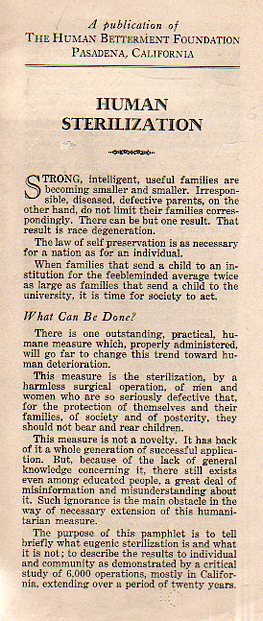
    The Human Betterment Society put the issue quite simply in their slim little pamphlet, Human Sterilization–to save ourselves from “race degeneration”  society had to act and restrict ‘defective” men and women from bearing and rearing children.   There aren’t that many pages in this publication but they each present some astounding assertions, perhaps the most shocking of which is that this society had its eyes on a larger prize–the country was burdened by as many as 18 Million people with mental disease, who “put a charge and a tax on the population” and who would “cost a billion dollars a year” to take care of.  The Human Betterment people do not say outright that 18 million people should be sterilized, but the statements come in the middle of a pamphlet making the case for sterilization, so we are left with the determinant that riding this people from the gene pool would be a desirable outcome. 

    Dr. William Hutton makes the case for the humanitarian treatment of the treatment espoused in the title of his A Brief for the Sterilization of the Feeble-Minded (1936). “It would be unjust and anti-social to withhold the privilege of sterilization from the victims of mental disorders (the insanities)…”(emphasis mine). He dives into the deep-end of the sterilization issue, making the cse for dealing with the “blind, deaf-mutes, haemophilicacs and brachydactyly (deformed fingers)” in the same manner.

    Of course the Nazis performed all manner of sterilizations before 1939 and before they started to simply exterminate entire populations of who they considered to be human beings unworthy of life. The eugenics people didn’t want to kill people–they just wanted to take away all of their reproductive rights, forever.

    As it turns out, the list of the types of people who were subject to enforced, state-organized sterilization got a little shadow-y around the edges, enough so that prisoners or mental patients accused of “moral terpitude” could include, say, poor women forced into prostitution. The lateral motion of these sorts of issue were decided by different state agencies–in New Jersey for example it was the Board of Examiners of the Feeble-Minded; in Indiana, it was a board of “eugenics experts” (who were to be paid no more than $3 per case).

    The reach of sterilizations varied by state–some states did not have any laws regarding enforced sterilizations, though most did–the reach of the practice varied from state to state as well, some (like New York) reaching beyond the state penal institutions, mental hospitals and “homes for the feeble-minded”, and then right down into reform schools for boys and girls (with Michigan looking into industrial schools as well).   Some states–like Kansas–reached across these lines into the lives of epileptics; Michigan did not hunt for epileptics but did so for “imbeciles”. Oregon seemed to cast the widest net, including the “feeble-minded, insane, epiletpic, habitual criminals, moral degenerates, and sexual perverts” found in any institution maintained at the public’s expense who condition was found to be “inadvisable for procreation”.  Maine on the other hand simply included “other forms of mental disease”.

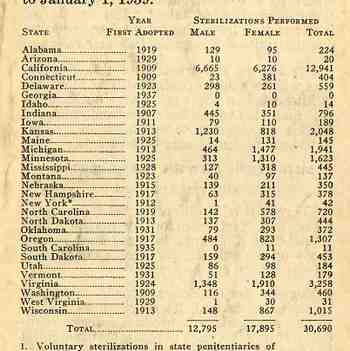
    By 1933 state-sponsored sterilizations of these classes of people reached the following totals:

    Blog1sept_10_sterilization539And so it almost ends, the story of sterilization growing weak and stale by World War II, exhausted and failing under its own exhaustion and failure.  The sterilization of sterilization really begins with the Supreme Court Decision of 1942, the Court finding unanimously that (in Skinner v Oklahoma) that Mr. Skinner’s–a chicken thief–right were being violated when faced with castration.  Justice William O. Douglas wrote:  “[S]trict scrutiny of the classification which a State makes in a sterilization law is essential, lest unwittingly, or otherwise, invidious discriminations are made against groups or types of individuals in violation of the constitutional guaranty of just and equal laws.”The practice continued with less abandon and more restrictive uses into the Nixon administration, which even as late as 1970 increased Medicaid funding for sterilizations, a weirdly appropriated funding that seemed to dramatically increase the sterilization of poor blacks.  Forced sterilization breathed its last in Oregon in 1981.  


  • Electro-Punk Heavy Metal Birthing Machine–a Fantastically Bad Idea

    JF Ptak Science Books   Re-posting entry #1500

    I found this by accident, and needed to share it immediately, because in the splendid and chilly vastness of the infinite Encyclopedia of Bad Ideas, this entry would seem quite the poster child for such a stupendous effort–the mud to which all dust aspires. 

    The centrifugal machine for human birth…its hard to even finish that sentence, let alone finish it without wincing.

    I think what we have here is the Vitruvian Woman of Bad Ideas relating to human birth, the patent described more fully in this great piece by Marc Abrahams (of the Annals of Improbable Research) in The Guardian, 2006):


    Read the rest of this post here.

  • Videos of Scientists & Mathematicians: Feynman, von Neumann, Dirac et al

    JF Ptak Science Books   Quick Post

    Richard Feynman on being “stupid”:

    John von Neumann inerview:


    ·Posted by :

    ·in:

  • An Episode in the History of Bread Photography: Monumental Bread and Infographics, 1914

    JF Ptak Science Books   Post 1662

    Infographic999
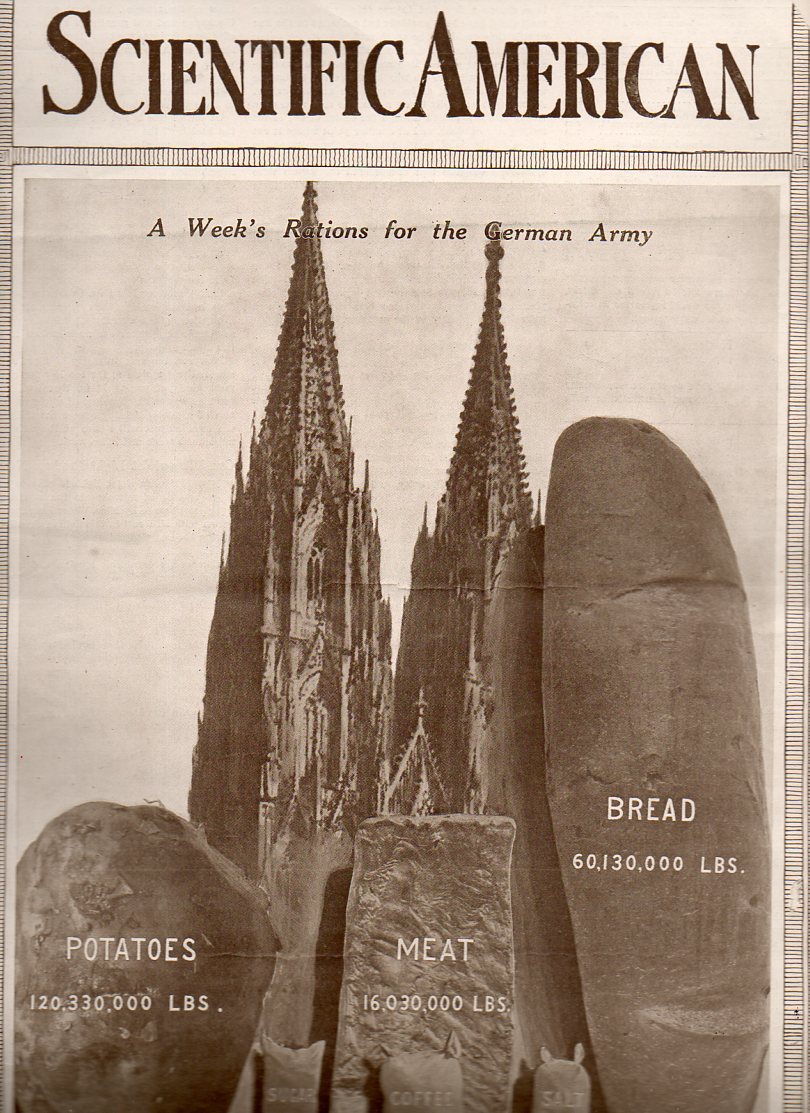
    In the history of pictures of bread, this loaf seems to be about the biggest.  The 60-million-pound loaf is meant to represent a week’s ration for teh newly-fighting German army.  The war, the Great War, WWI, was just beginning when this article hit the newsstands on 22 August 1914.  There wasn’t much yet printed in the Scientific American regarding the war, and it seems as though this was the first cover of the magazine to deal with the new world-ender.  But in the blazes of the guns of August (B Tuchman) the end of the conflict might’ve looked a little close at hand.  I doubt that many would’ve seen the 100,000,000 dead and wounded that would come as a result of the war, at this point just finishing its first month.

    I am not sure why, but the editors of SA chose to think about supply for their first stab at making a cover-comment about the war.  It does give some idea of the sheer numbers of people involved, at least on the German side.  Hoiw this is iterated by a 400-foot-tall loaf of bread, I can’t exactly say.

    (Are potatoes one tenth the density of :”meat”?  The potato sack and the meat chunk look to be about the same size, though the meat bit is less than a tenth of the weight of the potatoes.) 

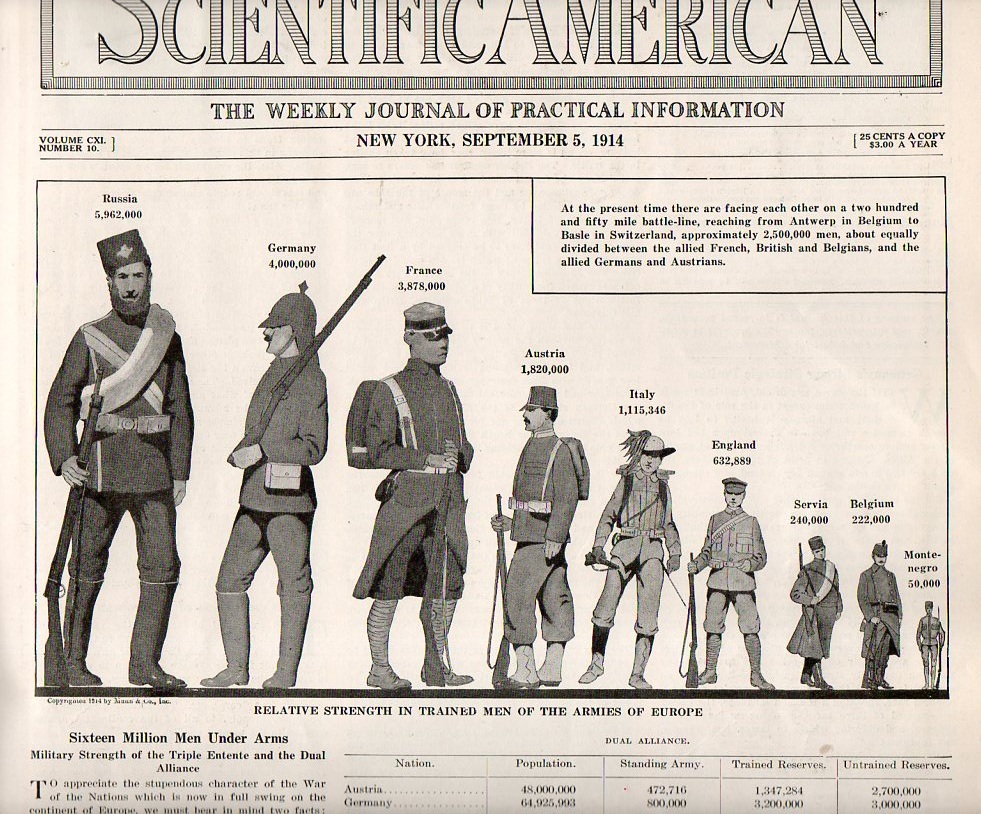
    Two issues later–5 September 1914–we see the following artistic display of quantitative data, a much more effective way of generating understanding on the differences in troop strengths among the waring countries:

    Infographic army size001


    The United States would not get involved in WWI until 1917, and so American statistics were not included in this image.  But if they were, the U.S. Army’s size would be somewhat larger than little Montenegro there at the far right.  Given the American population of 92,000,000, the army was quite small, with barely 98,000 soldiers under arms (half of whom served overseas). (Montenegro’s force of 50,000 was somehow pulled out of a population of 350,000 people–Belgium, with a population of 7 million, had an army more than double the size of that of the U.S.)  Of course this was a peacetime, hands-off army for the United States, and by the end of 1914 President Wilson expanded the standing army to 140,000; by 1918, when the newly-instituted draft1 really kicked in, more than 4,000,000 people would be in the armed services, half of whom would serve overseas. 

    Notes

    1. Beginning in 1917 all males between the ages of 21 and 30 were required to register for the draft/military service, and by September 1918 more than 23,000,000 men had done so.  This was an extraordinary leap from the Army totals for 1914.   

  • War Rations–Iron and Bread

    JF Ptak Science Books   Quick Post

    Food german pows004
    Continuing yesterday’s post #1662 (A Short Episode in the History of Bread Photography…): my friend Jeff Donlan pointed out that if 60 million pounds of bread were served weekly to the 4,000,000 members of the German Army, then each soldier must be eating about 2 pounds of bread a day.  And that’s not eating a loaf or whatever of “Wonder Bread” (its a wonder its bread–watch that trademark!) or any other white bread where you could ball up two slices and pop them whole into your mouth.  As Jeff points out, if this was a dark or rye or Napoleon’s-solder’s-like black bread or some some thing, it would be thick and dense.  And so, two pounds of this sort of bread is a lot, especially if the average soldier was running around and weighing in at 150 pounds or so–eating two pounds of bread plus four pounds of potatoes would mean that each soldier was eating about 5% of their body weight in just those two foods per day.

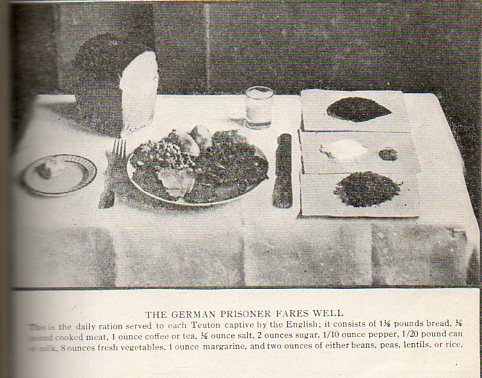
    This all sounded like a lot of food to me–until I stumbled on the following article in a journal I had never encountered before.  It was in Illustrated World, a Popular Mechanics-lite sort of publication, for November 1916, in an article “From Trench and Barrack” that I found these two photographs.  I was astonished first of all to find a bread-consumption reference within 15 minutes of wondering about such a thing for the first time ever–but there it was.  A big slab of fork+-high bread in a picture made to depict the daily rations of a German POW in the hands of the British.  The prisoner was alloted 1.5 pounds of bread.  Plus a half-pound of (cooked) meat, 8 ounces of vegetables, one ounce of coffee or ta, and the other stuff as can e seen in the photo’s caption. 

    And there you have it.  If the prisoner is getting 1.5 pounds of bread, then it makes sense for the active soldier to be eating two pounds.  At least it all makes sense in 1916.

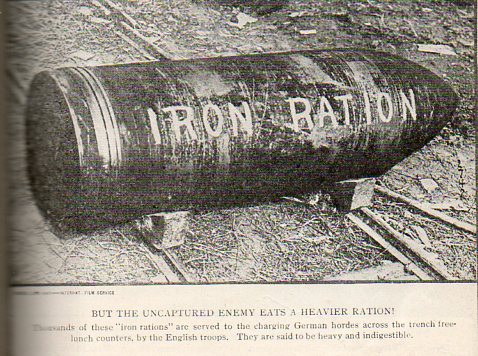
    The thrust of the article in Illustrated World though was the other sort of ration that Great Britain would be shelling out–shells.  This would be the iron ration that–after two years of a terrible and monumentally destructive war–would be the most common form of ration exchanged during the conflict.

    Food german pows005


  • Baseballs of Death–the Baseball Bomb, 1916

    JF Ptak Science Books   Quick Post

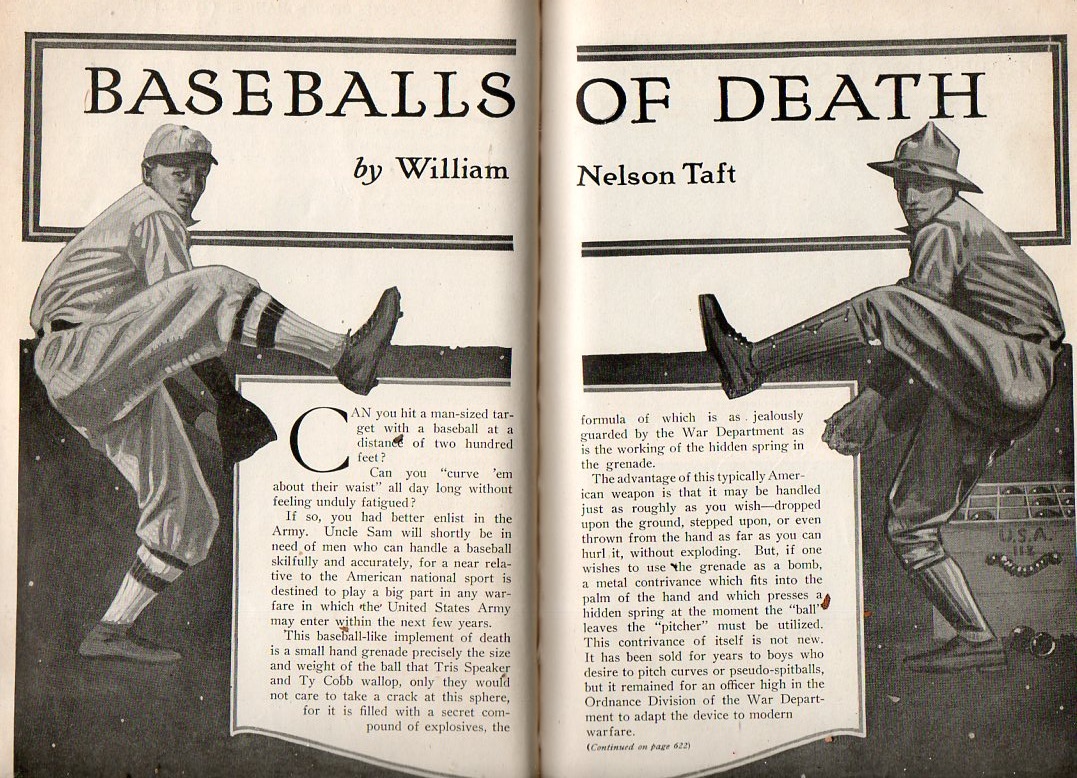
    Baseball of death015
    This unlikely advertisement was for baseball players with good throwing/pitching skills to enlist in the U.S. Army and throw the newly-design, baseball-weighted and -sized hand grenade. 

    “The United States Army needed a grenade that would be accident-proof and the baseball bomb has been the result.–Illustrated World, 1916, page 622.

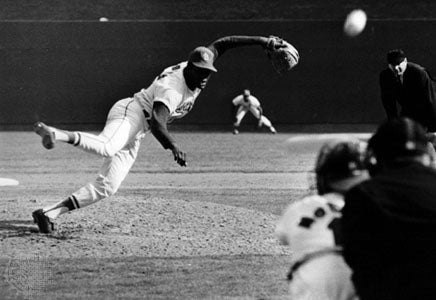
    Bob Gibson threw many of these in the 1960’s.

    gibson_bob

    So did this guy a little later on:

    ·Posted by :

    ·in:

  • In Closing: “a Kiss from Your Beethoven”. Artistic and Literary Valedictions from the Master.

    JF Ptak Science Books   Post 1663
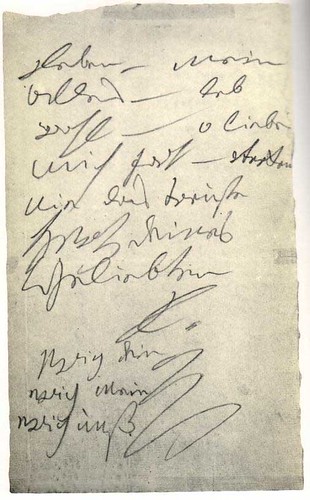
    http://farm4.static.flickr.com/3072/2554654204_1d32764d1b.jpg

    On how to end a letter.

    I’ve read pieces of Thayer’s Beethoven, and parts of the Conversation Books (the collections of rough notebooks that visitors used for written communication with the Master (1770-1827) once his hearing got too far away from him), as well as pieces of his journals and letters–which seem to me to be the most interesting part of reading about the man.  I find his writing style to be formal but surprisingly easy, and I’m continually enchanted by his valedictions–the way in which he signed-off a letter.  The man could leave you with a nice thought, especially in the way where he would begin his last sentence and incorporate that in his closing:

    (1795–to Franz Wegeler)  “I shall come to you myself and throw myself into your arms, imploring you to restore my lost friend, and you will give yourself to me, to your penitent, affectionate, never-forgetting,/ Beethoven once again”

    The sentiments seem fast and genuine and seem to be out-of-place with the man’s big, semi-unsure handwriting, which looks as though his efforts were accompanied by grunts while writing.  But his letters are really quite beautiful things, and a very interesting read; and as I said, the way in which he sent his letters off into space, the way he closed them, is exceptional and artistic.

    And so some examples:

    (1787)  “Your obedient servant and friend/”

    (1793)  “Your true and admiring friend/”

    (1793)  “Think occasionally of your still true and admiring friend/”

    (1794–to Schenk) “Farewell, and do not entirely forget your/”

    (1795–to Franz Wegeler)  “I shall come to you myself and throw myself into your arms, imploring you to restore my lost friend, and you will give yourself to me, to your penitent, affectionate, never-forgetting,/ Beethoven once again”

    (1798)  You will find Schuppanzigh here as well and the two of us will tease, cuff and shake you to your heart’s delight, a kiss from your Beethoven…

    (1800–to Wegeler)  “Always rely on the love as well as the friendship of your BEETHOVEN”

    (1800)  “Sometimes recall your truly admiring/Beethoven”

    (1800, to Franz Anton Hoffmesiter) ) “I hope that we shall often have occasion to assure one another how truly you ar emy friend and how I am/Your brother and friend/L v. Beethoven.

    (1800)  “Always rely on the love as well as the friendship of your/”

    (1800–to Pastor Amenda)  “Now, farewell, my dear kind friend! If by any chance I can serve you here, I need not say that you have only to command me. Your faithful and truly attached/”

    (1800–to Wegeler) “Rest assured of the love and friendship of your/”

    (1800–to Pastor Amenda) “Farewell, beloved, good, and noble friend! Ever continue your love and friendship towards me, just as I shall ever be your faithful/”

    (1801) “With great respect, I am your devoted/”

    (1802) “If you should think of any favor I might do you here, it goes without saying that you yourself will at once inform/Your faithful, truly affectionate, Beethoven”

    (1802) “Farewell, my dear, faithful Wegeler, rest assured of the love and friendship of your/”

    (1802)  “Even unto death, your faithful/”

    (1806) “Remain well disposed towards your friend/”

    (1807) “Farewell and do not forget your true friend/”

    (1808) “Friend Beethoven embraces you all”

    (1808)  I embrace you with all my heart and am your faithful friend/”

    (1809–to Zmekskall) “I come without any card from you, but I hope you will not on that account discard me. Yours truly–most truly, L. V. BEETHOVEN”

    (1810–to Wegeler)  “Think of me with kindness, little as I apparently deserve it. Embrace your dear wife and children, and all whom you love, in the name of your friend,/”

    (1810–to Zmeksall) “Ever remain my friend, as much as I am yours,”

    (1816–to G. Del Rio) “God, however, directs all things; so my position may undergo a favorable change, when I shall hasten to show you how truly I am, with sincere esteem, your grateful friend, / “

    (1817) “We have the honor to remain, most astounding Lieutenant-General! your devoted/GENERALISSIMUS” (Beethoven sometimes signed himself this way.)

    (1820, to Therese Makfatti)  “Think of me, and gladly, forget my follies, rest assured: no one can wish your life to be more carefree, even more cheerful than I do, even if you should feel no concern at all for your most devoted devoted servant and friend/Beethoven”

    (1824–to B. Schott’s sons) “In greatest haste, with greatest urgency and yet with the greatest brevity, your / “

    (1824–to Nageli) “I embrace you as one of the wise men of Apollo, cordially yours /”

    (1825–to a copyist) “Well, look after yourself. A thousand thanks for your devotion and kindness t me.  I hope you will not be punished for them. / Yours, with love and friendship, / “

    (1825–to Karl van Beethoven, his dead brother’s son and legal ward, and legacy of a complicated relationship) “May God grant my wishes, for never again shall I be capable of suffering on your account./ Unfortunately your father/or rather not/ Your Father”

    (1826–to Tobias Haslinger)  “With the most reverential reverence and fidelity, yours, / “

    (1827–to B. Schott’s sons) “Pity your devoted and respectful friend, / “

    (1827–to Pasqualati) “May Heaven bless you generally and for your affectionate concerns, / With your respectful,/ suffering Beethoven”

    (1810, to Archduke Rudolph)  “Well, it really makes me laugh to think how Your Imperial Highness consider me even on this occasion; for this, assuredly, my whole life long I shall remain, Your most obliging servant, /”

    One of the valedictions in the “series” of letters to his famous and as-yet-unknown2 “Immortal Beloved” in July 1812 goes so:

    “be calm – love me – today – yesterday – What yearning with tears for you – you – you my life – my everything – farewell – oh continue to love me – never misjudge the most faithful heart of your Beloved/ L”

    and also:

    (1807, to Josephine Brunsvik) “never misjudge the most faithful heart of your beloved L”

    And of course he could start a letter, too, as we can see here in his start of the towering love letter to his Immortal Beloved (above):

    “My angel, my everything, my very self. – only a few words today, and in pencil (with yours) – I shall not be certain of my rooms here until tomorrow – what an unnecessary waste of time – why this deep grief, where necessity speaks – can our love exist but by sacrifices, by not demanding everything. Can you change it, that you are not completely mine, that I am not completely yours? Oh God, look upon beautiful Nature and calm your mind about what must be – love demands everything and completely with good reason, that is how it is for me with you, and for you with me – only you forget too easily, that I must live for myself and for you as well, if we were wholly united, you would not feel this as painfully, just as little as I would – my journey was terrible…”  

    But we’ll leave the beginnings to another post.

  • On Infinite Blankness in the Infinite Library

    JF Ptak Science Books  Post 1664 

    (Part of a series of on the History of Blank, Empty and Missing Things and the History of Nothing .)

    Nothing017

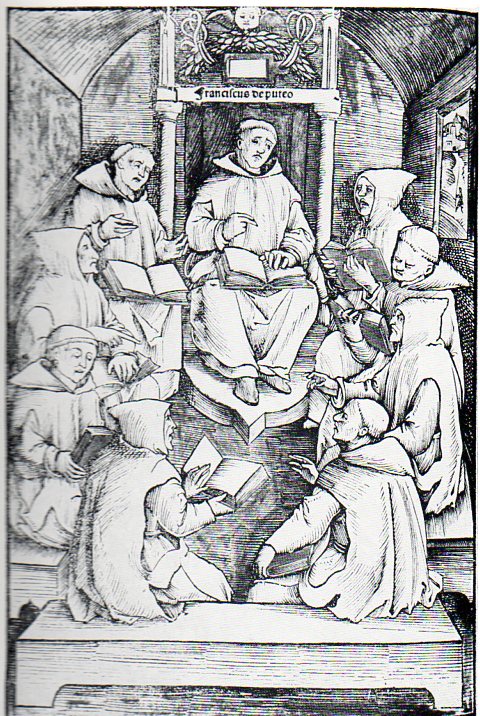
    I have a notion that when we enter the infinite library of Jorge Borges that what we find somewhere in there, in the middle (where every place is the middle) we find that the books being read are just like the volumes from this illustration. It may only make sense that in a place where everything that could be written had been written, and that in the place where there was a finite amount of the infinite and vice versa, that the whole mechanism would go spinning fractally out of control once the Primum Mobile got the chance to introduce the notion of the Blank Book.  Reproducing nothing infinitely may be a lot more cumbersome than reproducing everything than can be written.  At least the written aspect has some sense of order to its infinity, and that–like when approaching the speed of light–that when you get near “the end” that everything gets a little, well, funny. When confronted with infinitely reproducible nothingness, there’s nothing that quite reproduces to the end of pi like the blank book.  It’s nothing all the way down.  And all the way up, too, for that matter.

    Nothing016
    [Image source:  Statuta ordinis cartussiensis a domno Guigone priore cartusie edita, printed in Basel by J. Amerbach, 1510.  Illustrated with woodcuts by Urs Graf. This is a beautiful and important work, a great effort by an early and important press, and this image happens to show study timne in a Monastic setting. Their books of course weren’t blank.]

  • The Children’s Battalion–Santa and Guns, 1916

    JF Ptak Science Books   Quick Post

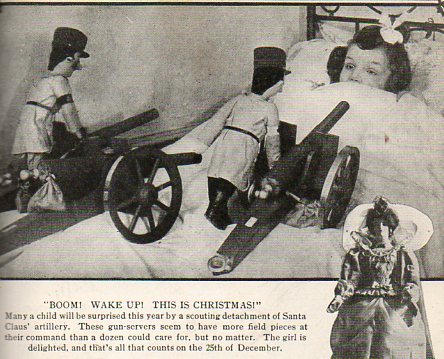
    Children battalion006
    I don’t know the Illustrated History of Santa and Gun Gifts, but I guess that a book could be written if one already doesn’t exist.  Well, that or something associating Santa with unusual, or questionable, gifts in his bags of joy could be made into something, something disappointing.  I’m not that person to collect those sorts of images because I have always held Santa in very high esteem, and I don’t care to have too many of those images floating in my mind, exploiting some dark corners of unknown memories, disturbing the happy bits with unneeded and unwanted visual info.  But, well, these pictures below, found in the December 1916 issue of the uncommonly-seen journal, Illustrated World, provides a little glimpse into the manufactured desires of kid-wishes for toys during wartime, and so I’ll pass them along.  These things do tell us something about the period–like the famous multiple images of Santa hanging cigarette carton Christmas ornaments (seen here in the post on Gift Porn, 1954), or a smoking Santa stuff a stocking with a box of Lucky Strikes–so it makes sense to make sense of them.

      Children battalion008

    I guess kids have fairly well always wanted toys (or not) guns for Christmas,  gifts from Santa, or at least so long as Santa has been around or identified as so, and to see Santa with a rifle would not be so unusual, especially given that this was deep into the second year of the bloody Great War.  (I have another interesting image here, somewhere, showing Santa distributing presents to British troops in trenches, riding a tank, but presently I can’t find its stack in a stack of stacks.)

    Perhaps the issue of playing with guns and cannons and so on was a way of easing fear and distress during wartime; perhaps it meant something soothing for the developing mind of a child.  I don’t know.

Recent Posts

Archives

Categories