A Daily History of Holes, Dots, Lines, Science, History, Math, Physics, Art, the Unintentional Absurd, Architecture, Maps, Data Visualization, Blank and Missing Things, and so on. |1.6 million words, 7500 images, 4.9 million hits| Press & appearances in The Times, Le Figaro, Mensa, The Economist, The Guardian, Discovery News, Slate, Le Monde, Sci American Blogs, Le Pont, and many other places… 5000+ total posts since 2008.

  • A History of Heavy: German Typography

    JF Ptak Science Books    Quick Post

    In the world of the history of heavy, nothing quite spells it so correctly in typography than some of the German entries in the 1920’s.  Big, thick letters, jumbo arms and legs with little breathing space, and no design to get in the way of letting gravity do its work, and place often on jet-black backgrounds, these alphabets are a perfect answer to the weight of the decade.  

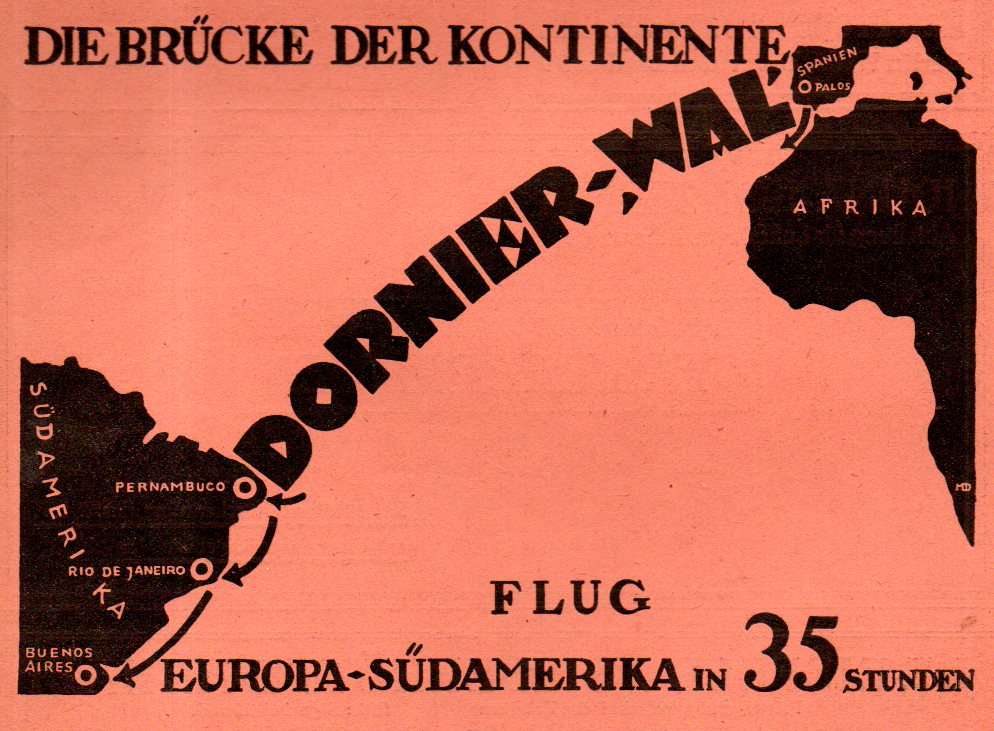
    Here is a good example of mid-heaviness, expressed in type and in a map and the overall design.  This is an ad onthe front cover of ZFM Zeitschrift fuer Flugtechhnik und Motorluftschiffahrt (14 April 1926) and for the leaving-the-ground aspect of the journal the design work couldn’t be much heavier.  

    Heavy, History of785

    This air travel ad posts the Dornier-Wal seaplane, the “Bridge of the Continents”, getting you across the Atlantic to South America in 35 hours.  (The Dornier -Wal was a flying boat, a metal monoplane with above-the-wing twin engines and a maximum speed of about 180km/hr, which means I guess that the aircraft was making on average about 90mph on its trip across the Atlantic.)  And the ad–well the ad is bold, and slightly spartan, and still very heavy for the amount of blank space in it.  

    ·Posted by :

    ·in:

  • Deadly Dead Ideas: the U.S. Thinks About the Great War, 1915

    JF Ptak Science Books   Quick Post

    Hollow square790

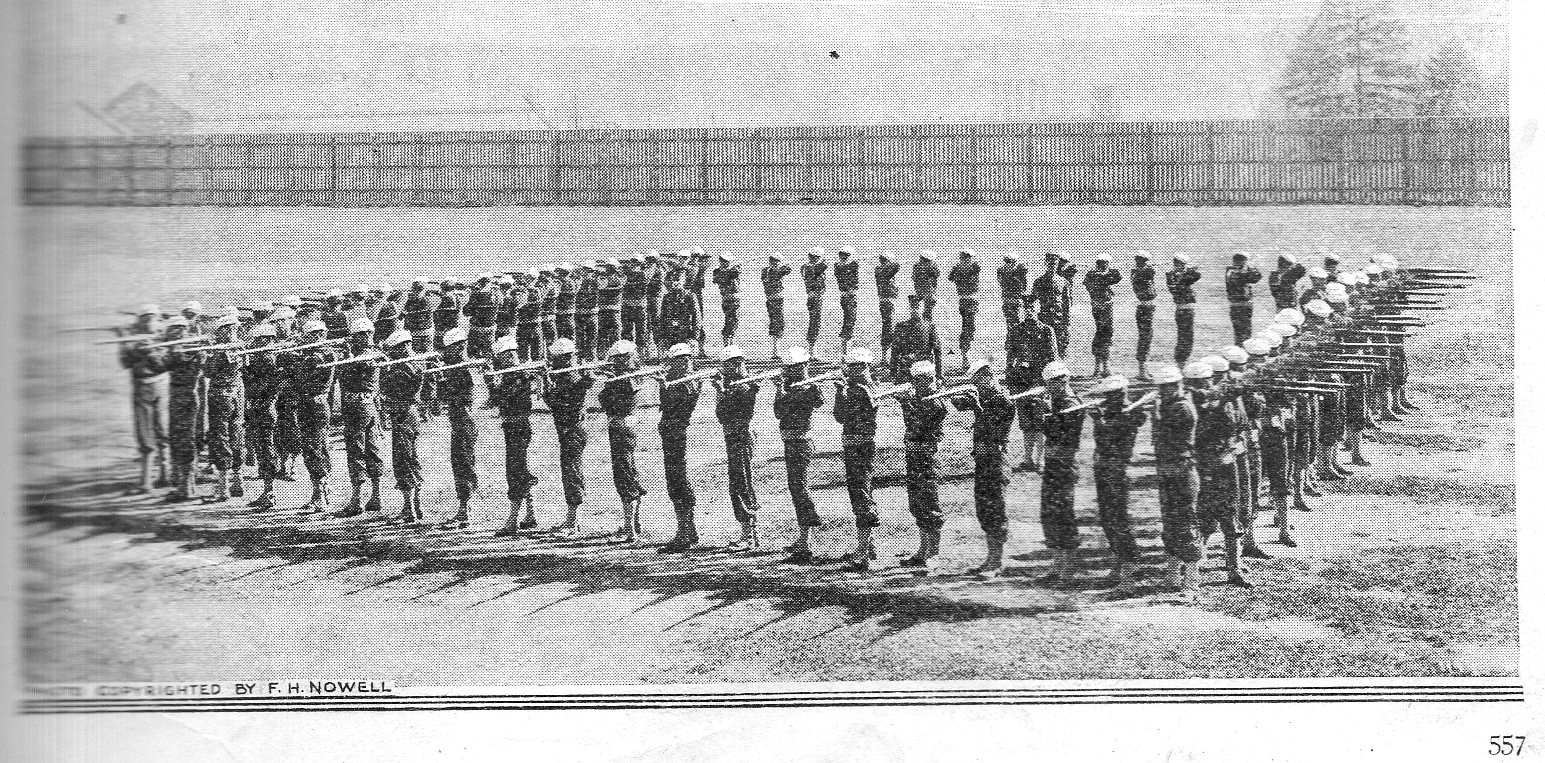
    My browsing came to a sudden halt when seeing this small inset photo in an article in Popular Mechanics for October 1915.  “My Four Years in the Navy” was a fairly long feature piece, and it showed a series of rather crowded images of life at sea with overtones of “readiness” should something happen to bring the U.S. into the year-old WWI.  It was the picture at the bottom of p. 567 that gives you great pause–first of all, the sailors are armed and on land, but they’re also forming a “hollow square”, a defensive position used when a large force attacks a smaller one.  The tactic has been around at least since Roman times and used steadily through the early 19th century (especially it seems during the Napoleonic Wars), but it gradually wore away from the face of battle, and was hardly employed in the late 19th c, except against irregular forces (like against warriors in the Zulu Wars). What made it an antique notion was the machine gun, and tank–mostly though it was rapid-fire assault weapons the crushed the square, the collection and stacking of soldiers close together (and in layers) made them easy targets to an opponent with such weapons).  Nobody was using this technique in the Great War, but there they were, these poor sailors, demonstrating the formation to fight against hundred-year-old ghosts.  The U.S. was nowhere near being ready to fight in WWI in 1915.  

  • Demolition Tightrope Act with Pick Axe, 1915

    JF Ptak Science Books   Quick Post

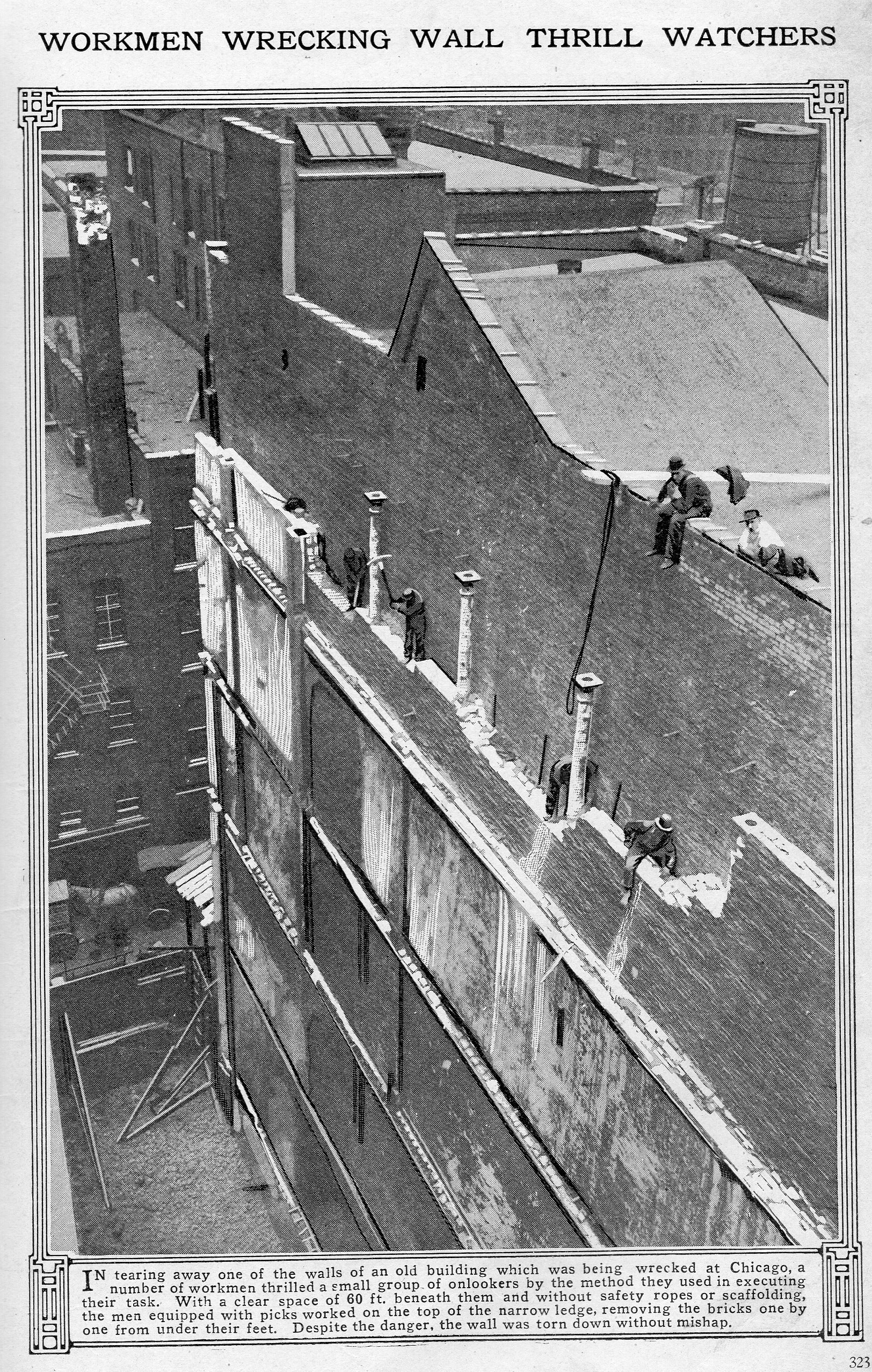
    There was a job to do in Chicago, and these men did it–how it all worked out safely accomplished, I do not know, because the episode is gut-wrenching just looking at the photo.  Not much can be said here except, “oh, wow”. 

    And for the record they are removing a wall from a mostly-demolished building, the last wall standing, built against its neighbor.  And what these guys did six stories up was swing a pickaxe to remove the wall beneath ,them, all the way down, brick-by-brick.  

    Demolition791

    [Image source: Popular Mechanics, August,, 1915, pg 323]

  • Superior Table of Early Computers (1956)

    JF Ptak Science Books  Quick Post

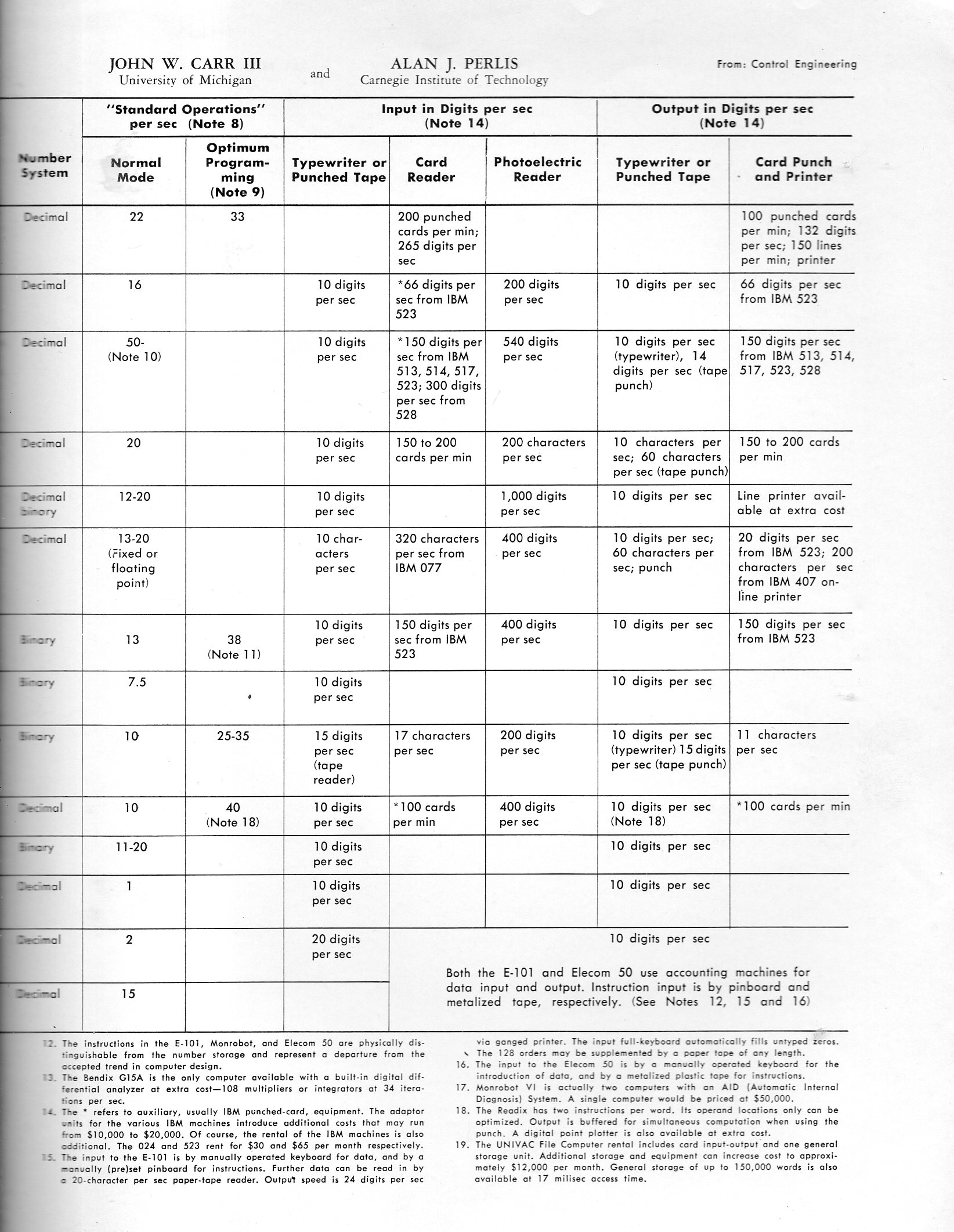
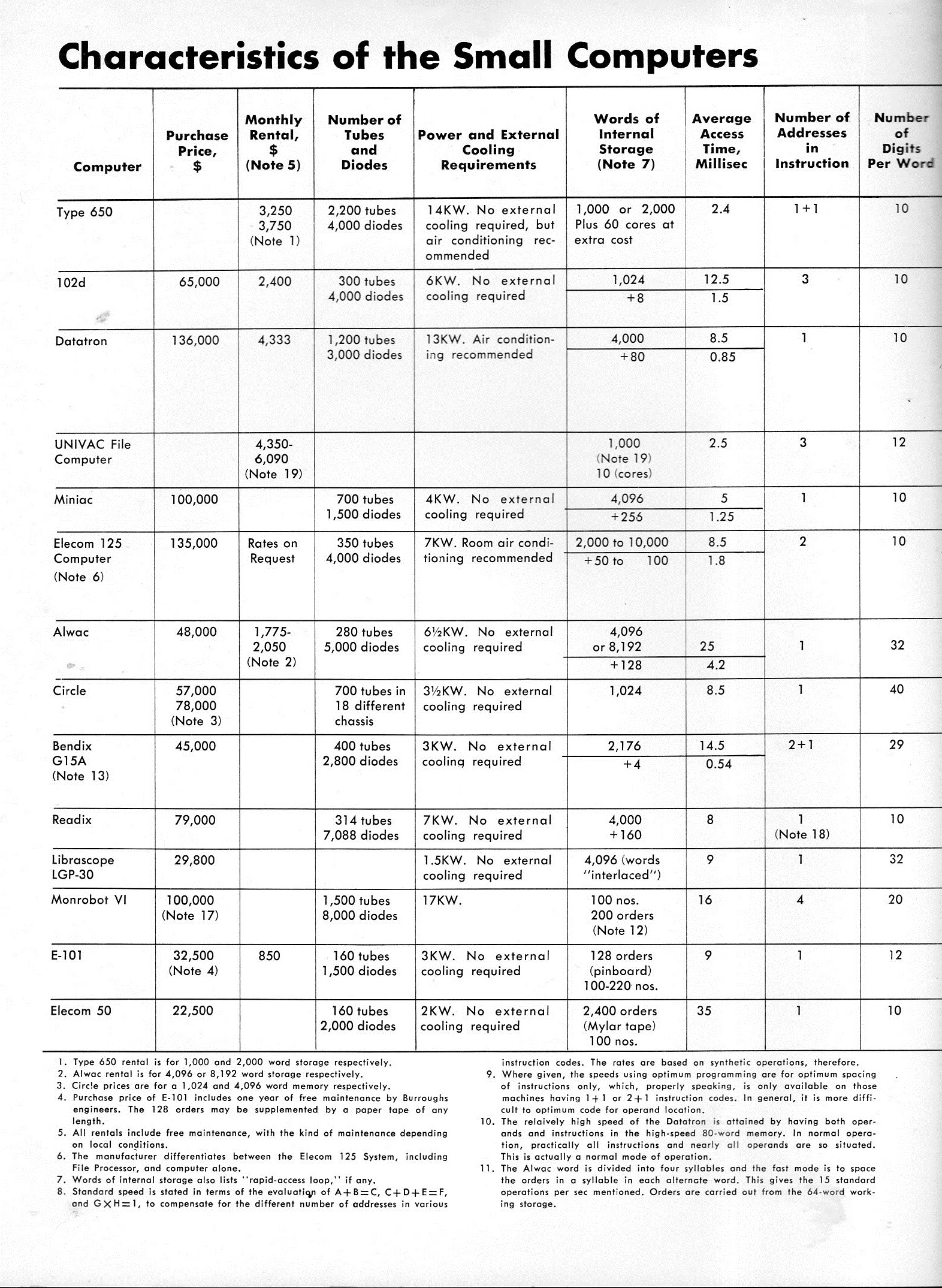
    “Characteristics of the Small-Scale Computers” looked innocent enough, 12″ tall and one folded piece of paper, and published in 1956.  The authors–John W. Carr III and Alan J. Perlis–were heavy hitters, and so I really wasn’t very surprised to see what they had done “inside”, though I was impressed and happy to see the data. Displayed on the 12×16″ sheet of paper are 15 data points on 14 computers, many of them classic/famous:  the 650 IBM, UNIVAC, Elecom, Alawac. 

    (Remember that when you’re looking at purchase price and monthly rental amounts that the 1956 dollar is equal to about $8.70 in 2015 dollars, so that $3275/month for the 650 would be about $30k.  The $136k for the Datatron is about a million today.)  


    Perlis795

    Perlis794

    ·Posted by :

    ·in:

    —
  • What Happens After a 1,667 Megaton Nuclear Attack (1962)

    JF Ptak Science Books   Post 2418

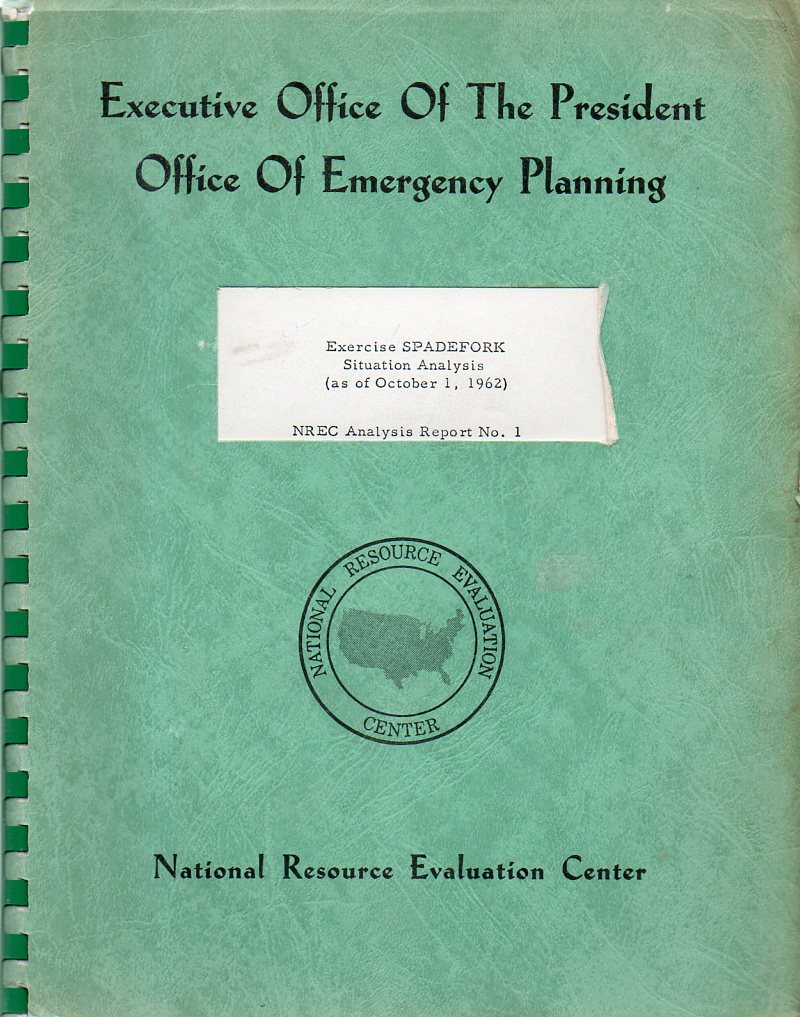
    This report on Exercise Spadefork was issued at the very beginning of the Cuban Missile Crisis on October 1,1962. Undertaken by the National Resource Evaluation Center (NREC) and other agencies it was supposed to give a good indication of what happens after a very large nuclear attack on the United States, “Measuring the Capability of Survival”, evaluating what remains of the country and its sovereignty. 

    Spadefork797The theoretical attack began at 3pm, Friday 21 September 1962. 221 nuclear missiles were exploded in/over the U.S. In the first hour, with a total of 355 in the first 48 hours. [I’m not sure that the Soviet Union had 221 intercontinental ballistic missiles at this time, nowhere near that, unless of course they were able to get their 700-missile medium-range ballistic missiles closer to the U.S.]

    A total of 1, 779 megatons were exploded almost equally between ground and air bursts.

    20 were 1 megaton; 15 were 10 megaton, and 320 were 5 megaton.

    • The Hiroshima weapon was about 20 kilotons, so in the roughest sense each one of the 5 megaton weapons carried about 250 Hiroshima weapons; the total 1,779 megaton delivery would (grossly) be equal to about 178,000 Hiroshima weapons.

    Most of the attack was delivered against military sites, “population and industrial centers appeared to be secondary targets, with only about 50 major centers receiving signifcant amount of blast damage”. Somehow “no major sections of the country were isolated due to fallout contamination”.

    How we make out:

    Military & “Sovereignty”: not so bad. Air Force and Navy take major hits (something approaching 50% casualties) but the Army does better, not being targeted so heavily, with 20% losses.

    ·Posted by :

    ·in:

  • Civilians as “Hostages” in the Nuclear Deterrence Equation (1967)

    JF Ptak Science Books   Quick Post

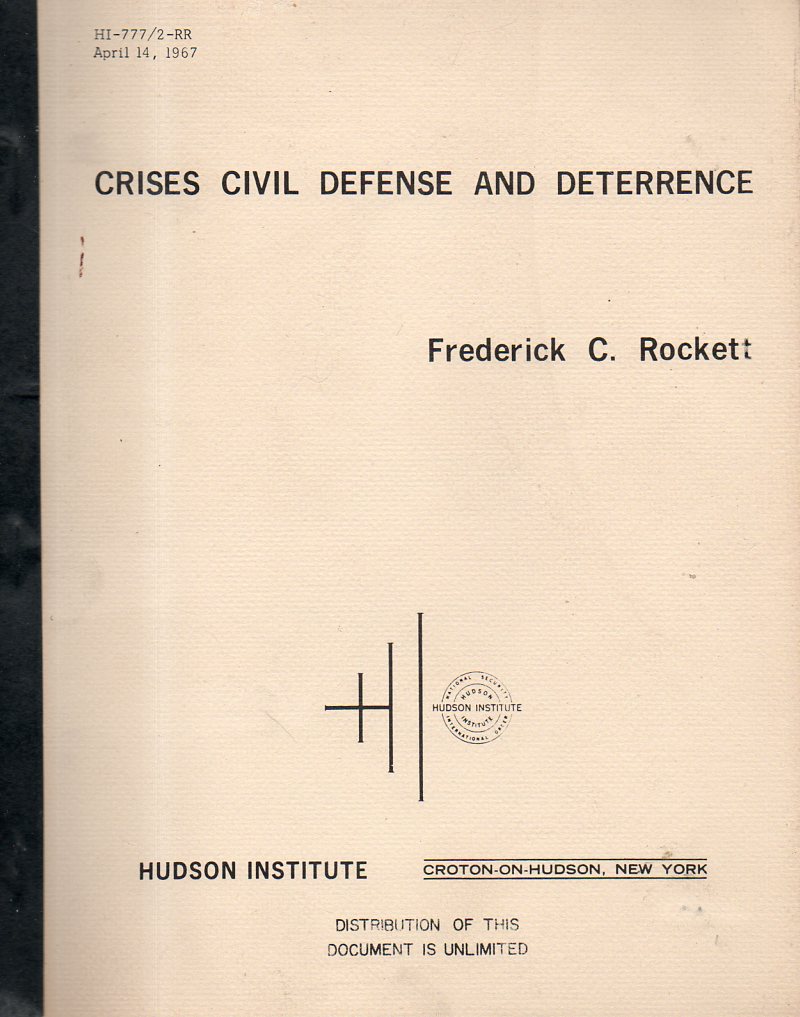
    Rockett798Frederick Rockett’s Crises Civil Defense and Deterrence makes a curious display of itself on it title page, what with no punctuation and all–same for the title page, though that changes a little to Crisis Civil Defense and Deterrence. With a comma here and there, the title changes meanings a bit.  In any event with my little screed over the document was published by the Hudson Institute in 1967 and is actually about how the Soviet Union, China and some other countries could reduce their vulnerability to nuclear attack by undertaking (emergency) civil defense precautions like large-scale evacuations and fallout protection. The author adopts a curious term here–“hostages”–to apply to the civilian population in relation to the nuclear policy of deterrence.  And what that means is that with increased numbers of civilians surviving there would be  a greater recover capability after a nuclear strike; in deterrence, enemy populations are part of the scheme, being seen as “hostages” to a nuclear strike and therefore a deterrent for that country to initiate an attack. With an increase in the number of survivors to an attack via the civil defense advancements there are fewer “hostages” and therefore the concept of deterrence is weakened, perhaps to the point where countries could begin to think of first-strike capacity with a more-protected population.

    • [The original document is available for sale at the blog’s bookstore, here.]

    And so down the rabbit hole we go, discussing mine shaft gaps. This is five year after Dr. Strangelove, but this was very real stuff–and I imagine that if I were in a position to have to think about nuclear strikes and deterrence and etc., I probably would have been thinking in these terms, too.  

    ·Posted by :

    ·in:

  • Stephens Bibliography on Nuclear Fission (1948)

    JF Ptak Science Books    Reference Tools series

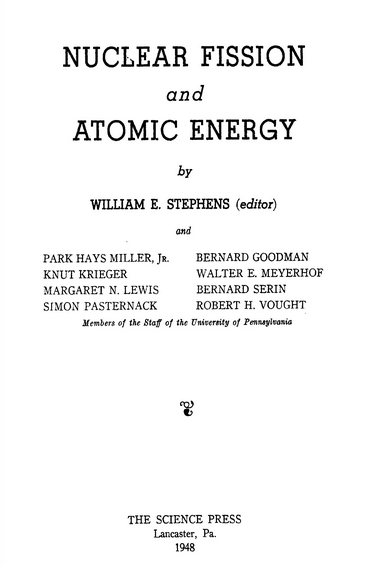
    Stephens nuclearHere’s a very useful tool for the early days of nuclear fission and atomic energy–the bibliography from William Stephen’s Nuclear Fission and Atomic Energy (published by the Science Press in 1948). The OCR is a little unsteady but the info is there even if it isn’t as clear as it might be.  

    The full text for the work is found at the Internet Archive, here:  https://archive.org/details/nuclearfissionan030064mnb

    Also see the excellent Louis Turner bibliography for nuclear fission, 1934-1940 (133 items) in an earlier post on this blog, here:  https://historyofideasblog.com/thesciencebookstore/2013/08/turners-bibliographic-review-of-nuclear-fission-1934-1940.html

    Partial Bibliography on Nuclear Fission and Transuranic Elements


  • Camera Obscura at War, II–Zep Buster

    JF Ptak Science Books, Quick Post

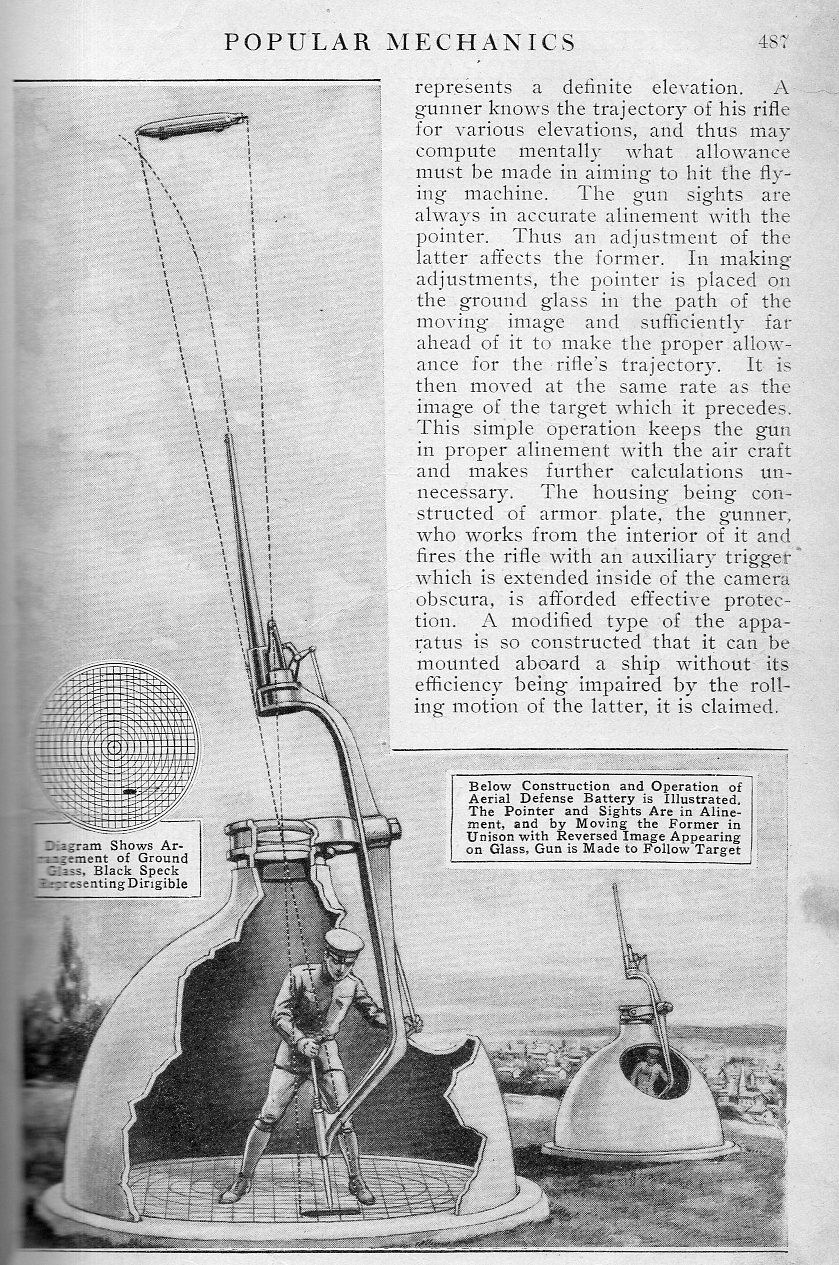
    Earlier in this blog I wrote about an unexpected military use of the camera obscura, here (“The Camera Obscura at War, 1885”).  Today I found another use, which was a guided/guiding anti-aircraft weapon.  I assume that this was mostly employed against the slower moving zeppelins (although in 1915 airplanes weren’t moving that much faster) due to its very limited range of fire.  The camera obscura itself didn’t move, and the relatively small occulus offered not that big a range of sky to work with. But that said the weapon was an ingenious and simple mechanism, an early and primitive semi-machine-directed anti-aircraft gun.  There is no mention of whether or not any of these were actually deployed, and compared to the AA guns that actually appeared in the first and second yer of the war, this attempt looks a little antiquated for the time.  The article also makes no mention of the artillery to be used, which is a major consideration.  

    Aa gun799

    The article appeared in Popular Mechanics, April 1916 (pp 486-7)

  • X-Rays and the Art of Seeing Things That Aren’t There

    JF Ptak Science Books    Post 2419

    In the History of Seeing Things That Aren’t There there are three main staples of disruption of reality: the introduction of the telescope by Galileo and the expansion of the night sky by an order of magnitude and the unsettling of what had been a pretty-much unbroken knowledge of the visible sky for thousands of years; the introduction of investigations with the microscope by van Leeuwenhoek and Hooke and so on, revealing an extraordinary new and unimaginably fine and tiny world, multiple worlds within our world; and the Rontgen discovery of the x-ray, the visualizing agent for stuff that could be seen but not without mess and fuss. 

    It is hard to overstate the significance of Wilhelm Roentgen’s discovery of x-rays, as well as the public reaction to it.  (Well, the enthusiasm of the popular response waned dramatically after the first few months, which–given the historic significance of the discovery–was not long at all.)

    Rontgen  bertha

    [Source: Wikicommons.   This is Roentgen’s wife’s hand,  the first image ever made via the new X-Ray, and one of the most iconic images in the recent history of science.]

    Scientific/technical journals as well as the popular press were flooded with articles published about the astonishing discovery of 50-year-old physics professor from Wurzburg.. The English-language popular science journal Nature’s announcement of his December 28, 1895  “Ueber eine neue Art von Strahlen” (“On a New Type of Ray”), appearing 16 January 1896, began the introduction of a new state of human experience.  His experiments—built upon the work of J. Pluecker (1801-1868), J.W. Hittorf (1824-1914), C. F. Varley (1828-1883), E. Goldstein (1850-1931), Sir William Crookes (1832-1919), H. Hertz (1857-1894) and Phil Lenard (1862-1947)—revealed as much to humans as did the experiments and inventions of Hooke and Leeuwenhoek on the invisible worlds revealed by the microscope.  There are more than 150 articles on the Roentgen (and soon to be “X-“) Ray, all published within 12 months of the original announcement, almost all excitedly, trying to comprehend, elucidate, expand, verify, this new world1. 

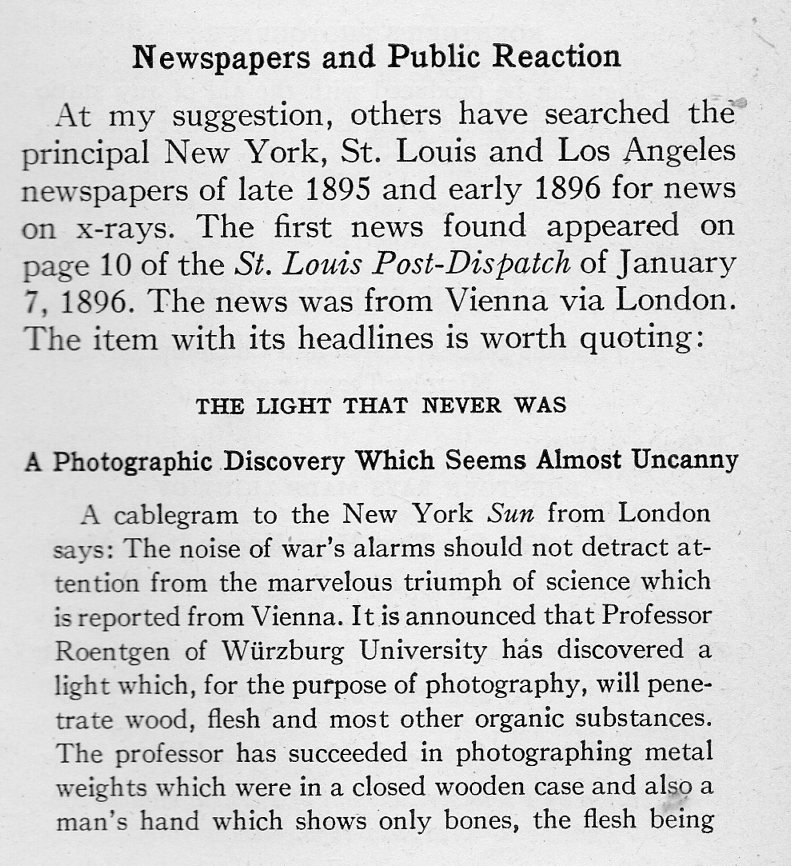
    So what brought me to this tonight was an article in the American Journal of Physics for 1945 (volume 13) which has a great article on the history of the discovery (by G.E.M. Jauncey) and which also has a number of samples reporting on the discovery in the popular press, none of which I had seen before.  And so I thought I’d share them here: 

    Rontgen800


  • Art as a Political Weapon: the German Unmensch, 1930

    JF Ptak Science Books   Post 2420

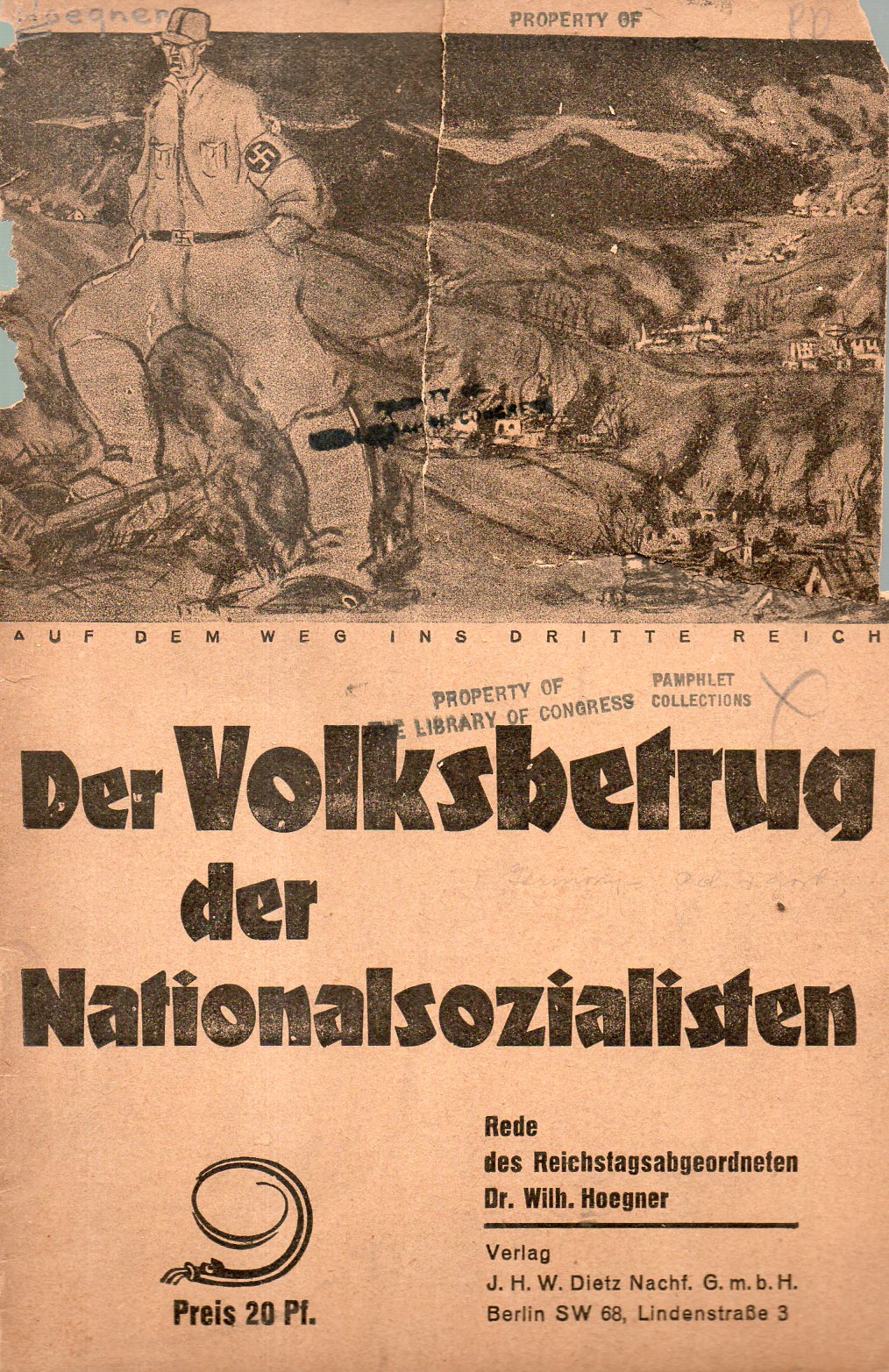
    Nazii, anti805

    [Private collection via the Library of Congress]

    Wilhelm Hoegner was SPD and anti-Nazi from the earliest days of Hitler’s political party.  In a developing chorus of other anti-Nazi Germans, he delivered this screed against the NSDAP while he was a member of the Reichstag in 1930.  Der Volksbetrug der Nationalsozialisten also features one of the most effective and tried pieces of social demonstration–artwork, and in this case a biting satire of the “progress” of the Nazi Party. The image features a hideous, rank-and-final brownshirt monster/Unmensch/Unhold, trampling his way across the land, with burning villages in his wake–the path of the Third Reich (“Auf dem Wege ins Dritte Reich”). Hoegner’s sympathies are instantly seen here, and there is no chance for mistake in how he depicts Hitler’s political party. 

    This is a very good example of social protest against the rising Verwünschung/plague that was just three years away from the total domination of the German political scene, and only 15 from total destruction. The artwork is anonymous, and it is dark, and gruesome in a very subtle and gritty–and effective–way. It is also good neighbors with other protest art/literature heroic figures like George Grosz, John Hearfield, Hannah Hoch, Kathe Kollwitz, Otto Dix, and many others.  There just weren’t enough of them. Or their followers.  

    Hoegner would last in Germany only another three or so years, but survivied–his surrepticiously published account of the Beer All Putsch (published in 1933) was a major inconvenience to the Nazis, though that was settled out once Hitler came to power in 1933 and as many copies of Hoegner’s work were found and destroyed.  Hoegner himself made it out to Austria and then to Switzerlqand by 1934.  He would return to Germany immediately after the war and assume advanced political office in the new Germany.  

    Full rext here http://library.fes.de/library/netzquelle/rechtsextremismus/pdf/hoegner.pdf

  • Beethoven, Bartleby, and Subtraction

    JF Ptak Science Books   Post 2421

    Is it really necessary to know subtraction? Or perhaps more appropriately, is it necessary to know subtraction (or multiplication, or division) to be a Pythagorean? Beethoven didn’t think so, and that might have been so because he wouldn’t express thoughts like that. He evidently never said anything about it but one thing seems to be for certain—he didn’t know how to subtract. Or divide, or multiply. Or much else arithmetical. I suspect the he didn’t know these actions because he didn’t care to, or need to, or want to. In his difficult childhood and his even more-difficult experience in school, I suspect that like Bartleby he simply preferred not to. Perhaps his public “knowing” of things like that were more “no-ing” than anything else.

    • Follow this link for an earlier story on this blog on the first appearance in print of the addition “+” sign.  

    This presents itself to me sometimes as a language of control, about what you do or don’t know, or choose to know or not know, or express, or admit to, somehow a not-knowing being the limiting factor in what it is you can come to know in the future. It seems to change the chromatics of knowing things.

    It is a remarkable thing that Beethoven didn’t want algebraic ideas or symbols in his head. Or maybe he did and just didn’t say, preferring silence or contrariness.

    I don’t know if he thought about the physical basis of harmony and the laws of rhythm. 

    It presents itself to me sometimes as a language of control, about what you do or don’t know, or choose to know or not know, or express, or admit to, somehow a not-knowing” being the limiting factor in what it is you can come to know in the future. It seems to change the chromatics of knowing things.

    ———-

    ·Posted by :

    ·in:

Recent Posts

Archives

Categories