A Daily History of Holes, Dots, Lines, Science, History, Math, Physics, Art, the Unintentional Absurd, Architecture, Maps, Data Visualization, Blank and Missing Things, and so on. |1.6 million words, 7500 images, 4.9 million hits| Press & appearances in The Times, Le Figaro, Mensa, The Economist, The Guardian, Discovery News, Slate, Le Monde, Sci American Blogs, Le Pont, and many other places… 5000+ total posts since 2008.

  • A Nosey Trifling on the Wealth of Famous Dead Scientists

    JF Ptak Science Books    Post 2417

    I intended to write a small post about some ads that I found interesting in Nature in 1895–Epp’s cocaine remedies, mostly.  It was Holloway’s Pills that lead me astray, looking to see what it was that was in them, which lead me straightaway to an article about the wealth of Mr. Holloway derived from his tasty patent cures, and then on to a site that hosted wills for England and Wales from 1858 to just about the present. So, being curious, I picked up the biggest 19th century English scientist and found to no great surprise that Charles Darwin left an estate of some £146,000 pounds, no doubt part of the family fortune, which is today “worth” about £12 million (according to whatsthecost.com, which is about average I’d say from the other sites that figure out translating old money to new).  
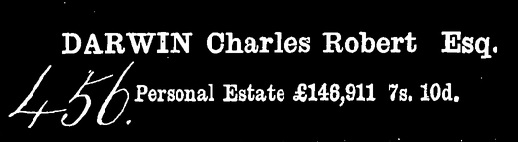
    Darwin willhttps://probatesearch.service.gov.uk/#wills

    It seems that the only surprise for me is how surprising it was to find so many of these folks with considerable estates.  Theoretically some made a lot of money via patents and inventions, and many started out life with family money, but just about everyone I checked out left the planet leaving behind personal fortunes.  One surprise–Alexander Fleming, the penicillin man, left an estate of some £29,000  when he died in 1955. That’s about £1.1 million today, which is a fair amount of money and gave him a comfortable life, but it just seems a bit low considering his achievement–believe me I’m not measuring worth via money; it just seems to me that more money would have stuck to him, somehow.  

    I spent about an hour tooling around the site and came away with 20 examples (with 7 of the 27 I started out with having no record of a will in these files, which I don’t understand).  Well, it is actually 20 scientists and Winston Churchill, who I just had to look up. (He left an estate of £304,000  when he died in 1965, or about £4.2 million.) 

    Then I looked up Alan Turing, and found that he did okay–I’m not sure why I was expecting to find him in hard times, but he certainly wasn’t, with  effects at £4,600  (£90,000  today). 

    TURING WILL

    And a few other examples of some major-domos: 

    • William Crookes (d. 1919) £29,013 (£1,078,355.98 in 2014)
    • Thomas Huxley (d. 1895) £9,290 ( £885,159.87)
    • W. Stanley Jevons (d. 1882) £6,980 ( £609,391.10)
    • Michael Faraday  (d. 1867) £8,000 (£644,974.61)
    • Charles Babbage (d. 1871) £40,000 (£3,405,630.66)
    • James Prescott Joule (d. 1889)  £12,765 (£1,178,678.58)
    • John Couch Adams (d. 1892) £32,433 ( £2,977,170.05)
    • James Young Simpson (d.1870) £35,000 (£3,021,645.81)
    • Henry Grey (as in Grey’s Anatomy, who died very young, at 34, before his book came close to ever taking off) (d. 1861)  <£9,000 ( £769,769.94)
    • Alfred Russell Wallace (d. 1913) £5,823 (£482,347.46)
    • Joseph Lister (d. 1912) £67,996 (£5,609,910.24)
    • Charles Darwin (d. 1882) £146,000 (£12,746,576.00)
    • Francis Galton  (d.1911) £104,487 ( £8,872,364.77)
    • James Dewar (d. 1923) £ 129,995 (£5,669,078.76)
    • Frederick Soddy (d. 1956) £37,605 (£678,505.06)
    • William Bateson (d. 1926) £25,435 (£1,122,679.34)
    • Alexander Fleming (d. 1955) £29,321 (£554,960.10)
    • Alan Turing (d. 1954) £4,603 (£91,041.68)
    • John Herschel (d. 1871) <£30,000 ( £2,554,223.00)
    • James Chadwick (d.1974) £33,146 (£249,333.66)
    • C.V. Boys (d. 1944) £36,500 (£1,061,175.65)

    There’s another site run by the U.K. National Archives that presents wills from the 14th century to 1858, located here: http://www.nationalarchives.gov.uk/records/wills.htm

    I went right away to William Shakespeare and found him: http://discovery.nationalarchives.gov.uk/details/r/D898518#imageViewerLink

    All of this is interesting and good and represents an enormous time hole, so I’m going to end this post here with enough bits and pieces to interest and help anyone who wants to go down the rabbit hole.  Have fun!
    ·Posted by :

    ·in:

  • Women, Work, and Bombs: 1918

    JF Ptak Science Books   Quick Post

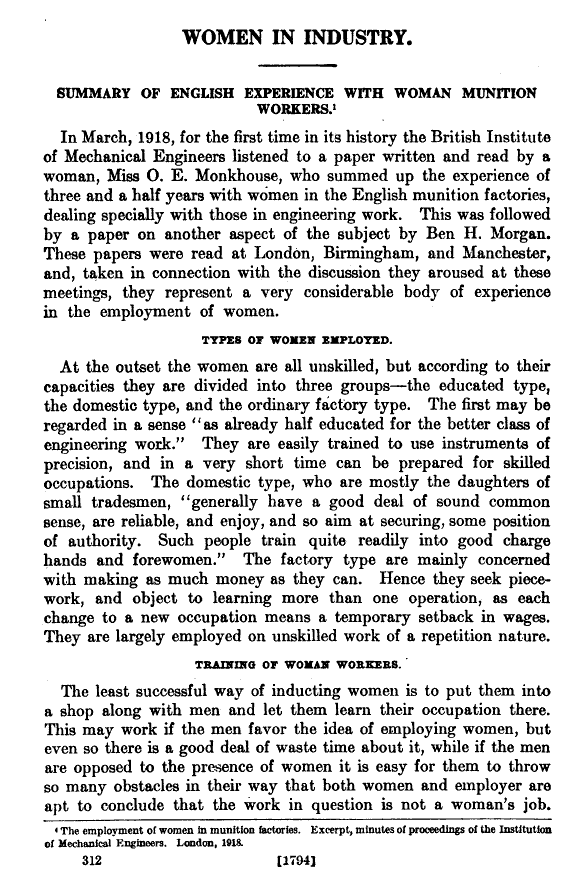
    I came across an interesting little story in Nature (March 28, 1918) about women munitions workers.  It is a note based on a report written by Miss O.E. Monkhouse–and as it was noted in the Monkhouse piece that it was the first paper read by a woman before the British Institute of Mechanical Engineers–and summarizes the work of a million women workers in wartime bomb  factories.  It is probably a valuable report for its telling of the number and nuts and bolts, and of course for the history of the introduction of women into a work environment where they had never been before, and in great numbers,  but it still must suffer through the painful prejudices and opinions of the times. Ms. Monkhouse though is an elegant spokesperson and proponent for equality, and makes several arguments for the abilities of women being equal to that of men, which makes this short article well worth the read. 

    Women in industry


    ·Posted by :

    ·in:

    —
  • A Very Early Bibliography on the Theory of Special Relativity (1910)

    JF Ptak Science Books    Reference Tool series

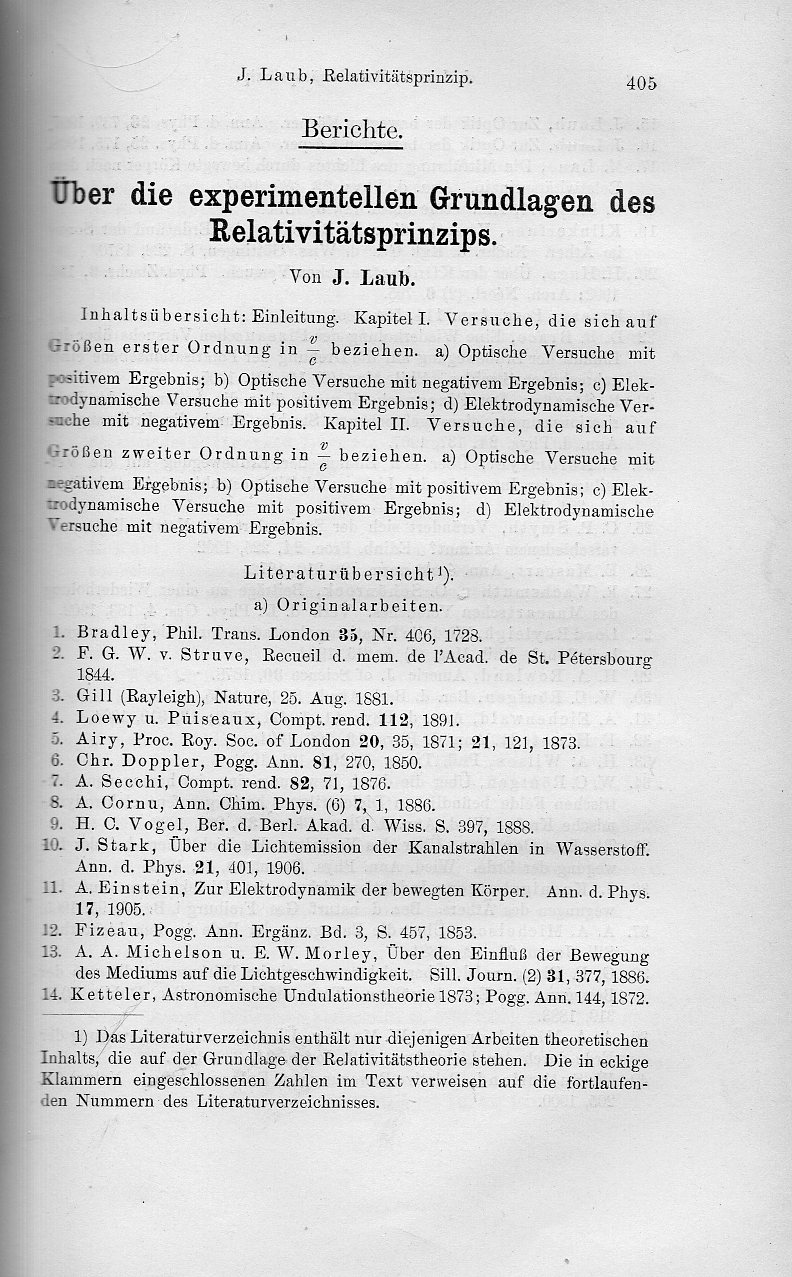
    Jakob Laub–the first collaborator of Albert Einstein–wrote one of the earliest histories/retrospectives of relativity theory for the Jahrbuch der Radioaktivitat und Electronik in volume 7 for 1910: “Uber die experimentellen Grundlagen des Relativitatsprinzips”, pp 405-463. (It seems that I don’t often see/notice references on this level citing the first German edition of an integral work in another language, which Laub does here for example in two articles by Fizeau that he found in Annalen when their original publication took place in the Comptes Rendus.)  (See the reference for Laub in Physics Before and After Einstein  edited by M. Mamone Cap; also The Scientist as Philosopher: Philosophical Consequences of Great Scientific ...by F. Weinert. 

    This paper also contains a 127-item bibliography, which I cannot find online and which I reproduce below.

    On Laub, from the Dictionary of Scientific Biography, volume 17:

    “Laub attended gymnasium in Rzeszόw. In 1902, after studying briefly at the universities of Cracow and Vienna, he entered the University of Göttingen as a student of mathematics and physics. There, taking courses and seminars with David Hilbert and Hermann Minkowski, he became interested in the electron theory. He turned to experiment, and in 1905 he decided to work with Wilhelm Wien at Würzburg. Laub’s doctoral dissertation (1907) concerned secondary cathode-ray emission. At his oral defense (1906), he introduced Einstein’s special theory of relativity, which Wien had recommended to him in September 1905. For the next several years Laub remained at Würzburg and concentrated on extending Einstein’s ideas.”

    “Although by early 1908 Einstein was attracting notice from distinguished physicists, he had not yet received a university appointment. It was an unusual step, then, when in February 1908 Laub wrote to Einstein to ask if he could visit Bern to study relativity with him. Laub became Einstein’s first scientific collaborator. Together they published articles criticizing Minkowski’s notion of electromagnetic force and suggesting an experiment to decide between Einstein’s special relativity and Hendrik Lorentz’s electron theory.”

    Laub764

    ·Posted by :

    ·in:

    —
  • Future Sky Cop, 2000 (from 1882)

    JF Ptak Science Books    Quick Post

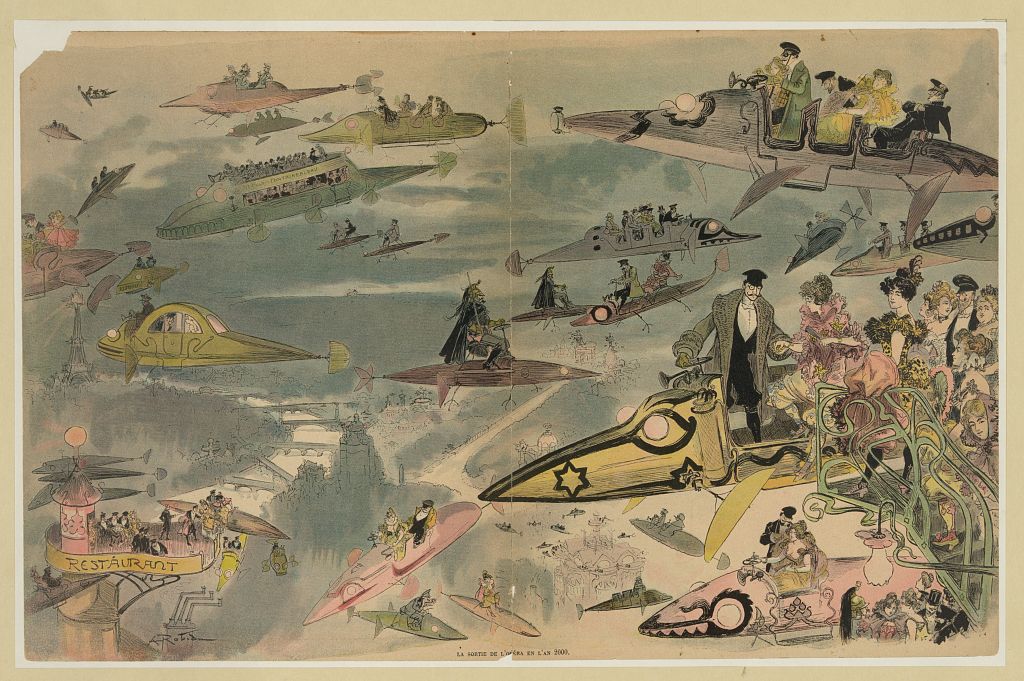
    Robida paris opera[Image source: Library of Congress, here.]

    Albert Robida (1848-1926) imagined many things in his long and illustrative career, seeing deep into the futures that would/didn’t come to be. Perhaps this one is nearly coming true but in a different format–his imagination 1882 inspiration of what the future of air traffic would be like attending the Paris Opera  (“Le Sortie de l’opéra en l’an 2000”) might seem more prescient of the view was in 2030 and the taxi cabs and other air chariots were drones instead.  In this version of the future there are restaurants and limos and buses and private air vehicles galore, all anthropomorphically cluttering the environment 1500′ above the city-center of it all though is a blue centurion, riding a futuristic Electra Glide, a helmeted cop on a small and sleek vehicle, right in the center of the sheet. 

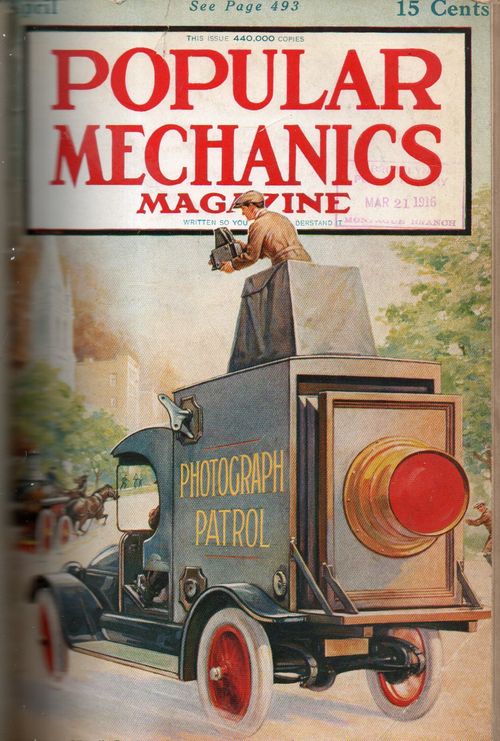
  • The Google Car, 1916

    JF Ptak Science Books  Quick Post

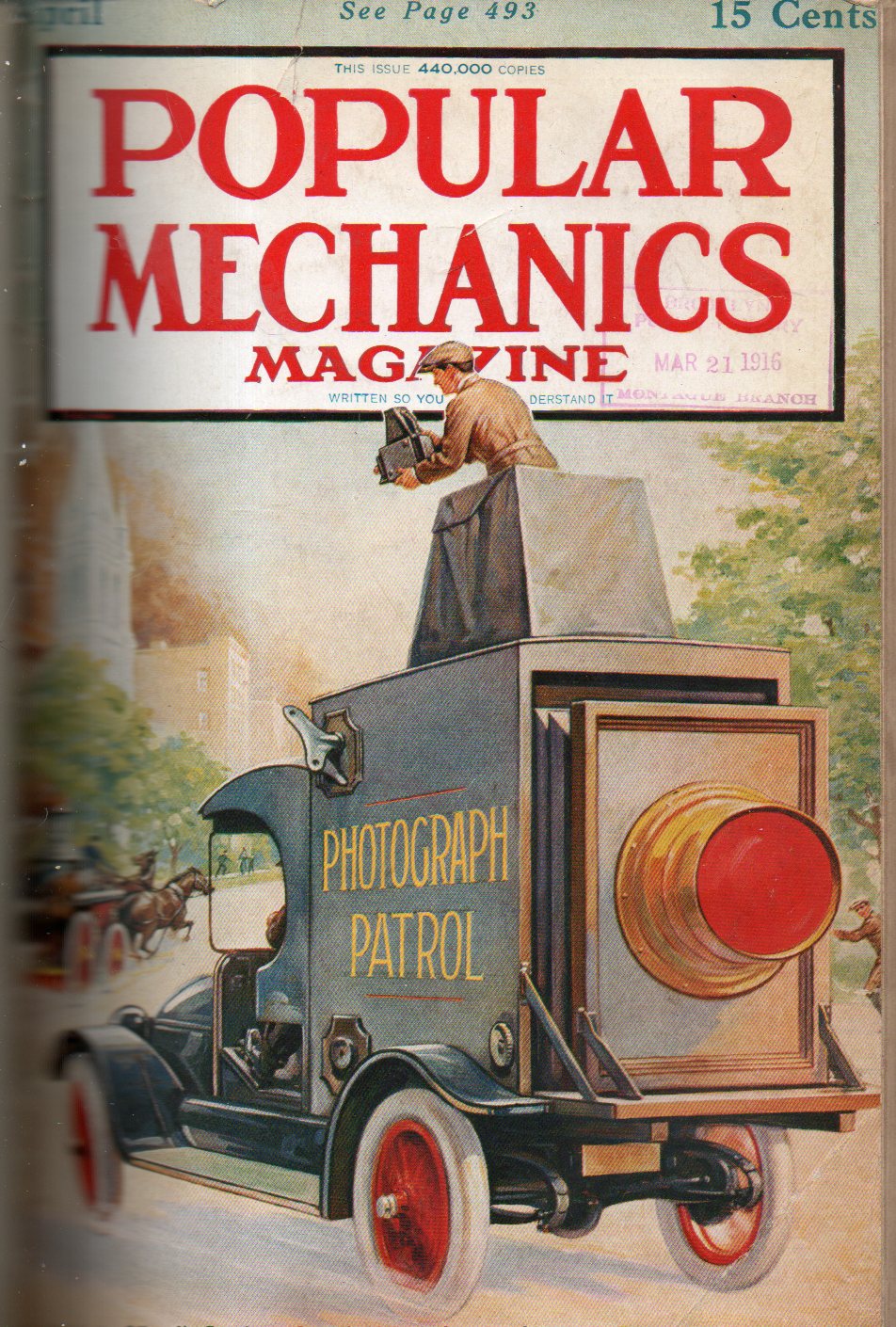
    No, this isn’t the equivalent of the Google  Street Maps photo car, but it does look a little like its great grandfather. It is simply a stunt truck, a rolling photo lab decked out to look like a camera. It appeared in Popular Mechanics for April, 1916.   

    Google car772

    ·Posted by :

    ·in:

  • A Million Violinists Playing Everything at the Same Time

    JF Ptak Science Books    Quick Post

    It isn’t quite that–wait a minute: yes, it is. But it wasn’t a “million”, but “millions”. The reference is to a thought experiment in which “millions of violinists performing every conceivable sound within the octave, with a view to the production of the purest and most ethereal of sounds”.  

    It seems like a musical experiment best left to stay inside the head, though I would of course love to hear a million of anything do anything at all.  

    The experiment occurs as a sidelight to a very interesting and very early article by Sedley Taylor, “Analogy of Colour and Music”,  found in Nature, volume 2, February 24, 1870, in the letters to the editor section, p. 430. His work on analogy in music and color is very early, particularly by someone who was conversant in both worlds. (Taylor would translate von Helmholt’s great work on the sensation of tone into English (On the Sensations of Tone as a Physiological Basis for the Theory of Music, publishing it in 1875.)  Also in 1875 Taylor published his work on the color/sound subject in a book, Sound and Music. According to Cyril Rootham (1920):

    “Sound and Music,” was… the earliest general exposition in short compass by a writer competent on both sides of the subject. An event which his characteristic energy rendered prominent was his invention of an apparatus which he named the phoneidoscope. It consisted essentially of a resonant cavity, with an aperture over which a soap-film was stretched: when the operator sang to it a note nearly in unison with the cavity, the aerial vibrations revealed themselves visibly in whirling movement of the coloured striations of the liquid film.”–quote via Wiki article on Taylor

    The entire article is included, below: 

  • A Peek at the World of No Tomorrowland–the Bomb Scare, 1950’s

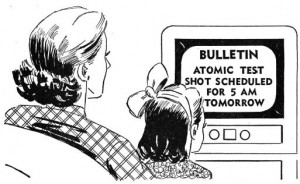
    JF Ptak Science Books   Adding to Post 2129   Part of this blog’s long series on Atomic and Nuclear Weapons    Follow Me on Pinterest


     Atomic-test-warning

    We saw it, and prepared for it, the Impossible Thing, the oncoming of megakilll, or what Henry Adams called The Distinguished Thing, acknowledged and prepared and built ourselves a reserve of anti-fear for it. 

     Once the Soviets demonstrated their capacity to field and then deliver an atomic weapon in August 1949, the great race to Armageddon was underway, a zero-sum game of nuclear dimensions, where an canonical victor is mostly that in name once the million-megaton war was fought and over.

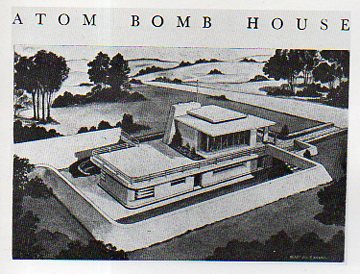
    The best that could be done so far as the general American population was concerned was to stockpile foods, recognize the sounds and sights of an attack, pay attention to the EBS, and possibly prepare for the worst by digging a fallout shelter, or hide under your wooden desk at school, or wear an atom bomb suit, or build an atom bomb house.  Of course if you lived in the 100+ metro areas that were deemed targetable you could also plan your escape route; however,


    since hundreds of thousands(and more) other drivers would be thinking the same thing, getting out of town might not be a possibility. (This was true even if you paid to one of the government-issue nuclear attack evac maps and stayed to the even/east odd/west as dictated by your car’s tags, there would still be an impossible mess.)

    Atomic bomb house746

    [Image source: Yesterday’s Tomorrows: Past Visions of the American Future, by Joseph J. Corn, a slender and pretty book and very easy to underestimate–it is a wonderful work of real depth and reach, remarkable given its brevity.]

    The Atom Bomb House, by Robert C. Scull and Jacques Martini, was designed and published in 1946, and for all intents and purposes supposed that the house and furnishing and all inside it would be safe from an atomic attack.  The blast walls around the house’s perimeter are a curious touch, and actually look pretty nice–I don’t know how much they would deflect the effects of an atomic bomb, though.  Still, it was a way around thinking about the impossible.

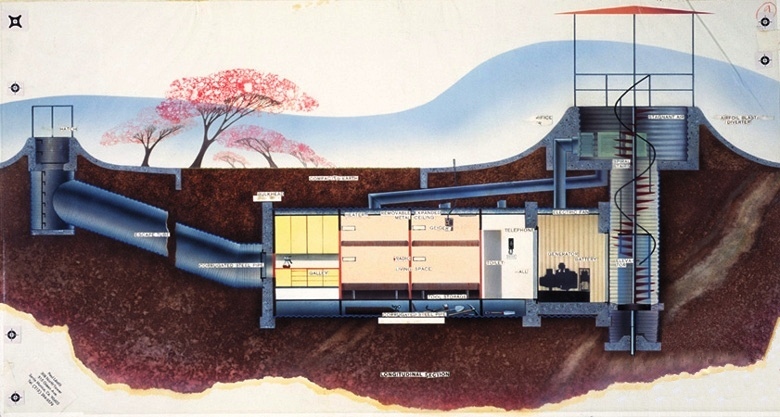
    Making the next logical leap, I guess, the architect Paul Laszlo presented Atomville in 1954, which was a collection of dwellings and structures that were bomb-survival as part of a design-survivable community. 

    Laszlo_bomb_shelter (1)
    {Image source: Mod2mod blog, here.]

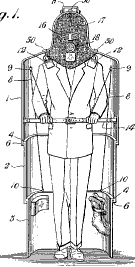
    And of course there was some thinking about making each person their own Atomville, with atomic bomb suits (which I wrote about earlier on this blog, here):

    6a00d83542d51e69e20154328c4d12970c


    [Source: U.S. Patent and Trademark Office, via Google Patents]

    So for 15 or 20 years of getting ready for the Soviets to attack Americans were probably desensitized to what that attack actually meant–after hundreds or thousands of warnings and exposure to the possibility of war and nuclear holocaust, many people grew immune to what it all actually meant, swirling away in the mists of Mutually Assured Destruction like a bad song that you know by heart because you’ve heard it on the radio fifty times. 

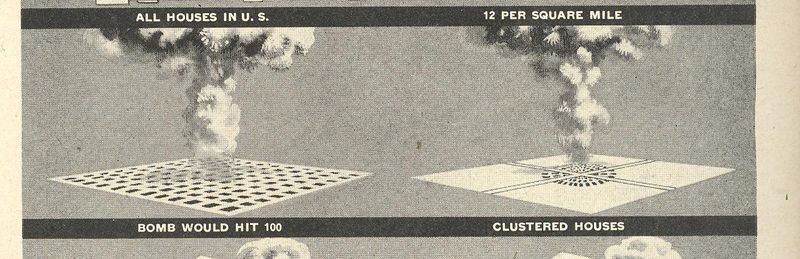
    Then there were those like Ed Teller who thought to spend the equivalent of many multiples of trillions of dollars in the hopes of spreading the country out so that there was an equal distribution of people and factories and such, making the U.S. impossible to attack because there were no centers of population and industry, meaning that the USSR would have to attack everything, everywhere. This would have involved building 20 million new homes and all of the infrastructure that goes along with that, as well as moving all business and relocating all of the means of production in the United States.  That was a towering idea that towered low, but it did represent another line of thinking on survivability that moved from the Atom Bomb House to Atomville to the seeming opposite of those, to AtomExUrbia.    (See here for the fuller story.)

    6a00d83542d51e69e2013480582512970c-800wi
    [Image source:  LIFE magazine in (15 June) 1947]

    So preparing for the worst, preparing for the thing that you really couldn’t prepare for, became an object of desire. 

    It was as though people could not see the forest for the trees–which is quite ionic, because one piece of nuclear weapon test films that is no doubt very familiar to most anyone over 40 depicts a “forest” being blown apart by a blast.  The “forest” was actually a stand of trees constructed in the Nevada desert to see what would happen to flammable trees in a nuclear conflagration. (“…The U.S. Forest Service brought 145 ponderosa pines from a nearby canyon and cemented them into holes lined up in tidy rows in an area called Frenchman Flat, 6,500 feet from ground zero. Then the Department of Defense air-dropped a 27-kiloton bomb that exploded 2,423 feet above the model forest…” on May 8, 1953.1) Not surprisingly, they were mostly destroyed, even using a tactical nuclear weapon. I guess that the issue was not if they would be destroyed but how destroyed they would be.  Still, looking at a forest and looking at a nuclear weapons test would leave little doubt that the forest would be pretty-well destroyed–it’s just the distance that the destruction would reach would be open to question. 

    Notes

    1. Check here for the atomic bomb test on the artificial forest in the Nevada desert (an article by Ann Finkbeiner in Slate).


    ·Posted by :

    ·in:

  • When Albert Einstein Wasn’t “Albert”–a Considerable Typo (1931)

    JF Ptak Science Books  Quick Post    

    Einstein, E777

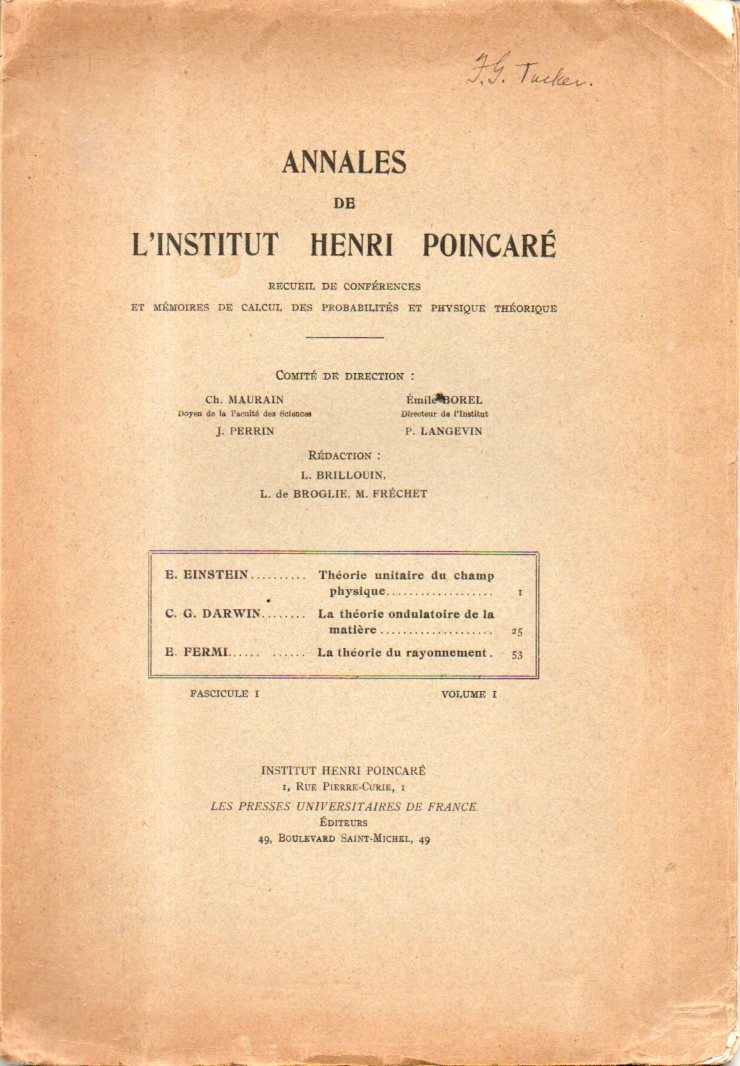
    I admit to making some impressive typos and even though I’m pretty diligent about finding all of my reversed letters many will still slip through my broken and tangled editing nets–but this one, the typo I found above, is really a typo of Enormous Dignity.

    When I first saw this I thought, well, there were a couple of other published Einsteins at this time who were not our Albert, but I wasn’t aware of an “E.Einstein” writing in physics, and also writing in A. Einstein’s area. But then I opened the pamphlet and saw that, yes, indeed, in 1931 someone had goofed and the name of the world’s most famous physicist (and perhaps “person”) appeared on the cover of a physics journal in a not-quite-right manner.  Unfortunately, it was also the inaugural issue of Annales de L’Institut Henri Poincare (published in Paris in 1931). Perhaps it was the ghost of the great mathematician/physicist/everything man, Poincare himself, who ruled over the situation, as he and Einstein didn’t quite “get along”. after all there was very little that one had to do with the other, in spite of their standings. And even though Poincare died in 1912, Einstein had his monumental year seven years earlier and had a number of highly important publication in the following years. He was so wel though of in fact that Einstein was approached to write the great Poincare’s obituary (for a journal that I do not recall presently), but Einstein declined.  Perhaps it was the Dreyfus Affair and the underlying causes of it?  I don’t know.  But I do know that someone really got Einstein’s name wrong, somehow, on the cover of the journal’s first issue.  Fermi and Darwin appear with Einstein on the cover and their initials are correct.  But not Herr Einstein. 

    Einstein, E776


  • Unusual PR Photo of Enrico Fermi, August 10, 1945

    JF Ptak Science Books  Quick Post

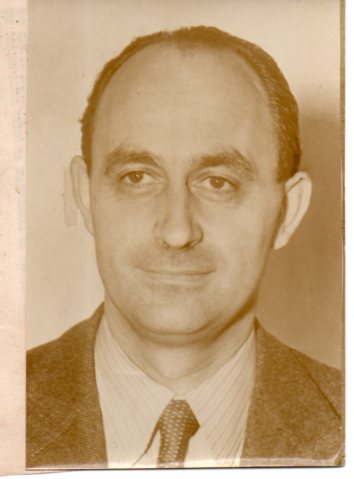
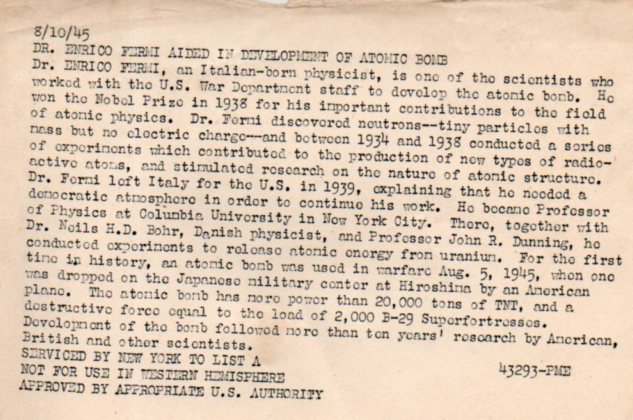
    This is a good, typical portrait of Enrico Fermi–the thing that makes it “unusual” I think is that it comes with the official caption and also is dated just a few days after the bombing of Hiroshima and Nagasaki.  

    Fermi239
    [Source: private. 6 1/2 x 4 1/2 inches, sepia-toned, head-and-shoulders portrait of Fermi.]

    The photograph is definitely original and at the very least an issue of either a news photo service agency or the U.S. Government. Given how quickly the image was released with its association to the atomic bomb (just four days after Hiroshima) I’m guessing that this is a federal source. My limited experience with governmental press releases concerning the atomic bomb leads me to believe that this was issued on 10 August–the government no doubt had prepared documents like this for pre-release (as we have seen with the initial Trinity tests and documents associated with that), but I feel confident that this photo and description are in fact in the first wave of “publicity” following the use of the bombs at Hiroshima and Nagasaki.

    Fermi txt240

    ·Posted by :

    ·in:

  • Report on Post-ICBM Weaponry: the “Non-Violent” War, 1957

    JF Ptak Science Books  


    The RAND Corporation (Research And Development) is a think tank originally formed in 1946 by the US Army Air Force as part of a contract to the Douglas Aircraft Company.  After 1948 RAND Corp was funded by a number of different sources, private and governmental, and left the sphere of being a direct arm of the
     U.S. military. (Maybe.)  It still did enormous amounts of work on behalf of the military, and seems to have been their chief  theoreticians during this period.  It was also the time that the policy of Mutually Assured Destruction (MAD) was formulated at , partially under the direction of we’ll-see-him-again-down-the-road Robert McNamara.  And of course much else. 

    +()+ebay icbm

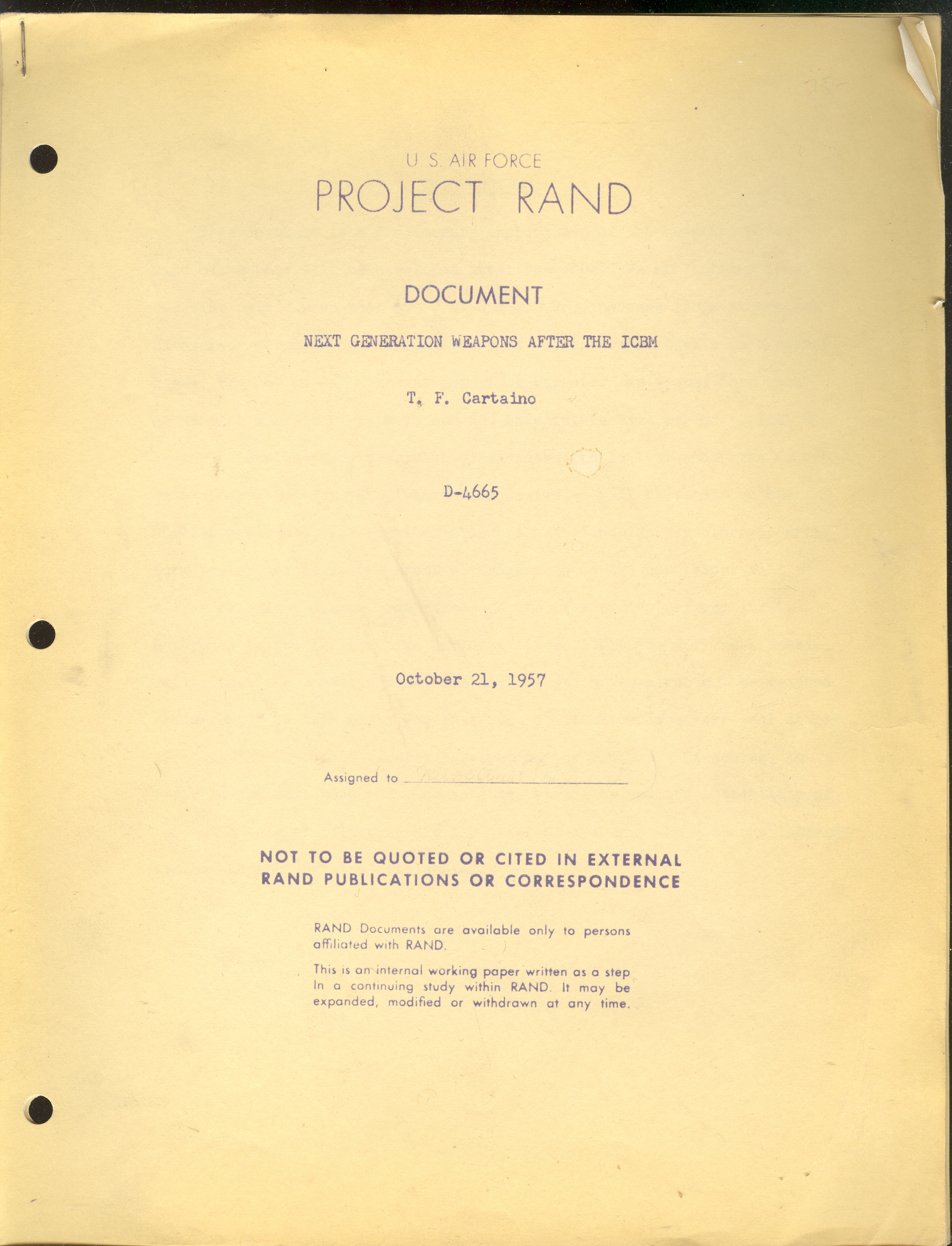
    This publication (Project Rand, Next Generation Weapon After the IBM.  RAND Corp., 1957). was an internal RAND document, not yet meant for the eyes of the outside world, at least in 1957.  I own a number of these reports, and I must say that this one is odd—it seems quick and flippant, sometimes oddly and darkly unintentionally funny.  It is also short (four pages) and gets to the very meaty part of the issue immediately.  The author(s) assume that the US and the USSR will have achieved a point of stasis such that it would make absolutely no sense for either actor to actually employ their arsenal (and excluding “the possibility of the button pusher ‘flipping his lid’ “.  The paper attempts then (“let’s jump right in and assume we find ourselves in this stalemated period”) to envision the next kind of war in which the ICBM would not be an active factor. “We therefore postulate here that the kind of war we will be engaged in…in the period of nuclear stalemate of the non-violent war, the opening phase of which has been called the cold war.”

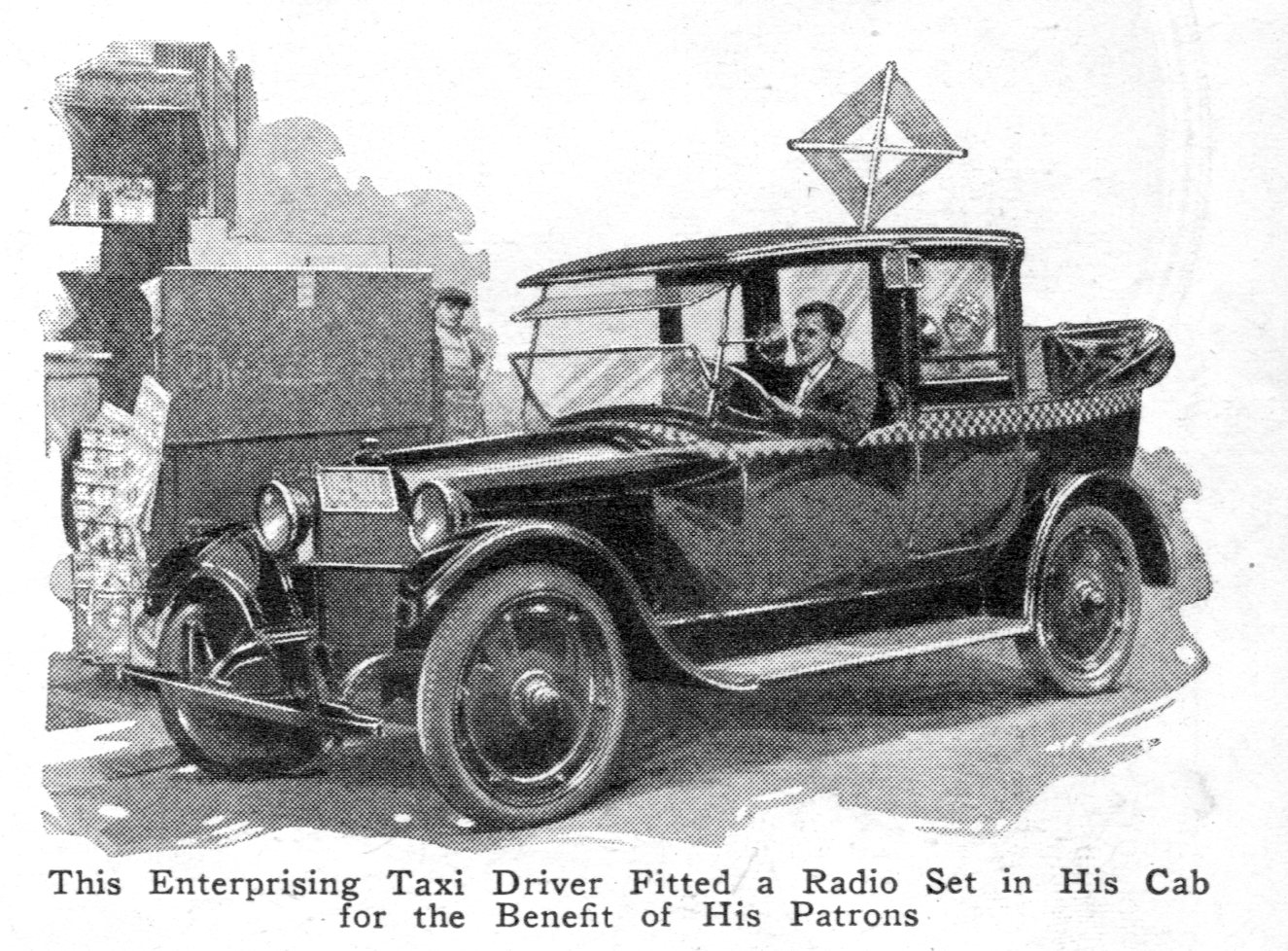
  • An Early Google Maps Radio Car–1925

    JF Ptak Science Books   Quick Post

    This image comes right on the heals on what has been a much-shared image of the pre-Google Map Car of 1916:

    Google radio781


    [Image source: Popular Mechanics, volume 44, October 1925]

    And as you can see, it isn’t that at all, but the antenna on the roof of the cab does suggest itself on the odd-looking Googlemobile, and would have attracted as much attention as the Google car does today. At the time cars were not outfitted with radio set–this enterprising guy did so with his cab (mainly because he couldn’t bear to leave his wireless at home) and attracted a lot of attention and clients due to the novelty of having the still-relatively-new idea of wireless in a car (of all places).  

    Here’s that Google Map Car of 1916:

    Google car772

    As I said in that earlier post, this was simply a darkroom on wheels, made to look like an enormous camera.  If these folks were more enterprising they certainly could have made that darkroom into a camera, without that much fuss…except for the giant paper negatives, of course.

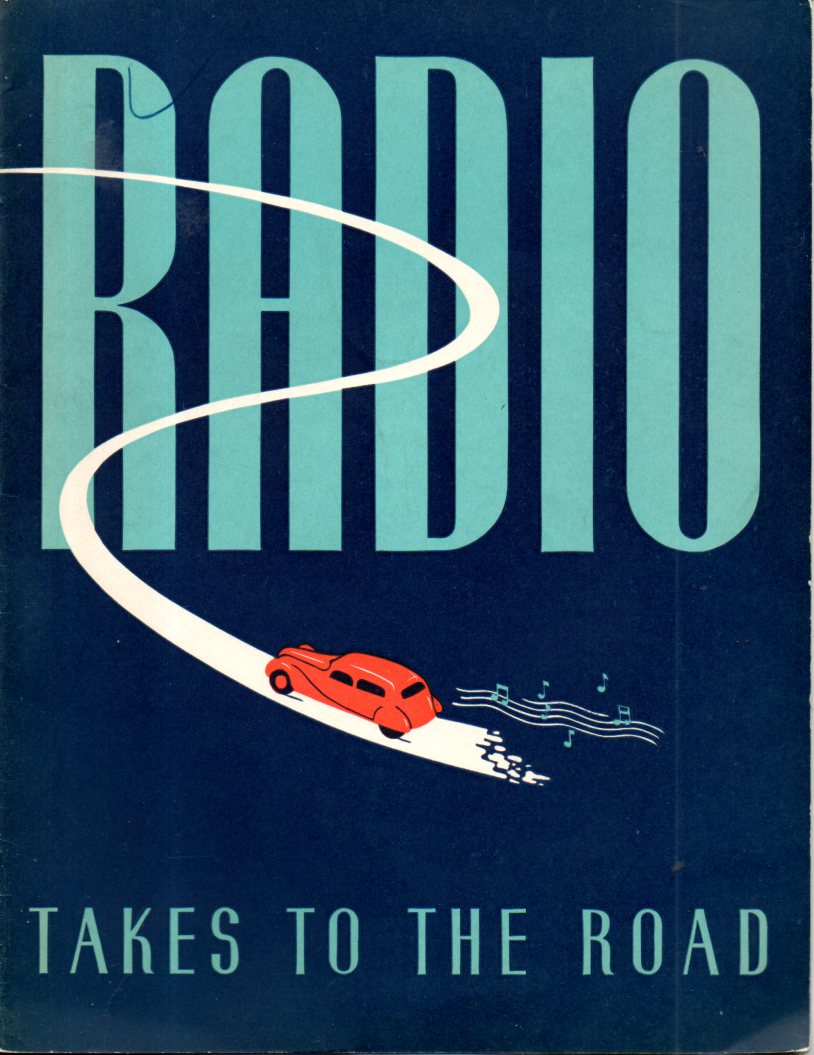
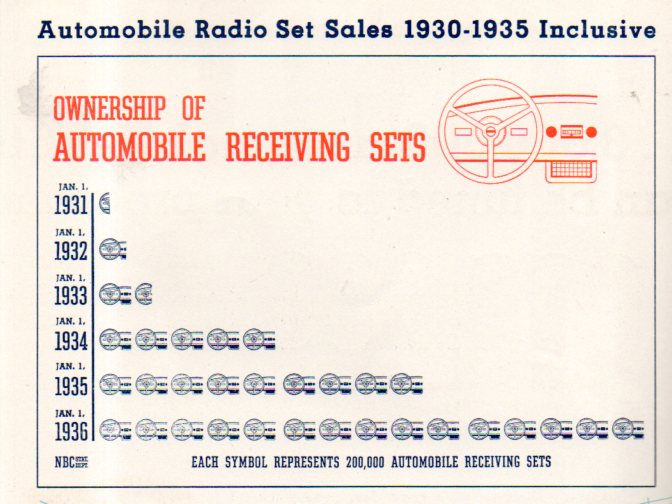
    Radios in cars though was a breakthrough idea in 1925, and as we can see in this lovely pamphlet (published in 1936 by the National Broadcasting Company as a revenue-enhancer) the idea of the radio in the car was just beginning to fly.  Shown in  a delightful graphic display of data using auto steering wheels as a unit of measurement, there were about 100,000 cars with “receiving sets” in 1931, and by 1936 there ere 2.8 million, which is significant growth. NBC points out that there were 22,400,000 cars on the road in the U.S., which meant that there were 20 million cars that needed radios, which meant that there was another gigantic mobile audience of 20-60 million people, which meant that there was a big opportunity for more listeners and a fantastic opportunity to sell advertisements of a value reflecting that new huge audience.  

    Google radio782

    And the delightful graph:

    Google radio783


Recent Posts

Archives

Categories