JF Ptak Science Books Post 2419
In the History of Seeing Things That Aren’t There there are three main staples of disruption of reality: the introduction of the telescope by Galileo and the expansion of the night sky by an order of magnitude and the unsettling of what had been a pretty-much unbroken knowledge of the visible sky for thousands of years; the introduction of investigations with the microscope by van Leeuwenhoek and Hooke and so on, revealing an extraordinary new and unimaginably fine and tiny world, multiple worlds within our world; and the Rontgen discovery of the x-ray, the visualizing agent for stuff that could be seen but not without mess and fuss.
It is hard to overstate the significance of Wilhelm Roentgen’s discovery of x-rays, as well as the public reaction to it. (Well, the enthusiasm of the popular response waned dramatically after the first few months, which–given the historic significance of the discovery–was not long at all.)
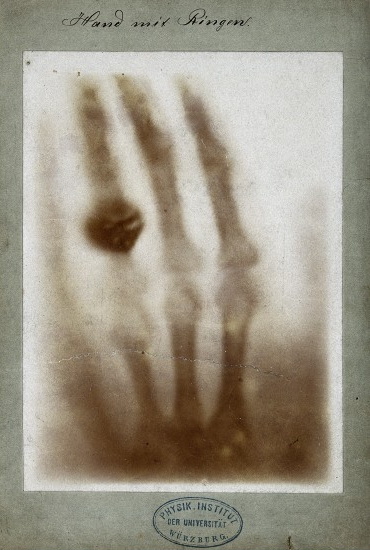
[Source: Wikicommons. This is Roentgen’s wife’s hand, the first image ever made via the new X-Ray, and one of the most iconic images in the recent history of science.]
Scientific/technical journals as well as the popular press were flooded with articles published about the astonishing discovery of 50-year-old physics professor from Wurzburg.. The English-language popular science journal Nature’s announcement of his December 28, 1895 “Ueber eine neue Art von Strahlen” (“On a New Type of Ray”), appearing 16 January 1896, began the introduction of a new state of human experience. His experiments—built upon the work of J. Pluecker (1801-1868), J.W. Hittorf (1824-1914), C. F. Varley (1828-1883), E. Goldstein (1850-1931), Sir William Crookes (1832-1919), H. Hertz (1857-1894) and Phil Lenard (1862-1947)—revealed as much to humans as did the experiments and inventions of Hooke and Leeuwenhoek on the invisible worlds revealed by the microscope. There are more than 150 articles on the Roentgen (and soon to be “X-“) Ray, all published within 12 months of the original announcement, almost all excitedly, trying to comprehend, elucidate, expand, verify, this new world1.
So what brought me to this tonight was an article in the American Journal of Physics for 1945 (volume 13) which has a great article on the history of the discovery (by G.E.M. Jauncey) and which also has a number of samples reporting on the discovery in the popular press, none of which I had seen before. And so I thought I’d share them here: