A Daily History of Holes, Dots, Lines, Science, History, Math, Physics, Art, the Unintentional Absurd, Architecture, Maps, Data Visualization, Blank and Missing Things, and so on. |1.6 million words, 7500 images, 4.9 million hits| Press & appearances in The Times, Le Figaro, Mensa, The Economist, The Guardian, Discovery News, Slate, Le Monde, Sci American Blogs, Le Pont, and many other places… 5000+ total posts since 2008.

  • Maps of the Cosmos of Moles, 1671: Astrology, Pseudoscience & Furious Belief

    JF Ptak Science Books LLC  Post 646  Blog Bookstore

    “The first principle [in science] is to not fool yourself.”  R.P. Feynman

    “The Woo-woo
    is all the same, everywhere, anytime, everytime.”
    —James Randi on the
    history of   the pseudosciences .

    Self-deception and belief in Woo-woo (spurious pseudo-scientific beliefs) is some of the stuff that separates humans from animals.  And not in a good way, unless it was all chalked up to an expression of creativity and imagination.  I started this post as an entry in the History of Dots category, then in the Blank and Missing Things department, and then simply to the Bad Ideas category.  But the more I thought about mole mapping and how extraordinary it was, the less extraordinary it became, especially once the veil of age has been removed. As it turns out, mole mapping is neither more nor less extraordinary than any other system of belief.

    Here’s
    a sentence one doesn’t get to write very often: 
    Richard Saunders (1613-1692) was perhaps the foremost historian, astrologer and seer
    of human moles and their predictive forces who ever lived.  He was far from being the solitary member of
    a one-unit class:  the use of moles as
    predictive and interpretive agents stretches back dozens of
    Blog--jun 11 circ mole

    centuries, so the
    claim of Saunder’s being its most famous practitioner is not empty,
    mega-pseudo-scientific or not.  The
    mystical commentary on the Torah, the Zohar (a part of the Kabbalah), gets
    right to the point of the significance of moles (“the stars of the body”),
    transferring the structure of the cosmos and the constellations to the
    skin.  The seer and soothsayer Melampus
    from Greek mythology, in one of his necessarily pseudographic works, writes on
    the importance of moles of the face and their zodiacal relations—an idea that
    was picked up 2000 years later by the extremely significant mathematician
    Jerome Cardano.  There was a decent
    amount of argument regarding the location of zodiac symbols on the face, as it
    turned out.

    But
    the leading exponent of moles is Saunders, who was also one of the leading
    figures in a wide and very powdery period of European non-scientific
    sciences.  These wonderful images come
    from the second (!) edition of his cumbersome but accurately-titled work Saunders Physiognomie and Chiromancie,
    Metroscopie, the Symmetrical Proportions and Signal Moles of the Body, Fully
    and Accurately Explained; With Their Natural Predictive Significations Both to
    Men and Women
    (published in London, 1671, by Nathaniel Brook), in which he
    divines the psyche and the future with peoples’ moles. 

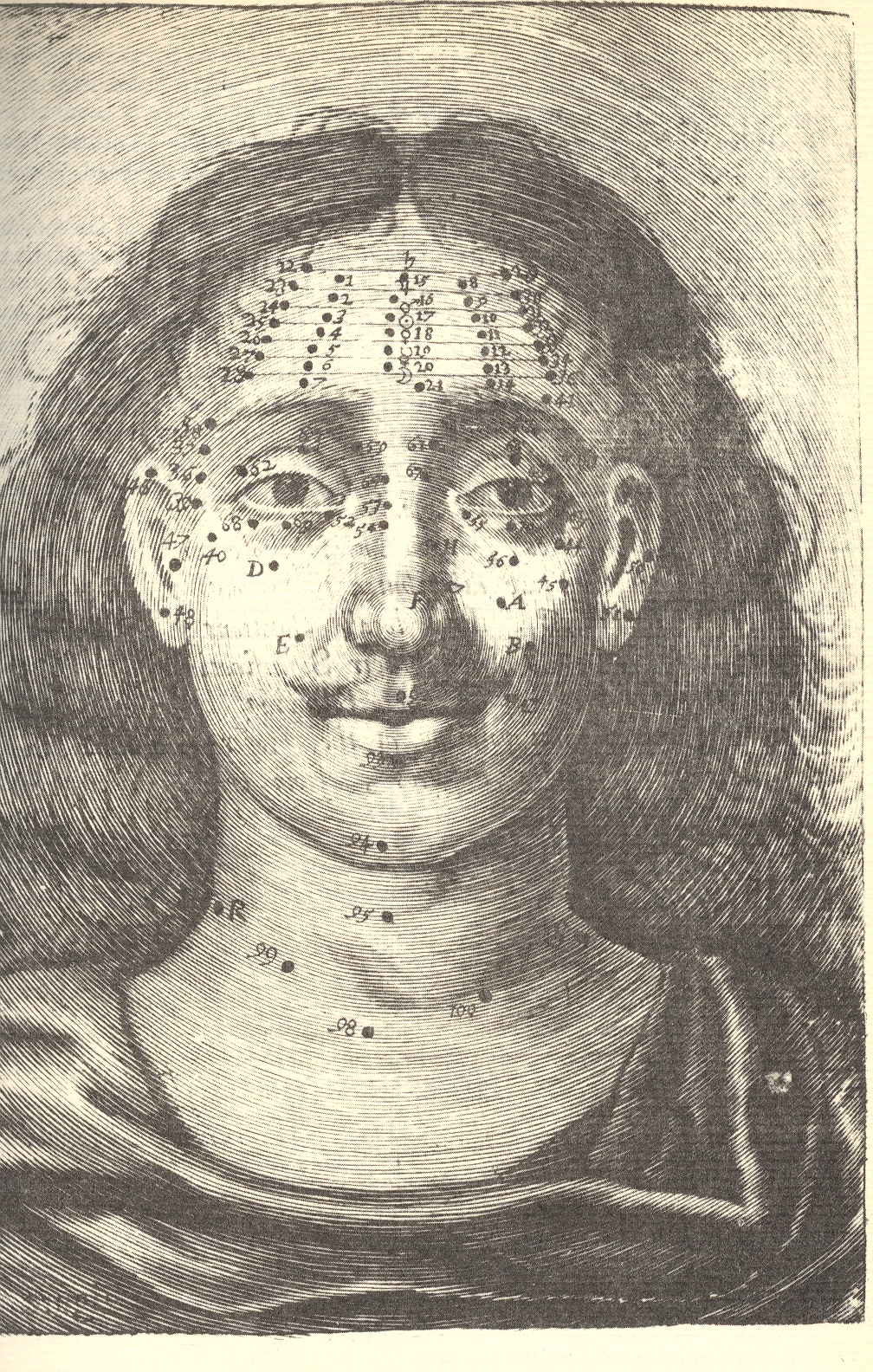
    The
    first figure, detailing the mole locations of a man’s face, is a remarkable,
    weird accomplishment, not only because of the exhaustive treatment that is
    given to every location of every mole (g_d help us), but also because of the
    manner of the engraving.  If you look
    closely, you can see that it is Fresnel lens-like—it is an engraving composed
    of (almost) concentric circles.  I cannot
    recall seeing such a thing before—needless to say the practice of engraving
    would be laborious, and not much practiced. 
    I’m not even sure what great good it causes, though it does give a
    little different idea of depth and dimensionality to the image.  The effect that it achieves here though is to
    give a solar-system-like background to the moles—something that is much more
    spectacularly achieved in the next image.
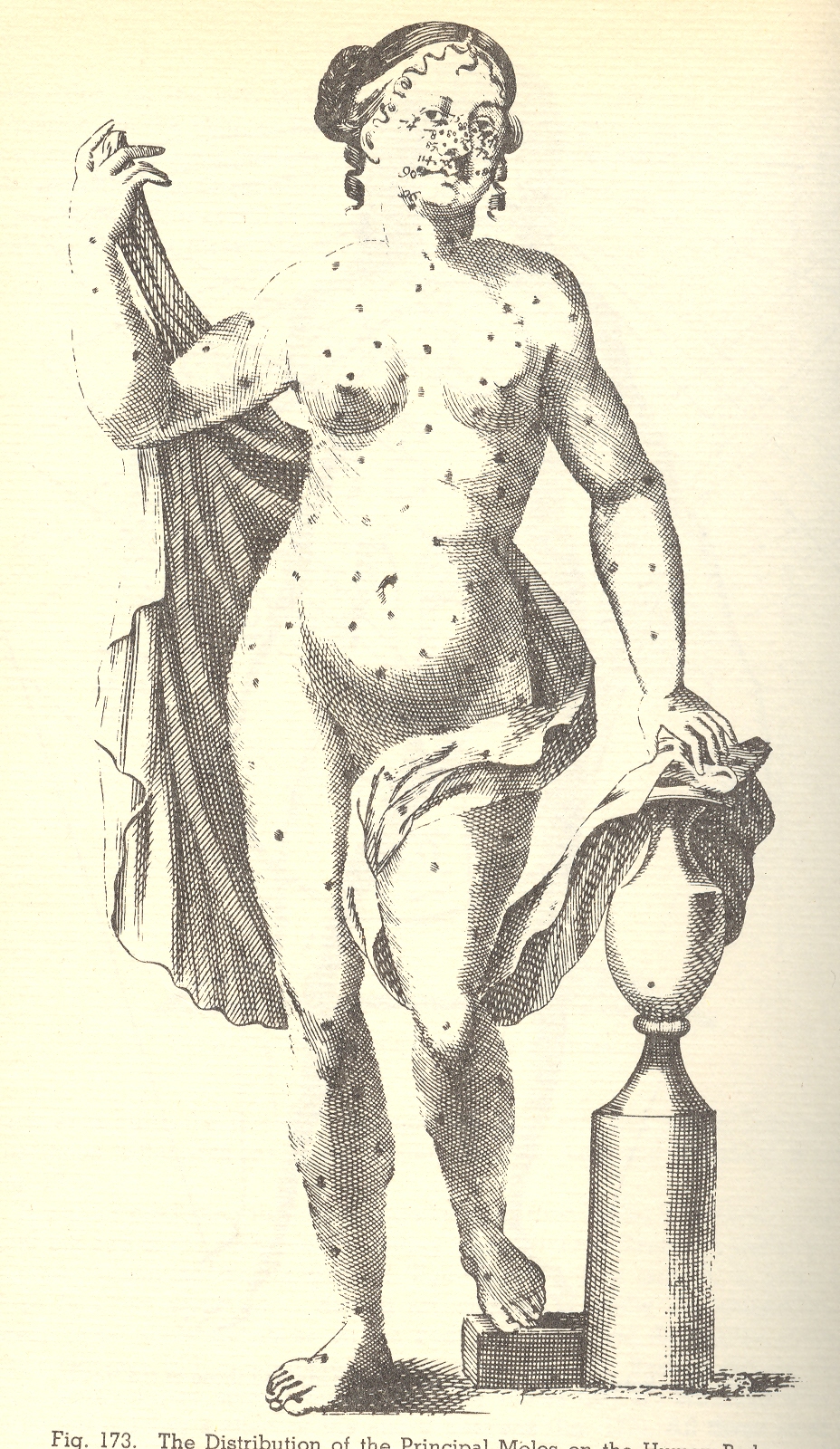
    Blog--jun 11 mole lcosmos The
    map of the moles of this woman’s body looks to me just like a constellation—and
    a constellation is just what they were for Saunders, who viewed the arrangement
    of moles on the body like an astronomer searching the night sky for a new
    comet.   But an astronomer would not be
    trying to force governing connections in the starry realms to occurrences on
    earth (or heaven, or whatever)—that would be the job of an astrologer, whose
    job would be enormously simplified since everything it conjures is
    fictional.  Had Robert Hooke been Richard
    Saunders-like when he made virtually the first microscopic investigations in
    human history, he would have been correlating the hairs and pores of the flea
    rather than making his minute and beautiful observations.

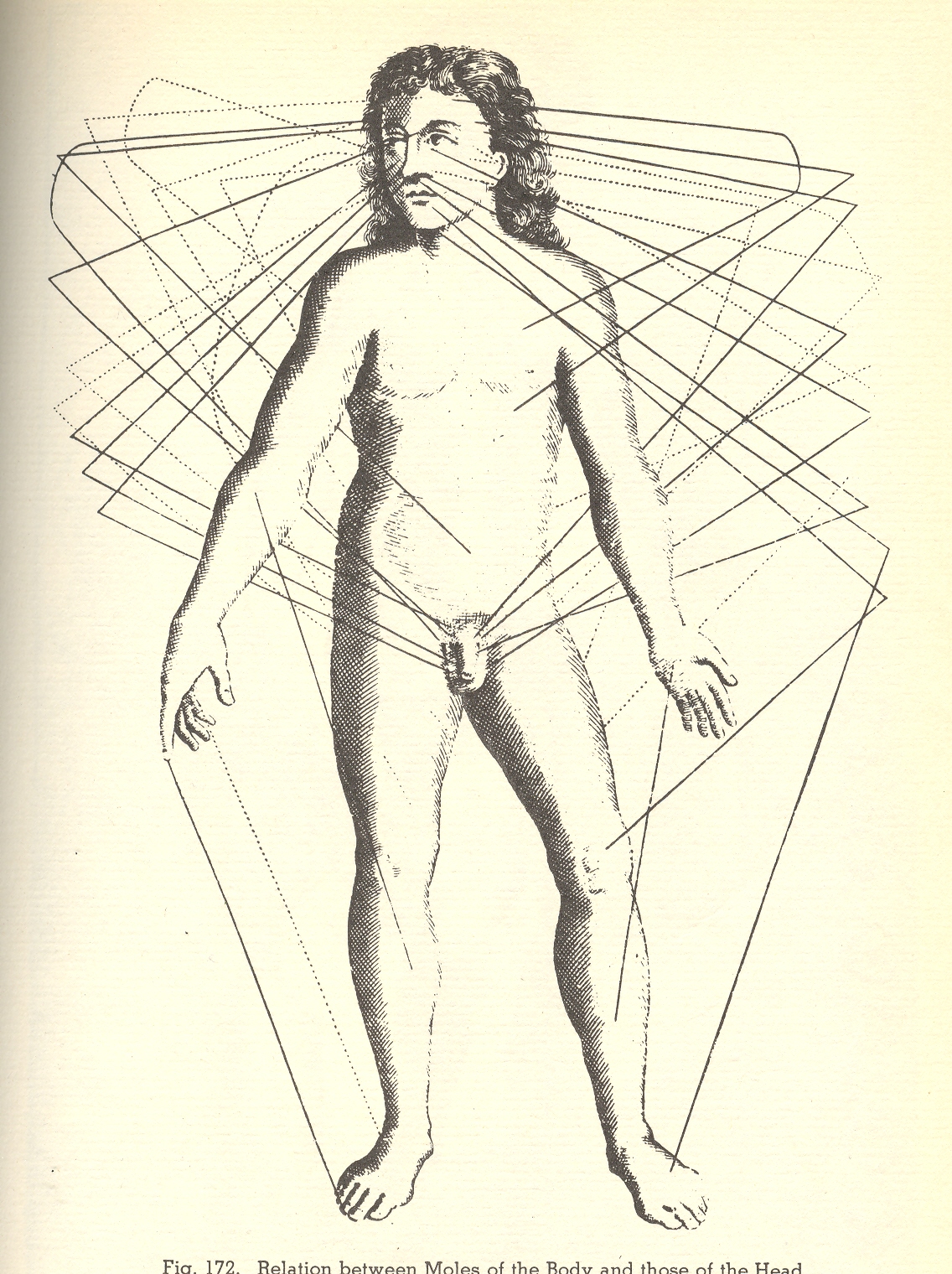
    Saunders
    sees mole connections everywhere, even developing sub-classifications to
    sub-classes: this is seen in the lovely relational map of face moles to moles
    on other parts of the body. (I like the spare curved lines most.)Blog--jun 11 mole lines
    This
    all looks perfectly phenomenal, unbelievable even,  from out here in 2009.  The fact remains though that the vast
    majority of newspapers in his country still carry horoscopes, and most Americans
    believe in UFOs, and a not-small percentage of those folks say that they’ve
    actually been abducted by Outer Space Aliens. (I calculate that from the
    “first” UFO sighting near Roswell 50 years ago that a sighting has been made about every ten seconds since
    then.  Why all of this interest?  And here’s a question among the many that I
    have about this stuff–outside the astronomical chances of actually
    encountering the other life forms in the universe that do undoubtedly
    exist:  why do these crafts, which have
    spectacular, beyond-physics capacities, have little dotty lights on them?)

    And
    so as bizarre as images like this might look, many (most?) folks in the present
    really haven’t left these ideas behind—they just get changed a little,
    upfitted, retro-ripped, and outfitted with flashing lights.

    In a
    very long career of getting people to think  in spite of themselves, James Randi (scientific
    investigator, keeper of the scientific method, head of the James Randi
    Educational Foundation
    , and formerly “The Amazing Randi” from years ago) has
    one particular mythbust-lecture that I find phenomenal, with a very large “oh
    my good god!” capacity for the students at the end of it–if they would but allow it.  Listen: 
    Mr. Randi would explore the possibilities of astrology, asking the group
    or class who there believed in it, taking a census of belief.  He would then make a very strong, convincing
    case for the application of this hope in astrology (he is a very determined and
    logical speaker), and then give astrological “readings” to each member of the
    group.  The readings would turn out to be exact and persuasive—a second tally would be taken of  believers, with
    the usual results being that (unless they knew who Mr. Randi was or was already
    a skeptic or logically un-needy thinker) the class would now consist of an
    overwhelming percentage of astrology-believers.

    Then
    Mr. Randi lets the high-wind boom swing free: 
    everyone received the same reading. (You can see a short snippet for one of these experience HERE–Mr. Randi has conducted this lecture many times for many different audiences.)  The shock of realization is palpable.

    On
    the telephone this morning Mr. Randi graciously explained this lovely lesson—he
    also explained that even after the key ingredient of the lesson was revealed,
    and even after he lectured on thought and belief and superstition and logic and
    so on, that the people who had already believed in astrology would almost in every circumstance still
    maintain that belief.  Even in the face
    of overwhelming evidence, the idea of belief was no match for fact.  Truth, fact, explanation, method, logic—none
    of these could put a chink in the armor of belief, and is no match for self-deception.

    “The
    Woo-woo is always the same, everywhere, all the time.  If its not astrology its something else, the basis for all of it is the same” (my
    paraphrase) says Mr. Randi. After approaching belief
    systems like UFOs and astrology and mentally bending spoons and mind-reading
    and on and on, Mr. Randi says that at their base, the stories have a common heritage of need.
    And they’re unbendable, and certainly unbreakable, for all of those who need
    the belief.  There’s no room for
    constructive debate and exchange in such belief systems, whether it is
    astrology or creationism (I just can’t call it by its other, cleaned-up
    name), as they cannot satisfy the basic tenets of knowledge growth and scientific inquiry which, according to RP Feynman, is the willingness to test your beliefs against falsity and to investigate all possibilities that might make them invalid.*  Mole mapping predictions and the
    fate of a life is no different from any of these other derivations in wishful/hopeful pseudosciences, either—just a different name
    for the same underlying system of beliefs, though the moles are a little long in the tooth. 

    Anyway, creationism or astrology or life-after death–they might as well all be mapping moles.

    As Feynman said:

    The first principle [in science] is that you must not fool yourself — and you are
    the easiest person to fool. So you have to be very careful about that.
    After you’ve not fooled yourself, it’s easy not to fool other
    scientists. You just have to be honest in a conventional way after that.

    * Feynman on the scientific method:  “It’s a kind of scientific integrity, a principle of scientific thought
    that corresponds to a kind of utter honesty–a kind of leaning over
    backwards. For example, if you’re doing an experiment, you should
    report everything that you think might make it invalid–not only what
    you think is right about it: other causes that could possibly explain
    your results; and things you thought of that you’ve eliminated by some
    other experiment, and how they worked–to make sure the other fellow
    can tell they have been eliminated “
    RP Feynman quoted by Ralph Leighton,  1985, p. 341
    ).
  • Upset in the Belly, Insanity and Murder: a Southern Interpretation, 1831

    JF Ptak Science Books LLC  Post 647  Blog Bookstore

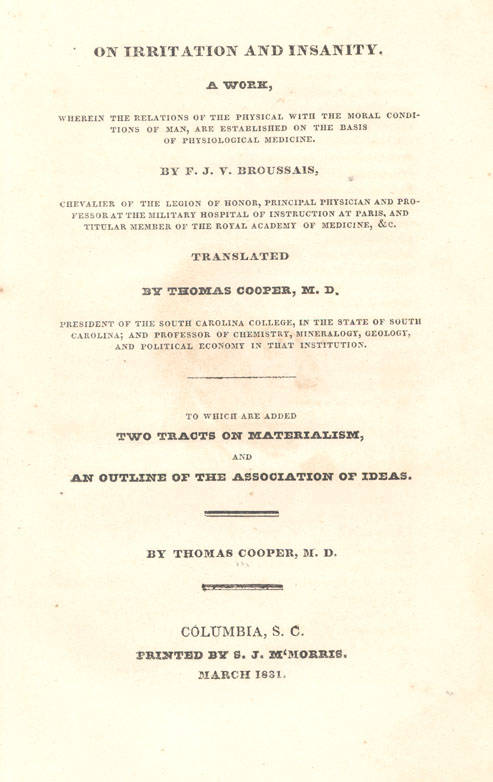
    Thomas Cooper, a merry, upper-educated intellectual called “a
    learned and talented mapcap” by none other than John Adams, wrote from his
    secure chair South Carolina College a translation of a rather individual effort
    in explaining insanity’s connection with moral outrages.  The work, published in Columbia (South Carolina) is called On
    Irritation and Insanity … to which are added Two Tracts on Materialism, and
    an outline of the Association of Ideas

    and introduced an unusual, foreign
    approach to the connection between sanity and malevolence.  Brousssais’ work may not have required such
    attention. 

    Blog--June 12--broussais

    He wrote, for example:

    “The causes of this morbid state consist always in
    irritation of the trisplanchnic apparatus, and especially in that of the
    stomach, acting on the brain.
    [Italics mine] This last viscus, may be such, by its normal
    constitution, as to give a propensity to cruelty ; but in the morbid state it
    is a sense of uneasiness perceived through the whole splanchnic apparatus,
    comprehending the brain itself, which renders ideas of murder predominant in
    spite of reason. This horrible perversion may be considered, as well as that of
    suicide, as a species of chronic anger or hatred, which impels the individual
    sometimes against himself, sometimes against other men or against inanimate
    objects. We have already considered it under a subacute form in furious mania ;
    but in the modification in which we now describe it, it is entirely
    chronic and apyretic. In fact it may be extremely obstinate, and conceal itself
    under the appearances of calm, of joy, of benevolence, until the lunatic finds
    the opportunity of executing his horrible project.”

     I can see these words being written by candle light.

     James Cowle Prittchard early on dispensed with M. Broussais,
    writing  in his A Treatise on Insanity
    and Other Disorders Affecting the Mind
    (published by Haswell, Barrington, and
    Haswell in 1837, just six years after the Cooper translation) states:


    “Such is M. Broussais’ theory of
    these phenomena. It must be allowed that various irritations, and especially
    those in the digestive organs, often give rise to irritability of temper; but
    that any such state as that .which M. Broussais has
    described is a cause, and even the principal cause, of moral insanity, and in particular of that intense excitement of
    malevolent propensity which leads to murder and suicide, is a position which,
    before it can be admitted, requires proof; and no such proof has been afforded
    by the ingenious writer who has advanced this hypothesis. It must be confessed
    that this subject is as yet enveloped in obscurity.”

    As it turns out Broussais recommended courses of bleeding, diet, soothing drinks, applications of cold and mild purgatives to treat insanity.  This went somewhat against the established regimen of treatment (but of different philosophical and theoretical approach to the idea of insanity) of Benjamin Rush, who practiced all of the above but of harsher application and with more force.  Broussais at  least advocated a more temperate approach to bleeding, that it not be “severe”, and that the strength of the insane not be completely diluted by massive exposures to dunking and the cold.  The translator Cooper, however, disagreed with the milder treatments, establishing for the record that the hotter and harsher  temperatures of the South required harsher and colder treatment. From page vi of Cooper’s [reface we read: “The Southern climate of the United States , seems to require more bold and decisive practice, than the Northern climate of Paris or London : then, to us, the therapeutics of Broussais, Begin, Coster, &c. appear feeble; but the principles, founded on the physiology and pathology of the tissues, are undeniable and universally applicable.”

    Such was the spirit of the day.  Broussais is not even a shadow, today:  he tried to establish a connection between gastrointestinal distresses and insanity, and that was seen as futile even by immediate contemporaries. Cooper survives because of his far reach into many disciplines–his treatment of Broussais, well, is memorable for his appeal to treat the insane differently in courts of law because of what he viewed as their diminished capacities. 


    ·Posted by :

    ·in:

    —
  • The Physician Discovers the Patient: Paul Barbette 1675

    JF Ptak Science Books LLC  Post 648  Blog Bookstore

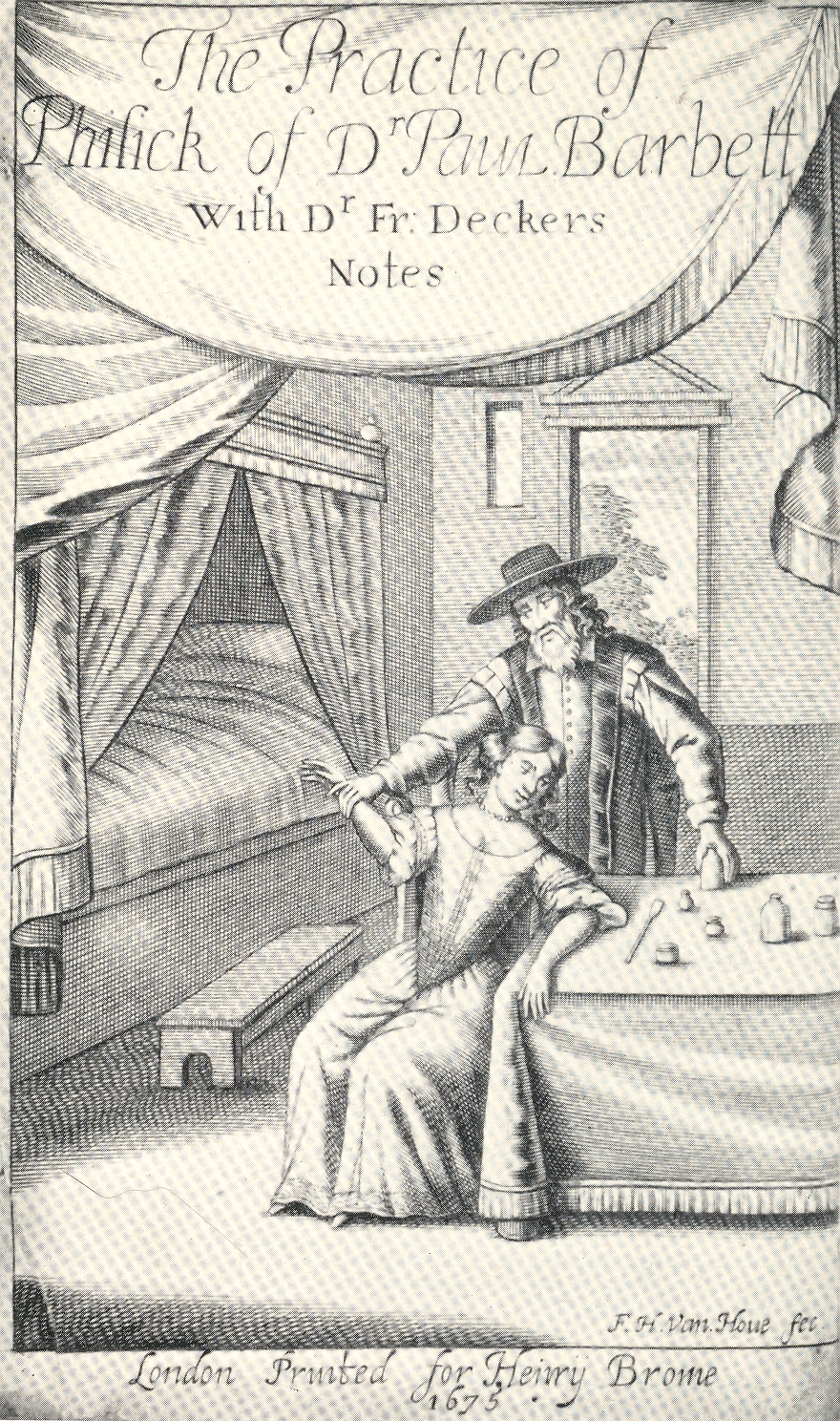
    Blog--jun 12 barbette Paul Barbette was an accomplished physician with a good touch for his patients, as we can see here in the title page illustration of his The Practice of Physik of Dr. Paul Barbette…, published in 1675.  Barbette (1620-1666 or so) was a celebrated Dutch physician whose many works were more a collaboration of experiences in his practice and classic works in medicine than they were of his own thought and creation.  The image of the physician interacting with his patient seems to me to be much more charitable than in other Doctor-patient images of these times. 

    Barbette certainly was a product of his time, writing of diseases of the upper body and treating them in the sustained manner of the mid-17th century, plus that of superstition and ancient herbals.  For example, the mugwort’s “old roots pulled from under the root of the mugewart” was a good curew for falling sickness, and must be harvested on the eve of St. John the Baptist “about twelve at t he night”.  He was also not afraid to use and apply “Crab’s eyes” and hog’s blood.  One thing he was not in favor of, however, was bleeding.  Sweating, yes, but not bleeding.  Perhaps though his most important contribution beyond accumulating a vast amount of medical information was his collection o patient histories and his interactions and interviews with them during the course of treatment.  A good idea today, not much practiced or so it seems.

    (Yes, the physician is determining the pulse of the patient in this image.  The idea of the pulse is as old as Galen but not understood until about 40 years prior to the publication of this picture with the work of William Harvey (1578 – 1657). Well it was understood about a century before that with the work of Michael Servetus, but his publication on pulmonary circulation was almost completely destroyed and its author burned at the stake for his religious temerities, so it remained for Harvey to rediscover in another century.)

    ·Posted by :

    ·in:

  • Pale Horses and the Lake of Fire: a Map to the End of the World

    JF Ptak Science Books LLC  Post 649  Blog Bookstore

    There are, in my experience, very few antiquarian images
    depicting the end of the world in which we see the entire globe exploding or in
    pieces or in flames. This sort of image gets more play in the 20th
    century, especially after 8 August 1945, but prior to that it is really very
    scarce.  I own a few images that appear
    in the 17th and 19th centuries, and another from 1929 (Das Weltbild which show a “giant ice
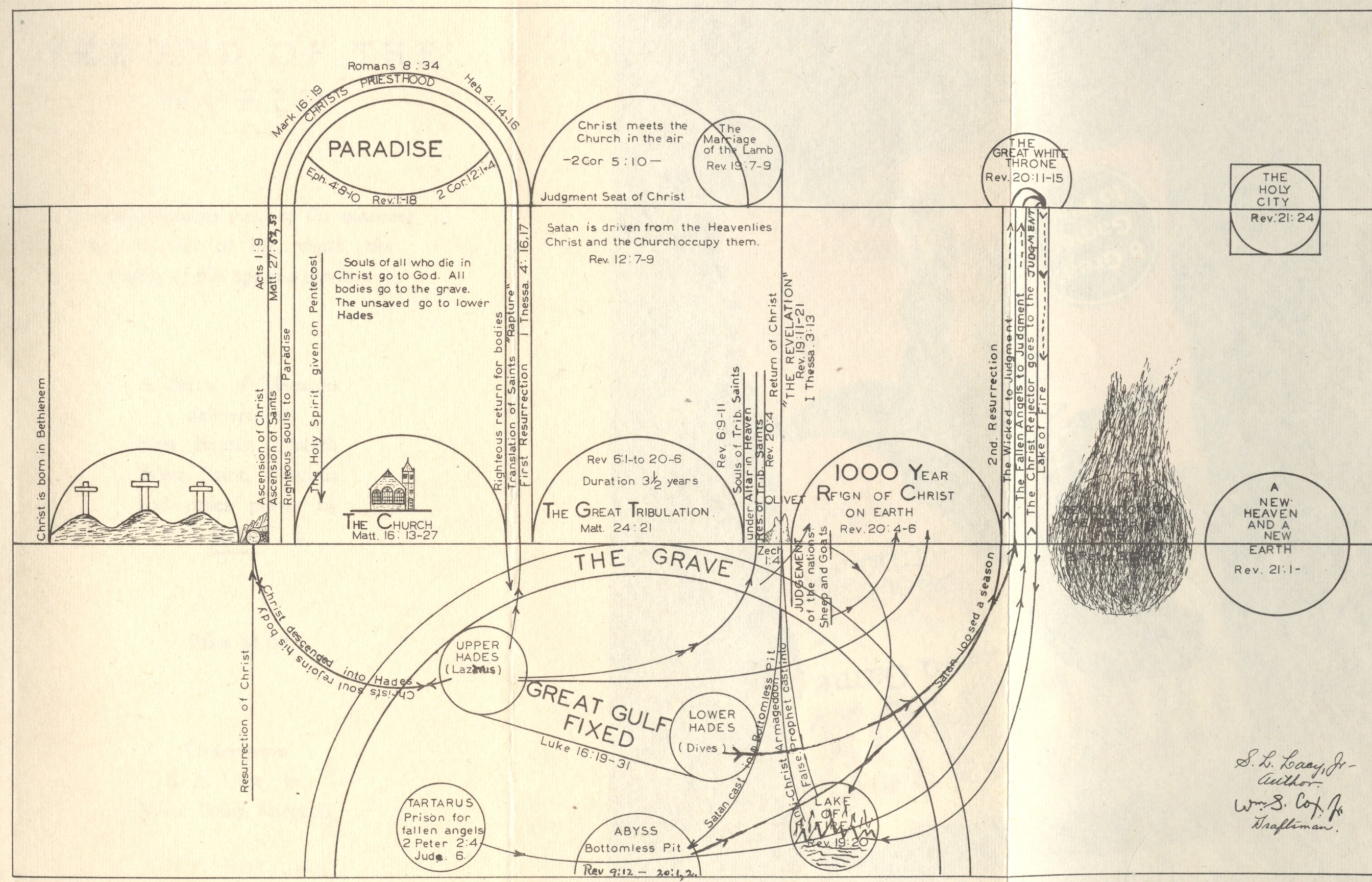
    ball” colliding into and completely destroying the earth). .  Then there is this new find, S.L. Lacy’s The End of the World, (necessarily) self-published
    in West Point, Virginia, in 1941.  It is a short and stocky, and bound in orange
    wrappers—its spine title (The End of the
    World
    ) begs the casual reader to pull it from the shelf. It’s a simple
    book—studying the Bible prophecies and revelations on the end of all things—and
    it annoys and is insulting but doesn’t disappoint.

    Blog--jun 13 end of the world

    I
    started to breeze through the book (back-to-front as always) and opened the
    book to Chapter XIII, finding this delicious chapter heading:  “The Chronological Order of Final Things”,
    this being a full page pre-PowerPoint summation of the time-shrinking fireball
    that is rolling inexorably towards us all. 
    To say that one is able to put a period at the end of the world’s flow
    of time, that someone is able to identify the point in the future where the
    future is no more, is “presumptive”–this in the most understated
    fashion as to offend even the highest of high-Victorians’ sense of restrained
    propriety.  Wrapped in a comfortable
    Christian chrysalis of pre- and post-apocalyptic religious certitude, Mr. Lacy
    delivers his interpretation of biblical prophecy for the coming of the end,
    hustling it to the front of the religious line of things to come.

    It seems that in 1941 the end was beginning, and Lacy saw
    all of the images implied by prophecy that were necessary to announce the
    glorious final days of broad retribution. This includes the list if the ten
    things indicating “the sign of The Times”, one of which (Number 5)
    was “The Automobile” and another (Number 7) was “Increased
    Knowledge and Travel” (announced by Nathum 2: 3,4 and old dependable
    Daniel. 12:4, respectively.  There’s
    nothing that doesn’t fit into Daniel’s visions or revelations, though Mr. Cash
    has certainly made a lovely song of them.) 
    When everything fits perfectly into a predictive model with no possibility
    of falsification (or of proof or disproof), then the model has no validity
    outside of a belief system in itself. Very tidy.

    Blog--jun 13 end of the world det

    It is an annoying, cloying minor treatise, promising little
    more than The Lake of Fire awaiting almost all of us, even the sleeping dead,
    who would be scraped from their graves to be spit into this burning
    tragedy. 

    Lacy does a lot of inspired interpretation and
    philosophizing, much of which he doesn’t seem to bother separating from
    biblical quotations—I don’t think it is intentional, just bad writing.  A random
    find in Lacy’s thinking dislodges the following  nugget:

    “Satan is in the atmosphere above the earth, with access to
    heaven and earth with a circumscribed power over the atmospheric elements and
    the earth including the inhabitants”. 

     Oh dear.

    But enough of this nonsense. What brought me to this work is
    the folding schematic map at the front of the book.  It is a slightly complex jumble of
    semi-circles and circular reasoning, and I have no interest in straightening
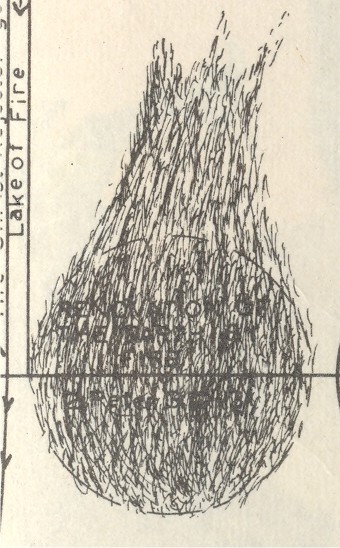
    out this jumbled linguine. What has my interest is the dissolving Earth part of
    the diagram, a part of the dead earth that comes between Calvary 
    and Heaven-on-Earth.  What makes this
    image different from the others though is that the Earth reappears—different from
    its former self having been vanquished and cleansed by all consuming fire, but
    the Earth nevertheless.  Or something
    like it.  Or nothing like it. 


  • Damaging the Gentle Nature of Nazism: German anti-British Propaganda. 1940

    JF Ptak Science Books LLC Post 650  Blog Bookstore

    Virtue itself scapes not calumnious strokes. Hamlet
    Prince of
    Denmark (Laertes at I, III)

    A man calumniated is doubly injured – first
    by him who utters the calumny, and then by him who believes it.

    Herodotus


    Blog--jun 14--calumny

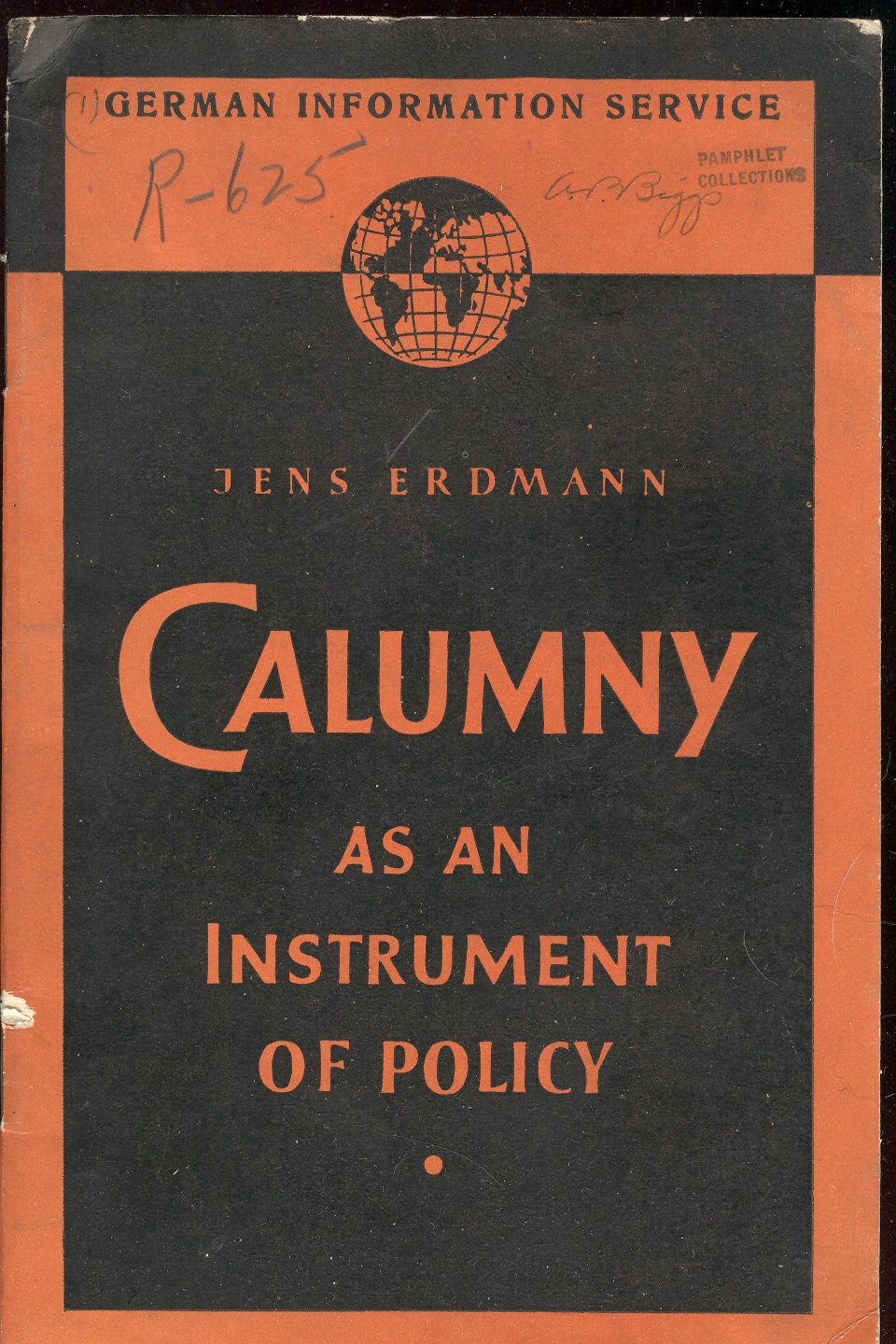
    This small
    pamphlet, written by the German Information Office (“
    Deutschen
    Informationsstelle”)  in 1940, wraps the good name of Nazi Germany in
    a double cloth of virtue, protecting itself against  the maligning and shriveling propaganda of the
    British Ruling Class.  At least that’s what
    Josef Goebbels & Co. would have you think. 
    The pamphlet was printed in English by Wilhelm Greve in
    Berlin, and in its 28 pages outlined the history of
    British “terror” propaganda in general, and of the recent “total defamations”
    against Germany
    in particular.

    Erdmann and etc.
    write:  “It is no mere chance that the British,
    who lag rather far behind the older artistic peoples such as the Italians,
    Germans and French in regard to the fine arts, nevertheless are conceded to
    excel them all in one form of portrayal—namely malicious political caricature.
    Presently the pamphlet was concerned with the general attack against the Nazi government
    overall, but took great offense in the British attack on the “Hausfrau”, a “shameless
    attack on the reputation of the women in the enemy camp…”

    The pamphlet does make
    its way around to “the atrocity lie”, which “so thoroughly ruins the good name
    of the enemy that all possibilities of companionship with him are paralyzed”.  The German propaganda office takes a very
    high and imaginary high road on this one,. Claiming that it is impossible for
    Germany to commit acts of violence and cruelty
    against innocent and defenseless people. 
    By the time this pamphlet was being distributed in 1940, the systemic
    extermination of the Jews had begun.  As
    had the war. 

    But the Nazis were
    concerned with the capacity for friendship after the war—or at least that is
    what Erdmann wrote—but that was now being made impossible by members of the “campaign
    of total defamation” which was mainly comprised of the members of the British
    ruling class, not the least of which was Winston Churchill. 

    “It is impossible”
    Erdmann writes of the imaginary damage done to the good name of the Nazis, “here
    to form an even approximate estimate of the extent to which all the European peoples
    have been poisoned by British propagandas…”

    Its hard to say for whom this pamphlet was intended–perhaps everyone.  The main intention was to separate the British ruling class (“caste”) from the rest of the British government–there is no mention whatsoever of the British people.  Now there were pro-fascist groups alive and well in Britain (the British Union of Fascists, The Link*,  and the Anglo-German Fellowship to name just a few).  Of course America was far from immune to pro-Nazi feelings and political parties. (I’ve written earlier here about Henry Ford and his Nazism, and there was also no end to American-Nazi business arrangements through 1944…but that’s a different story for another time.) But the main need of the Nazis in this pamphlet was to deny all of the calumny toosed its way by the rest of the world.  They just said, simply, “no”.

    The pamphlet ends with a plea for decency for teh world at large following the end of the present war:  “In the interest of political decency in Europe, it is hoped that the end of the present war will bring with it the possibility of such measures as will induce the ruling class in Britain to abandon once and for all their tradition of calumny.  That is an essential condition for the peace and the for the political and spiritual health of Europe”.

    The Nazis intended that this business of peace would be easier once the war was over, what with their elimination of the Jewish people, and tearing apart and murder of millions of Russians and Poles, and the subjugation of everyone else.  At that point they would write the history, and the British calumny would simply disappear.

    * “The Link boasted two dukes, the 11th Duke of Bedford, and the 2nd Duke of
    Westminster. Members of the Anglo-German Fellowship included 16 peers of the
    realm and the Governor of the Bank of England, Frank C. Tiarks. Many members
    were also former MPs. Lord Stamp was a director of the Bank of England. Another
    Fellowship member, Lord McGowan, was chairman of ICI, Britain’s
    trading partner with IG Farben. Lord Nuffield, chairman of Morris Motors Ltd,
    was a member of both the Link and the Anglo-German Fellowship. Perhaps the most
    disturbing name among the fellowship’s members was that of Sir William Strang,
    Chief Political Adviser to the Foreign Office.”


    ·Posted by :

    ·in:

    —
  • Spectacular Gravitational Sculpture in the Rings of Saturn, 2009

    JF Ptak Science Books LLC  Post 651  Blog Bookstore

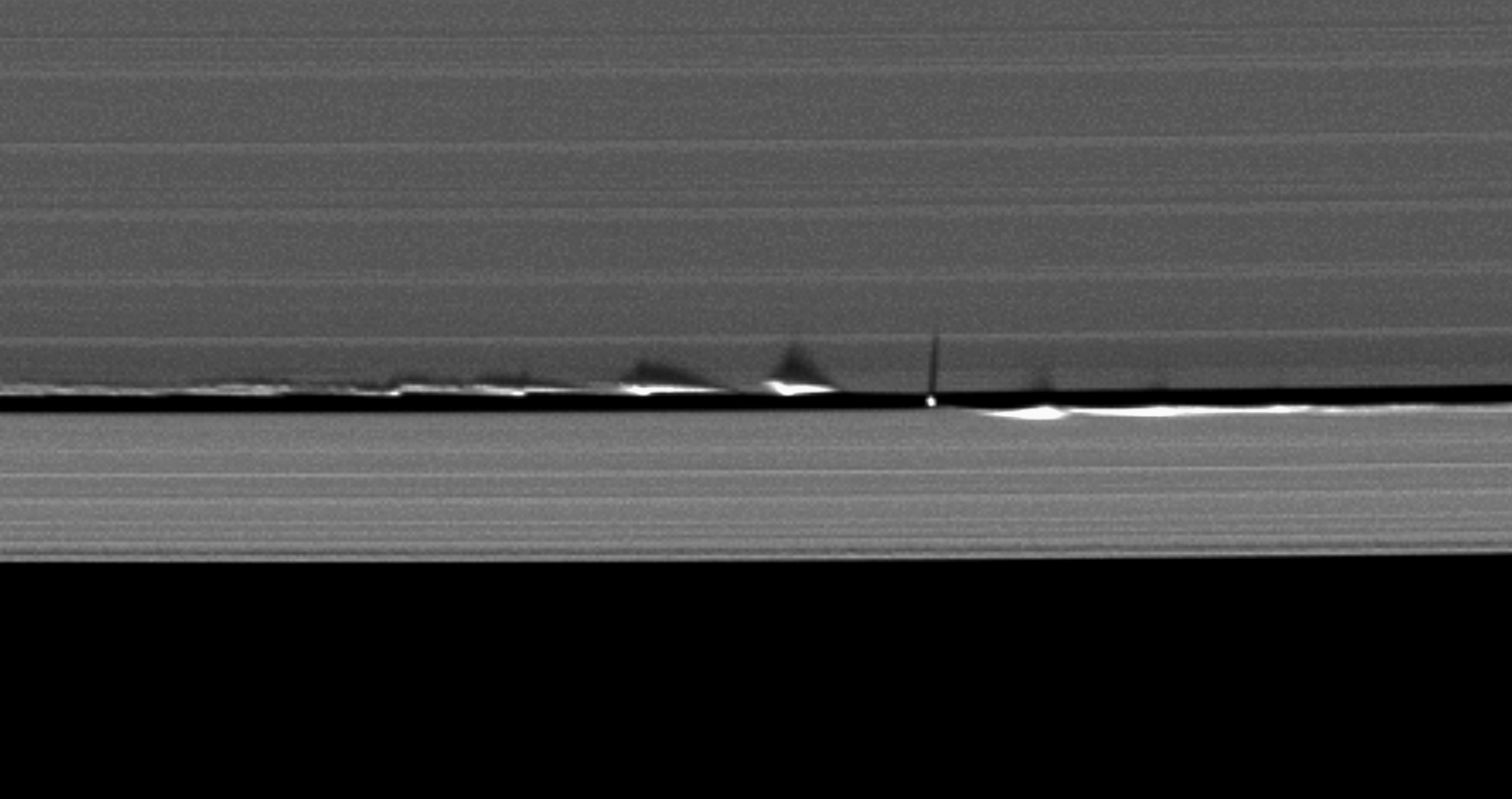
    These images, released on 9 June 2009, are from the Cassini Orbiter Imaging website (here for the press release of the photo) and were made by the international-effort Cassini voyager, launched 10 years ago in August.  The vertical structures (waves) that we see here in the rings of Saturn are cause dby the gravitational pull of Saturn’s 5-mile diameter moon Daphnis, which makes its home in orbit within the Keller Gap in Saturn’s outer A ring.  The news relsease says that the enormous strucutres–these bumps being beween 500-10,000 feet high–are the result of the gravitational pull of the moon perturbing the ring-edge partciles as it swings by.
    Blog--june 15--saturn rings det

    The photos are just stunning.  They are also the first evidences showing waves in the ring structure.  I think that they’re simply gorgeous. The little “ball bearing” type figure with the long shadow is Daphnis.  The JPL-managed spacecraft has produced remarkable photos throughout its long life–particularly in the cases of Jupiter and Saturn, where in my opinion no sci-fi or speculative artwork has ever come close to depicting the impossible beauty of those two planets as has Cassini.

  • What Things Are Not Department: Freeing Sex from Sin in A. Niphus, 1549

    JF Ptak Science Books LLC    Post 652   Blog Bookstore

    Blog--jun 15--love I suppose that one could write about virtually anything in
    terms of what that subject is not:  everything
    that is tangibly matter or energy could be something else, and everything not
    (like shadows and thought) are the stuff of being what they are and aren’t at
    the same time. 

    In 1549 Augustinus Niphus wrote a beautiful, not-so-little
    work on the subjects of beauty and love. Niphus (or Agostino Nifo,
    or Niphus Suessanus, or Niphus
    and sometimes  Nyphus) was born in the Kingdom of Naples

    around 1473, and was around 55 or so when he died in
    1538-1540.  He was a philosopher and
    historian of medicine in the high-Renaissance sense, was a great Aristotlean
    and Averroist,  and proved to be an able
    antagonist to the Christian churches on the subject of the blessed
    interpretations of millennially-dead Aristotle. 
    There are some who claim that Niphus was a little incoherent on the
    subject of Aristotle because, well, he taught the corpus aristotlelicum at university—but Aristotle at this point in the
    Renaissance was incredibly deeply ingrained in the curricula of all
    universities all across Europe, and was opne of the great basics of education. There
    was no escape.

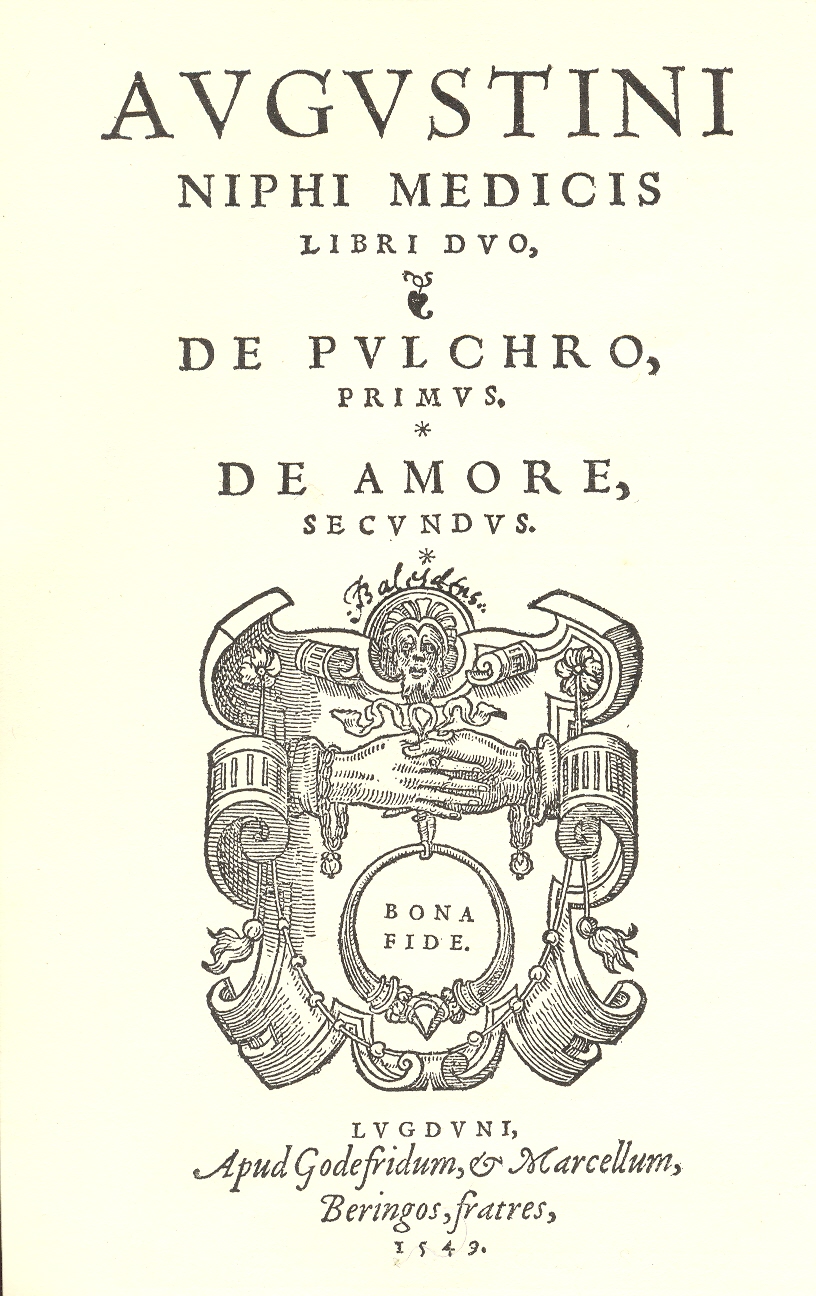
    But back to love.  Niphus’ Libri duo, de pulchero liber primus, de amore liber secundus was a
    277-page work printed at
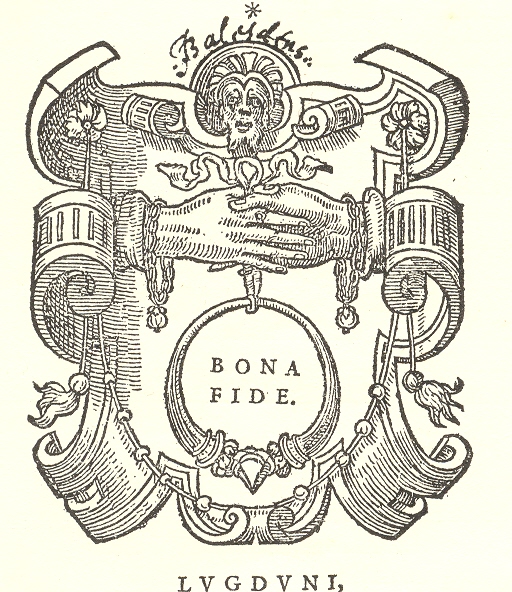
    Lyon (Latinized as “Lugduni”) by the Berigens.  The publishers also provided Niphuis with a
    beautiful title-page device showing the joing on hands under the watchful eyes
    of Christ, a love signified with an emblem announcing “bona fide”.  The book was about beauty (“pulchero”) and
    love (“amore”).  The first part of the
    two books deals with all levels of beauty and shows derivations on the subject
    from the most ancient philosophers./  The
    second part, on love, begins innocently enough on the philosophical and moral
    aspects of the emotion and institution, but then goes further, treating love in
    all of its aspects, including psychological and physical.  It is an enormously full treatment of the physiological
    side of sex, which was something that just wasn’t often encountered at this time.  

    Blog--jun 15--love det

    The main contribution of
    Niphus on love/sex was this—humans have a certain psychological and physiological
    disposition to sex, and how sex could not be considered sinful.  Not content with controlling the poor
    believing people’s thoughts with fear of eternal damnation, the church reached
    right into the very bedroom, specifying that sex was sinful, an abomination,
    dirty, laced with the potential of Satan himself, if not used for the purposes
    of procreation.  All other fruit was
    forbidden under dire threat of the
    Lake of Fire.  (And still
    is:  driving to the bagel store
    yesterday, Sunday morning, I tuned the radio to one of the preaching shows—an easy
    thing to do and sort of hard-to-miss on Sundays as I live in the Bible belt—and
    someone was railing away at “Satan’s fornicators”, which was “the basis of the
    Original Sin”, and on and on.  I don’t
    know how he got to the Original Sin part because the bagel shop is only a
    5-minute drive.) So the case made by Niphus was not popular in the minds of the
    social controllers—who knows what structurally-threatening powers might be
    unleashed in the libidinously un-hellish enjoyments of two people?

    I found this illustration in an old E.P. Goldschmidt (bookseller) catalog, and the old bookseller recognized the medical value of the work and wondered aloud why it hasn’t turned up in the major medical book collections.  I wonder about that, too. Be that as it may, Niphus should really show up as one of the great educators on the function of sex, and to physiologically and psychologically announce that sex was not the sin the church would have you believe it was.  Perhaps in a way, too, Niphus was among the earliest of those to release woman from thousands of years of blame as the proprietesse of selfish Satanic fornication–at least with Niphus, if sex were to be insisted upon as being a sin, there is the possibility of having two actors in the process, rather than having woman carry the blame for the entirety of the sin.

    ·Posted by :

    ·in:

    — —
  • Eat Me, Please: Simplifying the Message in Advertising

    JF Ptak Science Books LLC  Post 654  Blog Bookstore

    Soon her eye fell on a little glass box that was lying under the
    table: she opened it, and found in it a very small cake, on which
    the words ‘EAT ME’ were beautifully marked in currants.
    ‘

    Well, I’ll eat it,’ said Alice...

    Lewis Carroll, Alice’s Adventures in Wonderland

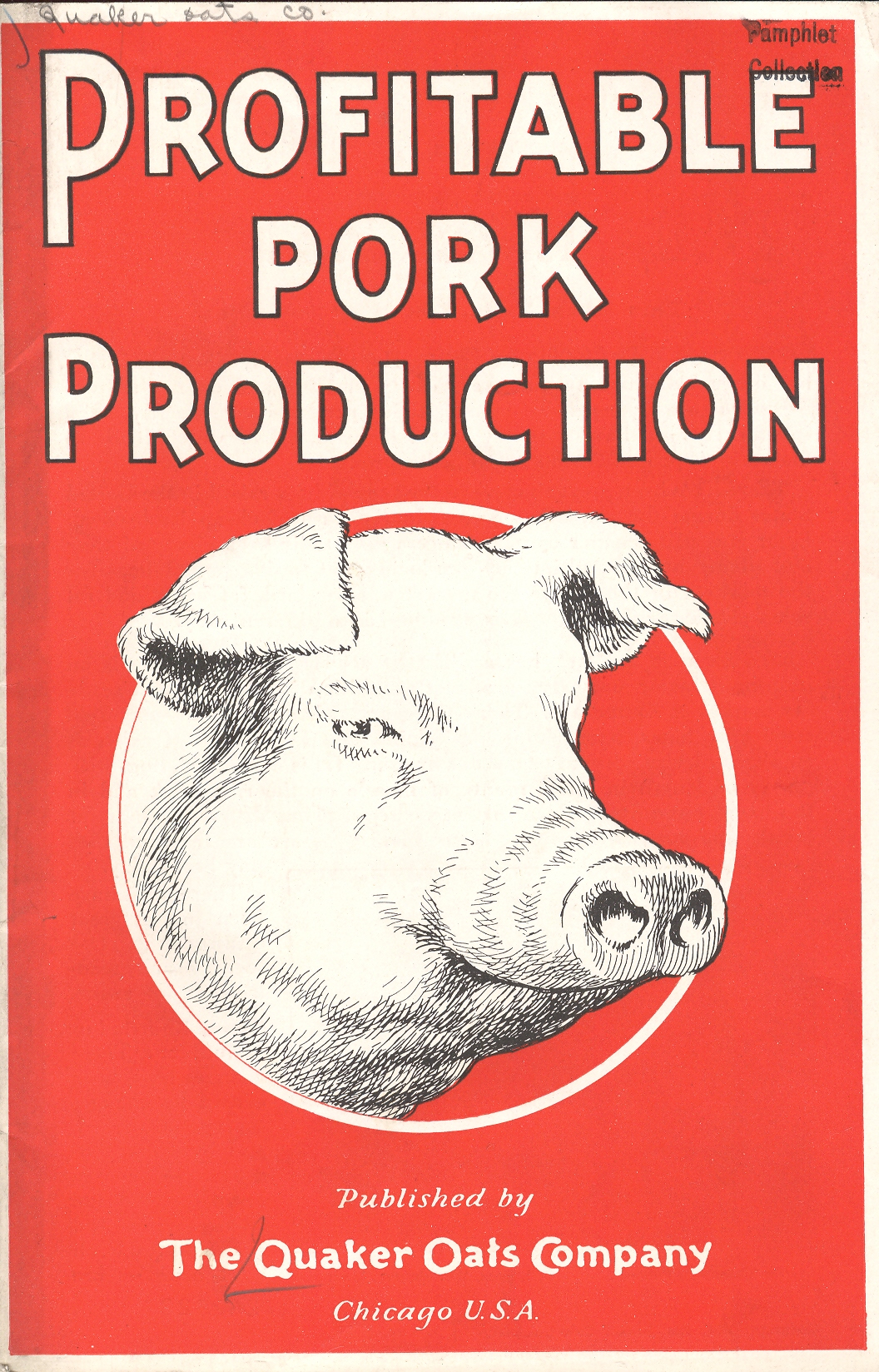
    In the annals of advertisements whose aim it was to beseech its readers to consume its subject, Profitable Pork Production (published by the Quaker Oats Company in 1938) is perhaps the most successful in making its eatable the happiest and most contented of all the lot of Things to Be Eaten.  Elevating need past the knowing eyes of the poor porker, making him/her both the object of being eaten while satisfied with that option is the ultimate and (in this case) attained goal of the pamphlet.  Blog--jun 16--pork

    I’ve seen very few other pamphlets like this whose subject says “Eat Me!” with greater disregard for their own life.

    What this pamphlet was really doing was selling (“delectable”) food pellets to farmers to feed to their pork to get them to market plumper than other non-Quaker Oaks pellet eaters. 

    ·Posted by :

    ·in:

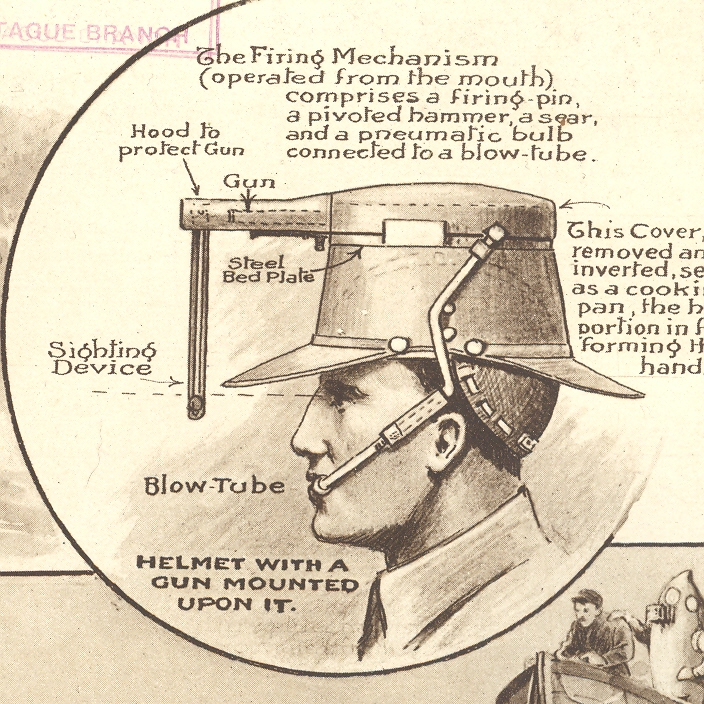
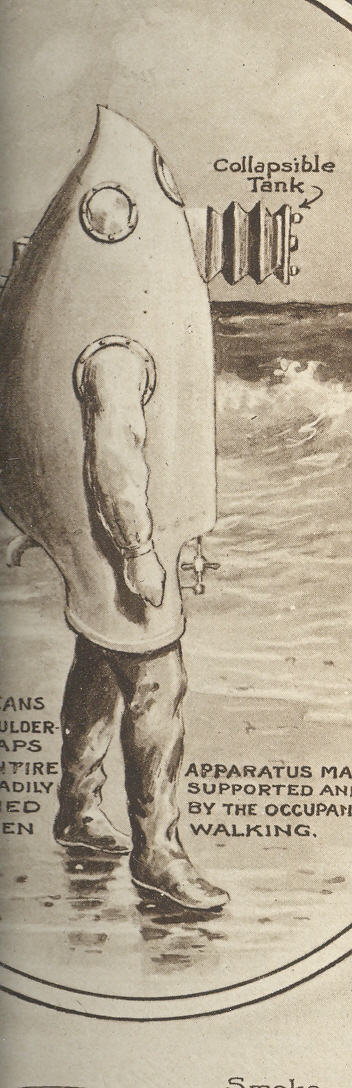
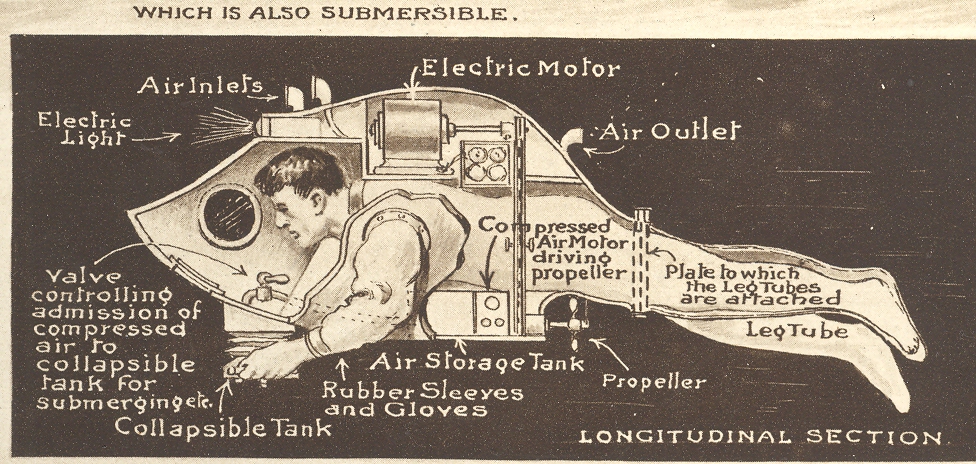
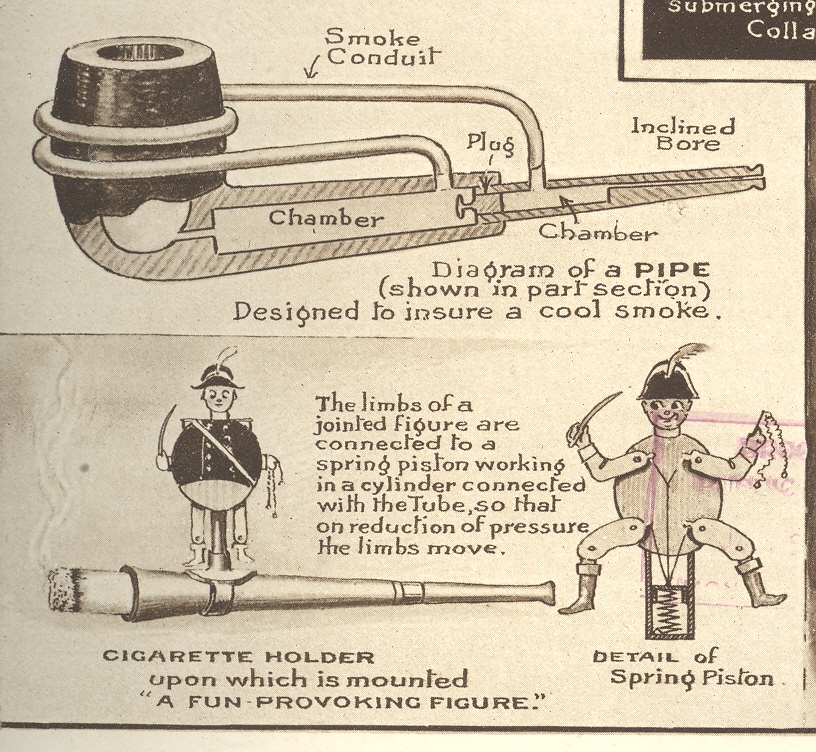
  • Curious, Impracticable and Useless Inventions: Gun Hats and Steel Fish, 1920

    JF Ptak Science Books LLC  Post 655

    Blo--june 17--hat gun I had started out to write this post about the Sham Paris,
    the False Paris, that was being built outside Paris to deceive German bombers in WWI.  Now, that wasn’t a particularly bad
    invention, per se—a bit like the
    Maginot Line in is way—just too much, over-the-top, short-distanced and muddied
    sight. 


    But on the way to the images of non-Paris I came across
    these few inventions as reported in The
    Illustrated London News
    of Christmas Day, 1920.  These innovations look older than 1920, to
    tell the truth, but here they are. 

     First is the hat gun—or, rather, the helmet gun.  It look as though the whole affair would be aimed
    and fired hands-free.  By the look of the
    barrel, the thing in the helmet looks like 50-calibre, which might have an ill
    effect on the neck of the shooter.

    Blo--june 17--stubby

    The next few images illustrate an improbable, cartoon-like
    device for swimming in the high seas.  It
    is a ticklish-looking thing, with air outlets and propellers and such being in
    the rather tender areas of the internalized man. 

    Blo--june 17--horizontal


    Lastly we come to a pipe designed with too much duct work (a
    la the movie Brazil)
    to deliver a cool smoke from a hot bowl. 
    The device below that tries to bypass the entire hot smoke issue by
    distracting the smoker with a movable whirligig. I’m not so sure that Bogart
    would’ve been taken very seriously as Phi Marlowe had he been (a) smoking a
    ciggy with a holder, and (b) if that cig holder had a movable figure on it
    that raided a sword every time he drew smoke. 

    Blo--june 17--smoling


    ·Posted by :

    ·in:

    —
  • The Shotgun in the Service of Natural History–Shooting Flowers

    JF Ptak Science Books  LLC  Post 657

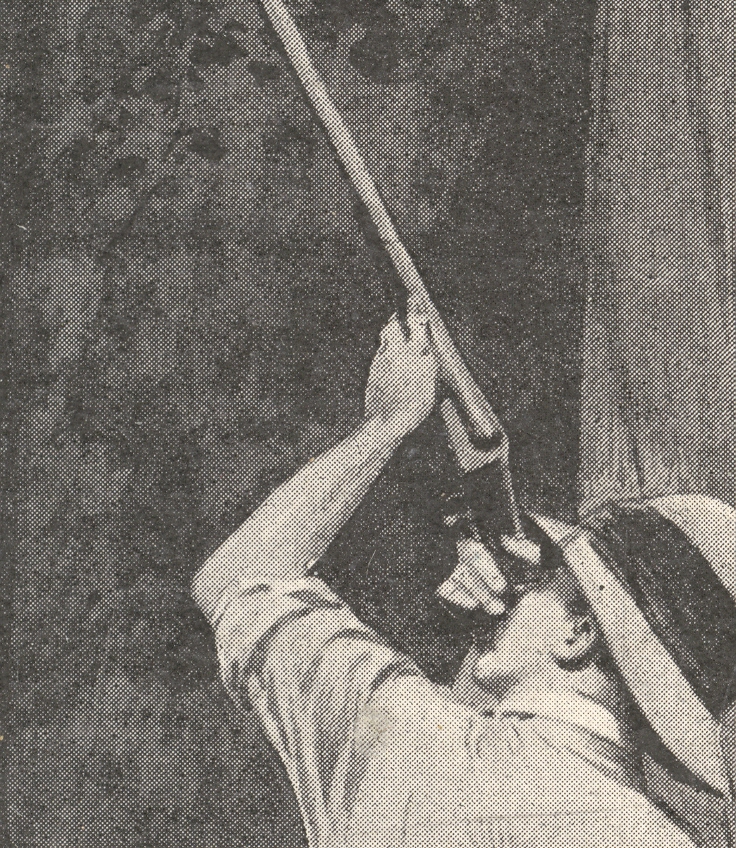
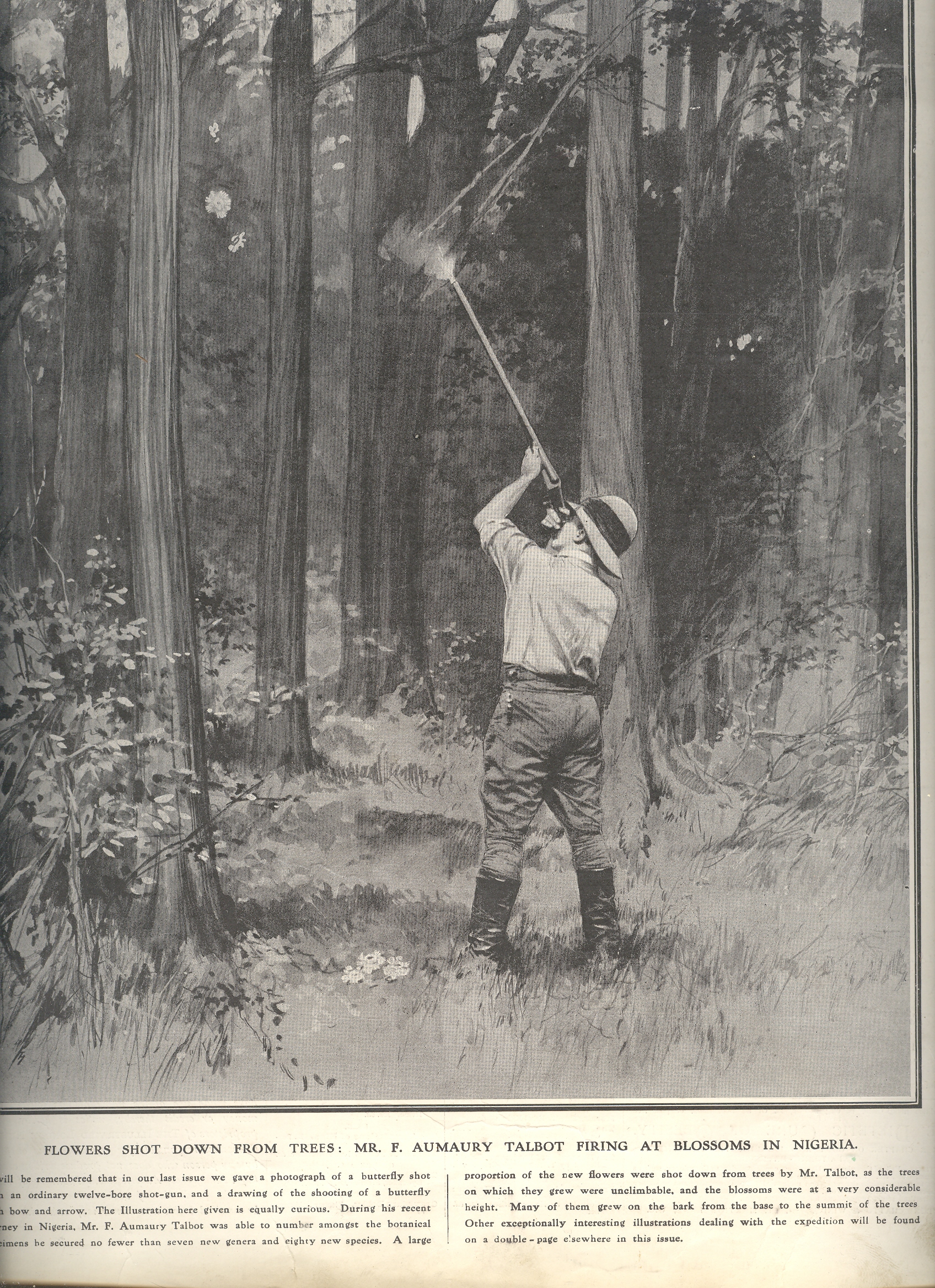
    In the always summery days of summer of 1912  , Mr.  F. Aumaury Talbot  went hunting in the wilds of Nigeria–not horribly unusual of course, except that the man was shooting flowers from trees.  

    Blog--june 19--detailBlog--june 19--detail 2

    I’ve never seen a picture like this, nor have I read anything about shotgunning blossoms from on-high in a tree canopy. And that’s what the man is doing–right down to the shotgun.   Mr. Talbot (for whom an estimable cash prize for academic work in anthropology is still named) was able to collect eighty (!) new species of flowers on this trip to Nigeria, many collected in this fashion. 

    We read in the story about this image (from The Illustrated London News of 8 June 1912) that in the 2 June issue appeared another shotgunning-in-the-service-of-Understanding-Nature:   this time shooting butterflies.  With a shotgun. 

    Blo--june 19--shooting flowers

  • Animal Imitation, Tight Corsets, and Perdition: Physiognomy, 1873

    JF Ptak Science Books LLC  Post 658  Blog Bookstore

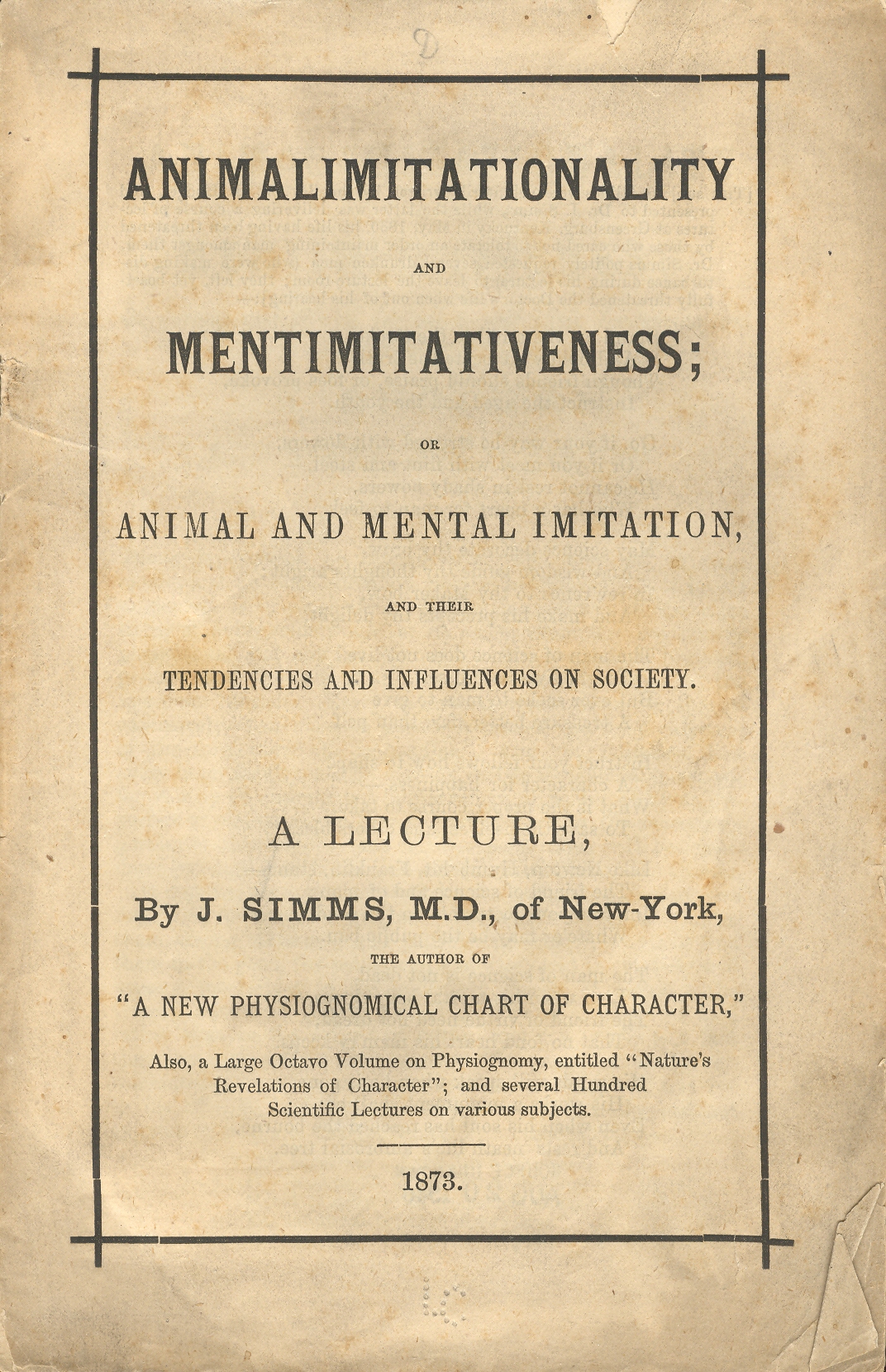
    Blog--jun 16--simms The fabulouslessness and learned foolishness of J. Simm’s horribly-named Animalimitationality and Mentimitativeness; or Animal and Mental Imitation and their Tendencies and Influences on Society, a Lecture, seems a poor-man’s ramble in a polysyllabic scribble.  At it base, J. Simms (listed as “M.D”., and who was also the author of A New Physiognomical Chart of Character) presents a two-paragraph idea and published it over twelve pages that seem twelve pages too many.  The idea is basically so:   humans at time resemble animals because animals imitate what they see, as do humans.  That is principally the entire deal, though it evidently was the cause of numerous lecture bookings for Mr. Simms.  And what Mr. Simms talks about are the problems of imitation, the results of which are found in tight shoes, tight corsets, big hats, and bad walking, all leading to debauched society and wrecked personal dreams. 

    There are many things the Simms work is not.  It is not a work that encompasses the social geometry found by other people later in the century–those who came across the study of people and immitation and the like legitimately, such as Gebriel Tardem Emile Durkheim, Scipio Sighele and Gustave Le Bon, for example.  These folks worked with capable data and reasonable assumptions in looking at how the transmission of data and knowledge takes place between people, and sought to explain the construction of the social membrane in logical and scientific ways.  They were trying to address what Marcel Proust would call (somewhat later) “a new distance between ourselves and things”. 

    Simms was interested in did this too, but did so in terms of how people imitated animals, and how that imitation spread to imitating people, and then fashions, and then resulting in too-tight corsets and too-tight shoes, and wanton neediness, all eading to advanced imitation and, finally, to perdition.  The man had an odd vision which obviously appealed to some. And so it goes.  There’s not that much difference in the set of assumptions of Simms and those of Dr. Freud, is there?

Recent Posts

Archives

Categories