A Daily History of Holes, Dots, Lines, Science, History, Math, Physics, Art, the Unintentional Absurd, Architecture, Maps, Data Visualization, Blank and Missing Things, and so on. |1.6 million words, 7500 images, 4.9 million hits| Press & appearances in The Times, Le Figaro, Mensa, The Economist, The Guardian, Discovery News, Slate, Le Monde, Sci American Blogs, Le Pont, and many other places… 5000+ total posts since 2008.

  • “Total Atomic Defense”: Moving DC to Idaho and Letting the Nukes Fly 1952

    JF Ptak Science Books LLC    REPOST

    One of my favorites from the “What the Hell?” Department:

    Also see my series Atomic and Nuclear Weapons

    Blog--untinkable tp
    Sylvian Kindall’s Total Atomic Defense (published
    by a very severely right-wing publisher in 1952) is one of a series of
    books made for a deceived American population, offering the general
    reader both fear and hope, often from the same, exact source. But
    Kindall has a  somewhat diffident approach, offering his belief that
    the country and its population can largely  survive an all-out nuclear
    war–intact.  Of course the “intactness” is dependent upon massive
    internal change of the social and industrial fabric of the country,
    which would have to transform in ways as to make it largely
    unidentifiable from that which we would quickly recognize.  A quick
    look at the table of contents tells the story in miniature, with the
    exception of the solution to the problem, which was generally to build
    underground.  (The neutron bomb would soon complicate this solution.) 
    Suffice to say that Dr. Strangelove would approve of the publication of
    such a work though would hardly believe in any of it for himself…
    [read the rest of the story here]

  • A Note on Forgetfulness: London, the City of the Lost (Things)

    JF Ptak Science Books LLC  Post 636  Blog Bookstore

    Blog--June 1--overiew In the panoply of play upon the
    title of this post are many variations. For example, book and movie titles which could  fill  the space in the
    category of “City of
    Lost _____” are Children, Dragon Lace, Souls, Soles, Angels,
    Heaven, Books, Dream and Men.   Filling in
    “The Lost City of _______” are Atlantis, Chernobyl, 
    El
    Dorado
    , Nan Madol,
    Abad,
    Bethsaida, Geraptiku, Trellech, Dvaraka and Uganit.  For “Lost Cities of ____” that were never
    really ever found, and which existed in the imagination and on the printed page
    would include Metropolis, Wonderland, Utopia, Narnia, Fredonia, Eden,
    Yuknapatawpha (County), Oz, Lilliput, Middle Earth (etc.), Slobbovia, Dune and
    Hell. 

    Blog--June 1--corset Then of course there are the
    cities that were and weren’t any longer (though some did come back but without
    its original inhabitants:  the annihilated Jewish ghettos of Europe, Nagasaki, Hiroshima and Nanging
    are just a few that come to mind.  New Orleans seems to be in a different category, partially destroyed
    by benign neglect and arrogant stupidity at the very highest reaches of the federal
    government (and resting in the one man, now thankfully lost). Blog--June 1--toys

    It would be fun to write a history
    of forgetfulness with its companion volume on The Lost., but that has been
    accomplished a number of times, already (see below*).  

    Blog--June 1--chick My post is not an attack upon London or its imaginary lost souls–it really is about lost
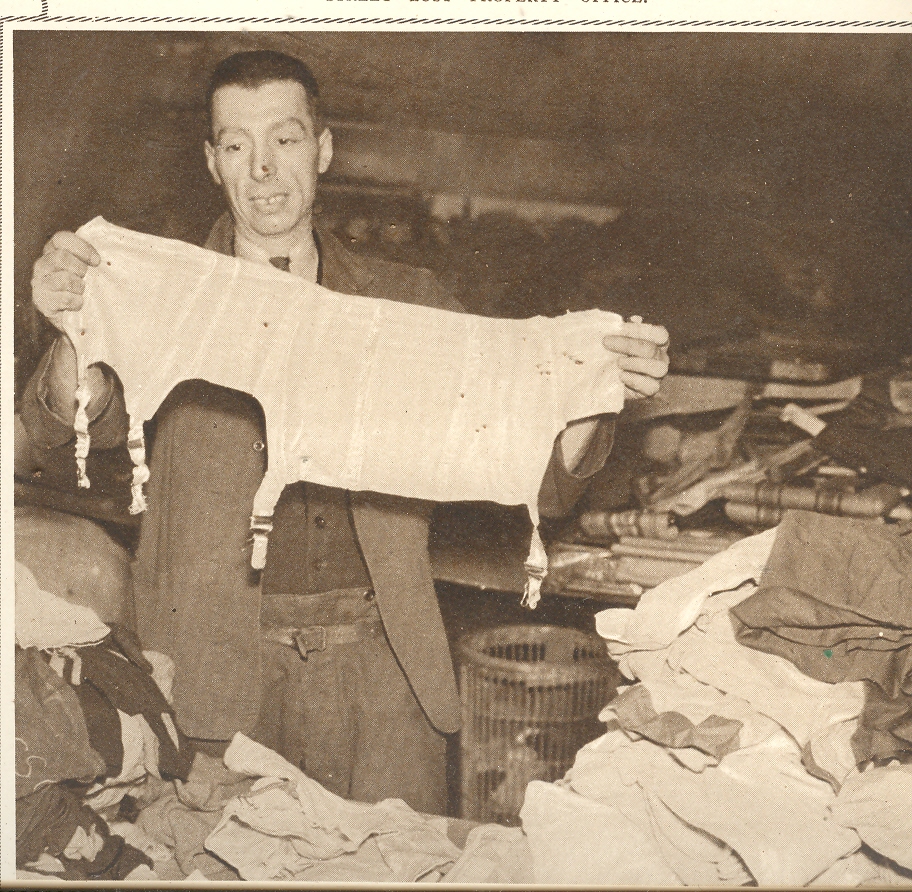
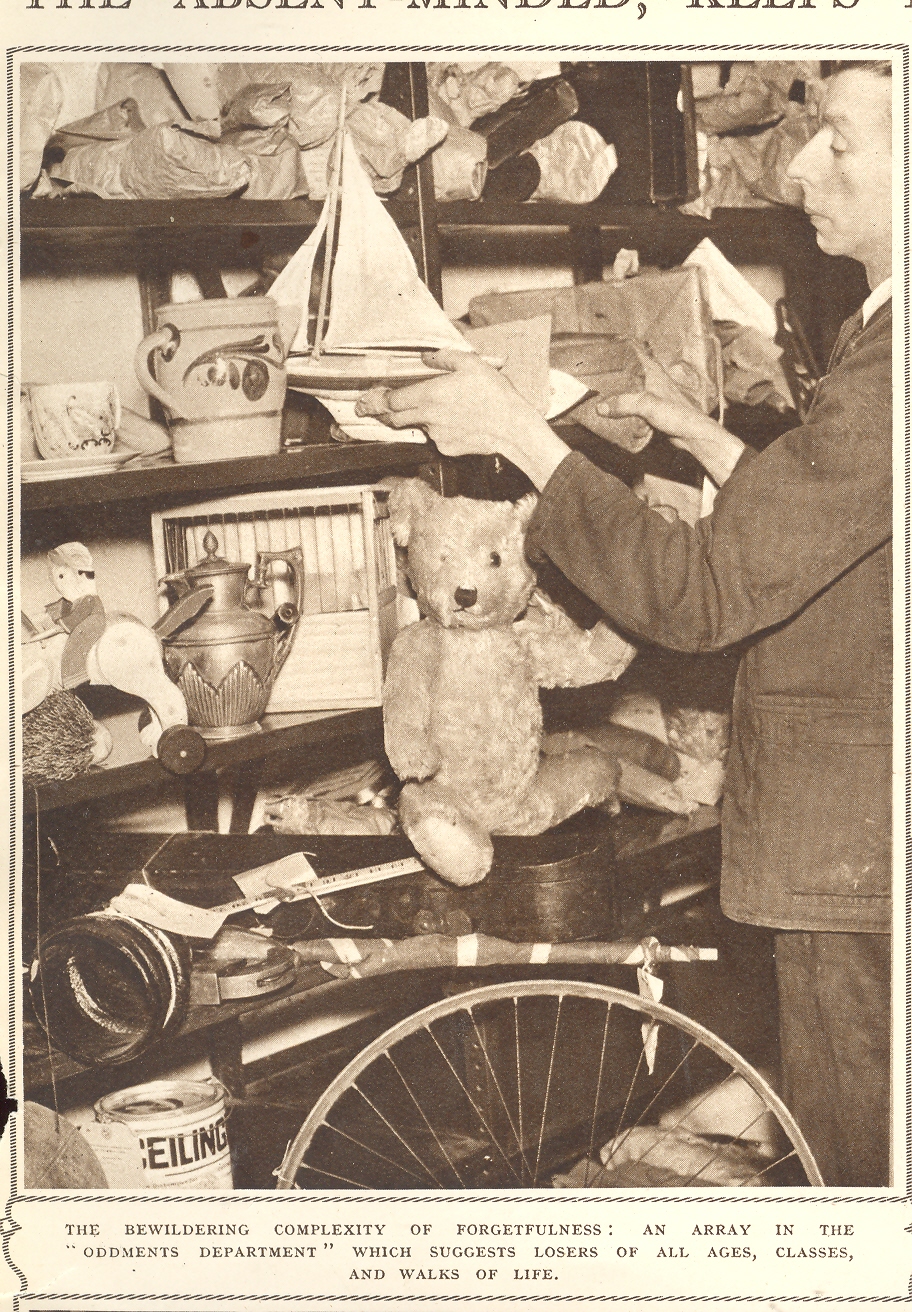
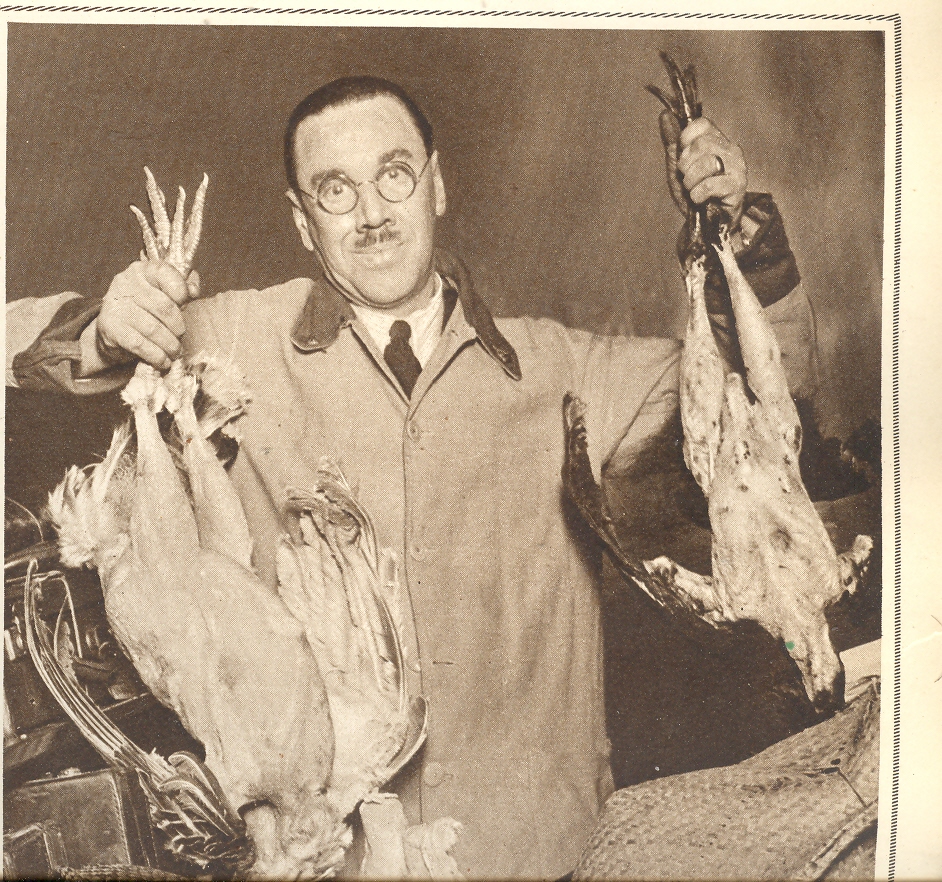
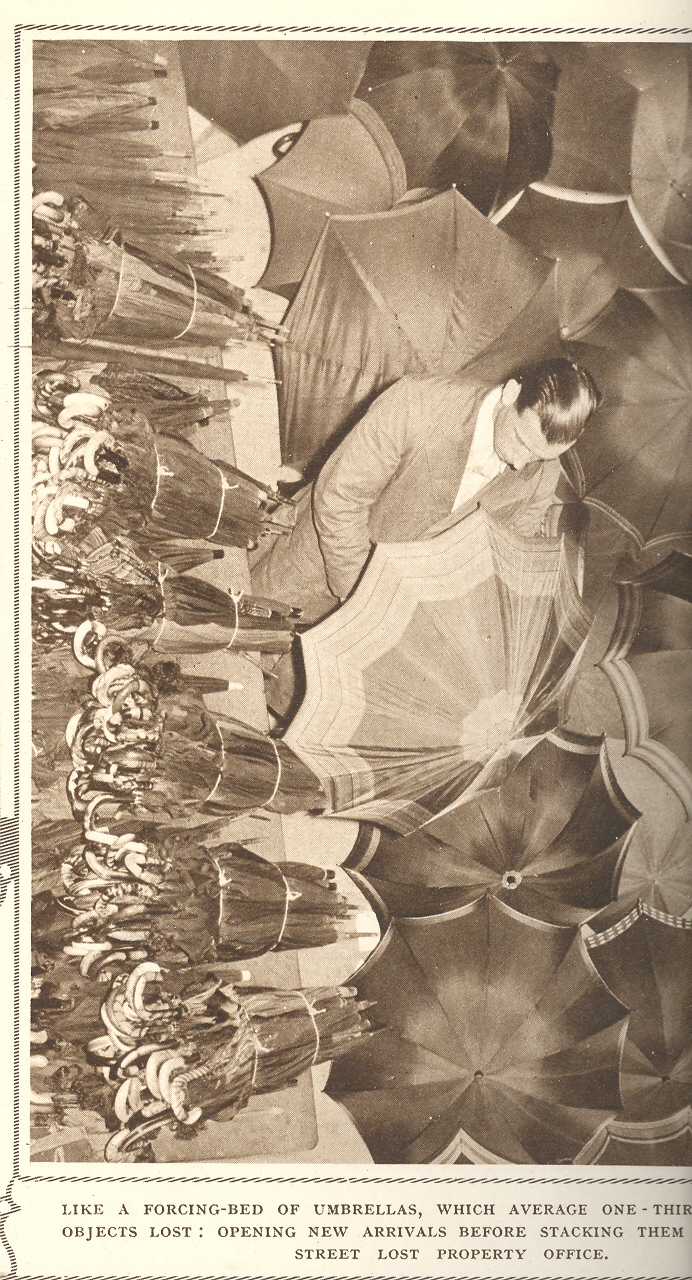
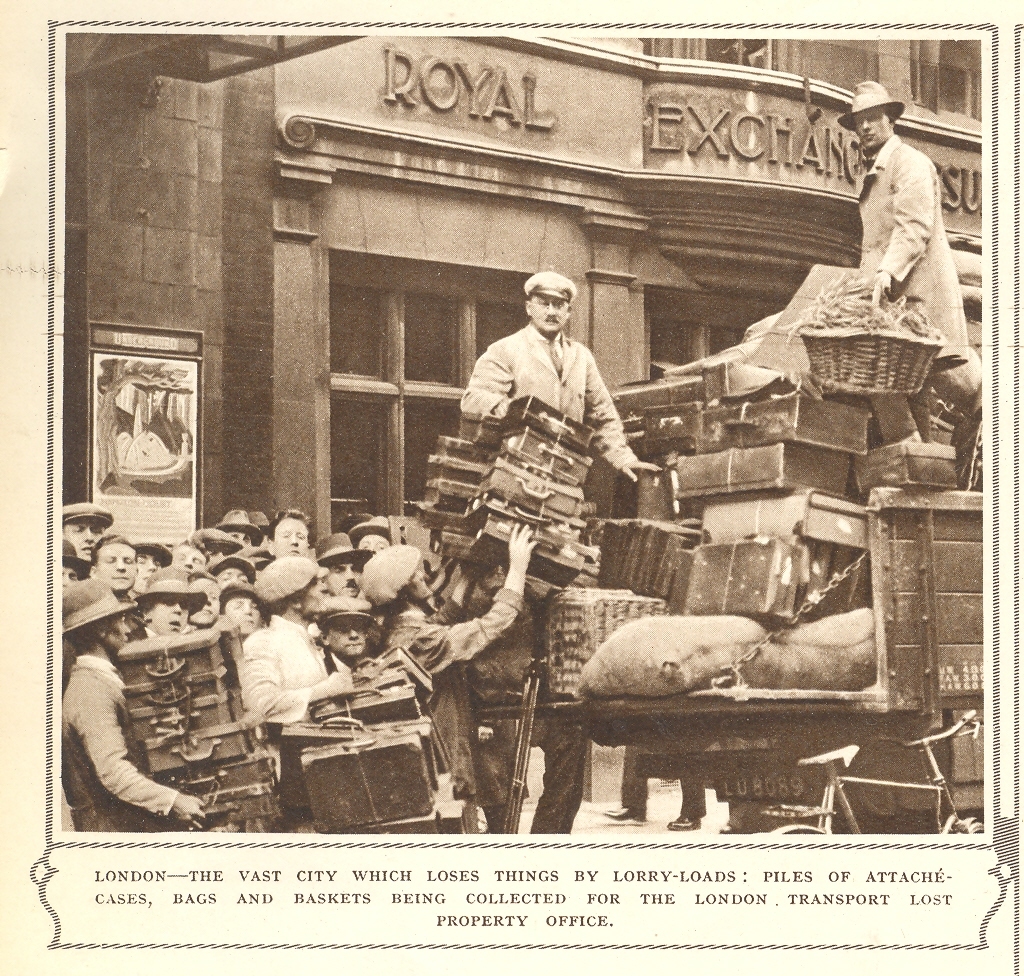
    things.  The images come from a fabulous article from the Illustrated London News of 5 March 1938 called “Forgetfulness by Tons and Thousands; How London, the Absent Minded Keeps Lost Property Offices Busy”. Evidently, in the old days when London Transport were superb, there was a very well orchestrated and
    Blog--June 1--umbrellas detail-orientated staff that collected the lost things of the day found in the Tube, tram depots, buses and lorries; they were gathered and brought to the London Passenger Transport Board at Baker Street, where all of the items were meticulously cataloged and stored, kept for a half year (?!), all registered with the Lost Property Office. Add so aside from the pinch-faced Aubrey Beardsley-fingered man handling the sailboat, and the Floyd the Barber lookalike celebrating the fowl, and the low-belted quizicum inspecting the nether garments, and the slick-haired man inexplicably opening all o the thousands of closed umbrellas, are the following statistical bits on Lost Things Identified for the Year 1937:  49,9999 pairs of gloves; 19,978 single gloves; 33, 361 pieces of clothing; 25,489 attache cases; 24,600 books; 24, 158 pieces of “undefined property in parcels”; 5,805 spectacles; 5,278 keys; 4,005 pipes; and 2307 different pieces of foodstuffs.  All this was just part of a grand total of 348,477 lost things for one year.

    I think it would be fabulous if there was some lost room there at the old Lost Property Office, a place waiting to be rediscovered after the room itself had been lost for the last 71 years. If I had to chose I’d certainly would shout for Mr. Beardsley-fingers–he is,after all, pictured in the beautifully named “Oddments Department”, admiring the “beautiful complexity of forgetfulness” stored there.  Perhaps that room would be filled antique story lines, lost-items-found that were of such an unusual origin that the professionals used to dealing with such things found these to be unclassifiable, tossing them all into a I’ll-Deal-With-it-Later locale.  The material seems like a lock looking for a treasure.

    *Philip Grove’s The Imaginary
    Voyage in Prose Fiction
    (1941); Pierre Versins’ Encyclopèdie de
    l’Utopie, des Voyages extraordinaires et de la Science-Fiction
    (1972);  Alberto Manguel
    and Gianni Guadalupi. The Dictionary of Imaginary Places
    (1980, 1987, 1999)

    ·Posted by :

    ·in:

  • Blank and Missing Things: a Map of Missing People of Central Europe and Russia, 1881

    JF Ptak Science Books LLC   Post 636  Blog Bookstore

    The History of Blank, Missing and Empty Things (Thread, #45)

    “Heaven and earth were one form…. (then they were separated
    from one another…)”

     In ancient times the representation of the gods and beliefs
    was handed from one writer or storyteller to the next, on and on, changes here
    and deletions there, for many generations. 
    This practice was possible (necessary?) because there really wasn’t a
    solitary scripture to follow (as in the Koran or the Bible) and no priestly
    class to guard and cherish a particular strong story line in all of its barbed
    details.

    Juden_1881  

    There are of course bits that have survived intact for
    millennia.  One of these is this fragment
    from one of Euripides’ lost plays (only 20% or so are complete), The Wise Melanippe, and begins a
    statement of cosmogony that states the creation of all things.  The separation of heaven and earth has always
    stuck with me, because this separation begins with Euripides with the creation
    of the world seems to continue on its way with mini-separations of all things
    over the course of time—like the cosmological world-bearing turtles—all the way
    down.  I’m not sure how or who exactly
    did this heaven-rending, or to what force it owed its being:  evidently the Presocratics tended to
    depersonalize the actions of the gods and grant their actions to natural
    forces, so the issue with the heaven-separation business may well have been a
    motive force rather than a god.  Anyway
    it’s the tearing apart, the removal, the separation phenomena that got my
    attention to begin with, and one which has stayed with me, though I’m sure that
    Euripides didn’t have that sort of violent rending in mind while describing the
    birth of the earth.

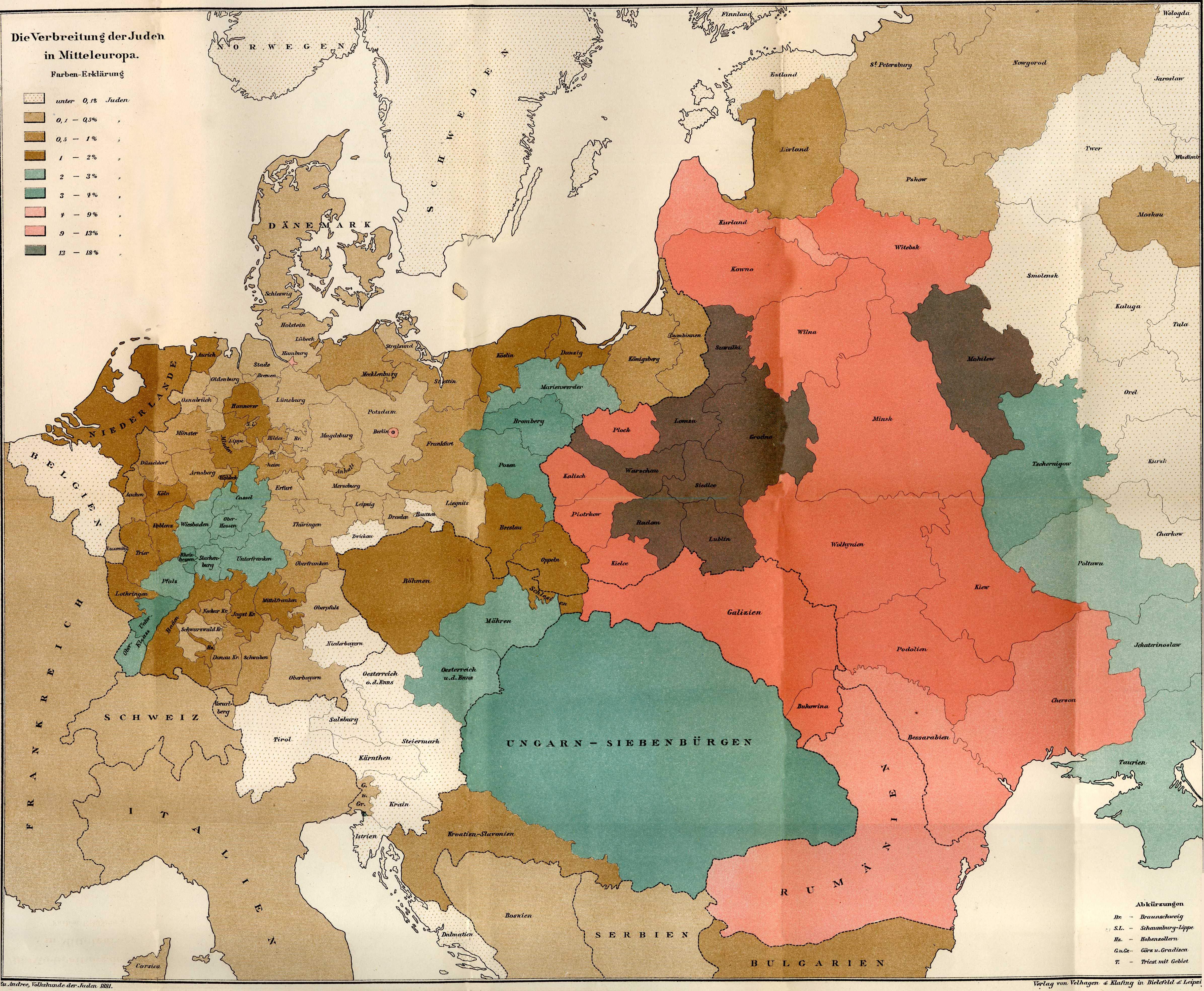
    And so it is with this map* showing the concentrations of the
    Jewish people in Europe  in the late 19th
    century. Between the time of the publication of this map—1881—and the beginning
    of the Nazi regime in  Germany
    in 1933, there were many persecutions and Pogroms and deportations of the
    Jewish people.  Nothing prepared anyone
    for the concentration camps and the systematic extermination of that people
    between 1935 and 1945.  What this map
    shows is the distribution of the Jewish people (by percentage of the total
    population) before they were eviscerated: 
    the difference between this map in 1881 and the map of 1945 would be completely
    different.  The Jews were gone:  killed. 
    Some deported.  Others
    escaped.  But they were basically torn
    from Europe  in the cruelest manner so that in
    almost every case the only indicators of their existence were shadows. 

    There are large-scale maps of this sort of evidence for
    other groups of people in their pre-Euripidean tearing from
    their home:  maps showing the locations of Indian tribes
    in North America (pre-Columbian, 17th
    century, 19th century, they’re all telling pretty much the same
    devastating story) is one good example of a slender category.  There aren’t maps for the mass extermination
    by starvation created by Joe Stalin, or the millions murdered by Pol Pot or Mao.  There are of course more small-scale,
    localized maps depicting the results of forced relocations or devastating war
    or drought or hunger or floods.  But few,
    I think, take such a compelling x-ray of a people’s past on a continental scales
    such as this. 

     *”Die Verbreitung der Juden in Mitteleurope”  found in  Richard Andree’s , Volkskunde der Juden…,  Verlag von Velhagen & Klefirg in Bielfeld und Leipzig:  1881. 

  • Michelangelo v. Leonardo, Blake v. Newton: Famous Contraries Chess Set

    JF Ptak Science Books LLC  Post 638  Blog Bookstore

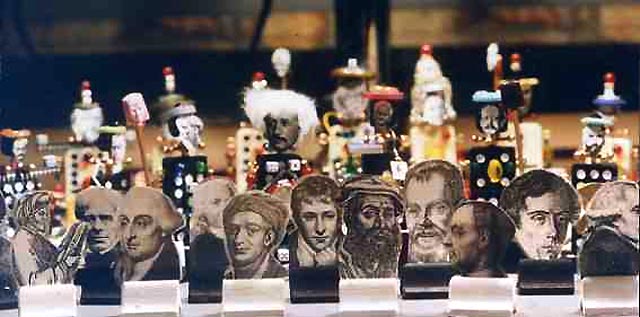
    Some years ago I made a chess set whose pieces forced a
    battle between mathematicians and physicists. The pieces were constructed with
    a mélange of bric-a-brChess ac and junk, all with the same bases of dominoes.  Each piece was an identifiable person from
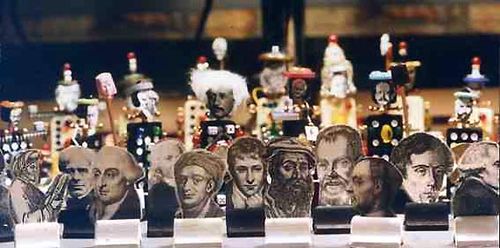
    the history of their respective fields.  And
    while the two divisions of science have become necessarily more porous over the
    years, there remains no difference that there still is a difference between
    math and physics. I brought this set with me when exhibiting my rare bookstore
    stock at national meetings for the American Mathematical Society  and the American Physical Society, and it
    attracted a lot of attention—more so for the choice of who was what piece than
    any game that was ever played on it. (The mathematicians were much more
    ambitious in offering their opinions on the choices of mathematicians per
    position.)   There are chess
    sets of “contraries” on the mass production market, though it is usually
    limited to Star Wars and Civil War figures—and there it is generally generic
    figures for anything outside the King and Queen. 

    I was intending on doing a post today on the unpleasant
    contrariness of Michelangelo and Leonardo. (These guys are two of a small
    number of people who are instantly identifiable by one name only, though a very
    popular and vastly oversold modern author chooses to use Leonardo’s second name
    as the identifier, a distinctly minority position….like referring to Michelangelo
    as Buonarotti of Florence.)   And then it struck me how interesting a
    chess set would be made up of such opposed figures, happily or not squaring off
    against one another on the 64s. 

    Finding the
    contraries is not so simple.  Skipping
    past Leonardo/Michelangelo (I’ll get to them in a minute) I went to the most
    famous of all contrarians in the world of science—Isaac Newton.  (Is the “Isaac” really necessary?) During his
    famously grumpy and combative lifetime
    Newton battled a night sky of most shining stars of
    his day:  Hooke and Leibniz being two of
    the greatest of these figures.  But I
    think for this chess set I’d have
    Newton squared up against a man who wasn’t even
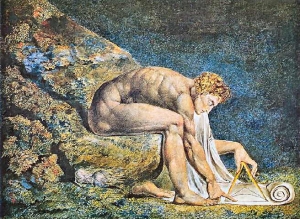
    born during his lifetime—William Blake. 
    Blake was an impossible anti-Newtonian, making a career of being a
    spectacular (and perhaps insane/manipulative) anti-rationalist,  a weaver of smoke, playing with and
    distorting images like a theramin player, using language to produce dichotomies
    in even the most standard of sensate ideas. 
    Blake was the poster child for thing anti-tech, an anti-scientist out to
    save the world from its scientific self, 
    the rationalist world set to destroy imagination, the “Antichrist
    science” hell bent on destroying the soul of art and religion. 

    “Art is the tree of
    life; Science is the tree of death” wrote Blake, and so he chose the
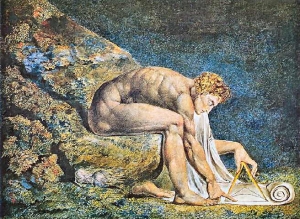
    “Athesistic”  Sir Isaac to stand for the
    beast, depicting him in art as a naked geometer intent on subjugating the world
    with a compass and a keen brain, reducing glory to quantification, the work of
    Satan..  For most of my life I thought
    that this image by Blake was celebrating
    Newton—I knew little of the poet/artist/poet, and
    thought the painting a reverence.  When I
    understood Blake a little,  I saw that
    the image was intended as a mockery of
    Newton and the idea of science—this was an unusual
    sensation, because absent the unspopken intention of the artist,  you could still take the subject matter of
    the artwork two ways. 

    Blake’s writing
    leaves no doubt about where he stood on the issue, even though much of it (to
    me) seems not terribly understandable due to its repeated and visceral
    self-reference and private language (“Reason is the bound or outward
    circumference of energy”, the “ratio of the things of Memory”:

    The Spectre is the Reasoning Power in Man,
    and when Separated from Imagination and enclosing in steel a Ratio Of the
    Things Of Memory, It thence frames Laws & Moralities To Destroy
    Imagination.   

    Science—embodied
    here in Newtonian mechanics, there in Renaissance rediscovery of classical
    perspective—was killing the “eternity of the imagination”.

    I could well imagine
    a “conversation” between the two men: 
    Blake saying Things, and
    Newton not able to find any space in his head for
    them, answering in silence.  OR perhaps
    he would be vicious.  God knows.  Newton died in 1727 when Blake was still in
    ueber-dimensional pre-pregnancy, waiting his turn to descend from the heavens,
    which was not bound to happen for another thirty years.
    Newton_blake

    In his otherwise
    brilliant book, Art & Physics,
    Leonard Shlain refers to Blake as a Cassandra, having the ability to see the
    future but not being able to say or do anything about it.  To think that Blake was “correct” in  foreseeing the problems that technology would
    bring to people’s lives leaves me baffled: 
    it is certain that people became more cog-nified with the advance of
    technology, but it also allowed for the birth of “free time” for the masses,
    giving them some soul and imagination that they would’ve have had if they were
    in a flat field in Poland pulling potatoes out of the ground for 18 hours a
    day.  Perhaps Blake was just referring to
    those lucky enough to wear clean white shirts and have a benefactor; perhaps
    all of those Others didn’t exist in his many scheduled god/heaven visions he
    had every day.   (
    I should point out that Blake published Songs of Innocence and of Experience:
    Shewing the Two Contrary States of
    the Human Soul
    in 1794, which was actually a varied republication of his
    1789 Songs of Innocence with the
    addition of the Songs of Experience.  Blake exposes the duality of experience and
    innocence, of their opposing nature in human existence, neither negating the
    other, both trying to survive simultaneously. 
    His engraved poems really are striking and gigantically, unreservedly, ars-religico-veritas
    of the highest Romantic order. And then some.)

    Back to chess and
    picking out the first pieces: :  Blake
    and
    Newton.  I’d
    have to give
    Newton the nod for Queen for the sheer enormity of his abilities.  Blake gets a pawn’s position, the first piece
    sacrificed. 

    Chess Contraries,
    Piece Two:  Michelangelo and Leonardo.

    It is odd that even
    though Michelangelo (1475-1564) and Leonardo (1452-1513) lived in the same city
    (Florence) for several years that the only thing that developed between them in
    the smallish societal/artist communities was a brew of mutual disdain.   Diplomatically speaking, the men did not
    care for one another, though it seems that the junior of the two,
    Michelangelo–who was a well-established rising star of 35 or so to the more
    famous Leonardo, who was 55—possessed the young man’s temper and was more
    outspoken in his dislike of Leonardo.  It
    does seem spectacular that the two greatest talents of the Renaissance could
    live so close together for several years and have no working or collegiale
    relationship, no exchange of ideas, nothing. 

    They did, however,
    almost work together in the same (big) room, though that too never came to
    fruition.  Both men received a commission
    from Piero Soderini to decorate the walls of the Council Hall of the Palazzo
    Vecchio with massive  (20×50’ !) paintings
    of great Florentine military victories:  Leonardo would paint the
    Battle
    of Anghiari
    and Michelangelo the Battle of Cascina.  Like much else in the careers of both of these men, the projects were unfinished–Michelangelo not even getting beyond the cartoon stage in preparation; Leonardo actually got paint on the wall,s but made an error in trying to quicken the slow drying time, and heated the wax undercoating enough to make the paint run down the wall and puddle on the floor.   It is interesting that  it would be Guiseppe Vasari–the man who wrote one of the earliest biographies of renaissance painters, and the creator of the Ufizzi Gallery, and a large talent in his own right–who would be brought in to produce one of the large paintings.  It seems to some that Vasari, ironically, painted his own work over that of the started  and probable masterpiece of  Leonardo.  (As a matter of fact, there is an art historian who thinks that some of the Leonardo might have survived under Vasari’s work; that story can be seen here.)

    I don’t mean to set out for pure contraries (like Ovid’s question
    of water and fire–cunctarum contraria semina rerum, Fasti, IV, 783, f–the
    yin and yang, and other entities combative at all points. The question here is
    for entertaining contraries at some interesting points—that’s good enough.  All aspects needn’t be the mutually exclusive
    of the other such that if one is true the other must be false.  There’s room enough for neither-true-nor-false,
    at least for this game, a wide-open Wittgensteinian arbitrary contrary.


    It might be interesting to have a look at Vasari’s estimation of Leonardo and Michelangelo; I’ve reprinted the first tow paragraphs for each from Vasari below.

  • A Long, Low, Massive Circle: Circular Building, 1938

    JF Ptak Science Books LLC  Post 639  Blog Bookstore

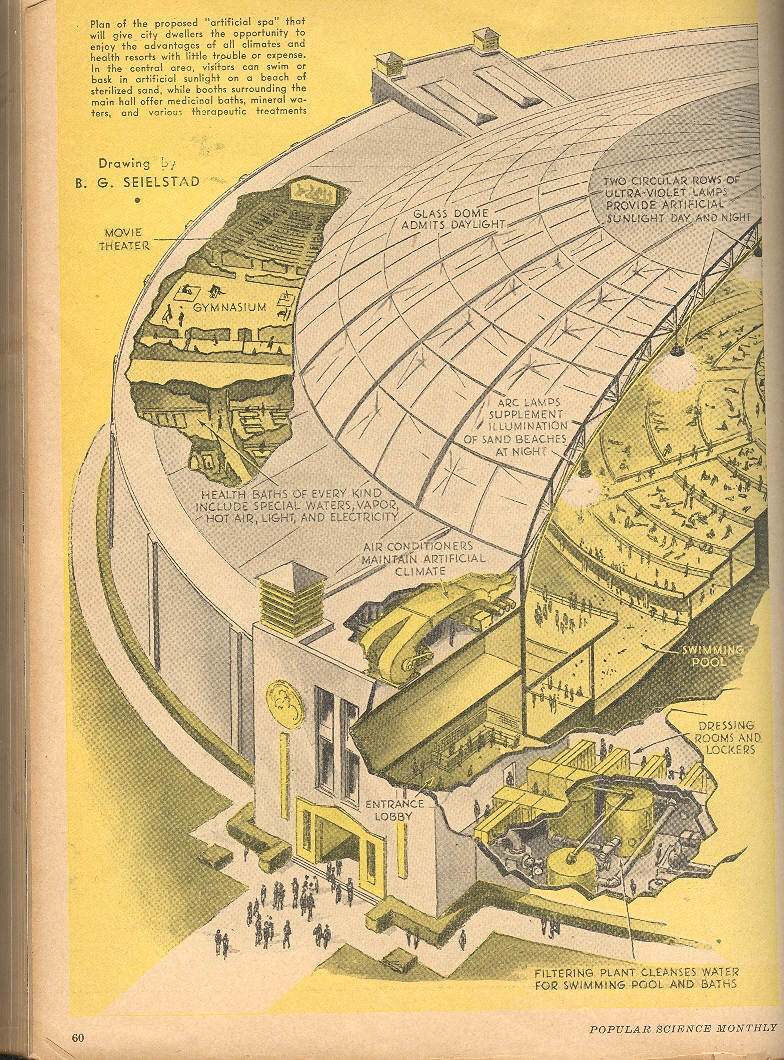
    This re-surfaced idea for a
    mega-spa was very wide, very long and very low. 
    Karl Stoldeck and J. Goldmerstein—architects and planners in Berlin—published
    a broad idea in 1928 called Thermenpalast (Thermal Palace, Spa Space, something
    like that), and although it seemed to satisfy almost everyone, the idea was
    consumed in the general economic malaise of the depression of 1929.  It looks as though the idea had a little life
    again in 1934, but there was a problem with fund raising.  The idea came back again, broader, bigger,
    and more defined, finding some idea-space in the Popular Science Monthly for
    March, 1938.

    Blog--jun 6 1

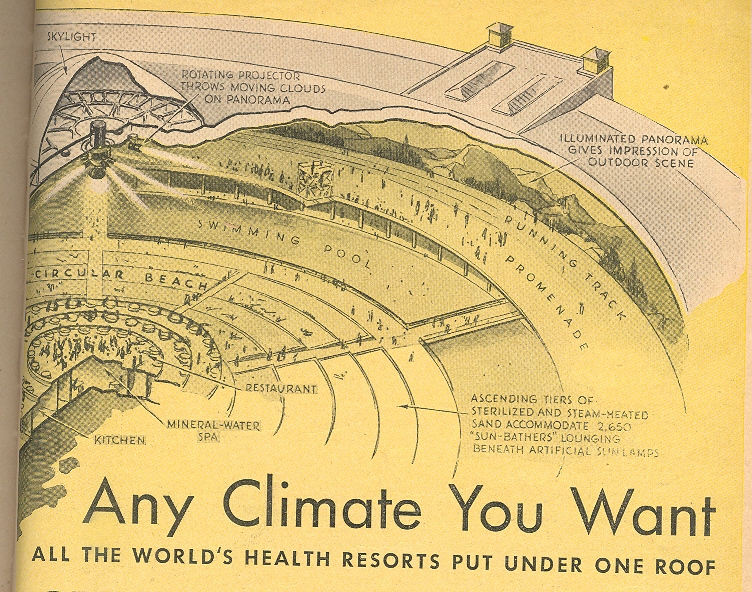
    The structure for health and
    exercise was massive—as a matter of fact, it would’ve been the most massive
    circular project in history.  The
    building had 6.5 acres under glass, which makes it 280k or so feet, giving the
    building a diameter of 1,800 feet and a circumference of something just over a
    mile.  IT looks as though the ceiling
    reached a maximum of 250’ or so; seeing that the dome would also be about 1200,
    that presents a little engineering problem. 
    But no matter:  it would never be
    built, anyway, even with Nazi dollars from home.

    The building was quite a feast
    of the body—there was a mountainside panorama around the exterior wall,
    illuminated from a  series of light sources
    from the ceiling.  In diminishing concentric
    circles: there was a mile-long running track, a promenade just inside that,
    followed by a spectacular pool which looks to be 4000’ long and 100’ wide!  Interior to the pool was a wide “beach”, a
    restaurant, park and lounging area.

    Blog--jun 6 2

    This was also a multi-floor
    building, with gyms and restaurants and a long series of health baths.  The entire spectacle would offer many
    different climates depending on the needs of the clientele. 

    The cost:  6 million, U.S. A few years earlier the Empire State 
    building was built for $24,718,000. The
    architectural firm Foster + Partners

    released designs for a the largest building (“Crystal Island”)  ever built: 
    2.5 million square meters (8.2 million feet, or 35 times bigger than
    this 1938 idea), with a tower 1476 feet tall, all sort of circular, and to be
    built in Moscow.

    Had the thing been built in Berlin and started in
    1938, it would’ve been about ready to bombed on the day of its completion. 

    Here’s an interesting read on water parks:  Water, leisure and culture: European historical perspectives, Susan C. Anderson, Bruce H. Tabb, 2002.

  • “Our Men Wear Shoes”: Wide Discovery in an Ephemeral Setting

    JF Ptak Science Books LLC  Post 640  Blog Bookstore

    Some Talks on Sugar
    , a nicely printed but thin pamphlet by Clarence
    R. Bitting, published in 1937, looked like a non sequitur of non-interest—until
    I flipped through the thing and found some very unexpected photographs, and then some fantastically unexpected text.  As it turns out, the interior title—Florida Sugar, Past, Present and Future…an
    Address Before the Florida Chemurgic Conference
    — provided a surprise,
    first with the Florida interest, and second with the not-seen-in-my-experience
    word “chemurgic”.  
    Blog--jun 7 sugar shoes

    It turns out that Mr. Bitting
    was the Vice President of General Motors, and was making a push to sell
    chemical fertilizers and such to other growers in the state of Florida  from the
    home-base company of United States Sugar Corporation (of which Bitting was president in 1939).  The USSC was purchased en masse by the exceptionally talented businessman and entrepreneur
    Charles Stewart Mott, who was also the major private shareholder in GM. (Mott’s
    Apple Juice came later after the company became fabulously successful—it was
    one of many other concerns created when USSC began to diversify.  From what I can tell, Mott’s today imports
    most of its apples from China—says
    so write on the bottle.)

    Now all of this had my
    attention.  Following six pages or so
    extolling the company’s successes and advances in cultivating (and draining)
    the Everglades, they got around to talking
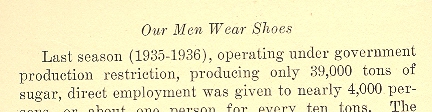
    about the 2,500 people who worked for them. The title of that section was “Our
    Men Wear Shoes”. 

    Really?

    The Vice President of General Motors was proud of USSC’s treatment of its workers: 

    “Florida cane-field workers wear shoes; they
    own their own hats
    , and their wardrobe consists of a great deal more than a
    second-hand or third-hand pair of overalls, so that clothing production as well
    as supplying the food requirements of those directly and indirectly employed
    furnishes much additional indirect employment.”(Bold emphasis mine.)

    This really does speak to the
    times, when the manufacturer could be proud to announce that its workers own
    their own hats and shoes. Hats?  Were
    hats rented? 

    It is also remarkable that for
    all of this—the hats, the shoes, the sort of new overalls—that these “cane-field
    workers” were also carrying other incomes on their backs for the people who
    would sell them these few bits of owned clothing and food.  It seems almost impossible that these would
    be laudable traits of the employer—but they were, evidently, because the VP of
    GM saw fit to mention them.  And to me
    this must mean that other  workers, elsewhere, didn’t wear shoes and
    didn’t own their hats.  Staggering,
    really. (My wife Patti just asked what the modern equivalent of this would be. I’m not sure; perhaps the fiction of “poverty line” income, or the wispy promise of the minimum wage? Or is it the floured-up sugar delivery systems that kids get to eat for free at” breakfast” in public school?  Or the last-ditch emergency care effort that is provided for children in direneed of medical assistance, given finally only modest attention along the lines of lifetime neglect? What is it that we are proud of today that will look so stingy and mean  in the coming years? Where is the capacity to help and aid so short-sighted and so under-capacity as in the hat/shoes issue? Its a great question. [See my post on the history of the minimum wage here.])

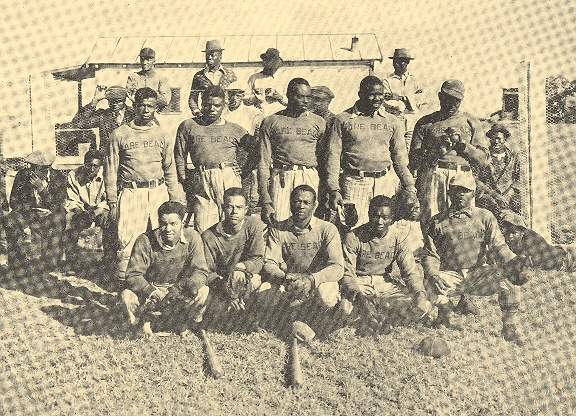
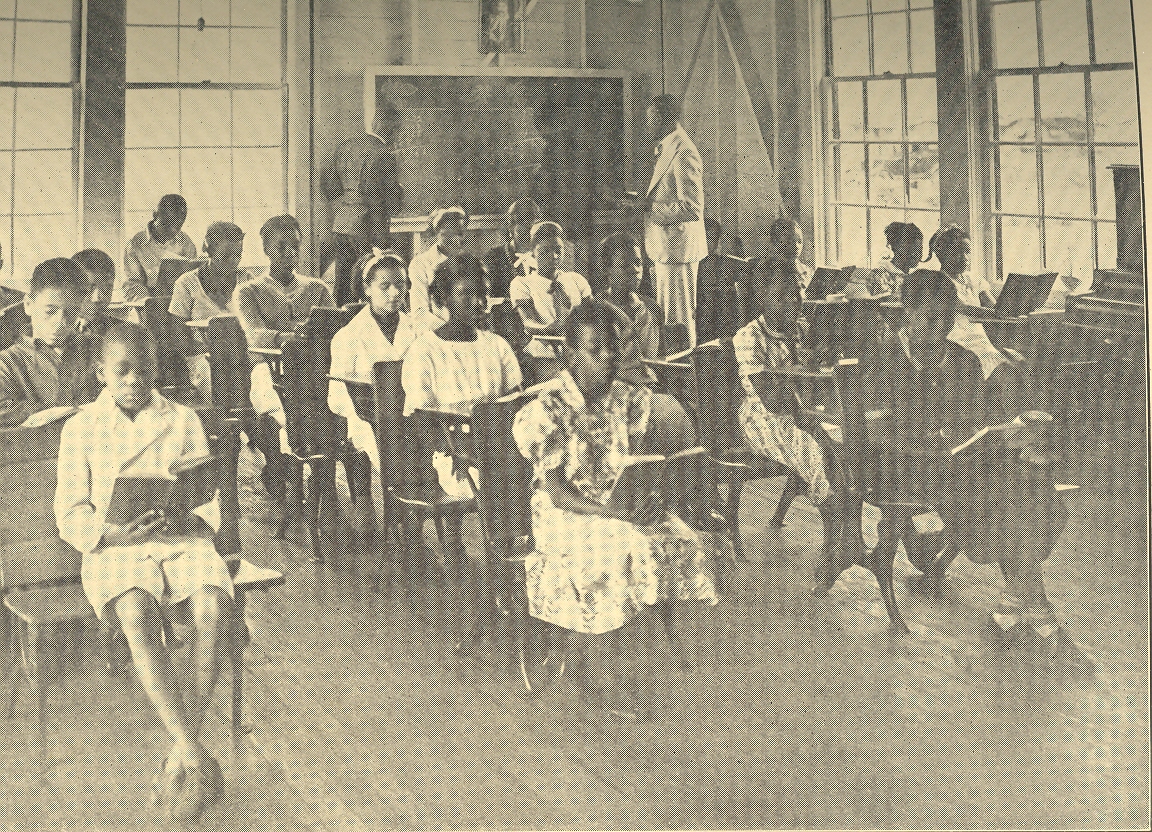
    Blog--jun 7 sugar bb And then the photos.  Pictures of Field Day festivities on acres of
    cleared sugar cane, a tug of war, men working at a conveyor built.  Then the school room and the baseball
    team. The men in the baseball photo look proud, and ready (and formidable, especially considering how many professional players of the day were lumpy and loose, thanking god that they were wearing form-hiding loosely-fitting wool uniforms). These men were muscular, lean, hard; I bet they could play.

     Blog--jun 7 sugar school

    Blog--jun 7 sugar bb2

    The children in the airy schoolroom are decently dressed, though the poor kids in the front row have no desk.  And the walls have no interior finish.  I wonder too about the tall boys in the back of the room with their bow-tied and jacketed teacher.  What are they doing with the blackboard in the rear of the room? Was it placed there to show that the kids had a blackboard

    and it needed to be in the picture?  Or is it because this was a one-room affair, with the older children in the back, getting special attention from the teacher who was trying to give age- or capability-relative instruction under slim circumstances? My guess is that since this is 1937 and we’re talking about a company-run school in the Everglades, that the sotto voce undercurrent of thought would be that the children had a room and a teacher, and what more could they want (?)

    The photographs are unintentional monuments
    to the little bit that was given to these thousands of people–so little that
    seemed like so much to the people who had almost nothing, and also, criminally,
    it felt like so much largesse from a company that had infinitely more.

    And all of this from what would seem to be a disposable piece of ephemera–and we haven’t even gotten to the chemical hardware bits and the draining of the Everglades to get to that good cane-growing topsoil….

    *See below in extended reading for Mr. Bitting’s testimony before the Congressional Committee Investigating the Interstate Migration of Destitute Citizens. 

    ·Posted by :

    ·in:

  • Blank & Empty Things #46: Languages of Tree Structure

    JF Ptak Science Books LLC  Post 641  Blog Bookstore

    A History of Blank & Empty Things , #46

    Messages and information, silently displayed data and the announcements of the state of all things are everywhere, all of the time:  these things only become part of the language and systematically codified once they are recognized and understood, or at least once the thrust of the message becomes distinguished from the surrounding noise. 

    Blog--jun 8 tree
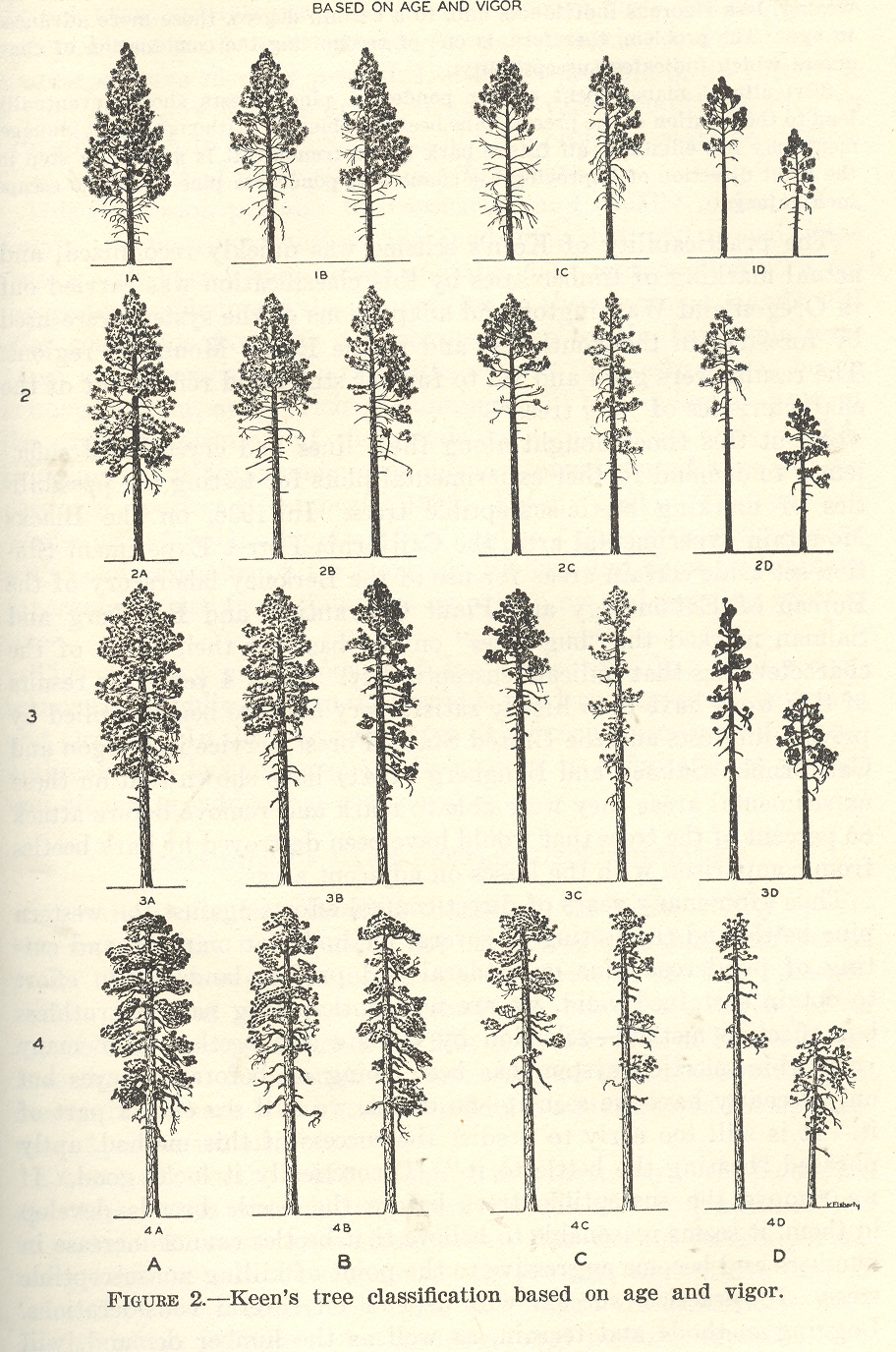
    One elegant interpretation of above-the-noise display was made by E.P. Keen in 1936 (“Relative susceptibility of ponderosa pines to bark beetle attack”, published in the Journal of Forestry)  who established a simple and practicable standardized vocabulary for the discussion and communication of tree health.  It is a relatively straightforward idea–based upon many years of keen observation and understanding–which used a pictorial schematic to establish a common baseline for the discussion of tree health/growth. Later on Keen would pioneer the use of aerial photography using various films and filters to determine the extent of damage done to stands of trees (and forests) brought about by drought, pests, diseases and other harmful stimuli–especially when the damage was done not in the visible spectrum. 

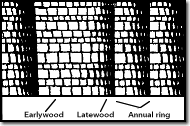
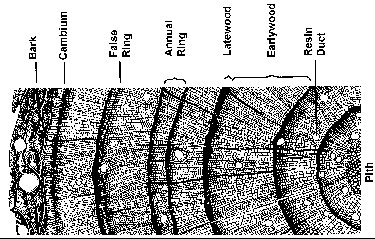
    The Blank & Empty part of tree language comes in the form of cells in the trunk of the tree which reveal–in cross section–the age of the tree and some climatic indicators of during the tree’s growth.  This comes in the form of tree rings–the rings are formed by the growth of the cells, the first of which in a new season respond with expansion, and depending upon water conditions will either grow somewhat less slowly than at first or stop growing altogether at the end of the season, and die; the new cells growing in the new season, and the demarcation being what we call a “ring”.  This was a fantastic idea, the brainchild of A.E. Douglass at the University of Arizona. 
    Blog--june 8--tree cell
    Andrew Ellicott Douglass (1867-1962)  was , ironically, an American astronomer at work at the Lowell Observatory in Flagstaff when, in 1911,  he began his experimentation with tree rings.. (I believe that he came to this end trying to ascertain terrestrial climatic conditions in his sunspot research.) The resulting effort was the clarification and near-founding of dendrochronology, with the resulting climatic understanding applicable across many different fields, and all from expanded/contracted cells.  Douglass perfected his observation and theory in a three-volume masterwork Climate Cycles and Tree Growth, which was published in 1936.
    Blog--june 8--tree 2

    For an interesting appraisal, see George E.Webb  Tree Rings and Telescopes, (the University of Arizona Press), Tucson, Arizona, 1983.

  • Bad Book Titles (and Worse Contents): Cruella DeVille and the Fur of Cats and Dogs, 1938

    JF Ptak Science Books LLC  Post 642  Blog Bookstore

    Blog--jun 8 fur title How
    could one pass up the chance to browse through such a  compelling and revolting
    title such as   Standardized Fur Tags, Their Use and Purpose, (published in NYC
    by the Fur Research Institute in 1938)? 
    Titles like this cry out in equal parts of pity, shame and pride,
    calling to their readers like fur-lined Sirens beckoning to fur-encrusted
    sailors floundering in a fury sea, hell-bent to crash upon fur-slathered
    rocks.  In a world of covering things in
    fur that once belonged to another living thing, the thinking’s all over but for
    the process, pricing and standardization, so that the furriers were less
    inclined to cheat one another and focus on the fleecing of the buying
    public.Blog--jun 8 fur title 001  

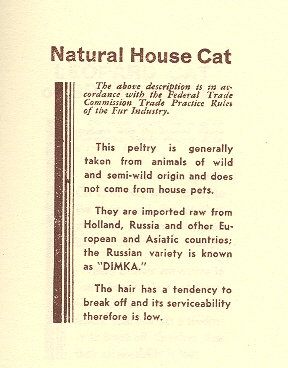
     Opening
    this oversized pamphlet reveals the explanation of the fur identified by the
    tags that would appear on the interior-neck of the garment.  There are 125 descriptions and standardization
    of furs, though I must say that what caught my attention first was the fur of
    the “natural” house cat (followed by the “dyed” house cat)—they say that this
    was not an agoraphobic cat’s pelt used to make the apparel, but from cats “wild
    and semi wild”.  Like barn cats, I guess.
    (We are told that the fur “breaks off”, and is not a very good choice for
    outerwear, though it did seem to work for the cat.)

    Blog--jun 8 fur title 002

    Then
    there’s the “dyed Chinese dog” and the “dyed Mongolian dog”—I’m not sure who
    would need pelts made of dog (or cat, or anything else for that matter), but I
    guess that they were popular enough to be included in these furrier  guidelines. 
    And so the list goes on and on: dyed skunk, pieced skunk, natural skunk,
    dyed squirrel, dyed weasel, natural wolf, dyed opossum, etc. 

    ·Posted by :

    ·in:

    — —
  • Flying Ocean Liners: Sikorsky’s Ocean-Crossing Futurama, 1941

    JF Ptak Science Books LLC  Post 643  Blog Bookstore

     Theodore
    Wright (aviation engineer, 1895-1970) wrote a lovely short piece (“Wings for
    Transportation:”)  in the Smithsonian Institution Report for 1941
    on the future of aviation and its importance in transportation.  Wright begins the article with a difficult
    paragraph on the good fortune of America‘s aviation industry to still be more concentrated on commerce than on military
    might, referring to World War II as the affair “starting with
    Munich”. 
    This is unfortunate.  But he does
    graduate from this myopic iconoclast’s future view to discuss the history of
    American aviation and its future as an essential element of the overall commercial
    transport grid.  Here he gets a lot
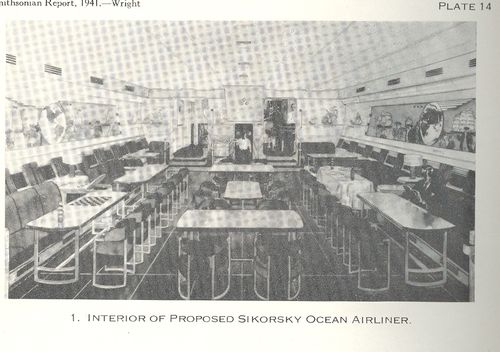
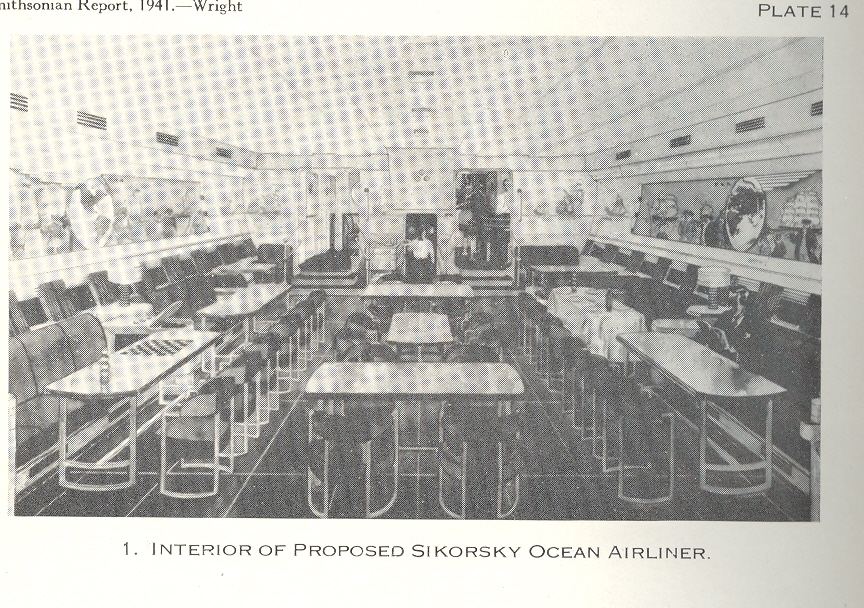
    correct. Blog--jun 9 sikorsky interior

    At
    the end of the article though comes a fantastic bit of futurology by an
    engineer and designer whose importance in aviation is unquestionable—Igor Sikorsky.  Sikorsky (1889-1972) designed the first
    multi-engine fixed wing aircraft and the great flying boats used by Pan Am to
    cross the oceans, though he is best remembered though for his enormous
    contributions in the development of the helicopter—a man of tremendous
    accomplishment.  He got an awful lot
    right.  He was also correct in the assumption
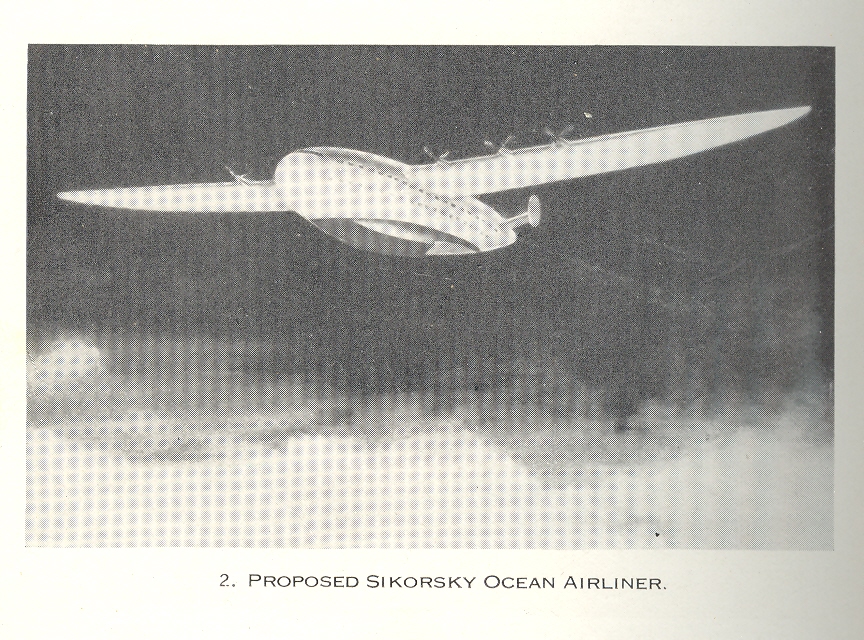
    that there would be enormous aircraft flying around the world in the near
    future—aircraft far larger than those being flown by Pan American Airways.  What he got wrong was the shape and style of
    this aircraft, which seems to be a further development of the flying boat.  Wright referred to these planes as “Ocean
    Airliners”, and that is what they certainly seemed to be:  behemoths that were ocean loners with
    wings.  They were wonderful things, and
    who wouldn’t want to be able to walk around the in-flight dining room, trying
    to pass some time on a long flight to New Zealand?  But it was not to be, of course, though
    Boeing’s superb 747 did for a while have a cocktail lounge for first
    class.  Still, these wishes die hard,
    especially when you’ve traveled with such accommodation.  (My own experiences with this is taking a
    electric tram in Helsinki
    and discovering that there was a bar in the back of the car. The open windows, the blue skies, the civility–it felt like the only way to travel: refreshed, thoughtful, and going 20 mph.)

    Blog--jun 9 sikorsky

    ·Posted by :

    ·in:

  • The History of the Evil Eye

    JF Ptak Science Books LLC  Post 644

    Fortis imagination generat cassum (“A strong imagination begets the event
    itself”)

     The Imagination of the human heart is evil
    from his youth
    (Genesis
    8.21)*


    Blog--jun 11 evil

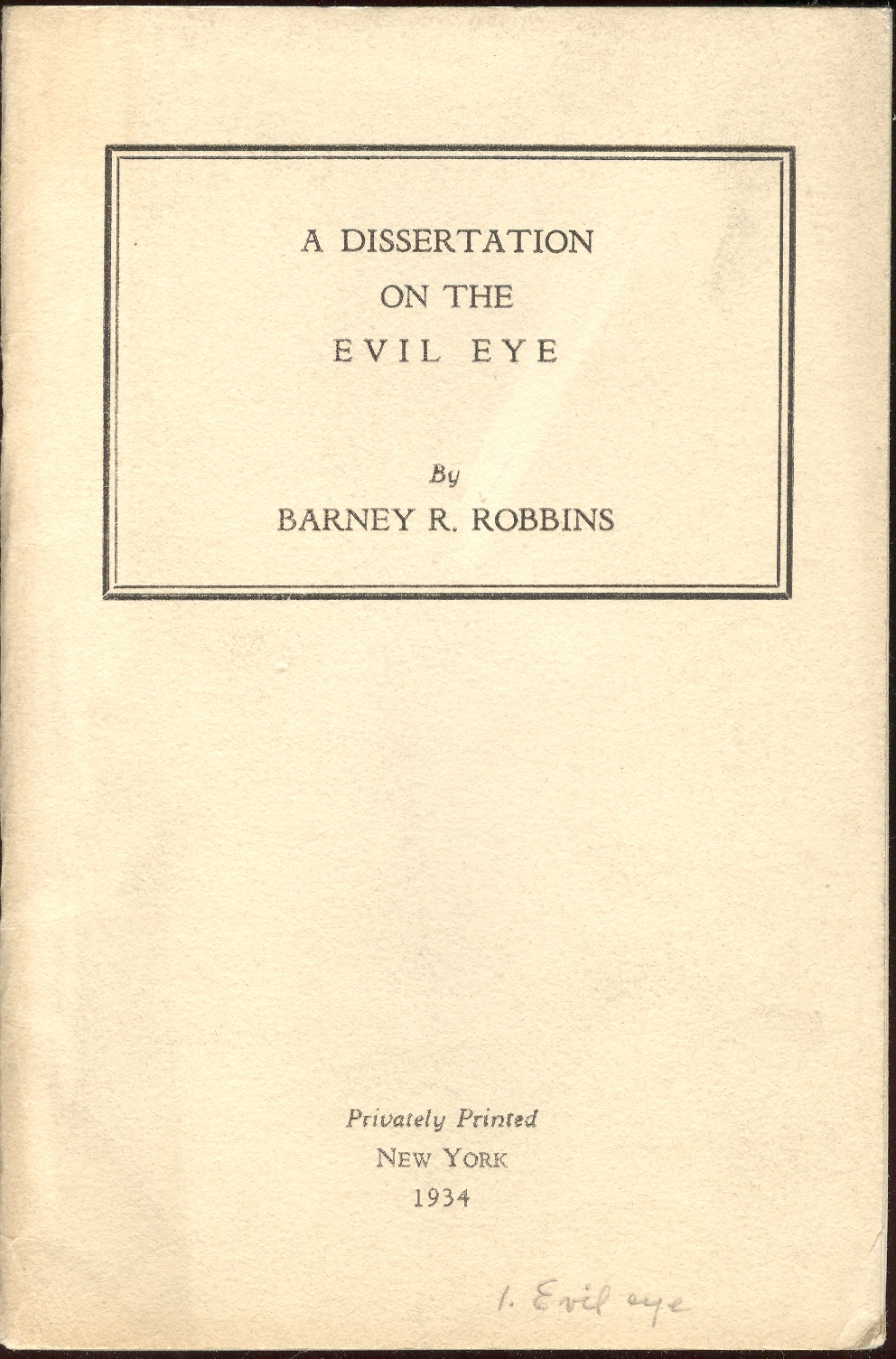
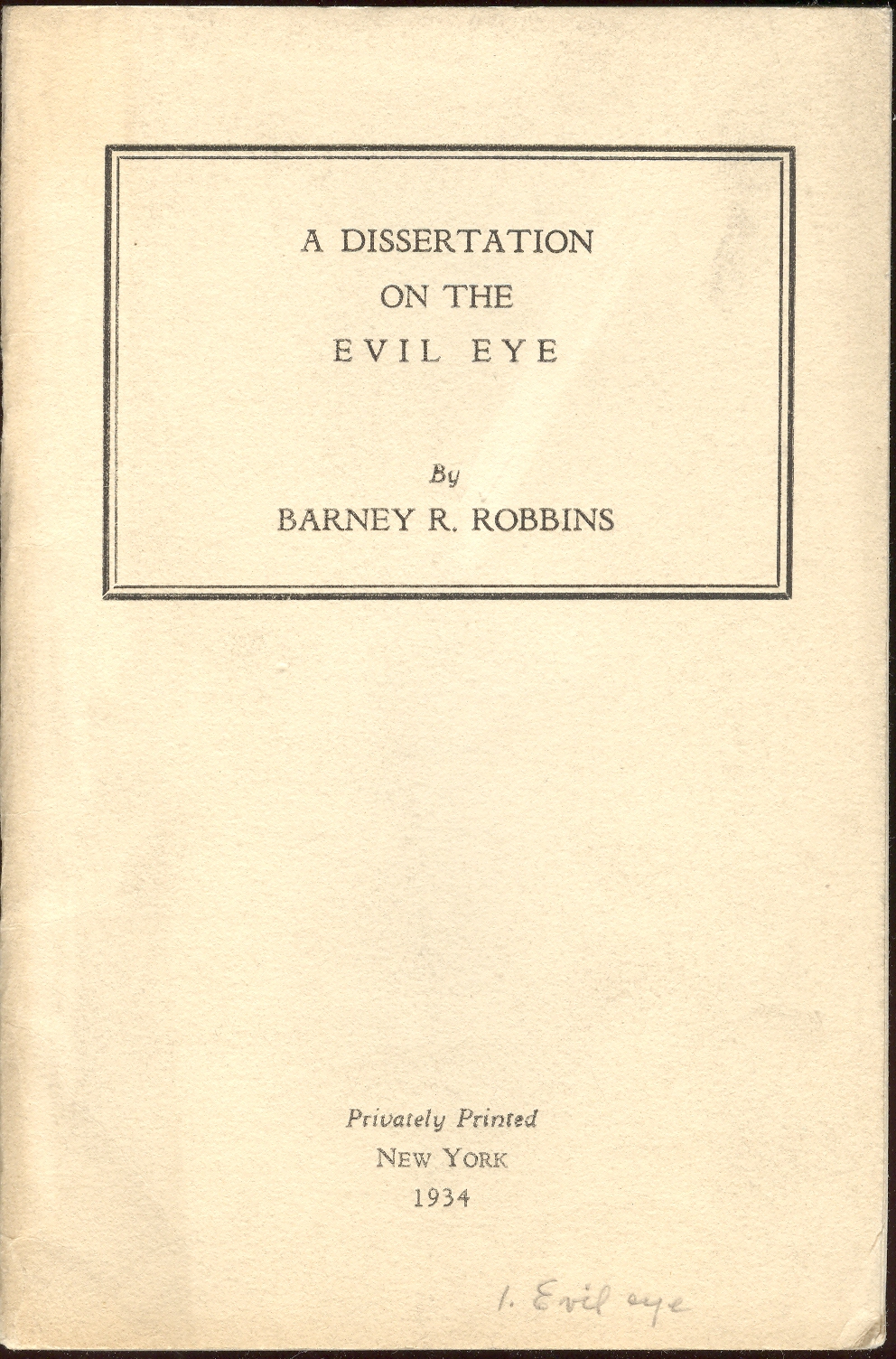
    Barney Robbin’s A Dissertation on the Evil Eye was headed to my category on Icons of Shouted & Mysterious titles—until I started to read it.  It turns out that Mr. Robbins wrote a fine, sort of brightly-written exegesis on the history of evil and its manifestation in the evil gaze—a tough thing to do in 40 pamphlet-y pages and still have lots of references to The Ancients.  He also has a pretty liberal undercurrent towards the authenticity of the Bible, the basis of human history (“our human ancestors lived in savagery during practically the entire existence of the race”), the invention of the convention of privacy in human sexual affairs (and its representation in the OT vs NT), Old Testament superstition, and other varieties of contemporary social mores and their interaction with asceticism and pagan practices. He then deftly slides into the origins of  “the preposterous belief” in and personification/transference of evil spirits, and in religious intolerance of the assumed imagination of the human mind and its role in rapturous misinterpretations of the Bible and the growth of redemptive evil.

    The last fifteen pages are spent solely on the evil eye, and is a pithy statement on how it was “given” in various cultures, and how people protected themselves from it. “They have the plague, and caught it of your eyes” writes Shakespeare in Love’s Labor Lost (V II), and this is the least of it, though Robbins points out that in various cultures you could seal yourself from this ”plague” by spitting, wearing bright colors, collecting and spewing rainwater collected on the 27th of April, cross dressing, keeping a phallic amulet on the body, keeping salt and coal in the pockets of children, blessing wine, blowing smoke into a child’s mouth, and so on.

    Robbins points to Francis Bacon, who wrote: ” It seems some have been so curious as to note that the times when the stroke or percussion of an envious eye does most hurt are particularly when the party envied is beheld in glory and triumph.” And of Robert Heron, who in his travels in Scotland in 1793 wrote : ” Cattle are subject to be injured by what is called an evil eye, for some persons are supposed to have naturally a blasting power in their eyes, with which they injure whatever offends or is hopelessly desired by them. Witches and warlocks are also much disposed to wreak their malignity on cattle. … It is common to bind into a cow’s tail a small piece of mountain-ash wood, as a charm against witchcraft.” And then to Thomas Lupton, who in his Book of Notable Things (1586) wrote : ” The eyes be not only instruments of enchantment, but also the voice and evil tongues of certain persons.”  And so it goes, on and on.  Entertainingly so.

    But there is something of Robbins that doesn’t sit well; perhaps it is his book on the New Testament, or the sniffly jaundiced Immigration and Americanization which form the background for some of the man’s thinking when he veers from liberal interpretations to right-wing political statements.  Out of nowhere comes the following gem:  “Communism is the accursed offspring of the evil eye with all its implications.  It is the collective evil eye of the masses…”

    I think what Mr. Robbins is getting to, ultimately, is the delivery of his belief that savagery has continued for thousands of years and continued to his present, “flourishing long past its day”.  Maybe so.  In any event I found his work to be unexpectedly interesting, and was impressed that he was able to weave such a complicated summation of evil in such a small place. 
    ______
    [Mr. Robbins also lobs in a  few unexpected grenades from the Old Testament, including this healthy reminder from the Book of Proverbs, which he uses in discussing a sidebar he pursues with Noah and the choice of god being evil and 58% alcohol:

    It is not for kings, O Lemuel, it is not for kings to drink wine; nor for princes strong drink; Lest they drink, and forget the law, and pervert the judgment of any of the afflicted. Give strong drink unto him that is ready to perish, and wine unto those that be of heavy hearts. Let him drink, and forget his poverty, and remember his misery no more.]

    *The imagination was also a source of sinful pride (Luke 1:51) and a source for idolatrous art (Acts 17:29), and still present in humans  in spite of the cleansing flood, and in spite of the races of man having been scattered and completely dis-united by Babel.


    It turns out that the Robbins book is rare:  only six copies have been located in OCLC/WordlCat:  Stanford, Harvard, Yale, Chicago, NYPL, Libby Congress (although not the LC any more, as this copy used to be their’s.)

    ·Posted by :

    ·in:

  • Naive Surreal Titles (Series #15): Antique Ideas About Womanhood

    JF Ptak Science Books LLC  Post 645  Blog Bookstore

    Blog--jun 9 odd titl ssh

    In a 
    continuing thread that I call The Naïve Surreal—common, ephemeral titles
    relating to subjects whose meaning has virtually no place outside its own era,
    creating art in their otherwise forgettable and forgetting covers and design—come
    these two examples relating to women and girls. 
    There’s really not much to say about their contents, really—so much has
    already been said.  They’re just a standard
    of their time.  Things People Won’t Talk About (1937)  is [sic] venereal diseases,
    and is an appeal for actual public discussion (“the foolish secrecy surrounding
    (the diseases) is what makes them so destructive”.

    Blog--jun 9 odd tevry grl
    What
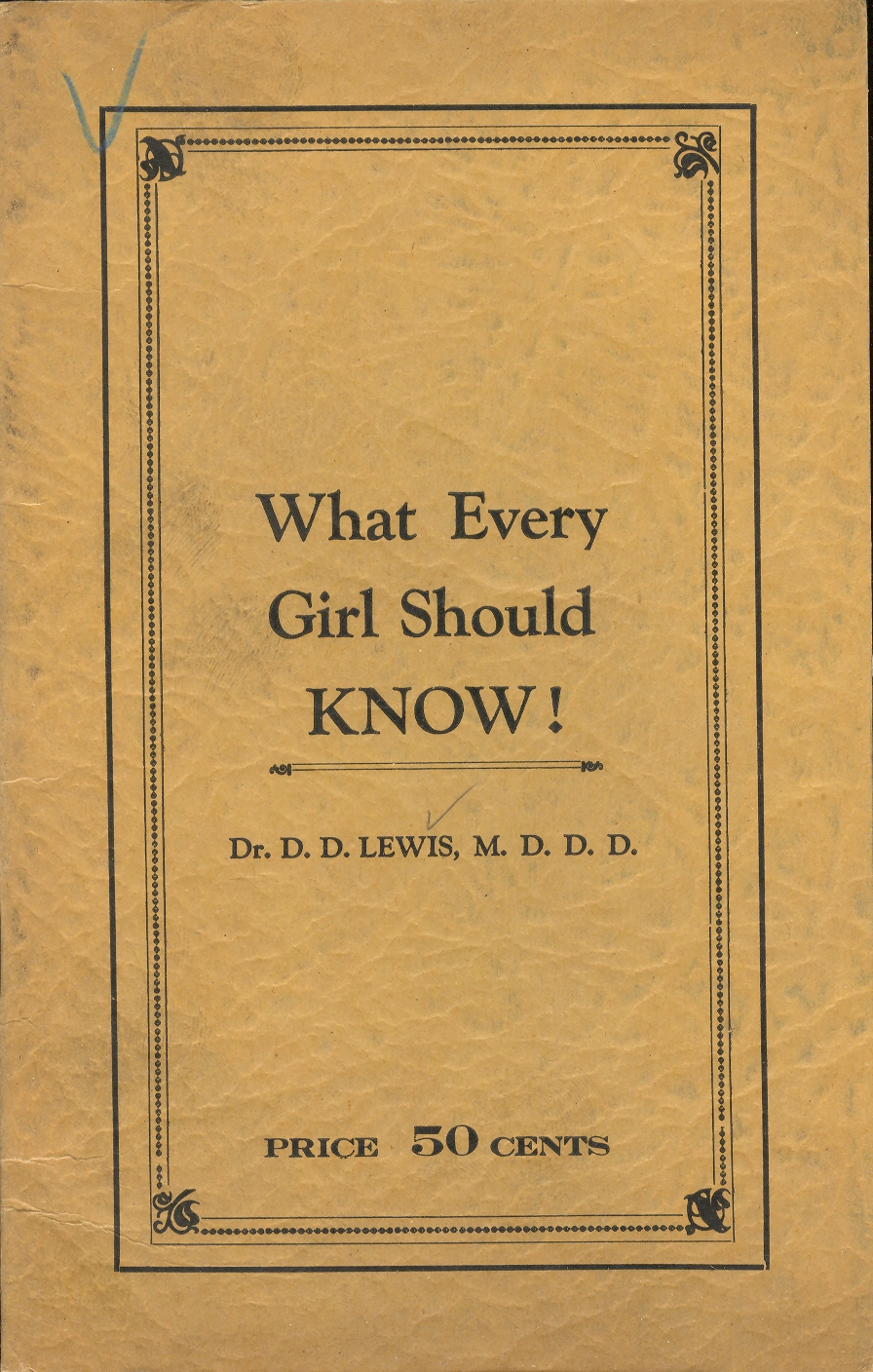
    Every Girl Should Know

    (1928) contains nothing I think outside what everyone would expect it top say,
    except that it is rather well written, and also (in places) quite strongly
    opinionated.  The little pamphlet also
    assumes that its readers already know its complaints:  “the evils of self-abuse are so well known,
    that there is no need to elaborate further on this point”.    Its “chapter”
    headings tell a lot of the story, and probably enough of it to make their
    reading the only thing you need to read: 
    “Know Thyself”, :Know Thyself Spiritually”, “Woman’s Mission”, “The Age
    of Puberty”, “The Ovaries”, “Harmoul—its Importance”, “Rash Marriage”, “Freedom
    and More Freedom”, “Lust and Love”, “The Value of Chastity”, “Buying Popularity”,
    “Selling the Body for Clothes”, “The Tragedy of Dual Love”, Menstruation”, “Masturbation”,
    “Promiscuous Sexual Intercourse”, “Gonorrhea”, “Syphilis”, “The Dreaded Third
    Stage”.  So. There you have it.

    ·Posted by :

    ·in:

    — —

Recent Posts

Archives

Categories