A Daily History of Holes, Dots, Lines, Science, History, Math, Physics, Art, the Unintentional Absurd, Architecture, Maps, Data Visualization, Blank and Missing Things, and so on. |1.6 million words, 7500 images, 4.9 million hits| Press & appearances in The Times, Le Figaro, Mensa, The Economist, The Guardian, Discovery News, Slate, Le Monde, Sci American Blogs, Le Pont, and many other places… 5000+ total posts since 2008.

  • Connections: from Plugging Gibraltar to Shakespeare’s Memories in One Step

    JF Ptak Science Books LLC  Post 691  Blog Bookstore

    “Simply the thing I am shall make me live.”

    –from Jorge Luis Borges, “Shakespeare’s Memory”


    ==Blog July 21==shakespeares memorie It is interesting to pursue a loose thought to its not-necessarily
    logical end.  Such is the case with the
    Paneuropic ideas of Hermann Soergel (1885-1952). Soergel was a Bauhaus
    architect and author of a number of works on design and far more ethereal,
    floating-castle ideas. His most spectacular contribution—incubated in the
    mid-1920’s and still clinging by its fingertips as an idea among some current
    thinkers—was to put a dam across the straights of Gibraltar.  The dam would generate electricity of course,
    but most importantly to Soergel, it would also empty an enormous amount of
    water from the Mediterranean leaving vast new
    expanses of land to be developed and colonized over generations into the
    future.  The master plan at work was that
    the world would be divided into three economic spheres in the future, all
    beginning with the letter “A”:  American,
    Asia, and the new land to be created by Soergel, “Atlantropa”, which was the
    former Europe expanded into the new dry beds of the Mediterranean and North Africa.  And also
    of course Egypt,
    which would be covered with canals and semi-submerged by the new borders of the
    meandering sea.  This would be the way
    for Europa to compete with the rest of the world in the future. 


    Perhaps it is actually three steps to get from the idea of
    damming up the straits of Gibraltar to the osmosis of Shakepeare’s memories into
    someone else’s brain—a squinting acquiescence of the middle touch being the
    brilliant Jorge Luis Borges.  You see it
    was in the Argentine master’s last published story, “Shakespeare’s Memory”, that
    we meet Herr Soergel (as Hermann Sorgel) again. 
    But so far as I can remember Soergel exists only as a fictional
    character, with no reference to his real-life self.  In this wonderful story, Soergel inherits the
    memories of William Shakespeare—these bits come to him slowly but surely, until
    they start to conflict with his own memory, and things get difficult.  The man with Shakespeare’s memories winds up
    phoning strangers on the telephone, giving them away at random, until Soergel
    is left with his own mind again. 
    Superior as Bill’s memories were, they still weren’t Hermann’s, who
    wanted his own life back in the end. 


    And so from the titanic, pan-europic technodream of
    Bauhausian Hermann Soergel to the dead brains and living memories of William
    Shakespeare, all through the fingers of the beautiful Jorge Luis Borges.  

    I should point out that the image above comes from the Illustrierte Zeitung (Leipzig) for August 1931, and is a drawing by an artist named “AS. Christ” after Soergel’s Panropa’s ideas.
  • Dreams of Mathematics

    JF Ptak Science Books LLC  Post 692  Blog Bookstore

    Thinking big thoughts in dreams is generally not a common thing, as anyone who has read their own semi-conscious half-awake memory notes of a dream-based inspiration could attest.  But it does happen: 
    ==Blog July 21=math dream
    Paul  McCartney1 dreamed the song Yesterday, Gandhi dreamed the source of non-violent resistance, Elias Howe
    dreamed of the construction of the first sewing machine, and Mary Shelley the creation of her novel Frankenstein…  For good or for ill, William Blake was evidently deeply influenced by his own dreams; on the other hand, Rene Magritte was deeply influenced by dreams but didn’t use any of his own for his paintings, or so it was said. Otto Loewi turned an old problem into not one in a dream, finding a solution to the prickish problem of whether nerve impulses were chemical or electrical (and resulting in the Nobel for medicine in 1935); the fabulous discovery of the benzene ring came to August Kekule in a dream as well.  Artists have been representing people in dreams and dreamscapes for many centuries: Durer depicted a dream in a 1525 watercolor, for example, and thousands of artists have depicted famous biblical dreams (Joseph of Pharo) for long expanses of time.

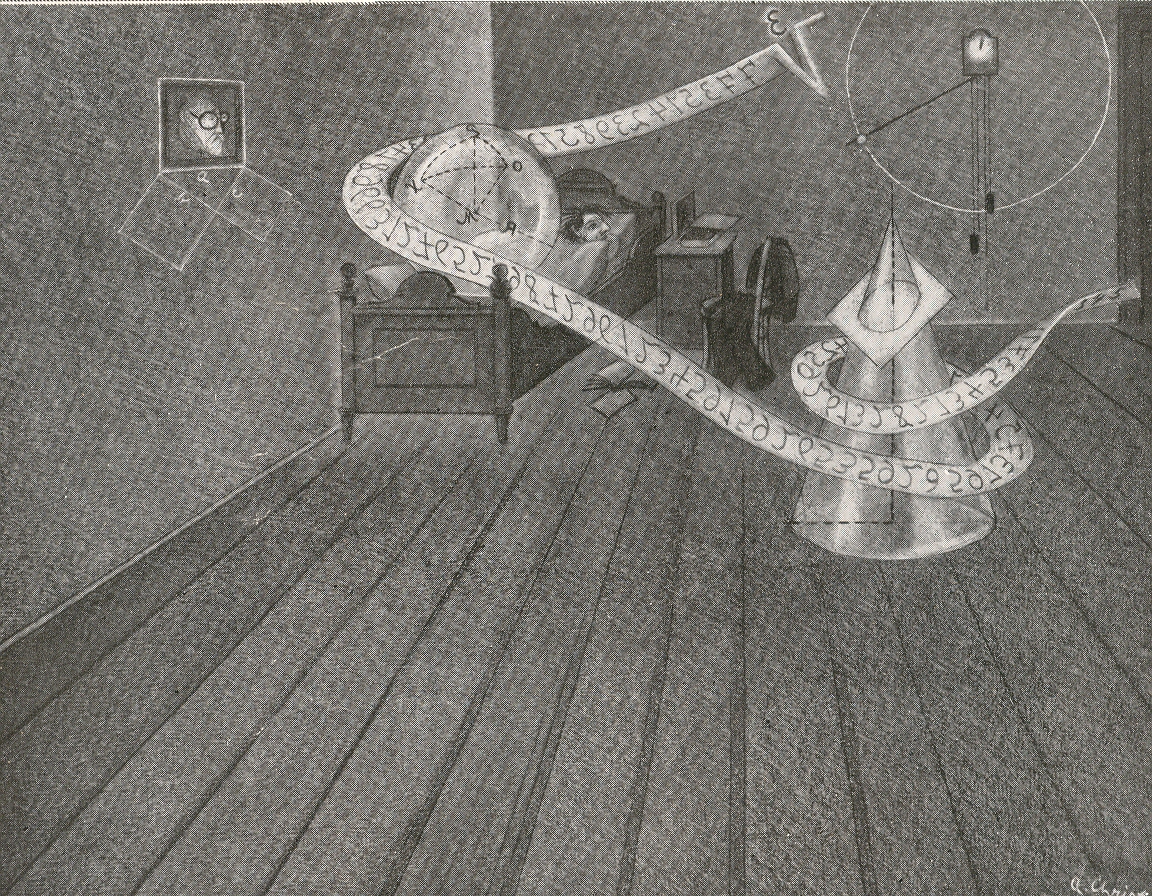
    What struck me, though, in this illustration found on the other side of the page of the Illustrirte Zeitung2 (for August 1932) that I used for yesterday’s post about damming Gibraltar and Shakespeare’s memories, was the depiction of someone dreaming mathematical thoughts…or at the very least, dreaming numbers.  People have undoubtedly dreamed much in mathematics, but I can not recall seeing illustrations of these dreams.

    I’m differentiating here from something like a Poincarean inspiration, or vision, or thunderstrike–I’m talking about drop-dead asleep sleep, dreaming sleep, REM and all that. Also I’m differentiating this from imaging mathematical thought, as in the work of Francis Galton in 1880 in which the subject of mentally seeing the process of mathematics is perhaps first addressed. I wrote a short piece on that here, way back in Post 9. )

    Photo

    The numerical sequence in this dream doesn’t look like anything to me:  the backwards radicand doesn’t strike anything common in my head.  The geometrical drawing under the portrait in the dreamer’s room though is the impossibly iconic Pythagorean theorem, and there is a nice picture of a conic section in the foreground; but the artist, who improbably signed the work “A. Christ”, doesn’t offer much of math in the dreamscape.  Still, it is a rare depiction of someone dreaming about math. 

    Notes
    1. “I woke up with a lovely tune in my head. I thought, ‘That’s great, I wonder what that is?’ There was an upright piano next to me, to the right of the bed by the window. I got out of bed, sat at the piano, found G, found F sharp minor 7th — and that leads you through then to B to E minor, and finally back to E. It all leads forward logically. I liked the melody a lot, but because I’d dreamed it, I couldn’t believe I’d written it. I thought, ‘No, I’ve never written anything like this before.’ But I had the tune, which was the most magic thing!” from Barry Miles (1997), Paul McCartney.
    2.  This is really a great sheet of paper, coming from issue 4492, pp 518-519.  Two pictures of dreams on one side, with three visionary images on the other (the Gibraltar dam, a sub-polar submarine, and a futuristic Indian railway/bridge.

  • Space 1898: Pre-Modern Space Flight

    JF Ptak Science Books LLC  Post 693  Blog Bookstore

    Also have a peek at my post on pre-historic space flight: de Bergerac, Leonardo & Co.

    Herman Geertz, a mysterious, unknown quality of a person to me, made a major contribution to the history of American spaceflight, albeit an unusual, ephemeral one.  In 1898 he published a song—with the firm of Broder & Schlam of San Francisco—called “A Trip to Mars (a March Two Step)”, and is perhaps the first piece of music ever published in the United States about interplanetary spaceflight. 
    ==Blog July 21=mars
    The musician–whose portrait appears in a frame at the upper left—also includes an odd view of the planet Mars, and, most important, an image of a space ship.  It actually took about 20 years for this sort of popularization of Mars to grab a hook in song, even though the interest in the planet and the possibility of life there had been bubbling since Schiapparelli’s  (misunderstood) work on the planet  in which he famously identified its “canalli” (and which was infamously and wrongly translated as “canals”.  Much of this great misunderstanding was rooted in Percival Lowell’s book Mars in which he takes the canalli idea and runs with it to the goal line of Martian civilization).

    One year later, in 1898, Kurd Lasswitz—a professor of math and physics, a Kant expert and philosophe, and an historian of science—published what was to make him the equivalent of Germany’s Jules Verne/H.G. Wells (in importance if not in quantity).  Auf  Zwei Planeten (first published in Leipzig in 1898) was an immediate best seller, as it was Germany’s first work of science fiction, and it made its scientist/historian an instant sensation.  It was an interesting, high-tech-utopian story that describes humans finding and dealing with an isolated Martian colony existing at the North Pole; humanity has its ups and downs, as do the Martians, the species trading moral highgrounds and such, until a peaceful co-existence comes into play between the two planets.  It was pretty heady stuff for the time.  Lasswitz saw into the future in this book, bits here and bits there:  space travel is rather accurately summarized as is a sort of television (that was actually a Martian tele-telescope) and synthetic fuels and foods. 

    This period right before the turn of the century was particularly progressive for the sciences and for science fiction.  In the world of science fiction, for example, in 1895 there was Lowell’s Mars, Williams Morris’ The Wood Beyond the World; for 1896 there was Morris’ The Well at the World’s End, H. G. Wells The Island of Dr. Moreau and The Invisible Man, and Louis Tracy’s The Final War.  1897 saw Lasswitz’ Two planets, Bram Stoker’s Dracula and William Le Queux The Great War in England in 1897.  1898 rounded things out very nicely with Well’s War of the Worlds.

     Frankly though science outstripped the fiction part of the creativity index:   the end of 1895 saw an entirely new world intruded by Roentgen’s X-Rays; 1896 saw Becquerel’s discovery of radioactivity and Langely’s aerodrome; 1897 Thomson’s discovery of the electron; 1898, the discovery of radium by the Curies; 1899, Collin’s invention of the wireless telephone, 1899/1900 the introduction of the quantum theory by Max Planck and also the rediscovery of Mendel’s work by Correns.    It was, in short, a remarkable and remarkably-intense period whose outward reach seemed to be more dominated by the fiction aspect of science (with spaceflight and invading aliens) while the vast  new interior worlds of the previously unseen were totally dominated by the sciences, which was of course the stuff that would stick,  If you stretched this period by just another five years, the Einstein annus mirablis would be included, further deepening this unbelievable period of achievement.  Then again, nearly the whole of modernity is invented during this time:  from 1875-1915 or so nearly every genre of human pursuit entered the modern period.  New methods of writing in literature and for the stage, new ways of painting (from impressionism to non-representational art), through music and the sciences, biology and geology.  Everything changes, except for one field:  political science.  Actually, if you included the invention of the concentration camp during the Boer War(S) then I guess you could throw polysci into this group, though but by screaming and kicking. 

  • A History of Dots: the Black Sun of Das Planeten Buch, 1541

    JF Ptak Science Books LLC  Post 694  Blog  Bookstore

    History of Dots, Part 15

    Soft on the Heals ==Blog July 21=dotsof
    the 1898 Planetary Visits post (earlier today) is this 1541 Books of the Planets (Das Planeten Buch.
    Von Natur, ey
    genthumb, und wirckung der siben Planeten…), which was published
    in Strassburg by Jacob Cammerkander..  It
    is a collection of medieval German accumulated astro-data and posie, cobbled
    together by an anonymous author, and strung together for the masses—it was
    evidently very popular, eager fingers pulling the many editions to pieces (and such), so that very few now exist. 

    The dot that I have in mind here is the standard astronomical depiction of the sun, and it appears brilliantly-n-black in the bottom panel close-by the image of Saturn racing across the sky. 


  • The More Lethal Alpha-Numeric: M-69 vs. U-235 (Japan, 1945)

    JF Ptak Science Books Post 695  Blog Bookstore

    Atomic and nuclear weapons series

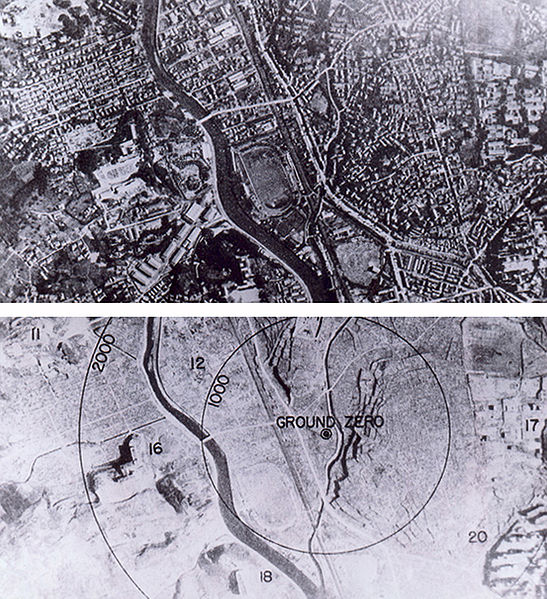
    I guess the immediate response to this question would the U-235.  This is the stuff (an isotope of Uranium-238, a fissile element that causes a rapidly expanding fission chain reaction), the heart of the atomic bombs that were exploded over Hiroshima and Nagasaki.

    On 6 August, 1945, the nuclear weapon “Little Boy” was dropped on Hiroshima, killing as many as 140,000 people, many of those dying lingering deaths over the course of the next few months; the bomb “Fat Man” was detonated over Nagasaki three days latter, and killed 80,000 over the same period.  Most people died of radiation and its extended influences than were killed in the initial moments of the bombs’ explosions.(Below is an image of Nagasaki, before and after.)


    It is M-69 though that may be the larger killer.

    547px-Nagasaki_1945_-_Before_and_after_(adjusted)

    [Image source: Roger Williams University Archives]

    The components of M-69 were naphthemic acid, palmitic acid, aluminum soap, oleic acid, and gasoline.  They were placed in tubes about two inches in diameter and 20 inches long, then placed in a 19-unit hexagonal, bound, and located in a bomb shell with a three-foot long paper tail (to slow its descent).. 

    [Source: https://www.youtube.com/watch?v=uPteVZyF4U0]

    When this bomb was exploded about a hundred feet over the ground, it was dispersed like a burning, sticky aerosol, and attached itself to anything that it could find.  It burned more furiously than any other incendiary device, exhausting as fuel whatever flammable thing it contacted.  It could also be dropped all the way to the ground, where it would lay for some number of seconds before exploding, sending dozens of flaming fragments (embedded in cheesecloth) flying in all direction, for a hundred yards or more, looking for flammable things to eat.  One such bomb—a 6-pound unit—could start dozens of fires. 

    This was a product of the US Army Chemical Warfare Services, and manufactured by Nuodex Products and the Arthur D. Little Company. (The Arthur D. Little Company–today an international management firm–was also instrumental, at the same period of time, in producing the first massively-available dosages of penicillin.) The flammable element is more commonly known now as napalm. In a popular article in Collier’s Magazine (14 April, 1945), the M-69 was dubbed “Tokyo Calling Cards”

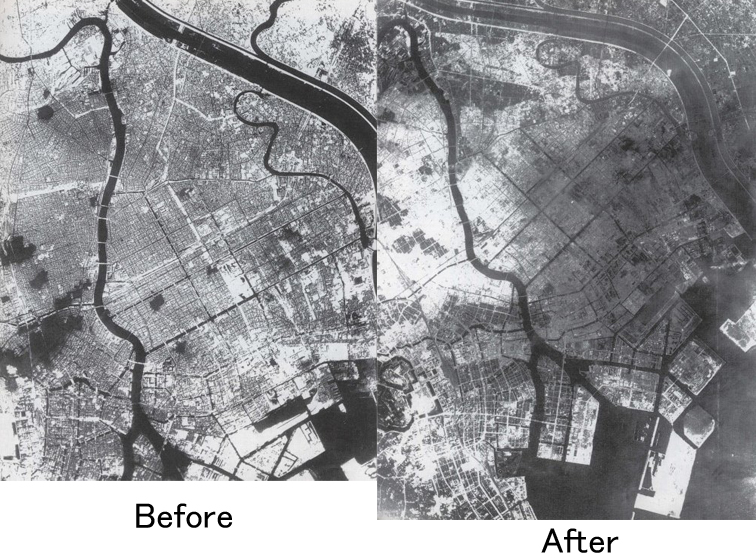
    On March 9-10, 1945, 339 B-29’s dropped 2000 tons (4 million pounds, about 496,000 bombs) of M-69 on Tokyo.  Two initial passes were made on the city, marking a large, burning “X” in the city. Each plane had the capacity to cover a drop area of 350 feet by 2000 feet, which means a much greater area was affected. The citizens of Tokyo met their ends with buckets of water and brooms in defense. Hours later fifteen square miles of the city were destroyed.  In the months prior to Hiroshima and Nagasaki, 66 cities were bombed with M-69, killing about a million people, and wounding more.  (Photo below shows Tokyo, before and after.)

    Tokyo-kushu-hikaku


    [Tokyo images via Wikipedia https://en.wikipedia.org/wiki/Bombing_of_Tokyo]

    Its easy to remember the destruction of the atomic bombs of August, mainly I think because of what those bombs became.  I don’t know why the 1945 series of firebombings of Japan aren’t recalled as often, especially given the continuing employment of the heart of the weapon that caused that destruction.  Perhaps it is the sheer inconceivable nature of what the atomic bombs became, while napalm, as terrible as it was/is, is knowable, somehow.I’m not at all sure.  But I think the M-69 should be brought up for discussion every now and then, and remembered. 

    ·Posted by :

    ·in:

  • Nothing as a Weapon—American Acquiesence in the Holocaust

    JF Ptak Science Books LLC   Post 697  Blog Bookstore

    “It may perhaps seem strange, that I treat as often in my
    works of the same matter…the contempt of the world, and the meditations of
    Death: but if the importance of the subject be considered, and the profit to be
    derived thence, a Man will never be wearie of seeing such faire truths under
    different presentations.”
     

    Jean Puget de la Serre, The Mirrour Which
    Flatters Not
    , 1639.

    Following up on yesterday’s post on lethal number
    (in Japan,
    1945) I thought I’d have a quick look at another devastating weapon.  In the arsenal of human weapons, man’s tongue
    must rank quite high, right there with ignorance and knowing conceit.  The seven deadly sins must also be considered
    lethal weapons, once they turned on themselves, unleashed from the human
    condition. 

    I’d like to focus on self-deception, the welcoming of not
    knowing something, of not wanting to know, of stopping: of doing nothing in the face of something needing to be done.

    The destruction of the Jewish people during World War II is a history with many
    bearings, a complex of actions that seem to have been both elusively
    unstoppable and eminently addressable.  The psychology of why this
    occurred is forensically comprehensible; the ultimate question, after
    everything is said and done, is why the extermination was allowed to continue
    for years on end. There is a considerable catalog of demons of nonactions and deceits
    that I just can’t address now in a short post like this. Though I would like to
    know why was it so difficult/impossible for the British government (and in
    particular, Anthony Eden)
    to allow Palestine
    as a safe haven for desperate Jews, engaging in torturously long non-decisions
    and bureaucratiuc inscrutabiulity to emergency situations?  Why did Franklin Roosevelt
    take so long to come acknowledge the documentation of the Holocaust and then
    cause almost nothing to be done about it?  Why did Sumner Welles act decidedly against any real
    action in presenting the full case of the Holocaust to American leaders? 
    Why would the War Department (represented by Assistant
    Secretary McCloy) respond in 1944 that  Auschwitz
    was both beyond the reach of tactical bombers and not be of sufficient military
    interest to divert Air Force resources away from other areas of interest? 
    The knowledge of vast extermination of Jews in Europe
    was known by early 1943, and yet, there was little action taken to do anything
    to stop it.  Not only that, the issue of emigration for Jews to the United
    States or any other country that would have them was caustic and slow; it was
    in short a history of the use of the word “no”. 

    Henry Morgenthau (1891-1967), an old-line politician, was
    secretary of the treasury under Roosevelt and
    was also the only Jew in the cabinet.  It
    was he who produced one of the most compelling, and damaging, documents questioning
    the American government’s culpability in doing nothing concerning the
    Holocaust, when “officials dodged their grim responsibility,
    procrastinated when concrete rescue schemes were placed before them, and even
    suppressed information about atrocities.”

    Its title left nothing to question:

    “Report to the
    Secretary on the Acquiescence of this Government in the Murder of the Jews”

     It starts so:

    “One of the greatest crimes in history, the slaughter of the
    Jewish people in Europe, is continuing
    unabated.

    “This Government has for a long time maintained that its policy is to work out programs
    to serve those Jews of Europe who could be saved.

    “I am convinced on the basis of the information which is available to me that
    certain officials in our State Department, which is charged with carrying out
    this policy, have been guilty not only of gross procrastination and wilful
    failure to act, but even of wilful attempts to prevent action from being taken
    to rescue Jews from Hitler.

    “I fully recognize the graveness of this statement and I make it only after
    having most carefully weighed the shocking facts which have come to my
    attention during the last several months.”

    The full document is reproduced below.

    It is a damning document outlining the power of doing
    nothing.


  • Asclepius, Modern Medicine and Health Reform

    JF Ptak Science Books LLC  Pos 698  Blog Bookstore

    Our exhausted elected servants have
    retired to their native haunts, spent perhaps by their efforts to noodle
    through a desperate plan to reform our national health care mess. It may be
    that they’ve retired to make good on their wakening efforts on health care, and
    go full throttle into sleep-and-dream efforts. 
    They might be able to find something there. At least for some of them
    there may be not a great difference between their awake and their asleep
    reasonings, so few will get injured. 

    ==jblog==july 26==ascelpius

    This is not without precedent; and as
    a matter of fact dream mental and physical therapy is far older than any sort of
    medicine that we recognize as “moderns”. 
    The dream temple was in extensive use in Egypt some 4000 years ago; people
    attended the temple and through various means entered a trance state, after
    which their visions/dreams were analyzed for medical benefit.  It was in many respects a hospital of dreams,
    with treatments ranging through the expansive gamut of sacrifices to the appropriate
    deities, sweating, fasting, bathing, meditation, sleep, and of course, more
    sleep.

    But the one degree of separation business
    connecting health care reform with sleep-thinking is Asclepius, on whose pillow
    the legislators can feel safe and comfortable. 
    In ancient Greece

    The connection between modern
    medicine and sleep and dreams is the staff of Asclepius—a snake-entwined staff,
    which is the very symbol of modern medicine. 
    In ancient Greece
    ,
    people in need would go to their Asclepieion and take their treatment, again
    consisting of fasting, prayers, meditation and sleep.

    The connection between modern
    medicine and sleep and dreams is the staff of Asclepius—a snake-entwined staff,
    which is the very symbol of modern medicine. 
    In ancient
    Greece
    the first step in attending the benefits of an Asclepieion was to sleep in its
    outer courtyard, waiting for a vision of the great Asclepius, who would be recognized
    by this very staff.  Once the pilgrim
    achieved this first level of dream/sleep/vision they could proceed to the
    interior of the temple and seek their treatment.  Perhaps now that the Congress is on vacation
    they might be more attuned to the possibility of entertaining a helpful sleepytime
    vision from the iconic benefactor of modern medicine, and  proceed accordingly.

  • Cruising Down the Cigarette Highway, 1950: the Unlimited Reach of Tobacco

    JF Ptak Science Books LLC  Post 699  Blog Bookstore

    See also my related posts:

    The Worst Picture of Santa, Ever 

    and 
    Deathly Equality: Liberty and Lung Cancer

    This is a simple ad for a butane-based lighter (appearing in LIFE magazine for 18 December 1950), lighting the
    way down Cigarette Road.  Actually,
    it was more a highway than a road, and a superhighway at that. Government-sponsored warnings about tobacco health issues was still more than a decade away:  medical doctors were part of the advertising machine, as were actors (including RWR), sports figures, and virtually anyone else with a mouth.

    ==Blog July 27=cis It seems to me that there are about 300
    cigarettes in this ad, and that looks like a lot—point of fact though is that
    in 1950, the average American (of 18+ years) smoked about 3,522 cigarettes a
    year, which means about 10 cigarettes a day for everyone in the country.  Not 10 per smoker; 10 for everyone in the entire country, smoker
    or not, who was over 18 years of age.

    The average smoker in 1950 smoked about 2.5 packs a day, or
    50 cigarettes or so—that’s equal to this line of cigarettes being smoked every
    six days. 
    There were virtually no brakes.

    Even Santa (a pipe smoker) got into the business. This was a standard, acceptable, vanilla-packaged advertisement.

    ==Blog July 27=cigs xmas


    United States Cigarette Consumption, ,
    1900–2007

    First number is total consumption in billions; second number
    is per capita yearly consumption for people 18+.


    1915   17.9   285

    1920   44.6   665

    1925  79.8  1,085

    1930 119.3 1,485

    1935 134.4 1,564

    1940 181.9 1,976

    1945 340.6 3,449

    1950 369.8 3,522

    1955 396.4 3,597

    1960 484.4 4,171

    1965 528.8 4,259

    1970 536.5 3,985

    1975 607.2 4,123

    1980 631.5 3,851

    1985 594.0 3,461

    1990 525.0 2,827

    1995 487.0 2,515

    2000 430.0 2,092

    2005 376.0 1,716

    2007 360.0

    Source: Tobacco Outlook Report, Economic
    Research Service, U.S. Dept. of Agriculture.

    JF Ptak Science Books LLC  Post 699  Blog Bookstore

  • Telegraph “Fax”, 1895. Transmitting Images by Wire & 120-Year-Old Emoticons

    JF Ptak Science Books  Post 701     Blog Bookstore

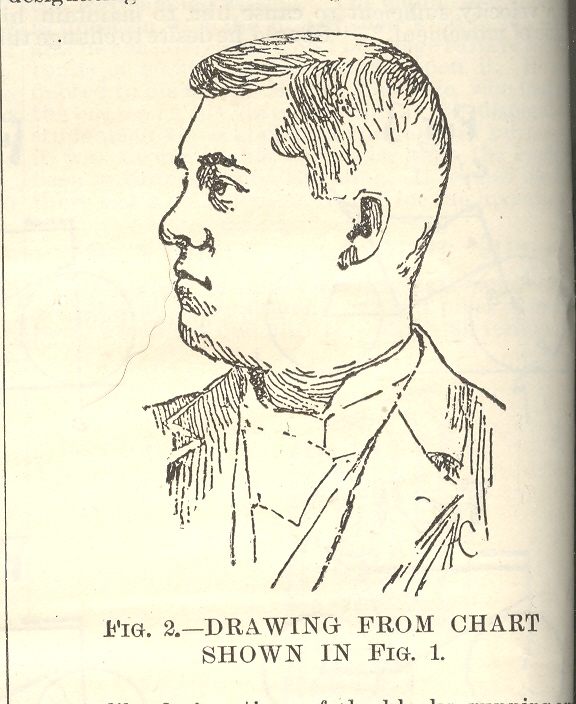
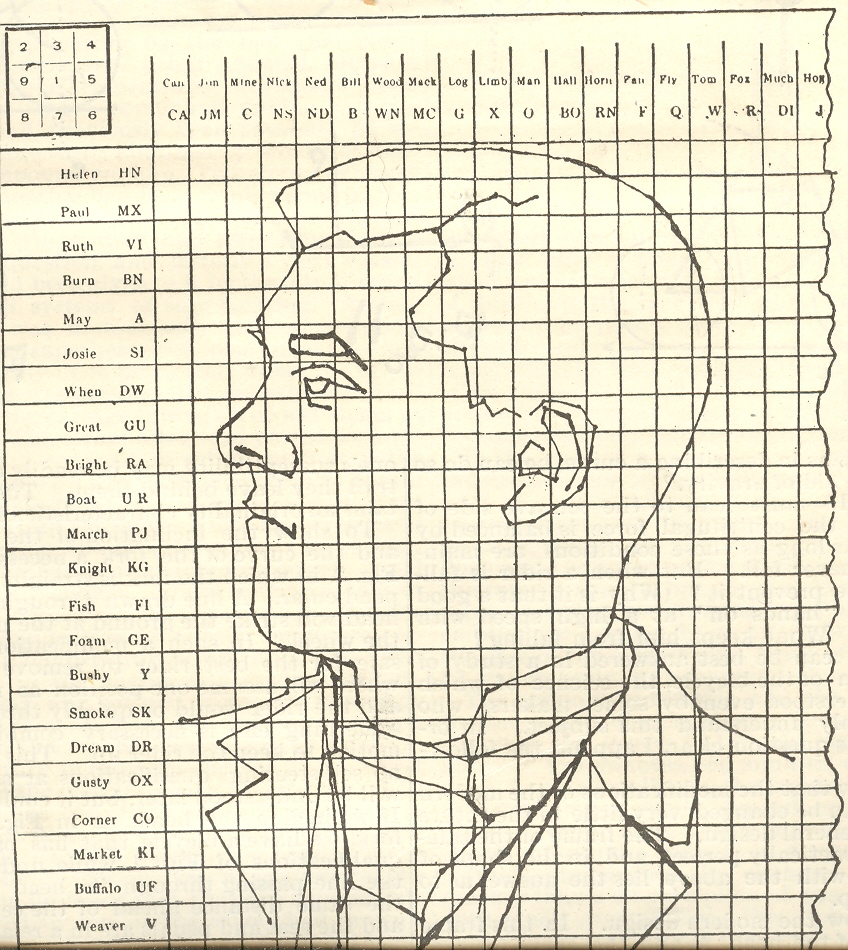
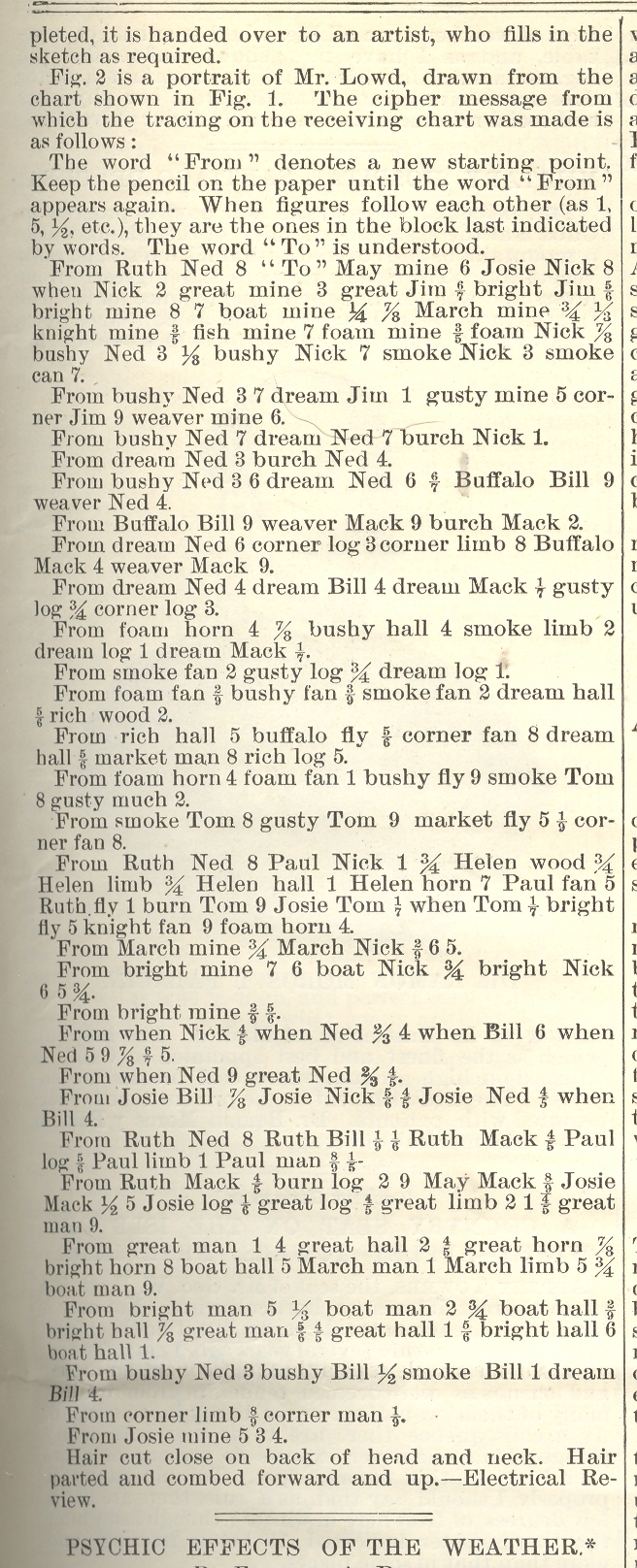
    ==Blog July 28=tele port 1This Scientific American article on the smart/odd/analog transmission of pictures via telegraph (14 September 1895) by W.H. Lowd, can make you say “ohhh, of course” out loud.  Mr. Lowd’s insight came fifty years after the Morse telegraph came into being, thirty years after it becomes the greatest means of communication, twenty after the first multiplex telegraph, and in the same year as Marconi’s first successful wireless transmission.   It was though an ingenious inspiration whose utility lasted for about 60 seconds—which is about how long it took to develop a smarter way of transmitting an image in its entirety.

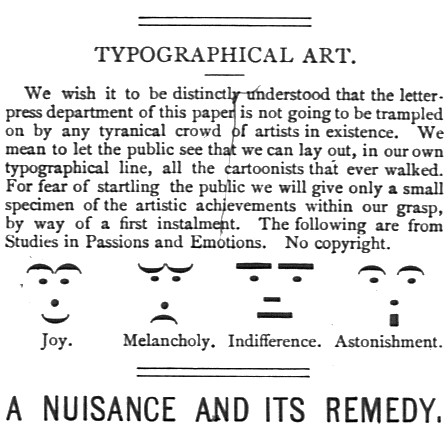
    Mr. Lowd recognized that he could transmit the outline of a picture by placing on opaque tracing of the picture on top of a telegraphic ciphering sheet and then transmitting the coordinates, which when received on the other end could be connected by short lines into the picture that was being transmitted from the sending end. ==Blog July 28=tele port 2 Images constructed of numbers and letters and such had been made for centuries before this; this however is a very early use of this idea that was employed to human-representational transmit the object electrically over distances by wire.  Emoticons—a more abstract version of this idea–such as we know them today are actually better than 150 years old.  They appear as early as 1857 in the telegraphers’ world, and somewhat earlier in the typesetter’s arsenal. (For example, a later attempt, taken from Puck Magazine No. 212, page 65, 30 March 1881, shows us something that we took to be “new” in the 1980’s as having roots that spread downwards into history by another 120 years.)

    ==blog==july 29=Puck

    But Mr. Loud’s idea was pretty, I must admit, even though it was far from being the answer to the question it addressed, with a more pleasing, technology-based solution appearing by 1899. 

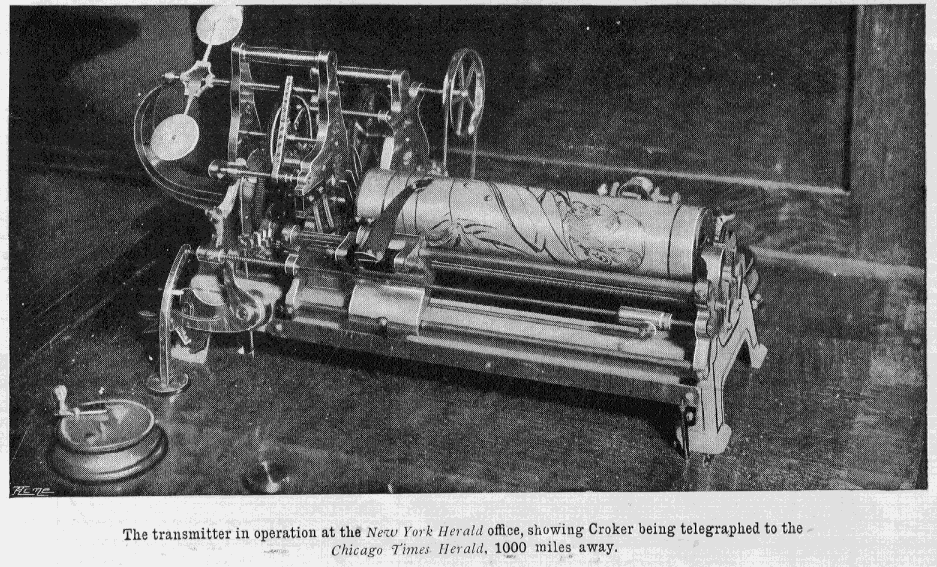
    (A successful apparatus for the true transmission of an image by wire is seen here, below, and was produced in 1899/1900.) ==blog==july 28==pics by wire

    The other bit that is interesting is that this transmission of an image necessitated an early Surrealist-like poem, dictated by the cipher/codes that were use by necessity to send the picture. 

    ==Blog July 28=tele port 3

  • The Problematic Wilfred Burchett & Forbidden Reporting from Hiroshima

    JF Ptak Science Books, LLC Post 702  Blog Bookstore

    Would it have made a difference to Watergate if, years later,  Woodward & Bernstein had reported on the prosperity of Cambodia and the largess of Pol Pot? Perhaps it would cause you to  wonder about their interpretation and judgment, overall, but becoming a lickspittle to the atrocious Pol Pot wouldn’t have changed the facts surrounding Nixon’s abysmal behavior. Such is partially the case with the Australian reporter Wilfred Burchett (1911-1983), who enjoyed an interesting, combative, contrarian and occasionally awful carreer around moments of great insight, courage and brilliance.  

     It is Burchett’s
    reporting from Hiroshima that attracted my attention–his was the first report made by an Allied reporter.  Against explicit and direct orders, Burchett
    traveled south from Tokyo to Hiroshima to bear witness to the bombing.  Noting could prepare him for what he saw in
    the devastated ruins—or in the people who survived the blast.  What he found to his great shock was that one
    month after the explosion was that people were still dying—slow, tortured, horrific
    deaths, a toxic visual tableaux  He saw that they were dying of
    the effects of the explosion, though not from the blast itself.  The interviews he did with medical personnel
    on the scene confirmed his own confusion—no one knew what was killing these
    thousands of people.  Burchett called it
    “the atomic plague”.  What he was
    witnessing was lethal radiation sickness. He published his observations in a story
    called  “Atomic Plague”  in the Daily
    Express
    , on 5 September 1945. 

    The official government
    position was that there was no lethal radiation generated by the atomic
    bomb.  The government and the sixth
    column (in general) came down very hard on Burchett, saying that he was an
    agent of the Japanese working to win sympathy for that country.  That, or he was a Communist spy. Or that he
    was just wrong.  Or crazy.

    The New York Times
    published a story on 12 September, 1945, rebuking Burchett’s account of
    “plague” as “Japanese propaganda”: 
    “US Atom Bomb Site Belies Tokyo Tales: Tests on New Mexico Range
    Confirm that Blast and Not Radiation Took Toll” ran the story. The article was
    written by William Laurence, a future Pulitzer Prize winner. 

    At about the same time
    another journalist—the American George Weller—made his own harrowing way to Nagasaki
    (again against orders from General MacArthur) to report on the damage done by
    the bomb.  Although Weller’s
    interpretations of the bomb and its use were diametrically opposed to Burchett’s
    (“The atomic bomb may be classified as a weapon capable of being used
    indiscriminately, but its use in Nagasaki was selective and proper and as
    merciful as such a gigantic force could be expected to be.”), his story was
    censored and seized when submitted for publication. 

    It would take several years for the story of radiation poisoning to reach the general public, and for the government to reverse its earlier position.

    In the meantime Burchett moved on to other provocative and unfortunate things.  After covering the war for four years through the Pacific and Europe, he moved on to middle Europe, reporting on the ghastly show trials of the Soviet regime, and for the most part taking the sides of the prosecuting agents.  He also covered the Korean War for a far-left leftie publication, taking the side of the Chinese. (In one infamous bit, Burchett reported from North Korean and Chinese POW camps, saying that they were like comfortable Swiss retreats.)  And then on the some eye-squinting, not-so-great observations from the North Vietnamese viewpoint in the 1960’s.  And then of course there was the whole Khmer Rouge pro-Pol Pot romance–which I just can’t see any way around. I don’t know what happened to him on this one. (I should say that Pol Pot was brought into power by a CIA-backed coup and received support and largesse from the United States, the United Kingdom, China, Thailand and Australia, among others. The detestable, scumbag genocidist died in his sleep only a few years ago, another totalitarianist gone terribly wrong after receiving arms and money from my country.)

    But there was a time when Burchett did deliver a story and delivered it well.  His reporting from Hiroshima is a classic of pursuing the logic of observations–and it stands still in light of all of his future missteps. 


    ·Posted by :

    ·in:

Recent Posts

Archives

Categories