JF Ptak Science Books LLC Post 662
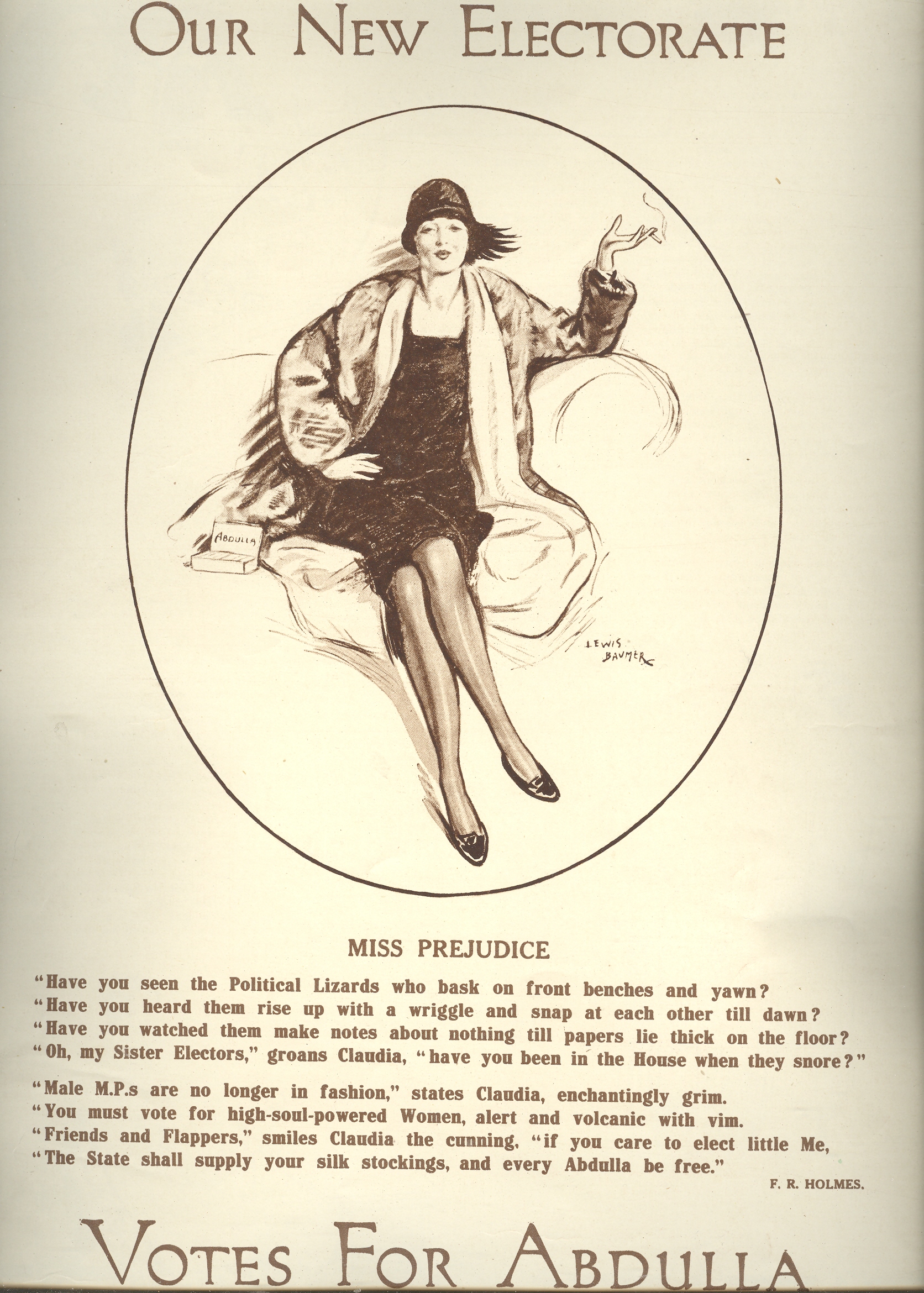 Abdullah Cigarettes has a twisted reliance with the recognition
of the social equality of women and making money. Mostly it was making money. Someone there at Abdullah corporate figured out
that there was an easy way of increasing their sales without spending huge
amounts of money on market development—open their market interests to
women. And in the case pictured here,
from The Illustrated London News of 1929, the Abdullah people were making a
direct appeal to the literal empowerment of women via the national right to
vote. This came a little post facto, as
women were given (?) the right in 1918*, though it seems that there were no ads
reaching out to women in GB until 1926/7, voting rights or not.
There was very good money to be made with cigarettes, which were/are
basically the non-kosher hot dogs (or worse) of the tobacco industry, the
tobacco equivalent of the utilization of the pig’s squeal, the remnant of other
products that was filled with profit. For
the overwhelming part of the history of tobacco smoking by the Western world,
the tobacco that was gathered and stuffed into a paper roll and smoked was the
lowest form of utilizing the product, the vice of the poor. This degraded
spectacle was soon morphed into an enormous social advantage and gigantic
economic opportunity for the producers.
first on the scene: that “honor” belongs
to Helmar Cigarettes, which in 1919 posted an advertisement for a pack of its cigs buried in a sea of female
faces. The tobacco companies didn’t embrace the notion of the growing
recognition of women, but did follow it, taking advantage of the new and
growing rights and their new marketability and giving everyone free access to
the same deadly diseases. Exploitation
of the emergence of the new social power was the key to making money for those
companies.
In the U.S.
Marlboro started mild ads directed at women in 1926, tempting its gentle
readers with ad copy like this: “Has smoking any more to do with a woman’s
morals than has the color of her hair? Marlboros now ride in so many
limousines, attend so many bridge parties, and repose in so many
handbags.” George Washington Hill followed this lead but was more bold,
pushing Lucky Strikes right to the forefront (in 1927) of the menace.
All of this worked very well: tobacco revenues in the U.S. went from
$12 million in 1926 to $40 million in
1930, this based largely on the new female marketization, tempting women’s new
economic and political power with the power of the cigarette, dressed in the
fashion of subverting the power structure, just like flapper’s dress, bobbed
hair and slacks.
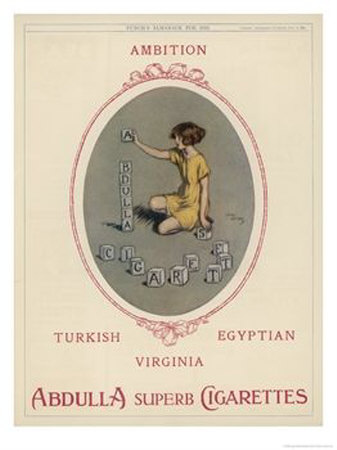 Abdullah also blurred the age barrier for smokers by pushing
their product with images of what seem to be ‘tweens, a move that expands the
concept of nastiness. (It should be remembered that the baseball player Honus
Wagner demanded that his picture be removed from the baseball cards distributed
with Sweet Caporel cigarettes because he thought the tobacco company was trying
to corrupt the young with it—the result was that his card is among the rarest
and most expensive of all baseball cards.) I don’t think that there’s much room
for negotiation in this image—it plainly is directed at the young. But of course it was all a nasty business,
top to bottom—even the American Medical Association got into the act, publishing
their first cigarette ad in their journals in 1933—a practice that would last
to 1952. The cancer connections were
there, but the lobby by the concerned national interests of the tobacco
companies were fierce, and the first warning labels about the cigarette/cancer connection
didn’t appear on packages of cigarettes until Surgeon General Jesse Steinfeld’s
tenure in 1970.** (Fat and heart diseases kills more, but so do hospitals. Lee Iococa fought seatbelts in his cars for
years, and on and on into the night goes this song.)
I wonder why there hasn’t been more recognition of the
earlier history of lung cancer—particularly since it really doesn’t seem to
exist in the 19th century and before. The disease only starts to show up in the
1920’s, after men had been smoking cigarettes for 20 years or so. The epidemic of lung cancer rose with the
consumption of cigarette–it is of particular forensic interest to look at lung
cancer rates among men and women from 1950-1980. These stats are a surprise to no one, the
rate of cancer among women spiking in the 1950-1980 era, when their habits were
mature from long use of the liberating agent.
Cigarettes was just one of many
ways in which women expressed their modernism—but is almost certainly the
deadliest.
that follows the New Zealand
lead, which granted women the right to vote in 1893. Ah how many times the Kiwis beat the rest of
the world to the punch for the correct political behavior! On the other hand, women in Mexico
they waited a little longer, until 2005.