JF Ptak Science Books LLC 663
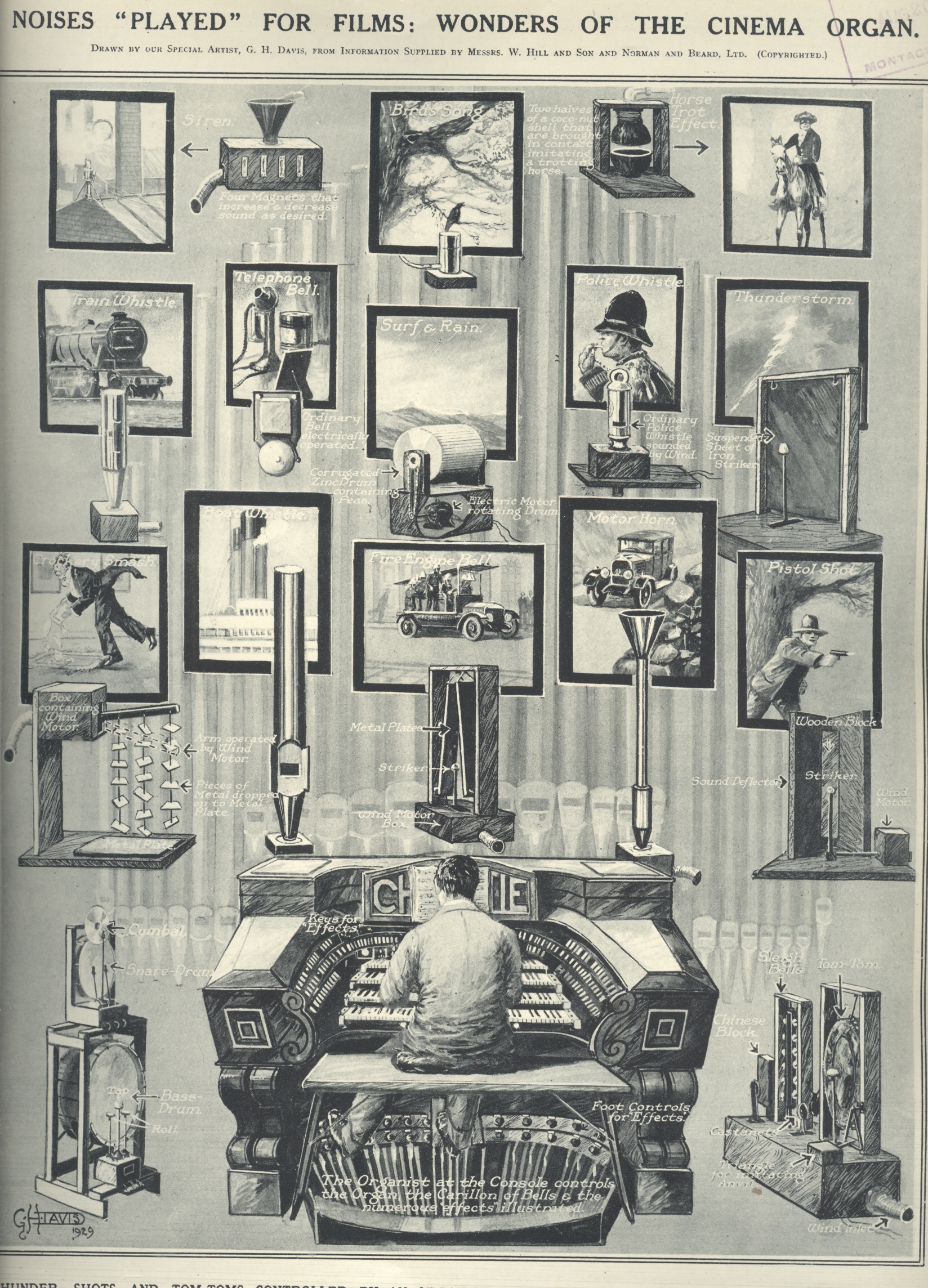 Making solid the concrete part of musique concrete has
never looked quite so orderly as in this image, found in the wonderful The
Illustrated London News for 10 August 1929, and depicting a device that would provide “sound effects” for silent motion pictures.
The electroacoustic organ was constructed at the very tail end of the
Silent Film Era, with simultaneous sound-on-film just having been invented (in
1925), and popular films just starting to be made employing it.
The control over the range of incidental, everyday and forgotten sounds
seems to be extraordinary, and extraordinarily presented on that fantastic
organ, providing an acoustic landscape against which move-goers could watch
their film.
enhance silent pictures with the sound of wind or the clopping of a horse’s
hooves. But not so, really—accompaniment
to silent films was usually and simply musical, with the occasional actors
employed to speak lines ere and there.
The introduction of incidental sound was something new—and it was almost
immediately something old with the introduction of the talkies, like a new dimension of achromatic
experience.
such effects from so long ago, with noises produced by the stuff that has
slipped into the past and, sometimes, right out of memory. The sound of the milkman’s bottles; the
clatter of the ticker tape; a standard gauge locomotive slowing
down; the
iceman’s truck; the P.A. system at
Field. Sometimes long un-reproduced sounds like these produce visual memories as well (as with the Paul Klee here at right, a painting called “Ancient Sound”, 1925.) There are hudreds of thousands of recordings done in the field as part of ethnomusical or anthropological research, but what I’m talking about is found ephemeral sound.
of events or objects long passed, or recording made recently of antique objects
making their modern antiquarian sounds. Found
sound is good too—the ordinary, forgotten stuff that blends into the acoustic
fabric of the day, undifferentiated because of heir common nature. There are a number of interesting Sound Zoos/Sound
Museums available online, one being the wonderful London
Sound Survey http://www.soundsurvey.org.uk/index.php/survey/
(found by benefit of Metafilter) –an excellent and deep site that allows you to
browse for sounds by era. The Sounds of New York provides a similar service at http://www.soundsofnewyork.com/.
There is also the very interesting Documentary Sound site, which is an index
and pointer for other sites. http://wlt4.home.mindspring.com/adventures/documentary.htm
For example, the owner of the site lists the following fantastic-sounding title
from the documentary sound releases by Smithsonian’s Folkways series: Voices of the Sky: Propellers and Jets (1957) Sounds of the American Southwest (1954)
Sounds of Animals (1954); Sounds of the Annual International Sports
Car Grand Prix of Watkins Glen, N.Y. (1956); Cable Car Soundscapes
(1982) F-6129; Here at the Water’s Edge: A Voyage in Sound-NY Harbor
Documentary (1962) F-6161; Sound Effects, Vol. 1: City Sounds
recorded by Tony Schwartz (1958) F-6170; The Sounds of London (1961)
F-5901 ; Documentary Sounds (1962) F-618 ; Speech after the Removal
of the Larynx (1964) F-6134; Sounds of Insects (1960) F-6178; Ionosphere
(High Altitude Sounds) (1955) C-501 ; Sounds of the Junk Yard (1964)
F-6143; Sounds of Medicine (1955) F-6127; Sounds of the Office
(1964) F-6142; Sounds and Ultra-Sounds of the Bottle-Nose Dolphin (1973)
F-6132; Sounds of Sea Animals (1955) F-6125; Sounds of the Sea, Vol.
1 (1952) F-6121; The Voice of the Sea (1954) C-5011; Sounds of a
South African Homestead (1956) F-6151; Voices of the Storm (1957-58)
C-1077; The Sounds of Camp: A Documentary Study of a Children’s Camp
(1959) F-6105; Sounds of a Tropical Rain Forest in America (1952) F-6120;
The Complete In Fidelytie: Sounds Natural and Un-Natural (1956) C-1044; Sound
Patterns (Natural, Musical, Human) (1953) F-6130.
A darker, disturbing and tough place
to visit is http://soundportraits.org/on-air/execution_tapes/,
which houses execution tapes and recording of the last statements of condemned
men. The tapes are from the mid-1980’s, and have a very grainy, ethereal quality to them–interviews take place with the condemned men in their cells, making their last public statements; there are also recordings of the actions in the command center as the execution area is readied, and also, lastky, in the death chamber itself, when the final designations are read to the condemned. (There is no actual recording of the death sequence.)