JF Ptak Science Books LLC Post 658 Blog Bookstore
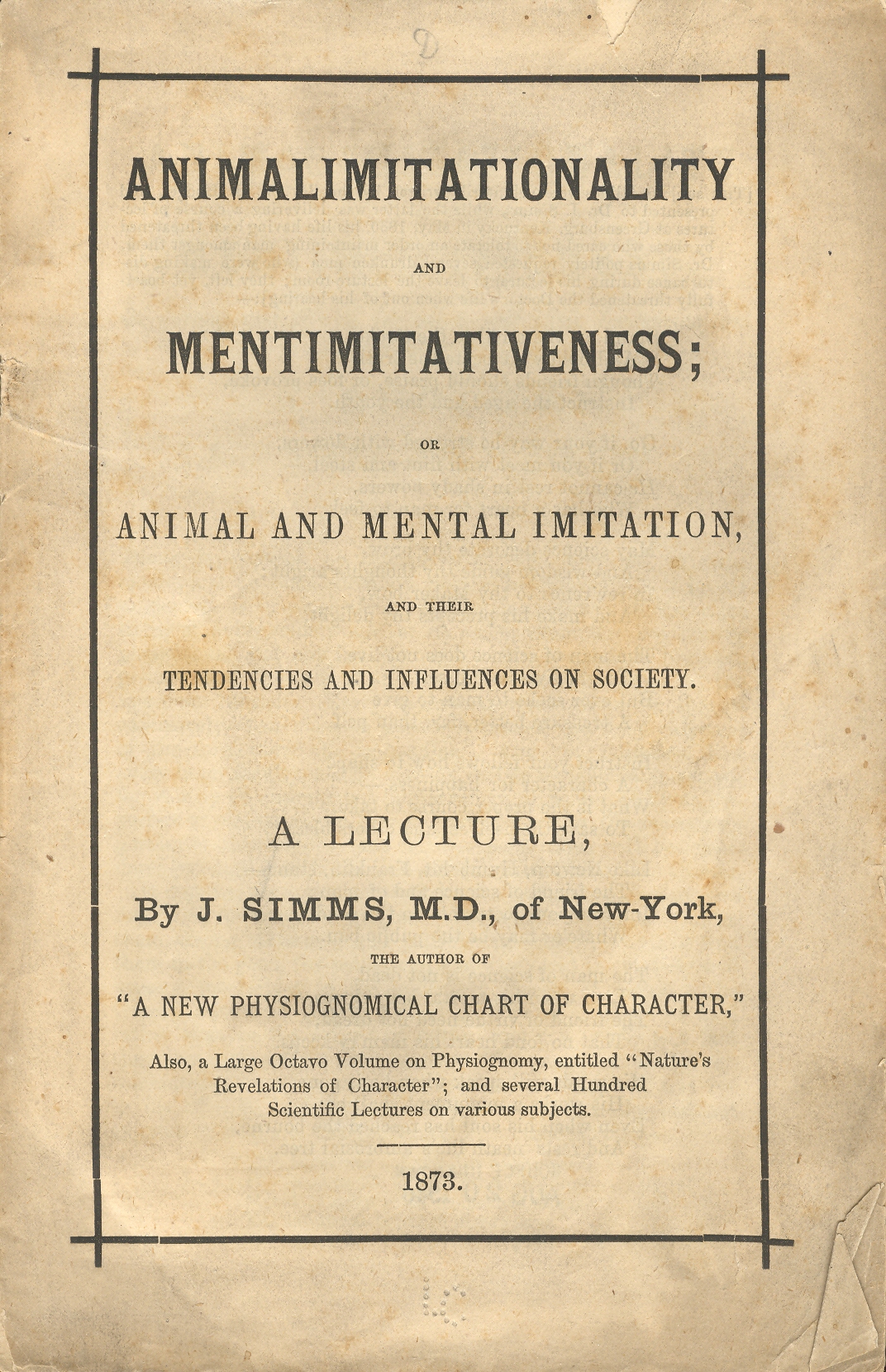 The fabulouslessness and learned foolishness of J. Simm’s horribly-named Animalimitationality and Mentimitativeness; or Animal and Mental Imitation and their Tendencies and Influences on Society, a Lecture, seems a poor-man’s ramble in a polysyllabic scribble. At it base, J. Simms (listed as “M.D”., and who was also the author of A New Physiognomical Chart of Character) presents a two-paragraph idea and published it over twelve pages that seem twelve pages too many. The idea is basically so: humans at time resemble animals because animals imitate what they see, as do humans. That is principally the entire deal, though it evidently was the cause of numerous lecture bookings for Mr. Simms. And what Mr. Simms talks about are the problems of imitation, the results of which are found in tight shoes, tight corsets, big hats, and bad walking, all leading to debauched society and wrecked personal dreams.
There are many things the Simms work is not. It is not a work that encompasses the social geometry found by other people later in the century–those who came across the study of people and immitation and the like legitimately, such as Gebriel Tardem Emile Durkheim, Scipio Sighele and Gustave Le Bon, for example. These folks worked with capable data and reasonable assumptions in looking at how the transmission of data and knowledge takes place between people, and sought to explain the construction of the social membrane in logical and scientific ways. They were trying to address what Marcel Proust would call (somewhat later) “a new distance between ourselves and things”.
Simms was interested in did this too, but did so in terms of how people imitated animals, and how that imitation spread to imitating people, and then fashions, and then resulting in too-tight corsets and too-tight shoes, and wanton neediness, all eading to advanced imitation and, finally, to perdition. The man had an odd vision which obviously appealed to some. And so it goes. There’s not that much difference in the set of assumptions of Simms and those of Dr. Freud, is there?