A Daily History of Holes, Dots, Lines, Science, History, Math, Physics, Art, the Unintentional Absurd, Architecture, Maps, Data Visualization, Blank and Missing Things, and so on. |1.6 million words, 7500 images, 4.9 million hits| Press & appearances in The Times, Le Figaro, Mensa, The Economist, The Guardian, Discovery News, Slate, Le Monde, Sci American Blogs, Le Pont, and many other places… 5000+ total posts since 2008.

  • History of the Federal Minimum Wage and Its Deeply-Past Present

    JF Ptak Science Books   Post 1226
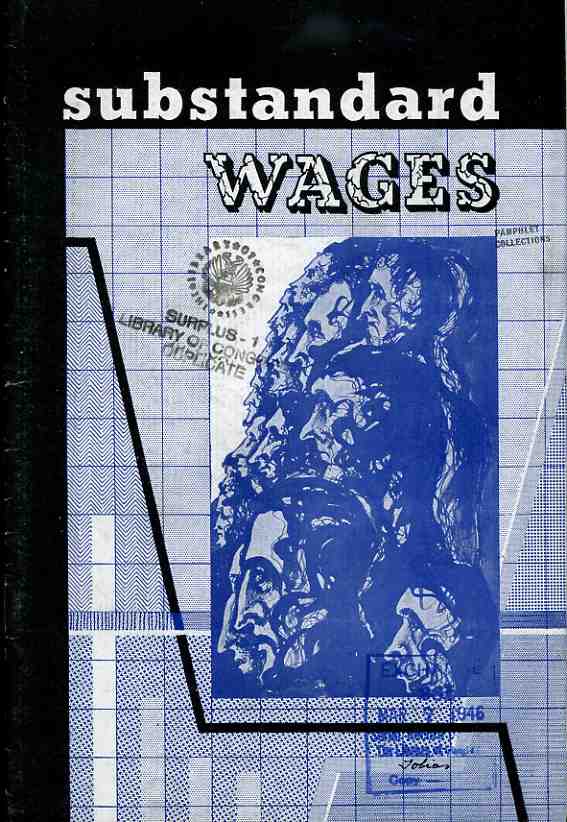
    0 blog jan 30 substandard489I’ve included this post in the Blank/Missing/Empty thread of this blog because the Federal minimum wage has been proportionally increased more so in th e last two years than at almost any time in its history, the increases really only get it up to what it niormally has been, maybe a little higher, with CPI-adjusted. This post is in response to an article in the New York Times today saying that the new minimum wage is equal to that of 1968, which is probably accurate.  The real point is that during the mid- Clinton years and the early Bush yeras the minimum wage languished during a time of tremendous growth for those who already had money–the poor for the years of 1992-2005  were left largely unprotected, unmolested by fortune.

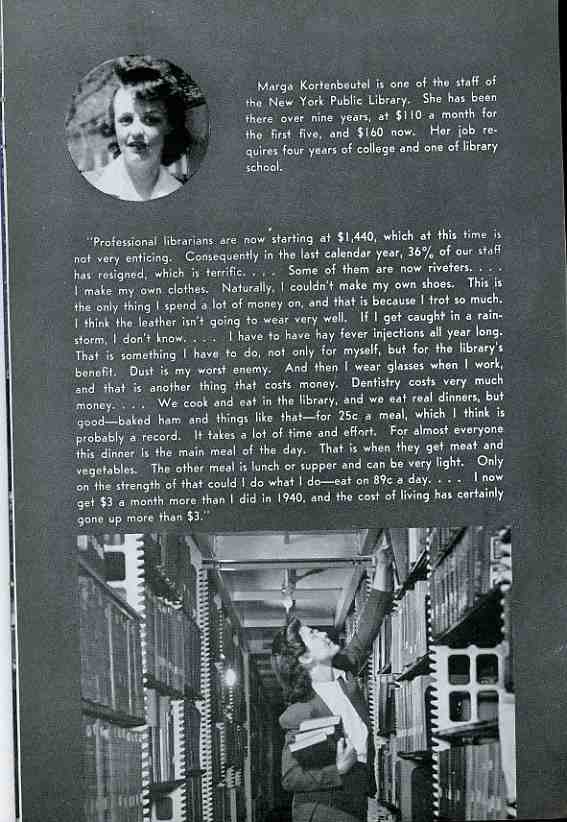
    Leafing my way through this interesting pamphlet, Substandard Wage, an Analysis of their Extent and Effect, and What Must be Done to Establish a Higher Wage Level, design “and presentation” by Abraham Joel Tobias for the Textile Workers Union of America, CIO, and for the Congress of Industrial Organizations, I found some very interesting bits.  First of all, the work was done to aid the working poor, people who were employed and making a wage, but the wage just wasn’t enough necessarily to being them out of poverty.  (The poverty line wasn’t invented as an economic bell weather until 1959.)  The first of the working poor that I read about was a librarian, Marga Kortenbeutel* (of the NYPL) who was working for $1,440.00 a year in 1945, which was just keeping her barely afloat, what with cutting out her 89-cent lunches and all.   That’s the equivalent (CPI adjusted) to about $17,500 a year in 2008 dollars.  Of course, the general economy was not doing well during the war, though it would rebound substantially by the late ‘40’s. The minimum wage, first established in 1938, was equal to about $3.50 2008n dollars in 1945. By 1950 this jumps to $6.25, and from there to about 1988 the minimum wage stays at at least that rate, with the period 1958-1978 soking aqt an average of about $8.hour.  From 1988 forward the minimum wage falls, winding up at about 5 dollars/hour in 2008, with the period 2003-2008 being the lowest level of real wages since World War II.0 blog jan 30 substandard490
    But what was this in terms of the rest of the population; what did these figures for minimum wages mean in the  society at large?  Was this a livable wage?  If we define “livable” as above what the government considered to be the “poverty level”, and “working” is a 40-hour work week and a 50-week working year, the answer is a quick “no”.  In 1959, when the poverty level was established, the minimum wage for the working person brought them to 67% of the income necessary to be “poor”; that left a gap of 33%, and that isn’t good.  That gap continued to close to 1968, when minimum wage go to within 10% of the poverty level, and then it began a slow and steady-ish decline.  The spiral down bottomed out for a bit in 1989, when it hit 52%,   building back up to just a touch over 60% in 1997.  From 1997 until the new minimum wage was instituted in 2006, the gap widened steadily, hitting 50%.  In 2008, with the new minimum wage in place , the gap is still at 41%, meaning that the new wage levels still only come to within 59% of what is supposed to be the poor line in the United States.  59% stops things from being a ridiculous slap in the face of American working poor, but not by much.  And it affects too few:  the minimum wage applied to a high of about 17% of the entire working population in the U.S. in 1979; today, the minimum wage which gets the working poor a little more than half-way to poor, applies to only 2.5% of the population. 

    *As it runs out, I found a little bit about Ms. Koretenbeutel; at the time of the publication of this pamphlet, Margathe was 35 years old.  She married someone named Voorhis in 1960, and died in 1971.  That’s all I’ve got.

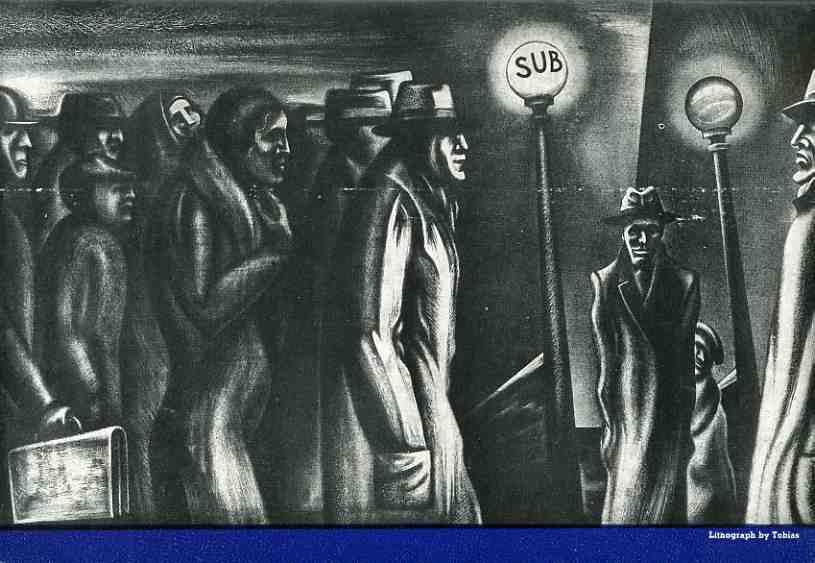
    The image below is from the back cover of the pamphlet, described as a “lithograph by Tobias”. 
    0 blog jan 30 substandard491


    A Timeline of Minimum Wage Levels, 1938-2009  (in continued reading section)
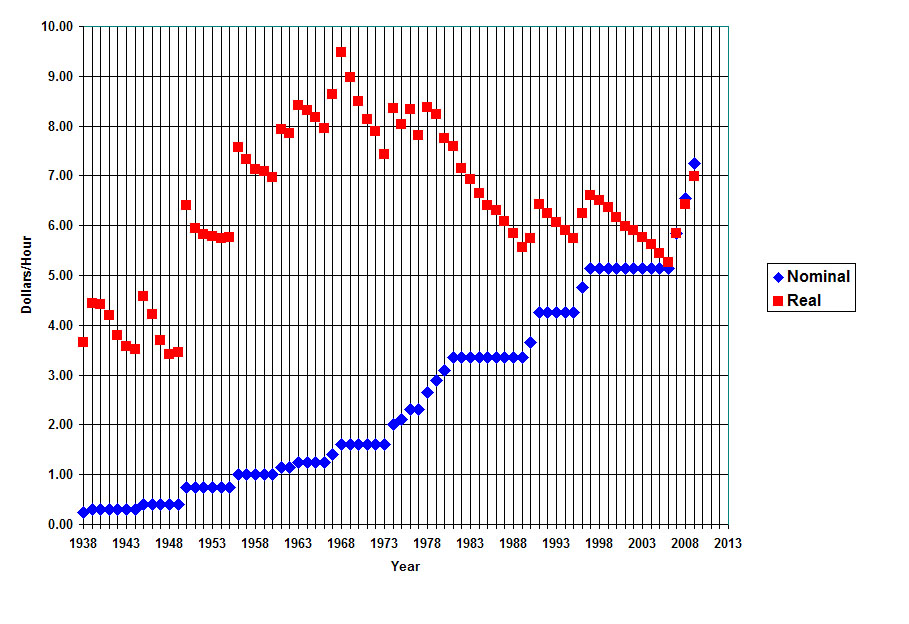
    Minwage The graph, above, is from Oregon State University website on the history of the minimum wage.  The accompanying text to it is also below.  The graph depicts “nominal” versus “real” minimum wages by year, the red dots (the nominal) showing what the original minimum wage translated to in 2008 dollars.

    A federal minimum wage was first set in 1938. The graph shows nominal (blue diamonds) and real (red squares) minimum wage values. Nominal values range from $0.25/hr in 1938 to $6.55/hr as of July 2008. The graph adjusts these wages to 2007 dollars (red squares) to show the real value of the minimum wage. Calculated in real 2007 dollars, the 1968 minimum wage was the highest at $9.47. The real dollar minimum wage (red squares) falls during periods Congress does not raise the minimum wage to keep up with inflation. The period 1997-2007, is the longest period during which the minimum wage has not been adjusted. The minimum wage increases in three $0.70 increments–to $5.85 in 2007, $6.55 in mid 2008, and to $7.25 in mid 2009. The real values after 2007 are projected for future decline in purchasing power. 
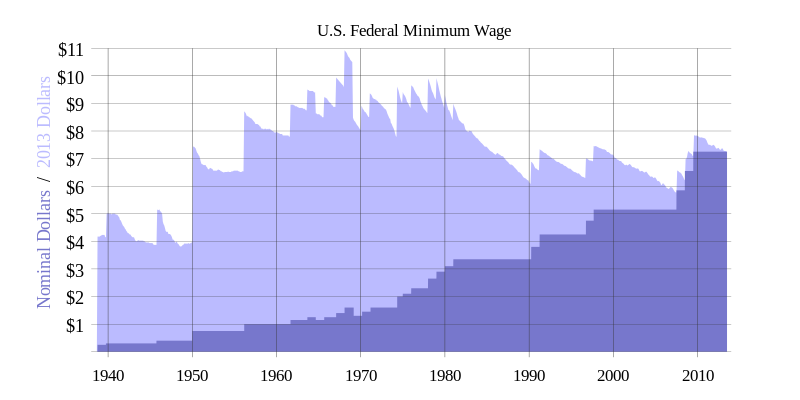
    Minimum wage History_of_US_federal_minimum_wage_increases


    [Graph from Wikipedia on the minimum wage, here]

    And this interesting graph from MotherJones, showing what the minimum wage would look like if it had kept pace with the salary increases for the top one percent:
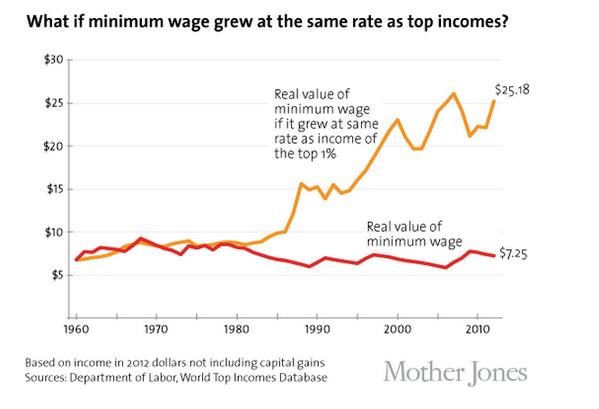
     

     Minimum wage top income

  • 1 Inch=$370 Million: a Great Height of Graphical Representation of Quantitative Data

    JF Ptak Science Books  Post 1227

    0 ebay 13 graphs268[Click image to enlarge; both original images are available for purchase from our blog bookstore.]

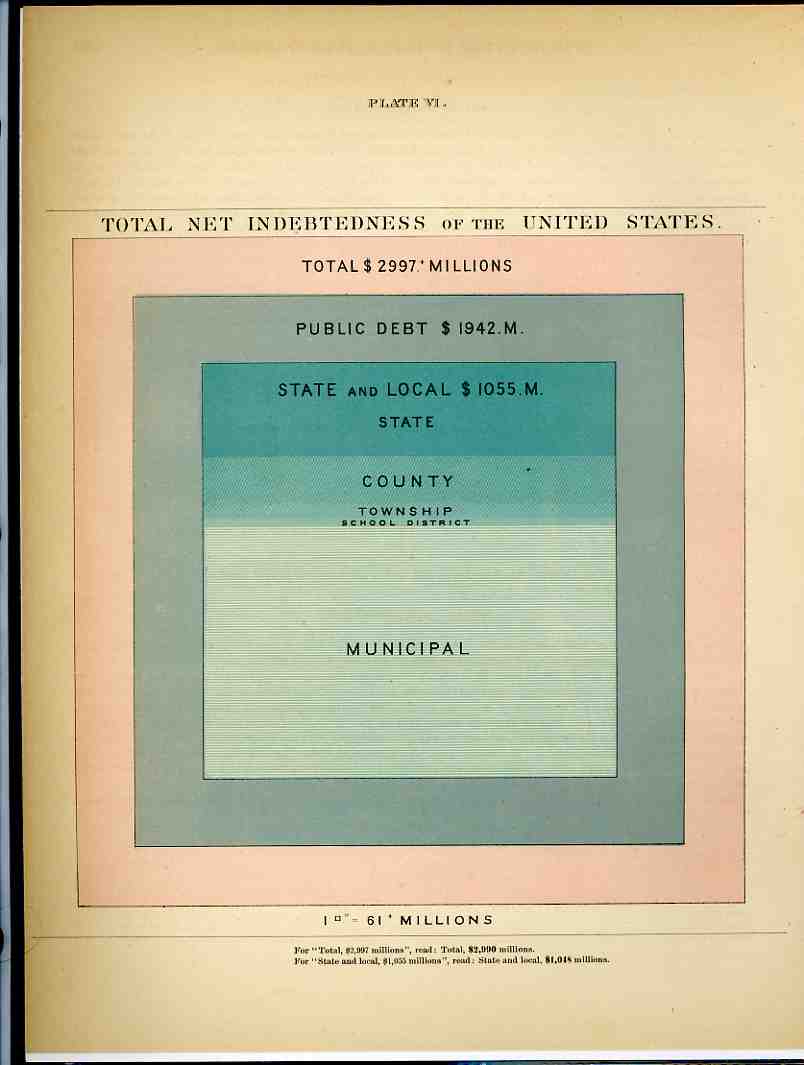
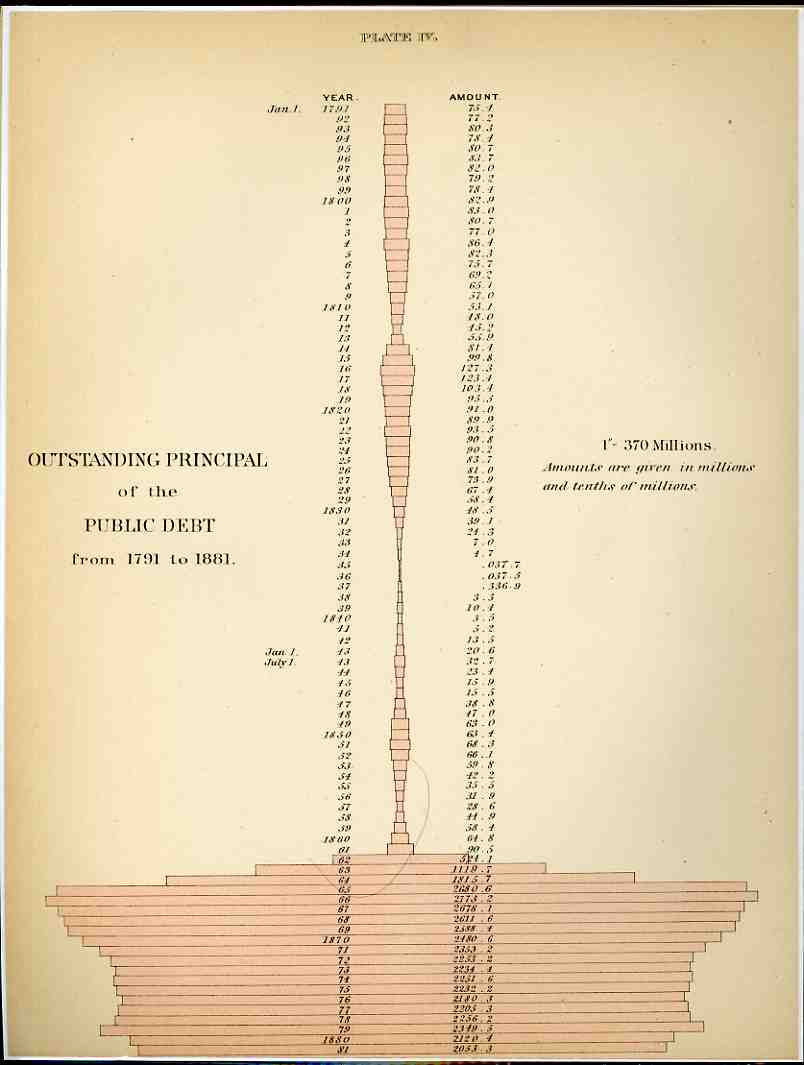
     It isn’t often that you see money represented by dry measure, but that’s what happened here in these two examples from the fantastic Walker Statistical Atlas ( Statistical Atlas of the United States based on the results of the tenth census 1880 with contributions from many eminent men of science and several departments of the government Comp. under the authority of Congress by Francis A. Walker, M. A., superintedent of the tenth census … and published in 1884).  What we see here is a history of American federal indebtedness from 1791 (when the public debt stood at 75.1 million dollars) to 1881 (about 2 billion).  Using the CPI (consumer price index) as a factor to translate that number in 2008 dollars (or so), the 2 bil grows to about $40 billion (a nickel then is about a dollar now). The interesting part of the legend–and what drew me to this graphic even before its somewhat unique shape–state “1”–370 millions”, that is one inch of pink horizontal bar stands for about $370,000,000, and the last bar on this graph is about 6 inches long, which, adjusted for inflation, would now be about 10 feet long. .That said, the really interesting part comes next–if we use this measure to graph a horizontal bar for the American debt as it stands in 2008, it would pink a pink bar that was about a HALF MILE long to express our 10(+) trillion dollars of debt.  OR, somehow, the old debt of 1881 would be about 1 story of a house, while the 2008 version would be up one side of the Empire State Building and down the other (and yes that includes the aerials).  I don’t know how to put this comparison in context, the differences are so staggering. 

    0 ebay 13 graphs269
    After having popped a neuron or two trying to get my head around that one, we’ll further confuse the situation with the second chart, which shows the total net indebtedness of the U.S. in 1881 in terms of square inches; or, at the bottom of it all, a 7×7 inch square represented the entirety of the $3 billion owed out.  49 square inches. Working backwards this time, our $10 trillion (or $10,000,000,000,000.00 writ large) adjusted back to a CPI value in 1881 would have covered about 88 PAGES of the atlas or 9,000 square inches.  Again, the numbers are just almost too big to mean anything. 

    We, as a country, owe one hell of a lot of money.

    And yes there are many different ways of trying to figure out what one 1881 dollar “means” in terms of 2008, but the CPI is the most simple to use and least argumentative and at least gives a pretty good idea of scale.  It would be more useful to try and establish the degree of difficulty  of turning the corner on the debt in 1881 compared to doing that today, but this is just a late-night post at the end of the week, and I don’t have a good clue about how to try and measure that bit simply.

  • A Paper Mirror and the History of Blank Things–Illusory (Sea) Power

    JF Ptak Science Books  Post 1228

    [This is a part of our History of Blank, Empty and Missing Things series.]

    Mirrors don’t necessarily have to reflect something to show  reflection–they merely need to offer you a picture of something that can show the difference of something real versus a false image of that same thing.  “Through a glass darkly” (1 Corinthians 13:12) isn’t necessarily a reflecting surface though it is a reflective one; neither is the painting in The Picture of Dorian Gray.  Harry Potter’s Erised mirror does act like a mirrorish mirror, and Narcissus does come to a bad and wasted end in front of his pondside reflection (the “perilous mirror”of the Romance of the Rose).  The queen’s mirror in the tale of Sleeping Beauty doesn’t reflect but does give advice, and Alice’s Adventures…  in 1871 begin with wondering what was on the other side of a mirror (“looking-glass”) above her mantel–in a similar vein Kurt Vonnegut introduces a mirror as a “leak” into another dimension rather than a reflection.   Sometimes you get a hand-held thing with glass, and sometimes you just get a piece of paper.

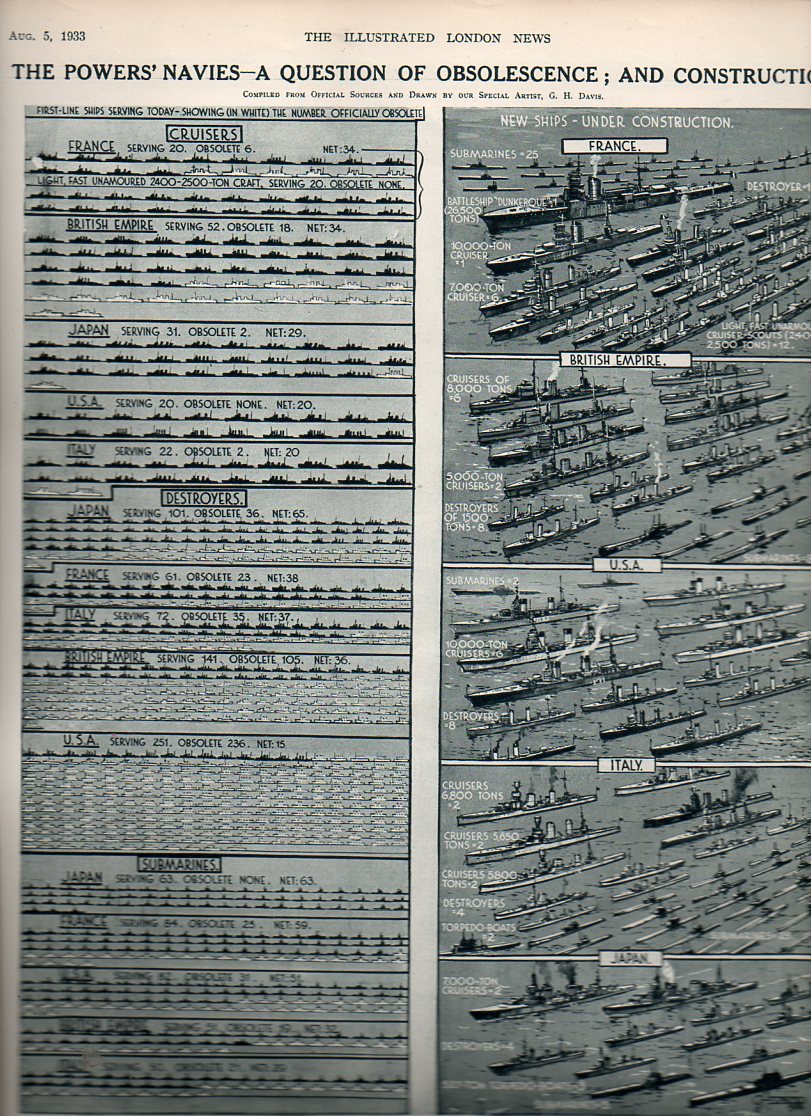
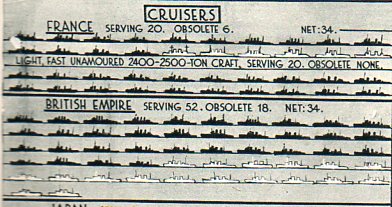
    Navy obsol818 This graphic from The Illustrated London News (5 August 1933, and available for purchase here) is an interesting case in point for a paper mirror.  It is interesting in how it presents a reported state of affairs and its actual condition.  In this case, the artwork shows the supposed/reported strength of the navies of the five major seafaring powers (France, British Empire, Japan, United States and Italy) and what those navies wpuld look like if the outmoded and obsollete ships were removed.  The modern and servicable ships are shown in black silhouette; the numbers of obsolete vessels were shown in white.  The dipiction of blank or empty of missing ships was a very convincing tool depicting the actual state of the major powers’ navies compared to a more romantic means of reporting naval strength. It must have been an excellent wake-up  to thopse with the capacity to see the truth, presented on one piece of paper, a mirror by any other name.

    Navy obsol cruisers819

  • Inauguration Gowns, “Buying American”, & Jackie Kennedy: the Kennedy Inauguration of 1961.

    JF Ptak Science Books   Post 1229

    [JFK Election/Inauguration rarities may be purchased through our blog bookstore.]

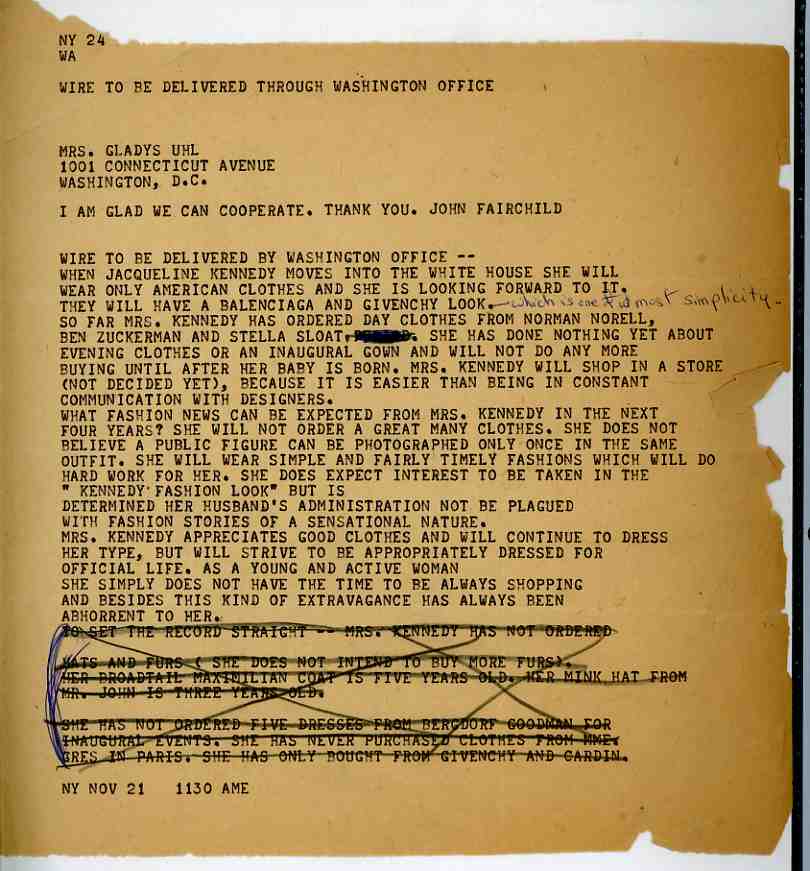
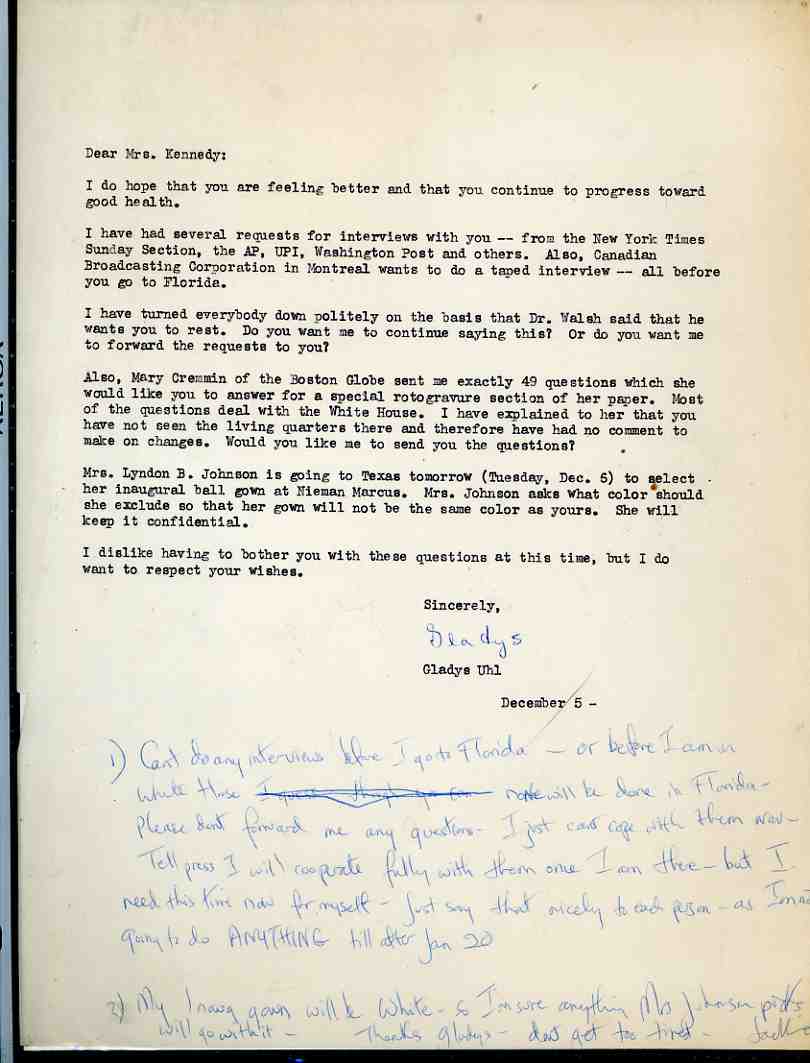
    0 blog jan 16 kenn inaug gown383 Some years ago I purchased a small archive of documents relating to the public appearances of Jacqueline Kennedy, wife of President John Kennedy.  The material is all pre-inaugural, almost all 1960, and  loaded with interesting unpublished nuggets.  One such bit is this telegram sent by the Kennedy camp to Mrs. Kennedy’s first (?) social/press secretary (who did not follow the Kennedys to the white House), Gladys Uhl, the content of which was to be reorganized and matured by Mrs. Uhl  for public distribution.  The subject here was Mrs. Kennedy’s coming fashion sense, in general, and of her inaugural gown, in particular.

    And what is interesting here is that “when Jacqueline Kennedy moves into the White House she will wear only American clothes and she is looking forward to it”.  A fine sentiment; a bolder one too for today if Mrs. Obama decides to follow suit.  It will be much more difficult though for that to happen in 2009 than it would have been in 1961:  this is an age when even some of the most classic “\American” brands of clothing have been moved offshore, made for the USA in China (or Indonesia, or Pakistan, or Vietnam, or wherever the work can be delivered cheaper.  Mrs. Obama has said something about wearing simple clothing, as from a store (chain) like J. Crew–it would be nicer if she were to decide to go with another New York-based clothing store whose goods weren’t made in China, though.  I could cozy up to that.  I could also cozy up to the “American Owned” supermarket that I bounce into every other day if that had more American-made products.  I can understand off season veggies and such, but does good-old Motts Apple Juice really need to be made from apple concentrate imported from China (for crying out loud?)?  I remember on 9/13/01 that the Giant Foods supermarket in my neighborhood in Cleveland Park, D.C., started selling American flags–all made in China.  This was just so entirely wrong that a protest was waged, the flags were removed, and then replaced days later with flags made in the USA.  But it is difficult to find American-made clothing in stores–even a so-called “iconic” Appalachian “general store” and landmark in Asheville, a store that wraps itself in folkiness and homespun regional taste, has, I would say, less than 5% American-made goods. 


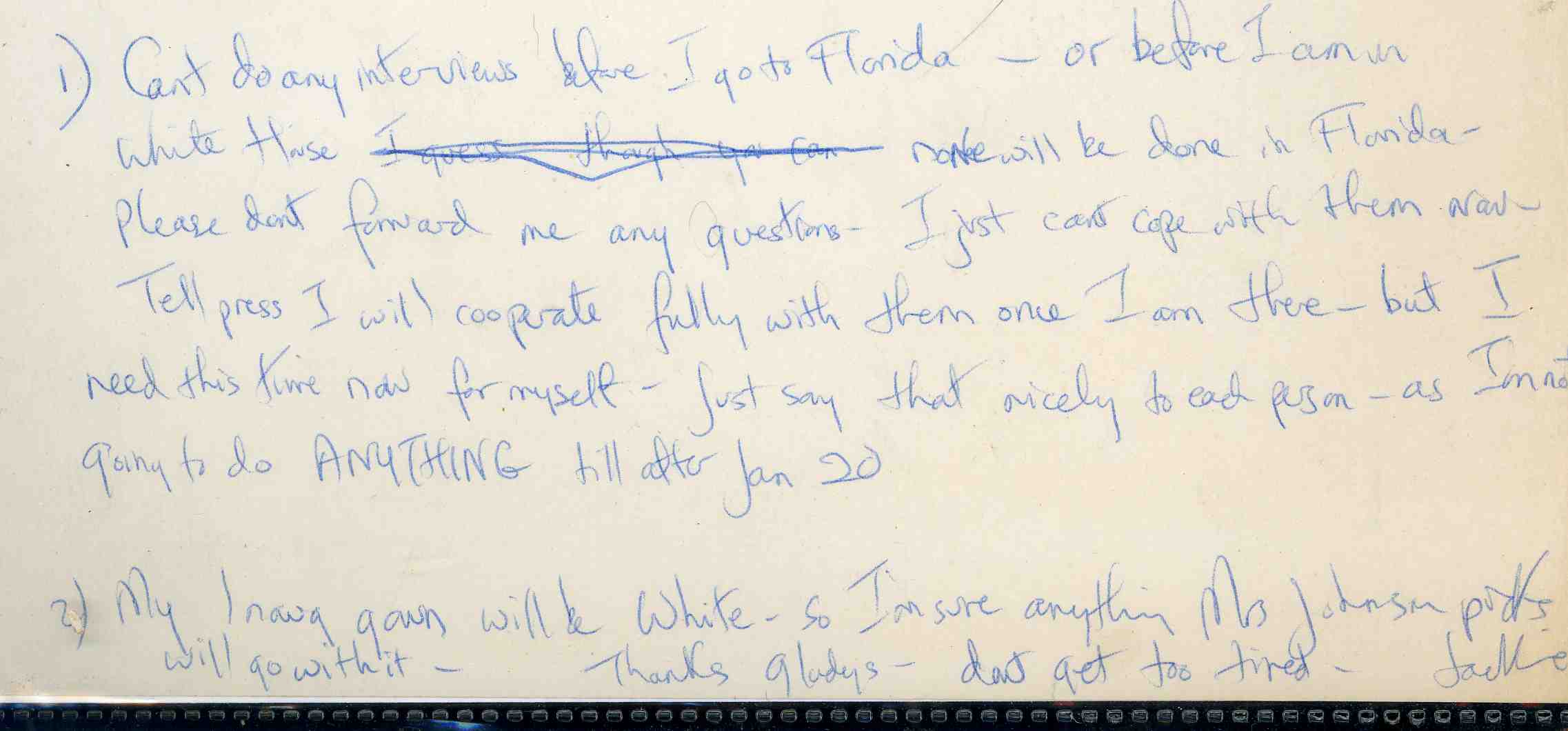
    0 blog jan 16 kenn inaug gown note384But I digress. I really just wanted to talk about Jackie Kennedy and her inaugural gown and her interest in ‘buying American”.  In another piece from this modest archive, Jackie sends back her response to Mrs. Uhl’s questions, and one in particular about color.  Seems as though Lyndon Johnson’s wife, Lady Bird, was going to go shopping at Nieman Marcus for her inaugural gown and wanted to know what color Mrs. Kennedy was going to wear so that she could avoid buying that same color.  Jackie responds at the bottom:  “My Inaug gown will be White–so I’m sure that anything Mrs. Johnson picks will go with it”.  

    There are other interesting items in this collection that I’ll get to soon–several of which are Mrs. Kennedy’s copies of some scripts for television commercials for her husbands campaign.  They’re actually pretty interesting, and a nice insight into the packing of the President in 1960. 


    0 blog jan 16 kenn inaug gown note det385 


  • WWII Aircraft Cross Sections–the Schematics Work of G.H. Davis

    JF Ptak Science Books  Post 1130

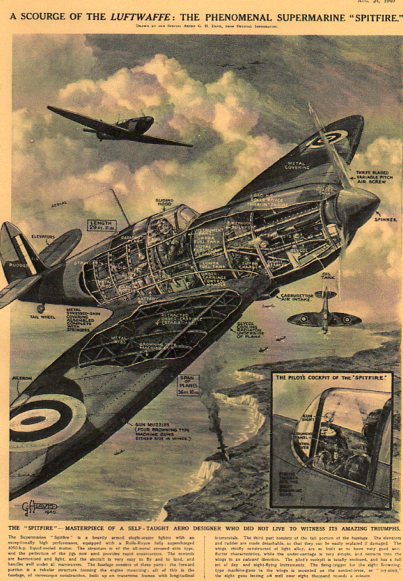
    sI’m sharing some of the collectrion here of the published work of George.H. Davis (1881-1963), the prolific and vastly accomplished artist for The Illustrated London News. His work with that magazine for the forty or so years that I am familiar with is superb, and his great strengths can be found in rendering technical cross sections and infographics.  He had a great sense of design and a very fine hand, and so far as I can tell he displayed an excellent control of his subject, thousands and thousands of times (2,500 times, according to Mr. Davis).

    Here are some fabulous examples of technological cross sections of WWII aircraft by Davis–the drawings are just superb, and you can easily get lost in them, following the geogrpahy of engineering detail from one logical place to the next.

    Blohm u. Voss BV141

    1ebay_sept_24_blohm_voss_141667

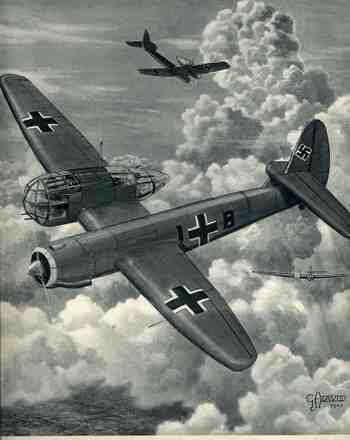
    This is the Blohm u. Voss “BV 141″a very unusual-looking aircraft, and it appeared in The Illustrated London News for 23 May 1942, and it gives an excellent view of what the editors called “a lop-sided freak”.  Perhaps the editors of the ILN wanted to educate its readers on the plane since it was supposed to be widely employed on the Russian Front, though it looks like only 38 were ever built (and none survive today). Actually, the plane, designed by Dr. Richard Vogt (1894-1979),  was a high-flying three-seater  surveillance aircraft capable of 220 mph at 17,000 feet, powered by a single 1000 hp Bramo Fafnir 9-cylinder radial engine.  The idea for the design was to give the pilot and co-pilot a very wide field of view–and by this, I’m guessing that the field of view most affected and aided by this would be straight down. The rear gunner also had an enormous field of view. 

    As it turns out Vogt survived the war and spent his Golden Years in the U.S., seven of them (1960-1966) with Boeing to evaluate hydrofoils and vertical liftoff systems:  he had built other odd planes during his career, and carried them with them into near-retirement, making this sort of design his metier.

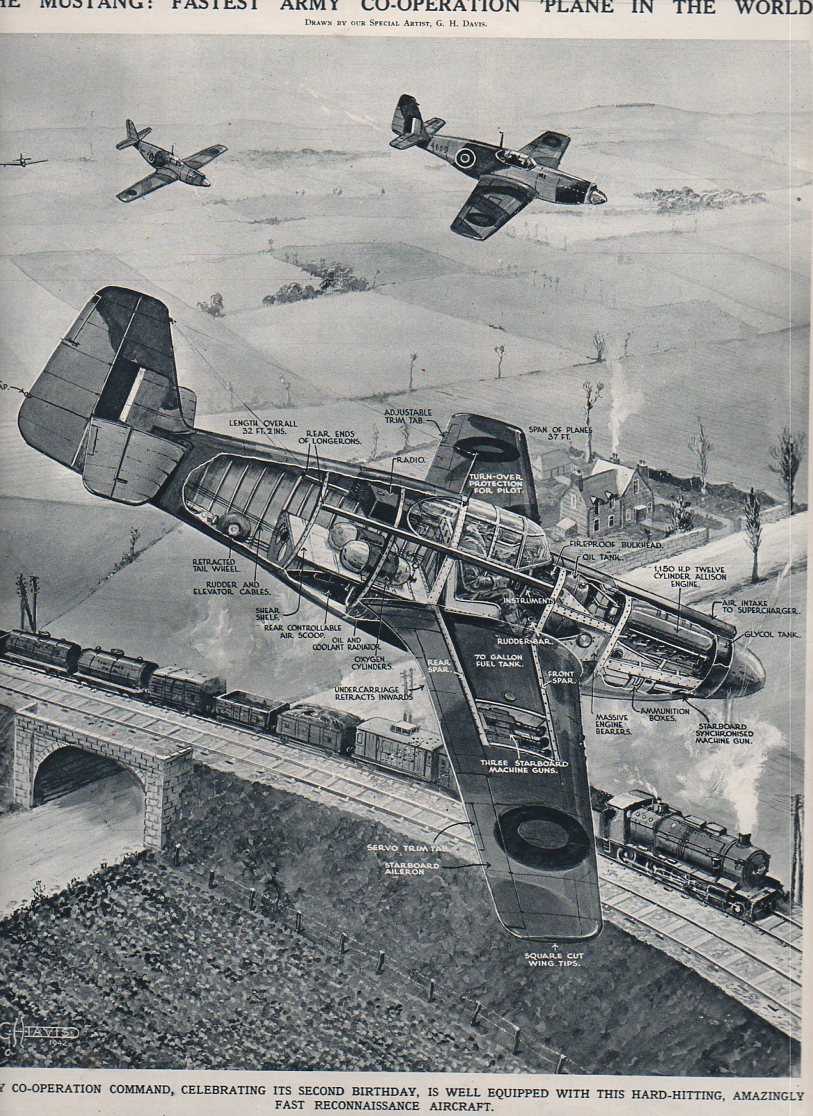
    “The Mustang–Fastest Army Co-operation in the World“, appearing in The Illustrated London News for 12 December 1942. 

    Aircraft x section-mustang849

     The Spitfire:

    X-Sect  SPitfire507


  • Finding Unseen Things In and From the Air

    JF Ptak Science Books  Post 1131

    Seeing more deeply--air weather det853

    Finding the hard-to-find, the invisible, the “hidden”, is an essential aspect of, well, mostly everything.  Whether it is Newton separating light with a prism to find its constituents, or Hooke investigating the formerly quasi-real microscopical world to reveal worlds within worlds, or Galileo using his telescope to quash the ideas of the unaided-eye-visible night sky as an unaltering perfection of creation, or Roentgen seeing through his wife’s skin, or Fraunhoefer finding the complex spectrum, or Henry Draper determining a chemical constituent of the sun, or the invention of the zero or negative numbers or subtraction, of finding Black Holes or other planets or the remnants of the Big Bang, or (Kandinsky) finding the nonrepresentational aspect of art, or Duchamp finding in an upturned urinal that art had no boundaries…the list goes on and on.

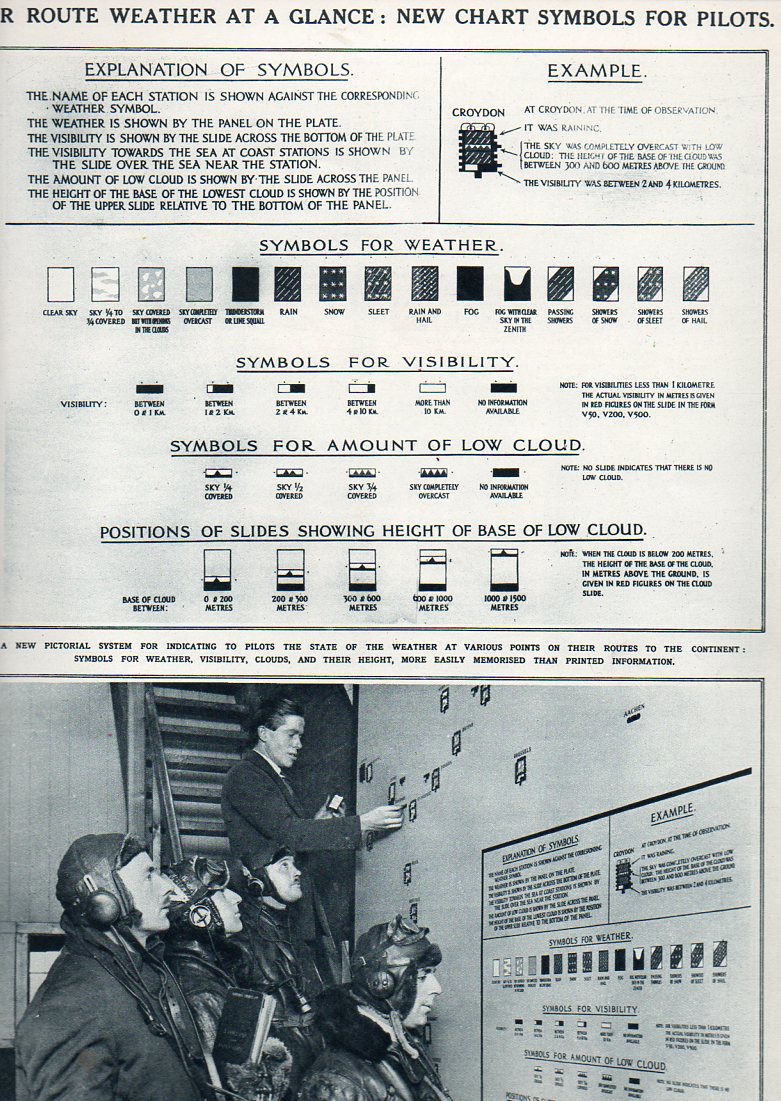
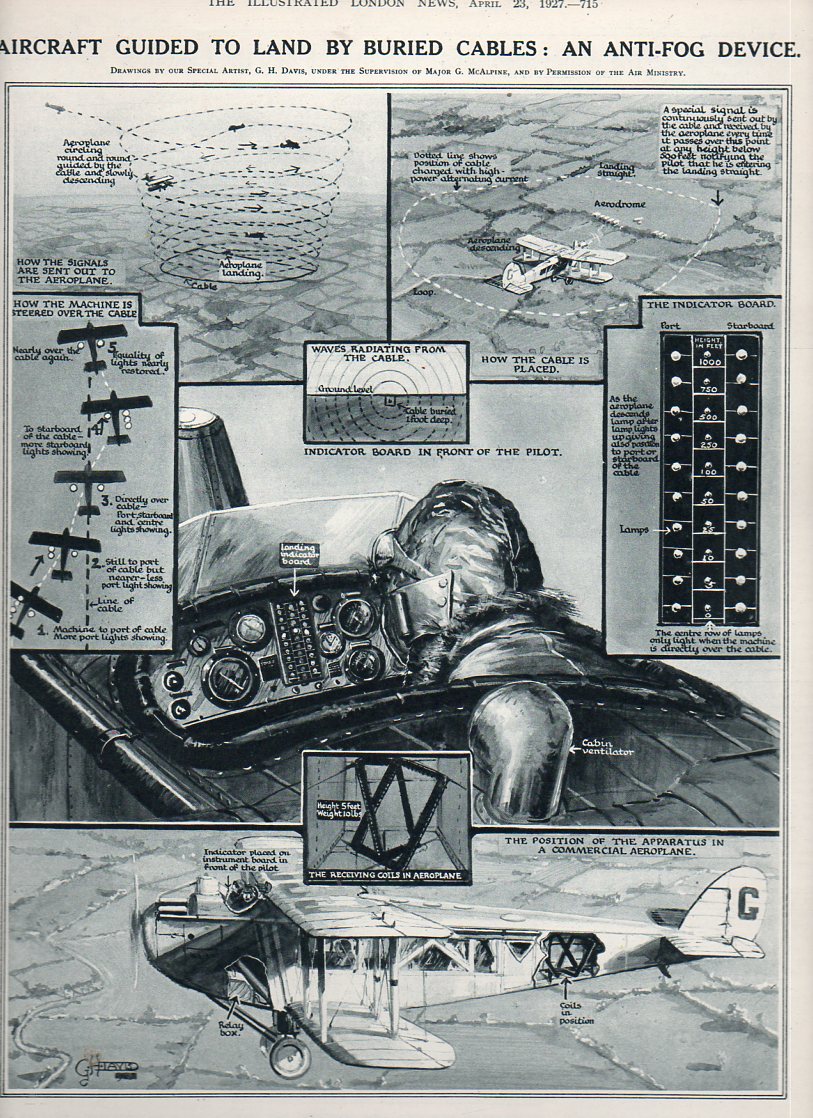
    One aspect of this “finding something in nothing” business that is interesting to look at because it is so local and discernible–and recent–is in air navigation and detection.  And I’ll do this using a series of excellent illustrations from The Illustrated London News, all of which are from the 1927-1938 period. 

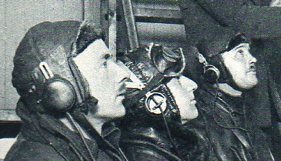
    The first is relatively simple, at least simple from here in the year 2014, which shows four pilots being briefed on weather conditions with a aerial chart for conditions along intercontinental routes.  The placement of these symbols represented a vast improvement over the earlier systems of readying pilots for what weather lay ahead, if indeed there were any communications at all.  This represents an early look at a codification of conditions and expectations for air travelers–a display of new and important data in 1927. 

    Seeing more deeply--air weather852
    Next is a brilliant device for assisting pilots to land in foggy and dark conditions–actually on how to find the ground safely.  In 1927 (again) a RADAR-like system was put into place on aircraft that involved receiving the signals of an ac-pulsed buried electrical cable that surrounded an airport.  The receiver (seen here on the flight panel of the pilot in an open-air cockpit) would be read to reveal proximity of the airport, the pilot making wider and then closer spirals in descent until his was basically within the buried airport cables and thus able to land.

    Seeing more deeply-anti-fog855
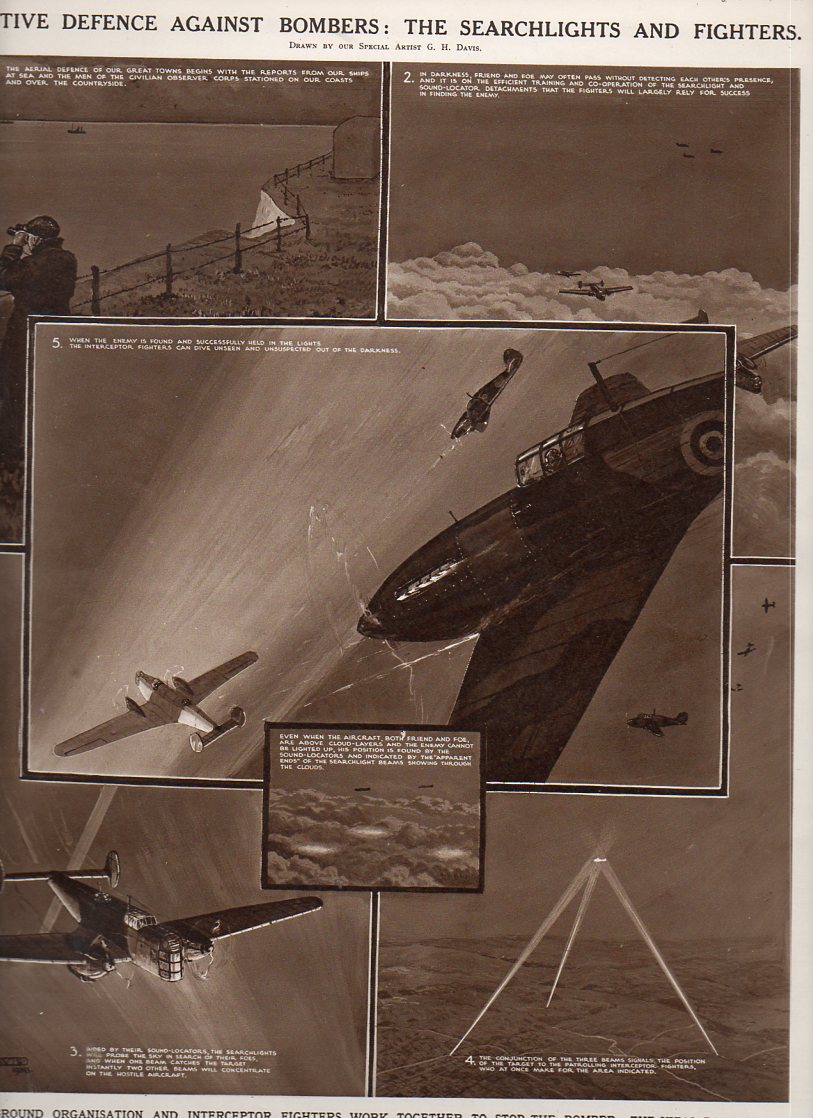
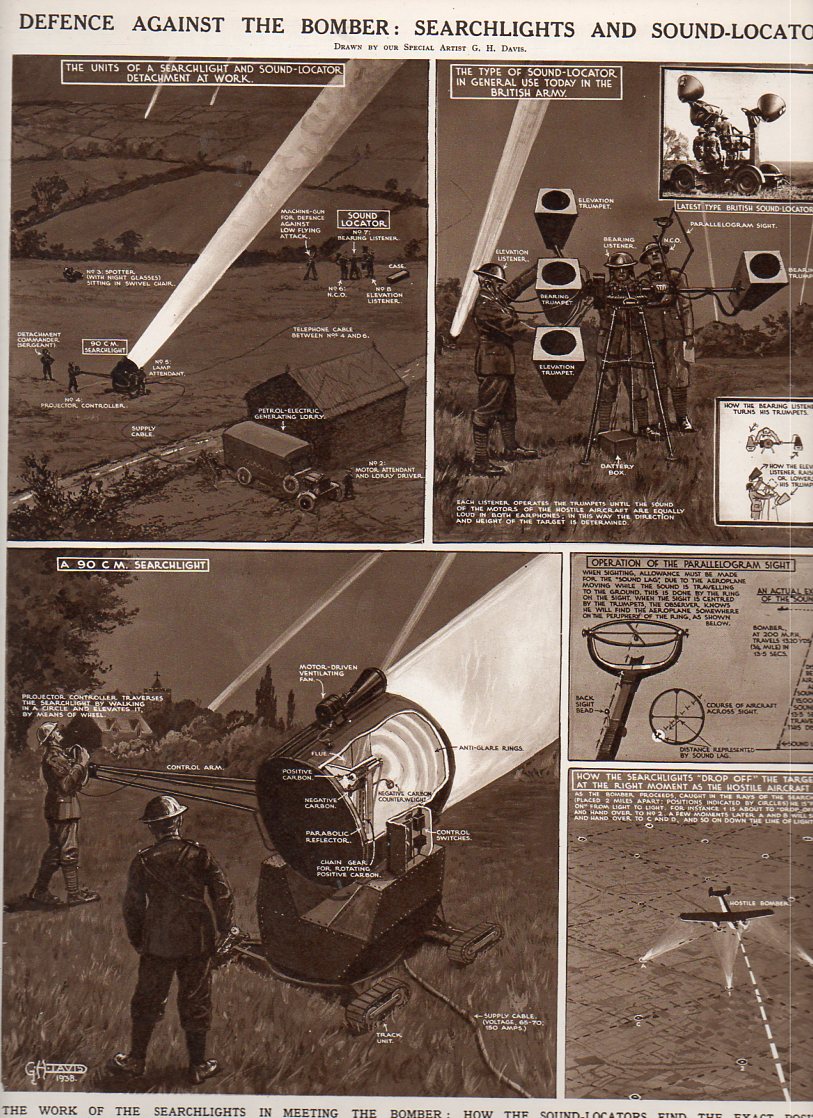
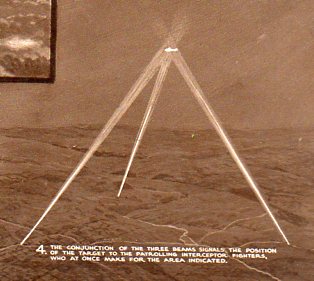
    Prior to WWII RADAR1 was somewhat functional but still in development, and as we see in this set of 16 July 1938 illustrations, the key methods for finding enemy aircraft at night (in order to shoot it down of course) was an audio-visual method, using “sound-locators” to find the approaching bombers and then spotlights to illuminate and track them to their destruction.  

    Seeing more deeply-searchlight856

    Seeing more deeply-defence against bomber854

    These images represent some idea of the state of the art of being able to find things–like the ground at night or approaching enemy aircraft–in the 1927-1938 period, all of which would be drastically changed in just the next two years.

    Seeing more deeply-searchligh detail857

    NOTES

    1. RADAR was coming very close to being developed in the early 1930’s–and in 1935 the process of experimentation and implementation was at a peak.  The development of this new technology was an international property, though perhaps no one owned it more in this period than the British, with Watson Watt giving his experimental ideas on RADAR to the Air Ministry on 12 February 1935 in a secret report titled “The Detection of Aircraft by Radio Methods”. Int his years alone there was feverish work being done by  Rudolf Kühnhold (Scientific Director at the ‘Kriegsmarine  Nachrichtenmittel-Versuchsanstalt) who in 1933-1935 established a RADAR-hunting company called Gesellschaft für Elektroakustische und Mechanische Apparate, or “GEMA”; there was also elements of the Royal Navy, Telefunken, Standard Elektrik Lorenz, Philips Company’s  (of Eindhoven, Netherlands) Natuurkundig Laboratorium, the Research Office of Nippon Electric Company, and even in the Soviet Union (until the key figures involved were murdered in Stalin’s purges–this one distinguished from others and referred to now as The Great Purge– of 1937), the French Compagnie Générale de Télégraphie Sans Fil (CSF), and  the Italian Regio Instituto Electrotecnico e delle Comunicazioni (RIEC, Royal Institute for Electro-technics and Communications) to name a few.  The United States of course had been long working on the project, at least since 1922 at the NRL, with considerable private (and federally funded) work done by RCA

    .
    Whipping ahead into WWII a very significant “battle of the beams” began between the U.K. and Germany, especially during the Battle of Britain, involving countermeasures, espionage, propaganda and false-positives in regards to the use and development of radio-based tracking and detection–the U.K. particularly making use of this technology in a wide-spread air defense system.  But it was in the United States in 1940 (and really by the U.S. Navy) that RADAR got its name (for RAdio Detection And Ranging) as well as its great impetus for development and deployment.

  • Stuff Blocking the Horizon–the Architecture of Christopher Wren

    JF Ptak Science Books    Post 1332

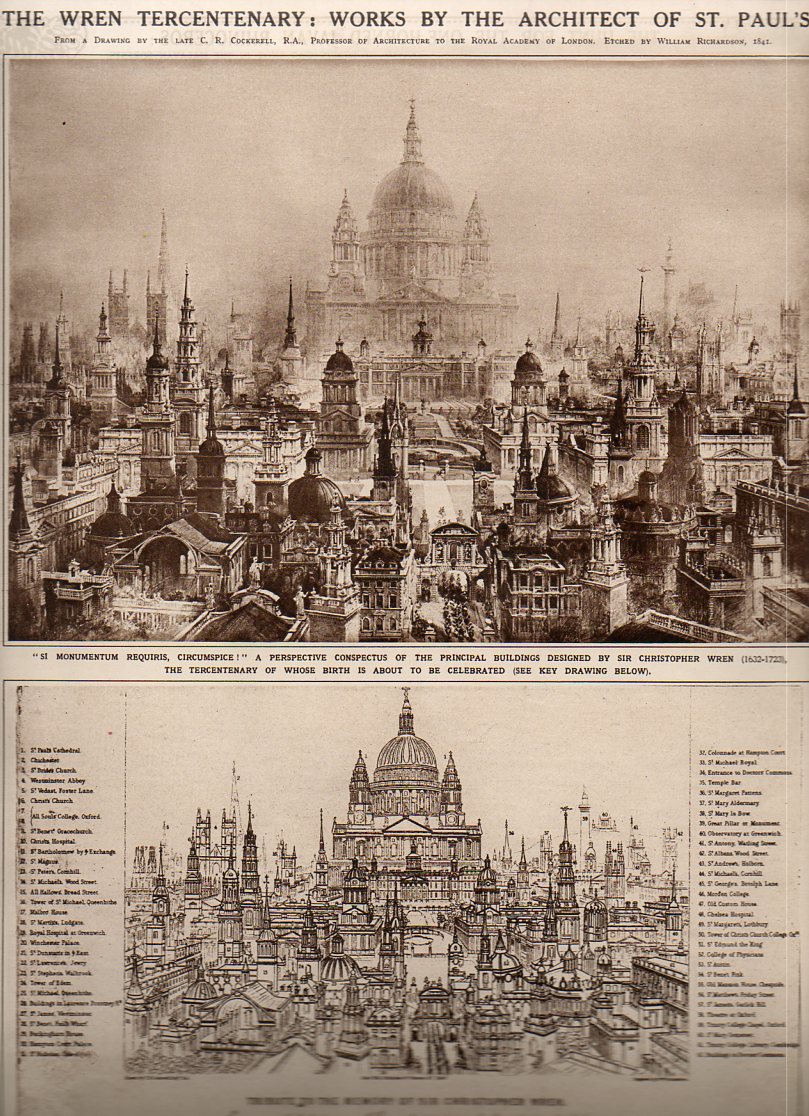
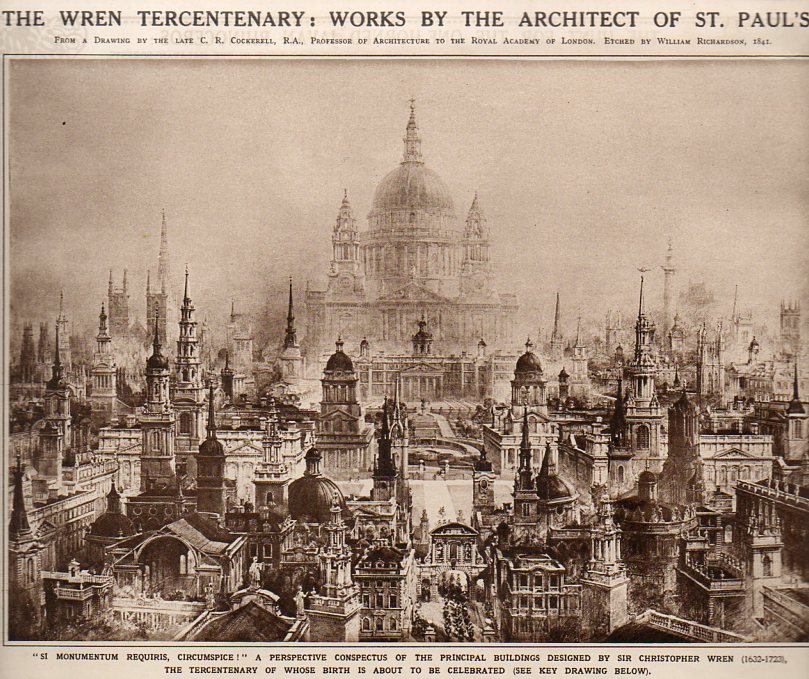
    In a short line of my favorite English Baroque architect/masters, there is no superior to Sir Christopher Wren, and there is no second.  Granted my interest in him comes ‘round the back door, through the almost-eternally-fabulous Robert Hooke (one of the great master British scientists of the 17th century and to whom nearly everyone owes some debt, a genius of great difficult and whose maligned reputation is somewhat deserved) who assisted/worked with Wren for a time after the Great Fire. 

    Wren860 Hooke (1635-1703) and Wren share a big Something–they were both capable of great thinking across many fields and disciplines  As a matter of fact Wren (1632-1723) received a formal scientific training and was a gifted astronomer and mathematician in addition to being perhaps the most-gifted architect in the history of England.  To give the devil his due, though, few people could touch the depth and breath of Hooke’s incredible interests, or match the phenomenal diversity of his productions. (He has been referred to, justifiably, as “England’s Leonardo” by Alan Chapman in his 2005 book o the same name. If it wasn’t Hooke as Leonardo, I don’t know who else it might be.) Wren as it turns out was also a founder of the Royal Society and acted as its president from 1680-1682–a Society to which Hooke was deeply devoted, and which was probably kept alive by his efforts.

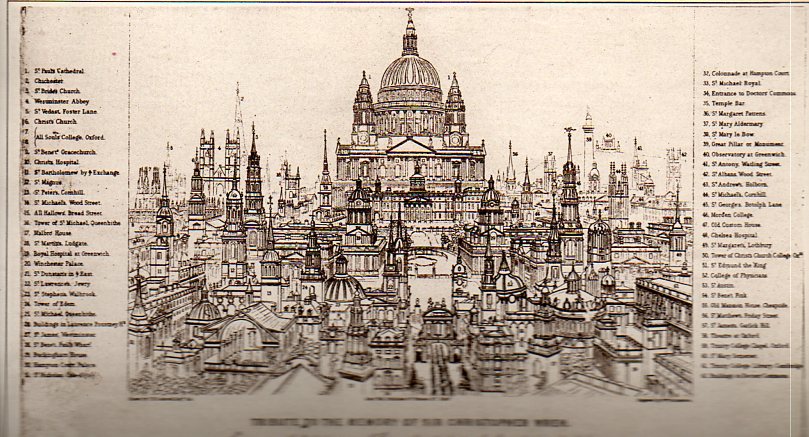
    When you look at Wren’s accomplishments writ large, all drawn together  in this reproduction, you can really appreciate the great spectrum of his building career–not the list of which includes the iconic St. Paul’s, featured, looming, in rear center.  Some people are able to place their accomplishments in great bumps on the horizion; some give you the opportunity to see or visualize them; some help you understand how those things are held together; and some give you the horizon.  Wren’s accomplishments are definitely very pretty horizon-blockers. [This image is available for purchase from our blog bookstore.]

    Wren det861
    Wren det b862

    ·Posted by :

    ·in:

  • Modern Antique Occupations

    JF Ptak Science Books   Post 1233

    Earlier in this blog I looked at the diminishing importances in antiquarian times–some occupations, formerly integral and important, have now become sufficient, occasionally a luxury to be afforded by folks who can pay for reigniting past importance.  This earlier example was found in William Pyne’s great-ish 1845 work, Picturesque groups for the embellishment of landscape..– it was a work of clip art for its day, really, showing, detailing, the attitudes and occupations of working people.  It was a book filled with the people who might ordinarily have gone missing from the work of the artists needing their images displayed in their brains by someone else’s labor; a book filled with figures to plug-up the blank spaces, round out that unkind bits that called out for a human touch. This new example’s lists (below) are interesting in this same way, though the jobs listed are less general and more “professional”, or technical, than the Pyne work–fishmongers and rat-catchers are not listed here. 

    The work is that of Edward Hazen who in 1837 described 68 specialized jobs in his Panorama of Professions and Trade. Unlike many other occupations from a less specialized list, nearly all of these jobs still exist, though many have been lowered to deep depths of obscurity (say, for “lithographer”), while others are changing whole-cloth but still quite popular (like my own profession as “bookseller”.  A bookseller from 1837 could see that some small percentage of the booksellers he met were indeed selling books in a way he recognized–but then there’s that knotty majority who even though were brothers-in-trade would seem I think to be almost entirely foreign to his antiquarian eyes.)

    Of all the professions listed below, only five, I think, are almost entirely removed from the public picture–jobs held by people now but by people who would be difficult to find. The short list–type founder, turner, wheelwright and stereotyper.  As I said, there are people who practice these positions, but their services are more luxuries than necessities, now.  Whereas my earlier post on the Pyne occupations was listed as a “Domesday tour” of disappeared professions, it it remarkable to see how many of the Hazen jobs continue to survive. 

    http://krisdedecker.typepad.com/.a/6a00e0099229e888330120a5f04659970b-pi

    http://krisdedecker.typepad.com/.a/6a00e0099229e888330120a6473e20970c-pi

    http://krisdedecker.typepad.com/.a/6a00e0099229e888330120a6473e20970c-pi

  • Evil Replaced by Evil: The Baltics, the USSR and the Nazis. An Anniversary, 25 November 1940

    JF Ptak Science Books   Post 1234

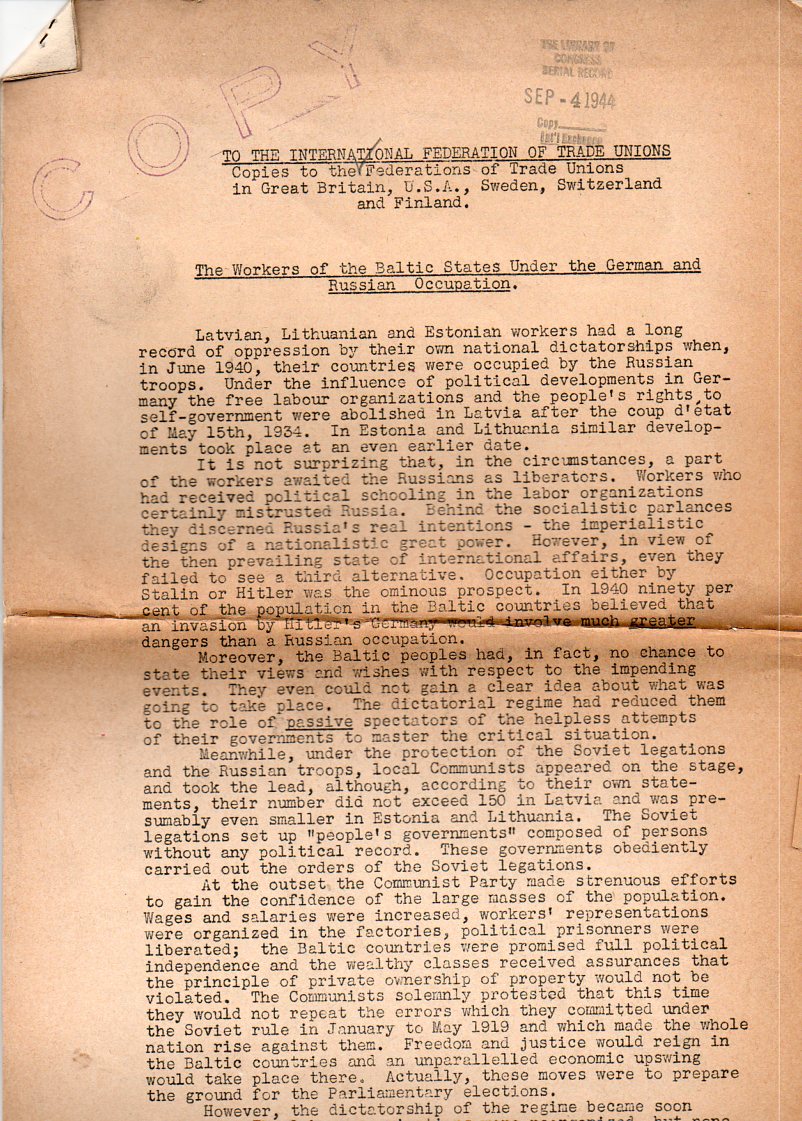
    This rare, offset-printed publication comes from the representatives of the Free Trade Unions of the Baltic States–a part of the International Federation of trade Unions (IFTU)–and is dated December, 1943, and is a witness to the brutal regimes that illegally and maliciously subverted the countries of Estonia, Latvia and Lithuania.
    (The IFTU was a social democrat-like organization that existed from 1919 to 1945, and which was a largely European body after 1925 when its main American counterpart, the AFL, chose to disengage.)

    Balticsb874
    [This document is available for purchase from our blog bookstore, here.  I would gladly reproduce the entire document except that given the nature of its reporduction the pages are brittle, meaning that the document could no tbe scanned unless taken apart, which I do not want to do, presently.]

    The six-page pamphlet is interesting to me because it provides some details on the rape of the Baltics–the theft of their legal status as nations, the murder and deportation of those who disagreed with the ruling Soviet and then Nazi occupiers, and then, lastly, the murder of the Baltic Jews–which, in December of 1943, was not common reading material.

    As a result of the Molotov-Ribbentrop pact, the Soviet Union moved into the Baltic states in June, 1940, after having compelled the thre nations to allow the establishment of Soviet bases on their soil.  In June of 1940 the life of the Baltics changed dramatically, when the U.S.S.R. overtly took control in the three countries. At the beginning of the Soviet brutalities, elections were stolen, military forces were moved, and murder and deportations and arrests began in earnest. In beginning to kill the soul of these countries, the Soviet union established a “Commissariat of the Interior…was a powerful apparatus for carrying out persecutions and taking reprisals”, a euphemism of the early part of the pamphlet which would be replaced by mor direct language just paragraphs later.

    But 25 November 1940 marked the final destruction of the independence of these countries when their national currencies were replaced by the ruble, allowing complete control by the Soviet Union, and plunging the countries into a malicious chaos, with the citizens now faced with an almost-order of magnitude change in their buying power.

    The report continues on the disappearances of workers and intellectuals, which came quite early in the Soviet occupation.  According to the document, tens of thousands of workers who were opposed to the new changes by the Commissariat of the Interior were arrested and deported to “enjoy a happy life” in prison.  More shocking details would come, highlighting the deportations, arrest and executions of thousands of people–tens of thousands who would be sent to “labor camps” in northern Russia, selected from”secretly drawn-up lists by the Communist Party”.

    There is in particular the mention of 14 June 1941–a bitter day in the history of the first Soviet occupation, though it seems that the author of the present paper did not yet have a full appreciation of the event, yet. Here the author mentions specially “equipped” railway cattle cars brought in from Latvia and used to deport 21,000 people from Lithuania, 11,000 from Estonia and 15,000 from Latvia.  In point of fact the period of 14-17 June 1941 was when the Soviets imprisoned/deported/murdered 100,000 Balts.

    After the Nazis trashed their non-aggression pact with the USSR and began their invasion (known as “Operation Barbarosa”) of the Soviet Union on 22 June 1941the Russians began to run, replaced very quickly by the advancing German armies. The author writes that “we have no exact data” on the deportation and execution in the earliest days of the Nazi occupation, but the conservative guess was that 50,000 had been deported and 10,000 executed.

    And then on to the Jewish question, where this paper reports that almost all of the Baltic Jews–by December 1943–were gone.  “Gone”in being  deported to   work camps, or collected in slums, or murdered.

    In the only underlining done in the printing of this pamphlet, we read that ‘All these murders are on the German conscience”, and then goes on to name the German officials responsible for the crimes. 

    In December 1943, when it was becoming apparent that the Germans were being turned in Russia, and that the Russians might return, there is this final plea from the pamphlet’s author:

    “Do not allow the red Army to occupy our countries.  Save our people from physical and legal annihilation.” OF course the Soviets who were replaced by the Nazis were again occupied by the Soviet Union in 1944–the Baltics would not see the Soviet Army leaves until 1995.

    This was a fast summation of a complex and complicated situation I the Baltic states for these years, but I just wanted to give the flavor for the background of this December 1943 pamphlet.  There were hundreds of references to mass killings and deportations (and vast rages of murders) that appeared in the press during this time period, but there was certainly not a collected resource for them all.  This pamphlet–quite rare in itself, as I’ve found no copy in any world-wide library holdings referenced in WorldCat–is another example of disparate reporting on what would be seen just 20 months later as a monumental climax of injustices.

    ·Posted by :

    ·in:

    —
  • Motion and Change in Natural Sculpture–the Galileos of Clouds and Snowflakes

    JF Ptak Ptak Science Books   Post 1235

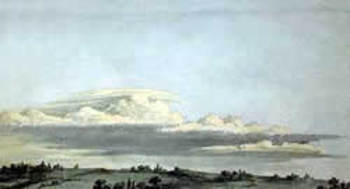
    Blogcloud_howard It is odd to think among the great classifiers of nature, including even the lofty-namer Aristotle, that clouds were not scientifically classified until the early 19th century.   Here they are, just about the biggest thing we have as earthlings that are gigantic and close to us, and nobody offered a good classifications scheme until 200-odd years ago—a pretty slim margin of time  in the terms of recorded human history. 
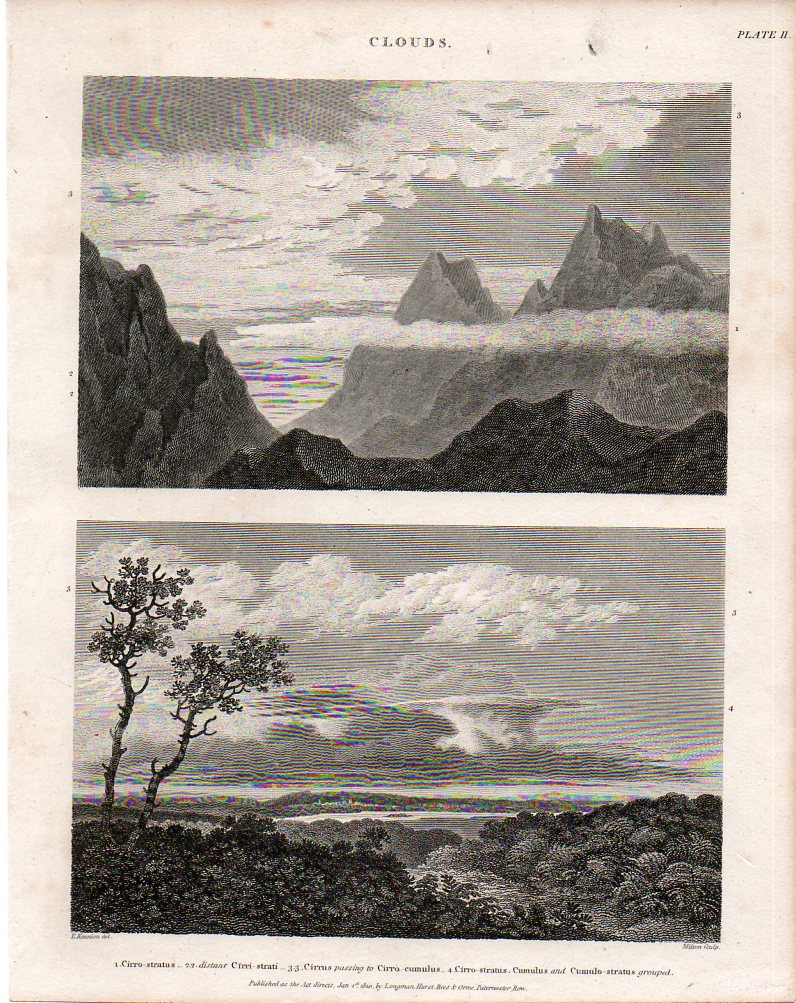
    Clouds are of course problematic, what with floating around and all—but if you didn’t already know the relative newness of their recognizable names isn’t it shocking to learn this bit of history? For the most part I think clouds must have been thought as being too transient, changeable, whimsical, wispy, to be given proper names.   The great scientist and classifier Lamarck tried to do so in his  Annuaire Méteorologique of 1802, and really is the first to try this, but his ideas weren’t terribly good (especially compared to the rest of his work), and it seems as though he left his best thinking effort on clouds at home.  For example, he gave us Hazy, dappled, massed, broom-like and grouped clouds as classifications (in French, respectively, en forme de voile, pommelés, attroupés,  en balayeurs and groupés).  They seem quite “French” to me, but largely outside the scope of being useful. 

    It was the English pharmacist and chemist Luke Howard who in 1803 gave a greater bit of thought to structuring cloud names, classifying them according to size and shape and giving them Latin names—and this forms the basis of our naming clouds to this day.  Howard was perhaps the first, greatest, meteorologist, producing On the Modification of Clouds, (in which he describes his naming system, the “modification” part actually meaning classifying rather than changing),  The Climate of London, and the first textbook on weather,  Seven Lectures on Meteorology.  Howard’s system was expanded in 1887 by Abercromby and Hildebrandsson, who further classified clouds by height above ground as well as by appearance (and utilizing Howard’s naming system). 

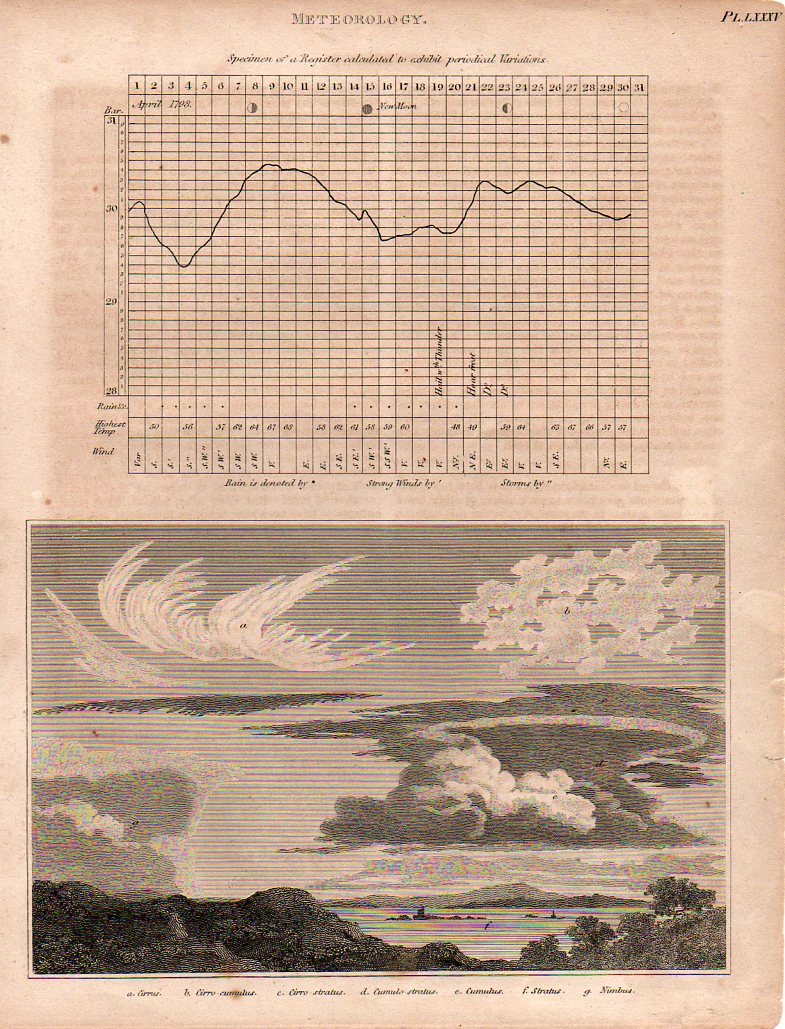
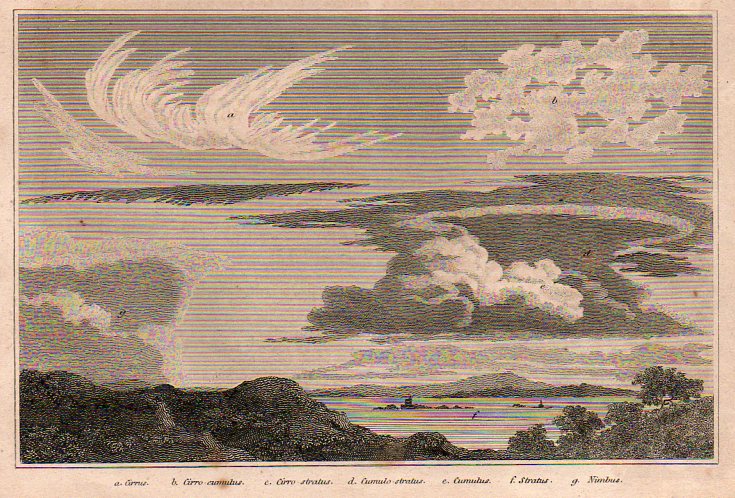
    Here (below) are two fine, early examples of cloud-naming for the scientifically-minded of the British elite, finding their way into print in the fabulous, ingenious and  mammoth (45-volume) Cyclopædia, or The New Cyclopaedia, or, Universal Dictionary of the Arts and Sciences, edited by Abraham Rees (1743-1825).  The work was published between 1802 and 1820, and was the resulting effort of 100 contributors who generally wrote monograph-length entries, contributing to a final tally of close to 40 million words.  I’ve particularly enjoyed the illustrations like those below—some of which have become iconic—and especially the fine and deep engraving of Wilson Lowry.

    {Both of these images below are available for purchase from our blog bookstore, here.]

    Clouds875

    Cloudsb876Howard began his system by identifying three basic shapes to clouds: heaps, layers, and curls.  Heaps of separated cloud  masses with flat bottoms and bulbous, splayed, tops, which he called cumulus, which is Latin for heap; the Latin stratus was applied to clouds in layers which were much wider than they were thick; and again to Latin for cirrus, which called out the wispy curls of clouds.  (Rain clouds were given the Latin nimbus, for rain, and so on.) 

      Cloudsbdet877

    It is interesting and romantic to think of Howard being moved in his love of clouds as many Brits and Europeans were in the Volcanic Year of 1783 by the enormous eruptions of the Eldeyjar (Iceland) and Asama Yama (Japan) volcanoes—the force of their eruptions caused enormous changes in the skies (especially in Europe), creating vast sky-borne tapestries (the “Great Fogg” in England) and for such extended periods of time that it would have beenBlogsnowflake_hooke impossible for the scientifically-minded Howard not to see them. 
    Blogsnowflake_bentley

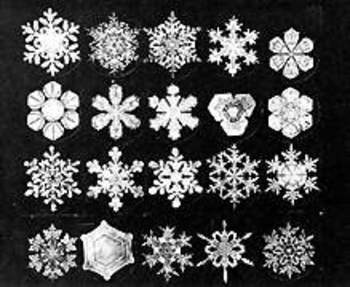
    Similar, in a way, to clouds is the snow crystal (snowflake)—they change forms in their lives from sky to ground, and may well disappear on contact with a warm surface.  Of course unlike clouds they may fall and be captured, kept even, though the ability to actually perform some sort of scientific something with them didn’t occur until 400 years ago, which means that snowflakes passed in and out of human existence being very simply named (in most languages) as a mass group, and not classified at all.

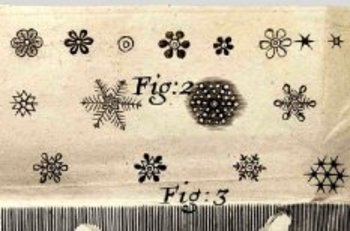
    Johannes Kepler thought very deeply in In 1611 publishing a short treatise called On the Six-Cornered Snowflake, thinking that perhaps their (mistaken) six-cornered symmetry revealed something much deeper about the basis of nature and the universe. The 26-year-old  Robert Hooke seems to be recognized as the first to throw the snowflake under a microscope, publishing drawings of them and just about everything else that he saw in his monumental (and tall, being 13-inches tall) Micrographia (1665)–the first truly scientific book of modern times.  The largest of the large images was saved for the flea, showing the unsuspecting public the great and beautiful nature of what seemed like a fantastical beast (under magnification).  Snowflakes appeared in the book, revealed in their intricate and seemingly-symmetrical nature.  Fantastic, unimagined images. This aside, he seems to have, um, borrowed these images from an earlier work, Thomas Bartholin’s  De Nivus usu Medico Observationes Varieae, 1661.  But so it goes. 
     

    The Galileo of the snowflake was Wilson Bentley (1865-1931), an autodidact Vermont farmer, seen by fellow hamlet-dwellers as odd and off, who figured out how to photographically and beautifully record the intricacies of the snow crystal world—no one had ever done this so dramatically, with such gorgeous results.  It really was as though he was able to record the heights of the mountains of the moon with a slender telescope in Pisa, 350 years earlier. The results of his decades of experience were published  in 1931 his book Snow Crystals, containing more than 2400 snow crystal images.  On the heals of Bentley’s accomplishments came the classically trained nuclear physicist Ukichiro Nakaya, who was truly the first person to apply a scientific classification to snowflakes, and who published his intrepidly-beautiful work in a 1954 book entitled Snow Crystals: Natural and Artificial.  His classification system of the various types of snowflakes would prove vastly more useful, interesting and appealing than that published by the 1951 the International Commission on Snow and Ice, and forms the basis of the discussion of snow crystals today—a classification system of a massively-occurring phenomenon that is younger than me. 

  • Millions of Miles of Hole-Filled Paper–Dystopia, Entertainment, Vonnegut and Prison

    JF Ptak Science Books  Poat 1236

    {Part of this blog’s History of Holes and History of the Future series.]

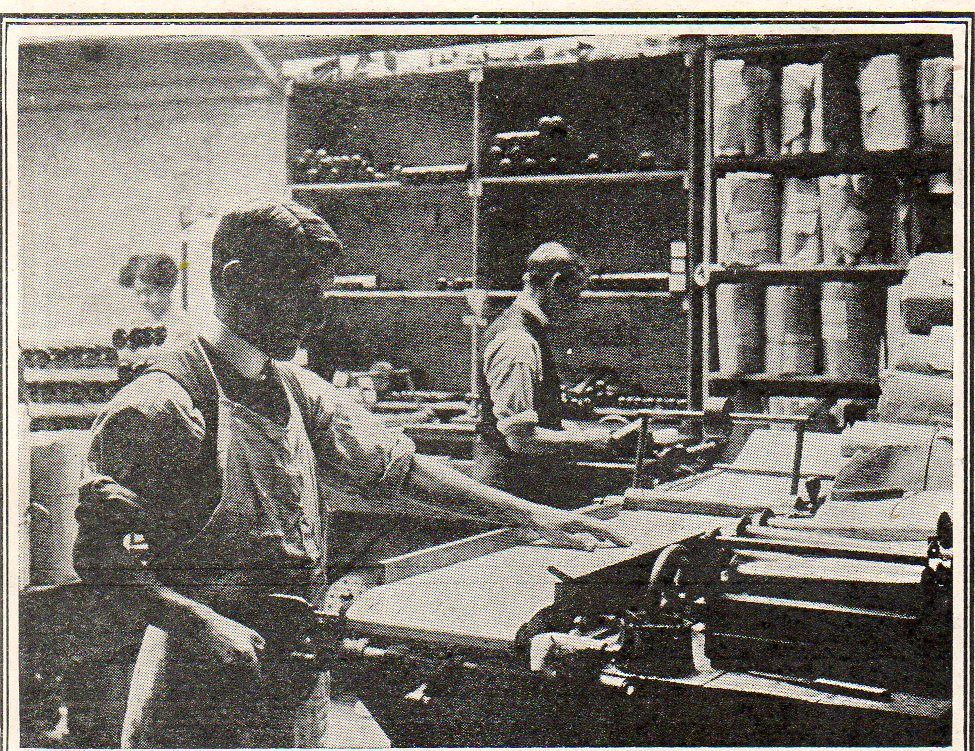
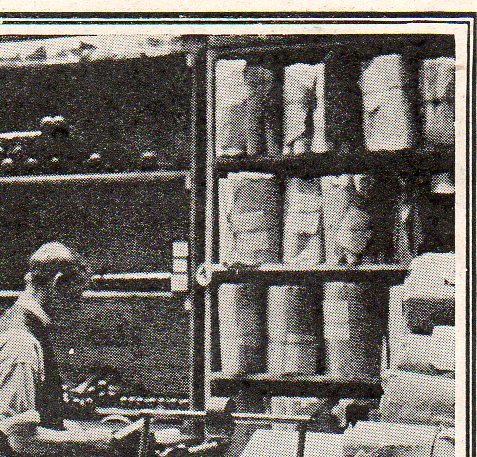
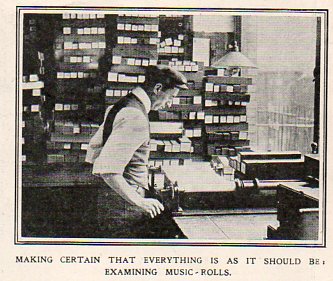
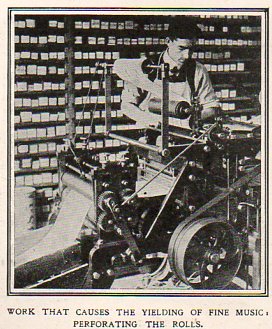
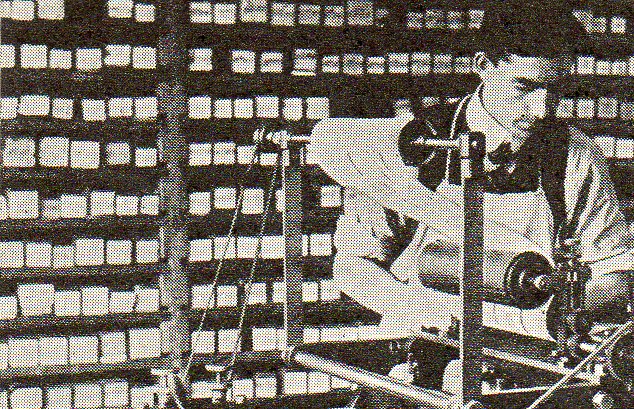
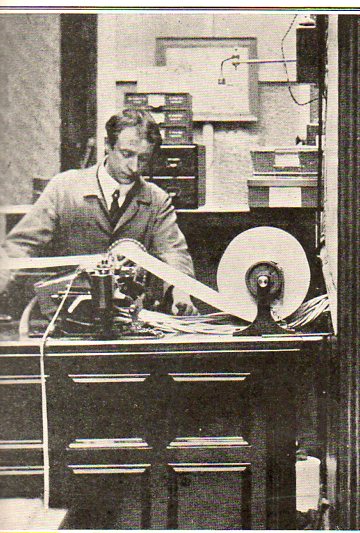
      Music role making--1871 There is a certain layered, geological dystopic quality to the  images of these men laboring at producing piano rolls for player pianos (and found in The Illustrated London News for 18 December 1909). This is true especially for the details, the small boxes in the background to where the rolls are being “processed”–music pounded out with metal points on a hard surface, as though produced by whatever it was that was in those little labeled wooden containers, far removed from the artistry of melody. These are images of a culture being made into hundreds of thousands of miles of hole-filled paper.

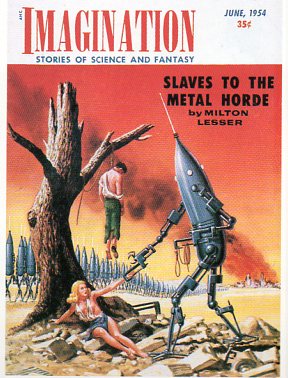
    The piano roles remind me of automatons replacing humans in entertainment, and then replacing the humans making the piano roles; of machines taking over the jobs of people writ large.  There’s a long and rich literary history of this idea, not the least (or first) of which is the appropriately-named Player Piano, Kurt Vonnegut’s first novel, written in 1952.  Like a tiny idea-machine, Vonnegut manufactured part of his tale from Brave New World, with Huxley having taken his bit from an earlier novel, We, written by Yevgeny Zamyatin in 1921–they’re all bleak images of a future dominated by machines, the humans acquiring numbers for names, like the replaceable and expendable units they became. 
    (Artwork by Malcolm Smith for Imagination, June 1954.)

    Robots in ocntrol--hanging human879

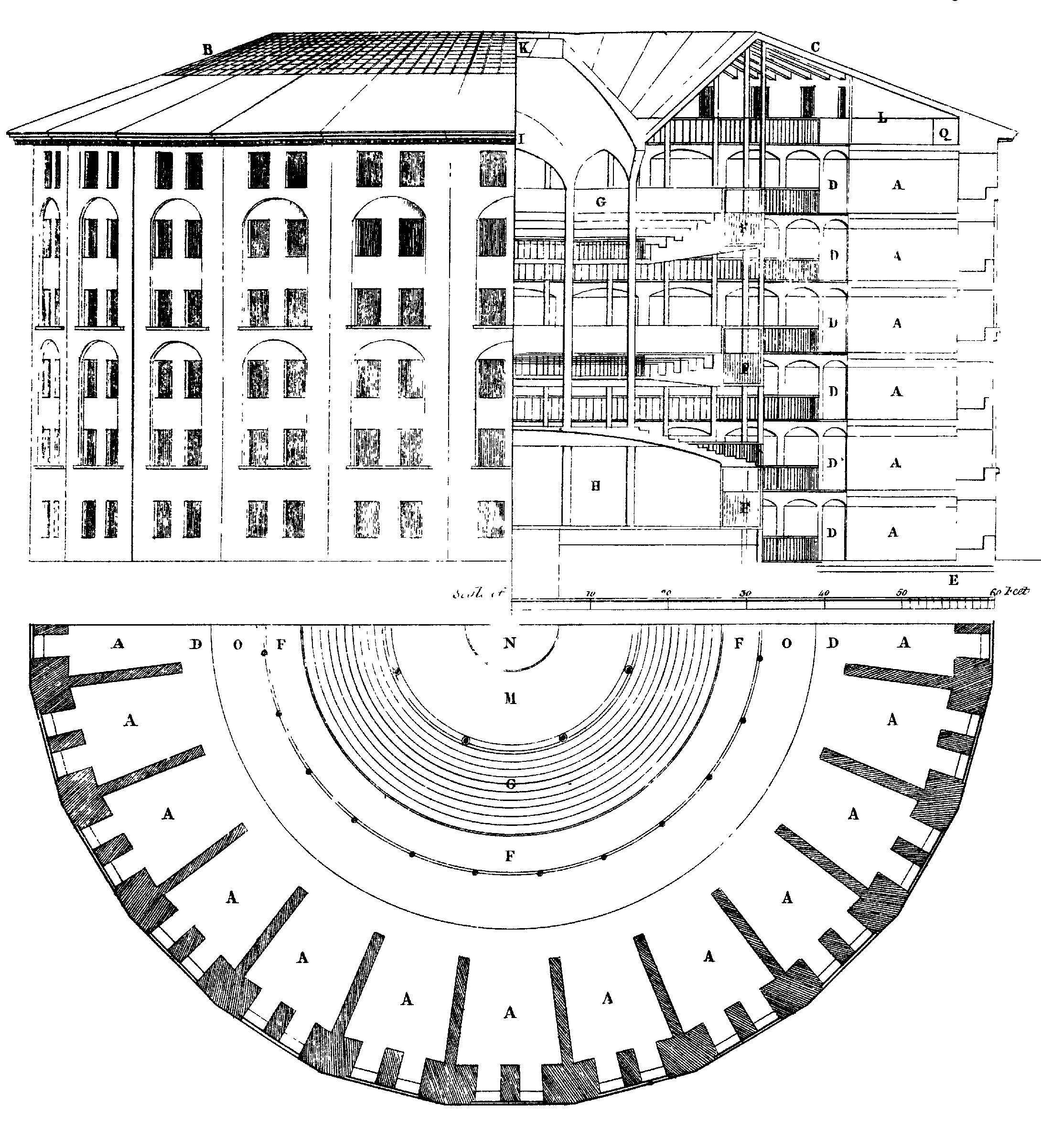
    The devices for producing the roles remind me of Jeremy Bentham’s panopticon, a functional prison designed so that all of the prisoners could be viewed from one central point.  The profile of the place reminds me of the geared punch machine for the piano roles; I’m not at all sure about what the function of the prison reminds me of.  But in the history of holes, I guess all it foes it fill u its empty holes with people, keeping them there for months or years or decades, and then replacing them with other people, part of a long and continuing series.

    File:Panopticon.jpg

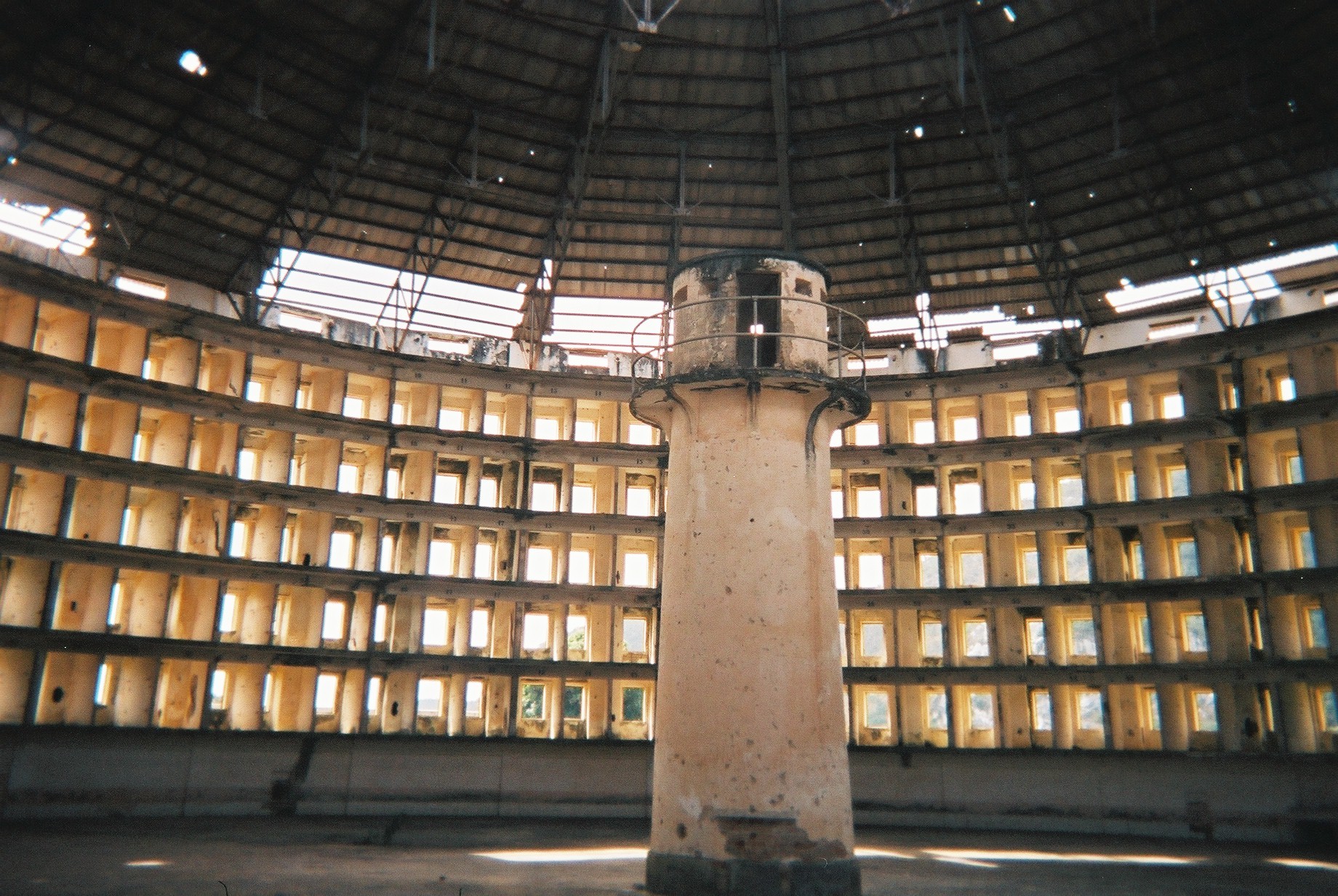
    Here’s the panopticonal prison at Presidio Modelo, Isla De la Juventud, Cuba–with the walls laid flat, and some cells filled-up, and reduced, you may be able to make a certain music with it, like reading the scores made by pigeons roosting on a five-wire-strung staff of utility poles. My daughter Emma just suggested that there could be a Morse Code crossover as well!)

    File:Presidio-modelo2.JPG

    The plan and elevation of these prisons relate to the player paino paper, like the early dots and dashes of communication, like the punched cards that Vonnegut had in mind when he was writing his early classic. 

    Now, the rest of the Illustrated London News story (available here on my blog bookstore):

      Music role making--1det872
      Music role making--3865

    Music role making--4866

    Music role making--4det870
    Music role making--5867


Recent Posts

Archives

Categories