A Daily History of Holes, Dots, Lines, Science, History, Math, Physics, Art, the Unintentional Absurd, Architecture, Maps, Data Visualization, Blank and Missing Things, and so on. |1.6 million words, 7500 images, 4.9 million hits| Press & appearances in The Times, Le Figaro, Mensa, The Economist, The Guardian, Discovery News, Slate, Le Monde, Sci American Blogs, Le Pont, and many other places… 5000+ total posts since 2008.

  • Virtuosic Apocalypticism: Maps and Charts of Nuclear Exchange, 1964

    JF Ptak Science Books LLC  Post 1214

    “…our choice of path may be delayed too long… “  Dante, Divine Comedy, Inferno, Canto XII, line XIII, 2nd level of Hell (envy).

    [This item is available for purchase from our blog bookstore, here.]

    March 3--cvr

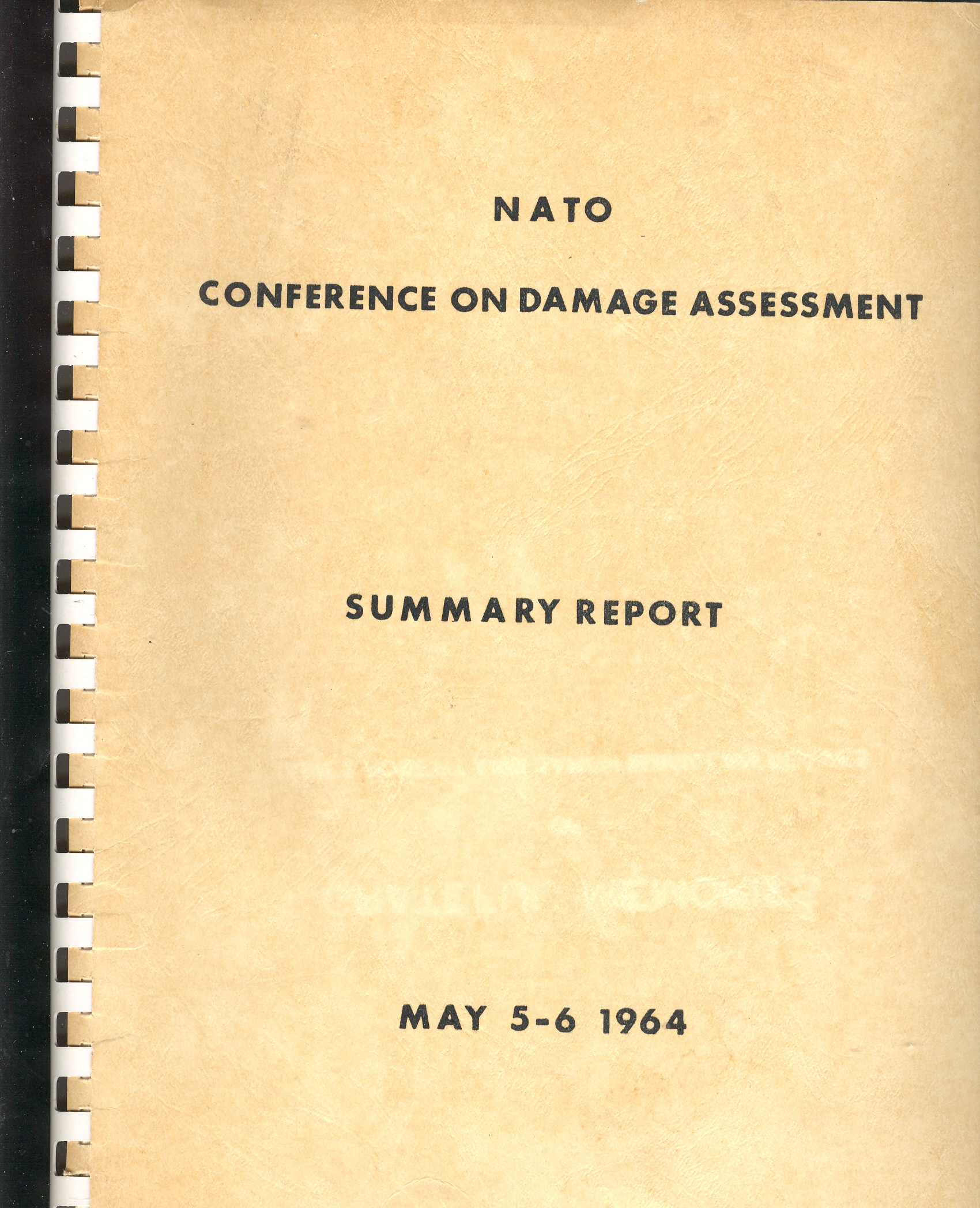
    The NATO Conference on Damage Assessment Summary Report (May 5-6, 1964) was not one written for its outcome, necessarily, but the means of getting there. The outcomes were highly differentiated levels of sameness, a strategic tour of Dante’s creation cataloging the layers of deep destruction like those of his funneling pit.

    Professionally  the paper dealt with several different ways of computing nuclear exchange scenarios (given names of understated inelegance like Jumbo, Brisk, Frisky, Dart and Dusk) with lots of smokily mirrored hocus pocus, the necessary ingredient of the philosophical technology of Mutually Assured Destruction. MAD.  Somehow it all worked out without any exchange ever happening. (The principal contributor here was James Coker, chief of the National resource Evaluation Center, Office of Emergency Planning, Executive off of the President, who I wrote earlier about here.)

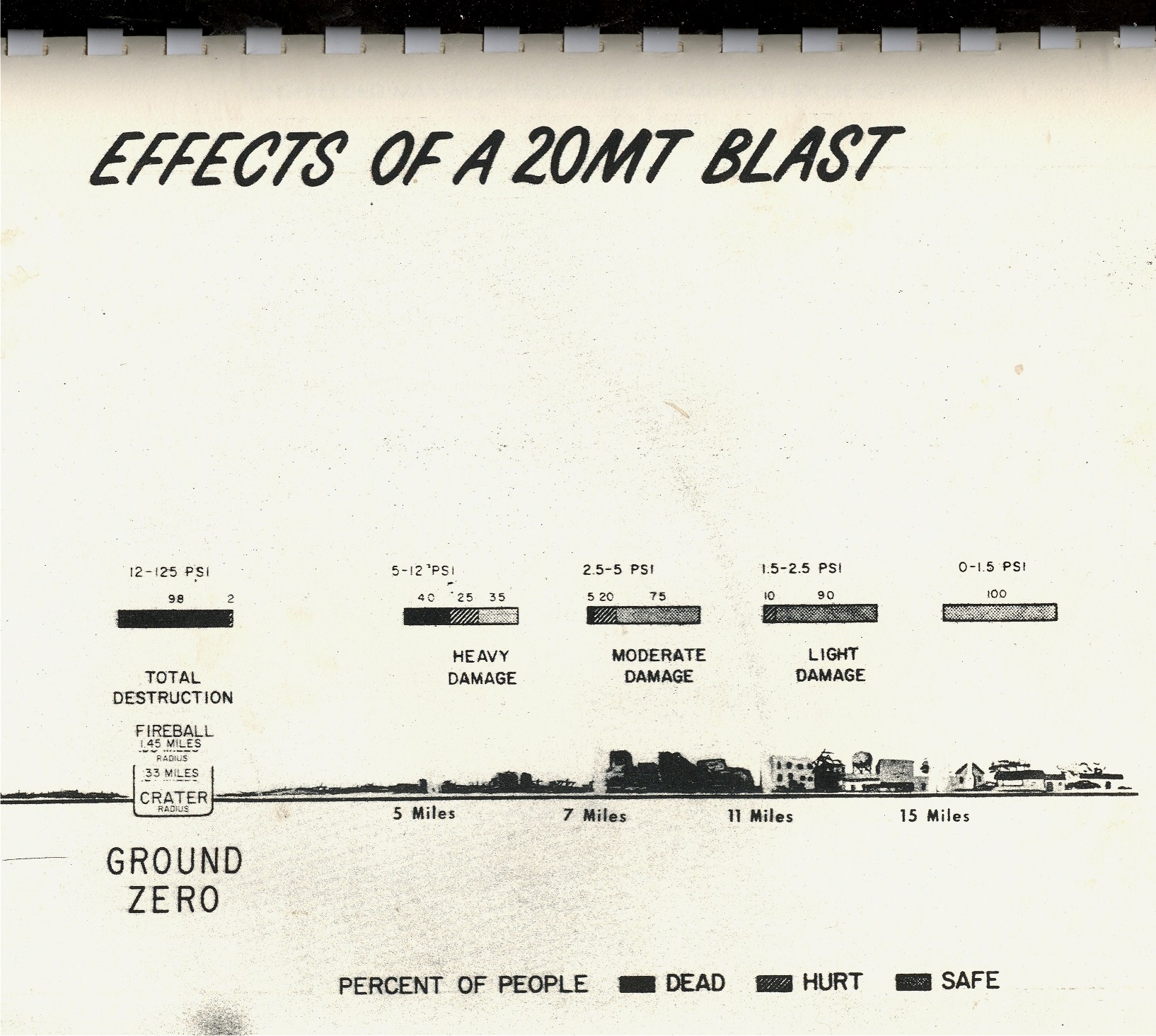
      March 3--20 mt blast“Which utterly with sadness had confused me,  New torments I behold, and new tormented Around me, whichsoever way I move,  And whichsoever way I turn, and gaze.”  Dante, Divine Comedy, Inferno, Canto VI, third circle, gluttony.

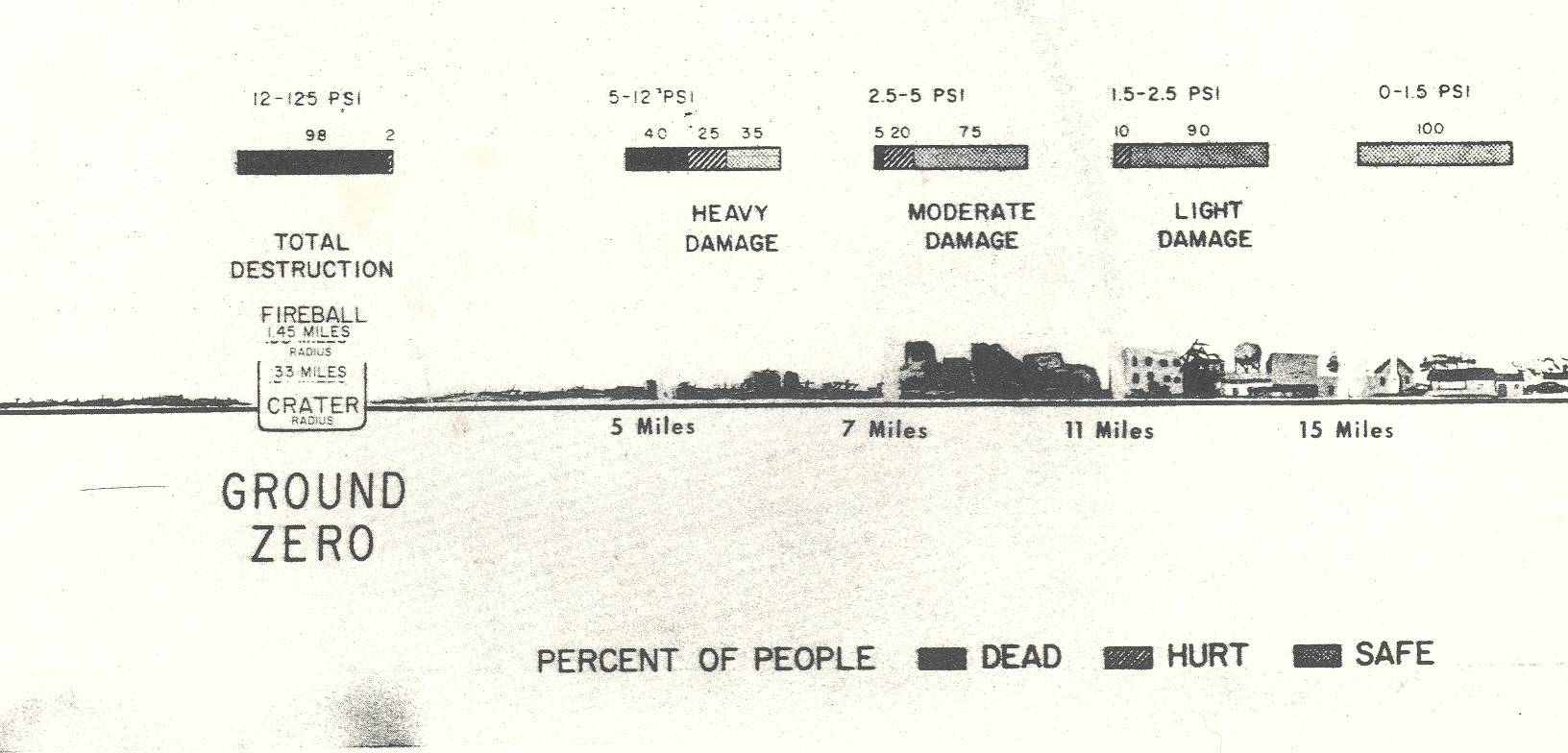
    The first image shows the effects of a 20 megaton nuclear blast detonated in in a city, presenting an incredible picture of absolute destruction, reaching out from ground zero for more than 11 miles.    

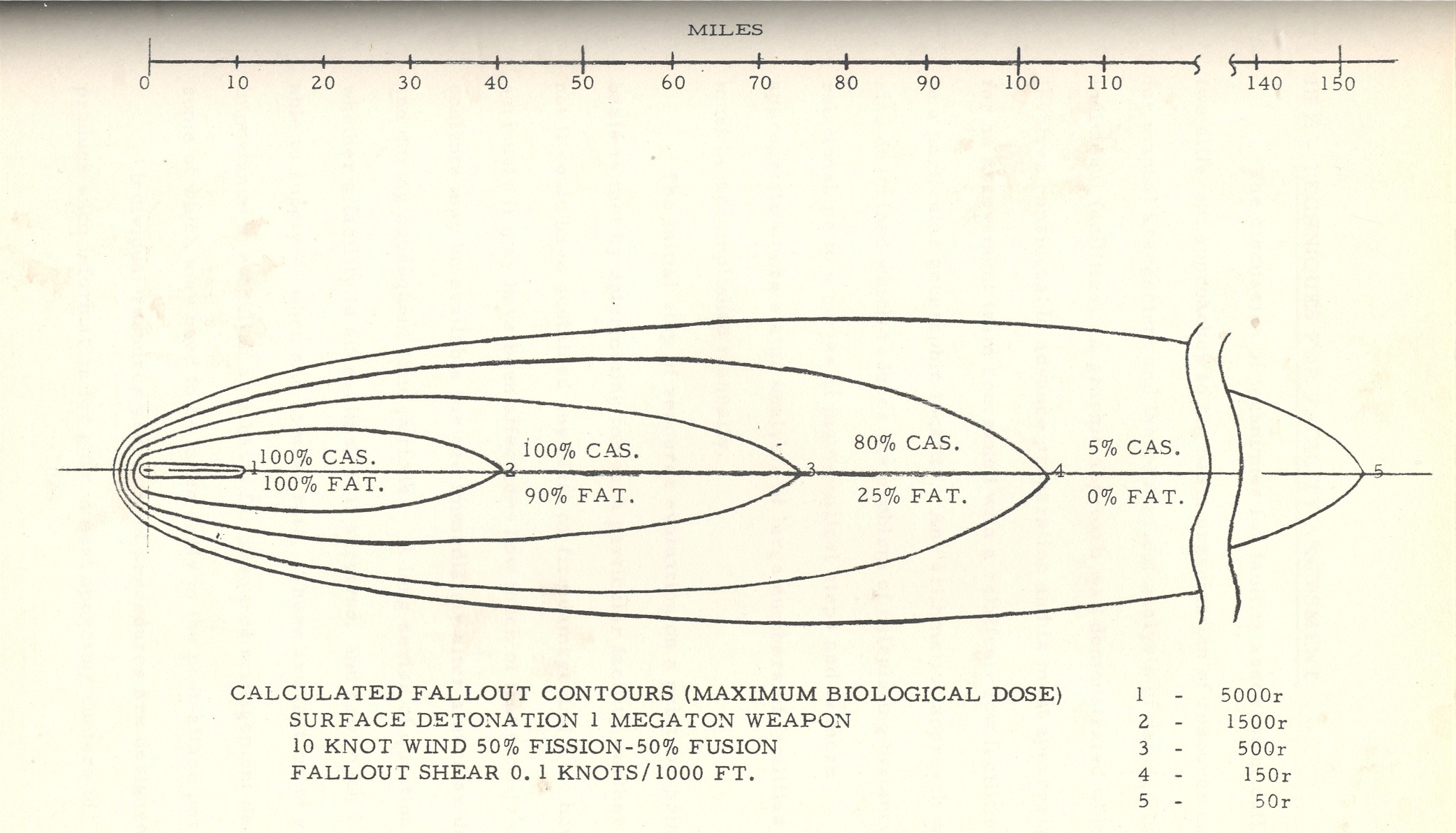
    This doesn’t begin to measure the overall damage inflicted by radiation, which is deeply, extraordinarily, severe.  This again is the effect of one weapon, the 100%  fatality rate eventually reaching out 12 miles; 90% reaching over 40 miles.  General casualties extend to 80% up to 70 miles from ground zero. 

    March 3--20 mt det blast
    March 3--spear


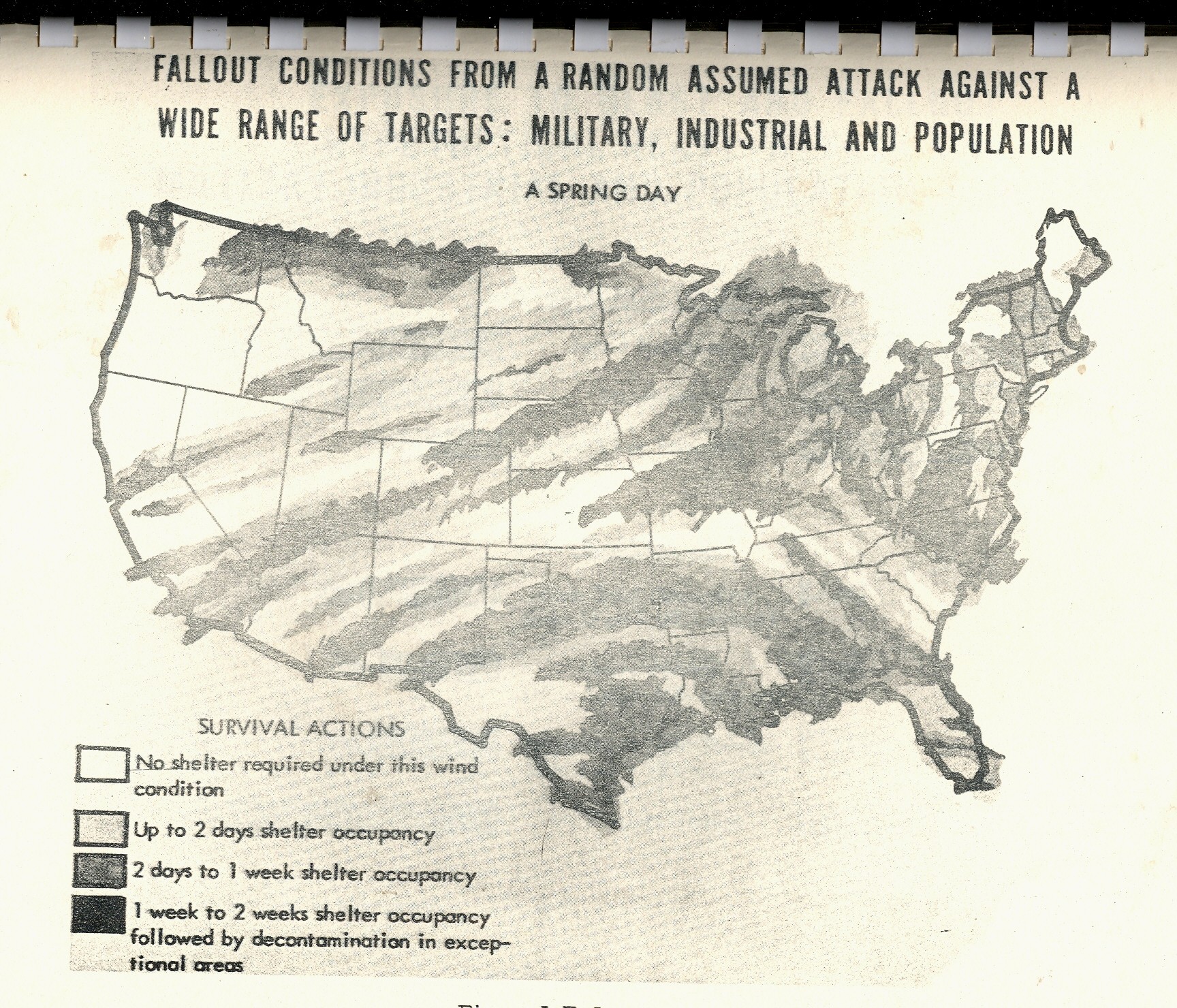
    The emergency planning end of the paper comes in at about this point.The fallout map of the U.S. shows a possible situation of an unspecified (though wide-ranging) attack (on a “spring day”) and its effects on the population as it is housed in various shelters and bunkers, suggesting the amount of time needed to “survive” the attack by staying inside the fail safe habitation.

    March 3--spring day

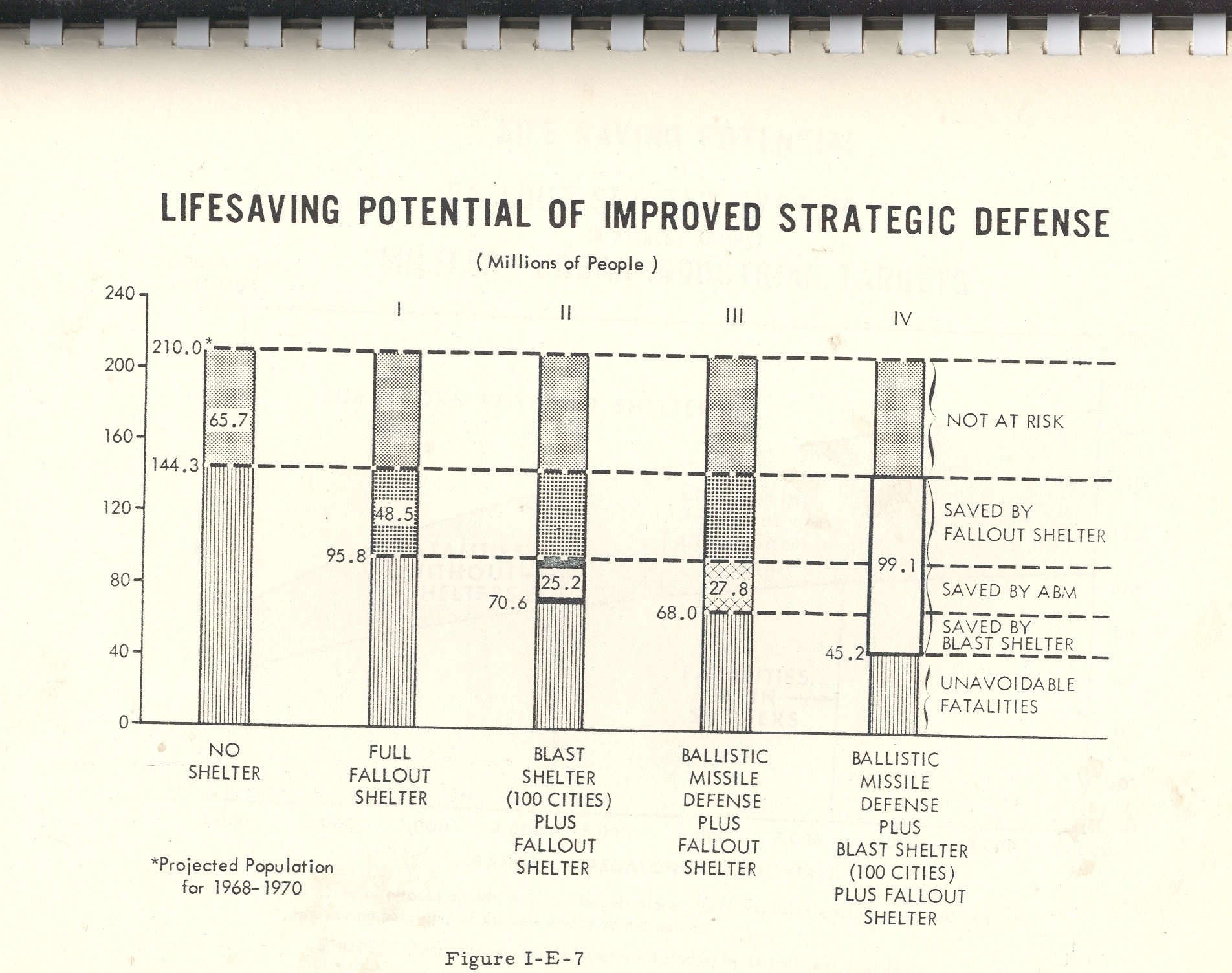
    The following chart, “Lifesaving Potential of Improved Strategic Defense” (in millions of people) shows the effect of the installation of the shelters and bunkers.  In this scenario, in  a massive strike, the fatality rate in the U.S. of an unprotected population was 65%, or 144 million.  On the other end of the extreme was “ballistic missile defense plus blast shelters plus fallout shelters”, or a massively- protected population of fictional expanse shows that in spite of all precautions 45.2 million people would die (as “unavoidable fatalities”). 

    “These have no longer any hope of death;  And this blind life of theirs is so debased,    They envious are of every other fate.” Canto III, Vestibule of Hell, the Opportunists.
    This document is nothing if not a death sentence had the massive strike ever been launched.  In the dozens of such reports that I’ve seen, there hasn’t been one with the Really Big One with thousands of euphemistically-named “exchanges”, which I assume would make all  of these others pale by comparison.

    March 3--life saving potential

    ·Posted by :

    ·in:

  • Quiet Images of Great Loss and Heroism–British Navy Losses, 1945

    JF Ptak Science Books  Post 1216

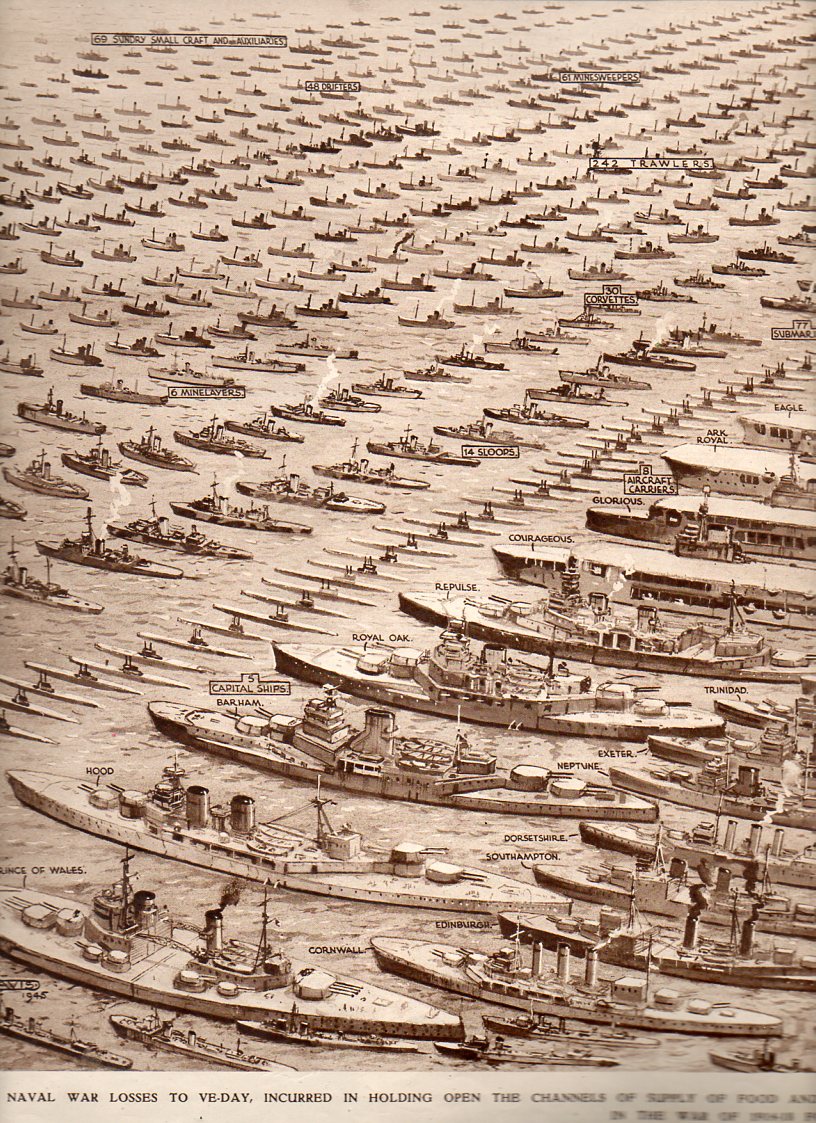
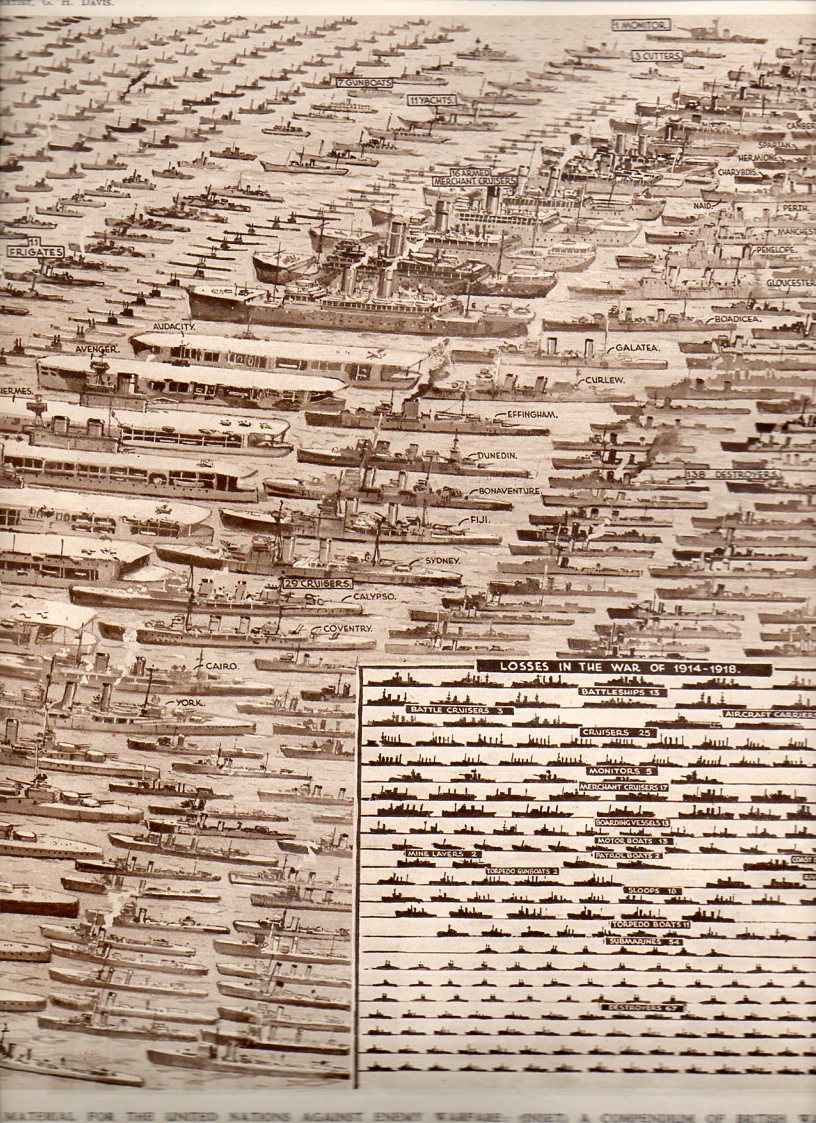
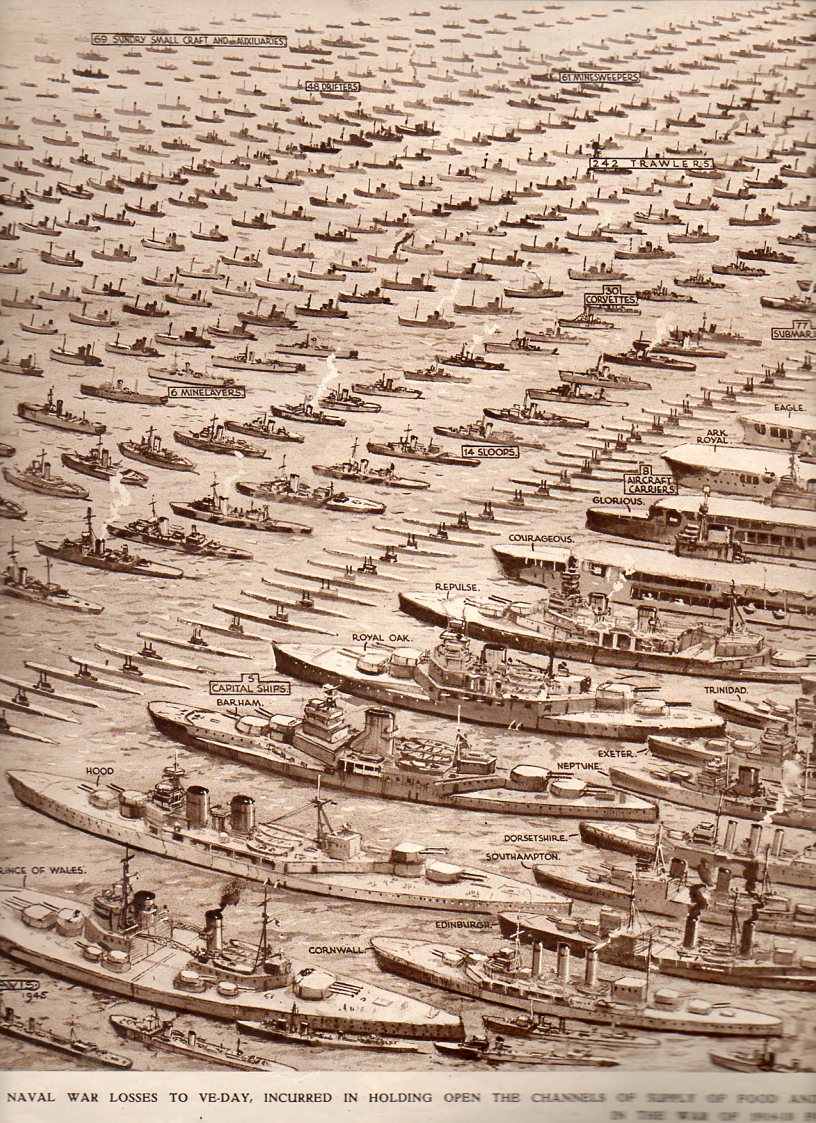
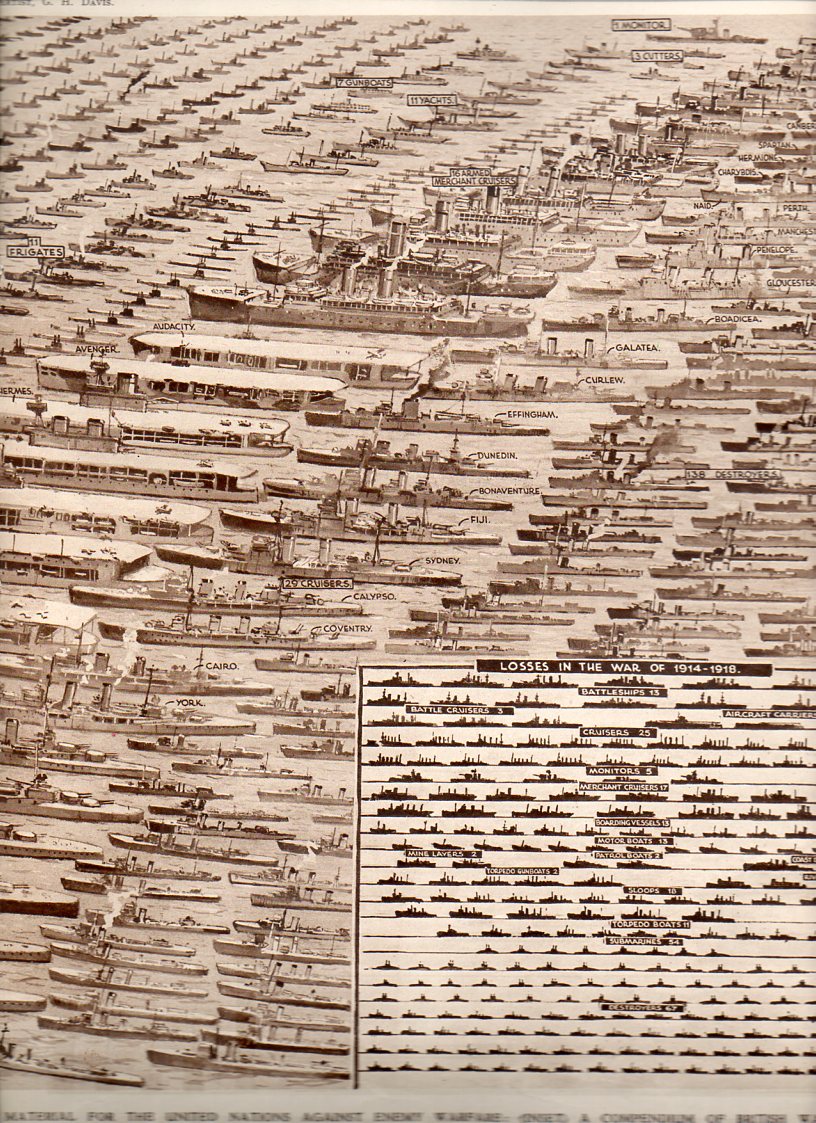
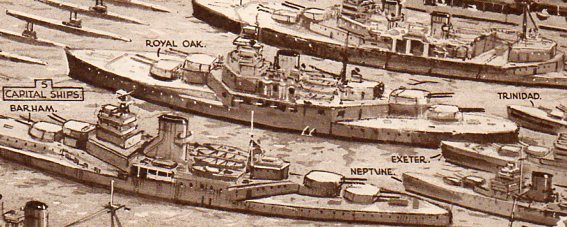
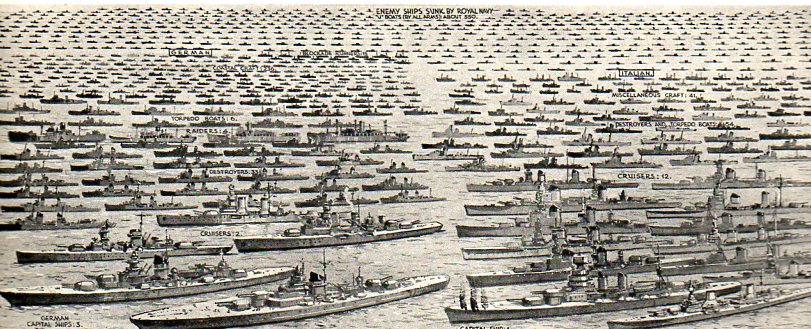
    This enormous, quiet image appeared in The Illustrated London News on 23 June 1945, just weeks after the termination of WWII in Europe.
    Navy Losses--left796 Navy Losses--right795

    It graphically presents every ship lost by Great Britain in the defense of “holding the seas against the Axis Powers…holding open the channels of supply and food and war material” from the outbreak of the war to VE day. The inset narrative states that there were on average nearly 3000 British and Allied ships at sea at any given moment, with the Royal Navy patrolling an aggregate  of 80,000 miles of trading routes, day in and day out
    Navy Losses--left796
    [This image is available for purchase–in the original and in a 30×40″ poster–at our blog bookstore.]

    It is a symbol of loss, of heroism, of lives not lived, of lives saved, of valor, of greatness, of will, of the cold black sea, of burning oil, of red waves, and above all, of sacrifice. Of splendid behavior.

    It is a terrible picture of what victory demanded of bravery.       

    It is as much an image of a military graveyard as anything else, a Remembrancer, especially for  those who were never recovered.  It is a grid, a finding aid, a visualizer, for all of those sailors lost in a sea that is indifferent to particular memory.

    Navy Losses--right795
    I can’t imagine how this image was received by the Illustrated London News reader on that day.  Did they suck their breath in at the scope of it, of the gigantic reminder of what all of those ships represented?  Was it the sort of image-reading that was forced, a white-knuckle, vacant-chested feeling of sweeping loss?  Of loss and gratitude?  Of gratitude and finding purpose for all of those sacrifices to the island nation?  I suspect that all of those words were in the minds of those readers in 1945–and also for emotions that have no words. 
    Navy Losses--left detail797

    Notes:
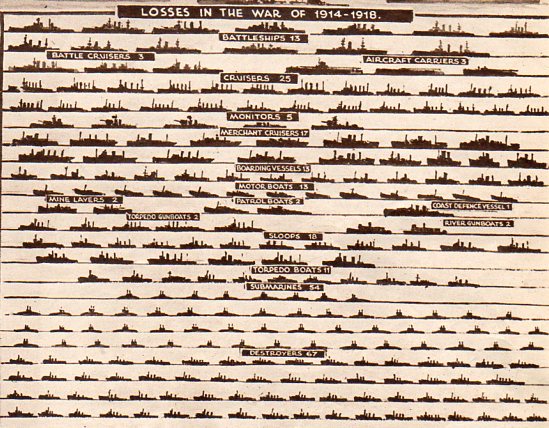
    There is also a small inset that shows in comparison the Royal Navy losses for WWI, 1914-1918. 

    Navy Losses--wwi798

    There is also this, an incredible single-page display of British merchant-marine war losses of 2570 ships.
                Navy Losses--merchant marine799

    Both images are the work of the incredible G.H. Davis, who provided cut-aways, cross-sections, maps, diagrams an all manner of information to the ILN readers throughout the war.  HE was an inexhaustible man of excellent design sense.

  • Cyborgs and Robots, 1920’s: Man as Machine and Machine as Man.

    JF Ptak Science Books   Post 1217
    [Also see my post on producing the geometrical man “Durer’s Beautiful Monster”, here.]
    I’ve written earlier in this blog about the advent of robots and human machines, and I’d like to add these two images to that thread.    Both are male, which is not horribly surprising since the earliest creation of a female robot belongs to the fertile Fritz Lang, who used his creation in his extraordinary movie Metropolis in 1927.  (Male robot-like creations go back fairly deeply into the 19th century; so perhaps the creation of female robots was verbotten because of the possibilities for unacceptable sexual fantasies in the high- and post-Victorian world, struggling under the weight of many and multiply-applied public inhibitions. Perhaps it was because of the possibility of sexual relations with an inanimate object that was the cause for one-gendered robots, or perhaps it was a fear of a powerful, intelligent, unstoppable, superior creation that was also “womanly”.  I don’t know.)
    Robot human machine817

    [Both of these images are available from our blog bookstore.]
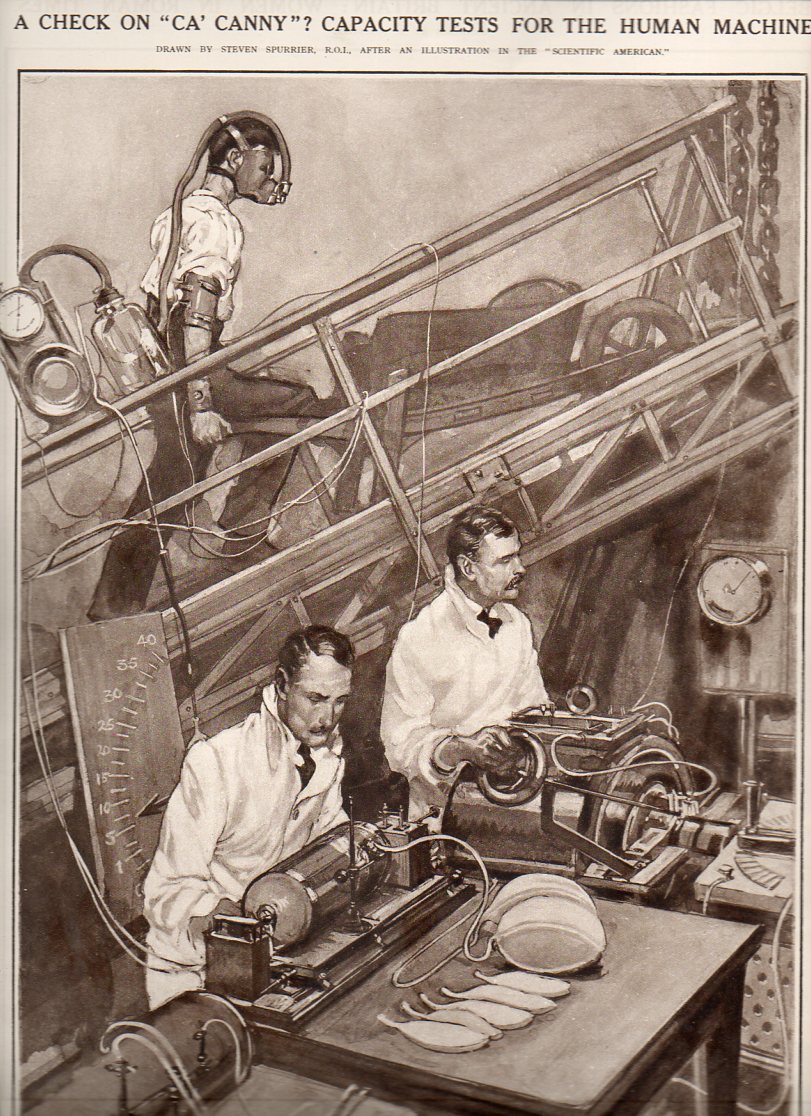
    The first is an image of the “human machine”, a cog-like adaptation of human workers in a Frederick Taylor-like The Principles of Scientific Management study, automatizing and industrializing people.  Though many people had written and worked around Taylor’s 1911 semi-revolutionary book (and not necessarily a good revolution, but one nevertheless), I’m not certain that I’ve seen the worker trussed up so before this, encumbered by so many technical testing elements as to make him look like a cyborg (though that term would still be a while coming into the vocabulary. 

    This image is actually testing a person’s energy expenditure while pushing a wheelbarrow on an incline, and utilizes the newly-created equipment of the French physiologist Langlois, which in 1921  may well have measured for the first time  the real-time changes in the rhythm of the heart and blood pressure, changes in body temperature and lung capacity of humans in an activity.  I have no doubt that the results would have been very interesting to cardiologists, and probably didn’t mean a thing to industrialists like Henry Ford, who would’ve plowed ahead with their demands on their workers regardless of what tests said, schedules being schedules and all. 

    Robot steam816

    (I’m no tsure where this experiment fits in, historically speaking, even within the context of biological advances for that very year.  Frederick Banting was able to do some pretty nasty stuff to dogs in a basement lab somewhere at the University of Toronto and come up with a successful treatment for diabetes mellitus–insulin, which would save the lives of millions and earn Banting a Nobel two years later.  In the quasi/fake biological arenas came two biggish events: Jung’s creation of the concepts of introvert and extrovert, and Hermann Rorschach’s one-way conversational device for detecting psycho-pathological conditions (in people).  I suspect that the Langlois data would fit in there somewhere along the rough edge of Jung and Rorschack, if only because the data was real.         

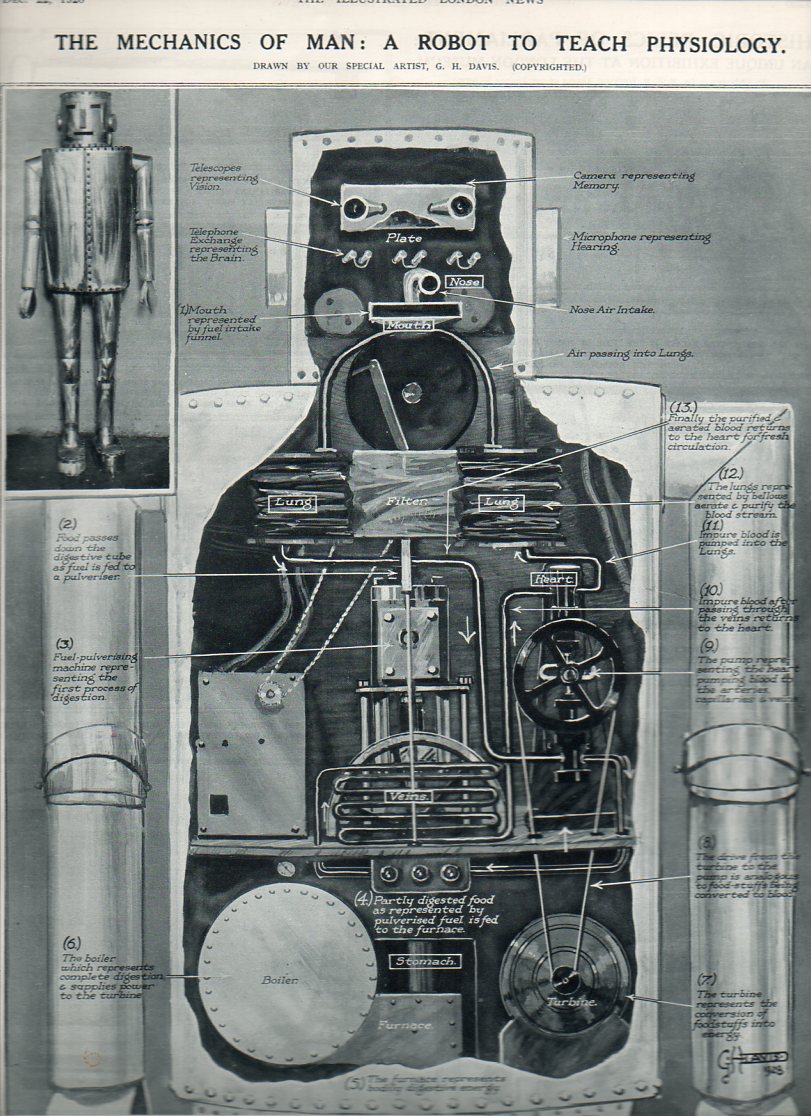
    The second image is in a way a reverse sequence of the preceding–an out-and-out robot that was being used to teach human physiology.  In this case, the robot was a steam engine, constructed for the Schoolboys’ Exhibition at the New Horticultural Hall for 1928, perhaps under the  influence of Karel Capek’s newly published drama R.U.R., which coined the term “robot”. The biological functions of humans were reinterpreted along a more user-friendly vocabulary of the steam engine, using pumps, boilers, hinges, belts, pulleys, filters, compressors and a furnace to explain the functions of respiration and circulation.   It was an interesting approach to show these functions on their most basic level–and in less than 75 years, many of these mechanically represented organs were actually replaceable by real mechanical units performing the same task as the biological (as in the heart), while others could be replaced (via transplant).

    Man as machine and machine as man.

  • The “Non-Violent” Ultimate Weapon Successor to the IBM? RAND Report, 1957

    JF Ptak Science Books LLC  Post 1218

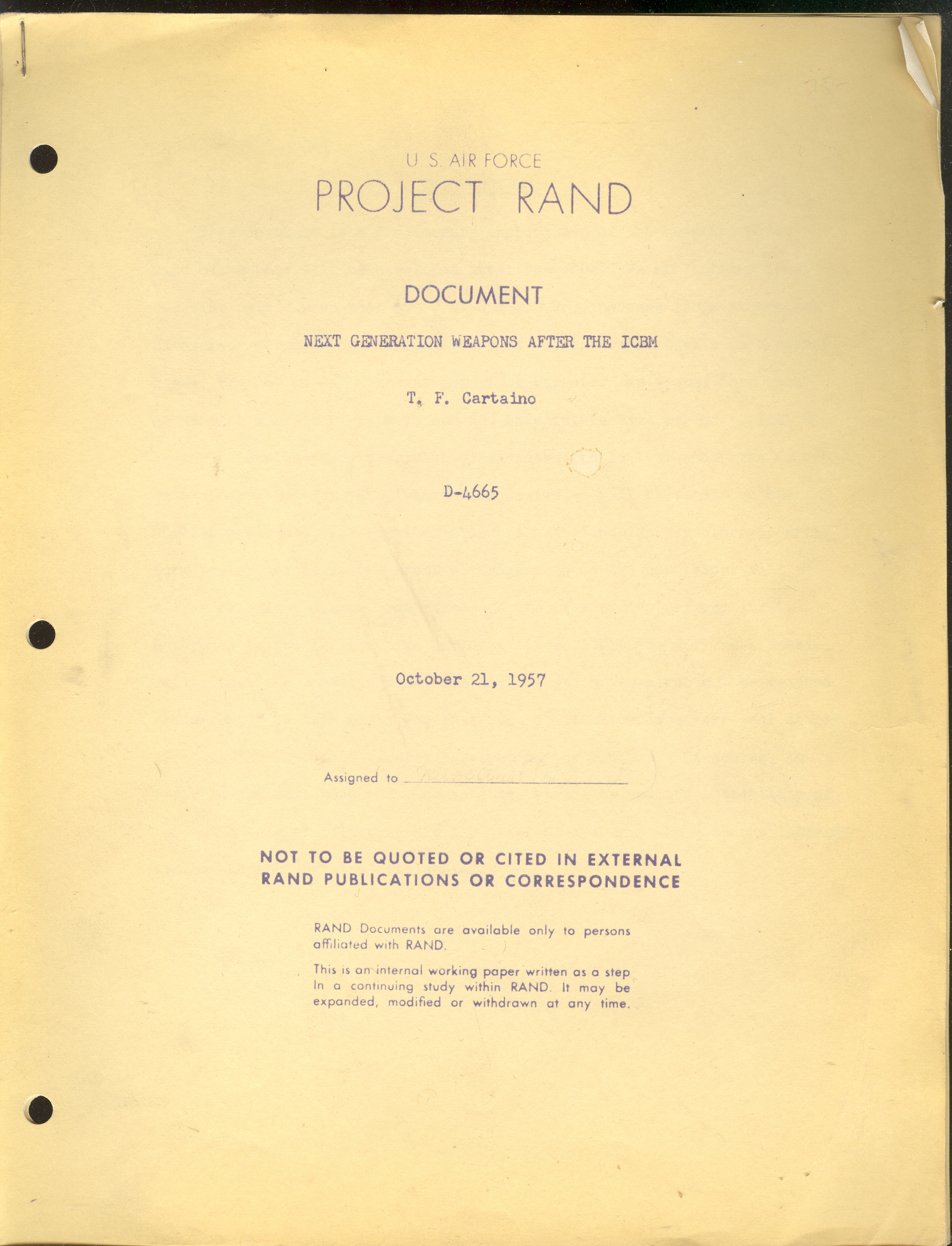
    +()+ebay icbm The RAND Corporation (Research And Development) is a think tank originally formed in 1946 by the US Army Air Force as part of a contract to the Douglas Aircraft Company.  After 1948 RAND Corp was funded by a number of different sources, private and governmental, and left the sphere of being a direct arm of the  U.S. military. (Maybe.)  It still did enormous amounts of work on behalf of the military, and seems to have been their chief  theoreticians during this period.  It was also the time that the policy of Mutually Assured Destruction (MAD) was formulated at , partially under the direction of we’ll-see-him-again-down-the-road Robert McNamara.  And of course much else.  [This pamphlet is available for purchase from our blog bookstore.]

    This publication is an internal RAND document, not meant for the eyes of the outside world, at least in 1957.  I own a number of these reports, and I must say that this one is odd—it is rather flippant, sometimes oddly and darkly (dare I say it?) funny.  It is also short (four pages) and gets to the very meaty part of the issue immediately.  The author(s) assume that the US and the USSR will have achieved a point of stasis such that it would make absolutely no sense for either actor to actually employ their arsenal (and excluding “the possibility of the button pusher ‘flipping his lid’ “.  The paper attempts then (“let’s jump right in and assume we find ourselves in this stalemated period”) to envision the next kind of war in which the ICBM would not be an active factor. “We therefore postulate here that the kind of war we will be engaged in…in the period of nuclear stalemate of the non-violent war, the opening phase of which has been called the cold war.”

  • Display of Quantitative Data: What was Left of the Japanese Navy, 1945 [Short Post]

    JF Ptak Science Books    Post 1220

    Japanese sinking detail

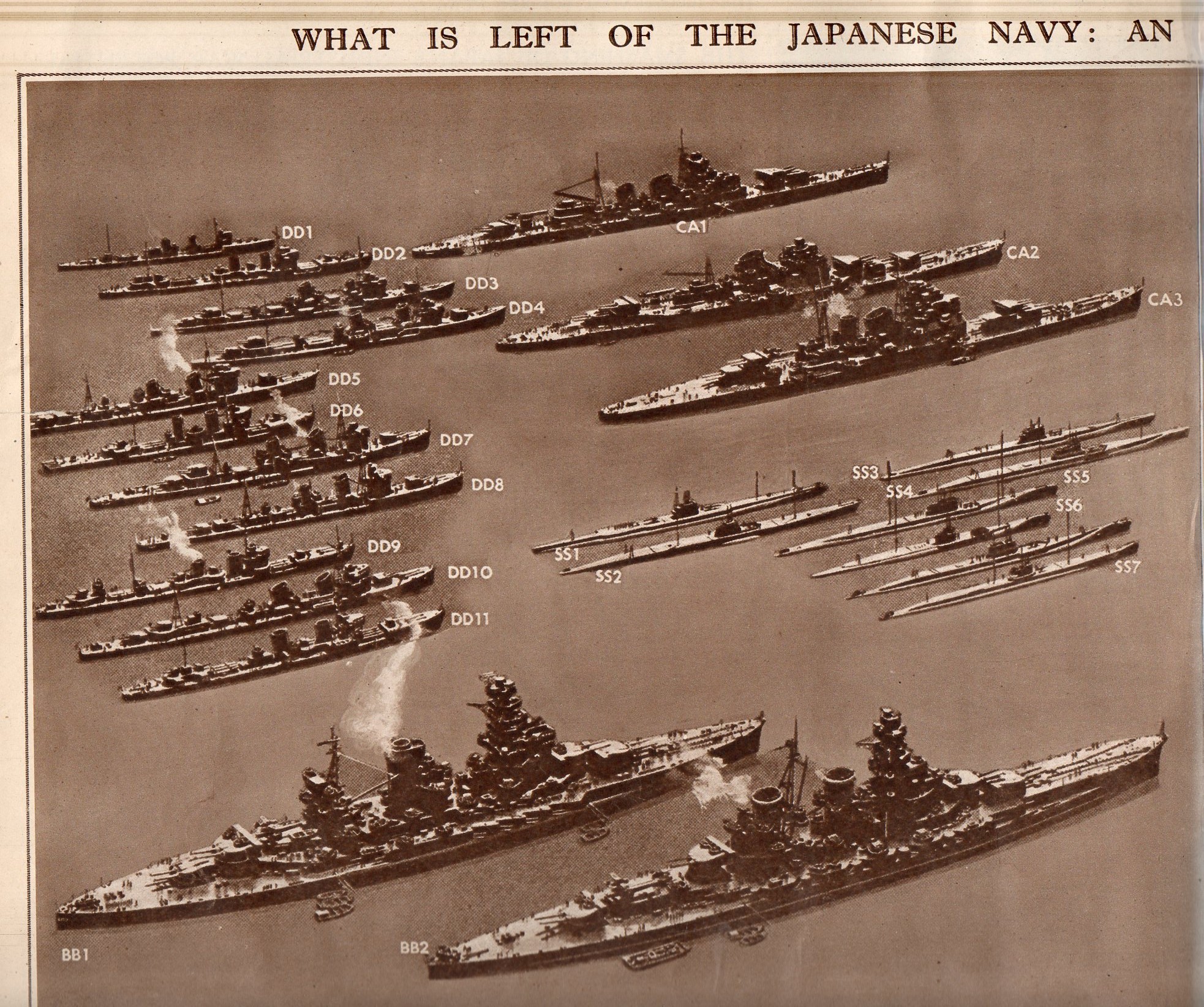
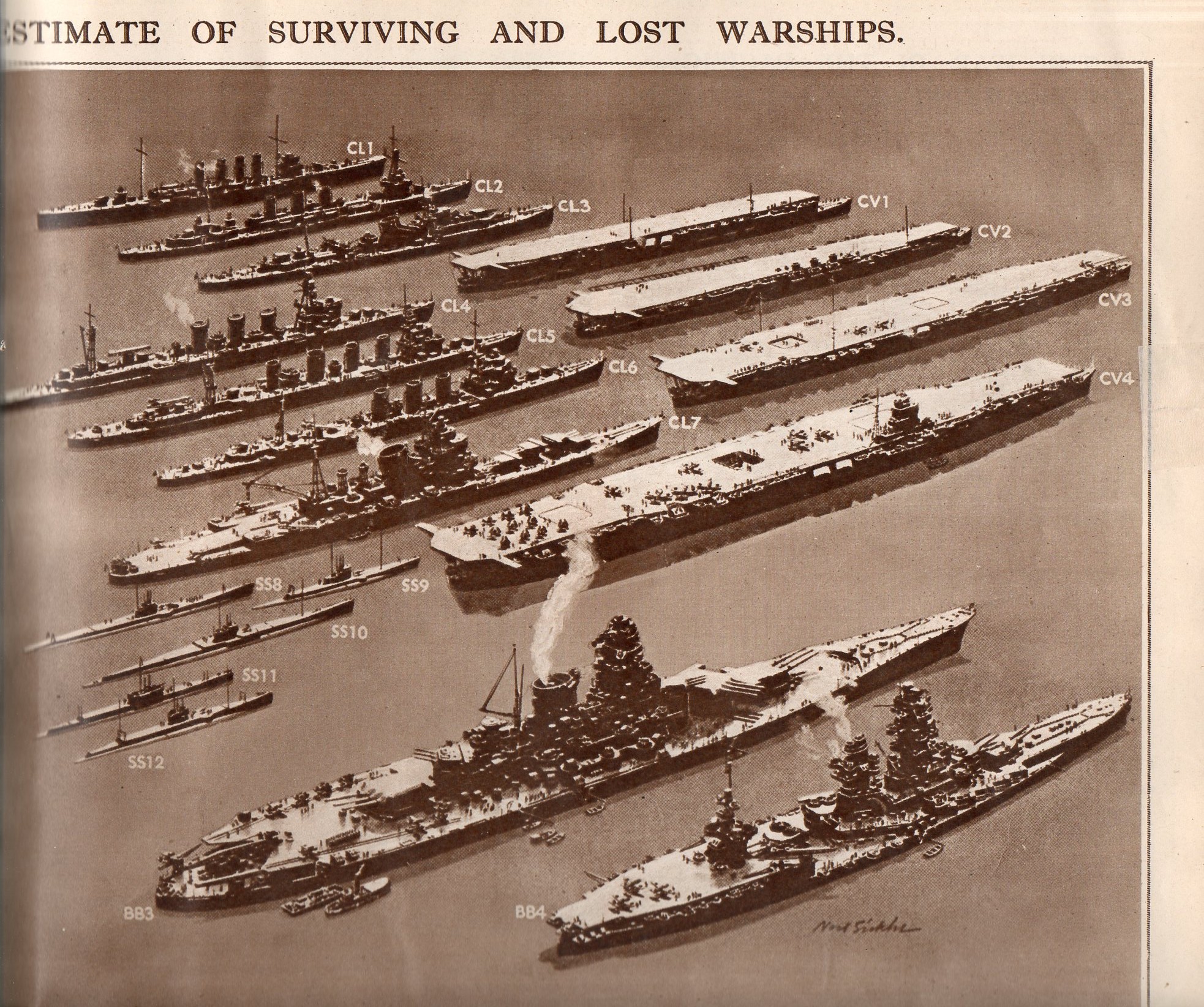
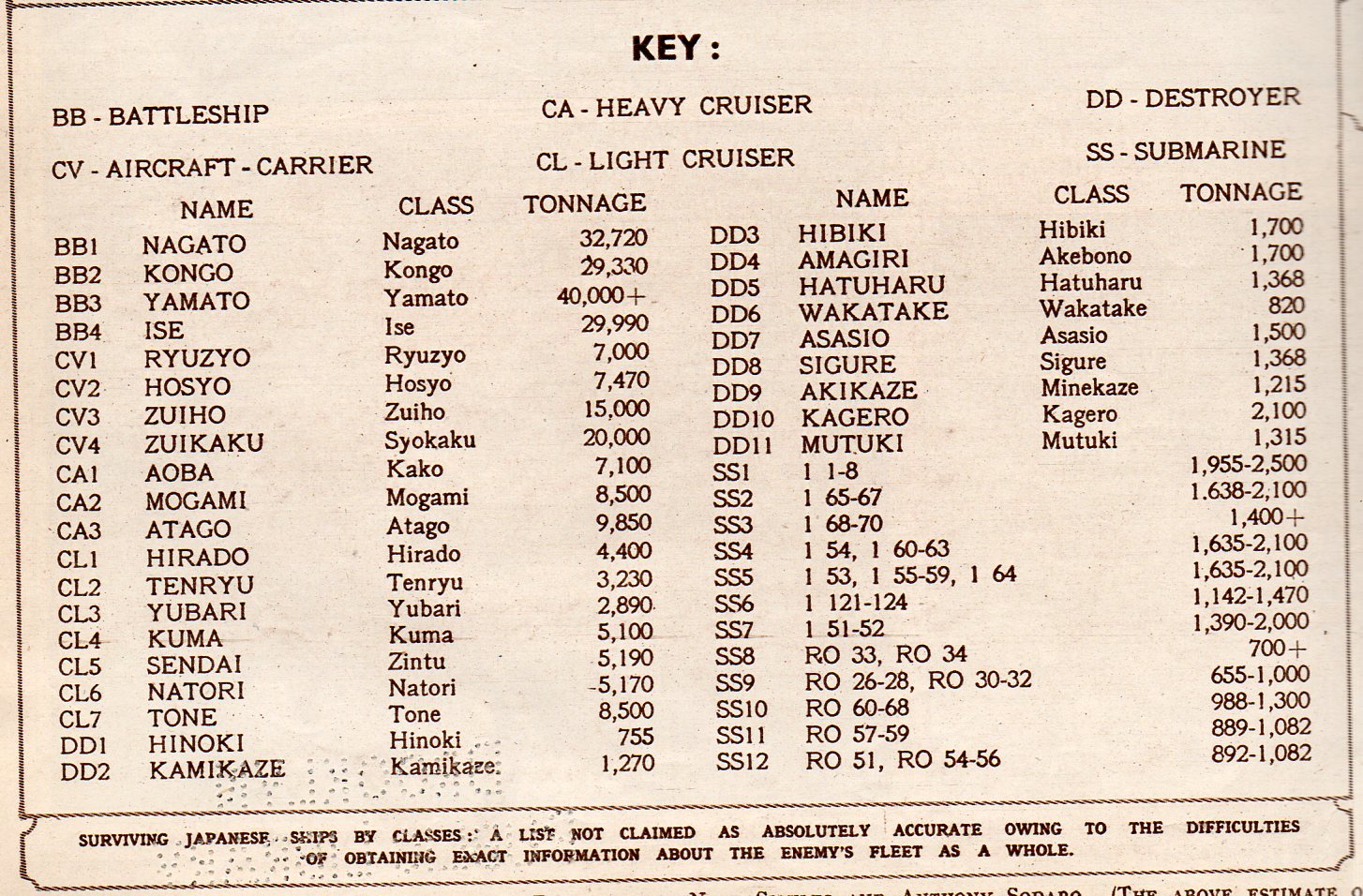
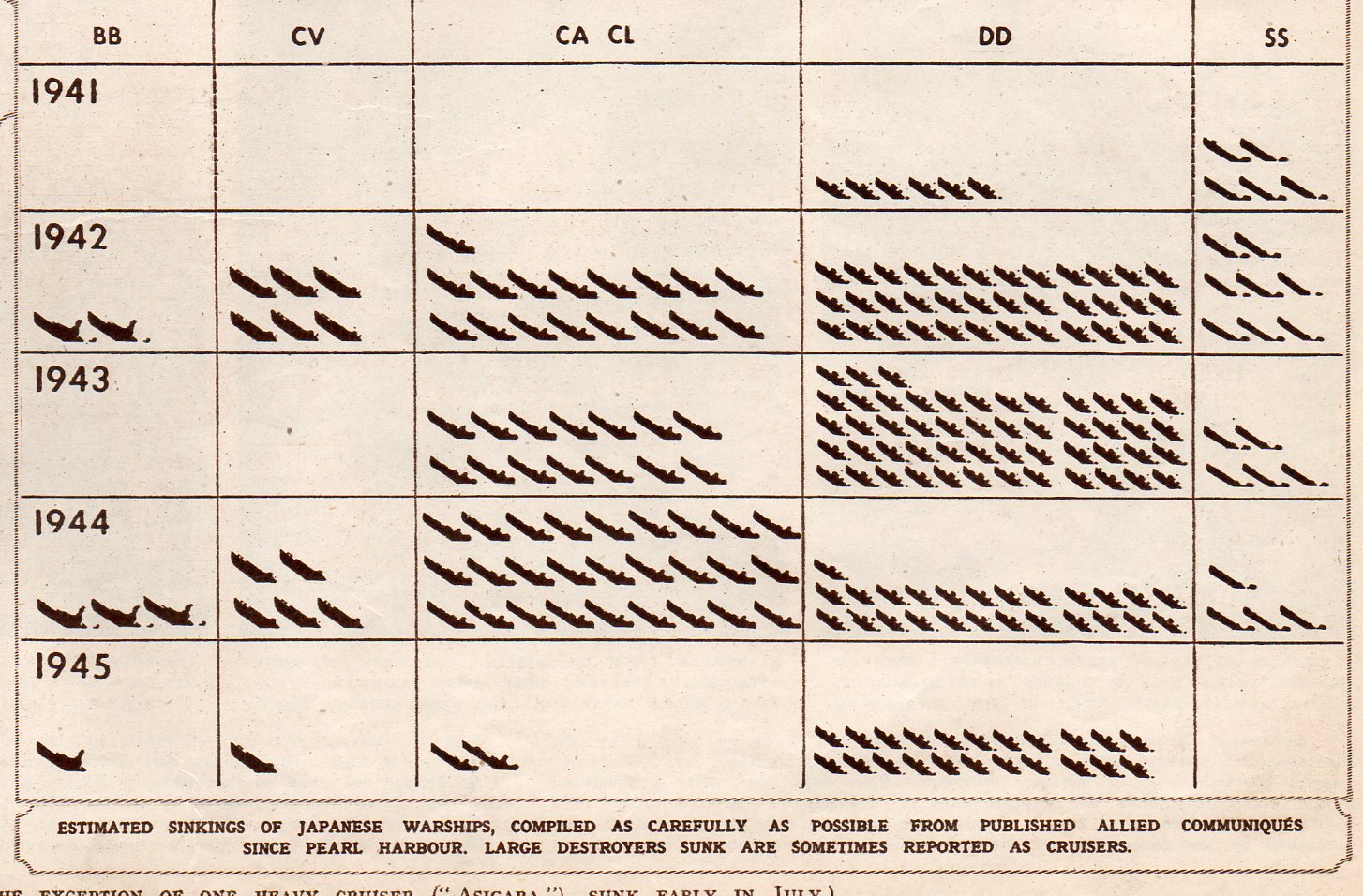
    This double-page spread in the Illustrated London News for 28 July 1945 displays what was left of the Japanese Navy.  Originally appearing in LIFE magazine a few weeks earlier, the image represents classes of Japanese naval ship, multiplied by the estimated number of ships in that class.  Even after all of the great  losses of 1942/3, the Japanese Navy was still the third largest afloat. 

    The navy consisted of an estimated 10 battleships, 6 carriers, 15-30 cruisers, 60-80 destroyers,and an not-estimated number of subs–or at least that is what was being published as the case in LIFE/ILN.

    This is an excellent display of a significant amount of historical data, made quickly understandable to even a quick reader, or even to a non-reader.  Two weeks from this date would find this information about the remaining Japanese Navy to be beside the point.

     Japanese Navy 1205 

    Japanese Navy 2206

    Japanese Navy 3207

    This chart shows the numbers of each class of vessel sunk by year:

    Japanese Navy 4208


  • Buckle-Up for the Nuclear Holocaust–The Fat Man’s Big and Terrifically Bad Idea

    JF Ptak Science Books LLC  Post 1221
    ==Blog July 27=wiener title

    Atomic and Nuclear Weapons   and The History of Bad Ideas series

    This is one of those ideas that just went viciously bad on contact, turning into an enabler of  the very thing that it was supposed to help prevent:  turning the Easter Bunny into Dr. Strangelove.  In the History of Bad Ideas, this one is top-tier. 

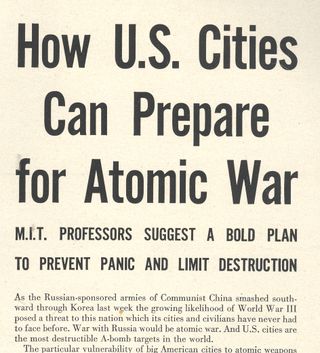
    LIFE magazine published “How U.S. Cities Can Prepare of Atomic War:  How M.I.T. Professors Suggest a Bold Plan to Prevent Panic and Limit Destruction” in their 18 December 1950 weekly issue, just in time for Christmas.  The plan was a partial response to the dire situation faced by the U.S. in Korea and the growing threat of China and of course the Soviet Union’s nuclear arsenal.  The government recognized that there was little planning in place to deal with the outcome of possible nuclear attack, and established the Federal Civil Defense Administration to help deal with the “problem”.  The problem  was how to make U.S. cities somewhat prepared to deal with being bombed with nuclear weapons—given that cities had a hard enough time dealing with 5:30 pm commuter gridlock, throwing a hundred megatons of explosive power into the equation made things more difficult. 

    ==Blog July 27=wiener left

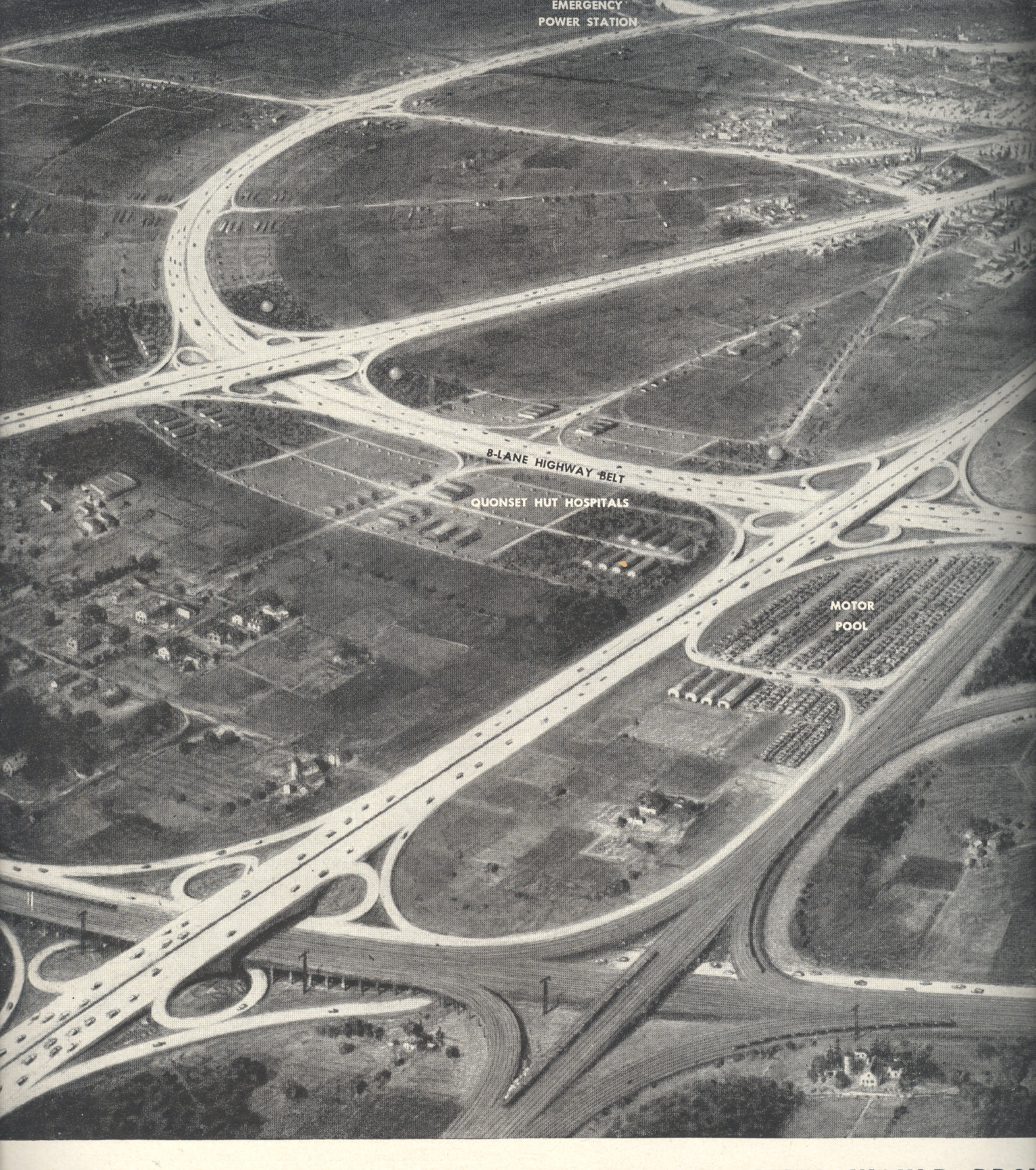
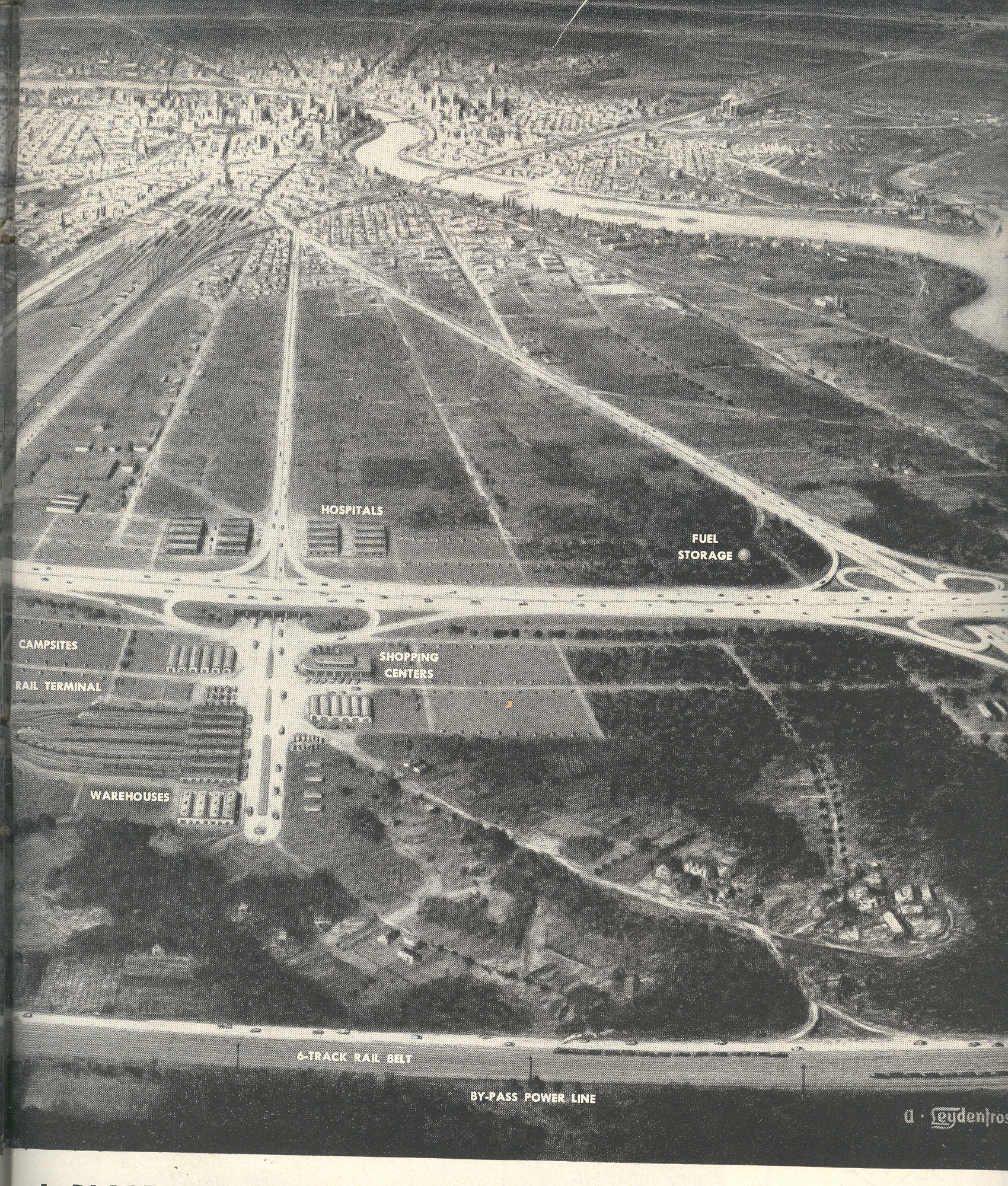
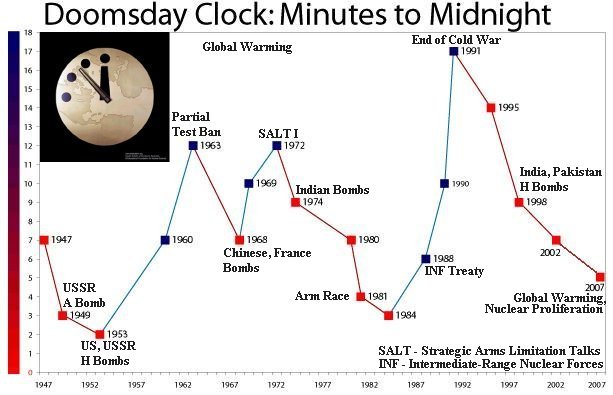
    One reaction was to construct concentric outer highways around metropolitan areas, “life belts around cities (which) would provide a place for bombed-out refugees to go”. In the birds eye view provided here, we see the plan in action, the main parts of which are an 8-lane “express” highway belt 10 miles away “from the built up edges of the city” , and a 6-track railway belt five miles further out, these accompanied by various feeder arms stretching straight-away from downtown.  In between the two outer rings would be land that would be kept free of development, so that farms and tent cities could be constructed after the attack. There would also be major collections of hospital and fuel depots in the greenbelt area.  Infrastructure would already be in place (gas and electricity, supplied with power from who-knows-where).   Shopping centers and a giant “motor pool:” would also already be in place, waiting for the Doomsday clock to strike midnight. 

    ==Blog July 27=wiener right

    One of the overwhelming presumptions here is that the interspersed green life living within the concentric rings of escape and transport routes would survive the attack. As would the highways.  Why on earth wouldn’t that infrastructure be attacked as well? Given the proliferation of weapons, it would seem highly unlikely that The Aggressor would target just downtown areas of major cities—they would of course have to include the safespots as well. Not that there would be that much of a change in targeting parameters:  exploding a series of 1 or 5 or 10 megaton warheads over a city like the one pictured here would pretty much decimate anything within the 15-mile life zone set out for survival.  With weapons in this megatonnage range, we’re talking about an explosive force that would be inconceivable, even using the Hiroshima explosion as a currency.  It is hard to imagine what happens when you deliver 3 or 4 5-megaton weapons to a city like this; when each of them would have the explosive force of 5,000 or so Hiroshimas, it is pretty clear that nothing will be left.

    This planning gap reminds me of the question dealing with UFO running/landing lights:  why are they there?  Even assuming a modest strike in the kiloton range (which simply would not be the case) why would these defensive structures not be a target, particularly, oh dear sweet creator, since they would actually be forming an enormous target, and one that even a half-blind flying pig could find from altitude? Ultimately, it wasn’t a good question to ask because the answer would reveal the helpless, soulless situation for what it was.  It was precisely an adult version of the ‘duck-and-cover” cartoons that showed the good students who got under their (wooden) desks being shielded from the atomic nastiness that just knocked down their school.  And of course these concentric evacuation and mobilization rings, even if they had miraculously survived a purposely modest attack, and even if they actually worked to handle the flow of millions of people in their eight lanes, and even if all of those millions driving these highways didn’t have any accidents that would choke the flow of traffic (and on and on), we still haven’t approached the radiation question.  For it was in the greenspace between the two concentric rings in which tent cities for the evacuees and homeless would come to life, some ten miles from ground zero (if, again, they weren’t themselves directly bombed with weapons in the megaton range). 

    So, in short, the way that these efforts would work is if (a) there was a lot of lead time to the attack, (b) everyone left the city in an orderly fashion, (c) nobody had any traffic choking accidents, (d) there was no radiation, and (e) one and only one “antique” nuclear weapons was used in the attack.  Given these parameters, the plan just might work. 

    One of the authors of this not-particularly well-thought or original idea was in fact a great and original thinker; this enormous and costly and not effective plan was certainly not one of his best moments.  Norbert Wiener (1894-1964), one of the co-conspirators of this idea, was a boy genius who grew into an adult genius, and that growing part didn’t take long at all.  He graduated with a Harvard Ph.D. in 1912 at age 18 and went on to a distinguished early career as a logician, studying under Russell and Hardy and Landau and Hilbert.  He left that part of his life mostly behind by the end of WWI, dedicating  himself to mathematics.  One of Wiener’s great accomplishments was (during the early stages of WWII) designing the capacity for anti-aircraft guns to be self-aiming, improving their accuracy (and effect) immensely.  This was the foundation of his communication theory which became the basis for his creation of cybernetics, a superior creation with vast applications over many fields. 

    By the beginning of the Cold War, Wiener became a pacifist, leading him down a dark and murky road to this “life belt” idea.  Perhaps this approach had precisely the wrong effect:  by lending the idea of sustainable and orderly survivability to nuclear war might have led people top believe that nuclear was survivable; and if there is a game played in which its two players are not necessarily both losers, then the specter of “winning” a nuclear confrontation with the Soviet Union becomes a possibility, making the whole idea of fighting with nuclear weapons feasible. 

    Doomsday

    I’ve not a clue as to what the great Norbert Wiener was thinking when he worked this out; even as a (and perhaps “the”) math guy,  the numbers just don’t add up. 

    When I put on my Jorge Borges x-ray specs the plan looks prettier, and of course involves libraries.  The outer concentric circles are still there, as are the green spaces, and the express/democratic ways of getting there; but what you would find there, on the highway ring, would be a series of libraries and dataports, and endless stream of books, and words, and numbers. 

    Addendum:

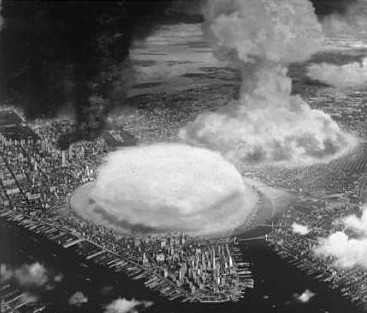
    One of among many things that I didn’t discuss above was the placement of such a greenbelt/lifebelt system for cities like New York, or San Francisco, or Los Angeles.  As we can see in the depiction of a nuclear attack on NYC from Collier’s Magazine (1948) there’s sorry little area for that highway ten miles out from 42nd Street…

    Atomic nyc

  • Strange Things in the Sky Department: Aircraft, 1919

    JF Ptak Science Books   Post 1222

    Blog--May 20--minerveA

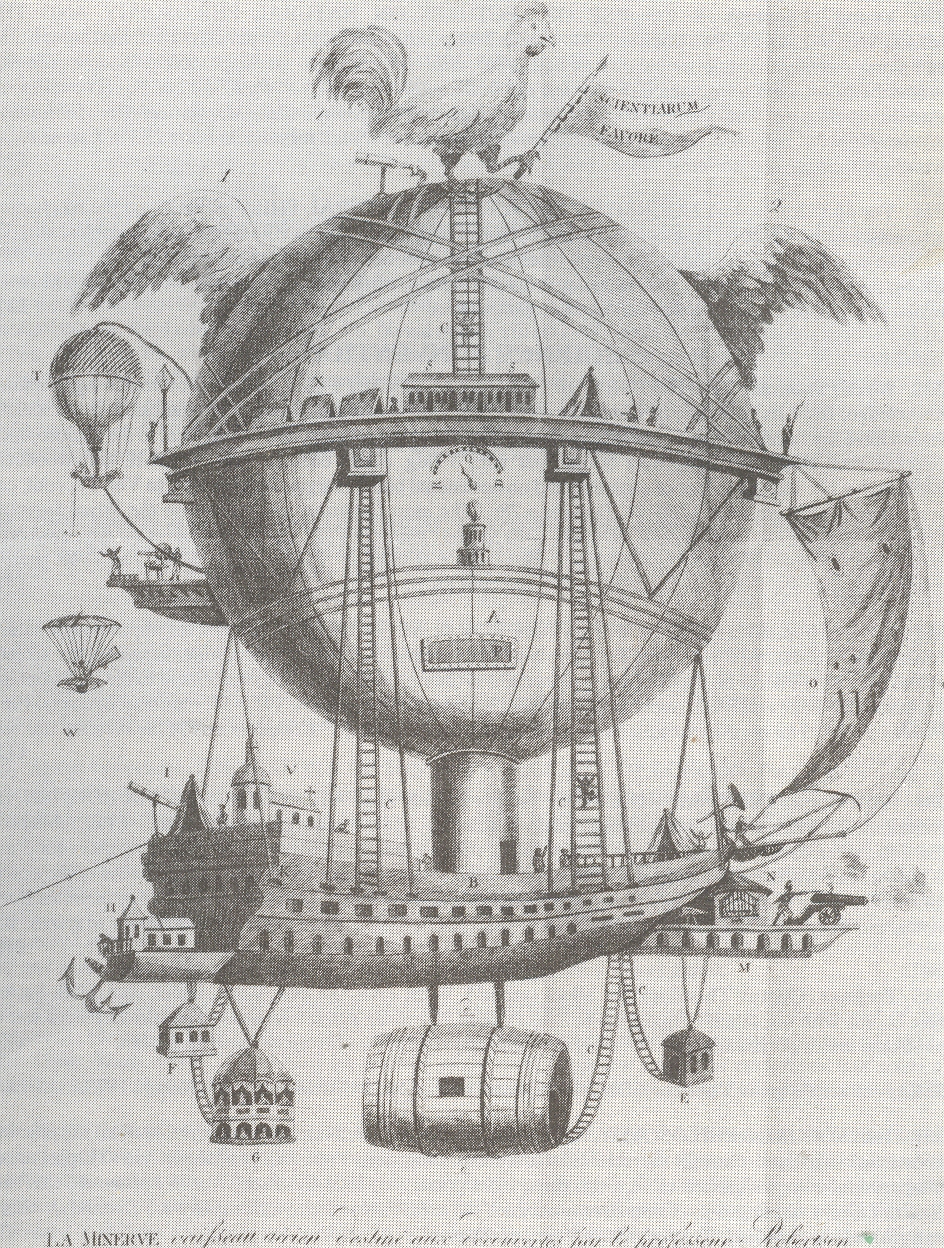
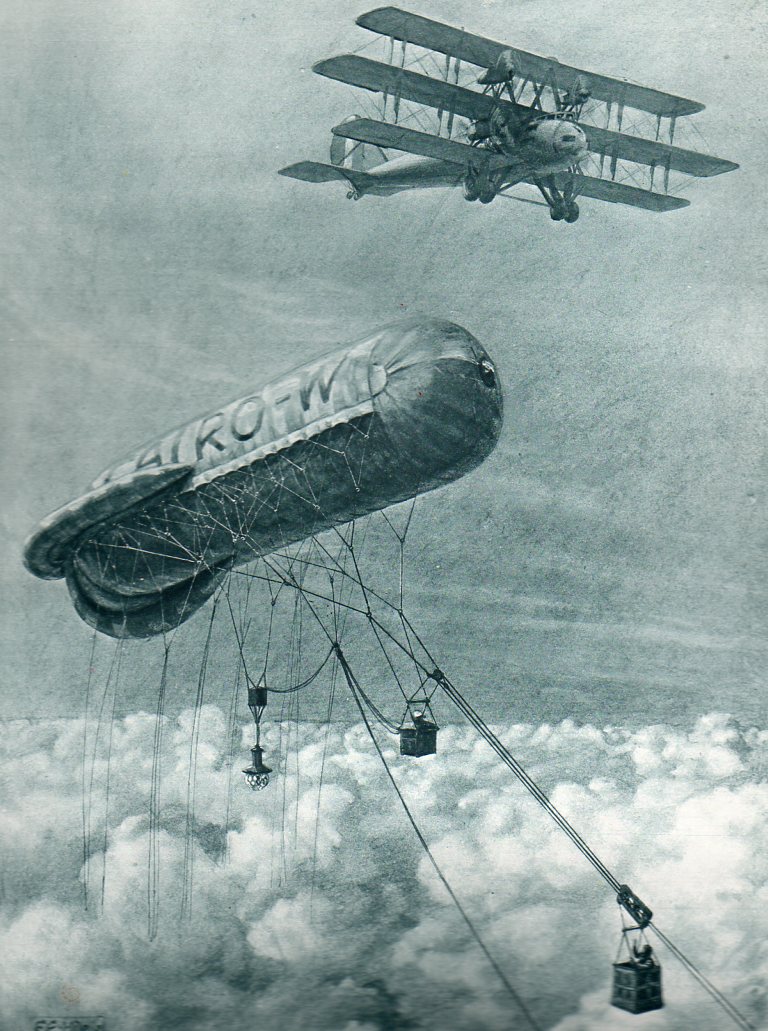
    I’ve written earlier in this blog about odd things found in the sky, some of which is imagined  (holes, extra Earths, blank Heavens, disembodied hands/feet/eyes/ears,proto-human empty aliens,  rat) and some of which were/are possibily real (like this fabulous aircraft with an escape pod for women, located here). [Both of these images are available from our blog bookstore, here.]

    These images present incredible, indelible ideas to us here in 2010, images of creations that look more like created steampunk for a retro-futurist novel than something real.  But they were actually state-of-the-art techno advances for their times, decent ideas, solutions for knotty problems that had no better answers than those presented. 

    Strange sky--launch plane839

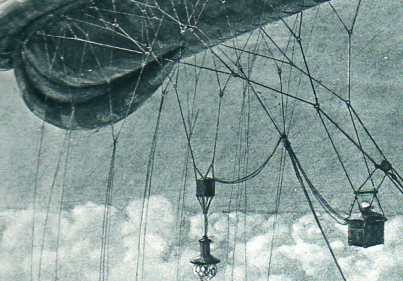
    The first is “The Clapham Junction of the Air, a Cloudland Signal-box”, seen in The Illustrated London News for 15 March 1919.  The idea was simple–cloud cover prevented aircraft from seeing their objective (lacking RADAR, which wouldn’t appear for another 23 years) and so something needed to be done to communicate with them above the clouds to relay data on ground conditions.  And so we have the tethered kite balloon with a mobile travelling car, the man in which would relate the necressary info to the waiting aricraft above.  (The description of the image notes that the aircraft is “one of a coming type”.)

    Strange sky--launch plane crowd det840

    Strange sky--launch plane det841

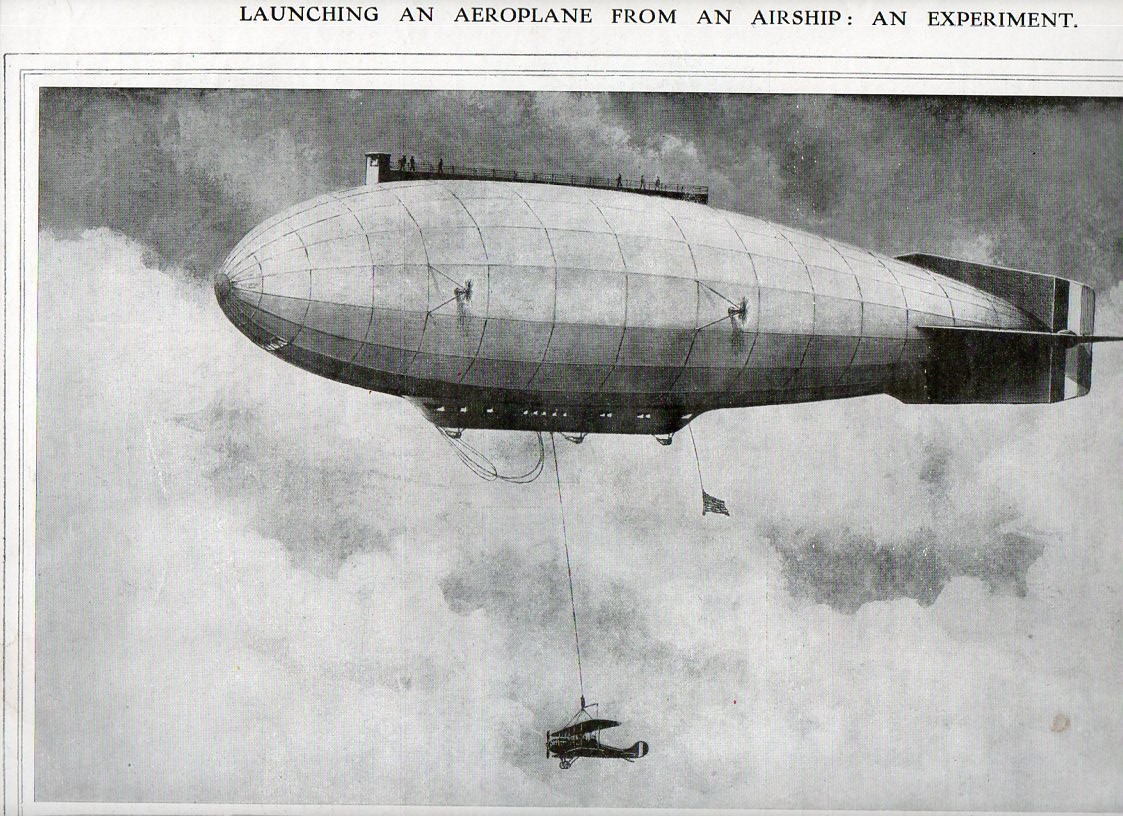
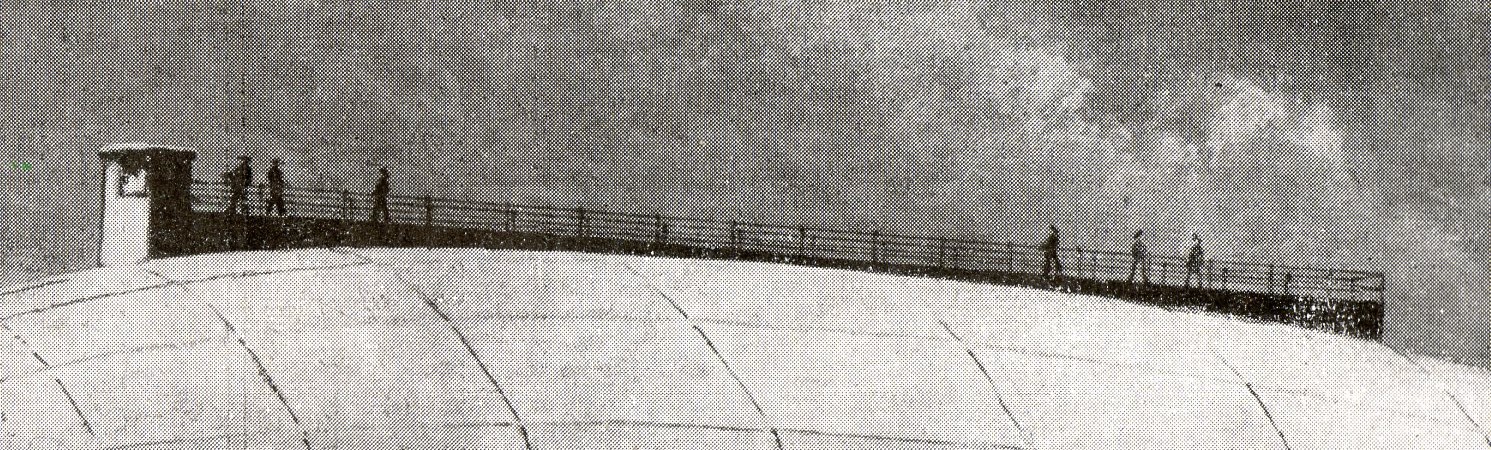
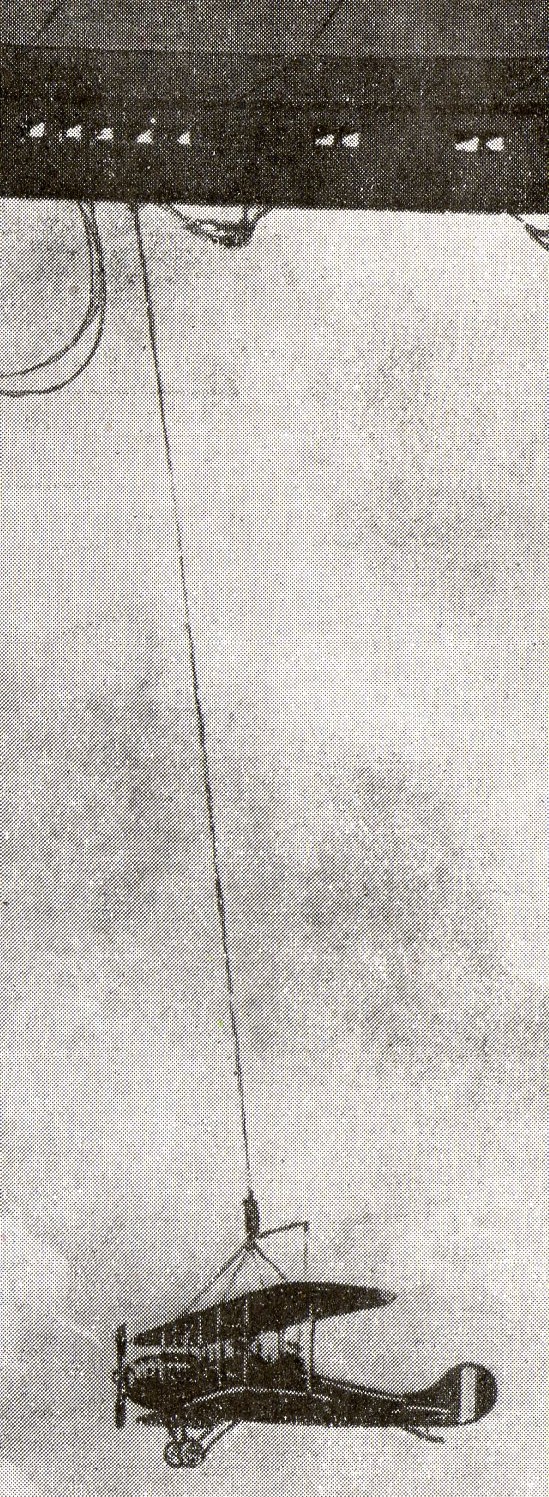
    The second image appears in The Illustrated London News for 1 March 1919 and is entitled “Launching an Aeroplane from an Airship, an Experiment”, and shows a helium-filled airship (“of the near future”) about to drop an aircraft.  The airship would have risen to some height with the aircraft already at tether, travelled a distance far beyond the normal range of the airplane-in-tow, and then release it–after a fall of a thousnad feet or so, the engines would start, and the plane would be operational.  that was one way of advancing air cover far beyond what woul dhave normally been feasible. 

    The set of problems encountered here woul de remedied in relatively short order, say with a few years of the publication of these pictures–but for teh time being, in 1919, this was the best that could be offered. 

    Strange sky--lmessages842
    Strange sky--lmessages det843

  • When White Newspapers Photographically Discovered Lynching

    JF Ptak Science Books   Post 1223

    In the long line of “firsts” in the history of photography–the first photograph, the first photo of a human, the first photo of the Moon, the first color photo, the first photo on paper the first mention of the word “negative”, and so on–the first published photograph of a lynching of an African American in America took place late, late in the history of photography, late in the history of lynching Blacks, late in the history of conscience, late. Too late.

    Even though images of lynching began to appear in pamphlet in the 1890’s, and then in Black-owned newspapers in the ‘teens, the first images in White-owned newspapers didn’t make appearnaces until the 1920’s.   The images were seen as being too upsetting, too divisive, too much.. During an era of yellow journalism and sensational exploitation of disasters and murders and crimes and bad craziness–usually accompanied by photographic illustrations–the pictures of hanged or burned black people was where the white-owned journalistic establishment drew their line in their own segregated sand.

    In a thorough and disturbing  work, Lynching and Spectacle, Witnessing Racial Violence in America, 1890-1940 (UNC Press, 2009), Amy Wood identifies numerous cases in which lynching/burning photos in Black-owned papers appear in White-owned papers, though with the victims of the violence cropped and edited out.  All that is shown in so many cases are the faces of the lynch mob and a mild description of what they were up to–their gross indignty white-washed, the enormous suffering and fear of their victim almost completely removed.  The images are revolting, sick, sadistic–but so are many of the other images that appear in these sanitizing newspapers over the same time.  The editors just weren’t showing images of these White-based hate crimes.

    This is necessarily an exaggerated summary of these events–and there were many White-owned newspapers (like the Chicago Tribune) that decided to carry news and statistics of lynchings back into the 1890’s)–but the fact remains that these same stories were not photographically covered until 85 years ago, within the lifetimes of 5% of the American population.  And it should also be noted that by the mid-1920’s there had already been many thousands of lynchings in the United States, and that it took decades for this sort of journalism to occur.

    [I do have the following material for sale to individuals; that, or I’ll donate all of them to an appropriate institution.]

    I came to this book by Woods after reading through some of the anti-lynching pamphlets here–well, those, and a postcard of an infmaous lynching and burning scene, a spectacularly ugly image, meant to entertain.  It is a repulsive idea–that such suffering could be seen as a joke and used on the front of a postcard to entetrtain the receiver.Lynching--appeal--web
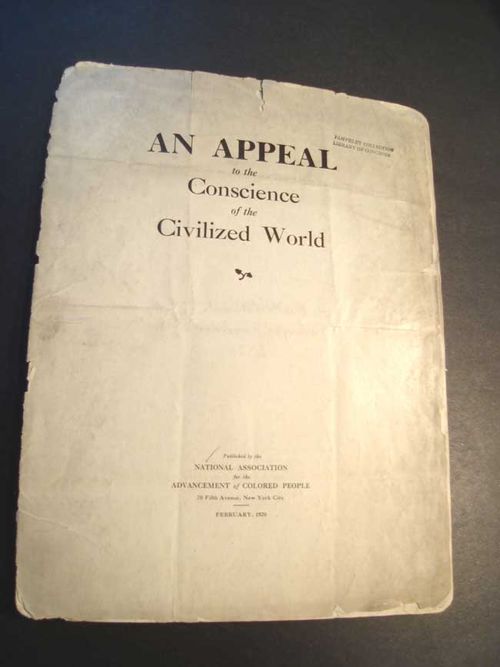
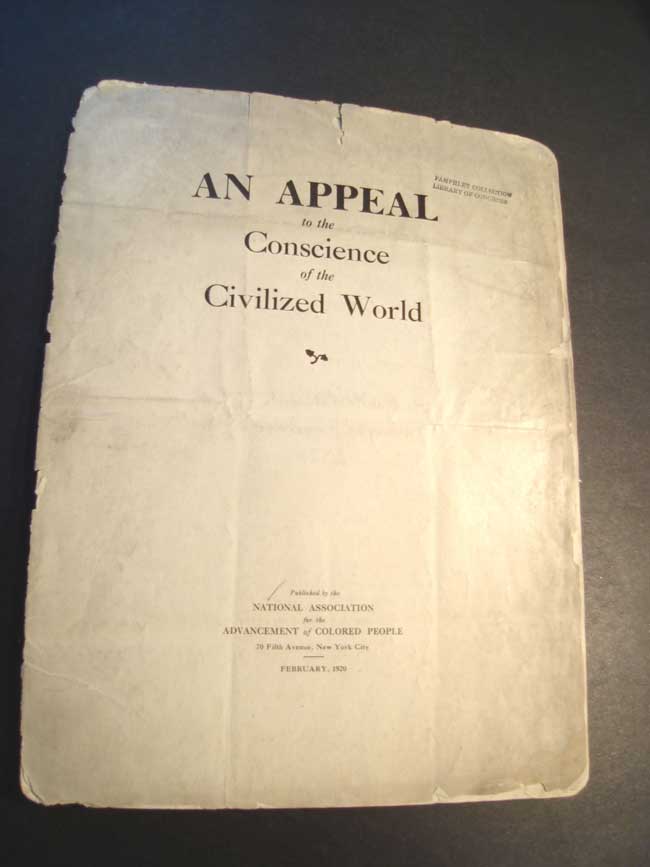
    An Appeal to the Conscience of the Civilized World, published by the National Association for the Advancement of Colored People, i s exactly that–a basic plea to stop lynching in the United States, a prayer for understanding, a call to action which is really a call for people to just stop lynching Black people. It is an incredible document, seemingly from another century but not so, being printed in 1920, just 90 years ago.

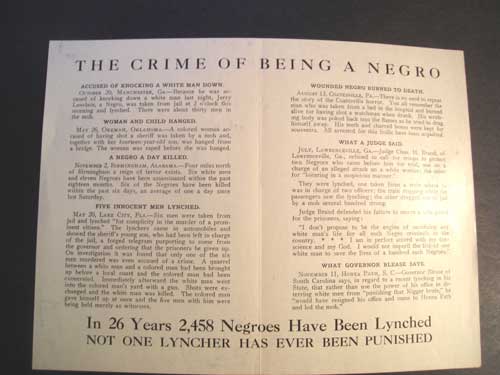
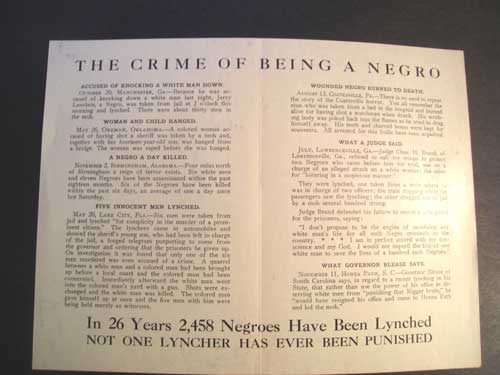
    The next pamphlet (really just a fold piece of 11×8 inch paper), A Crime of Being a Negro, is a little older (printed in 1912 at 20 Vesey Street in NYC), and details “some of the 51 lynchings which have occurrd during the last six months…and there are others”. It also makes the emphatic statement at the bottom, “in 26 years 2,456 Negroes have been lynched/not one lyncher has ever been punished”.  This would have been quite a crowd of lynchers–given the number of Blacks killed in this way, the total crowd of lynchers may well have been 50,000 people.
    Lynching--crime-being-negro


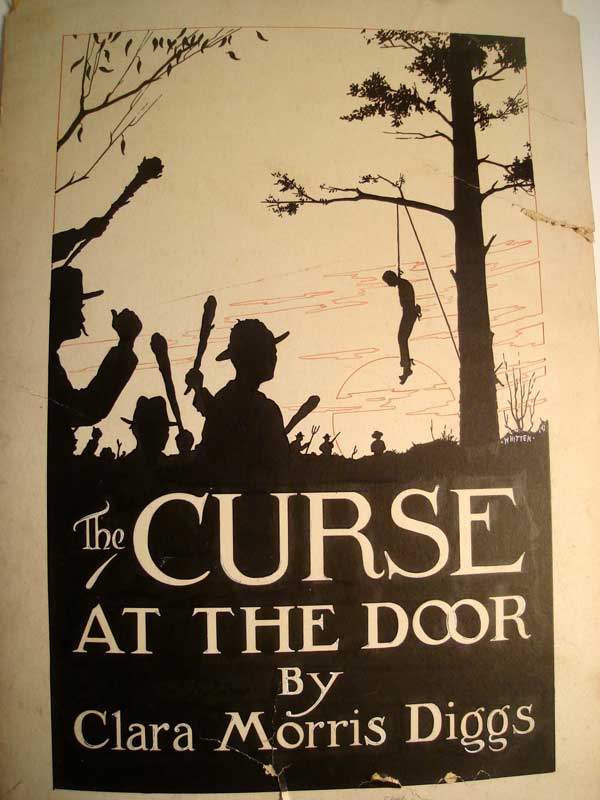
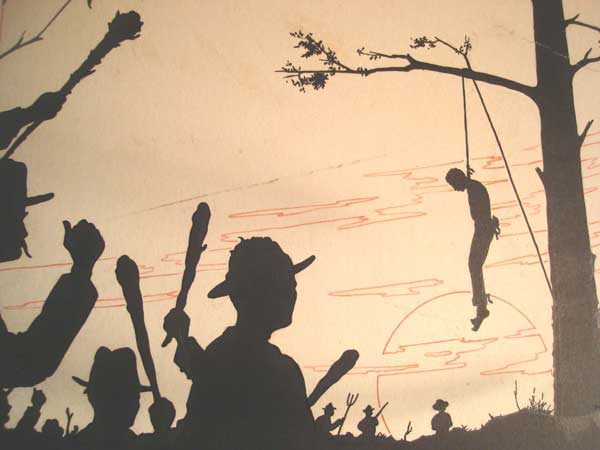
    One of the most shocking things that I have here in my small collection of items relating to these heLynchinginous actions is this original art, or mock-up, for the book The Curse at the Door, by Clara Morris Diggs.  The artwork and design is the work of Merton Witten (“Artist and designer”)  Illustrated scene of a lynching, being the original dustjacket art for the novel The Curse at the Door, by Clara Morris Diggs1.
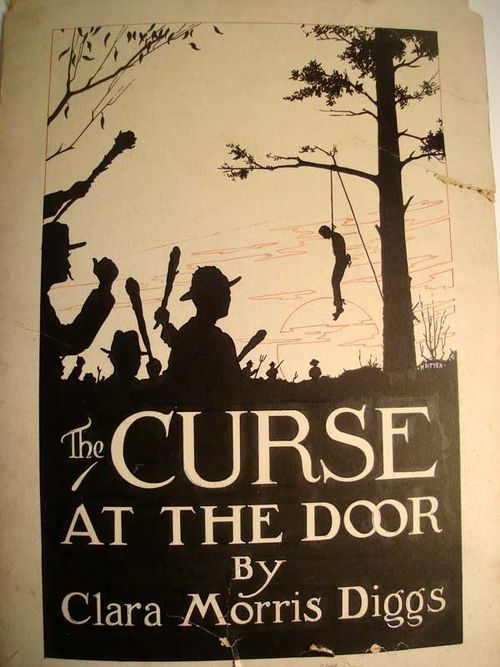
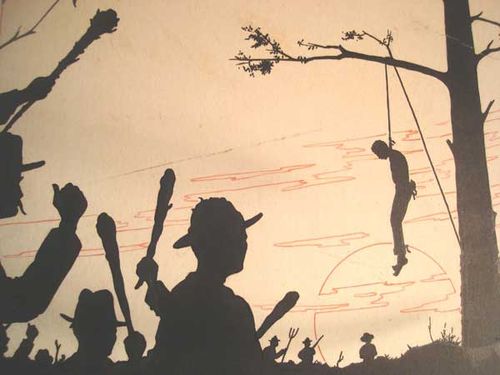


    Lynching2


    Lastly is this scarce mimeographed report by Robert Taylor Gray,  The Supreme Court Proposal and the Wagner Van Nuys Anti-Lynching Bill. It is basically a letter to Senator A.H. Vandenberg, Robert F. Wagner and four others from Gray, from typed originals, and dated   3rd August, 1937.

    It reads: “It scarcely takes a statesman to see that the murder of any citizen by a gang.is not justified on any grounds whatsoever. If any single Congressman dissents from the point of view here taken, I should appreciate his advising on what legal or moral grounds it is done.” If you thought that there wouldn’t be any dissent among Congress-people, you’d be wrong.

    Gray was a very prominent Philadelphia Quaker and scion of a business begun in that city in 1683. He was on numerous committees for racial fairness and equality including the Whittier Center Housing Corporation (where hhe extracted a promise from the Secretary of Commerce that the Public Works Administration would not build new apartment complexes ruled by discrimination or racial unfairness, a major coup)..

    Gray writes about the difficulty of establishing the Wagner Van Nuys Anti-Lynching Bill  and its coming to loggerheads with FDR’s plan to pack the Supreme Court. Evidently the President’s need for Southern support for his court plans would have to be purchased with the defeat of this Bill. Versions of this 1937 Bill (strongly written by the NAACP) had failed to pass the House and Senate in 1934 and 1935. The general way of defeat for these bills had been Southern Filibuster. So even though the bill was defeated, there weren’t any “no” votes cast against it–but it certainly had enough storming enemies to keep it from getting anywhere near a vote in the U.S. House of Representative.

    Time Magazine, 28 January 1938, reported the following:

    “The actual contents of the Wagner-Van Nuys Bill, as simple as they were familiar, would scarcely keep the U. S. Senate busy for that period. Like its predecessors, it provided for Federal prosecution, and a $5,000 fine or up to five years’ imprisonment, or both, for sheriffs & peace officers who did not afford criminals and suspected criminals reasonable protection from mobs (any gatherings of more than three persons).”

    (The principle Southern anti-anti-lynching bill proponents were) ” Tom Connally’s loyal little band-Georgia’s Russell, North Carolina’s Bailey, South Carolina’s James Byrnes, Tennessee’s Kenneth McKellar, Louisiana’s Ellender, and Pat Harrison.”

    “But if the practice has been general, the opposition to laws intended to suppress it has centred in the South. For two generations Southern Representatives and Senators have greeted every lynching bill that came up for debate with a reaction as sharp and unfailing as would be produced by a polecat. Snorted Georgia’s Richard Russell last week of the latest and one of the most threatening Federal attempts to prosecute and punish lynchers: “Skunk meat.”
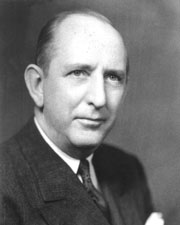
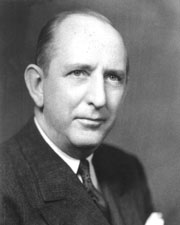
    Richard_Brevard_Russell In 1938 a Republican U.S. Senator from Georgia, Richard Russell, Jr.–a man who would rise to be President pro tempore of the Senate and leader of a conservative Republican coalition within the Senate, the great American legislative and deliberative body–referrred to legislation aimed at bringing lynchers to justice as “skunk meat”.  Here’s his picture.  He was indeed a product of his time(s)…well, perhaps he produced the product of his time, he and others like him were the manufacturers of this machine.  He did after all make it possible for this despicable outrage to continue and made it possible for those working way outside the law–the lynchers–to escape prosceution.  He subverted the law.  And he was one of the highest officials in the land. So I’d say he was a little more than just product–people like this were the producers.

    Notes

    1.The address for Merton Whitten on the back of the board lists 35 Mt. Vernon Street in Boston–this is Beacon Hill, and is in the same block (today) as the Colonial Society of Massachusetts (a very considerable old structure). Julia Ward Howe lived next door once upon a time. Whitten is listed as a “Commercial Artist” in the 1923 Boston Directory with a business address of 118-A Bowdoin.
  • The Sublime Antiquarian Art of Children, Part I

    JF Ptak Science Books   Post 1224

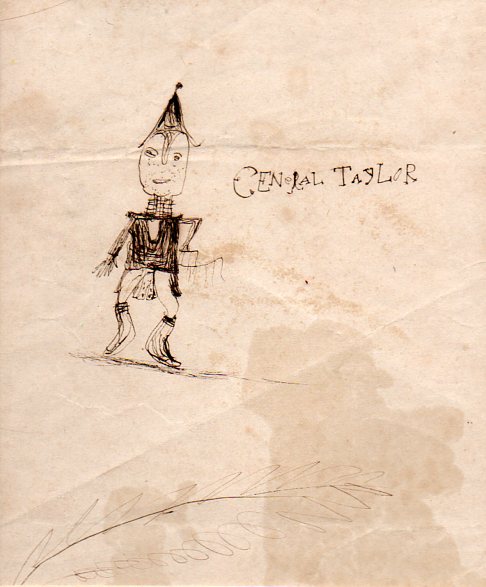
    Children's art--3846
    Among my favorite places in Washington, D.C.–a place where I lived for 29 years–are its cemeteries; in particular Rock Creek Cemetery, but more specifically, Congressional Cemetery.  Congressional is a big place, tucked away, sort of, away in Southeast D.C.–that is if you can tuck away a 30-acre piece of land. Congressional is an odd place, filled with many interesting people; its filled with their actual remains, and also their memories. There are many folks who have been interred in spirit in the cemetery, in cenotaphs; there are also many who have been laid to rest their temporarily, in the Public Vault, until conditions (in the old days) improved to have their remians received in their final resting place. 

    Children's art--2845
    Among those in the temporary funeneral housing were JQ Adams, William Henry Harrison, Dolley Madison, and Zachary Taylor. It may be one of the great vaults in the history of our country, a small place holding great people.

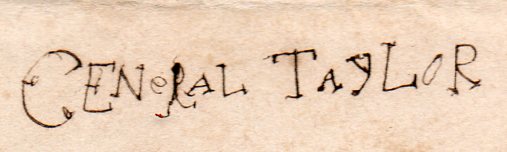
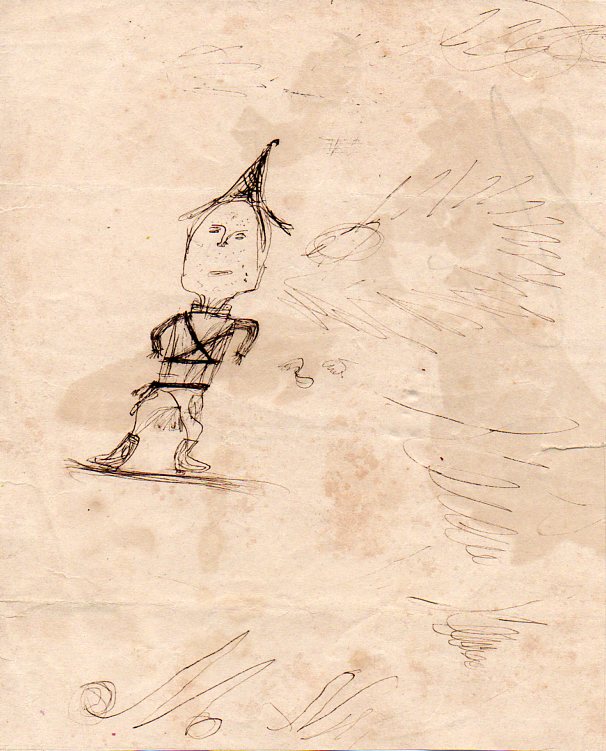
    President Taylor.  General Taylor.  That’s why I’m here right now.  He’s the subject of these magnificent efforts by an unnamed child.  The boy, or girl, drew these images on the back of a section o fmap that was printed in about 1845-1850, just about at the time that Taylor was at his greatest height–a general, a famous militaryu leader, about to become president of the United States without ever having been elected to any office.  He was a gigantic figure at the time, and no doubt occupied some piece of mind of the artist who rendered him, The General.

    I came to collecting childrens’ art in a roundabout way–not so much “collecting” per se as in “finding” them.  They’re difficult things to locate.

    First of all, materials were scarce.  Paper, pencils, ink–these were not common things for kids to own in the 19th century, especially more in the middle and early parts of the century.  These items were expensive, especially if you were a kid in a working-class family who didn’t have much of anything at all, anyway. In addition to a real crunch, a severity of absence, of the basic materials, the art that was made had to survive the artist’s own hands.  And then it needed to survive being culled from family clutter for a generation. And another. And another. And another. And four more.  150 years of parents clearing out the clutter is a lot to survive. 

    And so there doesn’t seem to be much left.

    I find them in flyleaves of old textbooks and such.  Its not as though there is are websites devoted to such things–at least not until now.

    And so I’m selling two of the three portraits of The General that I own.  I’m keeping one.  They just feel superb, to me.

    If you’re interested in owning one, visit the blog bookstore, here.  I’m developing now a site for nothing but pre-1900 kid art. 

    The artwork of children is a gorgeous thing, even when the children are not your own.  Its not that there is a sense of a certain charm, or charms–the words are just too weak. The vocabulary is more in the realms of the work being sublime, far more so than anything else.

    Children's art--1844


    ·Posted by :

    ·in:

    — —
  • Attacking Darwin’s Descent of Man in The London Times, 1871.

    JF Ptak Science Books   Post 1225

    “But with regard to the material world, we can at least go so far as this—we can perceive that events are brought about not by insulated interpositions of Divine power, exerted in each particular case, but by the establishment of general laws.” W. WHEWELL: Bridgewater Treatise.

    “To conclude, therefore, let no man out of a weak conceit of sobriety, or an ill-applied moderation, think or maintain, that a man can search too far or be too well studied in the book of God’s word, or in the book of God’s works; divinity or philosophy; but rather let men endeavour an endless progress or proficience in both..” BACON: Advancement of Learning.

    The quotes above stand alone, the first things that the readers see, sitting on the half-title page of  Charles Darwin’s On the Origin of Species (first published in 1859 in an almost-immediately sold out run of 1250 copies) an extraordinary, epochal book that was a lightning rod for reception both good and bad, heaven and hell, the Boschian hells of which were clearly not deserved, then or now.  (It is easier to understand a poorly-reviewd Origin in 1859 or through the 1860’s or even through the rest of the 19th century or even somehow through the early twentieth, but not afterwards.)

    Twelve years after the first edition of the Origin (and two years after the appearance of the Origin in its fifth edition) came his elegant and formibible The Descent of Man, and Selection in Relation to Sex

    The Times of London gave such an awful review of the book that a review of this review was published in the April edition of Nature [(Darwin),  Charles.  REVIEW of Review: The Descent of Man.  London:  Nature,  1871, volume 3, 20 April 1871].   It was Thomas Stebbing who wrote the response to The Times‘ incitful, hateful attack upon the Descent of Man. The Times saw Darwin’s work as an attack upon society,  accusing him of undermining authority and principles of morality, opening the way to “the most murderous revolutions”.  A “man incurs a grave responsibility when, with the authority of a well-earned reputation, he advances at such a time the disintegrating speculations of this book.” Stebbing’s review of the review is drippingly sarcastic, pointing out obvious errors in specific and the tone of the article in general in the defense of the book. Darwin’s “facile method of observing superficial resemblances” (says The Times) incites Stebbing to issue the following: “they may fancy that truth is worth discovering , even when it seems to involve some contradictions to our pride and some loss of comfort to our finer feelings…” (What a great line!) The article runs about 1000 words, and is a two-column, 1-page bit. [This issue of Nature may be purchased from our blog bookstore, here.]

    “No one ought to feel surprise at much remaining as yet unexplained in regard to the origin of species and varieties, if he makes due allowance for our profound ignorance in regard to the mutual relations of all the beings which live around us.” Darwin, leading the last paragraphs of the end of the introduction to the Origin, page 7.

  • Simple Alphabetical List of Major Civil War Battles

    I just wanted to introduce the first of a series of new pages on this blog devoted to the U.S. Civil War. The 150th anniversary of the war begins soon, and I plan to do a Civil War day-by-day newspaper article for contemporary coveragre of thhe war, beginning in December.

    Alphabetical Listing of Major Civil War Campaigns, by Battle

    Allatoona Georgia October 5, 1864
    Amelia Springs Virginia April 5, 1865
    Antietam / Sharpsburg Maryland September 16-18, 1862
    Appomattox Station Virginia April 8, 1865
    Appomattox Court House Virginia April 9, 1865
    Aquia Creek Virginia May 29-June 1, 1861
    Arkansas Post / Fort Hindman Arkansas January 9-11, 1863
    Atlanta Georgia July 22, 1864
    Athens Alabama January 26, 1864
    Averasborough / Smiths Ferry / Black River North Carolina March 16, 1865
    Auburn / Catlett’s Station / St. Stephen’s Church Virginia October 13, 1863
    Auburn / Coffee Hill Virginia October 14, 1863

    ·Posted by :

    ·in:

Recent Posts

Archives

Categories