A Daily History of Holes, Dots, Lines, Science, History, Math, Physics, Art, the Unintentional Absurd, Architecture, Maps, Data Visualization, Blank and Missing Things, and so on. |1.6 million words, 7500 images, 4.9 million hits| Press & appearances in The Times, Le Figaro, Mensa, The Economist, The Guardian, Discovery News, Slate, Le Monde, Sci American Blogs, Le Pont, and many other places… 5000+ total posts since 2008.
“There is no mystery about these machines[computers]. The mystery is how the human brain has been able to develop them. These devices are merely small tools which men have devised to help them do a better job.“–Thomas J. Watson, chairman of the board of IBM, 1954
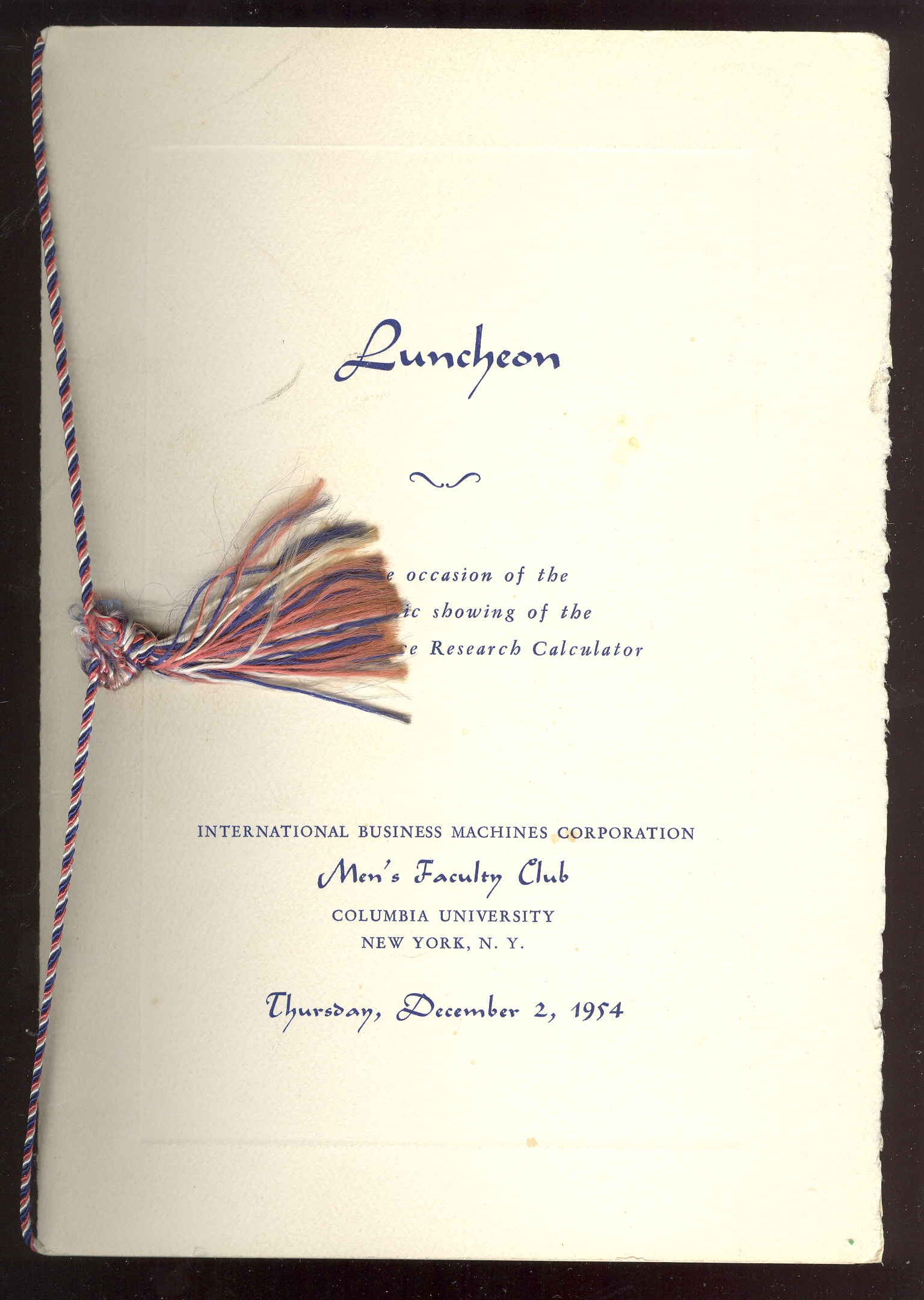
Here is something that one doesn’t get to say very often: this is perhaps the most important menu in the history of computing1. And if there’s another menu out there of the same or greater significance, then I offer that this is perhaps the most important menu tassle in the history of computation–that seems safer.
In the history of odd bits of historic computeriana ephemera, this tassle joins the ranks of other one-percenters, like this: the world’s first portable computer had a gun rack. This was hardly a laptop though it was portable, and very well lived up to its Herman Melville-inspired acronym: MOBIDIC.
The Mobile Digital Computer was intended to be a transistorized van-mounted computer used to store and route data as part of the U.S. Army’s Fieldata system. The machine was indeed built and deployed by 1959–as were the MOBIDIC A,B,C,D,E and 7a by the early 1960’s–and it was a successful component, even though the overall network was not successful. Fieldata was supposed to integrate all manner of information and distribute it to battlefield recipients. My friend (Dr.) Carl Hammer (1914-1904), who I knew from being in the neighborhood in Georgetown, was a delightful man who had long and significant history in the development of the modern computer. He told me one afternoon–stopping in to visit on his constitutional–in his sly and amusing way about working on the MOBIDIC while he was at Sylvania. (He had just finished heading up Remington Rand’s UNIVAC European Division before going to Sylvania.) Anyway he started his story about the MOBIDIC by telling me that it was the world’s first portable computer (sitting in a 42-foot-long semitrailer) and that it had gun racks. The reason for the gun racks was simple–if something was made by the U.S. Army, and it had wheels, then it had to have a gun rack. Case closed.
Now let’s get back to the NORC.
[This item is available for purchase at our blog bookstore.]
This is the luncheon menu for the dedication of the NORC “Calculator” (the Naval Ordnance Research Calculator) a computer which was constructed principally with IBM parts and built at the Watson Scientific Computing Laboratory at Columbia. The NORC was the world’s first supercomputer, and the most powerful computer on the planet for about ten years (from 1954 to 1963, until it was surpassed by Seymour Cray’s CDC 6600 in 1964).
The NORC was an astonishing accomplishment, difficult to summarize simply, really, though a very good example is that provided by Dr. Paul Herget, the director of the Cincinnati Observatory. Dr. Herget used the NORC in 1956 to make precise calculations of the earths orbit for the 1920-2000 period. Dr. Herget said: “We used nine hours of running time and completed more computations than had ever before been done at one time in the history of astronomy.’”
Outside of celebrating the accomplishment of the NORC, the luncheon was also important for the remarks of the principal speaker, John von Neumann. Von Neumann of course was perhaps the most expansive mind of the century–a thinker of phenomenal proportions and the father of the modern computer. His brain was impossibly big. Impossible.
During the luncheon von Neumann made prescient and extraordinarily wide remarks on the future utility of the computer. Some of the highlights (from the entire address, included below):
–it is now “practical and feasible” to forecast, with the NORC, the weather for an entire hemisphere thirty or sixty days ahead
–calculation of the tidal motions of all the oceans, the marginal movements near the continents as well as the main motions of the oceans
–the hydrodynamics of the earth’s fluid core
–“In the statistical field, dealing with matters which are not wholly mechanical, such as troop operations and logistic operations which involve purely accidental factors like the prevailing weather during the operation, command decisions which have not yet been officially made can be stipulated and various solutions for various alternatives calculated. This has been done before on a minor scale but it takes too long to do on a large scale. “In this field the importance of NORC is enormous…”
–in the first four hours of operations the NORC performed more work than any calculator of ten years ago has performed in its entire lifetime. He termed this performance “completely fantastic; I doubt if it has ever been done before.”
The last section of von Neumann’s comments that were made at the dinner:
“The last thing, which is very important, is said in fewer words, but I think that it is none the less important. And it is this: In planning new computing machines, in fact, in planning anything new, in trying to enlarge the domain of parameters with which one can work, it is of course customary and very proper that one should consider what the demand is, what the price is, whether it will be more profitable to do it in a bold way than in a cautious way, and so on. This type of consideration is necessary — the world would very quickly go to pieces if these rules were not observed in 99 cases out of a hundred.
“It is terribly important that there should however be one piece in a hundred where it is done differently.
“And that one uses the definition which Dr. Haven (?) pointed out 20 minutes ago, namely to occasionally do what the U. S. Navy did in this case and what IBM accepted in this case: to write a specification essentially to build the most powerful machine that is possible in this day with the present state of the art. I just hope that this will be repeated very soon and will never be forgotten.” Source.
It may be the last statement that is the most important–pressing those of the present and future to perform.
Notes:
1. The importance of this menu was described to me in a lovely and painterly fashion for the first time by P.J. Mode.
JF Ptak Science Books Post 1204 [Part of our Bad Ideas series.]
Sometimes things aren’t what they seem, and then sometimes they’re not what they seem not to be, and then there are these things, below. These small pamphlets are very reaching examples of finding gold or silver or muffins or whatever in a sow’s ear, finding a hope for belief where there wasn’t room for any, logically speaking. But there’s always room for belief and faith, which takes on myraids of appearances, from believing in paper money to believing in heaven–in these cases, our writers believed in the unbelievable, creating and then believing in “innermost secrets” where there were no secrets and were no insides.
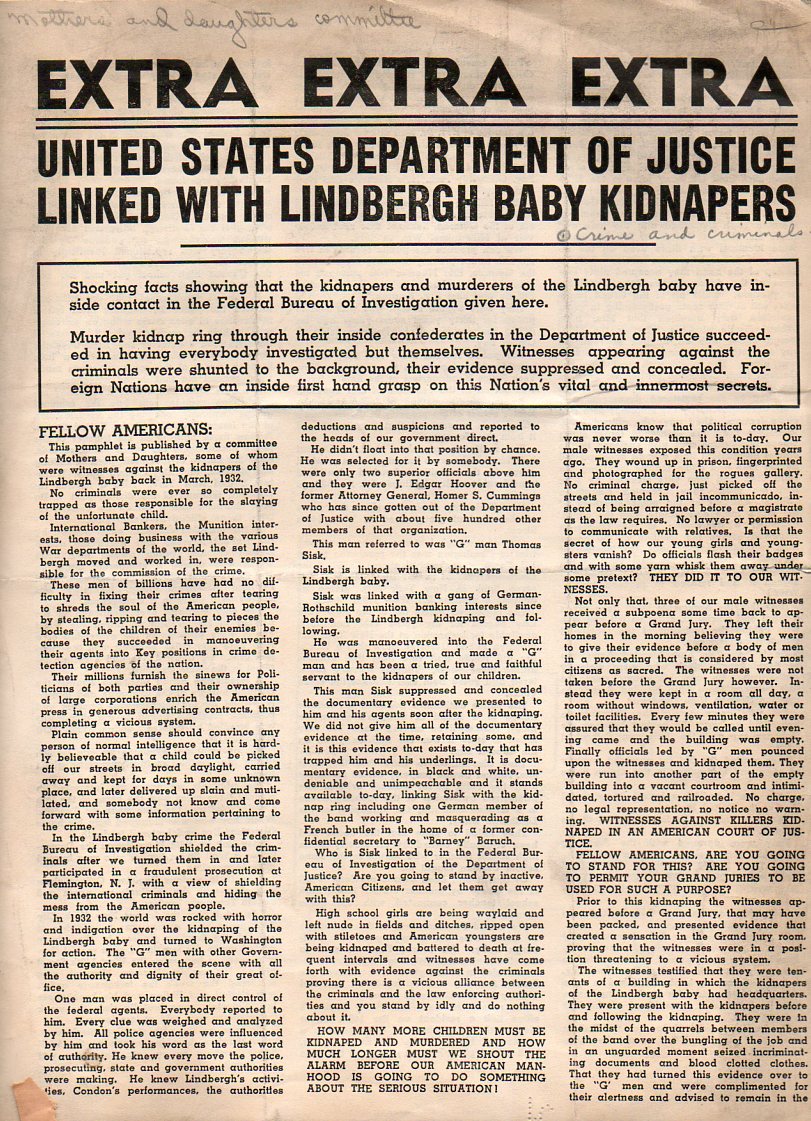
Both of the examples below relate to the kidnapping of the 20-month-old son of Charles Lindburgh in 1932. The crime was an extraordinarily national event, with seemingly everyone in the country following the case During the two-month hunt for the baby and the subsequent trial and execution of the man who was seen as responsible for the child’s kidnapping and murder, there were fantastic numbers of claims from people who had solutions to the mystery, or had been in contact with the kidnappers, or some other sad, imaginary relationship to the event. The examples below [both of which are available for purchase at our blog bookstore] claim to have incredible insight into the real nature of the crime, which of course goes blindingly beyond the simple matters of the case and on to include massive colusions between the U.S. State and Justice Departments, “international bankers”, F.D.R., Kaiser Wilhelm, and “the Japanese government”. And more.
The first example was published in 1942 by something called “The Mothers and Daughters Committee”. This group used the address of 280 E. 21St Street, Brooklyn, New York, which today is a six storey building with 96 apartments, and I suspect that the MADC back there in ’42 was nothing more than a crank in apartment inthis building. The thinking is too confusing and the references too many amnd too busy to actually do this thing justice by de-threading it, but suffice to say it claims that the F.B.I. was shielding “the international criminals”who were truly responsible for the crime–I’m not sure how F.D.R. works his way in there but it has something to do with “international bankers”, communist conspirators, traitors in the State Department, and “needy” lawyers, all brought together in a choking confluence to do harm somehow to American society and morality.
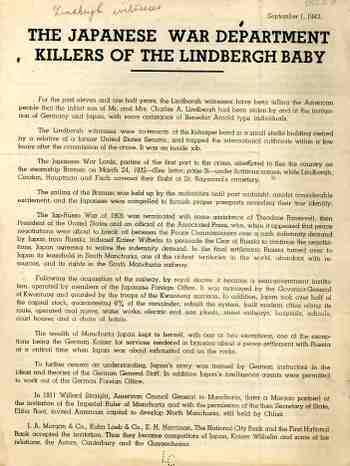
Now our second towering example is this four page pamphlet, received by the Library of Congress (and probably nobody else) on 1 October 1943, which divines the origins of World War Two and the kidnapping of the Charles Lindbergh baby to a complex and impossible cabal of Japanese “War Lords”, Kaiser Wilhelm of Germany, the assassination of Leon Trotsky, the League of Nations, Elihu Root, “3 cent gallon kerosene”, the South Manchurian Railway, and some sort of “historical documents of posterity countersigned by Tokyo and Berlin” in the possession of Mrs. Renee Valentine (“Secretary”) of Staten Island, New York.
The entire affair began with “co-tenants of the kidnappers band in small studio building owned by a relative of a former U.S. Senator” under the instigation of “Germany, Japan and certain Arnold Benedicts types” brought about by the end of the “Jap-Russo” War of 1905.
We are told it was an “inside job”.
Somehow Teddy Roosevelt gets involved with Kaiser Wilhelm in arranging for the Russians to pay indemnity to the Japanese in terms of a land agreement of Southern Manchuria, opening the way to exploitation of China by the Japanese. Something else happens, the South Manchuria Railroad gets thrown in as well as four competing U.S. banks and Elihu Root and a failed League of Nations agreement which upsets a balance of power and brings “the Astors, Canterbury and the Guggenheims” into competition with the Japanese and Kaiser Wilhelm, doing something to the Treaty of Washington.
After this incredible and unconnected and partially non-existent series of events is both untangled and entangled before our eyes, the writer reaches the lonely and very solitary conclusion that “the necessary documents to prove these charges (??) could be secured through the kidnapping of the Lindbergh baby”. I was waiting for the author to make a case for Lindbergh’s real-life (and long held) Nazi sympathies, but that just didn’t happen.
I really have no idea of what the writer is talking about, but the failure of making any connection whatsoever with any of the “facts and circumstances” is magnificently appalling, and has moved itself from the realm of being so bad that it isn’t even “bad” anymore. It is that singular sort of “badness” that makes the printed words seep into the paper and disappear before your very eyes, and the only thing that you can say is “wow”.
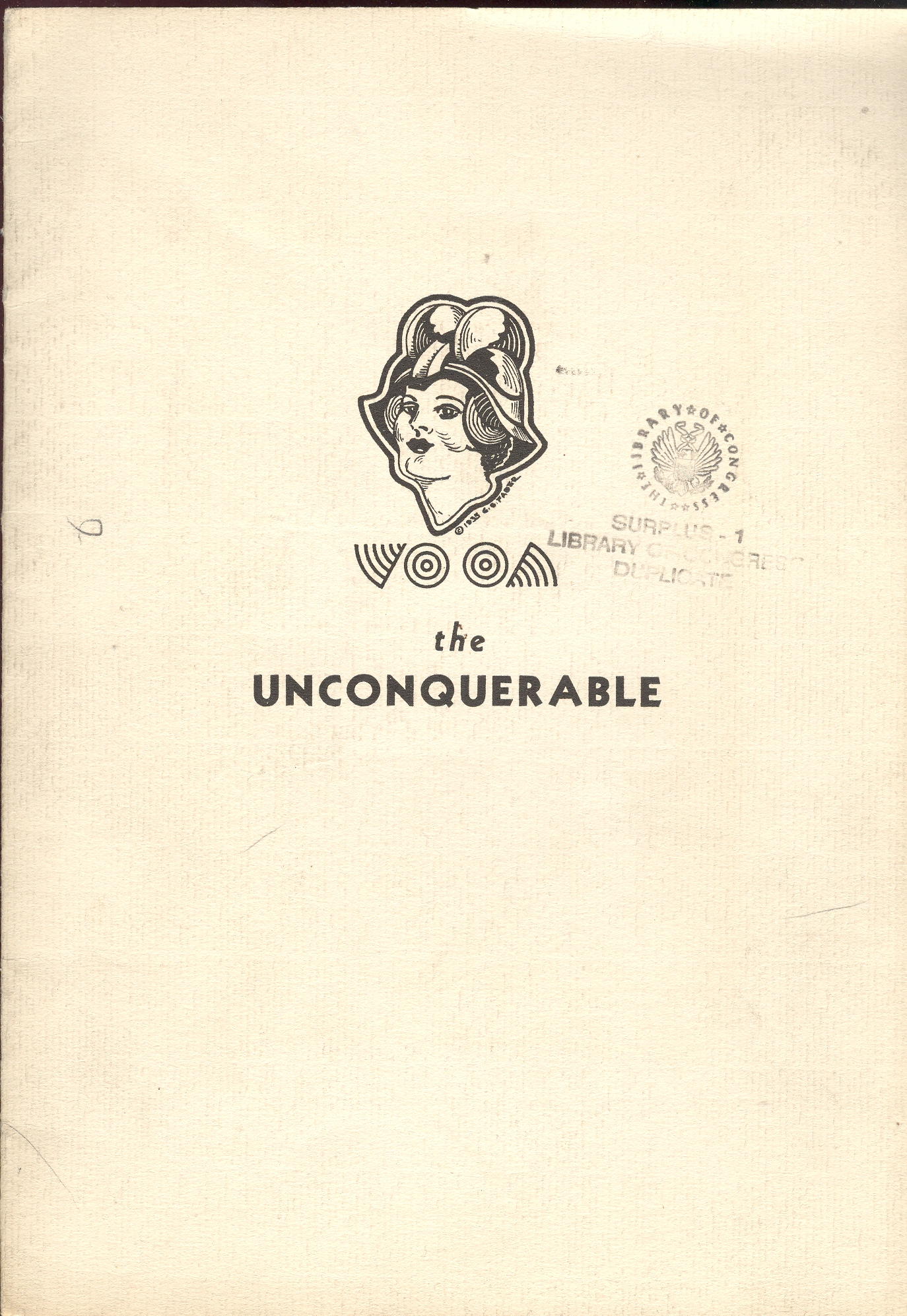
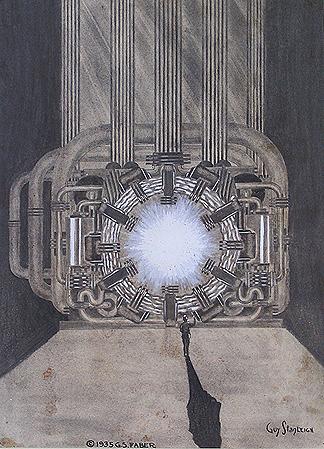
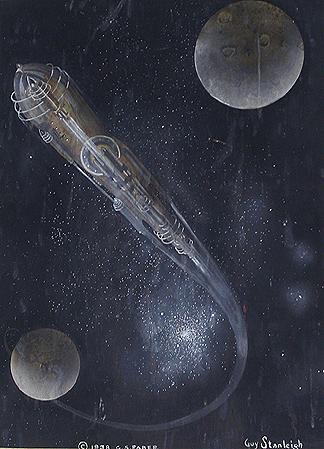
Sonos the Conqueror and Vooa the Unconquerable were two sorts of a sort, two flits in a fit, the products of the mumbley imagination of Guy Stanleigh. Actually Stanleigh (not “Stan Lee”) was an interesting scifi artist if not a writer. Well, he was really nowhere near being a writer, if writing had anything to do with writing and not drawing. His written word was the sort that vicious litcrit folks wait for in the bushes for on Friday nights so that they can catch and chew on them over the weekend before Monday’s deconstructionist deadline. I’m surprised that after 72 years the letters on the pages of his work haven’t yet slipped off.
[Both items are available for purchase at our blog bookstore.] His drawings though are an entirely different matter–they are accomplished in a naive way, and are big, and Botero-esque/bulbous, and unusual, and filled with a fair amount of imagination.
My favorites in his novelettes (Sonos the Conqueror and Vooa the Unconquerable, both of which stretch out to 16 pages, combined, which were undoubtedly vehicles for his artwork, if nothing else)were of a machine called the Atronic Ray energizer (“a concentrated collection of teh rays given off by the planets of the universe, a few of which (were) absorbed…circulating over the universe via inductive and repulsed forces….the primary or positive induced force emanating between and from an anode and biode…” Anyway, it was a terminus of fantastically great power that could either engender universal peace or destroy humanity. Life/death aside, its a pretty picture, and figure’s long and very sharp shadow relates a visceral feeling of hot energy.
Self- and purposefully-deceptive belief in spectacular and unsupportable scenarios espoused by governmental leaders which affect the lives of hundreds of millions of people deserve their own Dante-esque categorization:and that’s one that I haven’t come up with yet.This post is one of a continuing thread on the history of atomic weapons. {Incidentally, the pamphlet described here is available for purchase from our blog bookstore, here.]
I wonder how it was that we humans didn’t blow ourselves into melty dissolving bits during the Cold War.Somehow all of those thousands of megatons of disastrously radioactive explosives that were completely and reliably deliverable didn’t get launched—not even by accident, not even during all of those hot itchy-finger DEFCON 2situations.Did MAD (Mutually Assured Destruction ) actually work?Did the attempt at making a winnable nuclear confrontation keep people from actually trying to do so?Did the overwhelming and insane buildup of weaponry actually have so much enormous and foul intellectual weight that no one could actually make the decision to use the weapons for fear of snuffing out all human life?
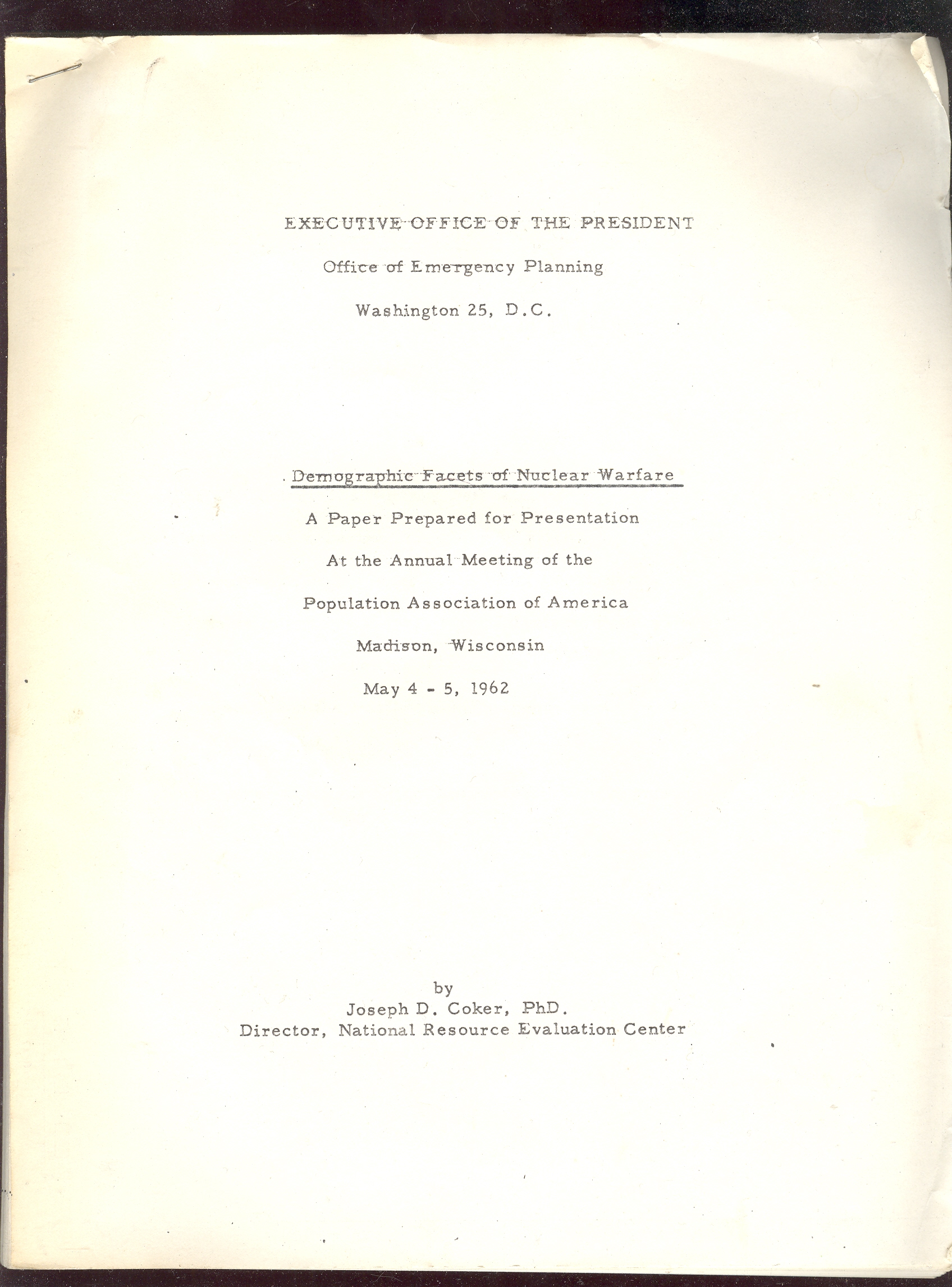
Here’s an embarrassingly shining case in point: Dr. Joseph D. Coker’s paper to the Population Association of America representing the thinking of the Office of Emergency Planning and the Executive Branch in general, which freely discussed the survivability of the United States following even a post-massive nuclear exchange. Dr. Coker was the director of the National Resource Evaluation Center, which tried mightily to figure out how/where /what/how the essential ‘stuff” of America could be saved/stored/allocated after the end of the world.Actually, Dr. Coker said that the big attack wouldn’t be the end of the world, so we needed to plan for surviving.
A few cases in point, some of which, I must warn you, are breathtaking and Strangelovian in their myopia:
Since Dr. Coker was addressing the Population Studies people, he related much of what he had to say (regarding national resources) to the American people.He found that millions of people could be saved if they built a blast shelter (not a fallout shelter) that was covered with mounds of heavy material and outfitted for an extended stay of two to 22 days.The unfortunate part of this scenario, Coker says, is that these shelters work best when 10 miles or more away from a detonation zone.And since these zones were all over the country targeted by thousands of warheads, very few people (especially in cities) would be outside the 10-mile ring, which made the blast shelter basically useless.
Coker notes that if an attack of 1000 megatons [a limited exchange] was aimed exclusively at U.S.air bases, “total fatalities will approximate 10% of the U.S. population”.If this attack was aimed at population centers rather than the air bases, it would kill 40% of the population. A 5,000 megaton attack on air bases would produce 50% overall fatalities in the U.S.; if that amount was centered on large populations, the number would jump to 80% of the population.10,000 megatons would yield 75% and 95%, respectively.“A 50,000 megaton attack would kill almost all U.S. citizens under either targeting assumption”.These figures didn’t include radiation deaths.
A big variable here not controlled for was the distribution of population at the time of attack.The numbers that were used were compiled by the census and counted folks who would be at home.So, the numbers above worked if and only if the Soviets attacked after dinner when everyone was at home for the night.Since it would make sense to attack when people were at work at their industry or job or whatever during the day—thus maximizing the effect of the bomb—the casualties would actually be higher.
And what does that mean?Dr. Coker relates this gem (on page 21): “The post-attack labor force available thirty days after the attack probably will represent a significantly lower fraction of the population than does the preattack labor force….” And this: “A nuclear attack can be expected to alter the occupational composition of the labor force.”
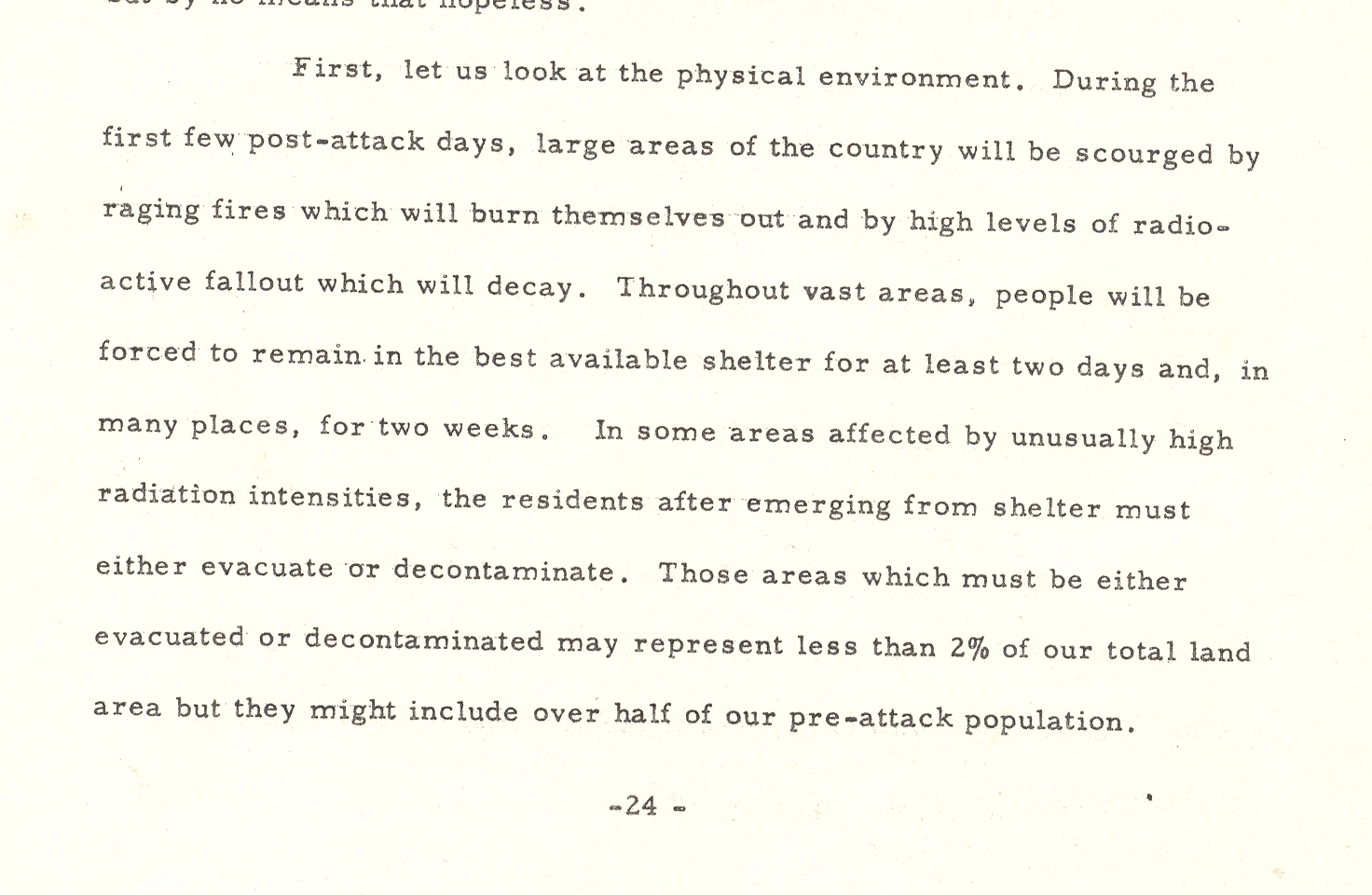
This sort of thinking overtakes the factual aspects of massive attack, with Coker stating on page 24 “I wish to sayemphatically that it [post-attack America] will not be anything like that depicted in Neville Shute’s On the Beach.It will be bad enough, but not that hopeless.”
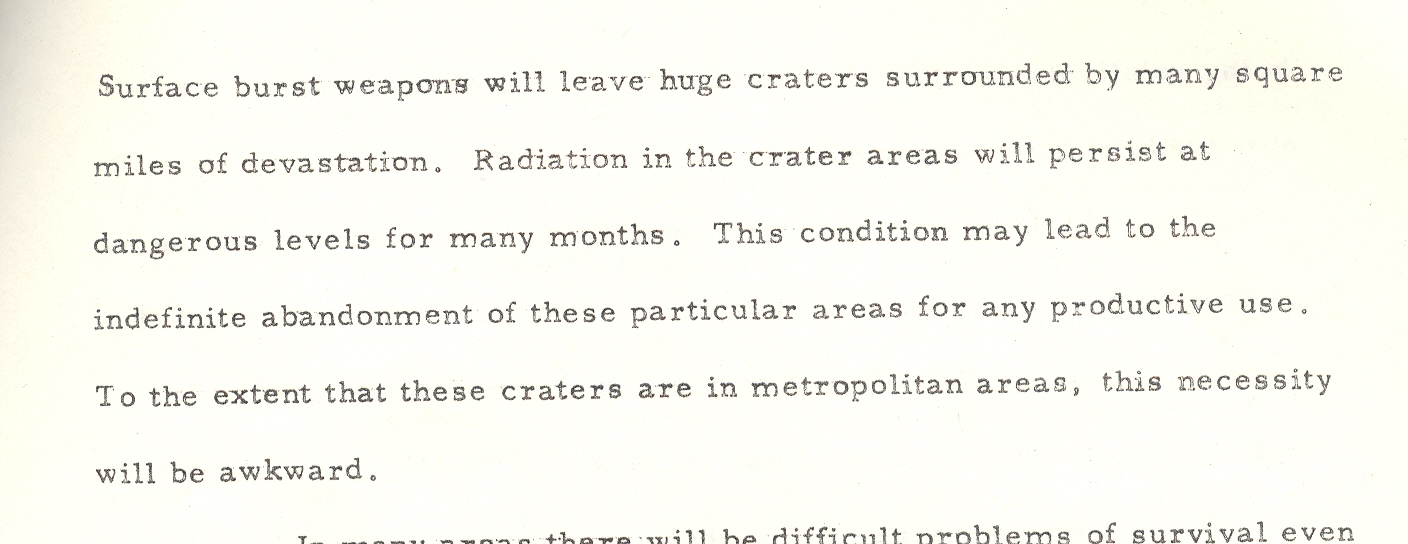
And this absolutely incredible/horrendous and perhaps worst-use-ever of the word “awkward”:
For the love of King Neptune’s Pants:Awkward?How in the name of _______ could someone in such a high position and authority relate massive attacks on every major American population center which would cover the area in fire and thousands of gigantic highly radioactive craters in which a city used to exist be called “awkward”?How great a sin was this, to influence opinion on holocaust via pathetic and unreasonable means?
And then this, on the survivability of our governmental and economic institutions:
“The post attack institutional environment will depend on the continuity, resourcefulness and general effectiveness of our leadership and the survival and resilience of pre-attack institutions…”
Hm?The post-attack institutions will depend on themselves?
This of course is followed by a major plug for Dr. Coker’s own work, because the preparations undertaken by the NREC will directly affect the survivability of post-attack America.So don’t stop the funding.“The more complete and realistic our preattack [sic] planning and preparations have been and the more effectively the government is at all levels in inspiring and retaining the confidence and support of the population, the less drastic institutional changes will be.”So it is the mealy aspect of inspiration that will direct the survivability of whatever it is that makes America so.
I should point out that Coker’s use of “post attack” and “pre attack” appear as two words, one word and a hyphenated word, depending on nothing. This is only a forty-page document.
Another nugget on the post-Armageddon future on the distribution of wealth, mostly hinging on blast shelters:“Per capita wealth in material terms may or may not be reduced by attack.”There will be a relatively proportional number ofpeople who emerge from the smoking holes to staff surviving industry, and so per capita wealth will stay about the same.If, on the other hand, people build more blast shelters, then the proportion of surviving workers to factories will increase, and “the surviving plant capacity will be spread more thinly among them”. It is left unstated, but what that means is that more successful implementation of blast shelters would mean a reduction in per capita wealth. Dr. Coker also forgets what he said earlier that the blast shelters really didn’t work unless they were more than ten miles from a target.Considering that the industrial workers would be living close to, um, industry, they will no doubt be (in 1962) in a ten-mile radius to where the blast would be.Then of course there would probably be more than one bomb, so the blast area would be more than a ten-mile circle, and so on and so forth.
In the following paragraph, Dr. Coker somehow draws all manner of feel-good high-probables around him, encasing himself like a sandman in a thin layer of improbability, to come to the following conclusion:
“…few of the analysts who have studied carefully these post-attack [sic] survival and recovery problems take any stock in the oft-repeated theory that the survivors will envy the dead.On the contrary, after a very rough year or two, the surviving population, if it so chooses, can begin to enjoy the advantages of a social structure and a physical environment not so very different from those which prevailed before the attack.” [Emphasis mine.]
This is an astonishing work of incredible deceit, and may be the worst quote of the lot.But it is so difficult to choose between unacceptable bits of thinking like this, raking out the horrible from the terrible.
Here’s another deceit that was absolutely better understood in 1962 than the writer acknowledges:“The long-term effects of radiation are subject to much less understanding and certainty than are the short term effects.There is some evidence that increased radiation exposure results in reduced life expectancy and increased evidence of leukemia and various degenerative diseases…”And this:“Genetic effects are more controversial.”Than what?! And this: “Studies of the Hiroshima and Nagasaki experience are said thus far to be inconclusive.” Honestly this was very well understood in 1962, and statements like these were enormously irresponsible if the data were actually misunderstood and criminal if they weren’t.
There are many more examples—I’d say actually that the entire paper was at the level of Apocalypse Fairy Tale—but I’d like to close with just one more, this one using another fanciful version of the possible post-nuclear future and another highly insulting euphemism.On transportation:“We hope in the near future to develop a family of network and transportation models to estimate capabilities to move surpluses into deficit areas in order to cover deficits during each time period and to support the use of more ambitious resource management techniques focussed [sic] on recovery problems.”Aside from bad sentence structure and misspellings I could hardly imagine sitting through a presentation where a person thought this stolen undercooked tripe.What we have arrived at here at the end of the paper is references to smoke-in-a-hole cities being “deficit areas”, and the successful removal of human consideration from the conversation—strange as Dr. Coker was addressing the Annual Meeting of the Population Association of America.(I’d love to know what the association members thought of the talk afterwards.)
And so what can we draw from the experience of knowing thinking like this?Is it as sterile as it might seem, so distant from our experience?The scenarios have changed, as have the leaders and delivery systems, but the insatiable stupidities have evolved and morphedinto our own time.Its easy to raise our eyebrows now on the whole MAD approach and the writings of people like Dr. Coker.The truth of the matter is that we have plenty of this sort of thinking going on right now, big head-waggers that will loom in our futures with the attached questions of “how could this have happened?”.WMD is one of the many examples of this, a Big Lie that was repeated for years and which ultimately cost the lives of many thousands of people and a great perpetuator of the culture of fear.President Bush drove that one into the ground and so far as I know still employs it when necessary, threatening listeners with fear of those three letters like they were a practice hand grenade.(I recall that a far-right radio personality filled with afterbirth blood and urine eyes said that he would resign his show “in a year” if WMD were not found in Iraq; that was five years ago, and of course he is still there, bloated and ponderous and mostly violently wrong as ever.)The Savings and Loan debacle.The deathly ambitious practices leading to our recent depression.The billion malnourished and desperate children in the world.And so on. The point is that there is no paucity of thinking displayed by Dr. Coker in the past, and there is definitely no lack of it right at this very moment.The problem is seeing it for what it is in the present and to not have to wait for the future to get to the truth of the matter.
[And how can I end this discussion without a bit more of Stanley Kubrick’s magnificent Dr. Strangelove.., who pointed out these absurdities better than,perhaps, anyone?]
Ah, don’t fret! The ending is just below (and just when you are about to laugh (“Mein Fuhrer, I can WALK” the other and last shoe drops.).
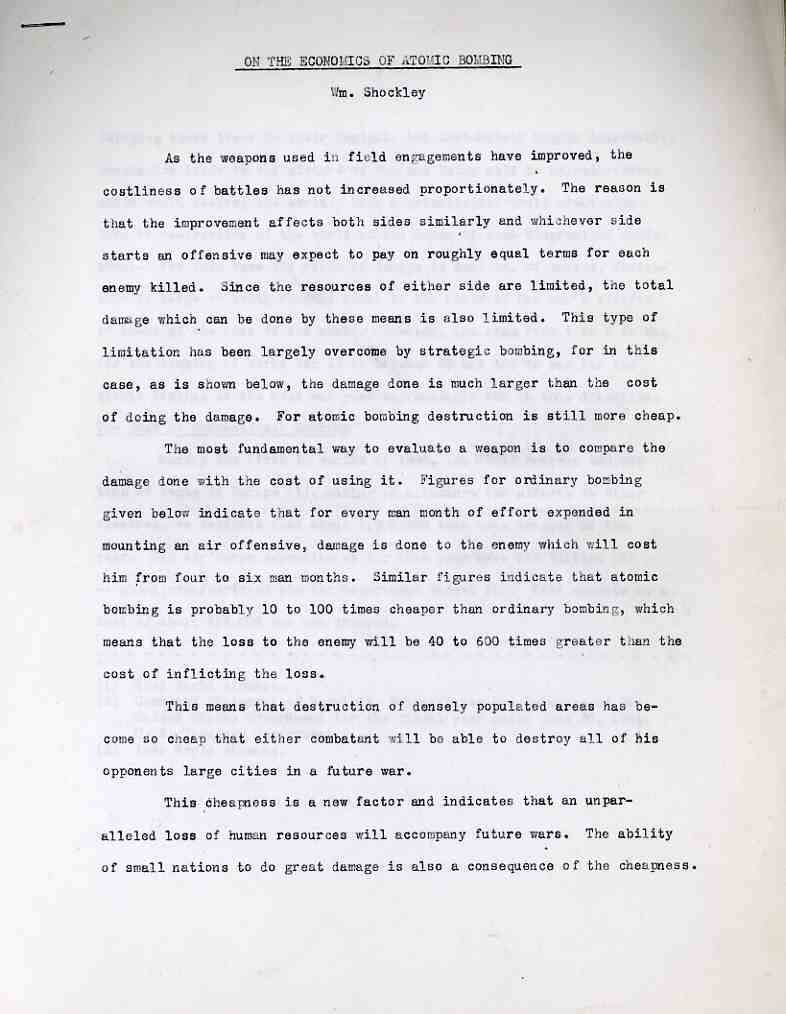
“For atomic bombing destruction is still more cheap”–WIlliam Shockley1.
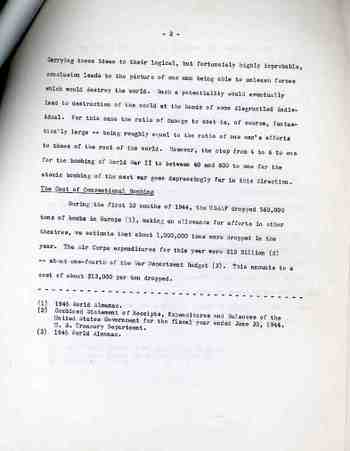
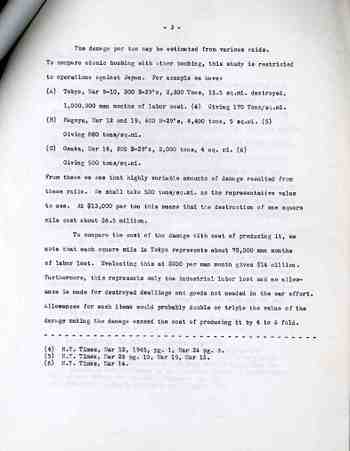
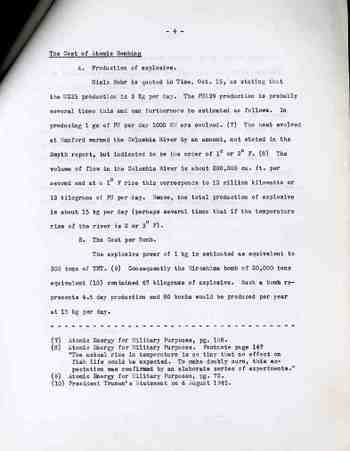
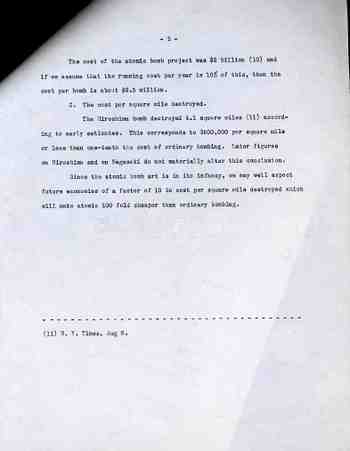
(Click image to enlarge; the other four pages are located in the “Continue Reading” section, below.This is also available for purchase via our blogbookstore.)
This paper is one a small archive of background and draft papers and proposals by the Vannevar Bush group working on the question of the control of atomic weapons and the formalization of the American position regarding the use and control of atomic weapons, October 1945-February 1946. This archive consists of 38 documents relating to the development of U.S. atomic policy, with contributions by President Harry Truman, Secretary of State James Byrnes, Dr. Vannevar Bush, (future AEC director) Carroll Wilson, Alger Hiss, I.I. Rabi, William Shockley, Frederick Dunn, Joseph E. Johnson, Leo Pasvolsky, Philip Morrison, Col. Nichols, William McRae, Admiral W.H.P. Blandy, George L. Harrison, and others.
I have written elsewhere on this site about Vannevar Bush and the coming atomic/nuclear arms problem–as perhaps one of the pre-eminent scientific minds in the Roosevelt/Truman administrations, Bush and others foresaw the development of the atomic arms race in 1943, and by 1945 Bush became a fundamental thinker and advocate on the problem. The items in this archive are low-formal background papers, drafts of proposals, informal studies, as well as mature statements of thought that would become implemented in the core of U.S. policy regarding the spread and control of atomic weapons. They are generally carbon typescripts and necessarily of extremely limited distribution, generally have no letterheads, occasionally carry the authors’ full names (although sometimes only initials are used).
The William Shockley paper was written towards the end of 1945 and is on five pages and runs about 1500 words, and is an extension of work he had already been doing for Henry Stimson with Quincy Wright on evaluating the combinations of casualties that would lead the Japanese to surrender3. He begins this paper with a logical statement of the issue of the economics of conventional and atomic bombing, ending with the sentence “For atomic bombing destruction is still more cheap”. What Shockley is getting to is the overall cost of the amount of destruction caused per square mile, and the conclusion that he draws over these five pages is the destruction caused by the atomic bomb is 1/100th the cost of conventional bombing per square mile destroyed (“atomic bombing is probably 10 to 100 times cheaper than ordinary bombing”).
Shockley also recognizes that the problem in the near future will be the increasing cheapness of producing atomic (and greater) weapons, and their developing accessibility to small nations. “This cheapness is a new factor and indicates that an unparalleled loss of human resources will accompany future wars. The ability of small nations to do great damage is also a consequence of the cheapness.” He writes further that taking this thinking to its “logical conclusion”, that at some point in the future a single individual will be able to use this new technology to destroy the world. The main point though that he was making in this line of thinking was the dispersion and proliferation of the new technology–that an arms race would occur, and that it would be dangerous, and that it could be very very bad. Shockley has of course nothing to say about any of that or the implications of his finds as that was not his charge.
After figuring that the cost of destruction by the atomic bomb was about $600,000 per square mile (compared to $6,500,000 per square mile for conventional bombing), Shockley concludes that “since the atomic bomb art is in its infancy, we may well expect future economies of a factor of 10 in cost per square mile destroyed…”
Shockley on the likelihood of casualties during the final invasion of Japan.
(The following three paragraphs are taken entirely from CASUALTY PROJECTIONS FOR THE U.S. INVASIONS OF JAPAN, 1945-1946: PLANNING AND POLICY IMPLICATIONS by D. M. Giangreco in the Journal of Military History, 61 (July 1997): 521-82
“As for Dr. Shockley’s initial report to Dr. Bowles, it was not submitted until after Stimson had left for Potsdam. He proposed that a study be initiated “to determine to what extent the behavior of a nation in war can be predicted from the behavior of her troops in individual battles.” Shockley utilized the analyses of Dr. DeBakey and Dr. Beebe, and discussed the matter in depth with Professor Quincy Wright from the University of Chicago, author of the highly-respected A Study of War; and Colonel James McCormack, Jr., a military intelligence officer and former Rhodes Scholar who served in the OPD’s small but influential Strategic Policy Section with another former Rhodes Scholar, Colonel Dean Rusk. Shockley said:
“If the study shows that the behavior of nations in all historical cases comparable to Japan’s has in fact been invariably consistent with the behavior of the troops in battle, then it means that the Japanese dead and ineffectives at the time of the defeat will exceed the corresponding number for the Germans. In other words, we shall probably have to kill at least 5 to 10 million Japanese. This might cost us between 1.7 and 4 million casualties including [between] 400,000 and 800,000 killed.”–W. B. Shockley to Edward L. Bowles.2 .
No accurate total of German military and civilian deaths was available at the time he prepared his report, but the number was eventually set at roughly 11,000,000. was not invaded and finished the war with just over 7,000,000 casualties, most of them from its armed services on the Asian mainland in fighting from September 1931 to September 1945.
Notes:
1. The brilliant Shockley’s story is difficult and problematic: from the way in which he misused his interaction with the rest of his team at Bell Labs in the discovery of the junction transistor to his sinful racial and eugenic (and dysgenic) public persona later in life–it is a hard and long one to tell, and I’ll not try to do it here. (I should point out that his attacks started in 1966 when he “delivered the first of a series of controversial papers to the National Academy of Sciences (NAS) in which he called for a renewed focus on racial biology, synthesizing under the title of eugenics the compulsive element of population control with the targeting of the dysgenic fertility of the black population”.[From “Confronting the Stigma of Eugenics: Genetics, Demography and the Problems of Population” by : Ramsden, Edmund in Social Studies of Science, Vol: 39 Issue: 6, 12/2009 pages: 853 – 884.] Suffice to say that I’m very aware of the very long shadows, and I think that other people should at least be aware of them as well, regardless of the staggering importance of “his” (with the wonderful Walter Brattain and John Bardeen) monumental discovery.
2. 21 July 1945, “Proposal for Increasing the Scope of Casualties Studies,” Edward L. Bowles Papers, box 34, Library of Congress.
3. For a detailed look at Shockley’s work in this area see Predicting the Termination of War: Battle Casualties and Population Losses, by Frank Klingberg in The Journal of Conflict Resolution, Vol. 10, No. 2 (Jun., 1966), pp. 129-171. Dr. William B. Shockley (later a joint winner of the Nobel Prize for his work in developing transistors) was an expert consultant to the Secretary of War, engaged in part in gathering and organizing information bearing on the problem of casualties in the Pacific war. He believed that historical studies of casualties might be helpful &dquo;for consideration in connection with the total casualties to be expected in the Japanese war, the rate at which land invasion should be expected in the Japanese war, the rate at which land invasion should be pushed ahead in Japan or held back while attrition by air and blockade proceeds, and the relativeapportionment of effort between the Army Air Forces and the Army Ground Forces…”
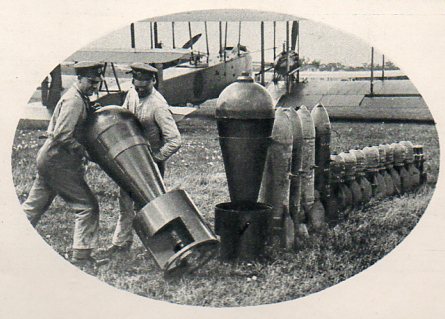
Aerial bombing from heavier-than-aircraft comes to a big anniversary soon, on 1 November 2011, a century after the Italian Lt. Giulio Cavotti dropped the first bomb from a plane on oasis-encamped Libyan troops at Tripoli. Of course things rapidly in the few years following that, so that by the end of WWI people got a good taste of what it meant to controlling pieces of property without actually occupying them, raining chaos and destruction from
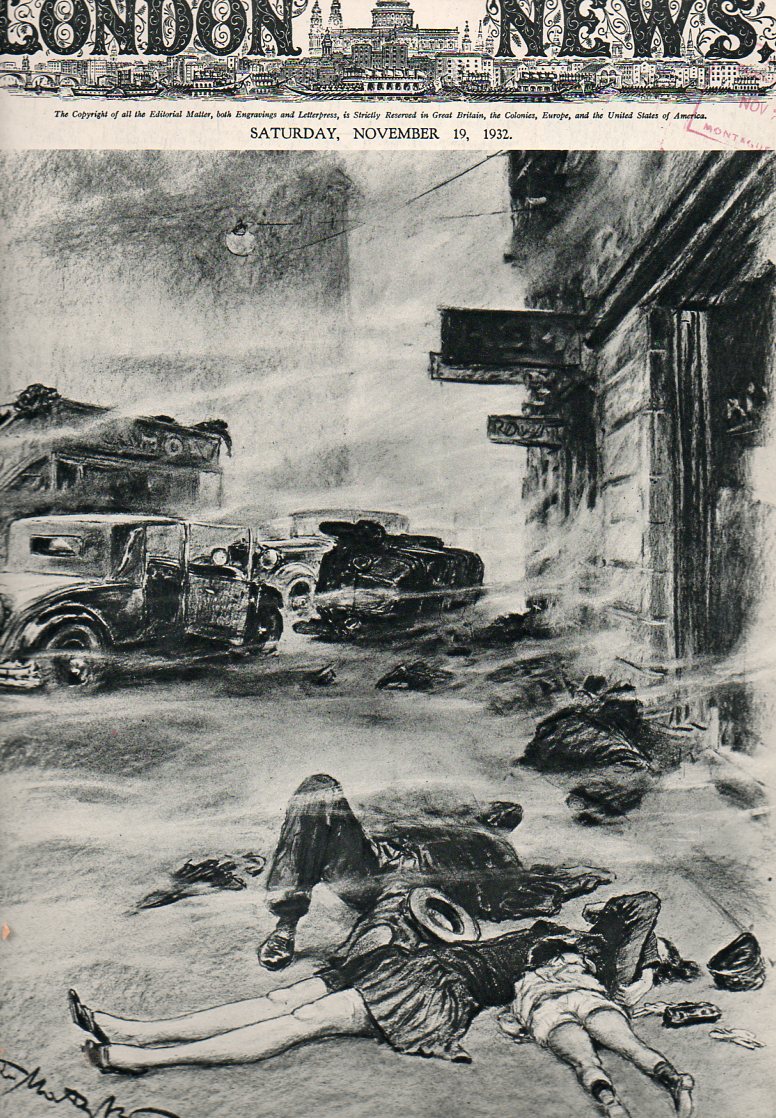
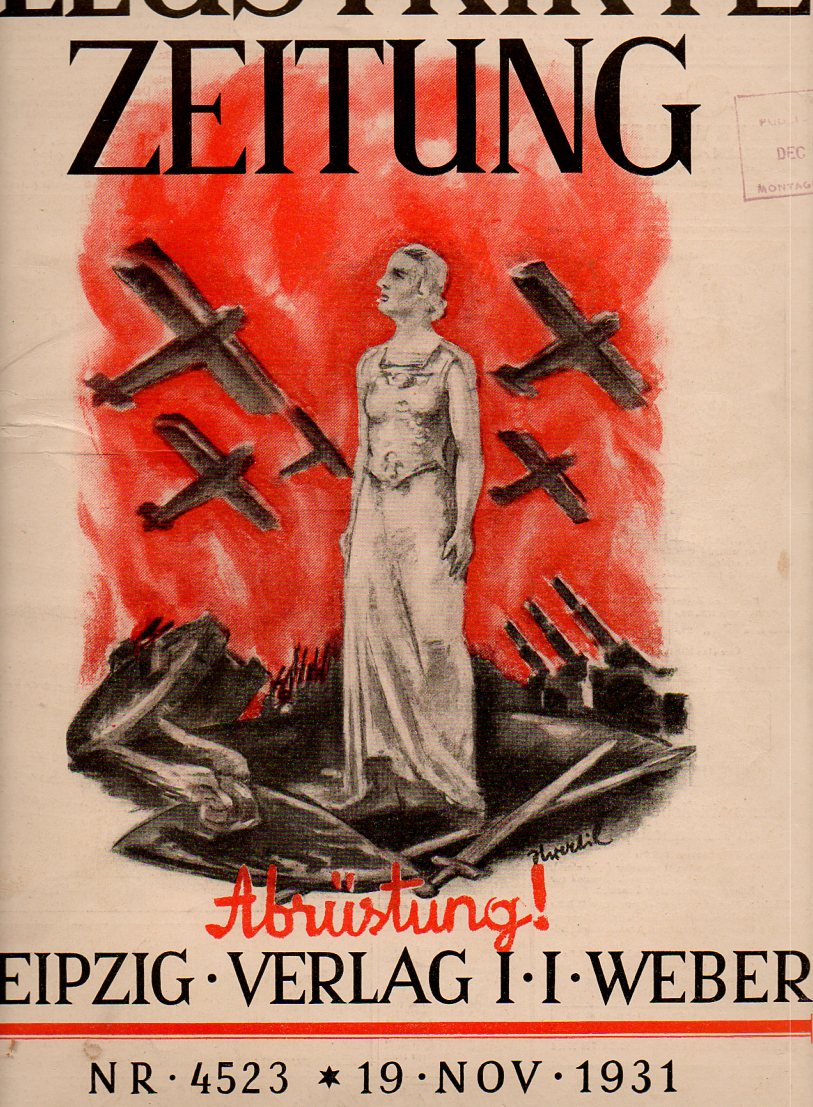
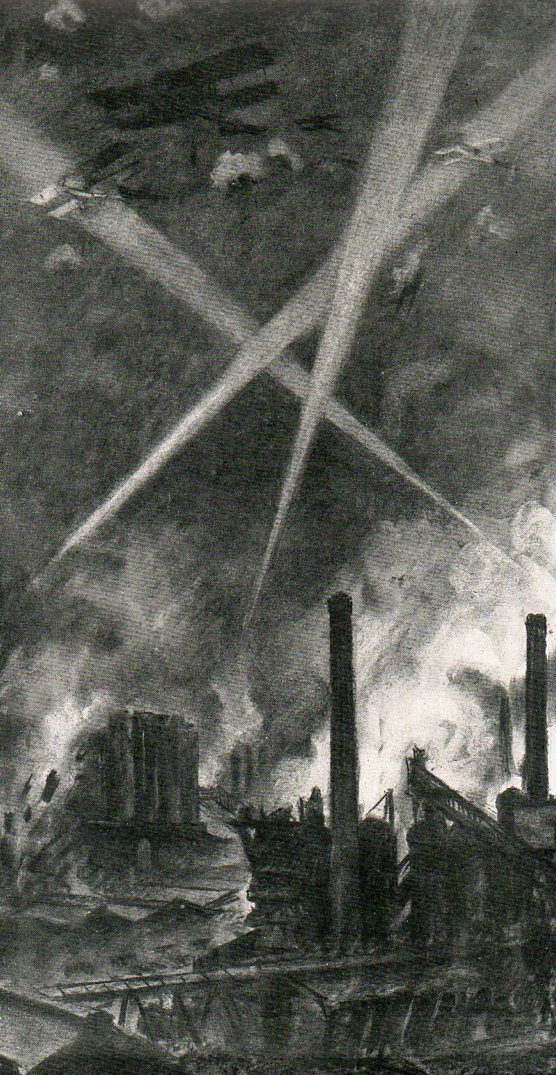
above. 20+ years later, in the early 1930’s bombing became more sophisticated, including a new arsenal of poison gas weapons. The threat from this weapon was agonizing and palpable–the results of gas attacks upon armed combatants in WWI and the gassing of civilians in the 1920’s and early 1930’s made a hard strike into the social fabric, an enormous gapping new hole to be filled in the heart of fear. [And of course this fear was felt everywhere, from London to New York to Leipzig to Moscow to Milan, as we can see in these few examples below. ALSO: these images may be purchased rfom our blog bookstore, here.]
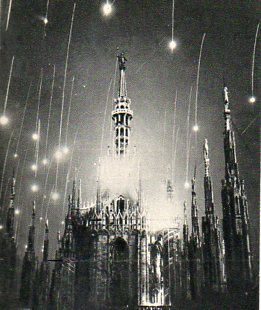
And this interesting image of a mock (or “mimic” as it was called in the report) attack on Milan in August, 1931:
There were a number of interwar aerial bombings that took place that kept the issue of mass destruction alive and well. For example, Britain used its air arm very convincingly in Iraq, bombing many places including Bagdhad in 1923; the Spanish bombed civilians into submission in Morocco, near Tetuan, in 1925, and the French crippled and destroyed their opponents–both military and civilian, it made no difference–in Damascus, Syria, also in 1925.
Fiction also harnessed the possibilities of air war, not the least of which included Armageddon-like scenarios for the semi-End of Days through the use of poison gas and “atomic” weapons. For example, deadly gas used in Anderson Graham’s The Collapse of Homo Sapiens (1923) and Neil Bell’s Valiant Clay (where the poison gas kills 1.5 billion) and Dalton’s Black Death (1934), while Reginald Glossop’s The Orphan of Space (1926) created an alien atomic spaceship which delivered holocaustal death to Soviets and Chinese and Communists in general. There were many more stories like this, not the least of which were the non-fiction strategy works, like Giulio Douhet, author of Dominion of the Skies (1921), legitimizer of the “strategic” bombing of civilian populations (in spite of the Hague Conference of 1907*), and JFC Fuller’s The Reformation of War (1923) which emphsized the new importance of air war and power and which also allocated the use of gas, justifying that morality because it could cause less harm than a conventional attack.
[Image below from :Mr Baldwin on Aerial Warfare”, The Illustrated London News for 19 November 1932, illustrating the sort of aerial bombs that could threaten the population of London.]
The fear was real, and the capacity to cause mass death (espcially from poison gas) was substantial, even if in a still-developing form. Eight years hence, though, it would almost all come true (except for the poison gas part, at least for WWII), and in ways that weren’t quite imaginable in 1932–500 B-29s flying criss-cross over Tokyo would’ve seemed more fiction than science to the 1932-person, even though that technology was only a dozen or so years away.
Notes
* This is where the bombing of civilian areas was specifically outlawed; what wasn’t defined, however, was what “civilian” meant–turns out that it was pretty loosely defined in the 20’s and ’30’s.
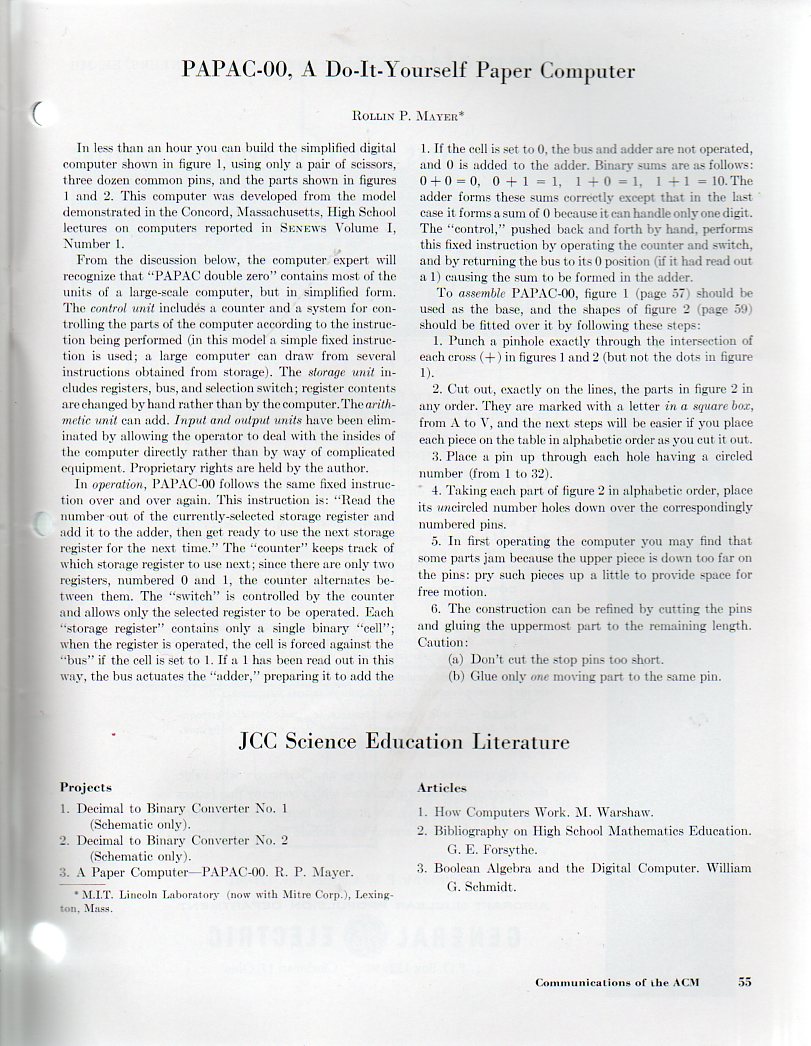
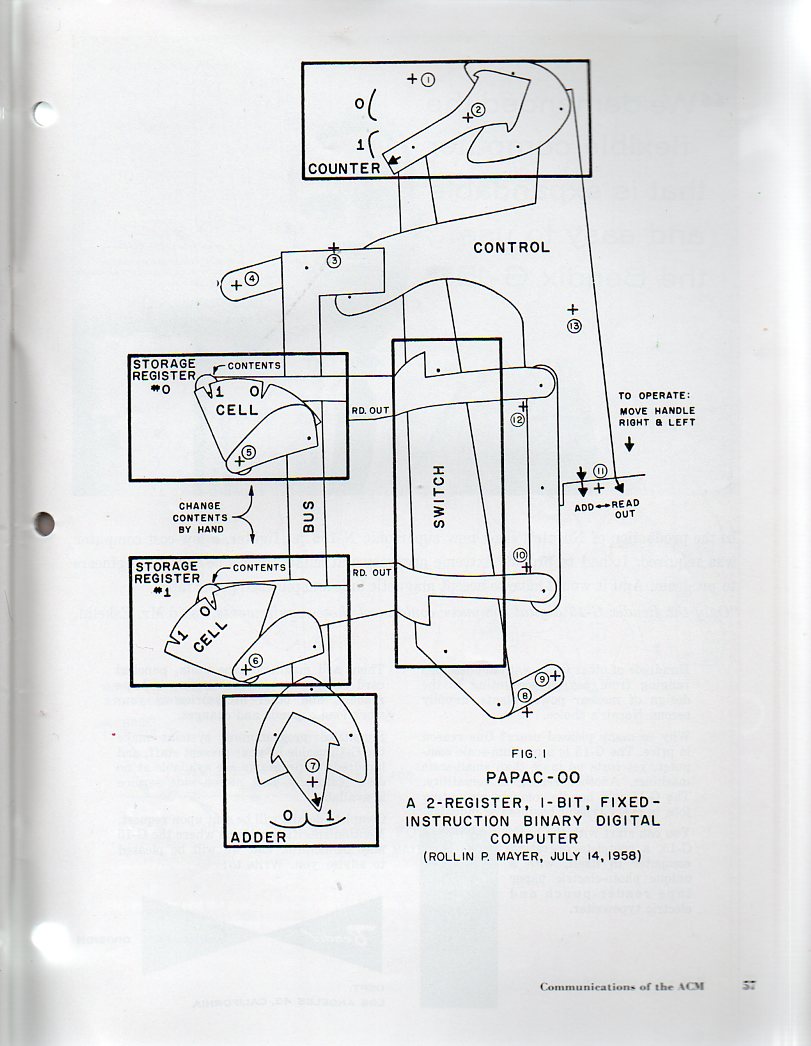
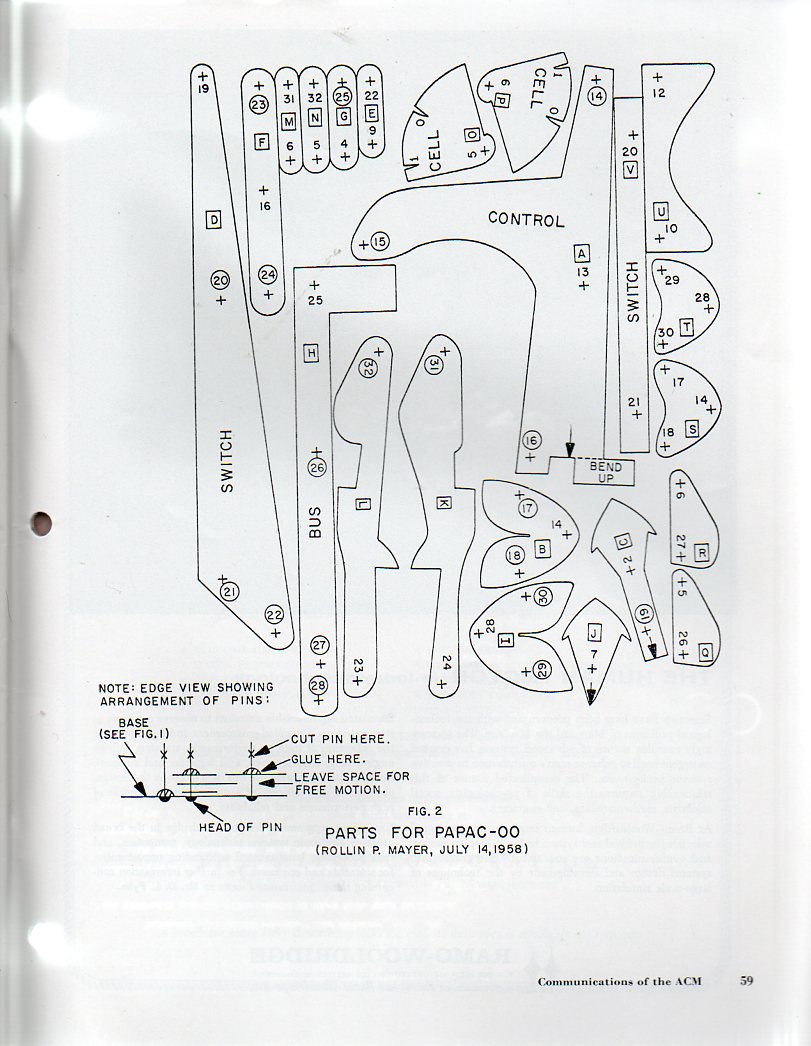
This wonderful cut-away and paste-up template for a digital computer comes to us from the Communications of the Association for Computing Machinery, volume 2, issue 9 for September 1959. The PAPAC-00 is a “2-register, 1-bit, fixed-instruction binary digital computer” and was submitted to the journal by Rollin P. Mayer (of the MIT Lincoln Lab). There’s a hunk of me that wants to make this thing really big–cut out the individual pieces and then crash them out to 50″ widths, pasted on found bits of cardboard packing from the neighborhood frame shop, and then piece the thing together as the world’s largest pre-1960 1-bit paper computer. Or maybe not. In any event I thought to share this with readers here who might actually print out these templates and try to construct the thing themselves–warning: you’ll need t be able to cut pins in order to make the model work properly.
Mayer also wrote an interesting article on including children in the scope of the computer industry…in 1956–something I find to be a very early piece of thinking on Little Humans and Big Computing. His abstract identifies the three main points of his paper: “(1) That the digital computing field needs, and will continue to need, not only more people who are capable of designing and programming digital computers, but more people who understand the basic limitations and potential uses of digital computers; (2) that the computer industry should take an active interest in providing a basic computer training to the largest number of people, in addition to more extensive training to those who show an interest in designing and programming computers; and (3) that the typical 12-year-old youngster has the interest, skill and basic knowledge necessary to build and understand simple working models of practically anything”. –“A proposal for training youngsters in digital computing techniques” in Proceeding ACM ’56 Proceedings of the 1956 11th Annual Meeting.
Lastly I should also mention that in this same monthly issue (which ranged all of 52 pages) was an article by Julien Green, “Remarks on ALGOL and Symbol Manipulation”, a three-page paper that comes from the near-dawn of the ALGOL (short for ALGOrithmic Language). (It can be argued that the beginnings of ALGOL were about 1955, but for the sake of simplicity here I’ll note that the first committee appointed to study the matter for the ACM was in September, 1957, and the first group to formalize it met at the ETH Zurich in 1958, producing the language’s first version, known as ALGOL 58. Julien Green was a member of the 13-person panel that created the ALGOL 60that met in Paris in January 1960. And so the Green paper did appear within the first few years of institutional study in America, and it was written by one of the six American members of the ALGOL 60 team.)
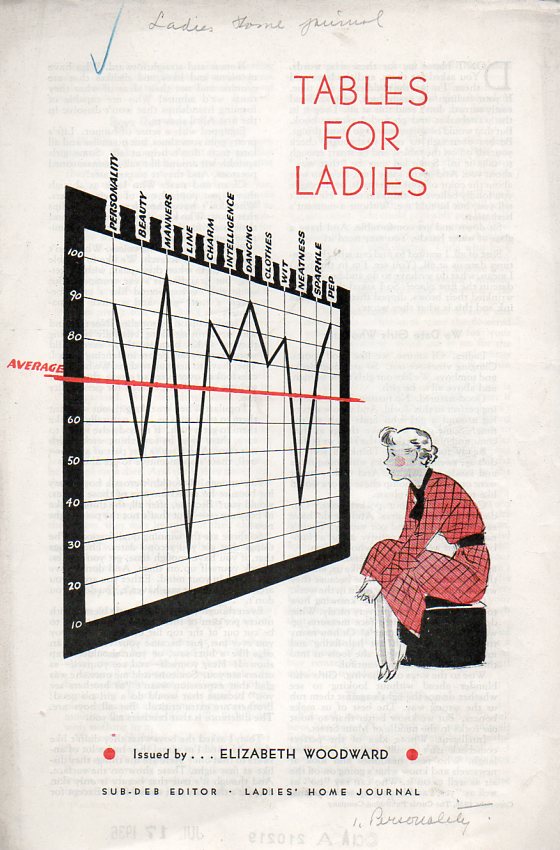
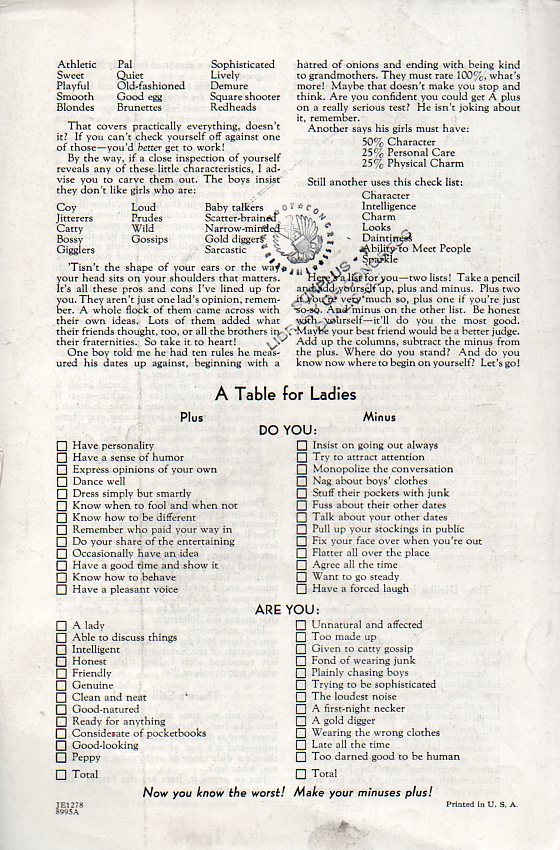
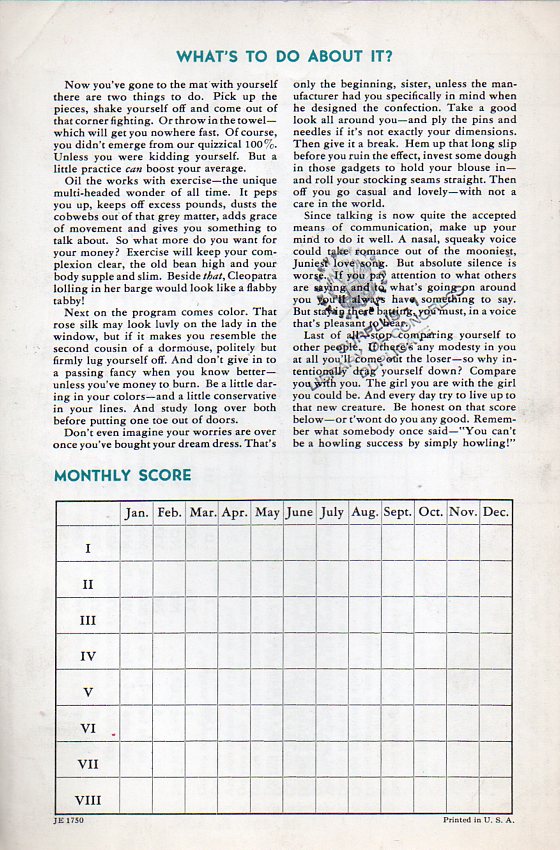
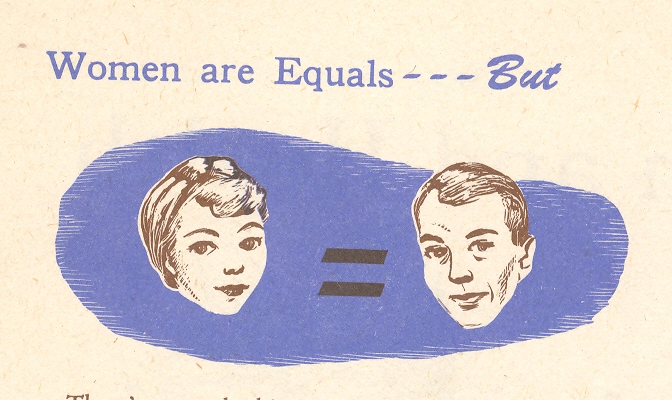
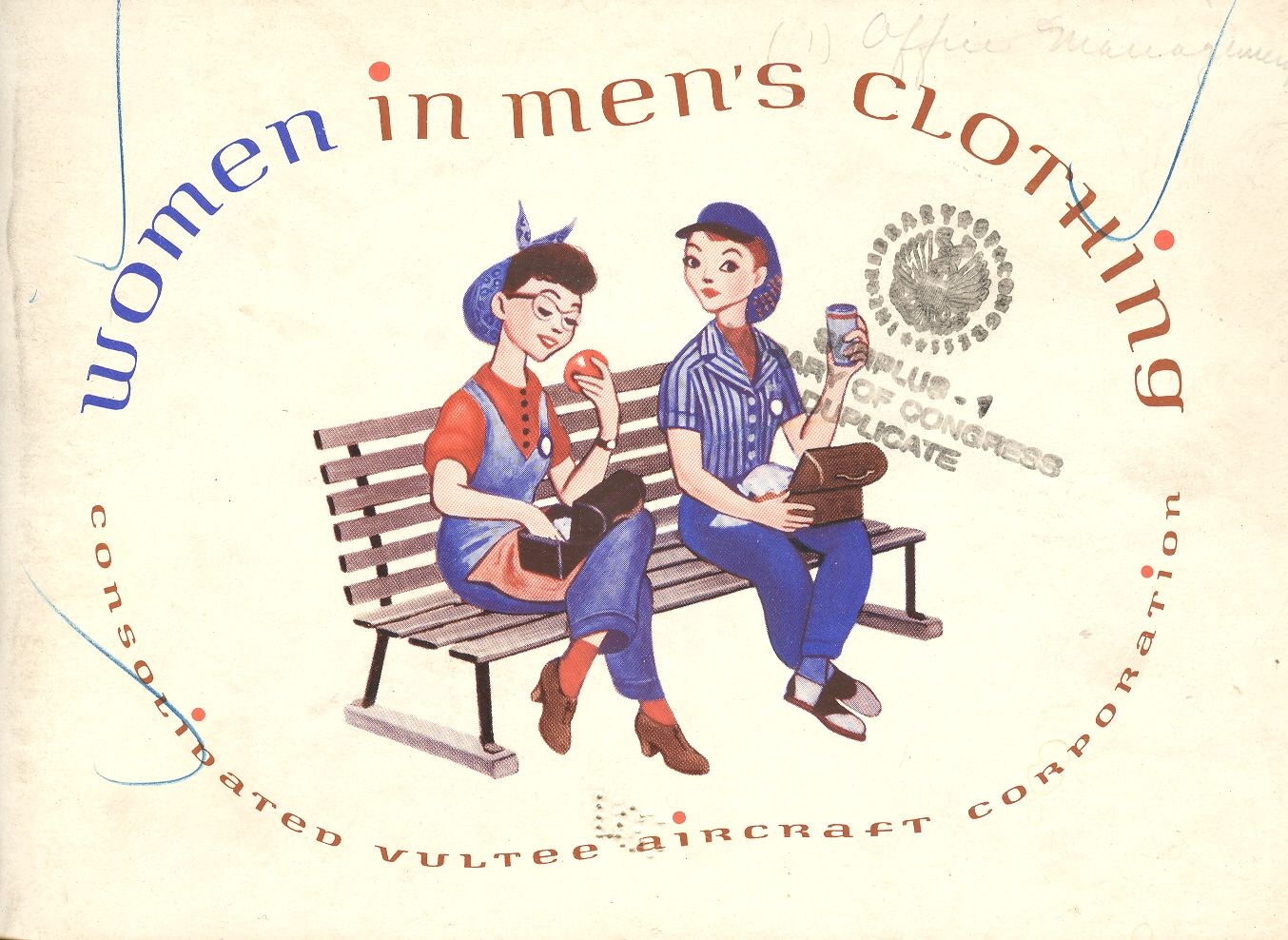
I must admit that I like the first of these two “lady tests” (separate publications from The Ladies Home Journal), cautionary tales as they are, like being able to select your own villainous wardrobe for a creepy (or loud or not) 1940’s version of a Brother’s Grimm fairy tale–instructive, occasionally delightful, often wincing. It seems that the dividing line between being particular and being peculiar displays its fair share of the miracle of capilary action.
For example, in Tables for Ladies (1936), the failing grades (minuses) actually look mostly like, well, problematic personality quirks. I get the “too made up”, “late all the time” and “gold digger” parts–also the character who has a forced laugh, agrees all the time, and is endlessly flattering while putting on makeup and pulling up stockings and monopolizes the conversation (simultaneously?)–and then wants to “go steady” right away while complaining about her (and his) former dates, does not make for an interesting time out. [Both Tables for Ladies and How Ya Doin’ are available for purchase at our blog bookstore.]
I’m not sure what “too darned good to be human” and “occasionally have an idea” mean, nor the failing grade for having too much stuff in your pocket. A lot of the other stuff looks okay to me: intelligent, honest, friendly, genuine, good natured–basic things that translate just fine into 2010. But then there are those servile, squinty-eyed parts that just give you a coppery feeling in your mouth for how restrictive they are.
Of course there’s stuff there indicative of the time, just like the awful racism that creeps into Babar or Bugs Bunny from th 1940’s, or the rank use of racial epithets that populate some regional maps of the south (I can easily attest to the very broad use of the n-word in more than a dozen places in a large 1932 map of my own Buncombe County, all gone today), or the portrayal of subservient women in 1950’s common culture–but for the most part, the overall reach of this little pamphlet seems not-terrible.
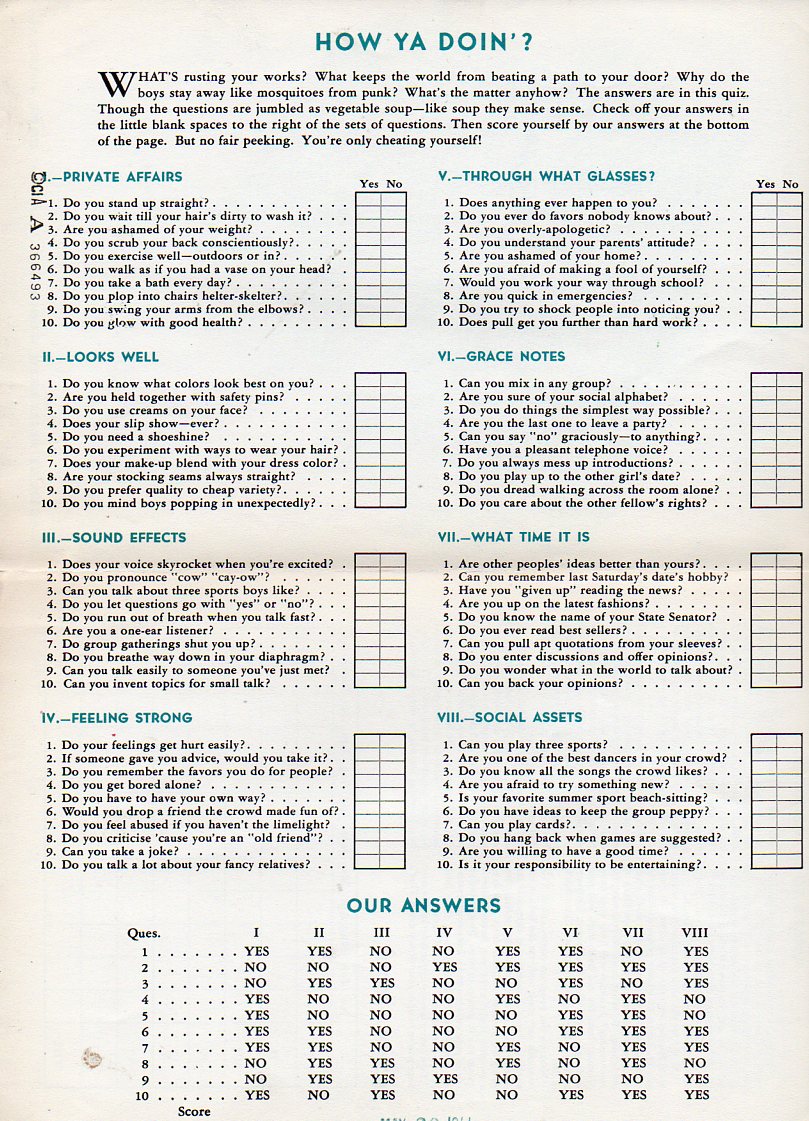
The second little test, How Ya Doin’ (1941), verges more on the need for the mass produced Stepford woman, only this one comes from an earlier period, the mother of Stepford. Some number of the questions seem less significant but more important, many feeling annoying and trite–many of the graded areas are so unexpected (here in 2010) but were in 1941 thought of as being socially important and, well, marketable.
It was important to say “yes” to the questions “do you scrub your back conscientiously?”, “do you walk as if you had a vase on your head?”, “does your make up blend with your dress color?”, “are your stocking seams always straight?”, “can you talk about three sports that boys like?”, “do you breathe way down in your diaphragm?”, “does anything ever happen to you?”, “can you play three sports?”, “do you know all the songs the crowd likes?”, “is it your responsibility to be entertaining?”, and so on.
Not all of the questions feel so sharp and stinging–there are many good qualities (or good qualities from the 2010 mind) that are listed here as well–not to abandon your friends, believing in yourself, inspecting and supporting your opinions, knowing how to decline graciously, feeling good about where you live, being kind, expressing concern, and the like.
The quizzes are not without quality.
In the same vein you might also enjoy these earlier posts in this blog
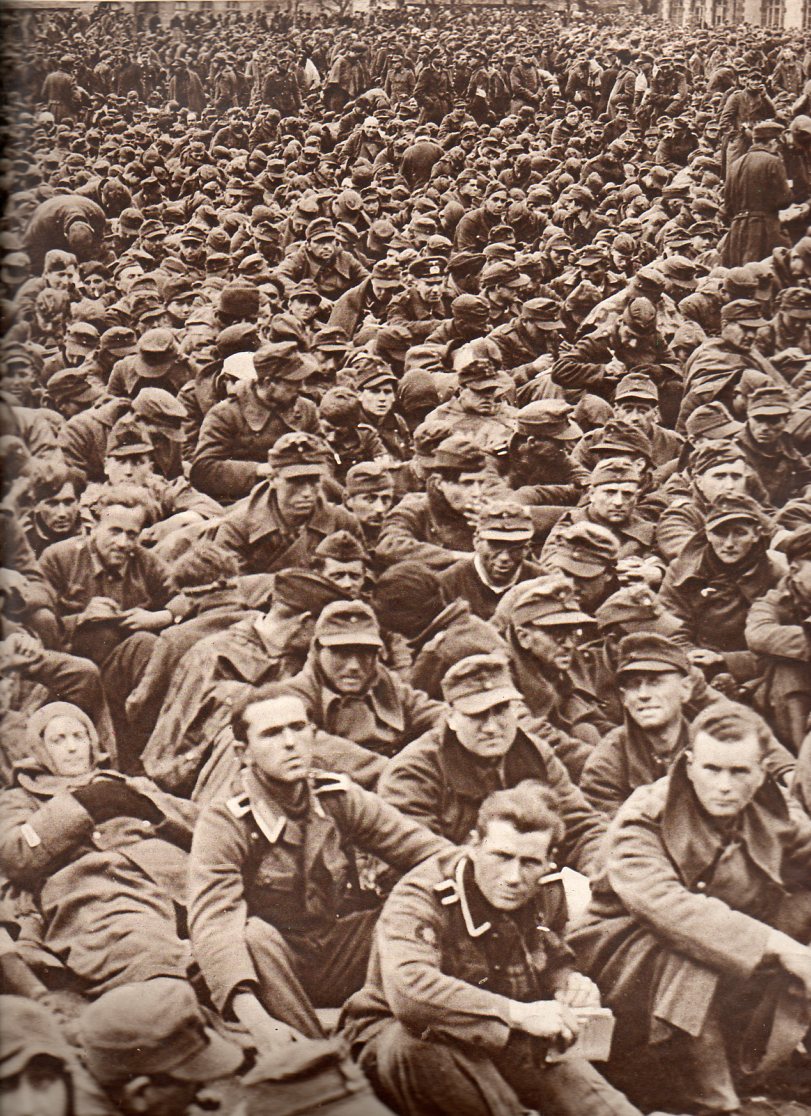
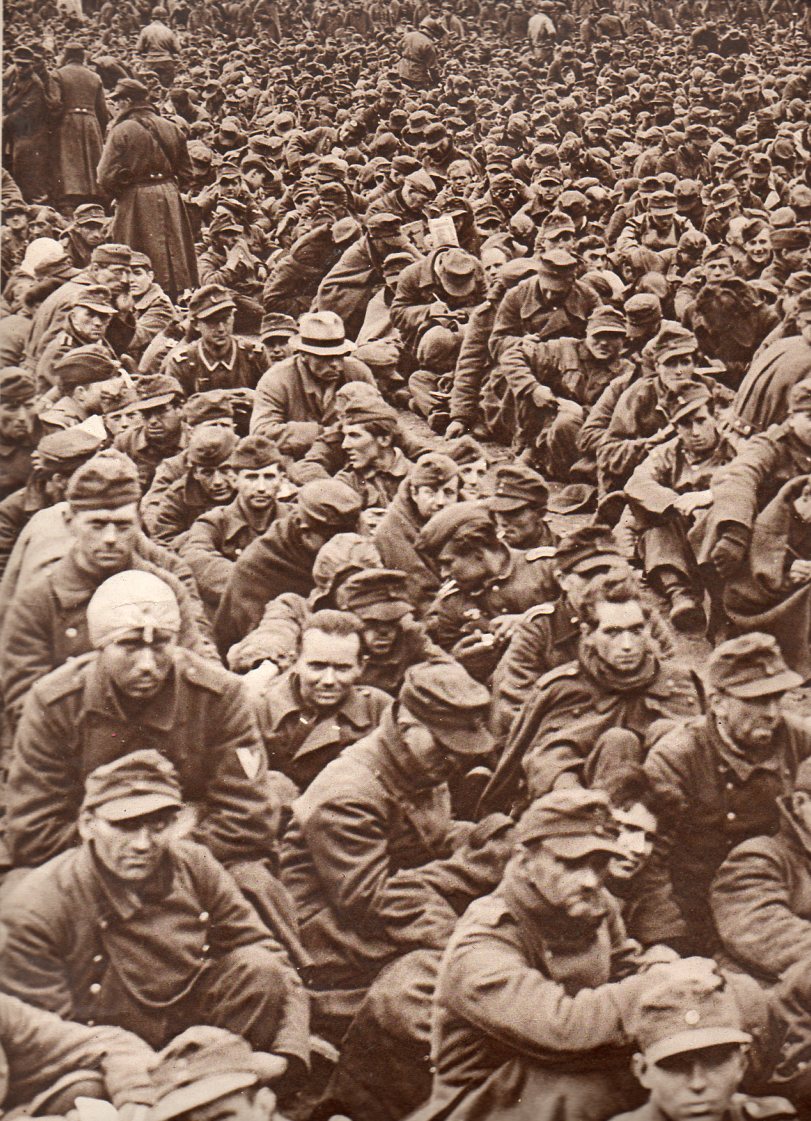
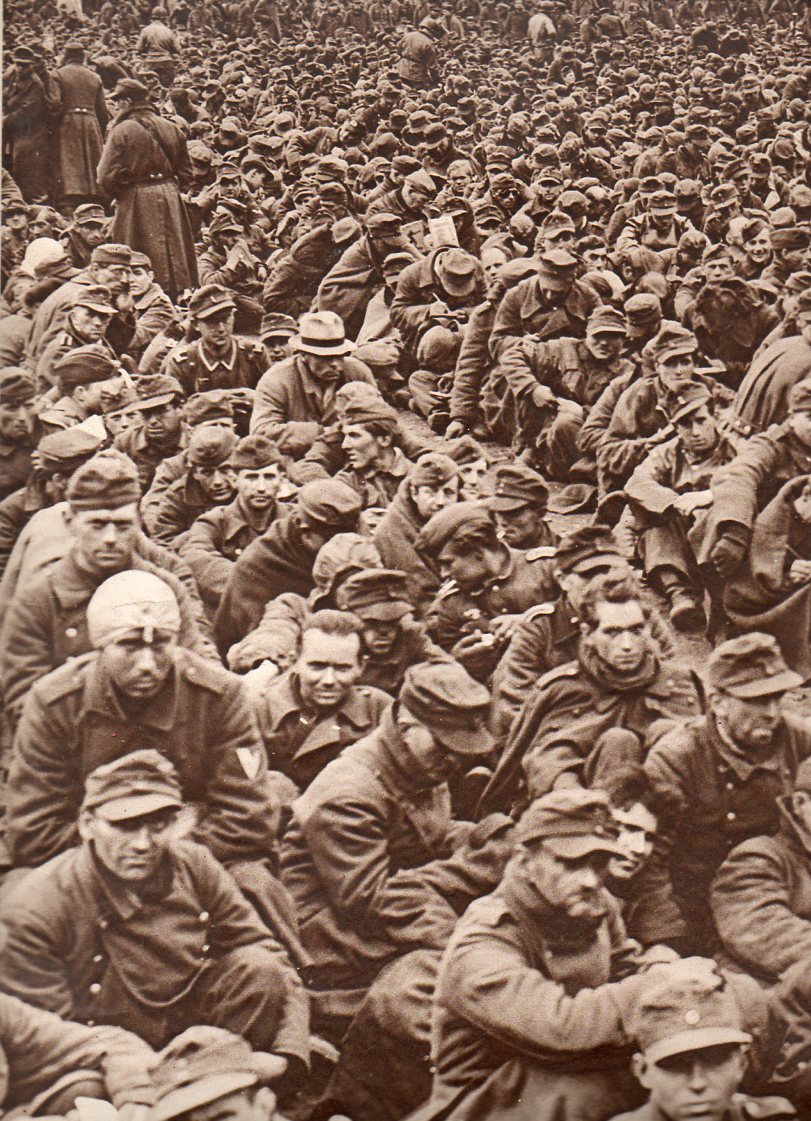
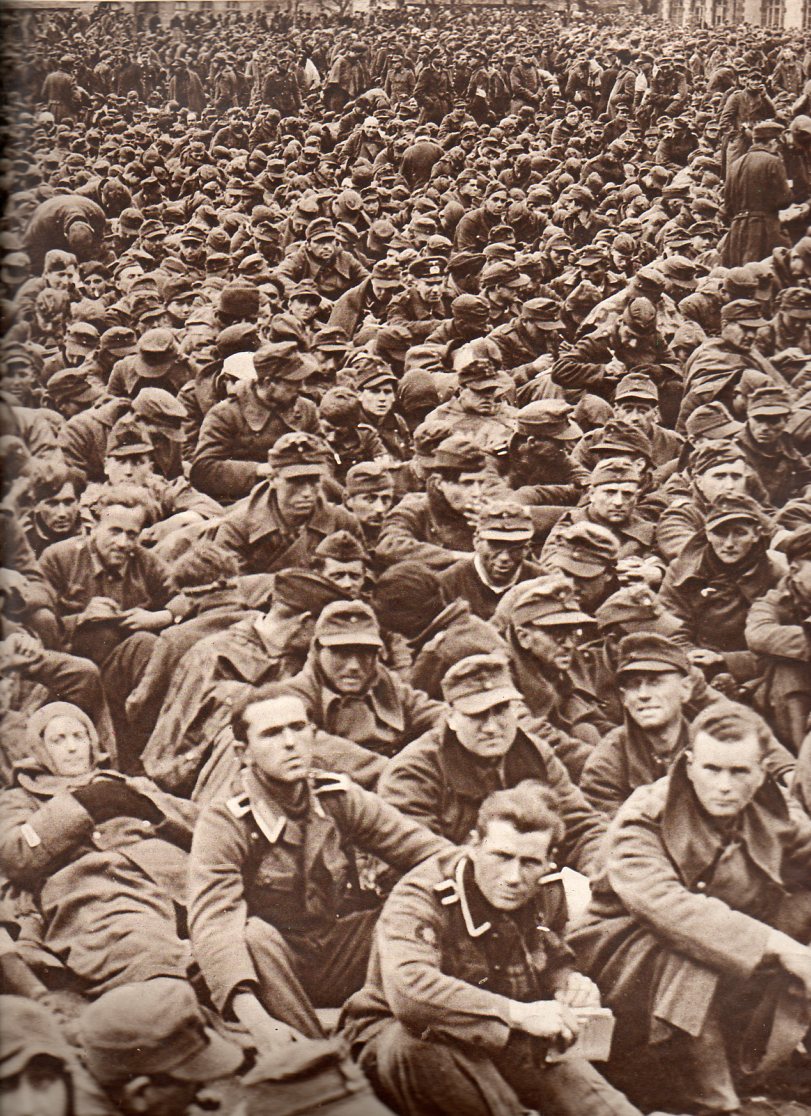
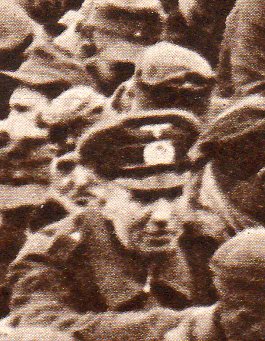
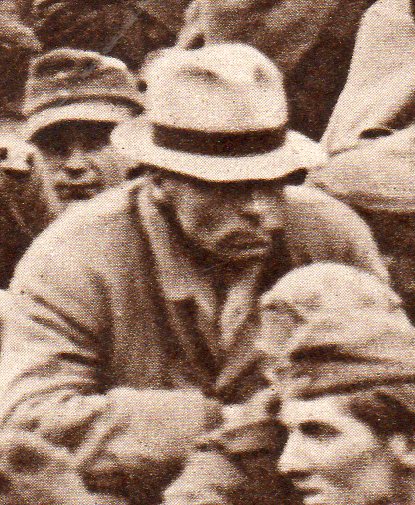
By April 21, 1945–the date that this photograph was published–I should think that those left fighting in the Wehrmacht would have thought that it was time now to be taken prisoner by the British or the Americans, and to not be taken by the Soviet Army. Thousands of German soldiers made their way west at the tail end of the war, trying to evade capture by the Russians, to find some sort of respite from the fear of being taken away by the Red Army to work and disappear somewhere inside the heart of Mother Russia. There was a heavy dose of vengeance being unleashed on the captured German forces in the east in partial payback for the devastating assault on the Soviet Union (Operation Barbarossa) by the Nazis beginning on 22 June 1941, and which caused millions of citizens and soldiers their lives. (Barbarossa was to have been a multi-month long campaign to secure the minerals and farm lands and forests of the Urals and Siberia and the Ukraine, but it lasted for more than three years along an 1800-mile front. The initial operation was very successful for Germany, but the Blitzkrieg ended quickly, and a long slogging campaign began, one which would be decided not only by weather, but by massive production of Soviet materiel and overwhelming army strength.)
The caption of this Illustrated London News photograph states that this is but a small fraction of the 2,000,000 prisoners then held by the Allied Forces. Shortly before this it was estimated that the Nazis held some 1.7 million Allied prisoners, which meant that in early 1945 more than 4 million soldiers were held as POWs in Europe. This enormous figure is exclusive of Japanese prisoners (estimated at about 150,000 in early 1945, with this number being exclusive of any Chinese prisoners), and the number of prisoners held by the Soviet Union.
Te return rate of German prisoners from Allied camps was very high; that same rate for Germans in possession of the Soviets was very low, something along the lines of 20%. The Nazi campaign through the Soviet Union showed small mercy and great cruelty; the Soviets reciprocated with the German soldiers they captured.
Overall, this is a tough photograph. The soldiers were evidently awaiting delousing before being sent onto trains to deliver them to more formal detention facilities. At least when these soldiers got on those trains with what sound like hgih-tin whistles, they mainly survived their ordeal, and the showers that they were going to receive were using water, and not zyklon-B.
[This is another in a long thread of posts on this site relating to shadows–simply enter “shadow” in the google search box at left for a listing.]
“Pulvis et umbra sumus” (“We are but dust and shadow”)– Horace
Depicting the capacity of sight and nature of light has been both an easy and a knotty problem in the history of science. Over the successive theories on the basis of light the artistic presentation of the phenomenon has been generalized (generally) in a very simple way: by straight lines. There’s certainly nothing wrong with that, the lines are just parenthetic place-holders suggesting direction, not actual descriptors of what light “looks” like.
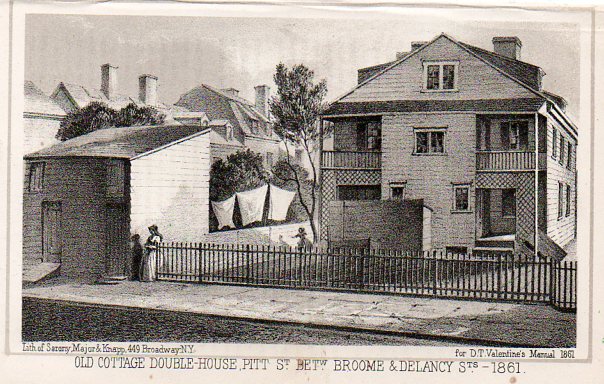
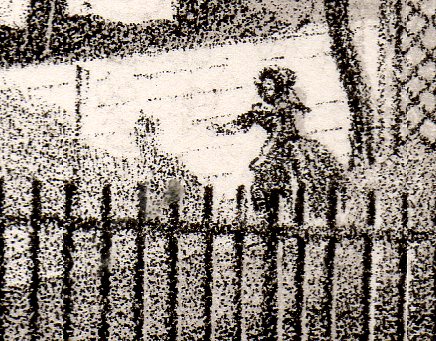
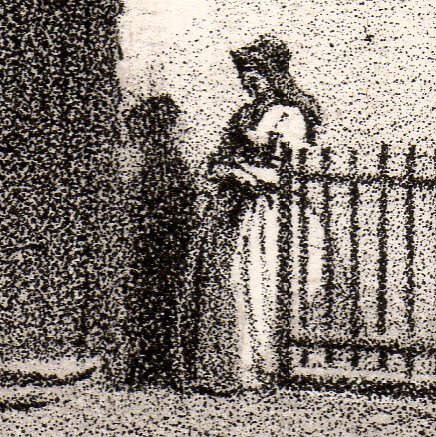
But what about shadows? Light and its effects are the basis of art, but what about light, “interrupted”? Or, really, how old is the depiction of the shadow in the history of western art? The shadow predates the modern re-discovery of classical perspective by a thousand years—little bits of shadows pop up here and there in deep antiquity, certainly way before Uccello and Alberti and the rest came along. On the other hand shadows do escape notice of many painters in the 15th century (and during the period of being very comfortable with the century-old realignment of perspective), which is odd, unless all of those works were depicting scenes at high noon or thereabouts. Which brings to mind this lithograph from one the 1861 edition of Valentine’s Manual for the City of New York. What strikes me is the low oblique angle of the sun–setting or rising–throwing the shadows of the two figures in the image very high up on the receiving surface. Odd things like this are interesting to me, and to be frank about it,. I’ve not noticed such a hard angle with shadow in too many prints.
 Now let’s get back to the NORC.
 Now our second towering example is this four page pamphlet, received by the Library of Congress (and probably nobody else) on 1 October 1943, which divines the origins of World War Two and the kidnapping of the Charles Lindbergh baby to a complex and impossible cabal of Japanese “War Lords”, Kaiser Wilhelm of Germany, the assassination of Leon Trotsky, the League of Nations, Elihu Root, “3 cent gallon kerosene”, the South Manchurian Railway, and some sort of “historical documents of posterity countersigned by Tokyo and Berlin” in the possession of Mrs. Renee Valentine (“Secretary”) of Staten Island, New York.