A Daily History of Holes, Dots, Lines, Science, History, Math, Physics, Art, the Unintentional Absurd, Architecture, Maps, Data Visualization, Blank and Missing Things, and so on. |1.6 million words, 7500 images, 4.9 million hits| Press & appearances in The Times, Le Figaro, Mensa, The Economist, The Guardian, Discovery News, Slate, Le Monde, Sci American Blogs, Le Pont, and many other places… 5000+ total posts since 2008.

  • Questionable Quidity Department: Cigarette-attached Ash Tray

    JF Ptak Science Books  Quick Post

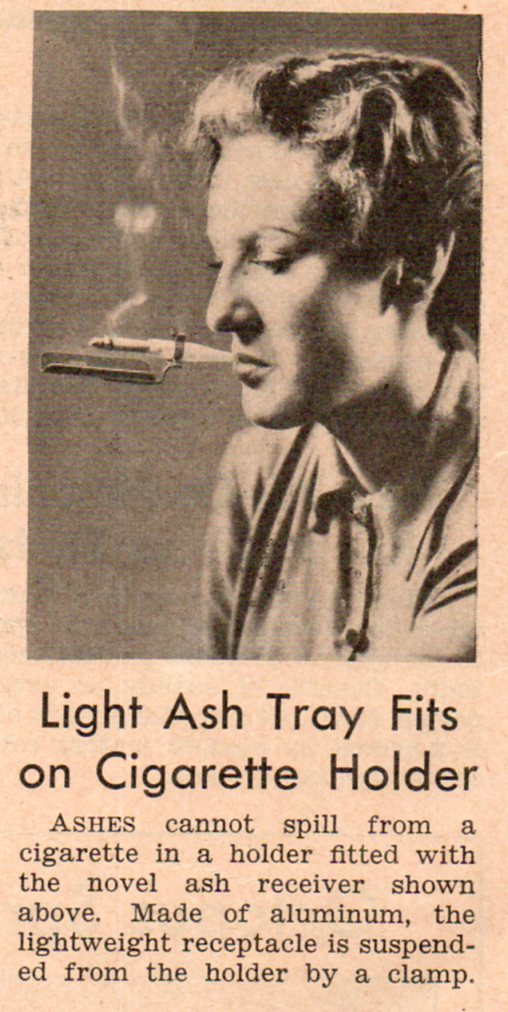
    In the entire invento-sphere of things crying out for suitable invention, this “innovation” in smoking is surely not one of them.  Perhaps if you needed an additional bit of strangeness in developing the quirkyness of an impossible boss for a character in a movie–someone who needed to be able to be free of the responsibility of flicking the ashes from their ciggie as they screamed at a subordinate, or a cook using the device to free up both hands while preparing a meal, or etc.–then I guess this invention could be part of the genius of a role.   Beyond that, I don’t know…particularly if there was a smoke-in-bed version.

    Perhaps the downfall of such a device is seen in the eyes of the model, which are transfixed on the ashes in her nose tray.  Maybe the settling of the ashes two inches from your nose would be a hypnotic event, altering the wearer’s sense of place and attention, giving you poor vision, and a certain sense of smoky sullenness.

      Bizzaro 509

  • Searching for Structure: Triangles and Trees

    JF Ptak Science Books  Post 1494

    Structure512

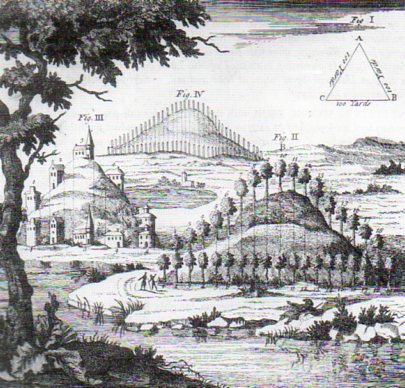
    It was this lovely engraving from Richard Bradley’s A General Treatise of  Husbandry and Gardening..., printed in London in 1721/2, that brought up the issue of structure in creation, and how that issue was in one way approached by the new tool in the scientific toolchest, the microscope. 

    “…the Contrivances of the Almighty Creator is as visible in the meanest Insect of Plant, as in the greatest Leviathan or the strongest Oak.  To touch upon all the Wonders this Instrument shews us would be infinite”–William Molyneux, on the microscope, in his A Treatise of Dioptricks in Two Parts (1692, quotation fro the second edition of 1709 via Marjorie Nicholson’s Science and  Imagination, Cornell, 1956.

    The question that the microscope—newly introduced and popularized by Robert Hooke in 1665 and Anton van Leeuwenhoek in 1674–was so able to address at this time was the question of the structure of things, and whether the Almighty Creator allowed for unrestrained creativeness or if the cosmos was subject to patterns and forms.  The microscope was so tremendously nimble that it allowed its observers the luxury of finding “correct” answers on either/both sides of the issue, that arguments could be well made and sustained for variety and regularity. But of course all found the reason for either end of the argument deeply seated in the e hands of god, as seen in the lovely quote below by the great early microscopical popularizer, Henry Baker1. 

    But this is just the tiniest bit of a nod at the question of structure in the history of science, a search for the relationships between, well, things small and large:  atomic, molecular, cellular, organism, population, ecosystem,solar system, universe.  The issue of structure may be the only issue–perhaps if you were made to select one question to have answered, automatically, an answer for everything, it might be this issue of how things stand in relations to one another.

    Which gets us to this 1721 engraving of a tree-covered hill, following the designs of a human creator, a re-animator of the natural landscape according to a theory of beauty, part of which hangs in the form of a triangle  in the right-hand upper corner.  A three-sided strategy of the relationships in nature, provided by a human vision. A very small  appreciation of an attempt to recognize the relationships between things, and in this case, the beauty of trees and hills. 

    Notes:

    1.  “The first Part of this Treatise discovers in the Particles of Matter composing Salts and saline Substances, Properties whose amazing Effects would surpass all human Belief or Conception, were we not convinced of their Truth by the strongest ocular Demonstration. That beautiful Order in which they arrange themselves and come together under the Eye, after being separated and set at Liberty by Dissolution, is here described and composed but one kind of figure, however simple, with Constancy and Regularity, we should declare it wonderful: What must we then fay, when we see every Species working as it were on a different Plan, producing Cubes, Rhombs, Pyramids, Pentagons, Hexagons, Octagons, or some other curious Figures peculiar to itself; or composing a Variety of Ramifications, Lines, and Angles, with a greater Mathematical Exactness than the most skilful Hand could . draw them?”

    “Sensible of my own Ignorance, I pretend not to account how this is done: all I know is, that Chance or Accident cannot possibly produce Constancy and Order, nor inert Matter give Activity and Direction to itself. When therefore these Particles of Salts are seen to move in Rank and File, obedient to unalterable Laws, and compose regular and determined Figures, we must recur to that Almighty Wisdom and Power which planned out the System of Nature, directs the Courses of the Heavens and governs the whole Universe.”  — Original, shorter quote of Henry Baker in his Employment of the Microscope (1753) found in Nicholson’s book; the above, longer version is from the 1764 (and second) edition, found here.

  • Precursor to Zombie-Phone-to-Deadsville: the Telephone Medical Metal Detector “X-Ray”

    JF Ptak ScienStructure513ce Books  Post 1495

    Did President Garfield Die Because of Metal Bed Springs?

    Thomas Edison famously took advantage of a naive reporter, telling the young man that he was working on an invention that would allow a person to telephone dead people–a story that was reported as true, and one which Edison (both thoroughly disgusted and joyful) helped to perpetuate to the day he died by simply not discussing the issue. (This story appears on this blog here.)

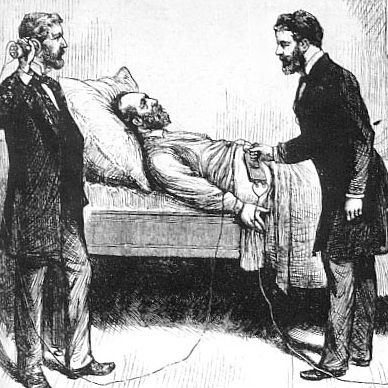
    Much earlier, only five years after Alexander Graham Bell first patented and published his invention of the telephone, the device was used by Bell to do some very early electrical medical imaging.  The new President of the United States, James Garfield, had been shot by Charles Guiteau in Baltimore and Potomac Railway Station (on 2 July, 1881, after a lengthy period of semi-abstract stalking and planning) Station in Washington, D.C., receiving fatal wounds in July and which would cause his death later in September.  The problem was that at this point in the history of surgery it was  difficult to locate bullets in the body, becoming more so if the bullet took a non-straight course through the wounded.  Normally, in 1881, a doctor could for example use a device called  a Nelaton probe, a thin porcelain device (as opposed to most other probes, which were metallic) to help locate the embedded bullet.  But given the nature of Garfield’s wounds, this was just not applicable, and the bullet escaped recognition from this and other probes.

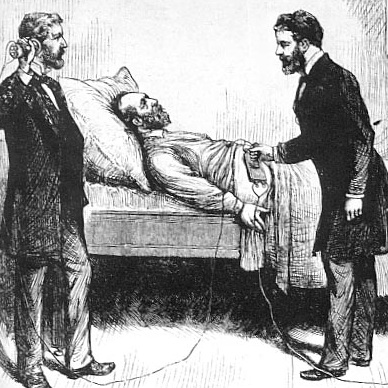
    Bell enters the scene with an electromagnetic invention, the induction balance, which he created to detect interference on a telephone line.  In the process of experimentation Bell recognized that the balance could be disturbed if the metal and battery-fueled probe came into contact with a piece of metal.–basically, the device was a medical metal detector. Bell resolved to use the device on Garfield, passing the probe along the President’s body while another person listened to a telephone ear piece for the telltale “click” of a proximate metallic object.
    Bell telephone garfield
    Bell was not successful with this, or at least not so at this time, and the President died, succumbing to an infection, finally.  But Bell was able to perfect this instrument, something that stayed in use as the principal means of detecting metal objects in the body, and was about as fine an instrument as could be expected, though it was completely eclipsed by the revolutionary machines brought about by Wilhelm Roentgen’s discovery of X-Rays in 1895.  And as it just so happens, the first surgical case in which the x-rays were used was for a case involving a shotgun wound. 

    Finally, one of the reasons why Bell’s instrument didn’t quite work on President Garfield is that Garfield’s bed had a metal box spring, which very well might have played havoc with Bell’s instrument.  Perhaps if there was no metal in examining area, Bell’s device might’ve worked. 

    Notes:

    An earlier and more crude device had been invented by Wilhelm Heinrich Dove (1803-1879, a German physicist and early meteorologist) though I am not sure that it comes into play with Bell’s apparatus at all.

    From Harper’s Weekly, 13 August 1881:

    “The experiments made by Professor Alexander Graham Bell with the view of determining by the aid of the electric current the location of the bullet in the President’s person were of the most interesting nature. The possibility that a time might come when it would be necessary to make incisions at once for the removal of the bullet, without consuming precious time for further consultation, gave to the experiments an importance which added greatly to their interests.”

    “An apparatus known as the induction balance had been used by Professor Bell in analyzing metals. This instrument, modified so as to impart to it the highest degree of sensitiveness, was used in the search for the leaden ball. Its nature is such that it is not easily understood except by electricians. It consists of a battery, two coils of insulated wire, a circuit-breaker, and a telephone. The ends of the primary coil are connected with a battery, and those of the secondary coil are fastened to the posts of the telephone. This latter connection renders audible any faint sound produced by the circuit-breaker, or any change in the pitch of that sound. The coils may be so placed in their relationship to each other that no sound is made by the circuit-breaker. They are then said to be balanced, and the wires are extremely sensitive to the disturbing presence of any other piece of metal. A bullet like that with which the President was shot, before it was flattened, will, when placed within two and one-half inches of the most sensitive point on the pair of coils, cause a faint protest against the disturbance to arise in the telephone. A flattened bullet of the same bulk, when presented with its flat surface toward the coils, will make its presence felt at a distance of nearly five inches. When its sharp edge is turned toward the plane of the coils, no sound is produced beyond the distance of one inch.”

    “With these facts in view, the experiments to locate the position of the bullet in the President’s body were begun. The patient was bolstered up in bed, and he watched the proceedings with mute interest. His physicians stood around. Professor Bell stood with his back toward the President, holding the telephone to his ear, while Mr. Tainton, Professor Bell’s assistant, moved the coils over that portion of the abdomen where the leaden ball was thought to be imbedded. When the sensitive centre of the instrument was immediately over the black and blue spot that appeared shortly after the President was wounded, Professor Bell said, “Stop! there it is.”

    “The experiment was repeated several times — once with Mrs. Garfield listening at the telephone; and she told the President when the coils had been brought to the spot where the presence of the bullet had previously caused the delicate instrument to give forth a singing sound. From these tests it was inferred that in any event the bullet was less than five inches from the surface, and that if it was only slightly flattened, or if its edge was turned obliquely toward the surface, it might be much nearer to the skin. The conclusion reached was that if it should become necessary to remove the bullet at any time, this might be speedily accomplished by two quick cuts with the surgeon’s lancet.”
  • Questionable Quidity: Fireworks Boxing

    JF Ptak Science Books   Quick QUIDITY Post

      Quidity514
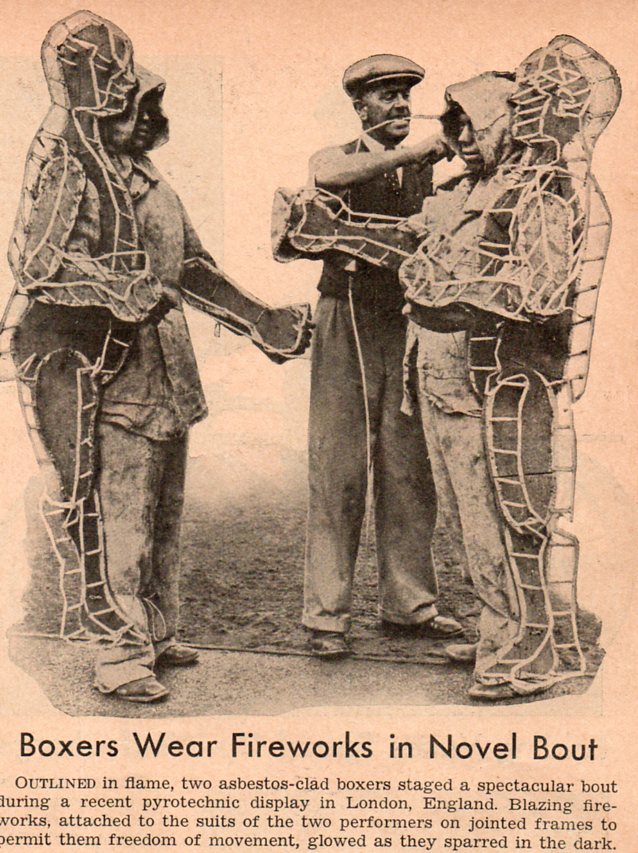
    Certainly in the history of creative chemistry there were more reasonable things to do than this.  But perhaps not, perhaps the folks in 1934 had come to the realization that the idea of creativity was spent, that there were not going to be any new, good ideas, that the era of reasoned inquiry was gone–and to celebrate, the sport of fire boxing was born. 

    These realizations came in 1934, and 1935, and every year, before and since.  The struggle with or for creativity and genius is a second-by-second bout, and there is no doubt that the quidity of what passes for a “good idea” for x^x ideas must surely fill the middle of the infinite Encyclopedia of Stuff that Doesn’t Make Sense. 

    My guess is that the number of bad ideas stays a relative constant among humans.  The only difference over time is the number of humans having the bad ideas and the ways in which everyone hears about them. 

    Note:

    The guy on the left bears a small resemblance to Augustus Saint-Gauden’s Adams Memorial (sometimes called “Grief”). 

    Quidity515 Adams-memorial-2

  • Questionable Quidity: the Preservation of Decay–Atomic Bomb Suits

    JF Ptak Science Books   Post 1486

    Part of this blog’s long series on Atomic and Nuclear Weapons


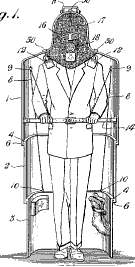
     Is there anything more revolting than this solitary, encapsulated,  iron maidenesque survival sarcophagus and its promised hope of survivability? 

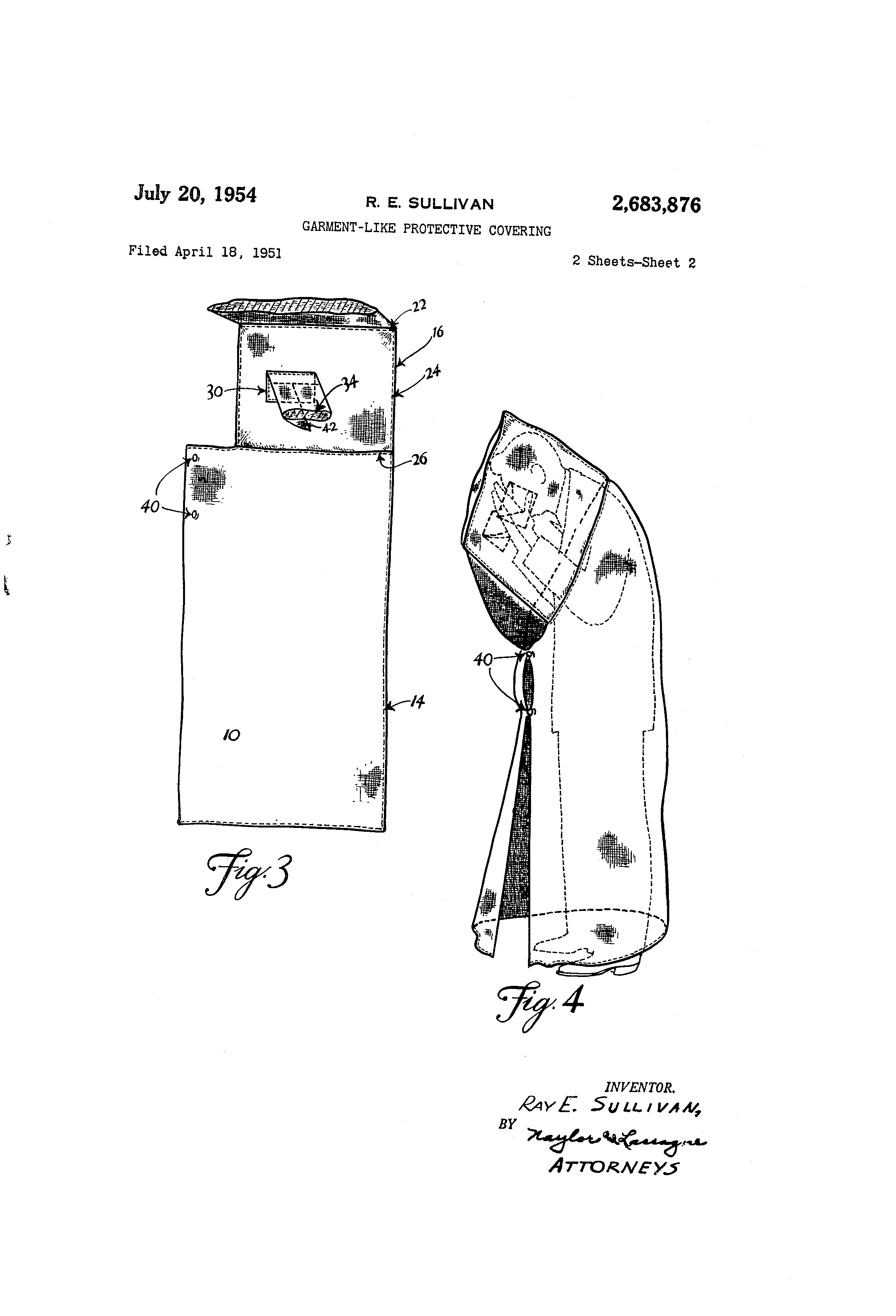
    Perhaps not.  This patent application for an individual survival suit from 1958 gives us something to think about, perhaps gives us the cause to imagine what the world would look like from the inside of that portable evacuation chamber (that had its own attache case for storage).

     
    Atomic suit 2
     
     
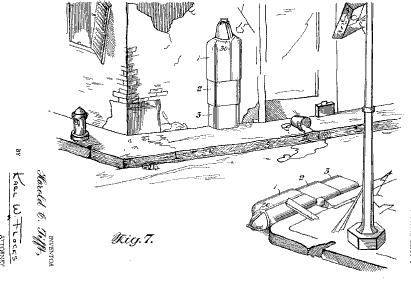
    Another variant, from 1958, shows a handy, mobile triangular leaf-incinerator-like environment that you wheel into position, put on its side, and then crawl into and die:
     
    The bomb(s) would go off, and there you would be, standing with your back against the wall, or laying in the gutter pressed against the curb, just another piece of the dead city, another piece of metal waiting to decay.  I’m not sure what is going on in this scene, which while being crude is still steeped in a high-creep factor.  I get the impression of slow time in these images, as though the atom-bomb-suited people have been there for a long time, though I suspect that we are seeing an urban area just after a blast.  It is a wincingly bad scene. 


    Atom bomb suit
    (Why is it that when seeing Civil Defense films and etc from this period we see people ducking-and-covering from one bomb?  Since the great majority of Americans lived in one of the 75 “essential delivery acquisitions” areas (I forget now the source for this phrase) it was exceptionally unlikely that people would be dealing with a single acquisitions implement, since the Soviet stockpile of nuclear weapons would’ve been at probably half-par with the U.S., which at this point (1958 or so) would be around 18,000.)
     
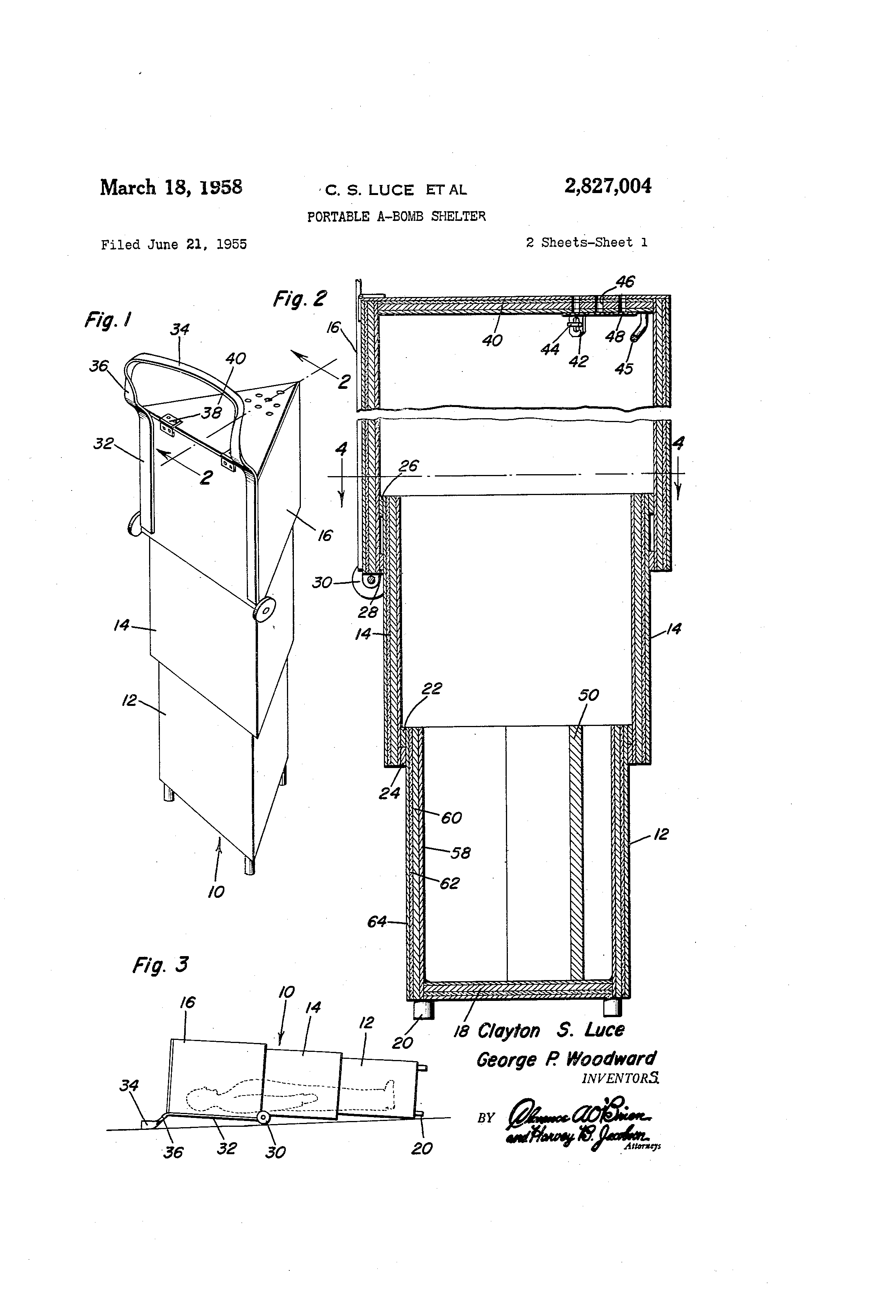
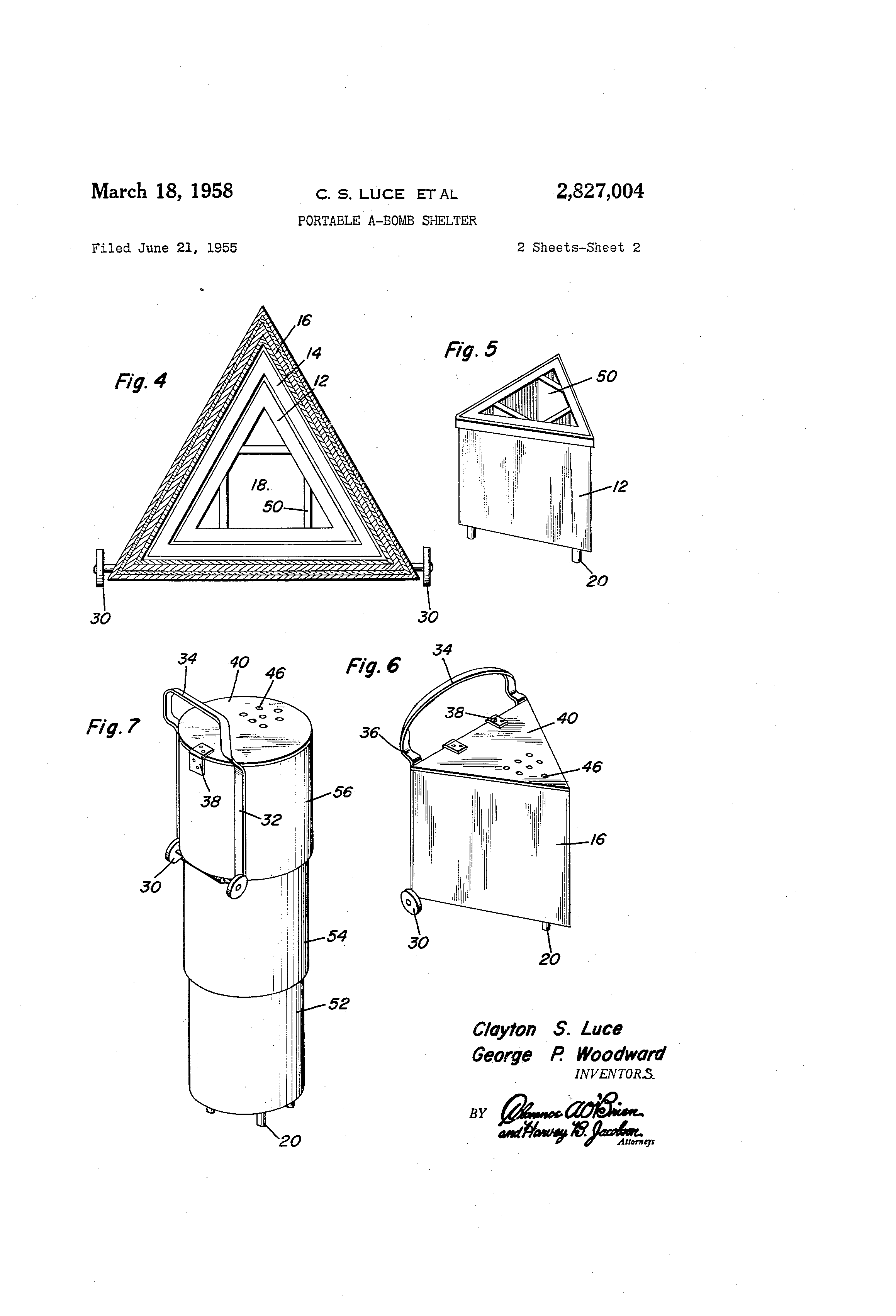
    Here’s another example of some unusual thinking on surviving nuclear holocaust, 1958, only these–while solitary–are not terribly mobile, even if they did come with wheels. (Didn’t it bother anyone that something that was supposed to prevent you from flying glass and bricks and the terrestrial ring of fire could be moved around on such tiny wheels?) They look more like waste receptacles.  Maybe that’s what they would wind up being, if they were ever used for their intended purpose. 
    Atom bomb proof suit prone

    [Source: Google patents, http://www.google.com/patents/US2827004]

    And another atomic bomb “garment-like” thing–this looks like it might actually be useful on airplanes, because most people who die in crashes do so from smoke inhalation…but providing one of these per person would be a bad flying vibe, just like seat belts (so ferociously resisted by Mr. Iacocca) were seen by the car industry as an unnecessary reminder of how dangerous cars were/are).

    Atom bomb proof suit 1958

    [Source: Google patents, http://www.google.com/patents/US2827004]

    Anyway, the only way these things might be useful in times of such an emergency as atomic holocaust would be as a burial shroud.  And since a bunch of people would (presumably) already be wearing them at the time of attack, the job of burying them would be that much less work, since they were already shrouded.  Of course, that’s assuming (a) that people would or could be buried, and (b) that there was anyone left to do the burying. 

    Atom bomb suit bent over

    [Source: Google Patents, http://www.google.com/patents/US2683876]


  • Atom Bombs: the Game.

    JF Ptak Science Books   Post 1497

    Atomicbomb pieces I do not know the precise date when displaying the death of children was used to sell detergent.  There were deep hints of a child’s death in a Twilight Zone episode (selling Borax) in the ate 1950’s, but in general I think that killing kids on television for story development and entertainment is more an ’80’s creation than anything else.  Children dying in stories on television had been verbotten, a non-starter, for decades; now kids die in Dr. House’s hands and all over the rest of that wasteland place and there’s barely a wrinkle in the entertainment continuum.

    Killing children in literature is entirely different, and of course much older.  Given the overwhelmingly and horrible basis of the news reports of the Old Testament, I wonder what the great flood would’ve looked like on OT TV?  After all, it was reported that the creator did away with almost everything on Earth–men, women, and of course  every child and baby on the planet, drowned like rats in a bag, but without a bag–kids left to float away from their parents, and then drown, sinking into the cold black sea created by the very thing that created them.

    Kids killing things in play is another matter, especially since it is done so for fun. I guess they smote or smitted things for time immemorial, but it wasn’t until very recently, and mostly with the invention of the middle class and the creation of disposable income, that killing toys were sold to kids in stores. Toy guns and knives and other implements of destruction at least made whatever the kids were doing a face-to-face activity.  When the atomic bomb toys started to appear in the late  ’40’s, killing stuff took on the potential of worldwide destruction.  Of course I doubt that any kid playing with these atom bomb toys had an inkling of what it meant to use the weapon in the real world, but the appearance of atomic bomb toys–while not quite yet at the level of Auschwitz board games–is on the revolting side.  On the other hand the destruction of entire galaxies has been witnessed by kids in any number of movies and television programs, what with billions of living being killed in the process.

    I don’t know what the effect is of exposing children to mass killings in the name of grand theft auto, let alone opening apocalyptic floodgates by putting nuclear weapons within their reach.  It just isn’t right.

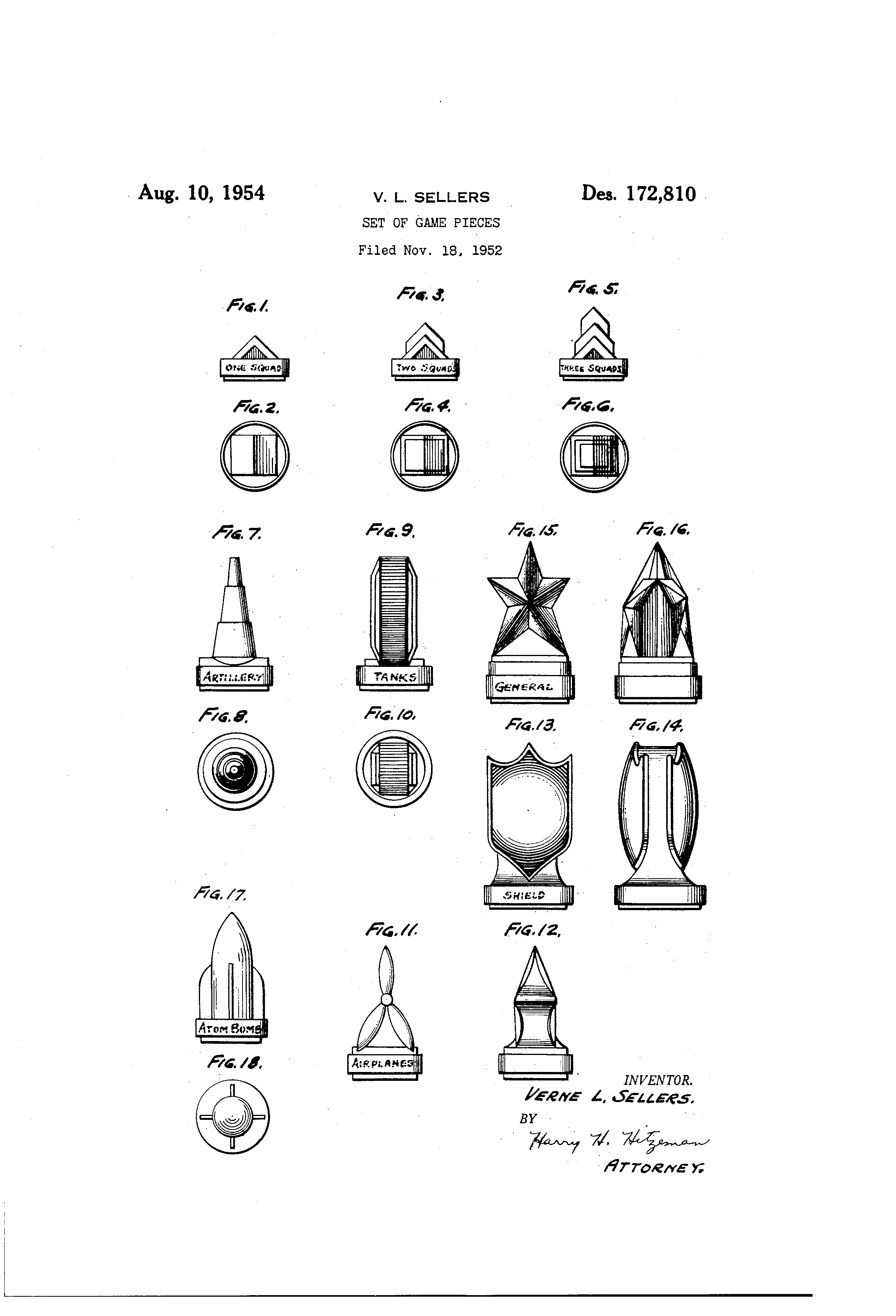
    Does these things, below, seem appropriate to you?  Take for example a simple matter in this detail from a U.S. Patent Office report for game pieces for a board game–the pieces were described; the game wasn’t.  The inventor, Verne Sellers, provided tanks, artillery, an air power of some sort, a “shield”, a general, a few undesignated items, and of course an atom bomb.  The atom bomb would make things all right. 


    Games atom bomb[Source: atomic bomb game pieces from US Patent and Trademark Office via Google Patents: http://www.google.com/patents/USD172810?dq=atom+bomb+game]

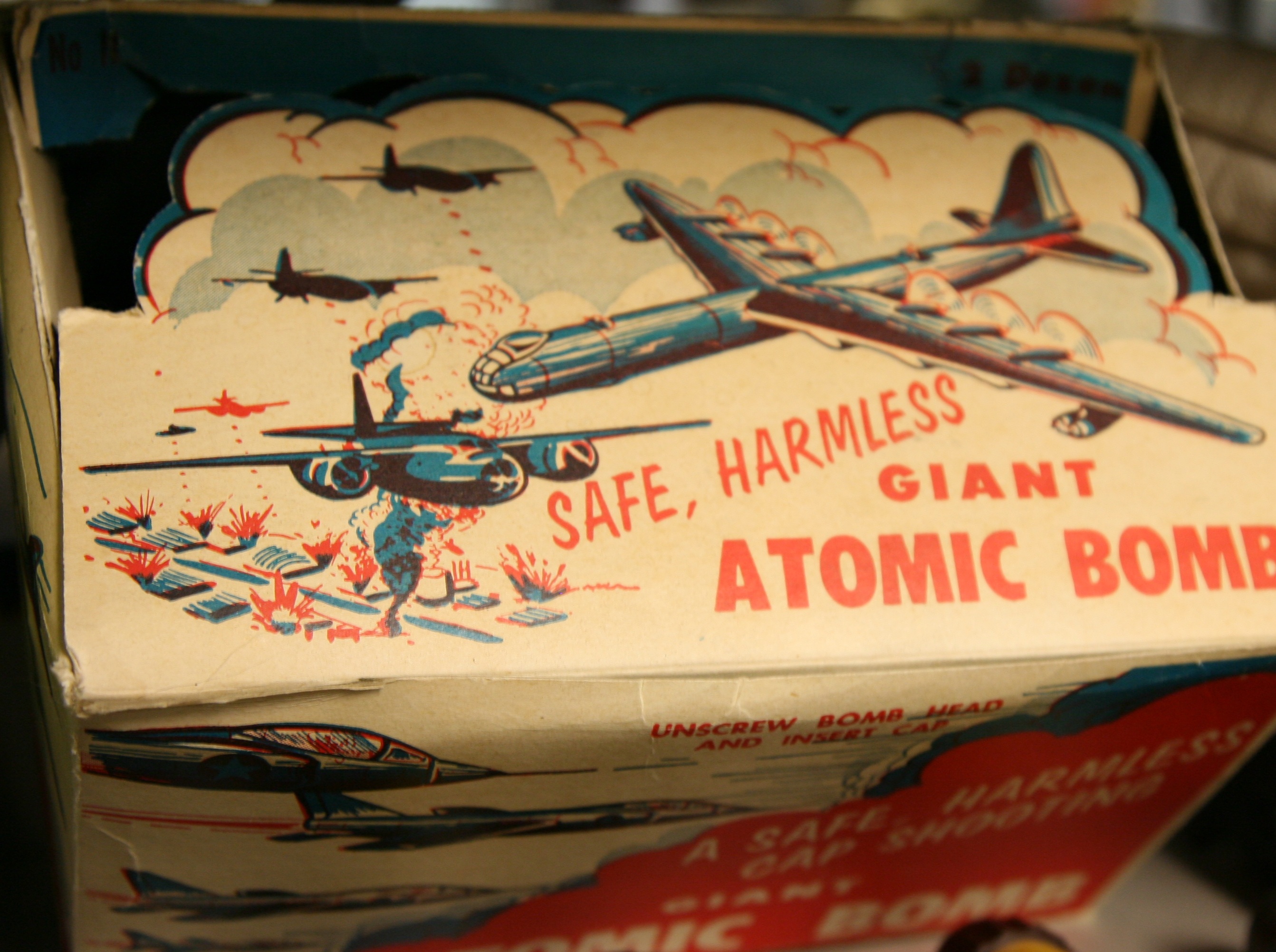
    And then there is the “Safe, Harmless, Giant Atomic Bomb”, which is something that is made to sound so much like nothing that it gives “nothing” a new meaning.

    Atomic bomb toy

    [Source: Pinterest https://www.pinterest.com/electrichermit/atomic-age-america/]


    Then this lovely thing, a small and cheap dexterity toy that places atomic destruction in the sphere of a semi-mindless time-killing toy, a real neutralizer to the significance of the thing it portrays:

    Atomic Bomb dexterity game

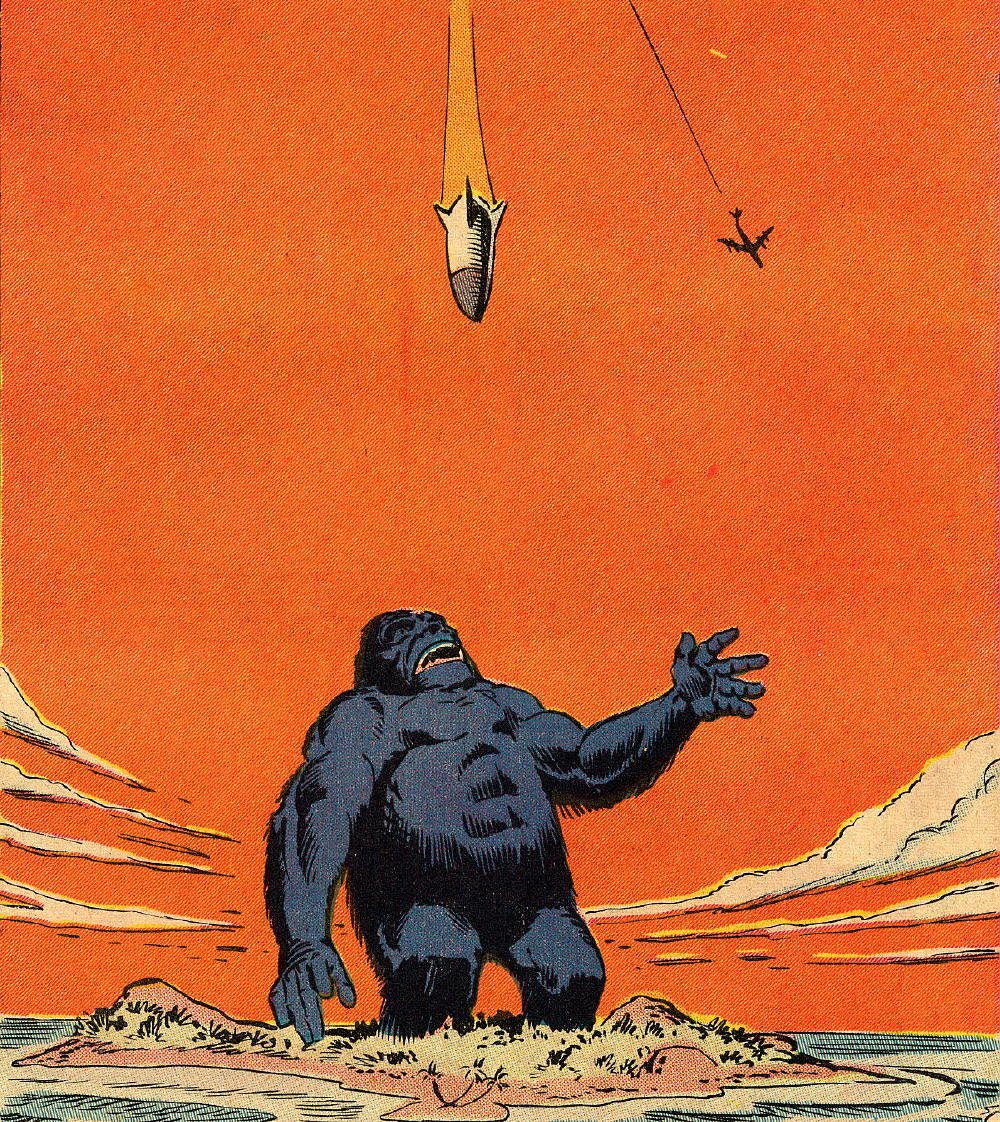
      I can’t imagine many people wouldn’t feel some sort of sympathy for this gigantic King Kong, who looks up just in time to see the massive nuke falling on his head, personalizing the delivery system of mass destruction:

    http://4.bp.blogspot.com/_xKCH2IWimP8/TKo0NZZutWI/AAAAAAAABgY/RbpLA7QTTD8/s1600/Konga+Atomic+Bomb.jpg

    Total destruction as a game, or game piece; an oxymoronic trivial pursuit.


  • A Backwards, Inside-Out, Oil + Iron Internet (1937)

    JF Ptak Science Books   Quick Post

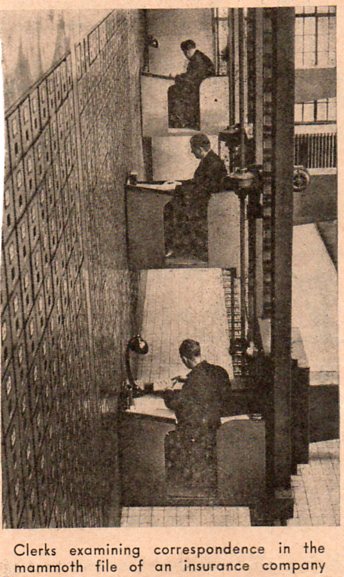
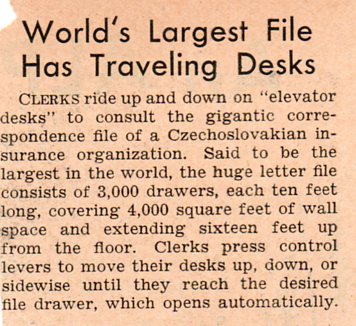
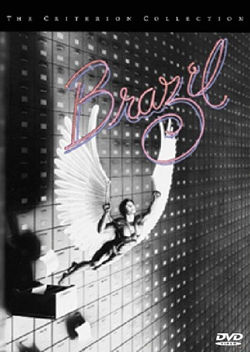
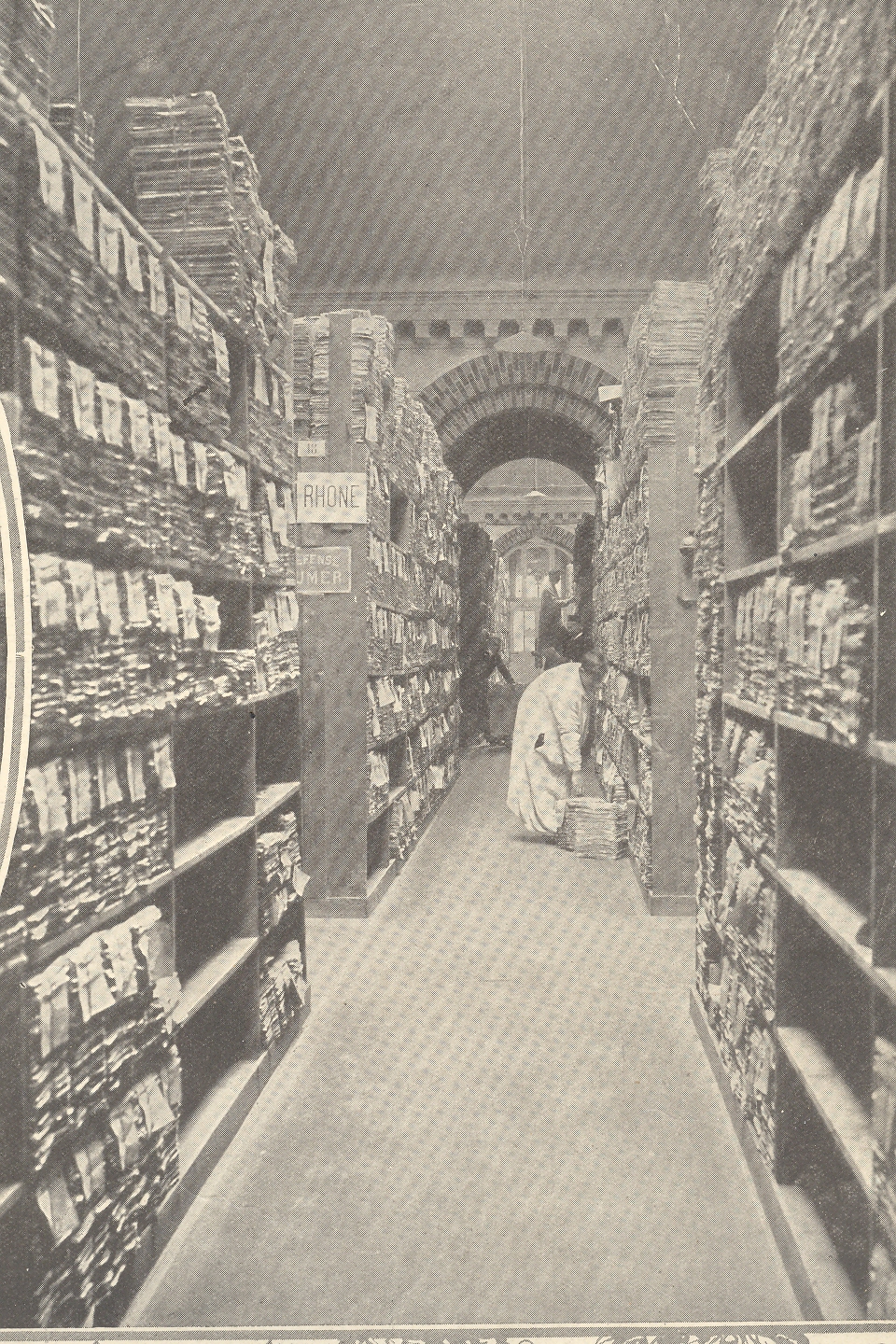
    I feel slightly queasy seeing this photograph, found in the August 1937 issue of Popular Science magazine–-it seems to me to be a backwards, inside-out analog cyberpunk (without the cyber) variety of the internet, a robotic device moving people around from data bit to data bit, an oil and iron process of automatic info retrieval, moving the user to the information rather than the other way around.  Desks517 Desks516 The image does put me in mind of Terry Gilliam’s Brazil, which renders info and other muck in a high-dystopian fashion with endless ducts and file cabinets, making things oppressively inaccessible in their accessibility.

    Brazil

    And to some degree there’s a little Spongebob similarity in there too, though without the iron nd metal part, just Mr. Squarepants and his cardboard filing cabinets for all of this thoughts and memories, serviced by smaller units of himself whop presumably have their own filing systems in their heads.  Filing cabinets, all the way down. 

    Spongebob's Brain
    There is a more-refined image of what is basically the same idea, found here in the fantastic bio-art of Fritz Kahn (1888-1968), who published his Der Mensch als Industriepalast (Man as an Industrial Palace or thereabouts) in Stuttgart in 1926.  Kahn is seen as a “modernist”, which I guess is true; to me he is far more than that–he’s “different”.

    In Charlie Chaplin’s great 1937 Modern Times, there are no file cabinets and I don’t think that there’s any paper, just the results of vast mechanization:

    http://www.altfg.com/Stars/m/modern-times-chaplin-conklin.jpg

    And of course, Fritz Lang’s Metropolis, made a little earlier, in 1927:

    Worker in Fritz Lang's movie, Metropolis

     And finally, an image of the semi-reverse of the gigantic filing system:  moving humans through mounds of paper not contained in file cabinets, stacked upon stacks of stacks.  Once everything is said and done, none of this info-sausage-factory seems very pretty.

    ++ blog ++ nov 16 french census 3


  • The 47 Sins of Isaac Newton, as Recorded by Himself

    JF Ptak Science Books     Post 1498

    “Nabed Efyhik
    Wfnzo Cpmfke’”–Issac Newton, ca. 1660

    So begins this extraordinary work known as the Fitzwilliam Manuscript1:  Isaac Newton’s name, plus for words on two lines, which the Newton scholars suspect to be a key to a cipher.  It was purchased at a Sotheby auction by Maggs Brothers in 1936 for £180, and within the month found itself in the Fitzwilliam Museum.  What makes it fantastic–aside from having some mathematical/physical work by Sir Isaac in its 5,000 or so words–is the almost impossible inclusion of a list of what Newton could remember of the sins that he had committed.  He finds 47 transgressions within his memory.

    It seems to me that listing the sins of people is nearly as old as writing, since the  absolutely overwhelming aspect of that practice is describing sin in general or, of course, the sin of others.  Or the judicial end, the sins of people have been listed and judged many millions of times for billions (or whatever) of offenses.  And certainly the listing or provocation or announcement of sin has been endless fodder for entertainment in the forms of story telling, theatre, novels, and so on.  Then, too, there’s all of the religious indictment and beseeching for proclaiming sins for atonement. On the individual level for a living human, a famous person, it is extremely uncommon to find a highly personal listing like this, even whispered as they were into a notebook, Sir Isaac I am sure thinking as though this was almost as good as writing the sins in dust.  I wonder how he would feel, seeing people discussing them, like this? 

    This transcribed list comes from the fantastic Newton Project,2 site.

    Newton (1642-1727) writing in about 1662 (and about 20 years old), and who was at Cambridge for a few years already, just prior to what was perhaps his most astonishing period of creativity, (and with the time of the Plague, just a few years in the future):

    “Before Whitsunday 1662. 

    “[Note:  Whitsunday,  the Sunday of the feast of Whitsun (or “White Sunday”) or Pentecost int he Christian liturgical year, celebrated/observed seven weeks past Easter, the celebration too of summer, and the descent of the Holy Spirit on Christ’s disciples (Acts of the Apostles chap 2.) ALSO Newton at this point is 20 years old.]

    Vsing the word (God) openly
    Eating an apple at Thy house
    Making a feather while on Thy day
    Denying that I made it.
    Making a mousetrap on Thy day
    Contriving of the chimes on Thy day
    Squirting water on Thy day
    Making pies on Sunday night
    Swimming in a kimnel on Thy day
    Putting a pin in Iohn Keys hat on Thy day to pick him.
    Carelessly hearing and committing many sermons
    Refusing to go to the close at my mothers command.
    Threatning my father and mother Smith to burne them and the house over them
    Wishing death and hoping it to some
    Striking many
    Having uncleane thoughts words and actions and dreamese.
    Stealing cherry cobs from Eduard Storer
    Denying that I did so
    Denying a crossbow to my mother and grandmother though I knew of it
    Setting my heart on money learning pleasure more than Thee
    A relapse
    A relapse
    A breaking again of my covenant renued in the Lords Supper.
    Punching my sister
    Robbing my mothers box of plums and sugar
    Calling Dorothy Rose a jade
    Glutiny in my sickness.
    Peevishness with my mother.
    With my sister.
    Falling out with the servants
    Divers commissions of alle my duties
    Idle discourse on Thy day and at other times
    Not turning nearer to Thee for my affections
    Not living according to my belief
    Not loving Thee for Thy self.
    Not loving Thee for Thy goodness to us
    Not desiring Thy ordinances
    Not long {longing} for Thee in {illeg}
    Fearing man above Thee
    Vsing unlawful means to bring us out of distresses
    Caring for worldly things more than God
    Not craving a blessing from God on our honest endeavors.
    Missing chapel.
    Beating Arthur Storer.
    Peevishness at Master Clarks for a piece of bread and butter.
    Striving to cheat with a brass halfe crowne.
    Twisting a cord on Sunday morning
    Reading the history of the Christian champions on Sunday

    Since Whitsunday 1662

    Glutony
    Glutony
    Vsing Wilfords towel to spare my own
    Negligence at the chapel.
    Sermons at Saint Marys (4)
    Lying about a louse
    Denying my chamberfellow of the knowledge of him that took him for a  sot.
    Neglecting  to pray 3
    Helping Pettit to make his water watch at 12 of the clock on Saturday night

    Notes:

    1. From the website of the Newton Project (described following): “Miscellaneous notebook containing Newton’s accounts for 1665-9, a series of increasingly complicated mathematical problems, and a highly revealing personal confession. At Whitsun 1662, Newton compiled a list of all the 47 sins he could remember having committed in his life, from stealing cherries to “threatning my [step]father and mother … to burne them and the house over them”. The accounts section charts the beginning of his study of alchemy in 1669, with purchases of books, materials and a furnace to equip the makeshift laboratory he set up in the grounds of Trinity College.”
    2. The Newton Project is the work of  Professor Rob Iliffe  (Director, AHRC Newton Papers Project) and Scott Mandelbrote (Fellow & Perne librarian, Peterhouse, Cambridge). 

  • Electro-IronPunk Centrifugal Birthing Machine–a Fantastically Bad Idea

    JF Ptak Science Books   Post 1500

    I found this by accident, and needed to share it immediately, because in the splendid and chilly vastness of the infinite Encyclopedia of Bad Ideas, this entry would seem quite the poster child for such a stupendous effort–the mud to which all dust aspires. 

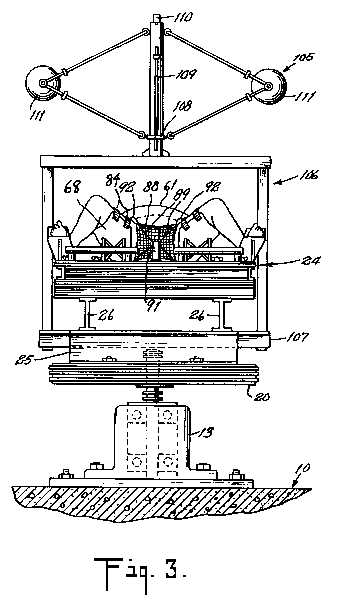
    The centrifugal machine for human birth…its hard to even finish that sentence, let alone finish it without wincing. What could possibly go wrong, or right, with spinning a pregnant woman strapped like Hannibal Lechter on a spinning turntable?  

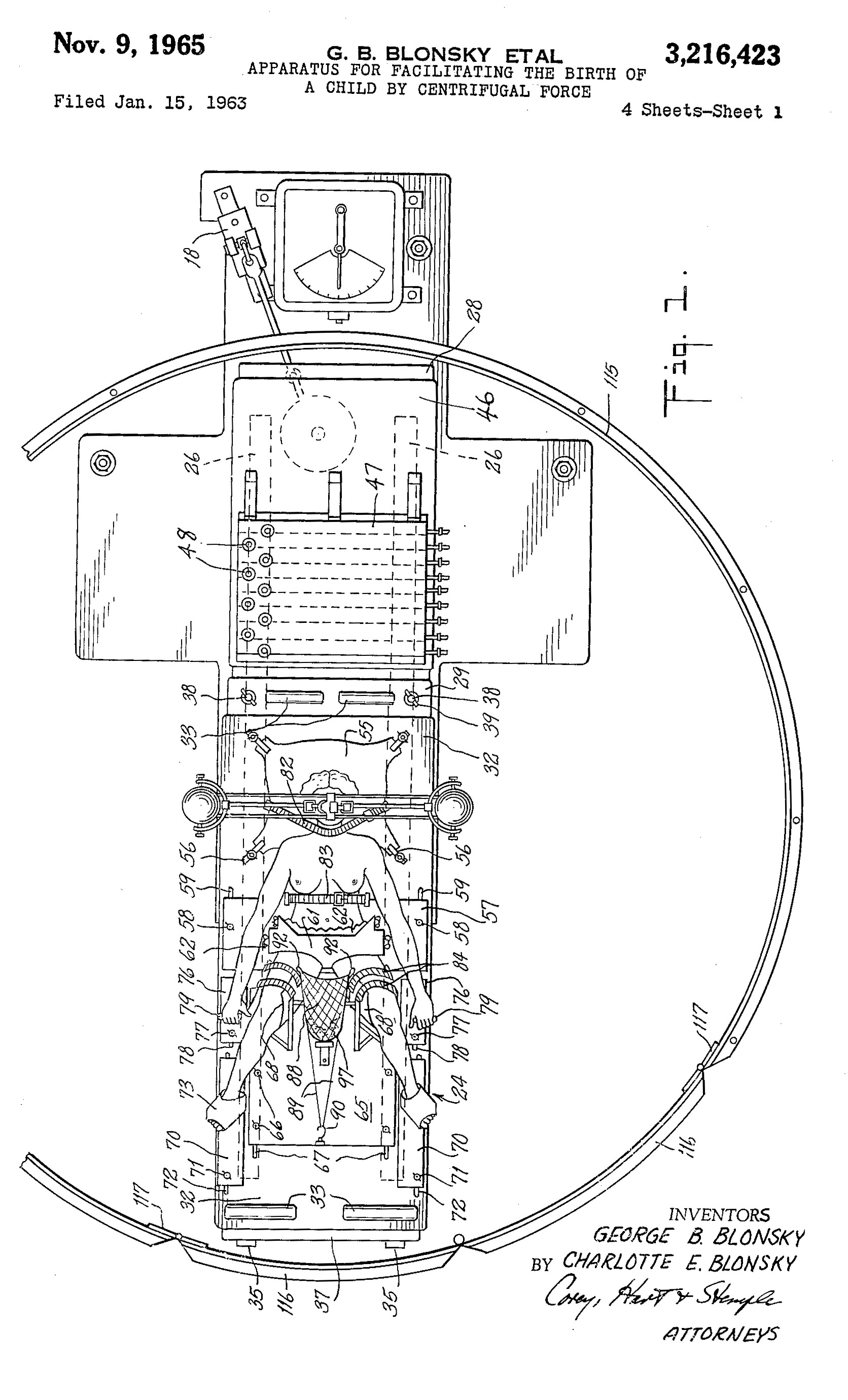
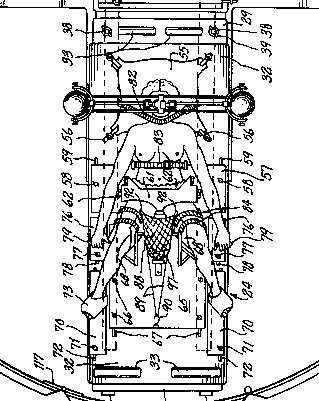
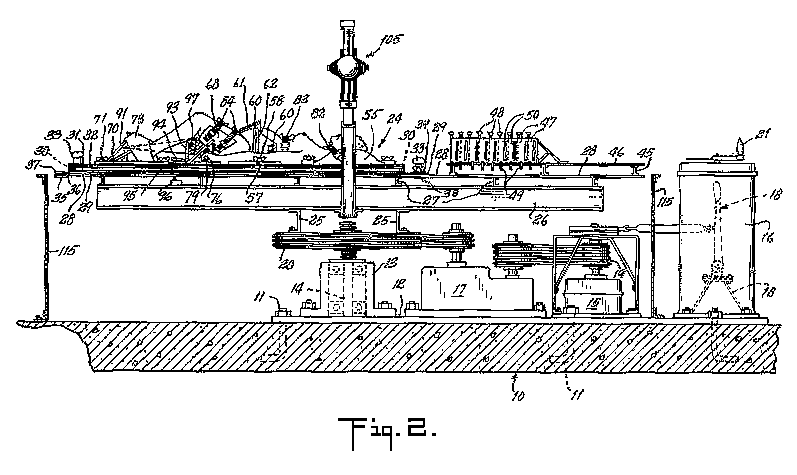
    I think what we have here is the Vitruvian Woman of Bad Ideas relating to human birth, the patent described more fully in this great piece by Marc Abrahams (of the Annals of Improbable Research) in The Guardian, 2006). And how could the symbology of the thing get any weirder? It looks like this poor woman has her head resting on a stretched piece of animal skin, all of which is located on a cross–but since there is a person on it the medical device become a crucifix. And let’s not forget the counterweights on either side of the governor, which in detail below are suspend to either side of the woman’s head; and also the baby sack, for, well, catching the baby…

    Image source:  Google Patents

    Centrifugal birth patent a overview fixed

    And the excruciating, inexorable detail:

    Centrifugal birth

    In their patent application, Blonsky and Blonsky explained the grievous and imaginary need:

    “In the case of a woman who has a fully developed muscular system and has had ample physical exertion all through the pregnancy, as is common with all more primitive peoples, nature provides all the necessary equipment and power to have a normal and quick delivery. This is not the case, however, with more civilised women, who often do not have the opportunity to develop the muscles needed in confinement.”–from the Blonsky patent.

    “Therefore, wrote Blonsky and Blonsky, they would provide “an apparatus which will assist the under-equipped woman by creating a gentle, evenly distributed, properly directed, precision-controlled force, that acts in unison with and supplements her own efforts”.–Marc Abrahams, quoting the Blonsky patent in The Guardian (referenced above).

      Centrifugal birth b

      Centrifugal birth c


    The text of the patent report, below, in full:

  • A Square of Horse–Naming Groups of Animals (“A Murder of Crows”, continued)

    Horses

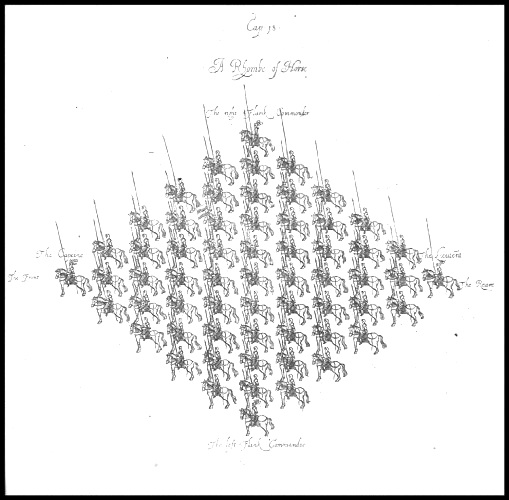
    Aelianus (Tacitus) The Tactiks of Aelian Or the art of embattailing an army after ye Grecian manner. Englished & illustrated with figures throughout & notes upon ye chapters of ye ordinary motions of ye Plalange by J.B…  

    The “J.B.” here is the author John Bingham, whose book was published in 1616. The “Square of Horses” seems to me to be a fine addition to a named bestiary, in addition to a “murder” of crows and an “unkindness” of ravens (and a “crush” of rhinos, and on and on, as we can see below). 

    Names given the collectives or gatherings or units of animals are useful and informative, and occasionally fabulous and bizarre.  It seems to me that such characterizations could be made with people as well,  Why should humans have such a uniform label for collective employment members (a “group” of lawyers, a “gathering” of architects, and so on) when animals have such a rich vocabulary to draw from?  Admitedly, animals don’t go out and get lawyers when they feel maligned by a broadly advanced descriptor, so there’s little chance that more appropriate upfittings could be applied to different job classifications.  Unless of course you consider the “managed corporate associate monetary inventorialist” (cashier) as an example—but that is not what I’m talking about. 

    In the animal world, for example, a group of gorillas is a simple “band”, chicks a “clutch”, and quail a “covey”, which is simple enough.  The names get more adventurous as things progress in the food chain:  hippos are a “bloat”, a word which seems to identify a characteristic of the animal, especially when they’re half-submerged, watching the sun move across the sky with their eyes just above the waterline..  Ferrets are a “business”, semi-inscrutable in their nervous activity. Hyenas are a “cackle”, hawks are a “boil” and finches are a “charm”.

    A group of rhinos are beautifully referred to as a “crash”, and squirrels are poetically announced as a “scurry”

    Perhaps the second greatest of all of these names is that for a gathering of crows, called a “murder”.  It is probably the crow which, among all animals, may be the only one “smart” enough to commit the crime—it is an undoubtedly intelligent animal, with a brain-to-body mass ratio third to that of humans (behind apes) and have been shown to work in concert with one another toward a common end, and have also used tools in the pursuit of food.  They have also been depicted for thousands of years in mythology and story as intelligent, crafty creatures.  My choice for the most fabulously-named:  an “unkindness” of ravens.   These birds enjoy a similar heritage to the crow, but have a greater literary heritage.  Unkindness and Poe seem to go together quite nicely. 

    A leap of leopards, a gulp of cormorants, a romp of otters, a parliament of owls.  An ostentation of peacocks, a prickle of porcupines, a stand of flamingoes, a pride of lions, a wake of buzzards, a tower of giraffes: all seem to fit quite nicely. 

    What would the human equivalent be?   A “grotesque” or a “provident” of attorneys,  a “shushing” or “shepherding” of librarians, a “scribble” or “release” of writers, an “envy” or “relief” of actors?  I think it needs to be Latin and deep for the politicians.  Very deep. 

    (A directory of names follows in the continued reading section)


    A band

    Gorillas

    A bevy, covey

    Quail

    A bevy, wedge (in flight)

    Swans

    A bloat

    Hippopotamuses

    A brace, flock (in flight), raft (on water) team, paddling (on water), badling

    Ducks

    A brood; clutch

    Chicks (of many species)

    A building

    Rooks

    A business

    Ferrets

    A cackle

    Hyenas

    A cast, kettle (flying in large numbers), boil (two or more spiraling in flight)

    Hawks

    A cete

    Badgers

    A chain

    Bobolinks

    A charm

    Finches

    A clowder, a pounce; for kittens…A kindle, litter, an intrigue

    Cats

    A colony

    Bats

    A colony

    Gulls

    A colony

    Penguins

    A colony, warren, nest, herd (domestic only), litter (young); specific to hares…A down, husk

    Rabbits

    A company

    Parrots

    A company

    Widgeons

    A congregation, wing (in flight)

    Plovers

    A convocation

    Eagles

    A cover

    Coots

    A covey

    Partridge

    A covey

    Ptarmigans

    A crash

    Rhinoceroses

    A deceit

    Lapwings

    A descent

    Woodpeckers

    A dray, scurry

    Squirrels

    A drift, drove, litter (young), sounder (of swine), team, passel (of hogs), singular (refers to a group of boars)

    Pigs

    A drove, flock, herd

    Sheep

    A drove, herd

    Cattle

    A dule, pitying (specific to turtle doves)

    Doves

    A fall

    Woodcocks

    A flight

    Swallows

    A flock, gaggle (on the ground), skein (in flight)

    Geese

    A gang

    Elk

    A gang, an obstinacy (I suspect these refer to old world buffalo; use “herd” for American bison)

    Buffalo

    A gulp

    Cormorants

    A herd

    Elephants

    A herd, bevy (refers only to roe deer)

    Deer

    A host

    Sparrows

    A labor

    Moles

    A leap

    Leopards

    A leash, skulk, earth

    Fox

    A litter (young), pack (wild), cowardice (of curs); specific to hounds…A cry, mute, pack, kennel

    Dogs

     A murder, horde

    Crows

    A murmuration

    Starlings

    A muster, an ostentation

    Peacocks

    A mustering

    Storks

    A nest, nide (a brood), nye, bouquet

    Pheasant

    A pace

    Asses

    A pack (in late season)

    Grouse

    A pack, rout or route (when in movement)

    Wolves

    A pack, span, barren

    Mules

    A parliament

    Owls

    A party, scold

    Jays

    A pod, gam, herd

    Whales

    A pod, herd

    Seals

    A prickle

    Porcupines

    A pride

    Lions

    A rafter, gang

    Turkeys

    A richness

    Martens

    A romp

    Otters

    A sedge

    Bitterns

    A sedge

    Cranes

    A sedge, a siege

    Herons

    A Shrewdness

    Apes

    A sloth, sleuth

    Bears

    A sord (in flight), brace

    Mallards

    A spring

    Teal

    A stand

    Flamingos

    A streak

    Tigers

    A team, harras, rag (for colts), stud (a group of horses belonging to a single owner, string (ponies)

    Horses

    A team, yoke

    Oxen

    A tiding, gulp, murder, charm

    Magpies

    A tower

    Giraffes

    A tribe, trip

    Goats

    A trip

    Dotterel

    A troop

    Kangaroos

    A troop, barrel

    Monkeys

    A wake

    Buzzards

    A walk, a wisp

    Snipe

    A watch

    Nightingales

    An exaltation

    Larks

    An unkindness

    Ravens


  • Maps of Things Not There: Eden.

    JF Ptak Science Books  Post 1431

    The tale of the Garden of Eden is told in the Old Testament, and although it described, its location is left to mystery1, even though its legend is ground zero for the Fall of Man, the eternal disgrace for which humanity still pays. I suppose it would be nice to have a tombstone for the grave. Over time—and particularly in the Middle Ages and then in the Renaissance—the location was fixed in the eastern reaches of the known Euro-world, and then in and about Mesopotamia.

    Eden 2359

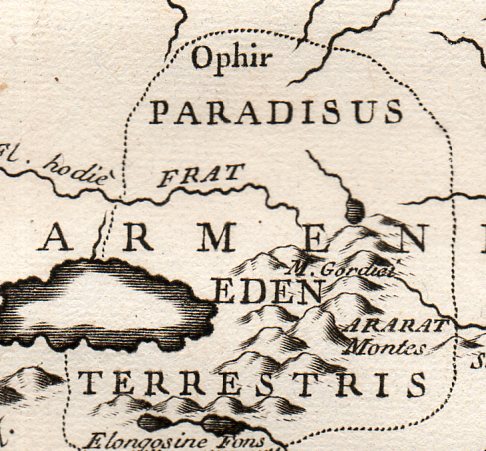
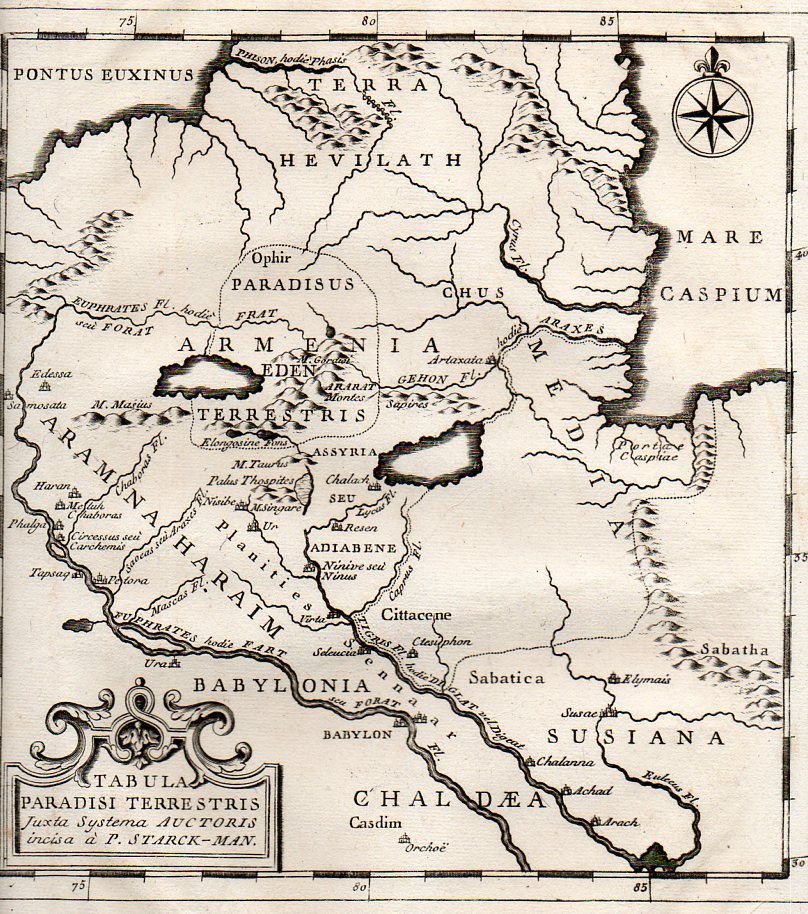
     The map Tabula Paradisi Terrestris justa Systema Auctoris incisa a P. Stark-Man was printed late in the 18th century, probably around 1775, and locates the GOE far in the north country, near the Dead Sea, deep in old Armenia, near Mount Ararat (where Noe and his family were supposed to have landed after the creator flooded the world killing everything, where everything else, young and old, infant younger, men women children, beasts and ants, were killed by a wrathful OT maker.).  

    Eden 2358

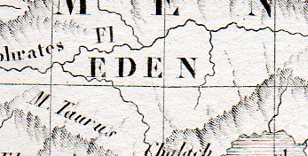
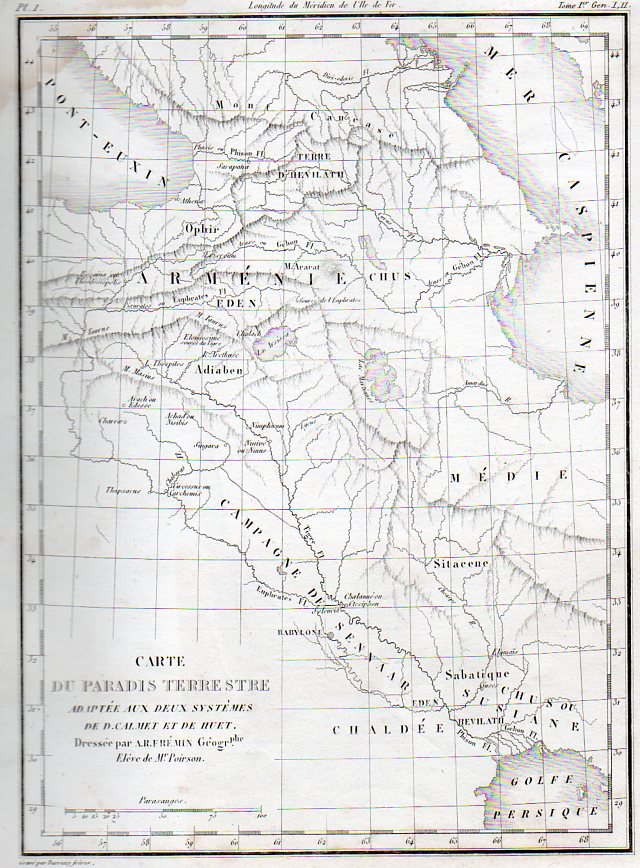
    The very finely engraved map by A.R. Fremin, Carte du Paradis Terrestre, printed 1839 (in Paris, by Félix Locquin et Cie, for  l’Atlas de la Sainte Bible)., again locates the Garden much further north than the great majority of other maps that I have seen, coming  (as with the map above) nearly to the Dead Sea.

    Linoleum italian274

    This image is a detail from:

    Linoleum italian273


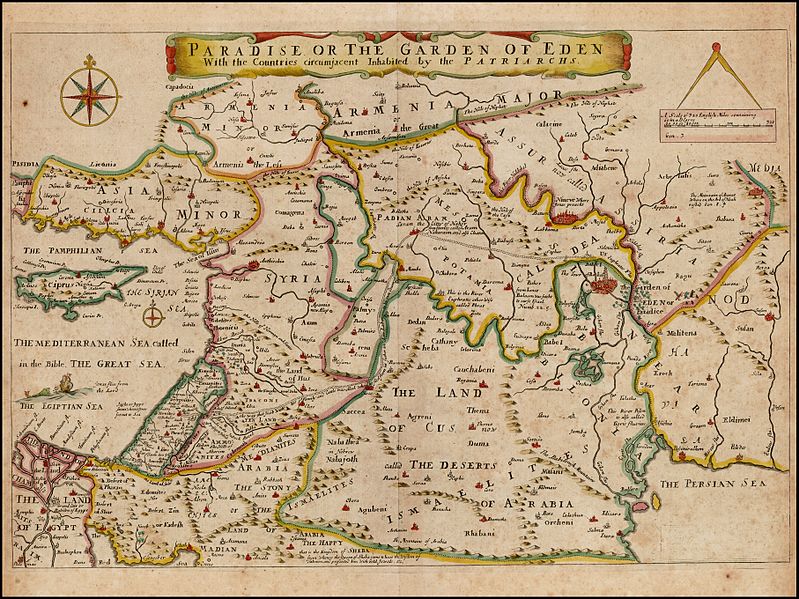
    Joseph Moxon’s Paradise of the Garden of Eden with the Countries circumjacent inhabited by the Patriarchs, printed in 1690,  shows the GOE as just to the east of Babel and not far due north from the Persian Gulf, just on the Euphrates in the Land of Nod, which is quite different from our two samples above. 

    Garden of eden Moxon

    [Source–https://commons.wikimedia.org/wiki/File:Paradise_or_the_Garden_of_Eden_With_the_Countries_circumjacent_Inhabited_by_the_Patriarchs,_Joseph_Moxon_1660.jpg]
     
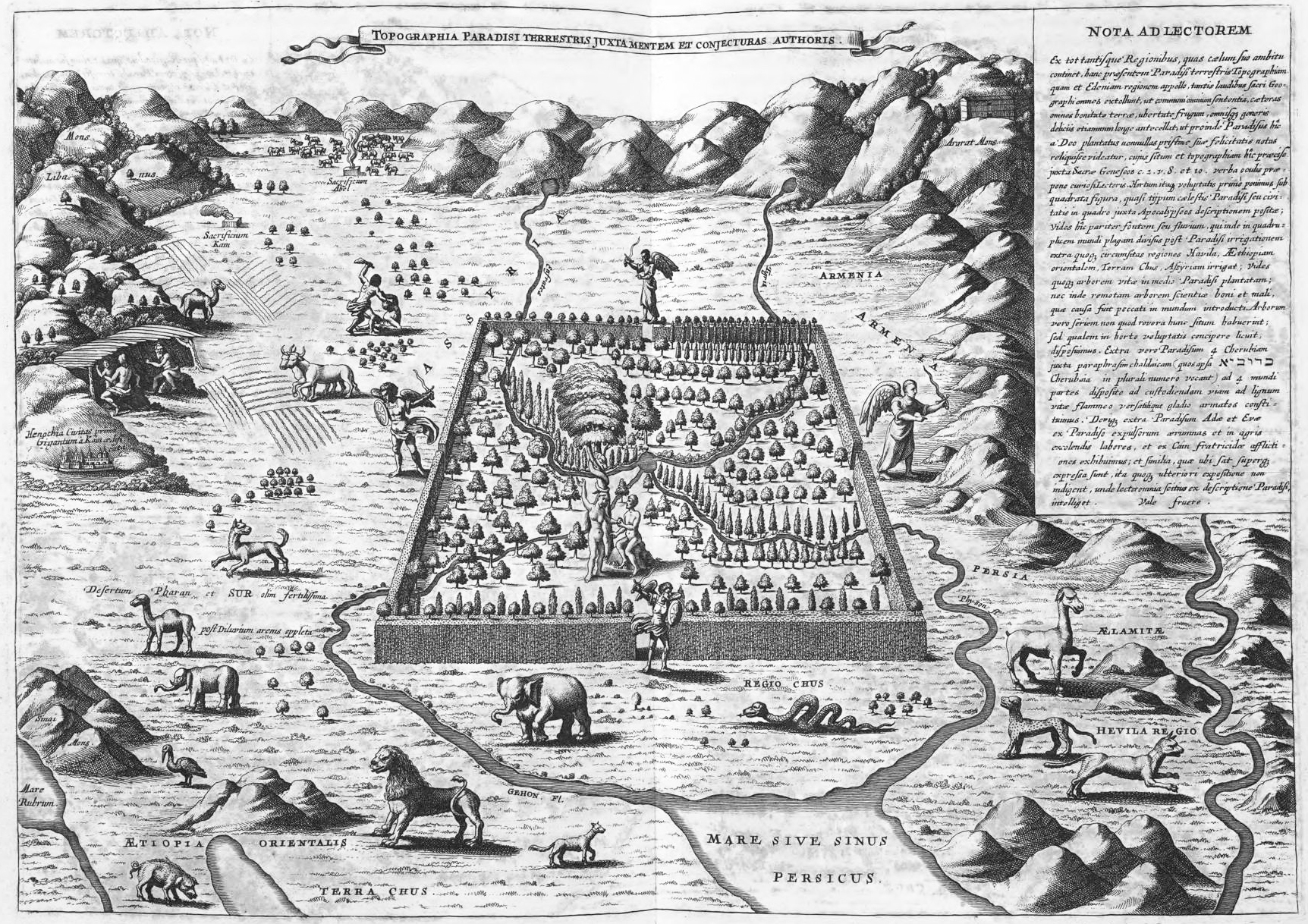
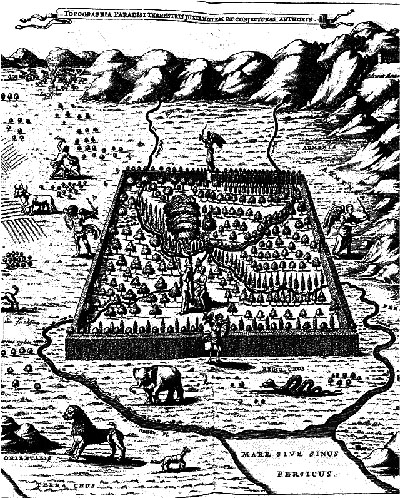
    The polymathic and semi-problematical Jesuit genius Athanasius Kircher suspected the location of Eden to be along the Tigris and Euphrates Rivers, in southern Iraq, and published his idea in this map Topographia Paradisi Terrestris in his book Arca Noe in 1665. It is of course a highly idealized map, Eden taking up a disproportionate amount of land, larger than life, bigger than legend almost, a monstrous overstatement of the lost land. Eden is shown here with four gates guarded by angels, but it does its occupants little good, as we can see that Adam and Eve are already stepping up to Satan in the tree of knowledge, and that outside Cain is killing Abel, all harm already being done.

    Garden of Eden Kircher

    [Source: the website The City as a Project, here: http://thecityasaproject.org/2011/07/paradise/]


    There continue to be differences of opinion on this matter of location, particularly in the modern age, when there are many laying claim to the position of Eden, including a number of half-hearted attempts to locate the place or its idea/ideal in the United States.  There are at least 14 Edens in the U.S.– Eden  City/Isle/Town/Valley/Prairie/Village/–in twelve different states (Idaho, Louisiana, Maryland, Minnesota, Mississippi, New York, North Carolina, South Dakota, Texas, Wisconsin, Wyoming and thankfully Hawaii),but for some reason they are fairly sparely populated, eight of them having populations of under 1000 people.  I don’t know what that means.

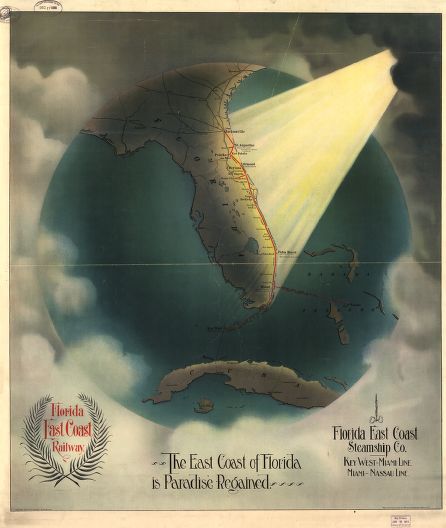
    Then there is this terrific example, coming from Florida (which does not seem to actually have anyplace in the state named Eden), in 1898, being a transorbital bird’s-eye view of the east coast of Florida receiving  pure holy light, announcing yet another newish Eden.

    Paradise florida

    [Image source: Library of Congress, Geography and Map Division.]

    Notes

    1. “And a river went out of Eden to water the garden; and from thence it was parted, and became into four heads. The name of the first is Pison: that is it which compasseth the whole land of Havilah, where there is gold; And the gold of that land is good: there is bdellium and the onyx stone. And the name of the second river is Gihon: the same is it that compasseth the whole land of Ethiopia. And the name of the third river is Hiddekel: that is it which goeth toward the east of Assyria. And the fourth river is Euphrates.” (Genesis 2:10-14 KJV)

Recent Posts

Archives

Categories