A Daily History of Holes, Dots, Lines, Science, History, Math, Physics, Art, the Unintentional Absurd, Architecture, Maps, Data Visualization, Blank and Missing Things, and so on. |1.6 million words, 7500 images, 4.9 million hits| Press & appearances in The Times, Le Figaro, Mensa, The Economist, The Guardian, Discovery News, Slate, Le Monde, Sci American Blogs, Le Pont, and many other places… 5000+ total posts since 2008.

  • A Giant Metal Kraken Worm, Beast Among Beasts: a Tunneling Machine, 1862

    JF Ptak Science Books  Post 2790

    This enormous  piece of machinery was designed and patented by Hubert Newton Penrice (of Norwich1) in 1862 for “tunneling and driving through rock and other strata”. The section labeled “F” is obviously the grinding business-end of the beast, meant to turn with a “variable” speed–what we see here is the outermost set of teeth which surrounded an unspecified number of smaller concentric cutting plates.  I imagine that if you looked at this machine straight-on from the front you’d see a number of concentric rings of hundreds of steel teeth, which immediately makes me think “Kraken!”, though this one is underground, boring its way through rock. No specifics are given for dimensions, though my guess would be that the cutting face had to be at least 8′ (?), meaning that the entire machine was on the order of about 50′. 

    Originally the steam-driven machine was powered “at a distance” though in this version the boiler and engine are right there behind the cutting face and a  car powered to inch froward as the tunneling is done.  The boiler would supply several engines–one to drive the cutting wheels, another to feed the machine that “swept” up the cut stone and directed them towards the back of the outfit another to power the forward motion of the whole thing to put pressure on the cutting face, and I think several more.  That long shaft along the top of the unit is for “waste steam” that would direct (some!) of the smoke and heat towards the rear and eventually out of the tunnel, somehow. 

    I don’t know how many workers it took to operate this thing and make it all work, and I find it difficult to imagine working in a cramped, hot, loud, dangerous and uncertain situation as this, and have it all underground and powered by steam. 

    The only thing worse that I can think of–outside of pure disaster–is failure: what happened if the thing got “stuck”?  

    • “On each axle is a screw or worm wheel and there are two parallel shafts one on each side of the boiler with worms or screws thereon there being one worm for each of the wheels by this means a slow motion may be given to the wheels and the machinery may thus be moved towards the face of the work. The speed at which the screw shafts are driven is capable of being readily varied in order to suit the varying strata and in order to be able readily to adjust the progress of the machine to the quantity of work which the cutters are enabled …”–from the article.
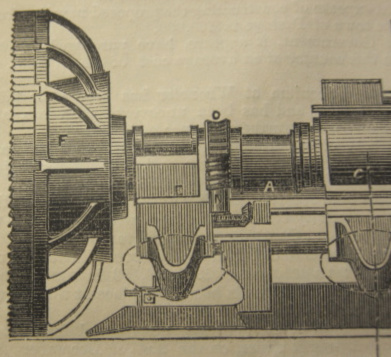
    Engineer 1862 tunnel cutter detail

    [Source: The Engineer, volume 13, January 17, 1862, p 44.]
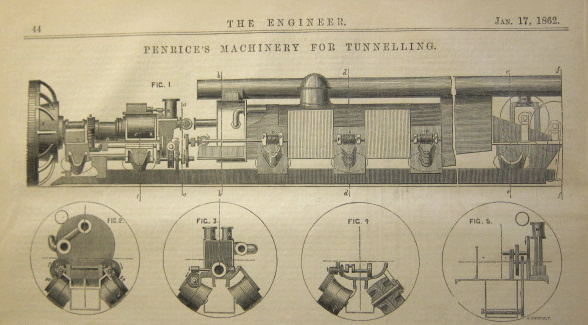
    Engineer 1862 tunnel cutter full copy


    And by the way, the article identifies Mr. Penrice as being “of Wilton House, Norwich”, and so I looked that up:
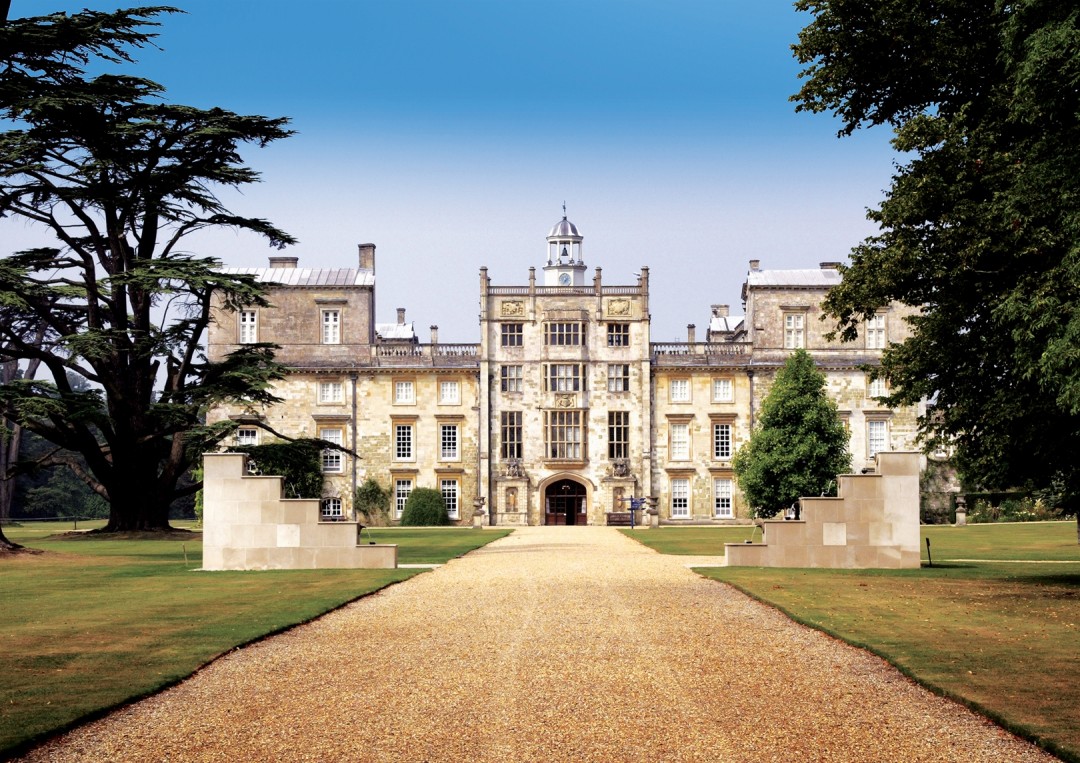
    Wilton house

    Source: http://wiltontown.com/feature/wilton-house/
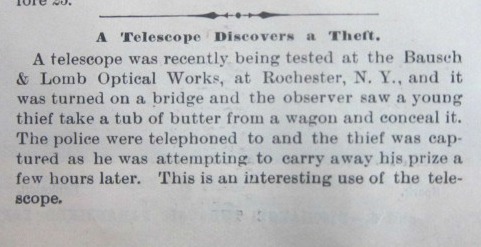
     

  • The Early Use of a Telescope in Crime Detection (1900)

    JF Ptak Science Books  Quick Post

    Just a quick notice here of an interesting note found in Scientific American (vol 83, no. 4, pg 54) for 28 July 1900:

    Telescope discovers a theft

    I wonder if this observation violated the expected zone of privacy of an individual, meaning a violation of the fourth amendment? Now this activity described above in Rochester took place on a bridge, so perhaps there was no expectation of privacy on a public street , especially if you are out-and-about and committing a crime. A quick look at the history of the fourth amendment gets immediately complex to me, and so I’ll leave it alone–except to say that it is not a clear-cut issue as to whether the above use of a telescope would’ve been a search-and-seizure issue. On the other hand, when this issue is discussed the idea of what would be “normally” observable to the unaided eye comes up–but what sort of unaided eye are we talking about? If the eye needed correction, would using eyeglasses constitute a challenge to the fourth amendment?  I don’t know, as I’m not a law guy–but the question about the telescope and the fourth amendment seems mildly interesting. 

    ·Posted by :

    ·in:

  • History of Lines Department: Supply and Demand (1870)

    JF Ptak Science Books   Quick Post

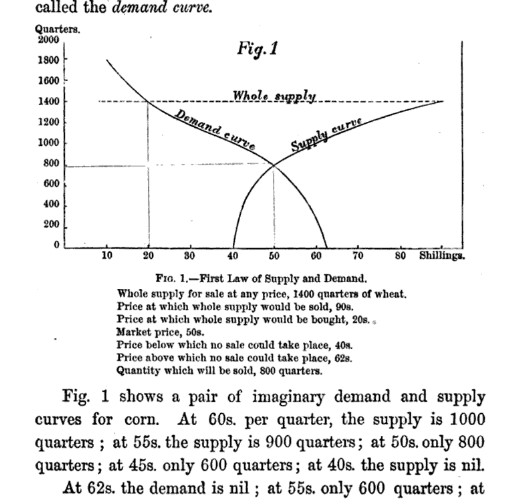
    The idea/phrase “supply and demand” goes back a very long way, and gets treated in a more-modern aspect by Locke (1767) and Adam Smith (1776) and David Ricardo (1813) and Thomas Malthus (1803)–however, the  first time that the idea was presented graphically came with (the beautifully-named) Fleeming Jenkin in 1870. The famous graph appeared in  “Graphic Representation of the Laws of Supply and Demand, their Application to Labour, Part I”, published in Recess Studies, edited by Sir Alexander Grant and published in Edinburgh.  And here it is, in brilliant simplicity:

    Supply and demand

    He writes in this paper by way of introduction:

    “Supply at a price denotes the quantity which at a given price holders would be then and there willing to sell. Supply at a price is also mensurable Demand at a price denotes the quantity which then and there buyers would purchase at that price. The supply at a price and the demand at a price in any given market will probably vary with the price they may be said to be functions of the price.”

    “Let a curve be drawn the abscissae of which represent prices and the ordinates the supplies at each price. This curve will be called the supply curve. A similar curve constructed with the demand at each price as ordinates will be called the demand curve.”

    A few notes in support of the Jenkin diagram:

  • A Note on the History of Backwards (1878)

    JF Ptak Science Books  Quick Post

    This is a tiny note on the idea of seeing/listening/thinking backwards–I’m not even sure what that means, except for teh obvious cases, especially when you throw technology into the mix to spice up the possibilities of investigation of a backwards form. First of all, the words “backward” and “backwards” go all the way back in the history of English, as we can see in these two pretty examples from the OED:

    • 1398   J. Trevisa tr. Bartholomew de Glanville De Proprietatibus Rerum (1495) xiii. xxvi. 456   “By vyolente puttynge of ayre bakward the body of the byrde meuyth forwarde.”

    •  1697  Dryden tr. Virgil Georgics iii, in tr. Virgil Wks. 101   “Clouds of Sand arise; Spurn’d, and cast backward on the Follower’s Eyes”

    • 1953 “When I go backwards I’m generally backing up”–Not Yogi Berra

    With technology I’m referring to the more subtle ways of exhibiting something/someone in backwards motion rather than the reserve of raising an obelisk–it would be more like seeing a fire burn a house in reverse or rain falling up or a locomotive recovering itself from a head-on collision with a tree via motion picture recordings, things can can’t be reproduced backwards simply by reversing the motion. 

    As long as I’m at it, I think this sense of “backwards” is differentiated from a reverse chronology.  Citizen Kane starts at the end and works it long and angled-dark ways from the beginning to the opening shot; the movies Momento and Eternal Sunshine… are fuller in their reverse chronology, as is the occasional episode of Seinfeld and the book (and movie) Benjamin Button, to name a few examples. 

    What brought me to this place was an article  by Fleeming Jenkin and J.A. Ewing on the new invention, “The Phonograph” in Nature (1878), where their entire interest in the short note was the use of the machine in playing recorded speech backwards. This would be among the first uses of the new technology in a way that displayed info in a new way from all other previous human experience. This leads me to think about the next step in the development of the motion picture, where people could “unwatch” a developed motion of something and have it reconstitute itself right before their eyes. No doubt that was an extraordinary experience. So far as the motion picture goes, it would be almost another twenty years before a motion picture would be exhibited popularly that showed an action in reverse–and that honor goes yet again to Louis Lumiere and his “Demolition of a Wall” in 1896, still in the first decade-ish of the invention of what we would think of as a motion picture film.  

    In any event, these are just some loose thoughts on the subject of “Backwards”. 

    Here’s the short article by Jenkin and  Ewing: 

  • Illustrations from Two Rare Computer Pamphlets (1945 and 1948)

    JF Ptak Science Books   Quick Post

    This is a repost from my books-for-sale pages, basically catalog entries (minus the sales stuff) for two very seldom seen works on early (and famous) IBM machines, the ASSC (1945) and the SSEC 

    With a Giant Fold-out Photo Illustration of the Mark I (the ASSC) Computer, 1945

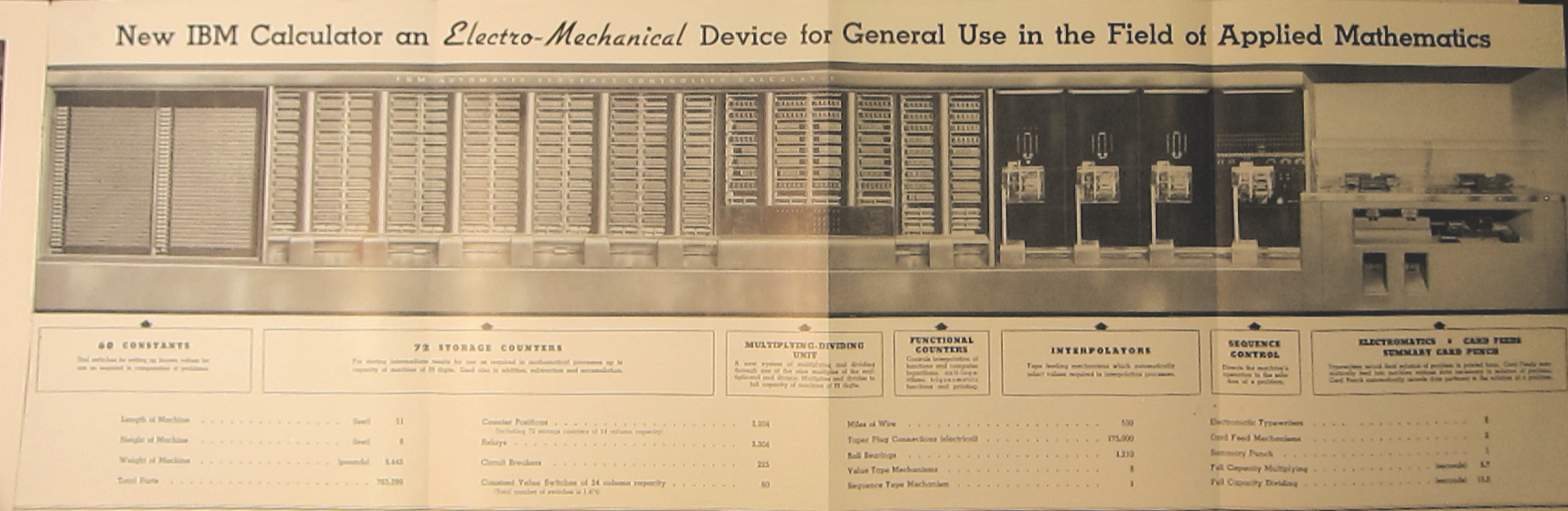
    IBM Automatic Sequence Controlled Calculator. Published by International Business Machines Corporation, 1945. 11”x 8.5”, 6pp. Illustrated with a massive (30” x 11”) folding photographic plate of the computer which seems to be the first image of the full length of the machine. (An earlier but less inclusive report appears in Popular Mechanics in 1944 (in an unusually-titled article, “Robot Solves Problems”) and though it does have a photo of the computer only shows a small piece of it. This photo is just fantastic, and it would seem to be the first full frontal image of the great computer. It is also one of the most impressive computer photos I’ve ever seen of any of the early machines. 

    AI 4 ASEC _long pic pt 2_

    This pamphlet tells the story of the ASCC starting with the establishment of the Columbia University Statistics Bureau in 1928 (for adapting IBM machines for Columbia’s computing requirements. Proceeding from there the outline develops around the 1934 establishment of a separate lab in the astronomy dept at Columbia, and then up to the efforts of H.A. Aiken, Harlow Shapley, T.H. Brown, and W.J. Eckert. Following this I s n extended review of Aiken’s speech at the dedication of the calculator in 1944, including 10 of the significant inventions “of the many basic units of the calculator, invented or developed by IBM”. Here appears on pp 5-6a general description of the calculator. Appearing at the end of the pamphlet is the magnificent folding photo showing the entire face of the 51′-long computer, while in the photo legend are a number of nuts-and-bolts facts about the composition of the machine (including “530 miles of wire”).

    ·Posted by :

    ·in:

  • On the Future of the Telephone as an Instrument for Listening to Music Remotely (Summer, 1876)

    JF Ptak Science Books  Quick Post

    Here’s an interesting piece on the future of the telephone, written just a few months after Bell’s patent was granted him (at the age of 29) on March 7, 1876. “Telephones and other Applications of Electricity”, appearing August 24, 1876 in Nature (volume 14, pp 353-355),  was written anonymously though probably by the editor (and founder of the journal) J. Norman Lockyer, who discusses advancements in telegraphy and then switches his interest to the telephone. It was not Bell’s telephone that the writer was discussing, but (mostly) that of Elisha Gray and “Reuss” (actually meaning Philip Reis).—and as a matter of fact there is no mention whatsoever of Mr. Bell.
    The article turns its interest to the future and to the telephone, and how it may come to be that you could basically dial up any sort of music you’d like to hear, and thus do away with live musical entertainment. Curiously there isn’t an implication for the using the telephone for communication–maybe the absence of Bell is less surprising in a way because Reis’ instrument was actually pretty good at transmitting musical sounds and not-so with voice. Still this is a little odd, given that Bell made his famous demonstrations of the instrument’s efficacy just weeks after his patent was granted.

    The text:

    • “We do not, however, believe that in its [the telephone’s] present state, the invention is so complete that we can, at a distance, repeat on one or more pianos the air played by a similar instrument at the point of departure. There is a possibility here, we must admit, of a curious use of electricity. When we are going to have a dancing-party, there will be no need to provide a musician. By paying a subscription to some enterprising individual, who will, no doubt come forward to work this vein, we can have from him, a waltz, a quadrille, or a gallop, just as we may desire. Simply turn a bell-handle, as we do the cock of a water or gas-pipe, and we shall be supplied with what we want. Perhaps our children may find the thing simple enough.”


    ·Posted by :

    ·in:

  • A Suggestion for Another Genre of Boundary: the Nothing Frontier, 1900.

    JF Ptak Science Books   Post 2792  Part of the History of Nothing series

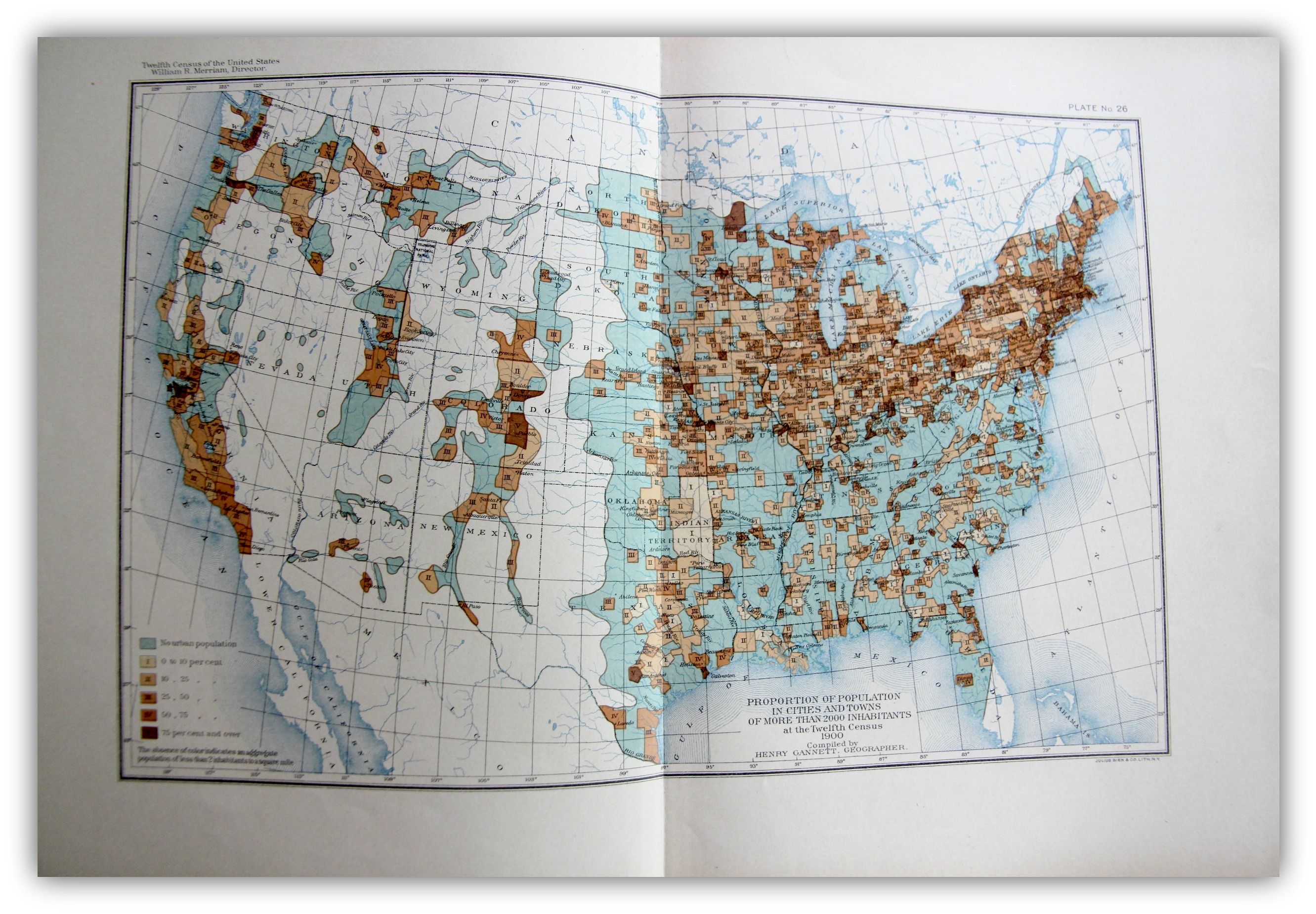
    The “frontier” in the history of the U.S. West is a pretty big deal, and old, the academic concept of  the frontier pressing its way back 13 decades, when for the most part once it was introduced it was pronounced to be “closed” by the man who reinterpreted it, Frederick Jackson Turner1.   On my shelves alone there are books on the mining frontier, the mineral frontier, the transportation frontier, the Indian frontier, the military frontier,the farming frontier, and so on, divisions allotted by wealth, nationality, numerous geographical attributes, and the like. One thing I think that I have not seen was the Nothing Frontier, where there are divisions divided by, well, sort of “nothing”. This is mostly a prosaic statement, slightly poetical, dependent on visual clues. And of course there isn’t “nothing” there because there is always “something”–there just isn’t very much of it.  And when things get colored-coded on map depending upon percentage distributions, and that object of measurement is left to a null color or no color at all, then it appears that the divisions one left to nothing.

    Maps--Census 1900 Urban

    [The image above is very expandable.]

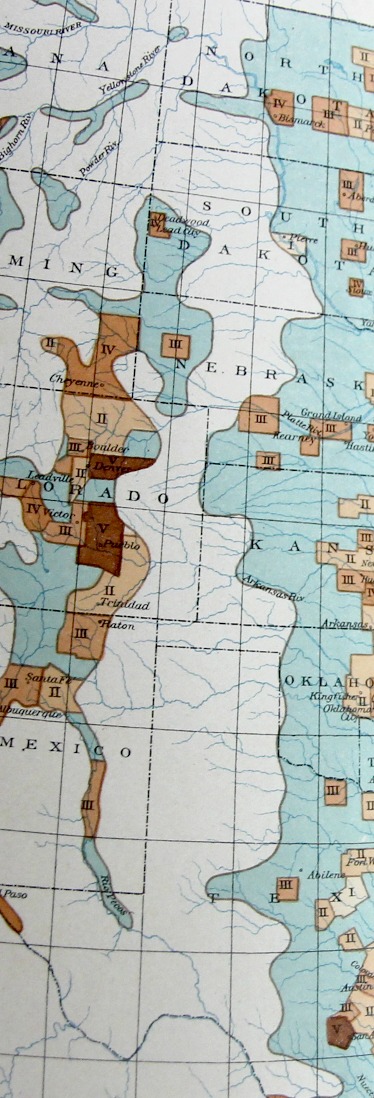
    This can be seen if you squint somewhat you can see an example of it in plate 26, “Proportion of Population in Cities and Towns of More than 2000 Inhabitants…” Statistical Atlas, prepared under the Supervision of Henry Gannett (Geographer of the the Twelfth Census), printed in Washington by the U.S. Census Bureau, 1903. This map–which is part of an historic series of atlases published with U.S. census data–shows the distribution of urban population in five shades of brown (as seen in the legend) plus a blueish color for “no urban population” as well as no color (“The allowance of color indicates an aggregate population of less than 2 inhabitants to a square mile”).

    Maps Census 1900 Urban detail

    It is that absence of color that makes it a frontier-ish sort of frontier, a part of the Made Up Frontier, this one being very straightforward north/south, Big Bend to Montana, pretty much the Lonesome Dove trail from the rough Big Bend Texas to nearly Canada.  

    I know it is just a thing I made up just now looking at the map, but given some effort, maybe the idea actually has some legs.  

    Notes

    1. Turner, Frederick Jackson. The Frontier in American History, Harvard University, 1920, full text via Project Gutenberg,  http://www.gutenberg.org/files/22994/22994-h/22994-h.htm

  • On Long-Lived Nazis, Part II: Instructors from the Cliff’s Note Summer Camp for Nazis, 1937

    JF Ptak Science Books    (Old Post 1849 expanded somewhat)

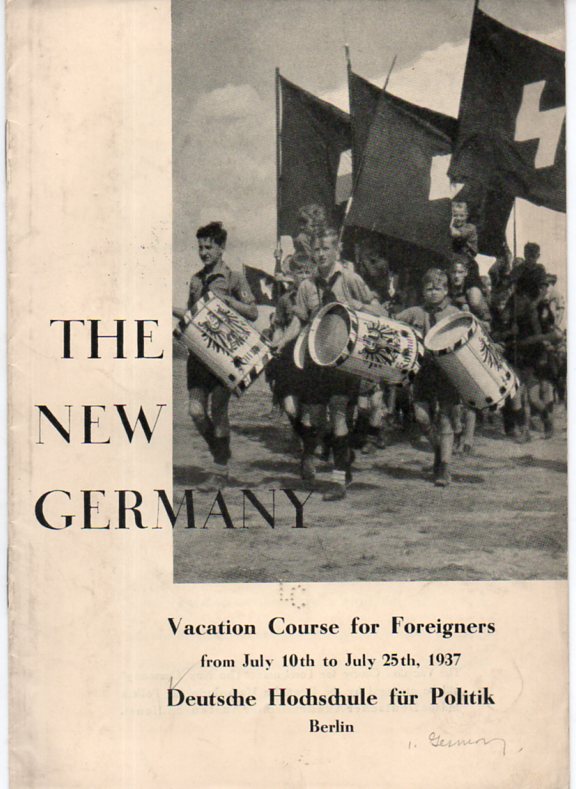
    Oh happy day for this handy Cliff’s Notes pamphlet for the visiting visitor, for the foreign foreigner, to the “new” Germany of 1937.  It is difficult to imagine but not horribly so the subtitle here, “Vacation Course for Foreigners”–it was, after all, so far as the rest of Europe and England and the rest of the world was concerned, still only a conceit that the Germans were harboring for themselves, the sabre-rattling Lebenstraum was still in the theoretical stage, though the loathing and discrimination of the Jews and other sorts of humans was not. 

    Nazi school621

    The pamphlet promises to “give our foreign guests an opportunity of seeing young National-Socialist Germany as it really “is” and to “show them that the German people do not want anything but to attend to their work in discipline and peace”. Which was not the case.

    I was interested to see the “programme” of instruction, and to check out the near-futures of the people who were the lecturers for each section.  Before I began, I wondered how much their fates would be changed eight years hence and if they would resemble the fates of other high ranking Nazis. (I looked at the lives of Nazi medical personnel and experimenters in an earlier post here called  “Kristallnacht: The Long post-WWII Lives and Forgotten Pasts of Criminal Nazis: Doctors”, here.)

    Mostly, they went on to live long lives.

    In the program, Dr. Reinhard Hoehn delivered a talk on “National-Socialist Law”. Hoehn was a Nazi academic lawyer with a criminally morose view of jurisprudence; he went rather high-ranking and was successful in laying the “legal” groundwork for Nazi ambitions.  Born in 1904, Hoehn went on to live until 2000.

    Next, Wilhlelm Haegert taught “The People, the Party and the State” to our foreigners, and became the Staff Director of the Propaganda Department and was a lead lawyer in Greater Berlin, during and after the war.  He died in 1994, aged 87.

    Friedrich Berber, lecturing on “the International Situation of Germany”, was a leading Nazi Propaganda person and international jurist. helping to pave the necessaries for the Lebenstraum philosophy.  He went on to establish the Institute for International Law at the University of Munich, serving as its chief, from 1954-1968. He died in 1984, aged 86.  He was an esteemed jurist post-war, and seemingly his Nazi career didn’t stand in the way of his later success. As a matter of fact, one of the current judges at the International Court of Justice contributed to a Festschrift for Berber in 1973, celebrating Berber’s 75th birthday. 

    Karl Boemer (lecturing on the Nazi press) became chief of the Foreign Press Department–he came to an earlier and bad end in 1942, after having spoken to the wrong people about the upcoming invasion of the Soviet Union, and was tried and sent to the Eastern Front, where he met his end.

    Herbt Scurla, speaking on “Cultural Problems of National-Socialist Policy” (and god knows what that was about), survived the war and lived to 1981. Heinrich Hunke, speaking on “State and Economics”, lived to be nearly 100 (dying in 2000), was a Nazi who served Deutsche Bank well to secure the assets of “undesirables”. 

    And lastly from the sample is Eugen Fischer, a Nazi by 1940, director of the Institute of Anthropology (and Eugenics), a racial anti-semite who worked in his anthro-derived eugenic race-baiting experiments into a basis for Nazi policy and practice and ideology.  He was a respected figure post-war, filling in his dates like some of the others, living to 93 (1874-1967).  I’m not sure if he died in his own bed, on his own pillow, or not. 

     These were high-ranking officials, almost all of whom (so far as I can determine) managed to escape (or disassociate) themselves from their high-Nazi past, and live to old age in a future they tried to destroy.

    ·Posted by :

    ·in:

  • A Fine Map from Alexander von Humboldt (1851)

    JF Ptak Science Books   Post 2793

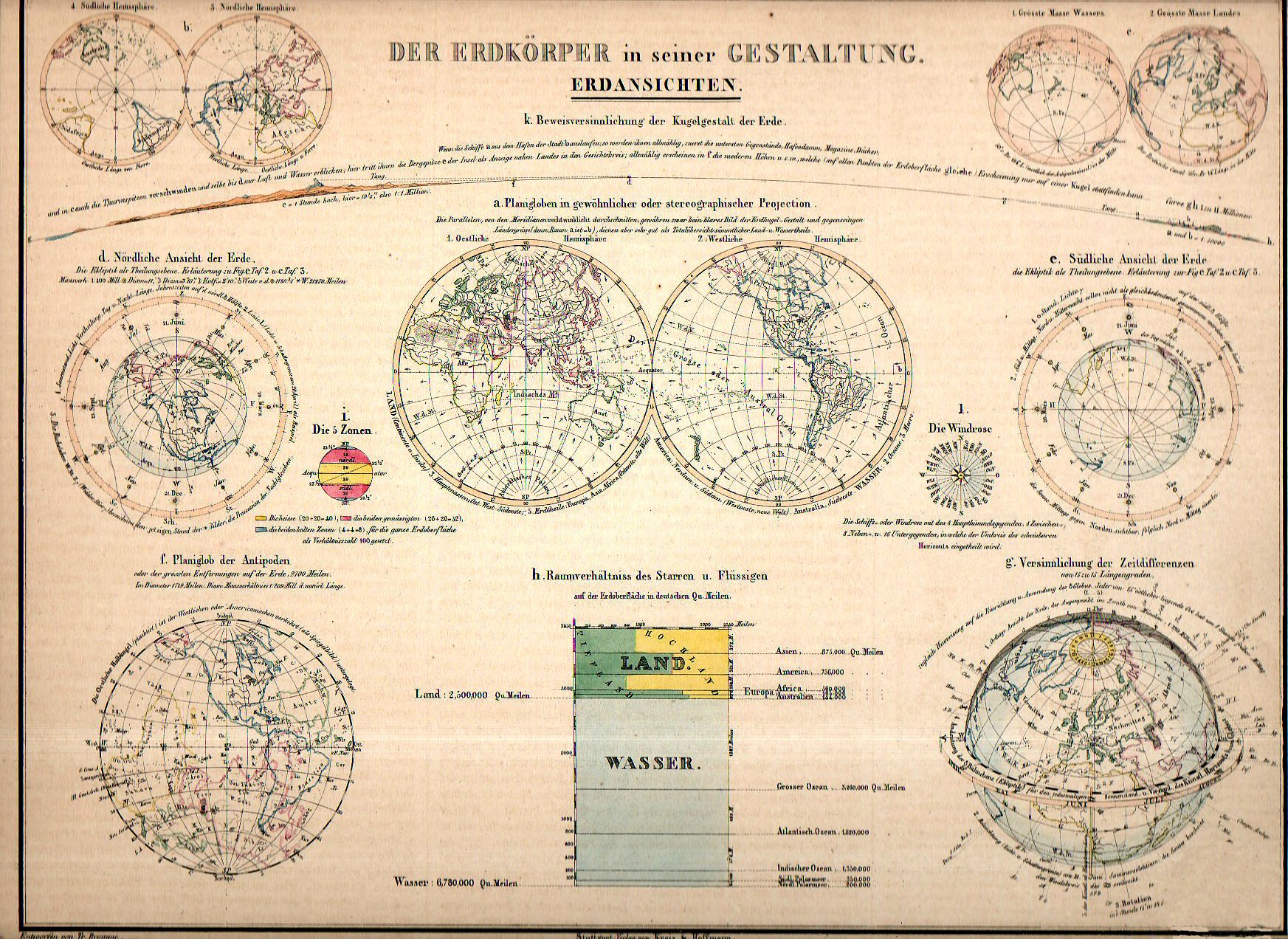
    Before the Neil deGrasse Tyson version and update of Carl Sagan’s landmark television series, Cosmos, there was Alexander von Humboldt, and his enormously influential book of the same title, printed in 1845-1862.  Well, von Humboldt’s (1769-1859) book was actually Kosmos when published in German, which is where it started its life (and which von Humboldt suffered mightily for in it English translation).  Von Humboldt was enormously studied and educated and of a high scientific mind over many subjects, one of those 19th century figures who seemed as though they could know everything, a polymath of high order (along the lines of Goethe and von Helmholtz and Thomas Young and others).  He was a meteorologist and biogeographer before those sciences existed; a naturalist, geographer, archaeologist, and explorer, a natural philosopher of magnitudes.

    Maps dataviz land wasser156

    • “Der Erdkorper in seiner Gestaltung. Erdansichten. Entworfen von Tr. Bromme. Ausgefuhrt v. E. Winckelmann”, published in Stuttgart, by Verlag von Krais & Hoffman.  This map appeared in  the atlas of Alexander von Humboldt’s Kosmos, 1851.  8.5×11.5″ image on 11×13″ sheet, with original hand coloring.

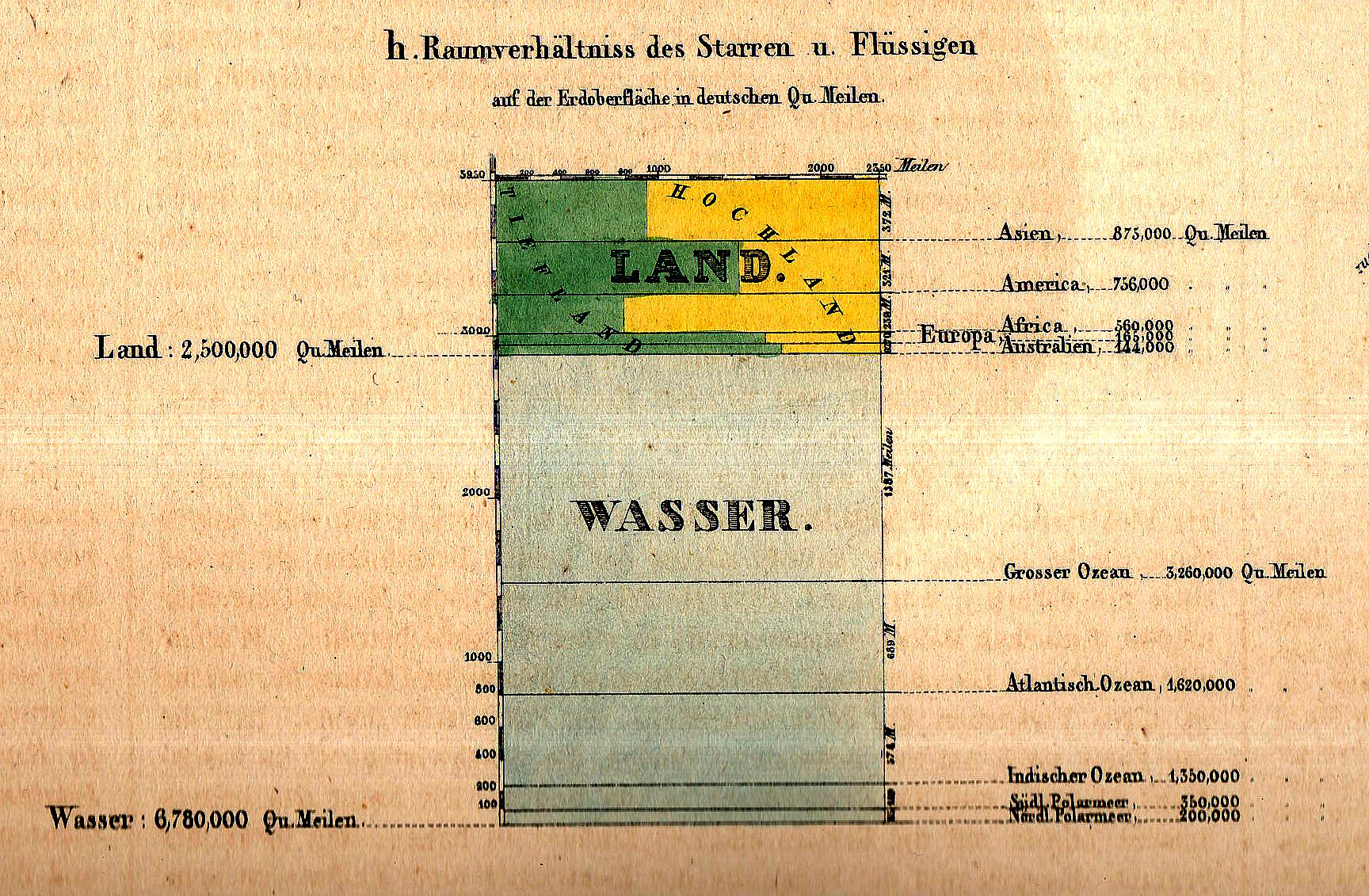
    And this fabulous small detail from the overall map:

    Maps dataviz land wasser detail

    Kosmos reflected his lifelong interest in order, and what he did was astonishing–he attempted to unifying the complexities of nature in one book (of five volumes), binding the various branches of science together in a cohesive whole, attempting to show how the laws of the universe acted here on Earth.  It was a very influential work, very progressive, a masterwork of scientific method.  

    Sagan (and Tyson, soon) tried to explain what the universe was all about; 160+ years ago, so did von Humboldt, and for his time he came damned close to doing so, or as close as anyone could possibly come. 

    The fine little inset above (1×1.5 inches in real life) is an excellent display of water/land mass of the Earth, and is but one of eleven such images on this beautiful image.

  • An Unusual Term: the “Civilian V2” (1951)

    JF Ptak Science Books  Quick Post

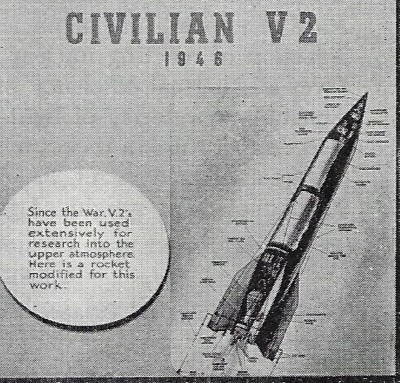
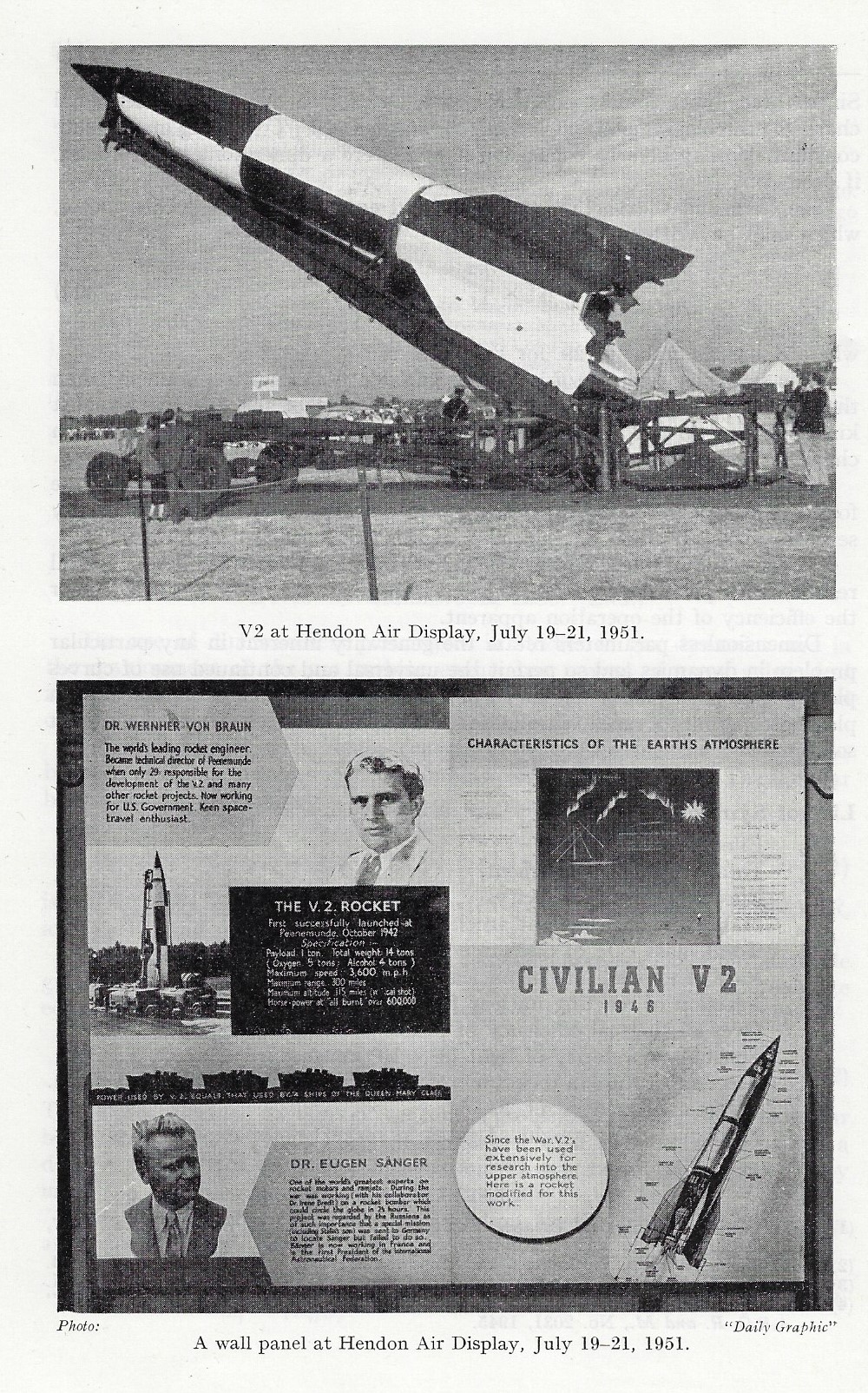
    British Interplanetary Society detailA few days ago in the pages of a 1951 issue of the Journal of the British Interplanetary Society I found a most unusual phrase: “Civilian V2”.  At the time it was probably necessary to distinguish between the wartime V2 and the astronautic research done with it over the next six years, but I’m pretty sure that I had never seen the term’s use before.  I’m not an expert in space flight, or early rocket-powered flight, though I have seen a lot of this sort of material and read around it over the last four decades–still, it looked very unusual to me. I did a simple search under “Civilian V2” and found only 9 hits in Google and 50-odd on “Civilian V-2”, none of which actually apply to the missile itself , but to a “civilian expert” on the V2 (“…civilian V2 expert…” In any event, this light look at the “Civilian V2” term indicates that it probably really is unusual and little-used.  If someone out there has any info on this, please let me know. 

    Source: Journal of the British Interplanetary Society, volume 10 no. 5, September 1951, page 212.  

    British Interplanetary Society full page

  • History of Lines Department: Weather Lines (1851)

    JF Ptak Science Books   Post 2794

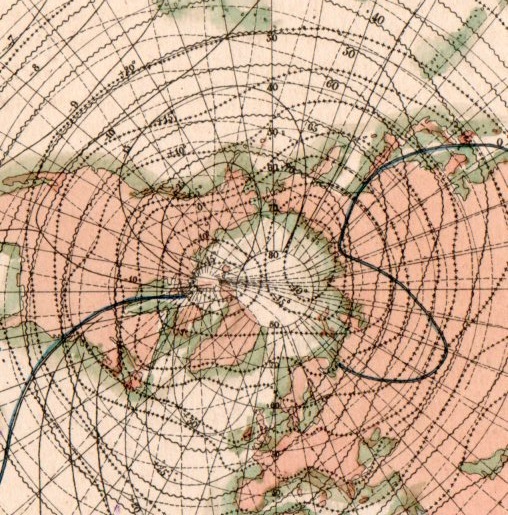
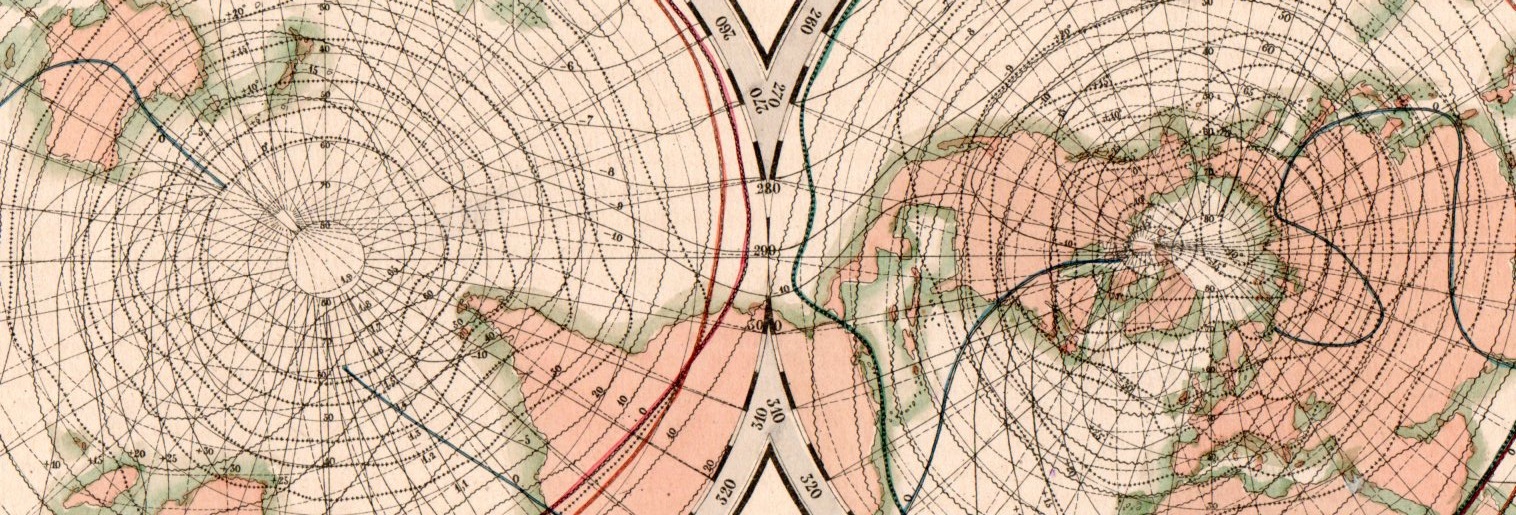
    This beautiful network of lines tells the early story of weather in cartographic form. They appear on Karte der Isothermen, Isoklinen, Isogonen und Isodynamen mit der Magnetischen Meridianen, and was published in the atlas to accompany the best-selling encyclopedic presentation of the natural history knowledge of the world to that time, Baron Alexander von Humboldt’s Kosmos, which was published over a period of several from 1845-1862. The map demonstrates and visualizes climatic information showing isothermes, isoclines, isogones and isodynamics, with the magnetic meridian.

    Map visualization isotherm653

    [This is a detail of the Northern Hemisphere section of the double-hemisphere map, which is reproduced below.]

    Map visualization isotherm654

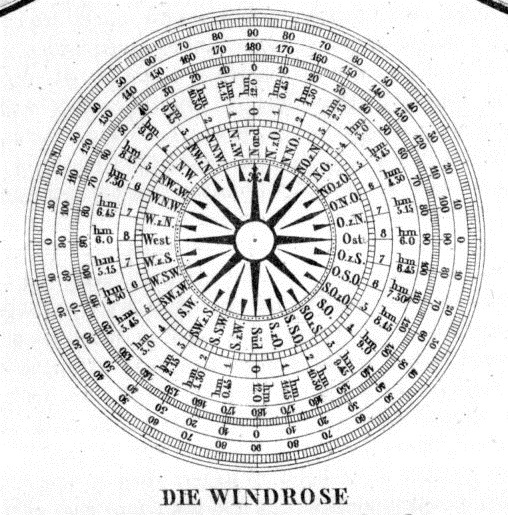
    At bottom there is also a beautiful 32-point wind rose:

    Map visualization isotherm651

Recent Posts

Archives

Categories