A Daily History of Holes, Dots, Lines, Science, History, Math, Physics, Art, the Unintentional Absurd, Architecture, Maps, Data Visualization, Blank and Missing Things, and so on. |1.6 million words, 7500 images, 4.9 million hits| Press & appearances in The Times, Le Figaro, Mensa, The Economist, The Guardian, Discovery News, Slate, Le Monde, Sci American Blogs, Le Pont, and many other places… 5000+ total posts since 2008.

  • From the Department of Blank, Empty, and Missing Things: Mathematicians (1934)

    JF Ptak Science Books  Quick Post

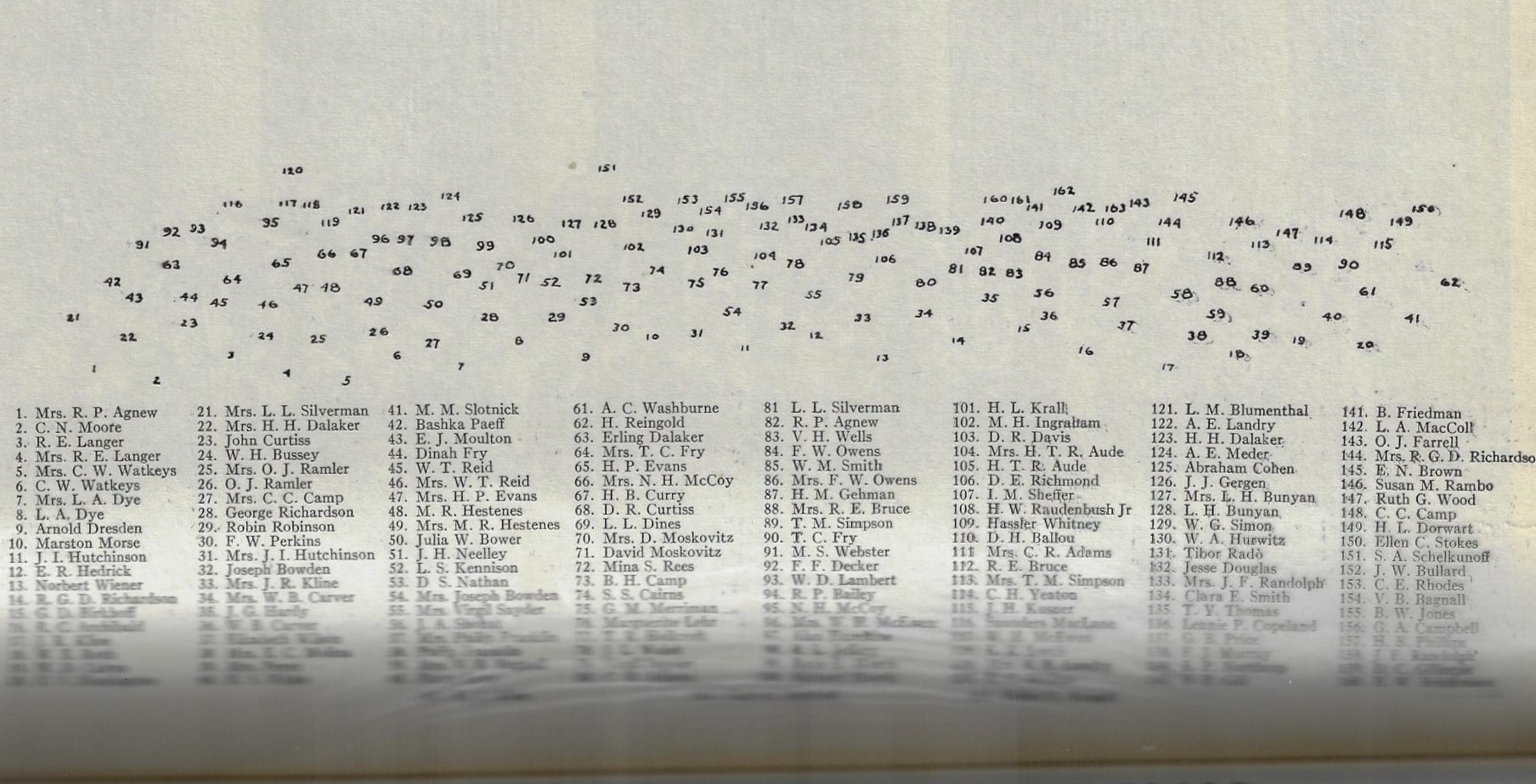
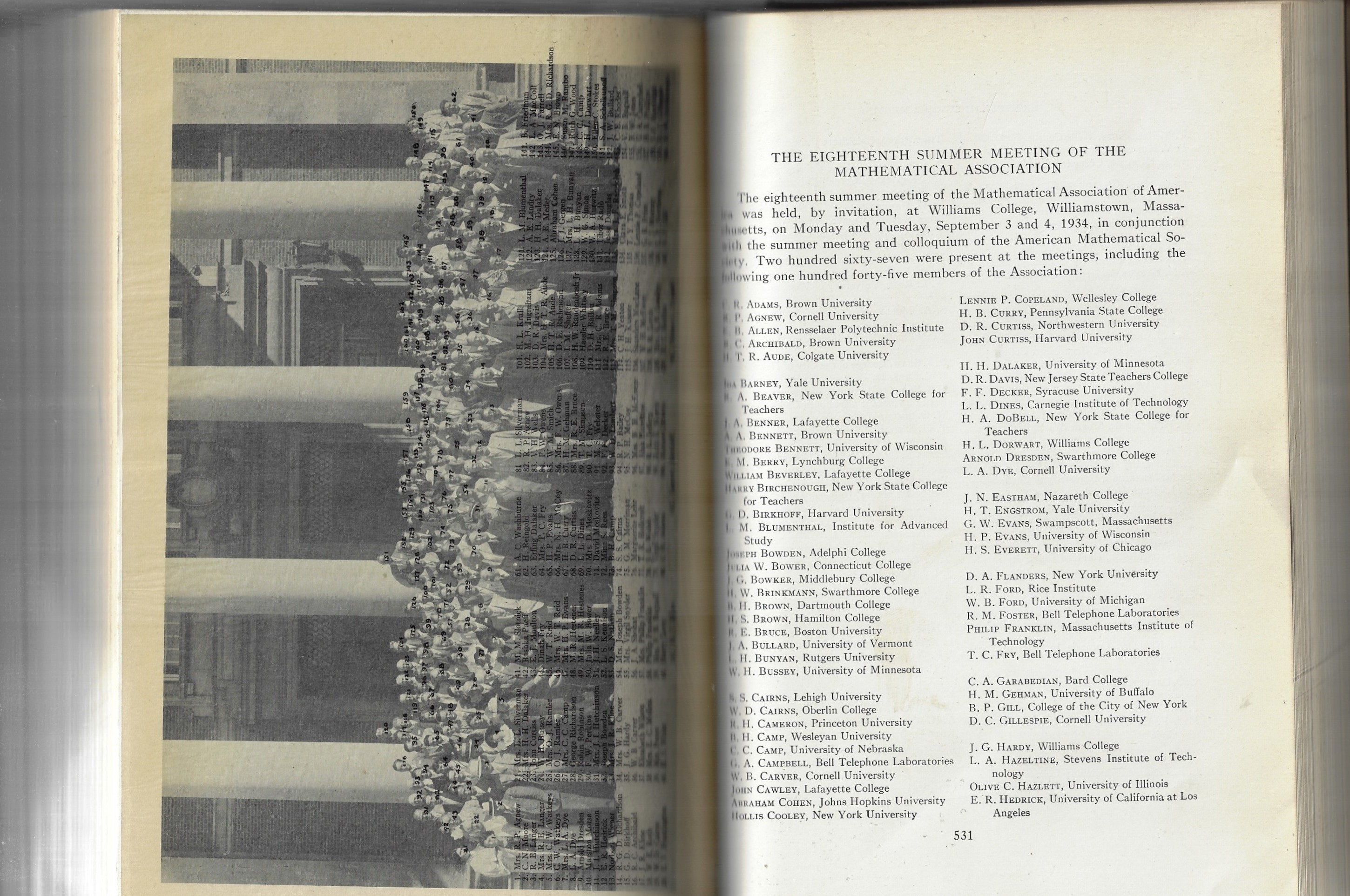
    There is a longish thread on this blog about Blank, Empty, and Missing Things: faces, ethics, beginnings, ends, causes, effects, insight, wisdom, clouds, blood, smoke, rain, depth, height, and so on.  There are also several posts that look a lot like today’s entry–one was for astronomers, and another for mining execs from the 19th century, which was a particularly peculiar image because the head outlines had no faces though most did have moustaches and beards.  Today’s bit is for mathematicians attending the 18th summer meeting of the Mathematical Association of America in 1934, and I found it somewhat ironic that there would be no outlines of the bodies at all, just numbers. Perhaps this is more appropriate than ironic.  In any event, here’s the glassine overlay:

    American MAth Monthly 1934 group photo _2_ blank

    [Source: American Mathematical Monthly, volume 41, 1934.]

    And the two page spread with photo and the glassine in place:


    American MAth Monthly 1934 group photo _2_ blank

  • An OSS (CIA) Routine for Processing Information from Pamphlets (ca. 1942)

    JF Ptak Science Books  Quick Post

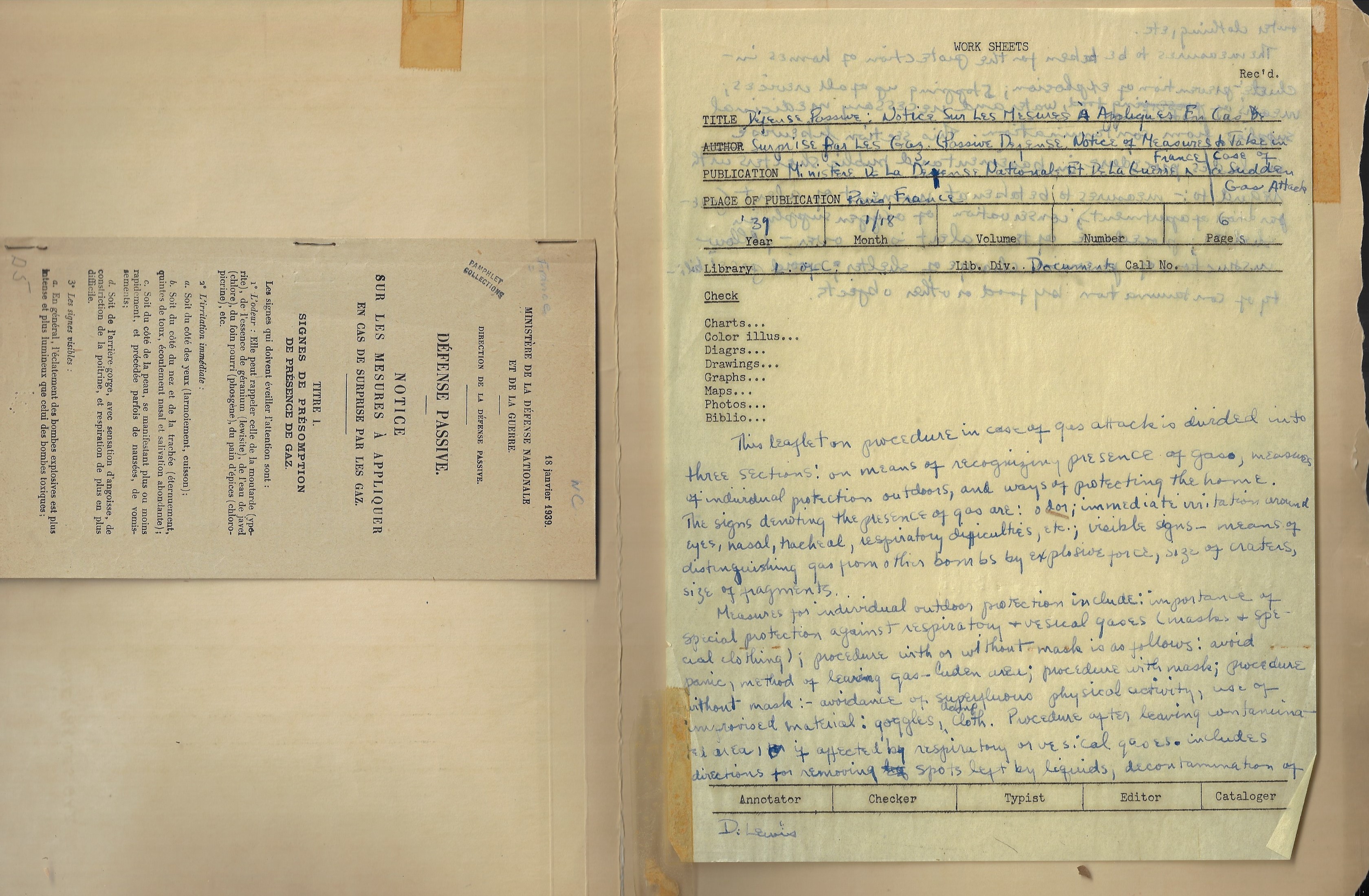
    A while ago–well, more than just a “while”–I bought a large non-collection of pamphlets from the Library of Congress. In this mass of material, all housed in 2000 blue document boxes that somehow managed to be undifferentially differentiated, there was a clutch of about 150 items that had been in the OSS library. That’s the Office of Strategic Services, which was organized and founded by William Donovan and Franklin Roosevelt and solidified in 1942 and which became dissolved and reformulated as the Central Intelligence Agency (CIA) in 1945.  So.  Many of the pamphlets were analyzed and coordinated for mobility of use, extracting information in abstracts that might enable the pamphlet’s data to reach the appropriate readers/researcher. I thought it would be interesting to share an example of this interpretation or information routing engaged by the fledgling intelligence organization, as we see below in a 1939 French pamphlet on what to do in the case of poison gas attacks. Perhaps this is one aspect of one of the many fundamental steps in building an interpretative foundation for analysis of  multivariate issues; it seems to be that it was simple, accurate, and effective.  

    WWII Pamphlets france minister defense


    ·Posted by :

    ·in:

  • A Political Map of Future Possibilities (ca. 1932-5)

    JF Ptak Science Books  Quick Post

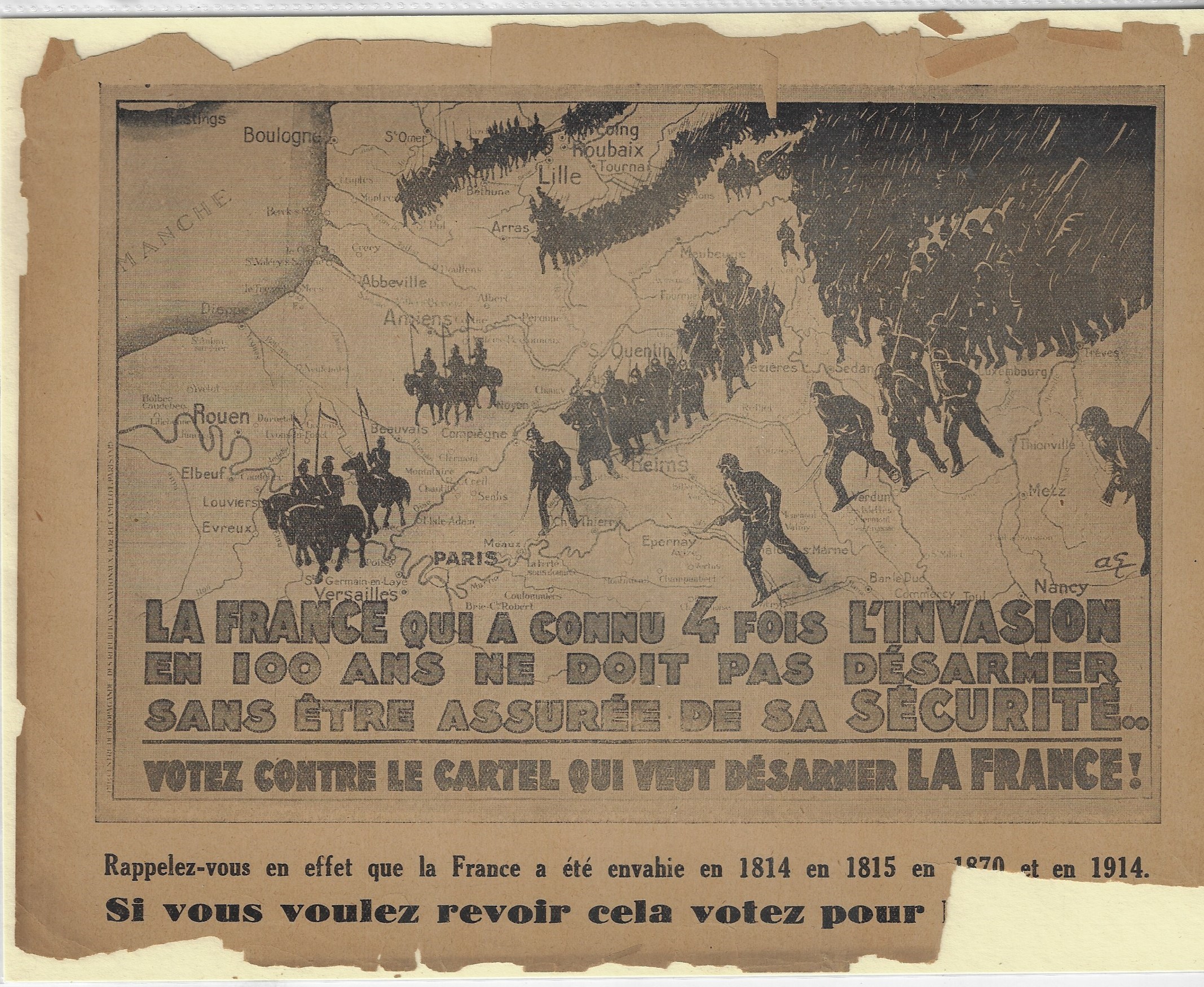
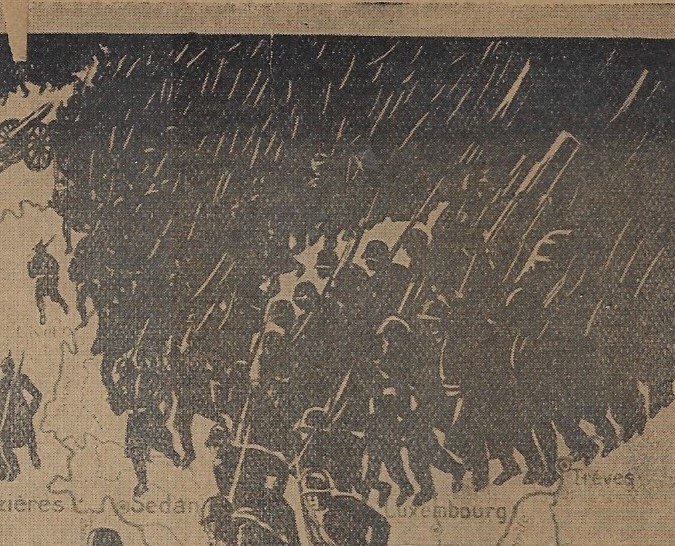
    This is certainly a successful design in describing fear and possibility for the near future and the security  (or lack of it) for France. Nothing quite conveys temporal disruption than a consolidated mass of dark and sharp objects advancing on the home front. 


    Maps propaganda France detail

    • “La France qui a connu 4 fois l’invasion en 100 ans ne droit pas desarmer sans entre assuree de sa securite. Votz contre le cartel qui vent desarmer la France!” (“France, which has been invaded four times in 100 years, should not disarm with being assured of its security! Vote against the cartel that will disarm France!”)
    • Maps propaganda France detail

    The image is a moderate Right Wing political propaganda piece extolling people not to vote for a political group (unnamed but Left Wing) that would “disarm France” by referencing the four times that France has been invaded in the last 100 years (1814, 1815, 1870, and 1914). Design by Andre Galland and printed 1932-1936. The fifth invasion was already on its way, coming in 1940, when Germany simply did an end-run around the ill-conceived modern antique of the Maginot Line, after which the very large French army was slow to respond, with France surrendering 46 days later on 25 May 1940.

    • In a tiny scroll script in the left margin reads: (translated) Propaganda Center of the National Republicans (Republicains Nationaux).

    This is an effective design for sure, showing a mass of infantry and cavalry crossing the northern French border…so massive in fact that most figures blend into an almost-solid black mass save for the white streaks of rifles/bayonets.

    I’m not sure what the intended use was for my copy of this image, which was originally produced as a poster, though this copy measures only 27x21cm. I don’t know if it was meant as a flyer, or small poster, or if it was simply an illustration in a larger book. It is interesting, regardless. (This image is available on the bookstore side of this blog.) It is certainly worth sharing, though. 

  • An Illustrated Book of Professions (1846)

    JF Ptak Science Books  Quick Post

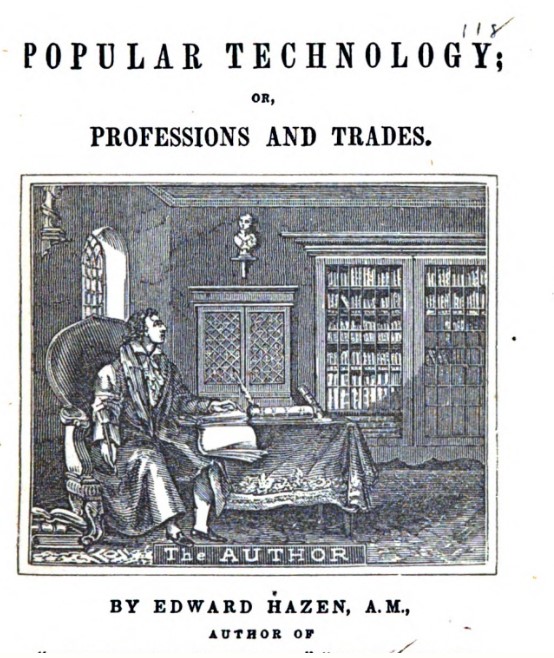
    Here’s a wonderful book that I found while looking for another “Hazen” (the 1930’s servo-mechanism guy), one of a series of books that have appeared over the centuries that  I’ve seen here and there, outlining and illustrating (usually for the young reader)  some of  the  popular and  essential  jobs  of  the  era.  Book of Professions Hazen

    The professions listed here in 1846  were stock-in-trade so to speak, jobs essential to the functioning of society, producing the necessaries that couldn’t already be made at home. Currently most of these professions are mostly or entirely gone, or basically gone, or reduced to niche sub-markets or some such. For example, you don’t see too much interest in or need anymore for the tanner, boot-maker, soap-boiler, copperplate printer, lithographer, wheelwright, cooper, nailer, comb-maker, and the like. Many of the other jobs still exist, though now subsumed in an industrial-sized entity like a supermarket or mall. And some of these jobs took a beating because of mass-influencers like radio, television, and of course the interwebtube, where one person (or small group) can now function in place of the local/individual provider, like, for example, the preacher. There are still churches in numbers in glorioso, though I’m sure some significant number of those in the religion industry have been stacked into the dark corner by televised/monitorized electric talking religico-heads, who exist online or on the television for tens of millions of people and who have taken the place of Preacher Joe down the street.

    Some of the jobs have just changed names though they provide a similar service, like the wheelwright and the tire-change shop.

    Professions come and go, of course, and it would be a fun exercise to look around you and try to determine the approaching antiquarian value (the AAV) of needs serviced by particular professions that are around you, right now. One of my stores, for example, occupied the space of what in the 1920s was a greeting card maker, which was replaced by a radio repairman and electronic tube shop. If only among the professions that will soon be unnecessary one could only hope that in the near future we didn’t need lawyers or doctors. Or dentists.

    So, the list of professions from the Hazen book:

  • The Earliest Appearance of “Einstein” in the “Physical Review”?

    JF Ptak Science Books   Quick Post 

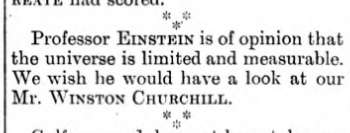
    I set out to see when the first mention of “Einstein” occurs in the Physical Review to vaguely see how he was presented in what was even then in its first few decades of existence the premier U.S. physics journal. It is well known that he doesn’t publish a paper in the journal until 1931, and then publishes “only” two more papers there (the EPR paper in 1935 and then the Einstein-Rosen bridge (the wormhole) paper in 1937). There was one other small contribution as a letter to the editor in 1952, but that was it. (There have been many papers written on his anti-interest in publishing in the Physical Review so I won’t go into that right now.) I had just discussed the first appearance of a relativity paper in the Physical Review, found in the bibliography by Maurice Lecat (1929), which spots 1908 as the first effort published in the journal, though of course this doesn’t necessarily answer the first “Einstein” appearance. According to my searches on the American Physical Society Physical Review site, the first time Einstein’s name is mentioned in the PR is in the May 1, 1914 issue, and then only 11 more times to 1919.  Unfortunately the 1914 record is definitely not the first time E is mentioned, as just about the fist paper on relativity published in the PR does mention him by name in January 1909. (This is an abstract of a paper given by G. Lewis and R. Tolman in vol 28 1909 p 150.) So I’m not all that sure what this means, except that it seems unlikely that this sort of word search is an accurate (or definitive) tool–and I’m pretty sure that I can’t access hoped-for easy answers answers to these questions.

    In any event, Einstein doesn’t have much of an existence in the Physical Review until his big year of 19161, and then again another uptick following the verification experiment of the eclipse of May 28, 1919. It seems though that the major amount of fame and acknowledgment comes in the popular press, where Einstein becomes EINSTEN after the eclipse proofs. As a side note Einstein had no notice whatsoever in the New York Times until June 1919, at which time the massive coverage of him as the New & Improved Newton begins. 

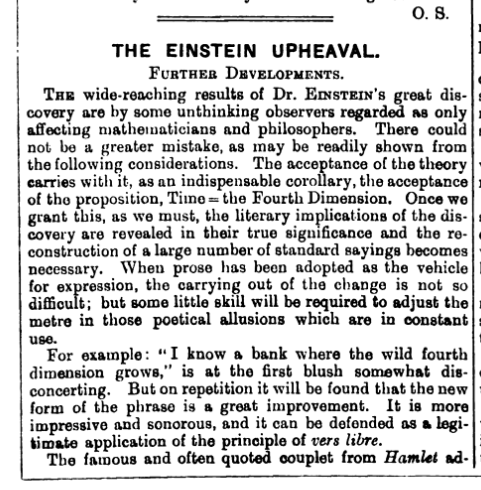
    I don’t have much of anywhere to go with this post, but I thought I’d at least share what I found, faulty as it probably is.  As a limp distraction from my inconclusive searches, here below are a couple of examples of early humorous treatments of Einstein, found in the pages of Punch, or the London Chiaravari, 1919-1921; the full results aren’t in yet, but it seems as though Einstein has more mentions in the 1920s in this satirical/entertainment magazine than he does in the Physical Review. I haven’t done supplementary searches in the databases of other journals/magazines/newspapers yet, though I will if this question of the earliest Einstein appearance in the Physical Review hasn’t left me. 


    Einstein Punch March 2 1921

    ·Posted by :

    ·in:

  • “Found Art” in Generic Illustrations (1878)–When Artists Have a Moment of Time for Minor Mischief in their Daily Work

    JF Ptak Science Books   Quick Post

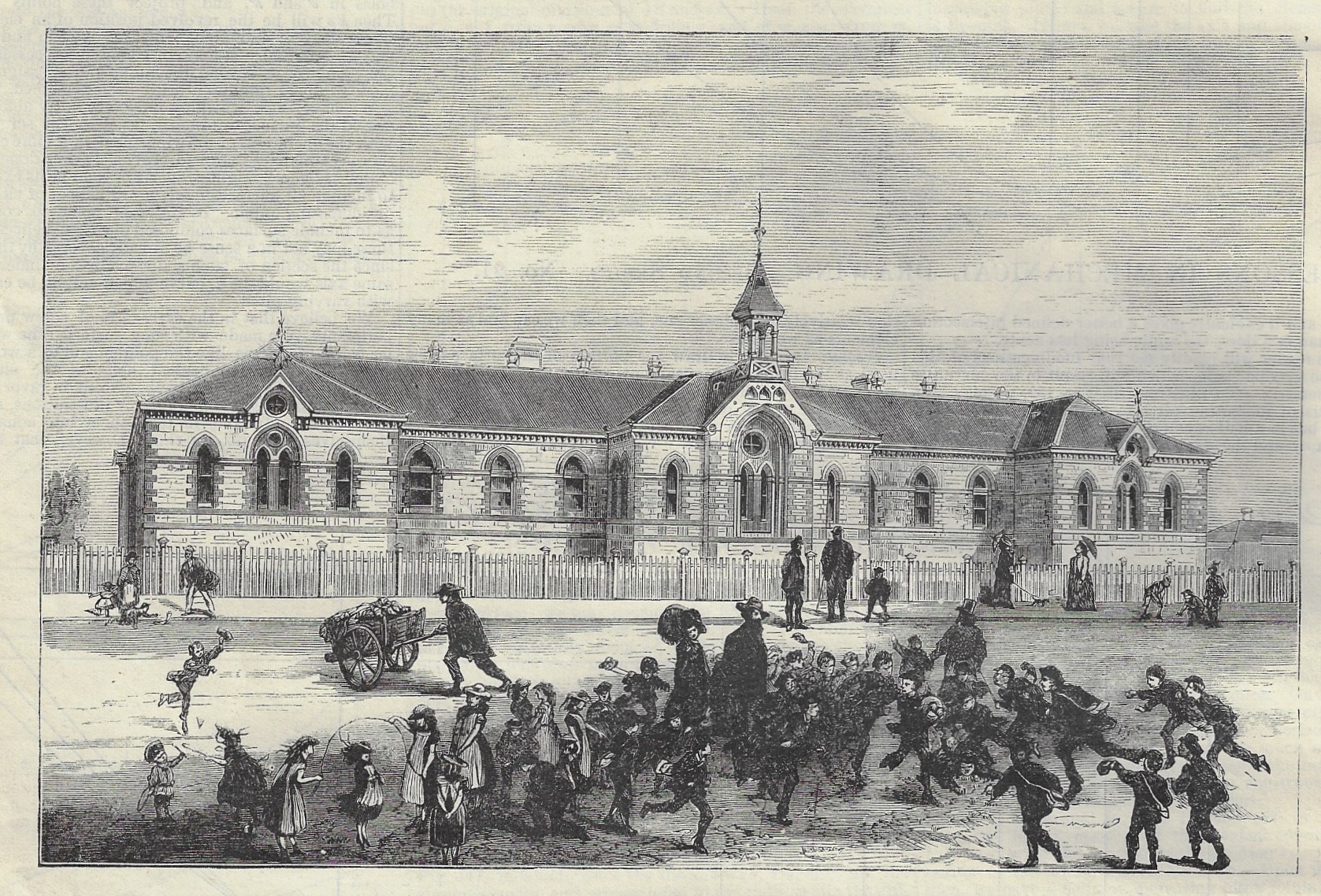
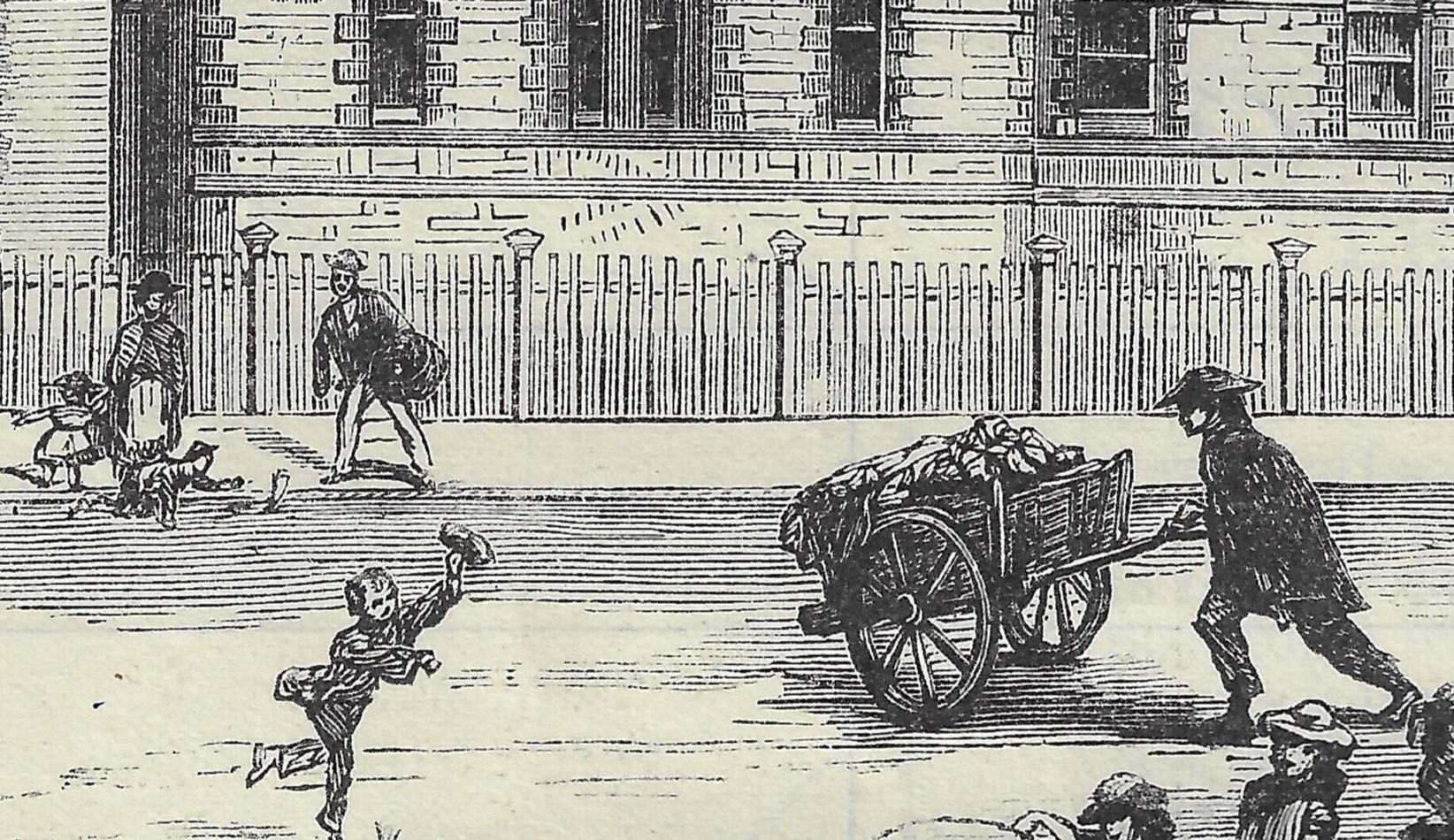
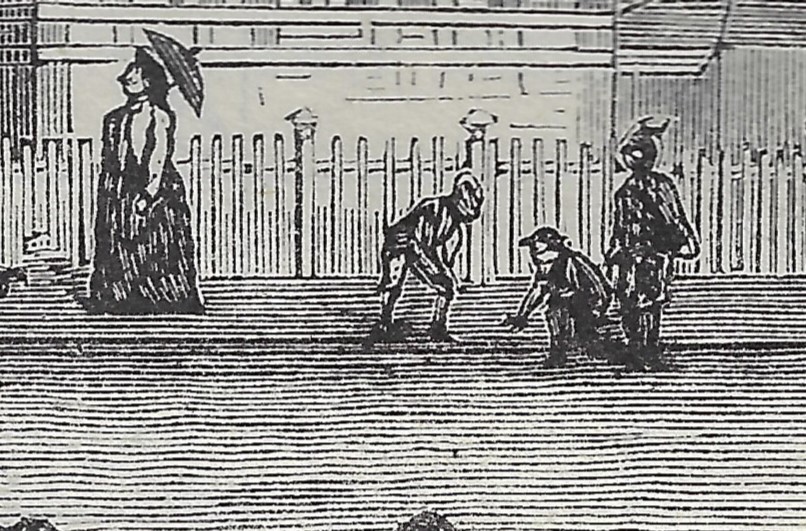
    Sci Am 1878 Prints looking deep school fullI noticed a couple of peculiar flourishes in this work-a-day illustration from the 26 January 1878 issue of the venerable Scientific American. It is a simple image of an “Australian Model School” in North Adelaide, Australia, one of a number of new schools opened that “exemplify the successful progress of the British Australian colonies”.  (It is a fine building, built of stone with brick facing, 142′ long, built on a site at Tynte Street, east of O’Connell St.–the school is still there.) In any event what I noticed in the background of very busy foreground of densely compacted children at play were two small groups of kids who were interested in…something. They are bending over, finding something in the street. They occupy only a centimeter or so of the viewing area, and have been included and shown doing something out of the ordinary. No doubt the contract-artist making the woodcut had a little fun with the scene of the children in the foreground once they had completed the mail task of illustrating the subject of the small article. And then, I think, the artist had a little fun by including some tiny expression of creativity beyond the necessary and incised a couple of small mysteries. I’ve seen this many times in relatively complex images like this–it really doesn’t take that much looking to pick those unexpected bits out.  

    So, here’s the first found bit–the child is reacting to or reaching out for something, some piece of paper, something-or-other that sort of looks like a snake…is the kid feeding this thing with a piece of fruit or veggie that is being peddled by the main with the pushcart?

    Sci Am 1878 prints looking deep detail 1

    And the other scene, the second bookend to the picture, seems to show a boy picking up/putting down some small creature. If you allow your attention to drift a little you can see-ish a small head with ears and a body in the child’s hand:


    Sci Am 1878 prints looking deep detail 1

    Whatever the case may be, I enjoy finding these artistic vacations, and over the years have found probably hundreds, though I’ve written on only a small number on this blog in the “Prints–looking hard/deeply at” category (found in the far right column).  


  • J.P. Joule and God

    JF Ptak Science Books  Quick Post 

    (With thanks to David Wenner for the introduction to this paper by Joule.)

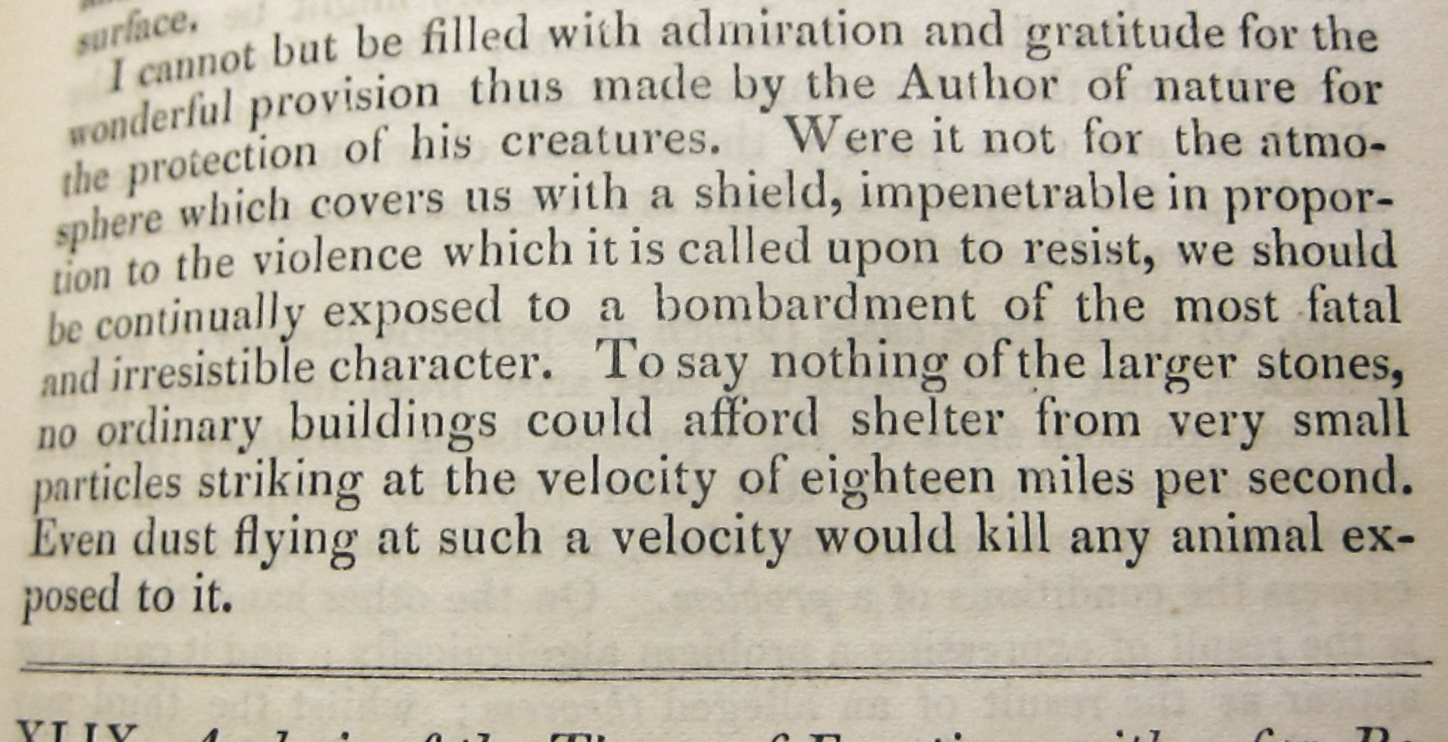
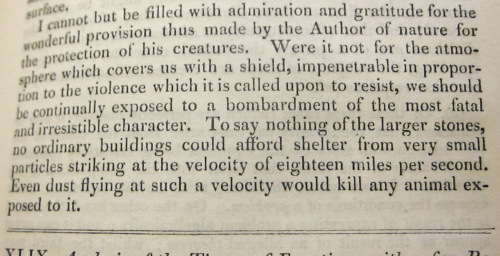
    There is a real work of unexpected beauty in the last paragraph in “On Shooting Stars” Philosophical Magazine vol 32, 1848, pp 349-351, by James Prescott Joule,  thanking the creator of the universe for including an atmosphere for the Earth.

    At the end of the day, the first law of thermodynamics is found in the law of the conservation of energy, which was found in the relationship of the nature of heat to mechanical work, which was found in the work of James Prescott Joule (“Wherever mechanical force is expended, an exact equivalent of heat is always obtained”.— J.P. Joule, 1818-1889, August, 1843.) The unit of energy called the “joule” (”used by the International Standard of Units (SI)…defined as the amount of work done on a body by a one Newton force that moves the body over a distance of one meter”–Universe Today/Astronomy ) is named for J.P. Joule.

    After addressing some issues of “shooting stars”, Joule writes his lovely closing sentiments, which to me can be easily arranged into a bit of “Found Poetry”–that is, it is the simple restructuring of the two paragraphs into a poetic format, and without changing any of the words. It is an interesting process, and I think Joule’s language easily transcends its sleepy place at the end of a mostly-forgotten work half-way through a scientific journal.

    Here it is: 

    I.

    I cannot but be filled with admiration and gratitude

    for the  wonderful provision thus made

    by the Author of nature

    for  the protection of his creatures.


    II.

    Were it not for the atmosphere which covers us with a shield,

    impenetrable in proportion to the violence

    which it is called upon to resist, we should 

    be continually exposed to a bombardment of the most fatal 

    and irresistible character [of shooting stars].

    To say nothing of the larger stones, 

    no ordinary buildings could afford shelter from very small  particles

    striking at the velocity

    of eighteen miles per second. 


    III.

    Even dust flying

    at such a velocity

    would kill any animal exposed to it.      


    This is the original bit of the poetry straightened-out, proper, and correct:
    Joule god _2_

    And the rest of the article:
    ·Posted by :

    ·in:

  • Stacked-Tech: Things on Top of Other Things (1926).

    JF Ptak Science Books  Quick Post

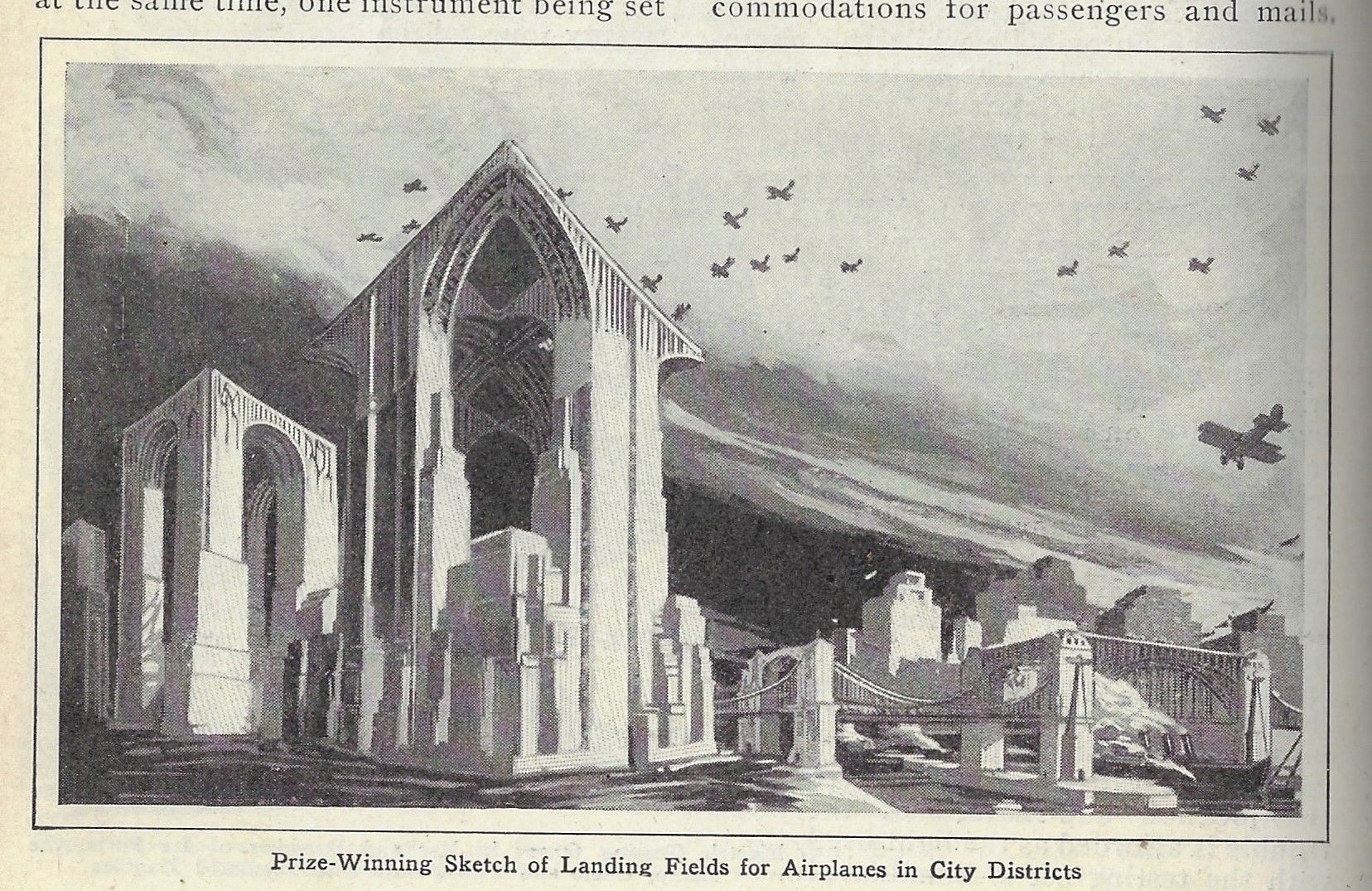
    In just three or four decades into the skyscraper era and heavier-than-air powered flight there was a certain sense of planning to join those two technological (series of) achievements. This sense of enlightenment though didn’t seem very enlightened, or practical. The idea of locating airports on the tops of tall buildings, or on structures covering rivers (like the Hudson or Thames), or on long and wide structures built over expanses of shorter inner-city buildings, seem to have had a life from the late ‘teens into the 1940s.  They were struggling ideas that struggled. 

    I found two more examples of this stuff-on-top-of-other-stuff tech thinking today. The first shows a structure 950′ tall made to accommodate a strained amount of air traffic in the heart of a large metropolitan center. (There are numerous examples of this idea sprinkled throughout this blog–just pop the word “airport” into the Google search box at upper right and you should find 10 or so posts on the topic, all with great illustrations.) By the way, this was one busy dream of an airport, what with 20 planes coming and going. 

    Pop Mech 1926 tennis court resevoir

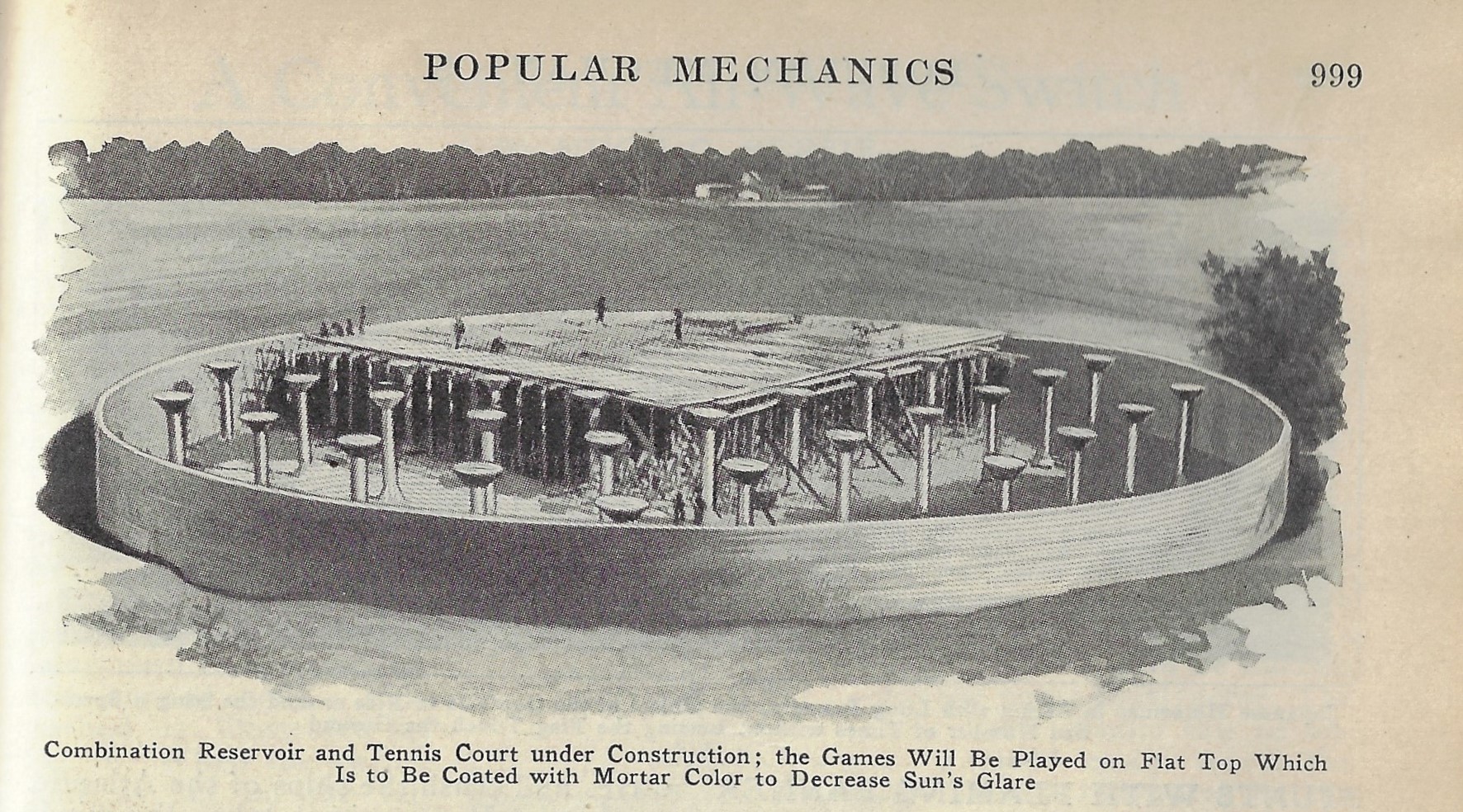
    The second image is unusual but less-techy: a tennis court built on top of a reservoir:

    Pop Mech 1926 tennis court resevoir

    I ‘m not sure how hurting people were for spaces for a tennis court in 1926, but the competition for the open land for such a thing couldn’t’ve been that severe. 

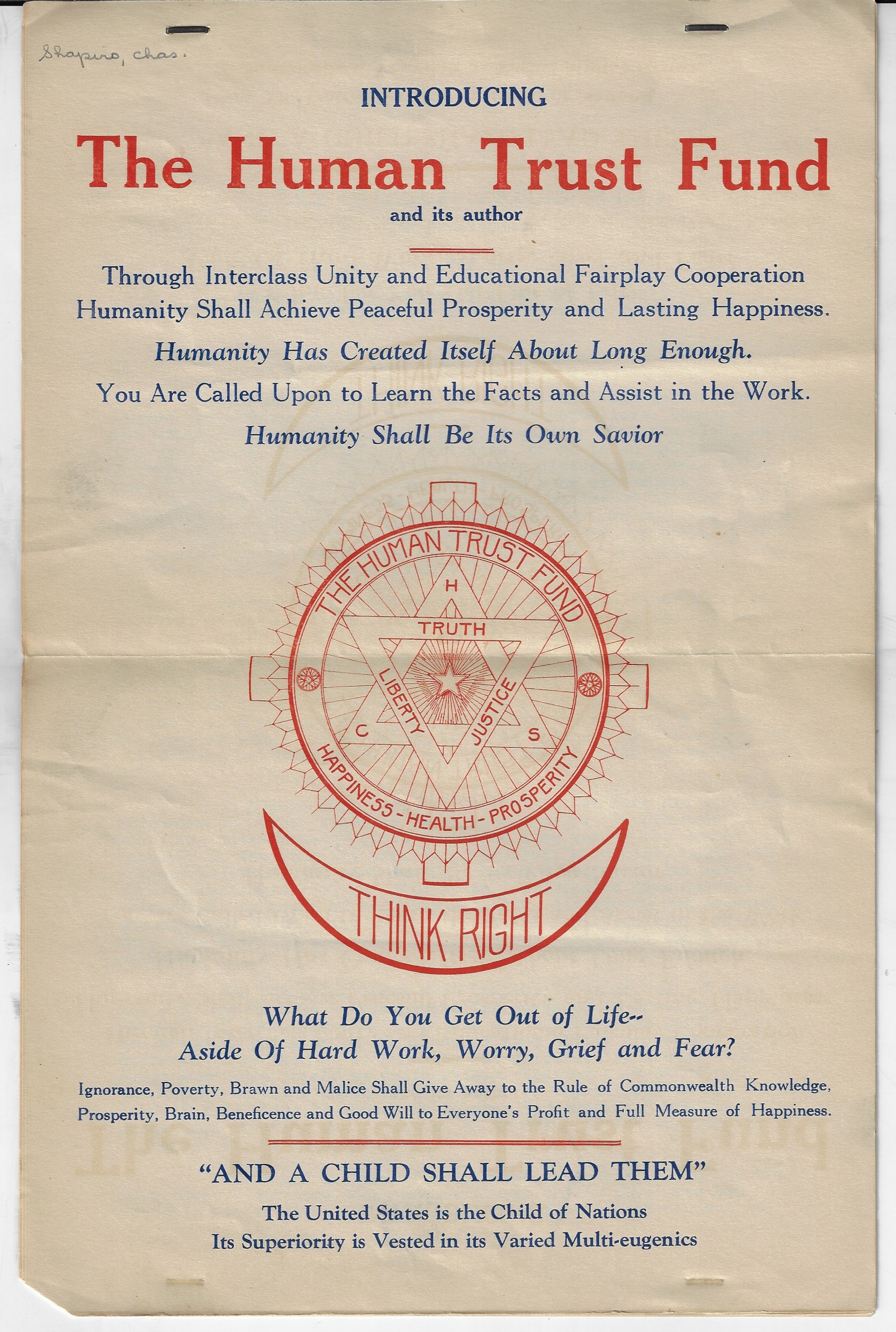
  • The Human Trust Fund (1929)

    JF Ptak Science Books  Quick Post

    No, not the work of George Costanza, but of someone else, a Chicago native who had an idea for saving the country, for saving humanity. I haven’t read but the first and last pages, and I think that that was about enough–I’m not at all sure what the author’s play was here, but whatever it was, he tried.  In any event, this pamphlet (13″ x 8″ and 24 leaves) was printed in 1929–there’s no mention of The Depression that I could see (the epithet “Great” wouldn’t be applicable for another 15 months or so)–and once belonged to the great but problematic H.L. Mencken, who didn’t own it for long. This pamphlet is part of my Outsider Logic Collection, in the Department of Gallant Tries. 

    Books covers human trust

    ·Posted by :

    ·in:

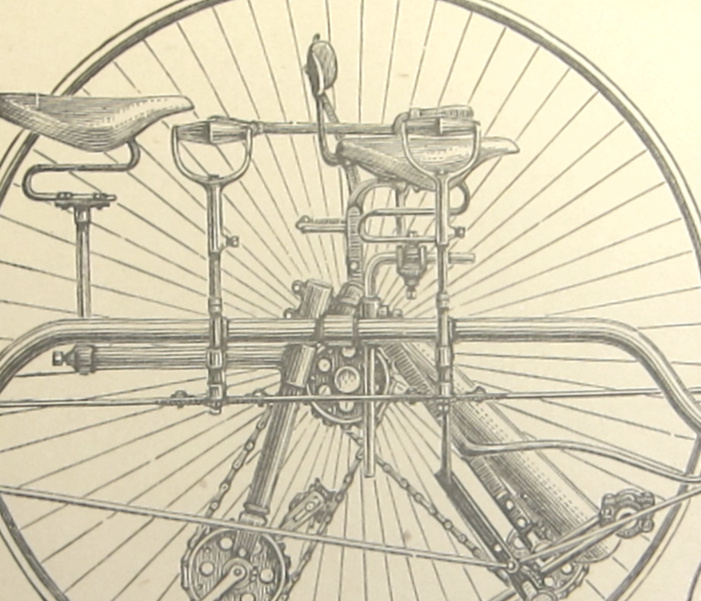
  • The Geometric Art of the Antique Bicycle (1885)

    JF Ptak Science Books  Quick Post

    Robert E. Phillips’ “On the Construction of Modern Cycles” was a beautiful short paper that appeared in Institution of Mechanical Engineers, Proceedings, and which was published in  October 1885. This paper appears in the issue of pp 461-552, occupying pp 467-521, fantastically well-illustrated with 39 engraved plates (numbered 62-100). The illustrations are beautifully detailed and feature all manner of technical aspects of bicycles. (Two years hence, in 1887, Phillips would published a lovely book, The Pleasures, Objects, and Advantages of Cycling, in London, by Simpkins).

    Bicycles _6 detail_

    ·Posted by :

    ·in:

  • Found Poetry of Fallacies (1864)

    JF Ptak Science Books  Quick Post

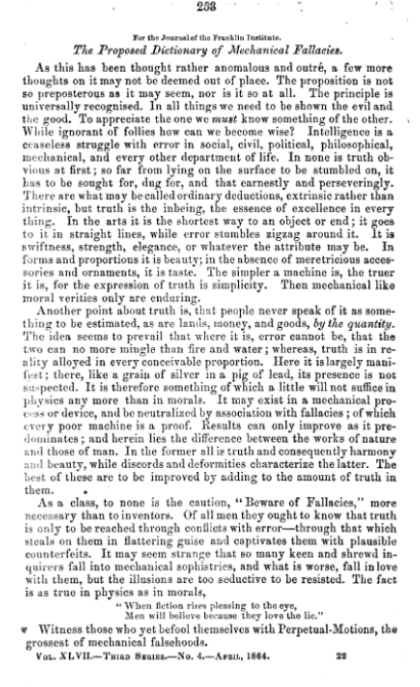
    “Proposed Dictionary of Mechanical Fallacies”

    “While Ignorant of Follies How Can We Become Wise?”

    The author (“E”) writes to the readers of 1864 in The Journal of the Franklin Institute1 an odd and open letter on truth, beauty, and the importance of recognizing fallacy.  “E” has a bit of a hard time of it, writing more in the style of an early 19th-century figure than someone at mid-century, but sooner or letter he gets to his point, and along the way there are some pretty interesting observations. He also takes things a bit too far in places, but if you concentrate on his successes, the article is worth a read. It isn’t a suggestion of De Morgan’s A Budget of Paradoxes, but “E” provides enough in three pages to make it a good read.  

    In the spirit of poetic adventure I offer some of the “E” article below in situ as “Found Poetry of Fallacies”:

    As a class to none is the caution, “Beware of Fallacies” more necessary than to inventors.

    Of all men they ought to know that truth is only to be reached

    through conflicts with error through that which steals on them in flattering guise and captivates them with plausible counterfeits.

    It may seem strange that so many keen and shrewd inquires fall into mechanical sophistries

    and what is worse fall in love with them but the illusions are too seductive to be resisted.

    The fact is as true in physics as in morals:

     “When fiction rises pleasing to the eye. Men will believe because they love the lie”  (Witness those who yet befool themselves with Perpetual Motions the grossest of mechanical falsehoods.”


    As this has been thought rather anomalous and outré a few more thoughts on it may not be deemed out of place.

    The proposition is not so preposterous as it may seem nor is it so at all. The principle is universally recognized.

    In all things we need to be shown the evil and the good.

    To appreciate the one we must know something of the other.

    While ignorant of follies how can we become wise.

    Intelligence is a ceaseless struggle with error in social civil political philosophical mechanical and every other department of life…

    The full article, via Google Books:

    ·Posted by :

    ·in:

Recent Posts

Archives

Categories