A Daily History of Holes, Dots, Lines, Science, History, Math, Physics, Art, the Unintentional Absurd, Architecture, Maps, Data Visualization, Blank and Missing Things, and so on. |1.6 million words, 7500 images, 4.9 million hits| Press & appearances in The Times, Le Figaro, Mensa, The Economist, The Guardian, Discovery News, Slate, Le Monde, Sci American Blogs, Le Pont, and many other places… 5000+ total posts since 2008.

  • Complete Destruction of an Entire Country: Japan, 1945

    JF Ptak Science Books   Post 1861
    Atom bomb 720
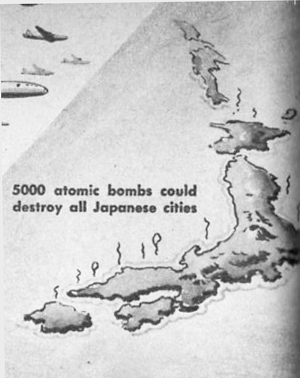
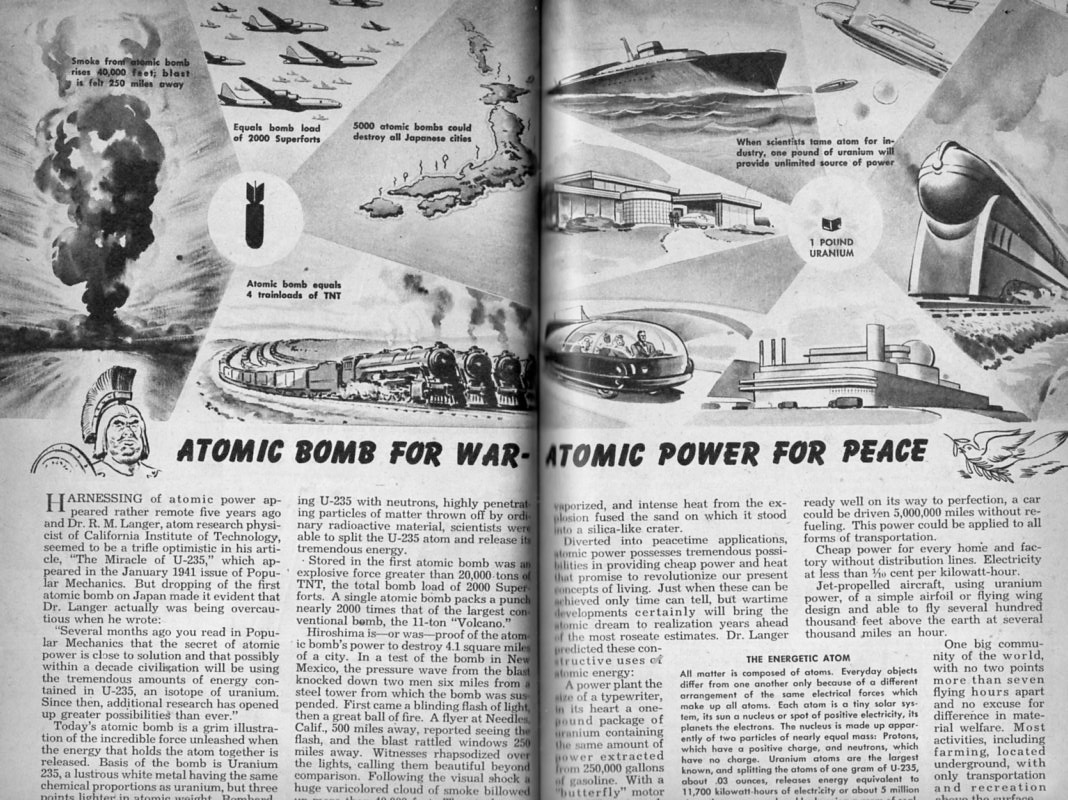
    The October 1945 issue of Popular Mechanics carried a story “Atomic Bomb for War / Atomic Bomb for Peace” as a reminder, I guess, to its readers that the vast destructive power of the atomic bomb was just one example of what nuclear power might be–and that there could be incredible and wide-reaching benefits of the process for peaceful uses. This work came about eight weeks after the bombings of Hiroshima and Nagasaki, and seems to be only the second post-use story on the weapon. 
    Atom bomb 719
    Half of the article’s illustration is dedicated to military applications of atomic energy, and the other to the peaceful; and in the upper-middle of the military side we are told that if necessary that every city in Japan could be completely destroyed with “5,000 atomic bombs”.  The truth of the matter is that a great percentage of the major  (and minor-major and major-minor) cities had already been pretty much decommissioned. (Just weeks before the bomb came the massive firebombing of Tokyo–334 of  General Curtis LeMay B-29’s were loaded to utmost capacity with the newly-conceived M-69s bomb, an incendiary so vicious  that the fires it produced were all but inextinguishable.  The B29’s bombed Tokyo for hours, killing 100,000+ people and making over a million homeless.)  And so I’m not sure what the message was, here, except to establish that the complete destruction of a city with weapons dropped from planes was now a possibility.  It was probably right at about this point that this idea became a real possibility–and so to for its extension, that given enough of these weapons, that the entire world could be bombed out of existence.

     

  • NYC as an Atomic Ground Zero, 1946

    JF Ptak Science Books    Quick Post  (Part of a Series on the History of Atomic and Nuclear Weapons)

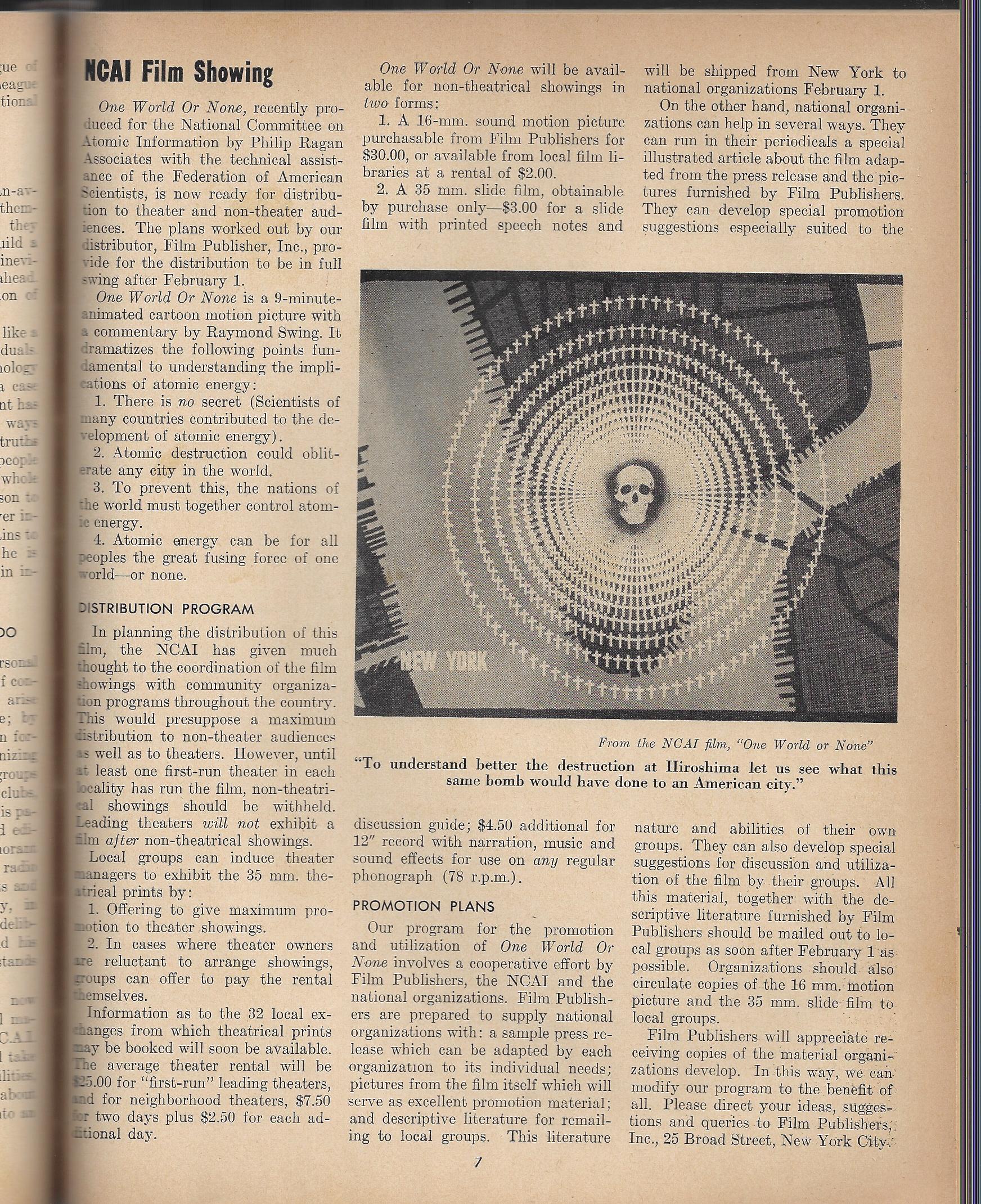
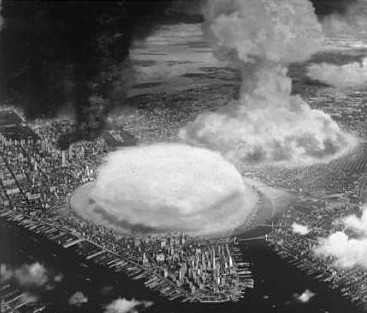
    Atom bomb nyc721 Atomic bomb nyc 1946 filmThis arresting image is a still from an extraordinary and scary 1946 film “One World or None” (published by the National Committee on Atomic Information and located (here)  held at the Prelinger Archive. It shows video graphics of New York City (and Chicago, Los Angeles and San Francisco) being attacked and bombed with atomic weapons.  The unfolding darkness very effectively shows the reach and extent of damage associated with each single explosion, and makes an effective and chilling point about the control of atomic weapons. (I’ve also included the particulars for renting and showing the film from  a short one-page notice in the journal Atomic Information, published by the L Street D.C. NCAI, published January 20, 1947, volume 2/1.)

    It is also part of a continuing sub-series on this blog relating images of antique images showing NYC destroyed, and include the following posts:


    and others, including a few posts that shows Manhattan sinking under its own weight, floating in the air, and set adrift in the Hudson. 


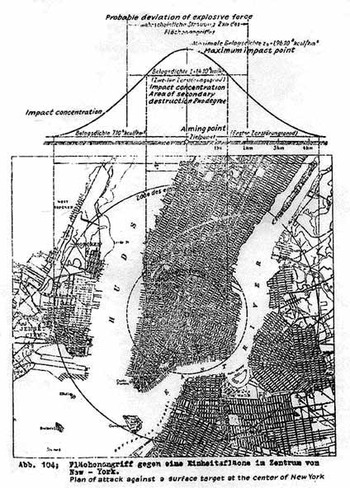
     And here is a detail of Manhattan as ground zero from the Sanger paper:

    Manhattan_bombed_4And Manhattan being hit by multiple atomic weapons (from this post):
    Atomic nyc


    ·Posted by :

    ·in:

  • Booze-Vision Atomic Farming and Other Nuclear Dreams

    JF Ptak Science Books  (Expanding an Earlier Post)

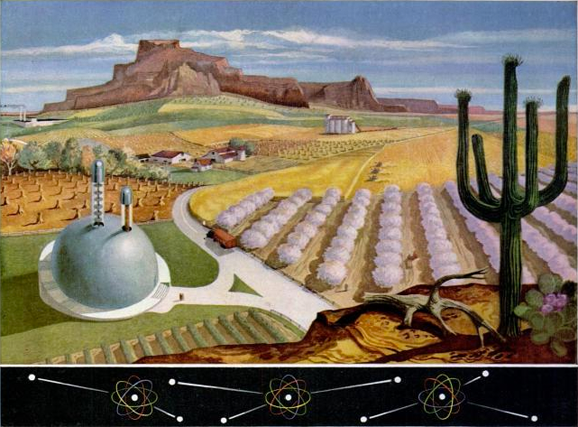
    Seagrams V.O. Canadian Whiskey powered the future through a series of a dozen or so ads for itself in the 1945-1947 period, taking a usually-strangled though occasionally interesting peep into what the future might bring.  (And of course the future is brought by men who drink Seagrams.)  In this ad, appearing in the 12 May 1947 issue of LIFE Magazine, we are told “deserts will bloom through atomic power”–how this might happen is left to the imagination. Also left to fantasy is what exactly is being farmed there in front of the incongruous “atomic energy plant”. Plastic smoke?  Taking a fractured approach to the possibilities one might say that atomic bomb mushroom clouds are being grown from seedlings here from the ground up, nurtured until the day they too will be as big as the blasts of August 1945.

    Atomic garden

    Oddly enough, the illustrator–who after all was just trying to sell alcohol–came pretty close to the truth, except that they got the power source wrong.  Rather than nuclear energy, it would be petrochemical industries that would lie there at the heart of America’s farm production (via seeds and fertilizers and so on)–I’m sure that it would’ve made more sense in a weak way back there in 1947 to believe the atomic story rather than the possibility that it would be petroleum that would drive the entire production of food forward. 

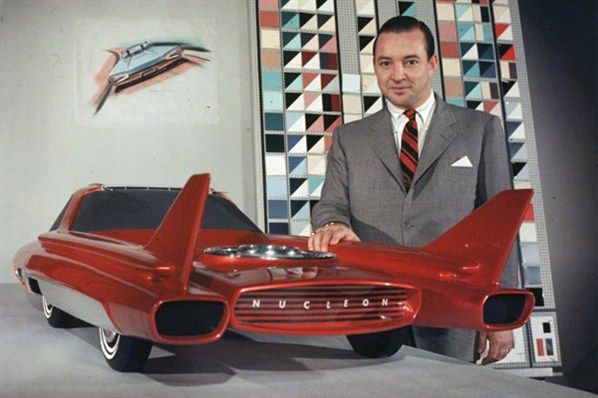
    There were many proposed uses for atomic energy over the next few decades, most not very good–the Ford Nucleon, a screamer with a 5,000-mile cruising range powered by a steam engine driven by a small uranium fission muscle box in the car’s rear, was one of those ideas.  The nuclear-powered submarine, which sounded like the Nucleon in 1946, was a solid workable idea, a science fiction come true in 1954 with the launch of the USS Nautilus (SSN-571).

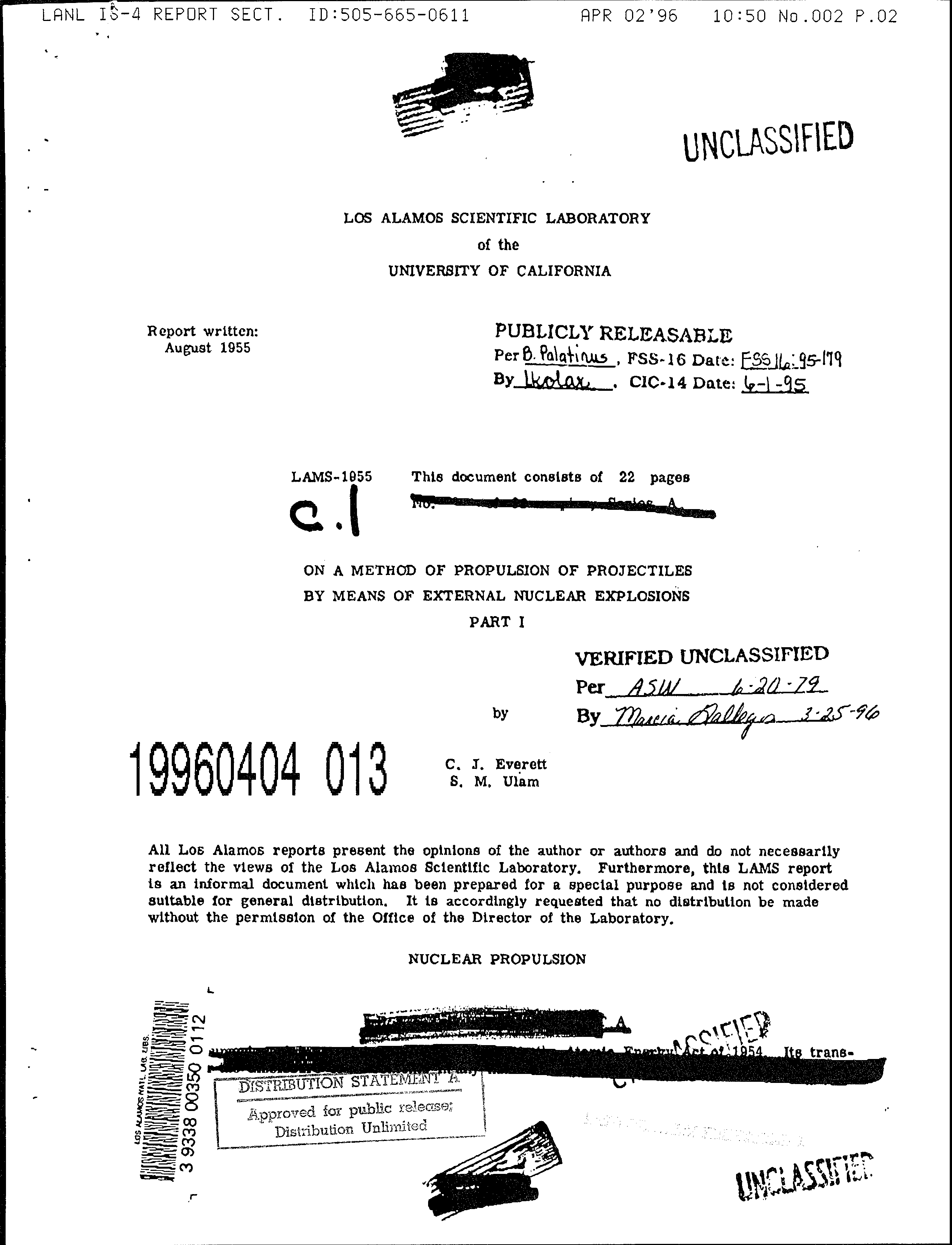
    Ford nucleonNuclear medicine–although not powering an atomic heart–was a very important development that seemed not conceivable in the decade preceding its development.  Atomic-powered helicopters, trains and planes are other examples of the not-good-idea variety.  The nuclear powered space vehicle, which was first proposed in 1946 by Stan Ulam (and then in a report written by him and C.J. Everet  On a Method of Propulsion of Projectiles by Means of External Nuclear Explosions. Part I. University of California, Los Alamos Scientific Laboratory, August 1955, pictured and linked below), has morphed into something monumental in Project Orion, and to me sounds like a fabulous idea:

    [Source here.]

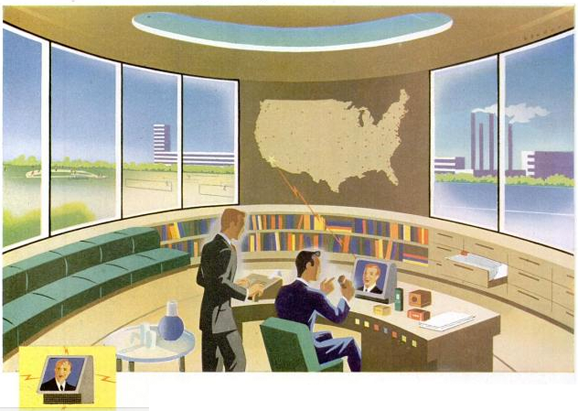
    IBut getting back to the liquor ads, here’s an weirdly prescien and naive image–“weird” anyway for a quick effort made by an artist trying to sell drunk juice–is this proto-internet office view, made in May 1945. There’s lots of passive solar going on here(though not really very effective when you consider the other ways of directing and filtering exterior light inside) in the office of tomorrow, but more important is the desk and the file cabinets.  The seated man is talking to someone across the country  via phone/wireless, with data en masse at his fingertips, a “computer” (in the old sense of the word, that being a person–and usually a women–given the charge of adding long columns of number or whatever and then doing the arithmetic, like a comptometer) working some sort of calculating interest on the largish calculating instrument. In general we see a decision-maker awash in responsibility connecting all of the parts of his world: a primitive, secular, analog internet.  And this too just at about the same time that Vannevar Bush introduced his own vision of the informational future with his superb Memex (which I wrote about earlier on this blog here.)

    Internet 1945

  • What Did the Delivery of the Plutonium for the First Atomic Bomb Look Like?

    JF Ptak Science Books  Post 1863

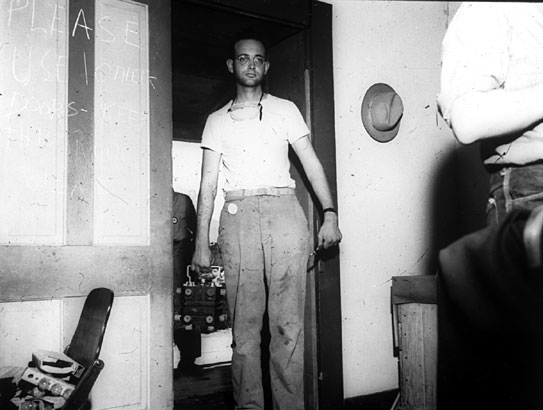
    After billions of work hours invested in the Absolutely Enormous project to build atomic weapons in WWII, much of it (for a short period of time, anyway) was balanced in the hand of Sergeant Herbert Lehr:

    Atomic bomb herbert Lehr
    This was the plutonium core (or in one caption, “half” of it), being transported by the sergeant, the plutonium housed in a shock-proof carrying device, passing through the door to the assembly area at  the George McDonald Ranch farmhouse. (The image first spotted by me in Richard Hewlett’s The New World, 1939/1946, Volume 1, a History of the United States Atomic Energy Commission, 1962.)

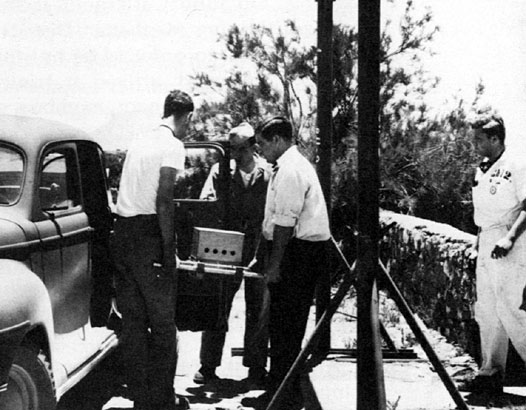
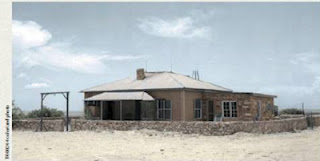
    Atomic bomb plutonium deliveryThe photo above shows the plutonium being delivered to the McDonald Ranch, carried from the Plymouth through the small wooden structure that we can clearly see in the color photo below, in which you can also see the short stone fence that surrounds (in a roughly 85’x85′ square) the compound.  The plutonium was then sent into the dining room, which had been converted into a clean room, where the device was assembled. 

    Atomic bomb macdonald
    (Source: Nuclear Weapons Journal, March-April 2003, p. 21, via the very interesting Diehard Empiricist site.)

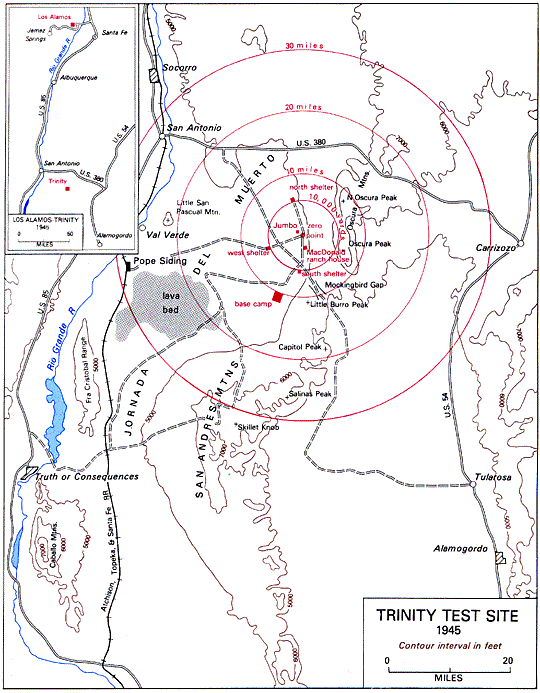
    The McDonald Ranch was right there at the heart of the Trinity Test Site, or nearly so (the explosion on 16 July 1945 being about two miles away, slightly damaging the structure), in the Llano Estacado.  This is a section of New Mexico and Texas  (the “Staked Plain”), which had for centuries been a ruthlessly mercy-free zones for people for centuries until it was conquered in the late 19th century–a hard and arid place where people disappeared.  Much of the Trinity Site was actually located in the Jornada del Muerto, or “Path of the Dead Man”, or more poetically, the “Dead Man’s Walk”.

    Trinity_small(Source:  Trinity Remembered site, here.)

    In any event, seeing the plutonium core taken out of a Plymouth and moved into a converted farmhouse and ultimately carried in one hand by a U.S. army sergeant into an assembly area that used to be a bedroom created an odd emotion, one that I’m still trying to identify, seeing the smallness of it all the result of enormous expenditures of energy and effort and brainpower over a thousand-day period all represented in the hand of one man.

    See also:  ALSOS:  Trinity Remembered, here  and Atomic Archive

    ·Posted by :

    ·in:

  • Golfography: a Map of Golf Around London, 1920

    JF Ptak Science Books   Quick Post

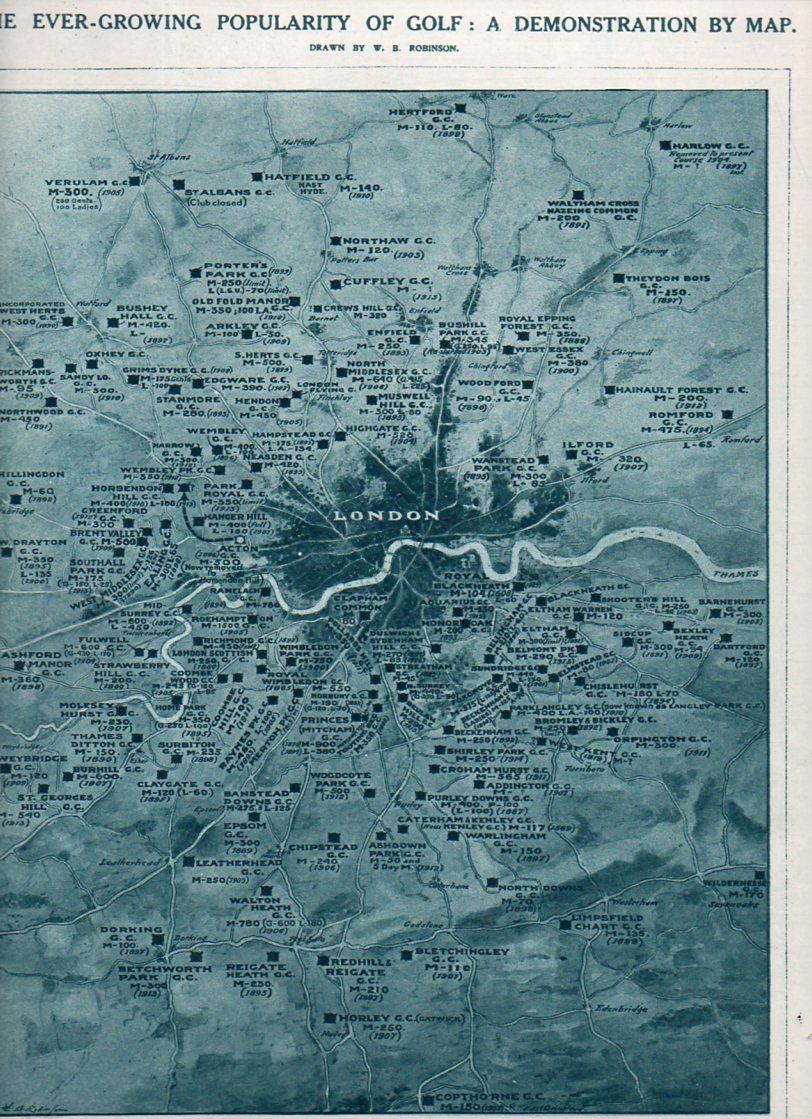
    I just happened upon this, but since it is the British Open and all I though to publish it here.  The map was composed for the Illustrated London News, 3 July 1920, by W.B. Robinson. It shows the number of links around the city of London–seems like a lot to me, and this data doesn’t even include miniature golf, which was very big at this time. The Key: M = a “membership” club; L = Ladies; A = “associate”, and the year underneath is the year the course was organized.  The game is evidently older in Scotland, but around London golf dates to the time of James I. 

    Golf730

  • Rainography: a Map of Rain in the British Isles, 1911

    JF Ptak Science Books  Quick Post

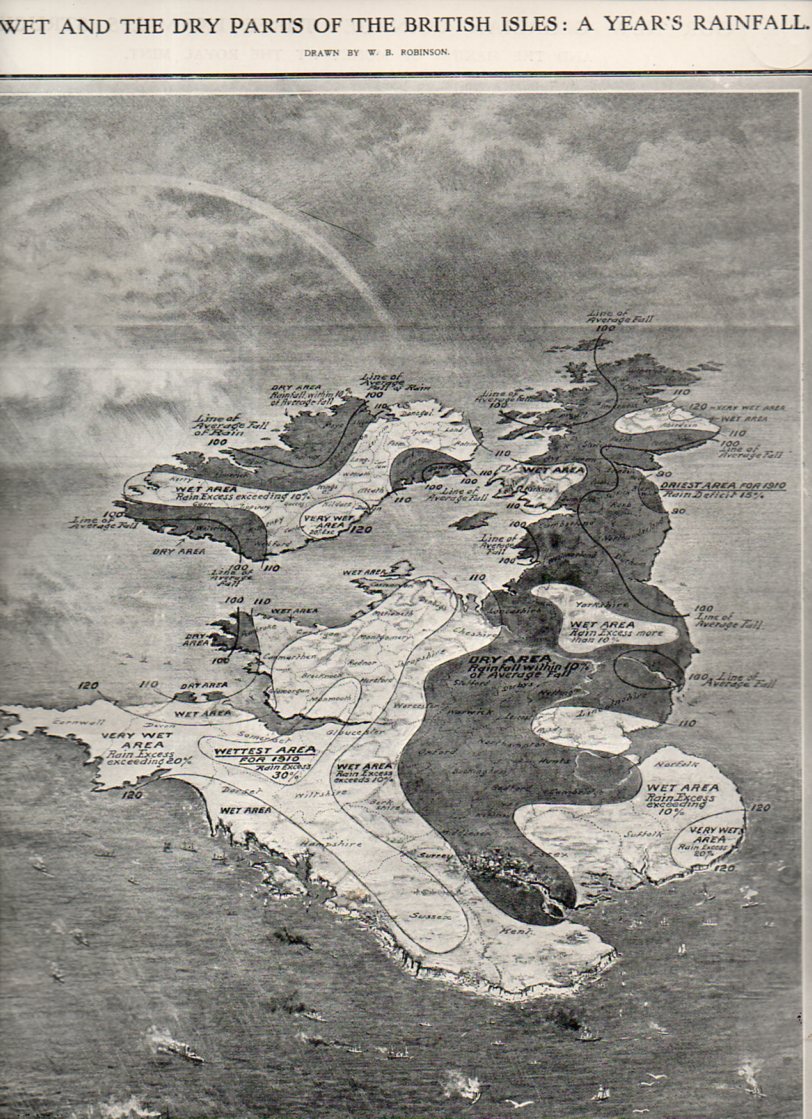
    “The Wet and the Dry Parts of the British Isles: a Year’s Rainfall” birdseye view appeared in the Illustrated London News on 28 January 1911, and it is a lovely and scarce example of a meteorological graphical display of quantitative data rolled into an oblique view.

    Rain731

  • A Masterwork of Graphic Display of Data: a History of U.S. State Populations, 1870

    JF Ptak Science Books  Post 1864

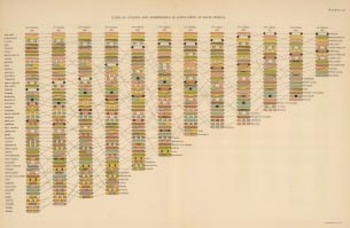
    Rank_states_1900 Though the U.S census has been completed decennially ever since 1790, the first census atlas wasn’t published until 1870. The issue wasn’t desire, of course—it was the time that it took for calculation, analysis and design that prevented them from having been published before this date. It was still a monumental task of producing an entire atlas of visual displays of quantitative data.
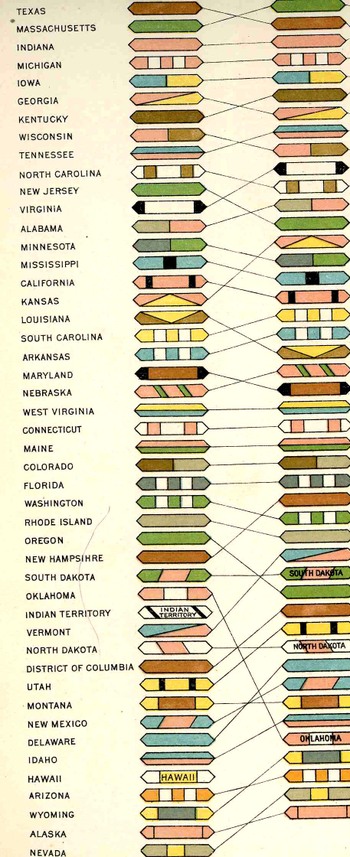
     The first atlas (produced under the direction of Francis Walker, who was the chief of the 1870 census) was printed in 1872, and was smaller, shorter and less graphically involved the later atlases, but it was the first, and it did present information in a way seldom seen before in the United States.  The first truly spectacular census atlas was produced twenty years later in 1890—it is elephant folio in size, and just a physically huge undertaking, and beautifully printed via chromolithography. It set the foundation for the two subsequent atlses of 1900 and 1920

    Blogaugust_24_statesd_detail442_2

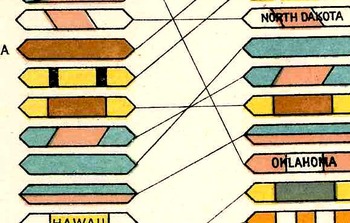
     The folding plate Rank of states and territories in population at each census (prepared under the supervision of Henry Gannett, Geographer of the Twelfth Census, printed at the Census Office in 1903 by Julius Bien & Co., N.Y.) from the 1900 census is nearly identical to the 1890 version, only it is about 1/4 of the size.  This graphic representation is remarkable because it displays and tracks a total of 348 data points (over time and ranking) using only eight colors.  (This atlas has been in my house a long time, and I’ve known about this plates forever, but I honestly never counted the colors–it is a surprise, really, to see that it was just eight colors being used in what seems like a dazzlingly different assembly of color.) The key was employing different shapes within the 6-sided polygon, making for the whole mass of objects and lines to be much more simply followed. Using more color rather than distinctive shapes-within-shapes would’ve made for a wall of color that would’ve been far less intuitively trackable.  This is just simply a fantastic achievement of data display–even if it takes a little while to train your eyes to become familiar with the geomertic shapes and sizes, it becomes quite easy to use.

    (Just for the record, the states in the United States at the beginning of each census over the first twelve censuses are:  1790, 14 states; 1800, 16; 1810, 17; 1820, 23; 1830, 24; 1840, 26; 1850, 31; 1860, 33; 1870, 37; 1880, 38; 1890, 44; 1900, 45.)

    For a complete display of the  1900 atlas, see HERE. 


    Blogaugust_24_statesd_detail_fine_d

  • New Page Announcement: Contemporary Abstracts of Einstein, 1905-1920

    I’ve established a new page (column at left) to accompany the other Einstein pages, this on abstracts and reviews of Einstein’s work (1905-1920) appearing in Science Abstracts (London, Institute for Electrical Engineers).


    ·Posted by :

    ·in:

  • Elvis Presley Childhood Literary Trail, 1948–a Signed Borrower’s Card

    JF Ptak Science Books   Quick Post

    Elvis detail

    I really do love these bits of unusual Americana, something from the early ages of iconic Americans that give a quick glimpse into an average day of a famous-someone way before they became who they became. 

    Elvis

    [Image from the American Heritage Auction Gallery, where the item is being auctioned, here.]

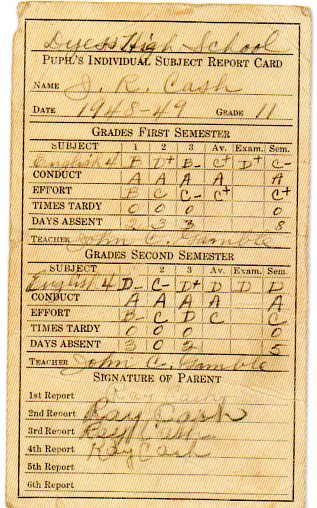
    [Elsewhere in this blog I wrote about what I learned from Johnny Cash’s report card (here) from just a year later, in 1949.]

    Johnny cash report card584

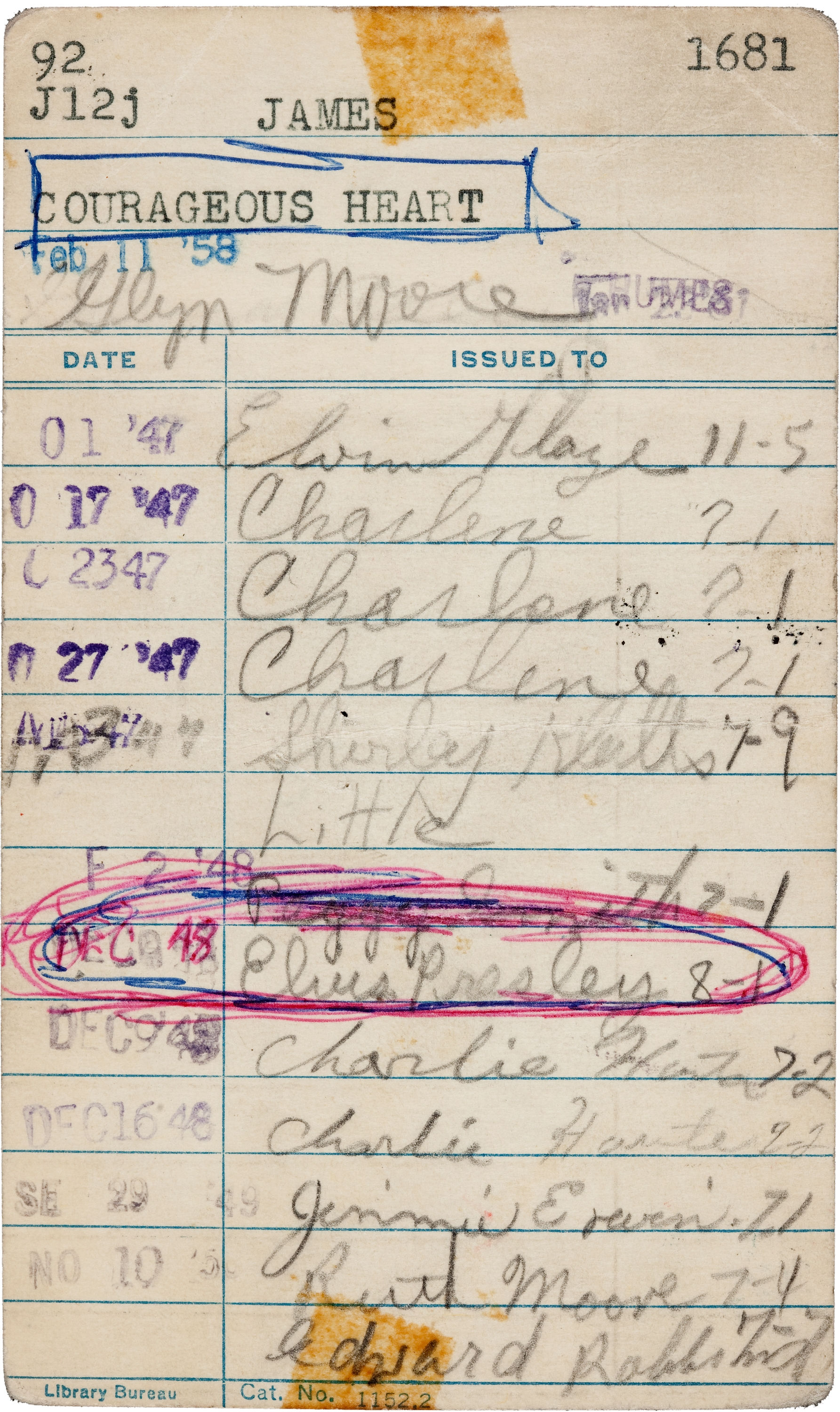
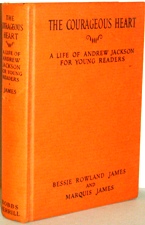
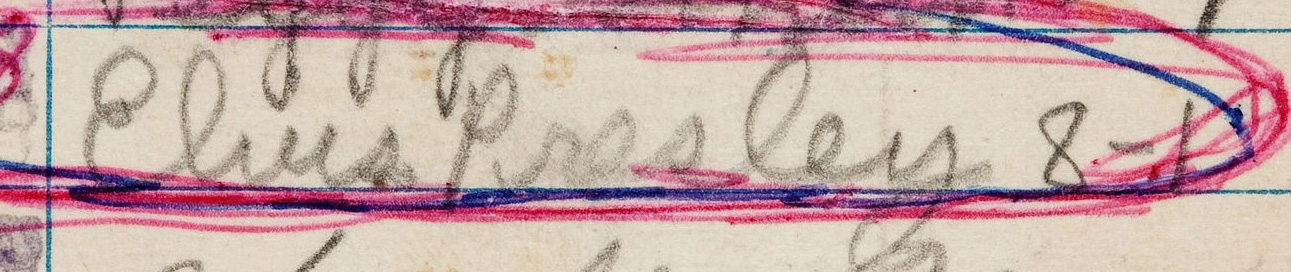
    Getting back to Elvis: this is a back-of-the-book-in-a-paper-pocket borrower’s card from a library book borrowed by Elvis Presley in 1948. The book–written by Bessie Rowland James (b. 1895)– was Courageous Heart, a Life of Andrew Jackson for Young Readers, and was published in 1934.  I guess it was appropriate reading,as the Presley family had just (September 12) moved from Tupelo into their new small apartment at 578 Poplar Avenue in Memphis, Tennessee–Jackson being a more-or-less Native Son (though other states claim him as well). 

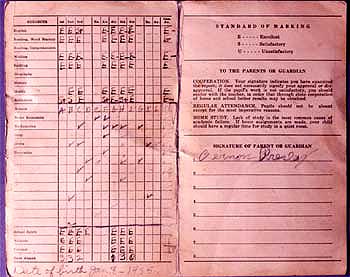
    To accompany the J.R. Cash report card is Elvis’ third grade card:

    Elvis report card[Source]

    Elvis courageous heart

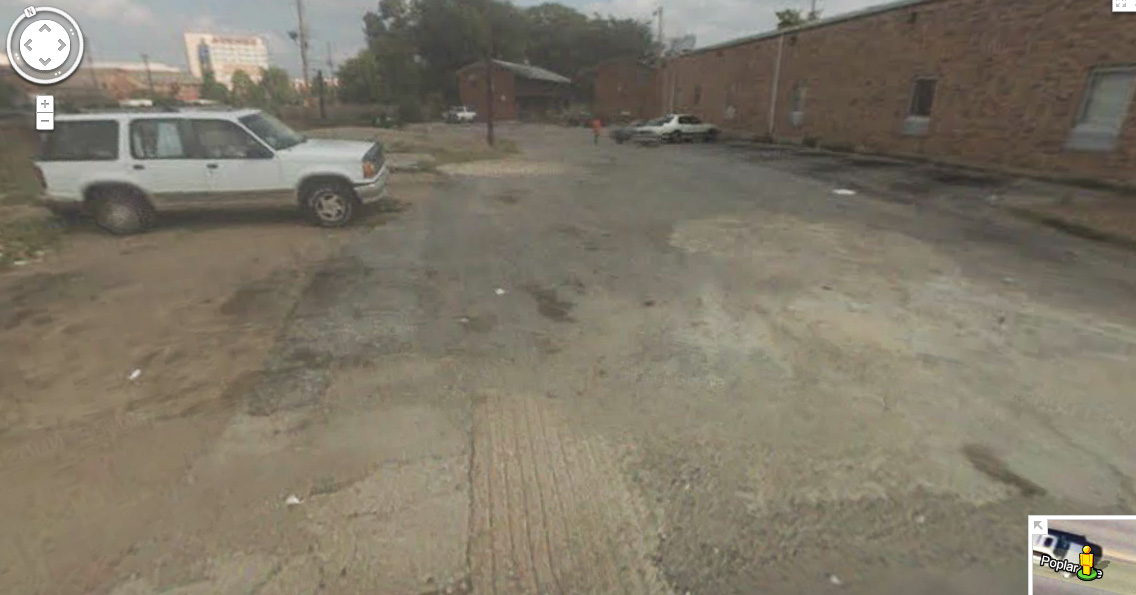
    As near as I can determine, this is 578 Poplar Street today:

    Elvis home_edited-1
    [Source: Google Maps]

    Elvis was enrolled at Christine School (formerly known as the Market Street School, and also as the Smith School)  on Third Street in Memphis to complete 8th grade the next day, September 13, 1948.  The school was demolished in 1948. The book evidently survived.

    ·Posted by :

    ·in:

  • Daily Dose from Dr. Odd: a Novel of a Worm-Conscious Pig

    JF Ptak Science Books   Quick Post

    [I just could not resist making a note of this book–sorry.]

    Pig story742
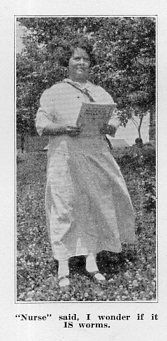
    Before there was Babe there were other pig stories, though not many I think with a bearing on pigs and worms. Or worms in pigs.  But that is the bent in this tall-and-slender volume, which I initially selected for three other reasons: (1) because of its odd cover (gilt-stamped “Sincerely Yours/Lenore Muth” rather than the title; (2) the caption to the portrait of the author (“‘Nurse” said I wonder if it IS worms’ “; and (3) the first line of the book  (“As a child I played with pigs”).  So the book had both everything and nothing going for it before I ever got to the content, which is indeed the story of a pig with worms. 

    ·Posted by :

    ·in:

  • Imaging Aliens 1859-1959, Part I: American Traders in Yokohama Bay, 1859

    JF Ptak Science Books    Post 1832

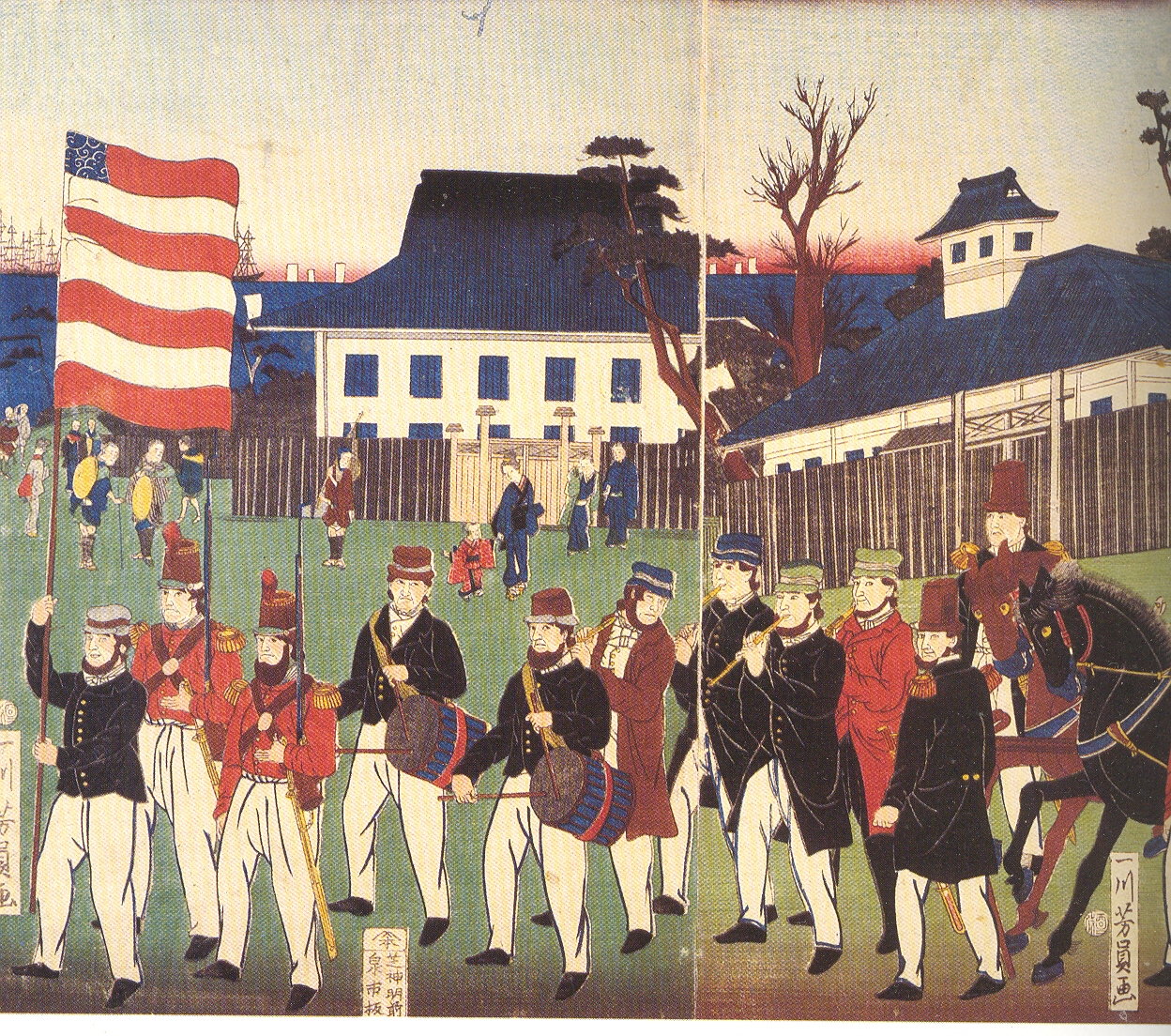
    Following hundreds of years of intrigue and shadowy majesty, of imagined life and legend, the Japanese finally allowed its transformation to take place, opening itself to trade and other permissibles with the rest of the world.  It was the beginning of massive cultural, industrial and scientific cross-fertilization, ending centuries of isolation and self-sustained empire–and which basically took six years to occur.  The change started with the efforts of the U.S. government and its liaison in Commodore Matthew Perry, establishing diplomatic and trade relations with Japan via Perry’s expedition there in 1853. By 1859* the transformation was very well underway, with Yokohama—as one of the major trading ports in Japan—being what former US

    Blog==July 5=flag

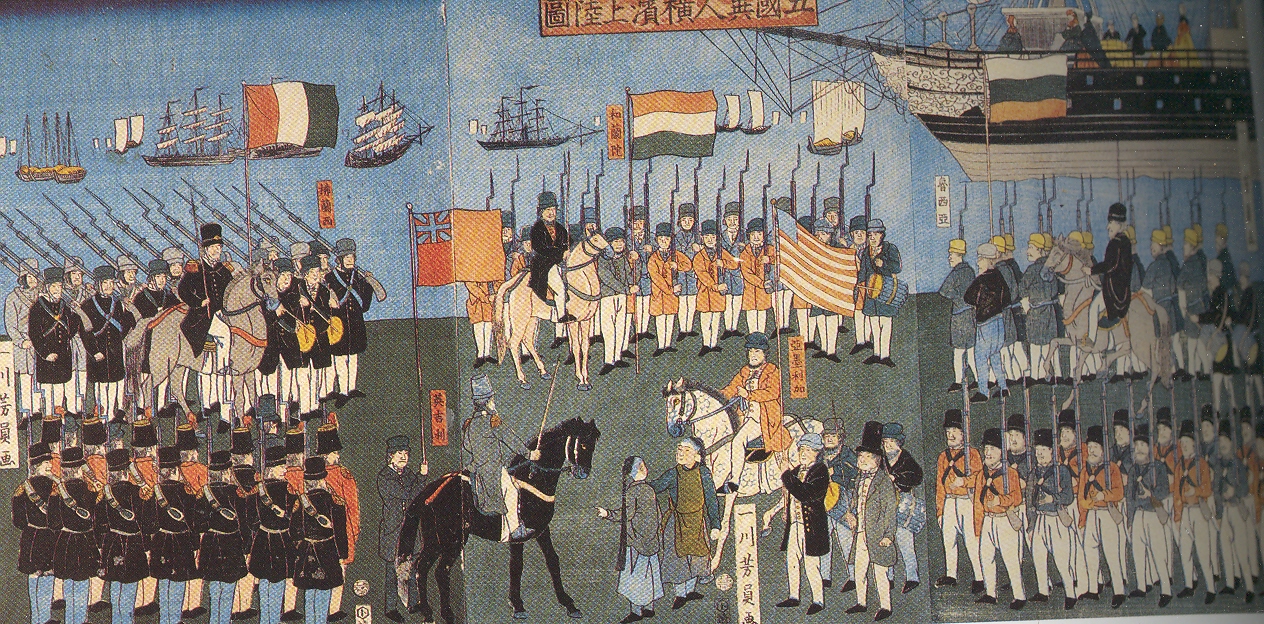
    Ambassador to Japan William Leonhart called “the microcosm of Japanese modernization”, and the port opened for trader with the foreigners.  Japanese artists responded to this influx of exceptionally different people with the Yokohama-e school of woodblock illustration—these artists were primarily from the Utagawa school, and worked illustrating the controlled invasion of their country for three decades, producing some 800 prints. Blog==July 5=flag4


    I like the idea of microcosms. Actually I like the detail within microcosms—sometimes, admittedly, the microcosms just don’t work, though their elements sometimes do. 


    The Yokohama-e school of  Japanese illustration was the pollination zone for the distribution of Japanese interpretations of these new cultures coming to their country.  They are a beautiful mix of the old (the very old) and the forces that were rubbing up against that antiquity, the old reacting to something brand new, images never seen before. 


    And in all of this beauty of newness, and all of the observations of never-before-seen rituals, and uniforms, and ships, and people, the thing that I have latched onto like a bad cold from a kindergartener is the American flag—and actually, the field of blue and the stars of the American flag.  For some reason the blue field is almost, always, tiny; and I’ve no idea why.  But I just love it—the flag looks big and billowy and alive, and it has that tiny blue space.   Blog==July 5=flag2


    *1859 was a very big year in the history of science:  it saw the publication of Darwin’s On the Origin of Species, and also the creation of Bunsen and Kirchhoff’s spectrum analysis.  A monumental year for the development of insight and vision.  


Recent Posts

Archives

Categories