A Daily History of Holes, Dots, Lines, Science, History, Math, Physics, Art, the Unintentional Absurd, Architecture, Maps, Data Visualization, Blank and Missing Things, and so on. |1.6 million words, 7500 images, 4.9 million hits| Press & appearances in The Times, Le Figaro, Mensa, The Economist, The Guardian, Discovery News, Slate, Le Monde, Sci American Blogs, Le Pont, and many other places… 5000+ total posts since 2008.

  • German Weimar-era Advert Artwork, 1923


    JF Ptak Science Books  Post 1857

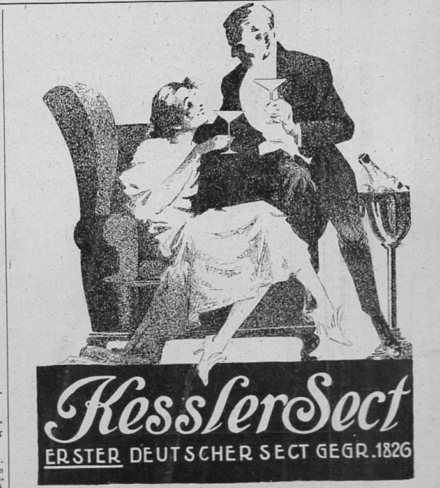
    The following ads appear in just three weekly issues of the LIFE-magazine-like Illustrirte Zeitung (Leipzig).  Generally the ads are crowded onto the 15-inch-tall pages–sometimes as many as 15 to a page.  Their design is remarkable, and artful, and effective.  Plus, they’re chock-a-block full of smaller design elements.  For example, this one is one of my favorites for this period:

    German B+W679

    I actually used it for the “Open” sign for my store back in Georgetown so many years ago oh my brothers.  That was before I discovered that it has a major problematic problem–it was designed by one of the greatest German designers of the time, Ludwig Hollwein, who also happened to be “a” (and then “the”) principle designer for propaganda/posters for the National Socialists, and that from the early period (1933) right on through the end of the war. 

    There was more to worry about than simply selling Germany’s oldest champagne, but of course many were immune to worry.  When this ad ran for Kessler champagne, hyperinflation had struck very deeply into thew Weimar Republic, with the U.S. dollar trading at 1:27,000 Marks. Even in January 1919 inflation wasn’t bad, with the dollar at 1:9 Marks (up from 1:5 in January 1918), but the simple tale of a long story is that the Weimar Republic kept printing money, and things got completely out of control, with the dollar trading in December of 1923 at 1:1.2 trillion Marks, which was a fertile seeding bed for National Socialism. 
    German B+W663

    This one is actually quite large, about a half-page, trying to sell the idea of the Reichenberger Zeitung to both the privileged and the working classes (the newspaper, which began in 1860, would not survive the Nazis, going belly-up in 1935):

    German B+W662

    Well, I don’t mean for this post to be very writer-y; I just wanted to post some of the images from these issues.  There’s really a lot to choose from, but these twenty or so will have to do for now: 

    This one is about an inch tall in the magazine:

    German B+W676

    Another tiny ad, this for a mechanical calculator:

    German B+W682

    ·Posted by :

    ·in:

    —
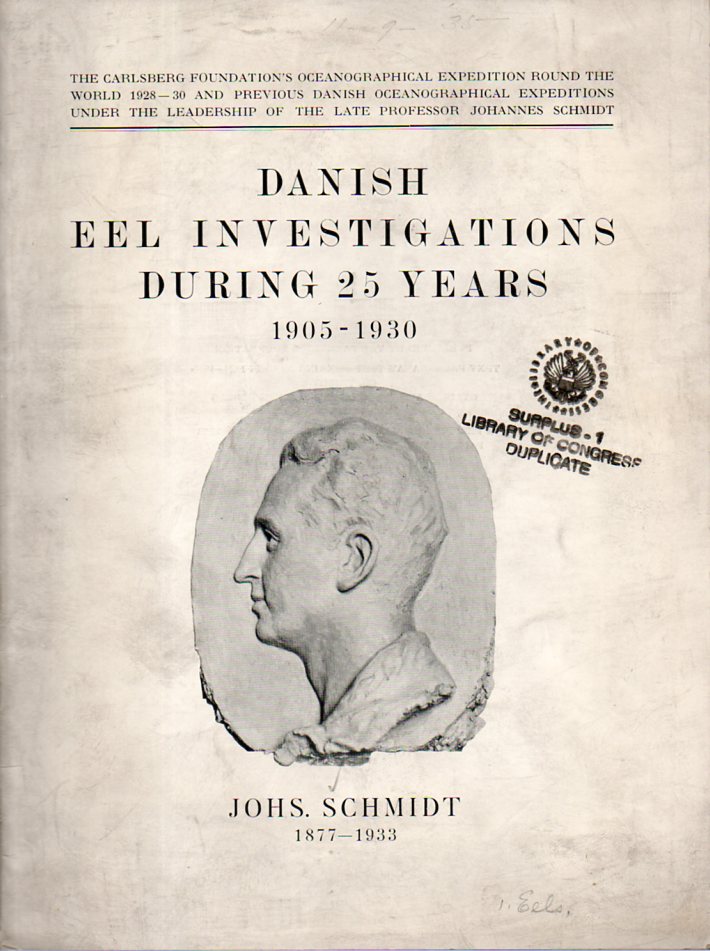
  • Daily Dose of Dr. Odd: Eels -with- an Eel Map

    JF Ptak Science Books   Quick Post   Part of the Daily Dose of Dr. Odd series

    Yes, this is totally out-of-context, but this title staring up at me from the bottom of a box was so unexpected that at first glance I thought it was in a European language of some sort.  Spacing and such.  But there it was, just a pamphlet on ill investigations for a 25 year period.  It is simply an odd thing, to my mind.

    Eel691

    ·Posted by :

    ·in:

  • Space-Time, 1885

    JF Ptak Science Books  Quick Post

    This remarkable letter, by an anonymous correspondent to Nature in 1885, simply signed “S”, is perhaps the first serious attempt to establish time as the fourth dimension.  That is, the first serious attempt in English, in an English scientific journal; the idea (according to A.M. Bork in his  “The fourth dimension in nineteenth-century physics.” Isis 55, 326, 1964) was already known in the late 18th century in the works of d’Alembert and Lagrance. (This is also pointed out by Paul J. Nahin in Time Machines, Springer Verlag (2nd edition), 1999.) Here it is:

    “Four-Dimensional Space”

    S.

    POSSIBLY the question, What is the fourth dimension? may admit of an indefinite number of answers. I prefer, therefore, in proposing to consider Time as a fourth dimension of our existence, to speak of it as a fourth dimension rather than the fourth dimension. Since this fourth dimension cannot be introduced into space, as commonly understood, we require a new kind of space for its existence, which we may call time-space. There is then no difficulty in conceiving the analogues in this new kind of space, of the things in ordinary space which are known as lines, areas, and solids. A straight line, by moving in any direction not in its own length, generates an area; if this area moves in any direction not in its own plane it generates a solid; but if this solid moves in any direction, it still generates a solid, and nothing more. The reason of this is that we have not supposed it to move in the fourth dimension. If the straight line moves in its own direction, it describes only a straight line; if the area moves in its own plane, it describes only an area; in each case, motion in the dimensions in which the thing exists, gives us only a thing of the same dimensions; and, in order to get a thing of higher dimensions, we must have motion in a new dimension. But, as the idea of motion is only applicable in space of three dimensions, we must replace it by another which is applicable in our fourth dimension of time. Such an idea is that of successive existence. We must, therefore, conceive that there is a new three-dimensional space for each successive instant of time; and, by picturing to ourselves the aggregate formed by the successive positions in time-space of a given solid during a given time, we shall get the idea of a four-dimensional solid, which may be called a sur-solid. It will assist us to get a clearer idea, if we consider a solid which is in a constant state of change, both of magnitude and position; and an example of a solid which satisfies this condition sufficiently well, is afforded by the body of each of us. Let any man picture to himself the aggregate of his own bodily forms from birth to the present time, and he will have a clear idea of a sur-solid in time-space.

    ·Posted by :

    ·in:

  • Outsider and Found-Dadaist Logic: Naive Captions and Text Illustrations, 1935

    JF Ptak Science Books   Post 1858

    Blogaugust_23_flaws437

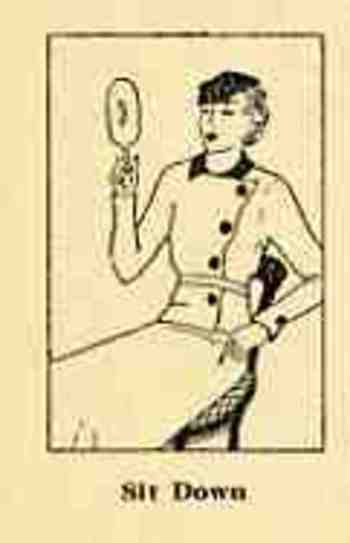
    This pamphlet (Are You Dressed Correctly?) comes from my extensive Naïve Surreal collection, which is composed of (a) pamphlets that were concerned with important ephemera in the past that today looks implausible  or impossible, and (b) pamphlets that addressed issues of, shall we say, a mostly-internal, very personal, High Imagination that may or may not have been part of the visual world or the imagined world of othersBlogaugust_24_flaws441_2.Kathleen Enright’s Are You Dressed Correctly? (1935) fits into category (a), mainly because the captions of the illustrations are  semi-devoid of connectivity with their illustrations, and in their simplicity are a bit of a challenge to make any association. That, or it is easy to disassociate image from caption and vice versa , making it easy for the images to slide right out of the book and stand on their own as some sort of self-educated Dadaist statement of simplicity. In this way they can almost form their own Alphabet of the Obvious. 

    Blogaugust_23_flaws435_3

    ·Posted by :

    ·in:

  • Reviewing Wells’ “The Time Machine”, June 1895, in NATURE

    JF Ptak Science Books   Post 1859

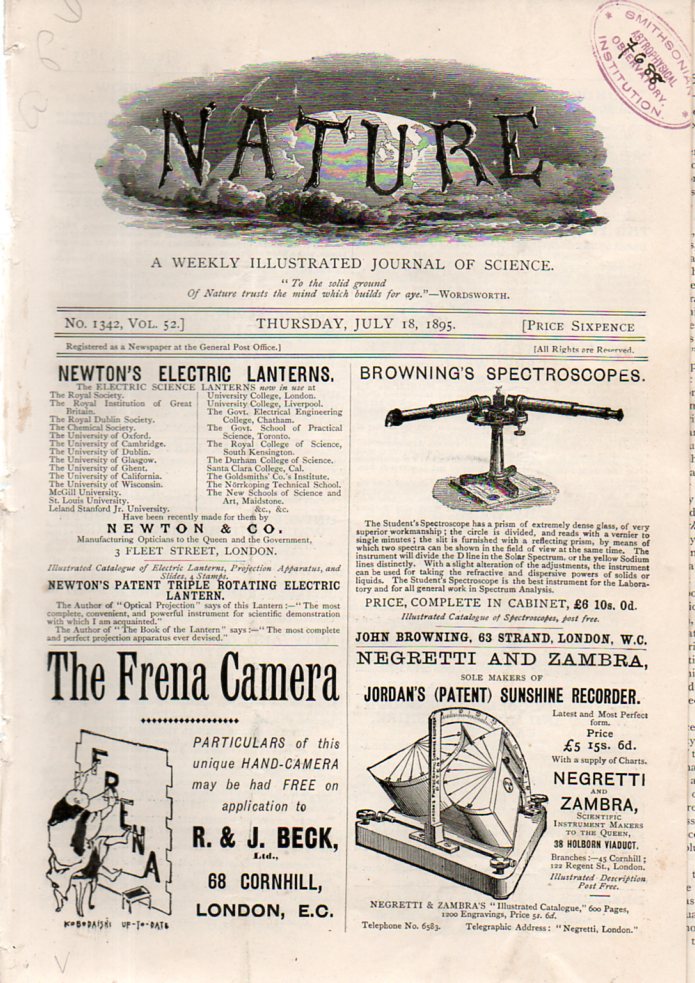
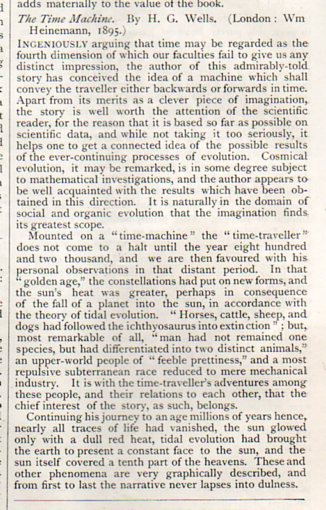
    Wells699I found this interesting 400-word bit in the 18 July 1895 issue of Nature (A Weekly Illustrated Journal of Science) and of course still very much alive and still a great publishing scientific powerhouse.  As Wells’ treatment of time as a fourth dimension was still quite speculative, and his creation of the time machine as we now came from his hands, and as its reception by some literary journals was not very cordial, it is particularly interesting to see the positive review from this science journal.  As reported by Paul J. Nahin in Time Machines, Time Travel in Physics, Metaphysics and Science Fiction (published by Springer Verlag in a second edition in 1999, a graceful book of splendid observations with an introduction by Kip Thorne, Cal Tech’s Feynman Professor of Theoretical Physics), Wells’ book was seen as “hocus pocus”  and a “fanciful and lively dream” by  The Spectator and “bizarre” by the Daily Chronicle.

    Nature’s editors says of the book:

    “…apart from its merits as a clever piece of imagination, the story is well worth the attention of the scientific reader, for the reason that it is based as far as possible on scientific data…”

    “It is naturally in he domain of social and organic evolution that the imagination finds its greatest scope.”

    “From first to last the narrative never lapses into dullness.”

    And so Wells–who had cleaned up and rewritten an earlier version of this book from 1888–received a happy review from one of the leading scientific magazines of the time. It is not because of a wide interest of Wells in the fourth dimension per se that Wells wrote the book, but rather in rattling Victorian sniffy conceits of his day. 

    Wells698
    *Time as the fourth dimension is a concept not much older than Well’s idea, one of the earliest publications of the idea appearing ten years earlier (and written anonymously by “S”) in Nature.  Charles Hinton, the person we most associate with the introduction of the fourth dimension  (or at least so on a popular level) didn’t really establish time as the fourth dimension. (Hinton led a colorful, or at least interesting life–he was a brilliant guy, and also a convicted bigamist who was married to George Boole’s daughter, and creator of an automatic baseball pitching machine. His books on the fourth dimension certainly were influential, and in the estimation of Florence was a contributor to the ideas of the coming modern art movements of the 1890-1910 period.)

    And there were certainly many who came before Wells on the subject of the fourth dimension (though not many on the subject of time as the fourth dimension):  R.C. Archibald wrote on d’Alembert’s (1754) use of time as a fourth dimension (in the Bulletin of the American Mathematical Society for May 1914); Cayley’s “Analytical Geometry of n-Dimensions (Cambridge Mathematical Journal, 1843);  Grassmann’s Die Lineale aus Dehnungslehre (1844); Riemann’s 1854 effort on curved space (translated in 1873 for Nature by W. Kingdom CLifford); Beltrami’s introduction of the pseudosphere in 1868;  J.J. Sylvester (again in Nature for 30 December 1869); Hermann von Helmholtz and his curvature for three-dimensional spaces; and Poincare’s work in 1900, among others.  There is a rich field of these efforts, beautifully investgated for the general reader by Linda Dalrmple Henderson in her classic The Fourth Dimension and Non-Euclidean Geometry in Modern Art (Princeton 1983). 

  • Frederick Soddy’s Economics and the Protocols of the Elders of Zion (1939)

    JF Ptak Science Books       Quick Post on Anti-Semitism & Propaganda

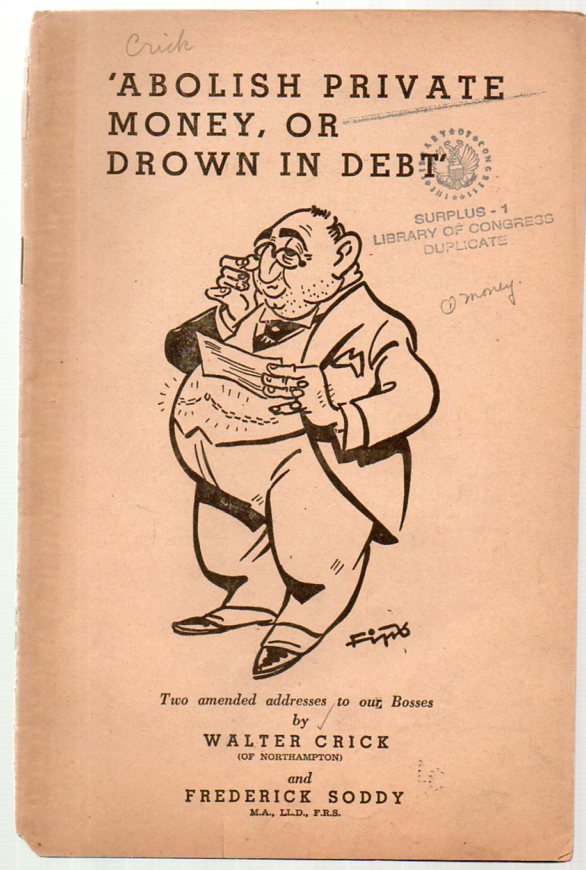
    Soddy700Frederick Soddy, Nobel Prize in chemistry (1921) and one of the fathers of nuclear fission, was also an economist.  Well, an anti-economist of high order, an anti-economist preaching anti-economics on the order of the altruistic anti-economy, ideal anti-economist, material- and Left- and Nationalist-economics, and so on.  He is the author, along with Walter Crick (who happens to be the uncle of Francis Crick of DNA fame), of a clumsily-titled pamplet-y takeoff of his major works on anti-economics, Abolish Private Money, or Drown in Debt (1939)  It was published by the Nationalist Press Association (147 E 116th Street, NYC), an arm of the American Nationalist Party, and which also published such works as Are all Jews Liars? (1940), The Jew and Peril and the Catholic Church (1936, also published by the American White Guard), Why are Jews Persecuted for their Religion (1940), and other titles.

    Soddy also quotes from The Protocols of the Elders of Zion, and did so five years after The Times ran a blistering and complete denunciation of the rabid anti-Semitic creation that seems resistant to contradictory evidence to its belief. And still he seems to have kept his belief in the document, like any other object demanding of belief and not-critical thinking, kept it alive like millions of others. 

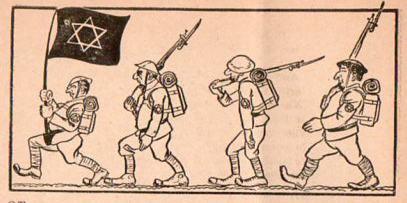
    I did not know this about Soddy, and I am sorry for it.  The cover illustration is disgraceful, though there is no place in the text that I have seen that is actually and outwardly anti-Semitic. The illustrations, however, are.

    Soddy701I really have no idea about what Soddy is talking about in his “scientific” and anti-economic theory that money and banks are the ruin of the way a country (and the world) conducts business.  Its structure brings immediately to mind–probably wrongly–the brilliant/odd/goofy contribution of T.E. Lawrence to the Encyclopedia Britannica on guerrilla warfare and his attempt to make a “science” of it.  But the overall flavor of the Soddy/Crick thing is not very good (and that leaving out the anti-Semitic part, which is something else, entirely)>.

    ·Posted by :

    ·in:

    —
  • Thomas Aquinas and the Inability of God to Change the Future, and All That

    JF Ptak Sciene Books   Post 1860      (A Thinking-out-Loud Note)                                         Part of the series The History of the Future

    “It seems to me, then , that time is merely an extension, though of what it is an extension I do not know. I begin to wonder whether it is an extension of the mind itself.” St. Augustine, Confessions, (26:33)

    In Paul Nahin’sTime Machines, Time Travel in Physics, Metaphysics, and Science Fiction (Springer Verlag, 1999), the author Paul Nahin makes a good case for St. Thomas Aquinas (1225-1275 or so) being a very early questioner of the concept of time travel (on pages 161-162).  In the Summa Theologica it does seem to me that Aquinas does indeed talk this way, if relating his comments to the ability of God to make changes in the past, present and future.

    Hence all things that are in time are present to God from eternity, not only because He has the types of things present within Him, as some say; but because His glance is carried from eternity over all things as they are in their presentiality. Hence it is manifest that contingent things are infallibly known by God, inasmuch as they are subject to the divine sight in their presentiality; yet they are future contingent things in relation to their own causes.1 Summa Theologia, reference below, source here.

    It seems as though it is possible for God to make changes in the past and present, but the future is another matter, and an area in which even the creator cannot bring about change.  He seems to say that God can cause things to exist or not in the present and the past, but not in the future:

    Whereas when we say he will be, we do not as yet suppose anything. Hence, since the existence and non-existence of an angel considered absolutely is subject to the divine power, God can make the existence of an angel not future; but He cannot cause him not to be while he is, or not to have been, after he has been.2

    I honestly do not know without doing some research how this sort of thought would have been received by other theologians, where the practices of God are omnipotent and unrestricted. For God not to be able to alter the future limits the logic of God’s actions, and seems to establish a limit in general to a limitless idea. 

    Perhaps Aquinas is a very early version on the assault of the completeness of the perfect creation of God’s universe, something that would be put to the test in the scientific discoveries of the coming centuries.  For example, with Galileo discovering that the night sky was hardly complete and perfect as had been thought, viewing nearly an order of magnitude more stars with his telescope than had (of course) never been seen before. Suddenly, the unchanging sky of the great creation was hardly so, and that it was far more vast than had ever been shown.  Same too with the creation of a vacuum by  Otto von Guericke with his experiment’s results published in his  Experiemnta nova (ut vocantur) Magdeburgica de vacuo spatio (Amsterdam, 1672, and which I wrote about here), something that assaulted the speculation that God could not create nothing, that the existence of a perfect nothingness was not possible. 

     Notes below:

  • GEAR-PUNK: German Technical Advertising Art, 1920’s

    JF Ptak Science Books    Quick Post  [Part of a series on German Design]

    German tech art715

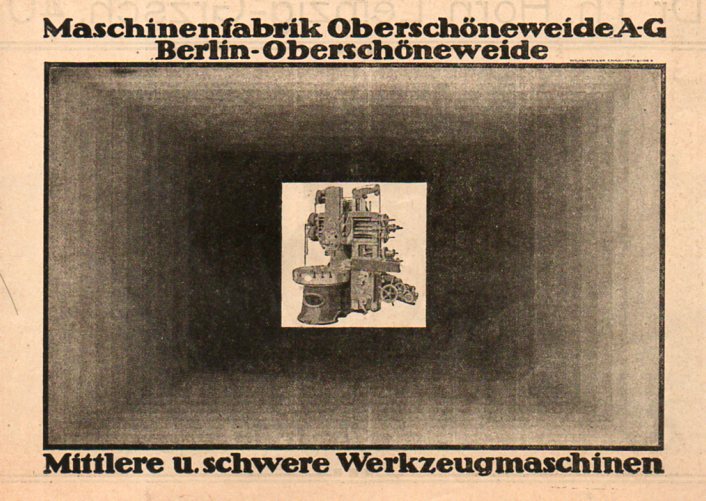
    Two odd pieces of German technical literature stared up at me from the bottom of a box of such things, both of which contained excellent examples of advertising technical art in addition to their technical content. But it just so happens that in this case the artwork that helped pay for the publication of the previously interesting and important technical and scientific information is of more interest now than the information wrapped around the ads. The sources of these images include the Festschrift zum Hundertjahringen Bestechen der Zeitschrift of the Dinglers polytechnisches Journal (1920), and Wirtschafliche Technik…Organ des Bundes Detscher Civil-Ingenieurre (1920).  Somehow the ads retain a certian light touch in the midst of their occasionally massive heaviness.  Or perhaps it is just robustness, solidity?  If nothing else there are an artistic anti-approach to what was going on in the world of art, the opposite of the disappearance of concrete or natural forms and replacing them with ideas and colors. 

    German tech art702Again, these are just two slim issues of rather obscure journals.  I’ll add to this collection in the German Design section as they come up. 

    German tech art706

  • Statistics as “Stutterings”; Dickens on People-Reduced-to-Numbers

    JF Ptak Science Books   Quick Post

    I found this in the Alex Cashman’s lovely site, Mathematical Fiction (here). The except is from Charles Dicken’s Hard Times (1854)1, and in it we see Dickens making another in a long series of assaults on what he thought to be a disturbed social layering of dealing with the underclasses and the working poor.–and this time in the form of an entire novel. In the instance sited below (of interest right now because of its maths connection),  Dickens makes a case  for the”success” for the government of the fictitious city of Coketown to see a relatively small percentage of people in that city starving to death on its streets to be not a success at all. The character making the complaint is Sissy Jupe, whose fault at school came when asked the percentage of the starving/dying responded by saying it really didn’t matter, because people were starving anyway, and whether it was one or a thousand dying from something as fixable as hunger meant all the same thing. She was presented with the “statistics”2 from her teacher, but to Ms. Jupe it came to her ear as “stutterings”, which is what Dickens felt the numbers were.  Dickens was attempting to make those people suffering in the streets less blank, less hollow, and more than a number.

    Notes:

    1.  It should be pointed out here that this is Dickens’ 10th novel, the 42-year-old already having a enormous success with his writing and an even grater one in his storytelling. To this date, Dickens had already written The Posthumous Papers of the Pickwick Club (Monthly serial, April 1836 to November 1837; The Adventures of Oliver Twist (Monthly serial in Bentley’s Miscellany, February 1837 to April 1839); The Life and Adventures of Nicholas Nickleby (Monthly serial, April 1838 to October 1839); The Old Curiosity Shop (Weekly serial in Master Humphrey’s Clock, 25 April 1840, to 6 February 1841);  Barnaby Rudge: A Tale of the Riots of ‘Eighty (Weekly serial in Master Humphrey’s Clock, 13 February 1841, to 27 November 1841); A Christmas Carol (1843);The Chimes (1844);  The Cricket on the Hearth (1845); The Battle of Life (1846);The Haunted Man and the Ghost’s Bargain (1848); The Life and Adventures of Martin Chuzzlewit (Monthly serial, January 1843 to July 1844);  Dombey and Son (Monthly serial, October 1846 to April 1848);David Copperfield (Monthly serial, May 1849 to November 1850); and Bleak House (Monthly serial, March 1852 to September 1853).  Remarkable.

    2. “Statistics” as a word has been in use for a long time, finding air as early as 1787, at least so far as the sense in which it is used here. There are earlier references, but they actually refer to the “state”, as in “statecraft” and government and such, and not for interpreting a collection of data.

    The selection from Dickens below:

    ·Posted by :

    ·in:

    —
  • Trinity+67 Years: the Explosion of the First Atomic Bomb, Alamogordo, New Mexico, 1945

    JF Ptak Science Books

    I’m listing a few links to some posts that I’ve done on the first and successful test of the atomic bomb in the Alamogordo Desert, July 16, 1945.  They are also part of a much larger (75+ posts) series on the history of nuclear weapons, found here. (This series also includes posts on social/popular aspects of the bomb and atomic energy.)

    • Trinity + 64 Years: the Explosion of the World’s First Atomic Bomb, Alamogordo, New Mexico, 1945 (here)

    • Atomic Bomb–Historic American Building Survey, Trinity Site (here)

    • Atomic Bomb Chronology (here)

    Oppenheimer_groves_090945

     Trinity Shot, 1945, Video via the Department of Defense, located at the Internet Archive, here.

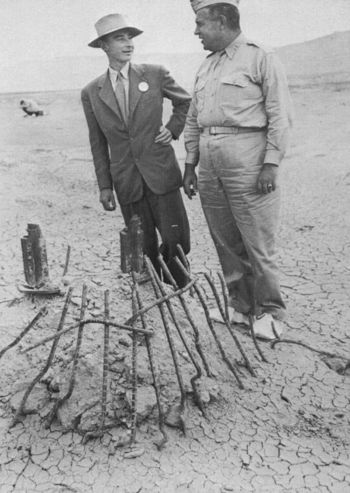
    [Pictured left are Robert Oppenheimer in his porkpie hat, in an odd leaning-away attitude towards General Leslie Groves–the two were largely responsible for the creation of the bomb.  They are picture in the desert at what was left of one of the tower foundations that held the bomb, suspended as ti was from the top of the structure.  Groves I must say has taken a lot of grief for his role, but I’ve got to say that the bomb may well have never been completed in such short order without him.]

    ·Posted by :

    ·in:

  • Great Books & their Titles: Galileo’s “Sidereus Nuncius”, 1610

    JF Ptak Science Books   Quick Post

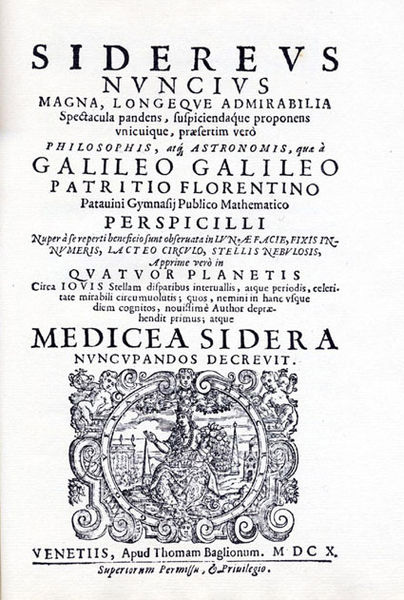
    By 1610 Galileo had produced his fifth and most powerful telescope, allowing things to be seen one thousand times closer than ever before, using it to make enormous discoveries–discoveries so big in fact that their towering significance is a bit hard to understand today in the context of early 17th century knowledge. It was all published in his fantastic Sidereus Nuncius on March 4, 1610—the extraordinary tale told in the very title page of the book, proclaiming some of the great discoveries of Galileo’s adventure.

    One monumental outcome of Galileo’s work was expanding the number of stars in the sky, which was basically mucking around with the perfect plan of the Creator–formerly a cornerstone for the existence of a divine being.  With the exception of comets and eclipses the sky had remained immutable, a perfect score of the creator’s creation, until 1572, when Tycho Brahe noticed something new in Cassiopeia, something that was not a comet—a “something” that was a star. This was momentous because the night sky had been seen for centuries as being complete—a new star, the Nova of Brahe, contradicted this high belief, offering the possibilities of newness where there had not been one previously.  And so too with Kepler’s new star of 1602. But it is with Galileo that all of this newness really finds a firm footing, challenges to the religious basis for belief in the heavens and all, not to mention the great amount of new scientific data presented in the pages of Sidereus Nuncius–it was the first time any scientific data had been published that was collected through the use of a telescope, and pictured such extraordinary things as the mountainous surface of the Moon, a view of our Milky Way, several moons of Jupiter, and other fantastic wonders. 

    The very full title page reads: The Starry Messenger, great and very wonderful spectacles, and offering them to the consideration of every one, but especially of philosophers and astronomers; which have been observed by Galileo Galilei … by the assistance of a perspective glass lately invented by him; namely, in the face of the moon, in innumerable fixed stars in the milky-way, in nebulous stars, but especially in four planets which revolve round Jupiter at different intervals and periods with a wonderful celerity.

    Galileo siderus[Galileo Galilei. Sidereus Nuncius (known in English as Starry Messenger), published 1610.]

    ·Posted by :

    ·in:

Recent Posts

Archives

Categories