A Daily History of Holes, Dots, Lines, Science, History, Math, Physics, Art, the Unintentional Absurd, Architecture, Maps, Data Visualization, Blank and Missing Things, and so on. |1.6 million words, 7500 images, 4.9 million hits| Press & appearances in The Times, Le Figaro, Mensa, The Economist, The Guardian, Discovery News, Slate, Le Monde, Sci American Blogs, Le Pont, and many other places… 5000+ total posts since 2008.

  • Letters of Warning: Einstein and Szilard on the Atomic Bomb, 1939-1945

    Einstein’s Letters of 1939 and 1945 and Szilard’s Petition of 1945

    There were certainly a number of cautionary flags waved at the Executive Branch in the period just before the atomic bomb was first used against a Japanese target.  As I wrote in an earlier post here, Dwight Eisenhower was adamantly opposed to the use of the bomb on a city, preferring an example to be made of the thing on an unpopulated area; in his memoirs, General Spaatz (who had received the only written communication authorizing the use of the bomb) was privately against using the weapon on a city. As early as 1939 Albert Einstein famously communicated with Franklin Roosevelt his concerns on the possibility of the terrifying nature of a bomb produced by his early efforts and those of Fermi and Szilard and many others.  In all Einstein wrote four letters to the President, the first part of the first letter is shown below:

  • A Half-Alphabet of Color by Isaac Newton, and What the Colors “Naked” and “Dead” Are (1659)

    JF Science Books   Post 1880 


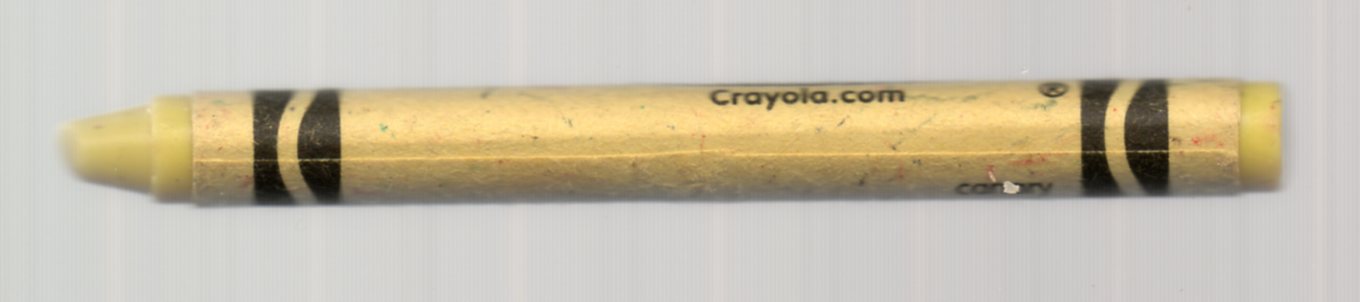
    Crsyon dead

    All material quoted below is from the magnificent The Newton Project website, which contains transcriptions of Newton’s writing in science, alchemy and religion, and also contains much correspondence. 

    There isn’t quite a complete alphabet here, but I think it is close enough, and it does organize (for my mind) some early thinking on color-making by Isaac Newton (1642-1727) when he as 17 years old.  There’s much of interest on the construction of color here, not the least of which is some prosaic methods for coloring dead people and a general color for clouds.  Things would get more involved, of course, as Sir Isaac would later write perhaps the most important books ever written on optics (in 1704).

    After the half-alphabet there is an installment of Newton’s mechanisms of art, containing instructions on the instruments of drawing, and how to do emblem work, prepare bases, how to shadow, how to enlarge and copy work, how to draw a landscape, and more.

    But first, here’s his list of how to make color.

    How to prepare your colours
    Such colours as have need of grinding you must grind them with faire water, then put them on a smoth chalk stone, & let them dry. then grind them againe with Gum water & reserve them in muscle shels for your use.

    B is for Blood

    A blood red colour.
    Sinaper, lake, & vermillion make a good red.

    Another
    Take blew Inde & steepe it in water & put to it a little Verditer.

    Another
    Take some of the clearest blood of a sheepe & put it into a bladder & with a needle prick holes in thebottom of it then  <6r>  hang it up to dry in the sunne; & disolve it {i}n allum water according as you have need.

    Charecole black & seacole black
    Grind charcole very small with water, let it dry then grind it with oyle. thus make seacole black.

    ·Posted by :

    ·in:

    — —
  • A History of Nothing: Creating a Creation Myth. On Hoaxes.

    JF Ptak Science Books  Post 1881  [Part of the series on The History of Blank, Empty and Missing Things.]

    The history of hoaxes is a long one–especially the history of the intentional host.  There have been creations like the farcical report on the Nacirem Tribe of North America (in 1956, by H. Miner, who simply spelled “America” backwards and loaded his tribe up with all sorts of geegaws), the Piltdown Man, the chess-playing “The Turk” automaton (by Wolfgang v. Kempelen in 1770), the fabulous Moon Hoax of 1836, the Cardiff Giant, Piltdown Man, and so on. Some were done for fun and amusement (like the Moon Hoax), some were perpetuated to prove a point (like Alan Sokol’s quantum gravity nonsense paper published as a rub against Jacques-Derridon’t and triblings), and some were scientifically vicious (like Piltdown). There are others that are larger than themselves, started perhaps as a hoax but then turned mysitcally into a belief system like, say Scientology (though its possible to make a case for this with most any other such thought-organization system). Some of course weren’t intended to be hoaxes when they began but remain intact even after their great shortcomings and displayed ill-logic have survived in the face of scientific refutation and common sense–like astrology. 

    Then there are complications, like Constantine Samuel Rafinesque (1783-1840) and the Lenape Indian creation myth. 

    It is uncertain whether this autodidact genius intended to fabricate his description of the creation myth, or whether he pieced bits and pieces together in a busy schedule that semed as though they were correct, or whether he was just getting stuff wrong.  It seems that, at the least, the drawings he conveyed as part of the story were all entirely his, and they may or may not have been derived from something that was ancient and real-enough.  In any event, all of what Rafinesque wrote was his fiction that may have been pulled together from other pieces of mythology (or not) rather than a scientific treatise.

    It is interesting to think of perpetuating a hoax whose result is a fabrication of an entire people’s belief system–basically constructing a religion from the ground-up. 

    Mark Hofmann, a convicted multiple cold-blooded killer psychopath serving a life sentence in Utah for bombing people to bits while trying to camouflage his deteriorating forgery empire, very nearly went the last mile to write the missing section of the Book of Mormon.  His great specialty was Mormon history, and he had been successful for several years in convincing the leaders of the Church of Latter Day Saints that his forged documents were the real thing, many of which put the church in an unpleasant light, and so he managed to create a ready market for his uncomfortable creations. In the meantime for the documents that did surface in public he actually managed to change the debate in the church community about its basis in belief–which is an extraordinary and foul commission. 

    It is not possible to say what was in Rafinesque’s head when he committed his own story of creation to paper. 

    I’m including it below as an interesting story, because, well, it reads well.

    The Walam Olum (or “Red Score”, also spelled Walum Olum, Wallum Olam, and several other ways.) of the Lenape.

    (“This Creation and Deluge story of the Lenape or Delaware Indians is taken from Dr. Daniel G. Brinton’s The Lenape and Their Legends (The Library of Aboriginal American Literature, Vol. V, 1885). Since  “walam” means “painted,” particularly “painted red,” and “olum” signifies the scores or marks or notches or figures used on tally-sticks or record-boards, the sense of Walam Olum is variously rendered by “Red Score” (Dr. Brinton’s choice), “Painted-engraved Tradition” (the translation left by Constantine Rafinesque, original copyist of these  Algonkin pictographs), or “Painted Bark-Record.” The pictographs or glyphs or signs were “notches” designed to keep the long chant in  memory.”

    The very beautiful translation is Dr. Brinton’s”–quote and text from the Sacred Texts of the World site, here.) 


    1. At first,   in that place, at all times, above the earth,


    2. On the   earth, [was] an extended fog, and there the great Manito was.

  • A Partial Alphabet of Thai Onomatopoeia–Words for Usually-Unusual Noises

    JF Ptak Science Books   Post 1882 

     [‘Joom’]–Sound of a pebble being thrown in a pond

    [“Seet’]–Sound of someone eating something very spicy

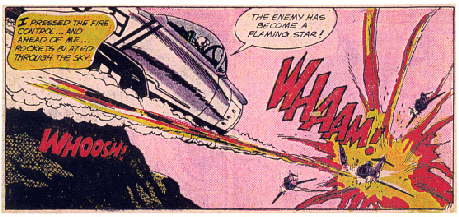
    I’m not sure that the idea of phonoaesthetics comes into play with the concept of onomotopeia–perhaps they’re mutually exclusive. Or inclusive?  Does cacophony fight euphony in lists of words that are composed to sound like the thing they represent? Or perhaps it is a given quality of this state that some of these words must sound cacophonus–“zok”, “thak”, or even “ptak” (which I saw in an issue of Sgt. Rock in the mid ’60’s as the sound bullets make when they strike a wooden dock)–simply because of what they represent, and must be so. 

    Then of course there’s the issue of onomatopoeia that look like or presented like the sound they are describing. For example, the word “Whaam” that appeared in comic book and which was famously derived as art by Roy Lichtenstein.  File:Roy Lichtenstein Whamm Original and Lichtenstein Derivative.gif

    When researching this I came upon cross-cultural examples of onomatopoeia–big an diwde and beautiufl and very far-ranging. It is a rich literature, and the examples are varied and deep. TO display an example I chose a list of  of Thai onomatopoeia, all of which have been collected by the author of  Weird Vibrations, who collected  these many fine examples one-by-one and for whose work in this and other areas I deeply enjoy and appreciate. I include them below in an odd alphabet of oddness–all that I’ve done here is separate them into a handy assembly, but let’s make sure that all of the credit of collection and transliteration belongs entirely to Weird Vibrations.

    For example:  “[Seet]  Sound of someone eating something very spicy” is a curious word, mainly because I’m not sure what this might  like unless “seet” is a quick ontake of breath.  “Joom” is a lovely word, and it really does sound like a pebble striking a pond surface.  Here are the others:

    Thai Onomatopoeia (alphabetized to the English-language action rather than the Thai transliteration).  Try sounding them out–many sound like their sounds, which might give a little credence to Mr. John Locke’s theory of knowledge (or not).

    A

    [Gra It Gra Eeuan]  To delay action through words

    B

     [Guy] Sound of someone bragging

    [Krok Kraak]  Sound of fluid bubbling in the stomach

    C

    [Gra Jaawng Angaae]  Sound of children crying annoyingly

    [Khaak]  Sound of coughing something up

  • A History of Blank, Empty and Missing Things: The Skin of Reinforced Concrete

    JF Ptak Science Books   Quick Post    An addition to in the post The History of Blank, Empty and Missing Things:  Stone and Wood.

    Arch  reinforced concrete648
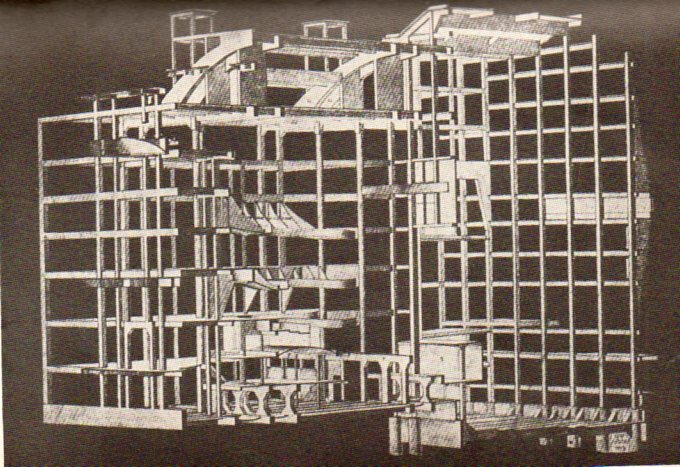
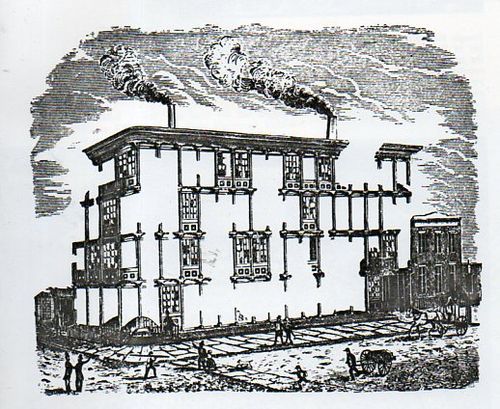
    Auguste Perret, a modern master in the use and adaptation of reinforced concrete, drew this fantastic skeleton representation of his “Theatre des Champs Elysees” (1913)–it was the great stuff that held the building together, minus the walls and everything else that makes a building a building, and a revolutionary approach in modern construction.  It reminds me strongly of this image

    Ogardus335
    which is a  remarkable illustration of the strength of the new approach to materials in architecture–cast iron–from a 16-page pamphlet by the inventor, architect and cast iron pioneer James Bogardus (1800-1874, Cast Iron Buildings, their Construction and Advantages, 1856 and 1858 second edition).

    The history of concrete in itself is pretty interesting and of tremendous antiquity, dating as a very useful and extraordinarily sound material at least to the Roman times.  The Peter Greenaway love affair (in his film “The Belly of an Architect”) with Agrippa’s Pantheon is one of concrete–the building stands today still of course, made of concrete, its dome still the largest un-reinforced concrete dome in the world. 

    And the Perret, complete:
  • The 1877, 38-Star Flag Displayed for Independence Day

    Flag 38 star

    That’s a big one, 12’x8′ or so. It’s beautiful. 

    This is the 20th (of 27) differently-starred American flags,gaining a 38th star after Colorado was admitted as a state on 1 August 1876. The 38-star flag became the official flag of the United States on 4 July, 1877, and stayed this way until 1889, when the 43-star flag replaced it. (This flag added stars for the admissions of five states: North Dakota (2 November 1889), South Dakota (2 November 1889), Montana (8 November 1889), Washington (not-D.C., 11 November 1889), and Idaho (3 July 1890).

    There were five Presidents who served under the 38-star:   Rutherford B. Hayes (1877-1881), James A. Garfield (1881), Chester A. Arthur (1881-1885), Grover Cleveland (1885-1889), and Benjamin Harrison (1889-1893).

    .

    ·Posted by :

    ·in:

  • Air-Punk: Underwater Cyborg Diving Suit (1797)

    JF Ptak Science Books   Post 1853

    Diving bell horizontal656

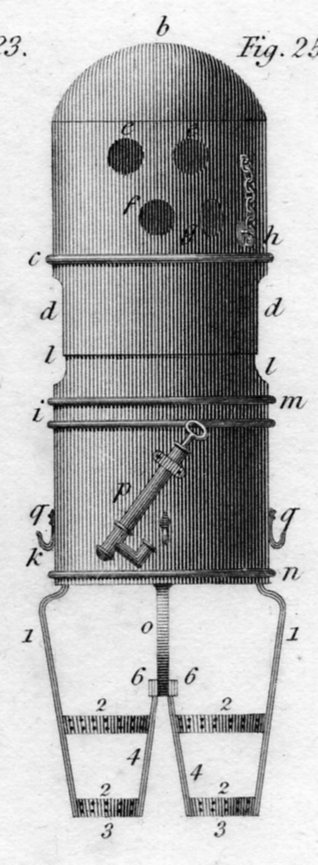
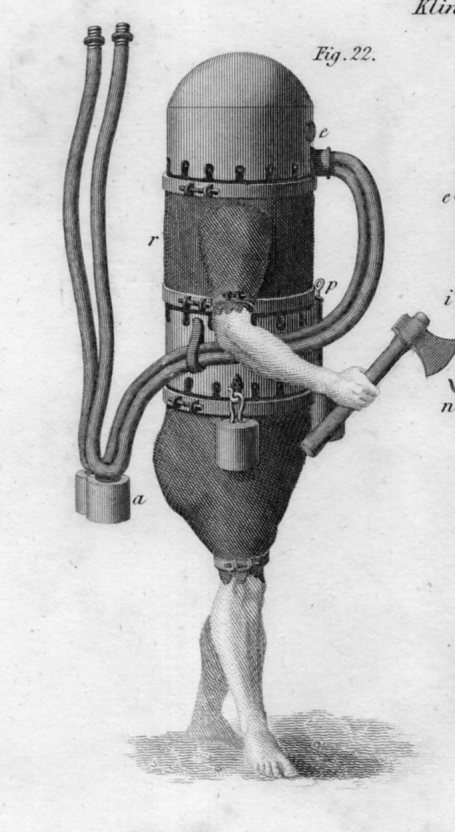
    Well, not really. It is however an early diving suit (and perhaps the earliest apparatus worn on the person and submerged) the creative and comparatively lightweight effort of Karl Heinrich Klingert, who produced it at the very end of the 18th century, in 1797 or thereabouts.  The suit was made of a metal helmet and wide metal girdle, with the vest and pants made of a waterproof leather, and with leather (?) leg straps.  The air would be pumped down to the diver from a turret above (see below, just) and would arrive in the diver’s helmet via weighted air tubes. 

    Here’s a side and occupied view:

    Diving bell horizontal654

  • Daily Dose of Dr. Odd: The Future-Punk of Astoundingly Big Things

    JF Ptak Science Books   Quick Post

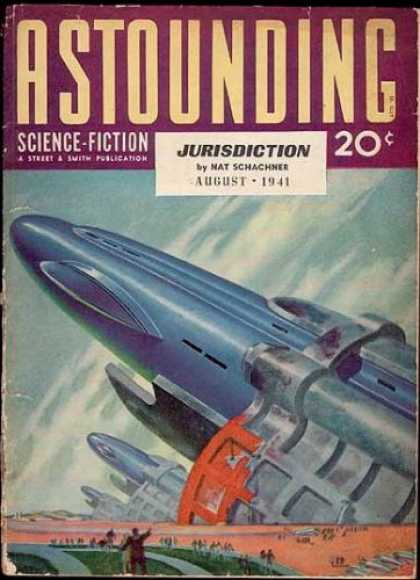
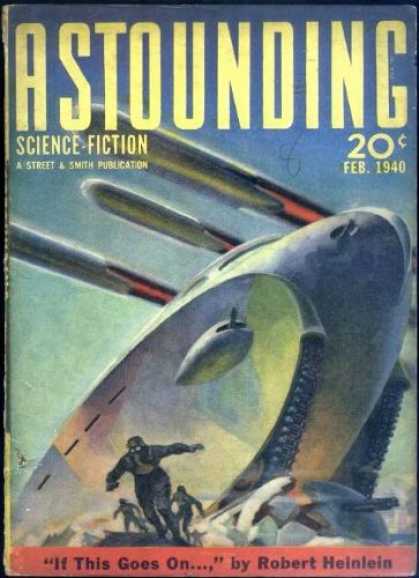
    There’s the Big Bang, Big Ten, big fall, big dream, Big Band, big shot, Big Apple, big picture, Big Bird, Big Brother (and Sister), Big Lebowski, Big Sur, big year, Big East, Big Kahuna, big ego, (really) big show, big money, Big Shot and big deal, and many others, all sorts of “big” things.  And then there are the Really Big things, like these astoundingly big things from the pulpy covers of Astounding Science Fiction magazine, from the 1940’s to 1971.  [The source for all of this artwork is at Coverbrowser.com, here.]

    Astounding Stories 129 - Jurisdiction - Nat Schachner - Science Fiction - Future - August 1941


    Gigant things astounding tank

  • Atomic Power with God, 1946

    JF Ptak Science Books   Post 1854

    Atomic power with god628
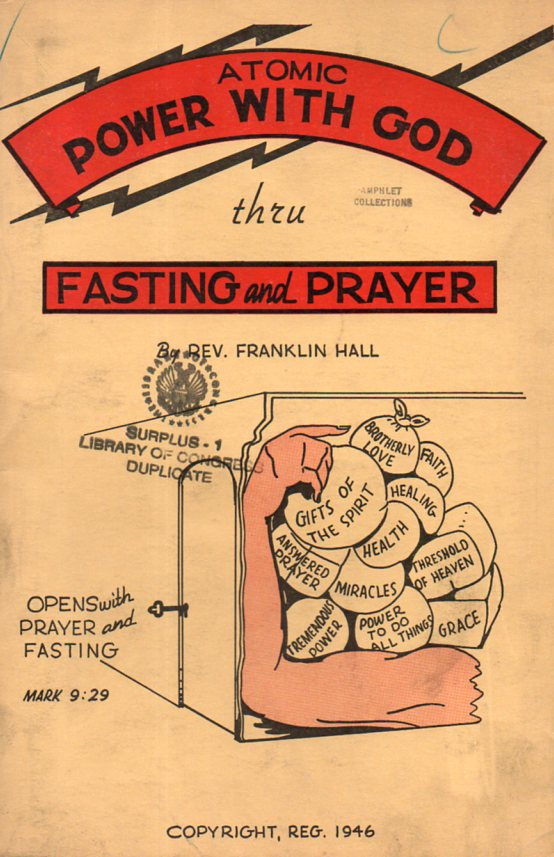
    Rev. Franklin Hall was a busy man:  with detritus haloes of failing humanity floating above everyone  (making them susceptible to the eternal lake of fire), he was on a concerted mission to save as many people as who would listen to his special message. Hall’s litany was equal parts simple and complex, as we can see even by just the title of one of his pamphlets: Because of Your Unbelief , Chains of Bondage, Food Slaves, Belly Worshippers, Fleshly Lusts, Unbelief, Doubts & Fears, Carnality (which I wrote about here), which was a short work of considerable claims with no basis of correctness or proof.

    He moved on, assuredly inspired by the use of the atomic bomb in August 1945, to write Atomic Power with God thru Fasting and Prayer (received by the Copyright Office in September 1946). As much as this might sound like an adult beverage of your choice, it is not; he set his course not on atomic power per se, but on the connection of fasting and prayer, because, as he writes on page 37, “the Bible is Ahead of Science”. (There haven’t been very many books at all written with the words “God” and “atomic” in their titles1–and this is one of those few.  And the Hall book is actually four of them, as this very small work went through  a number of revisions and four editions.)

    Which I guess is all fine and good, to a point, so long as the health debits do not pile up too high; the rest is a subject of faith, and about there there is not much that can be said that would be of any use.  In the long run it was rather tempestuous of Mr. Hall to assume that using the words “atomic” and “power” in the title of his re-polished gem-let was good to win him a few new readers, surfing on the tide of everything else in the world that was just at that time adding the prefix “atomic” to whatever product there was to be sold2.  And God evidently was right there among them. 

    Notes:

  • The History of Normalcy and the Idea of the Center

    JF Ptak Science Books   Post 1855

    Where is the center?

    Where is the center of the Earth, of religion, of the United States, of the universe, of art, of consciousness, of seriousness, of complexity?

    The center of stuff throughout history has been an almost entirely shifting matrix, a collection of vortices coming from Jupiter’s strongbox–a three dimensional representation of the location of their shifting centers over time would make an interesting Fibonacci-like display, I think.
    Center--theatrephone567

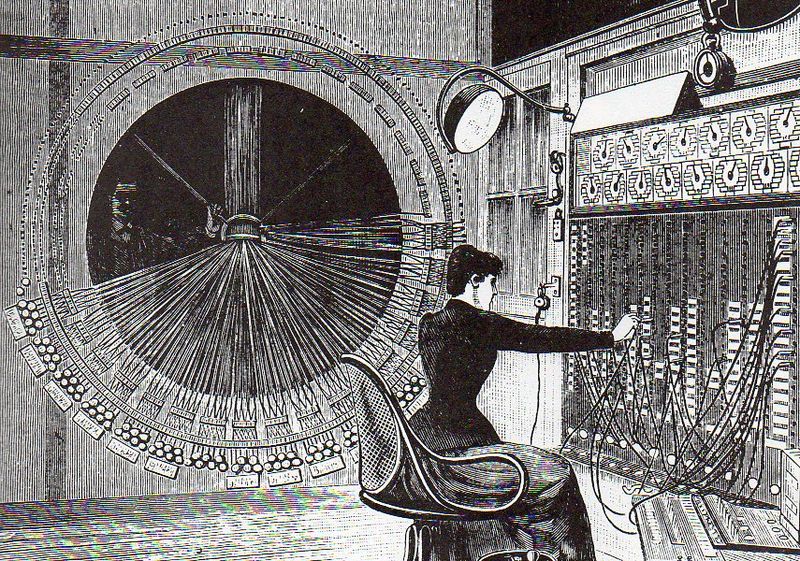
    The question may seem meaningless at first, but people have long asked it of nearly everything within their experience, trying to find the center of their world and universe, of their selves, of their religion, of their country, of politics, of art and music, and on through the Encyclopedia of Things that Could Have a Center.

    Take for example the questions of where the center of the Earth, or solar system, or galaxy, or universe might be?  There have been answers to these question more often than not over time, though the answers have been shifting.  The center of the Earth has certainly stayed more-or-less constant over thousands of years, though the stuff in the center has been swarming with change, from being hollow, to being filled with magma, to being a solid magnetic core, to being occupied by Mole Men, to housing the seat of the Inferno, or to be simply located on the surface of the sphere at Jerusalem (as the old T-maps have shown for hundreds of years), and on and on.  Working backwards, the center of the universe has drastically changed over time–for thousands of years, it was assumed that the Earth was the center of all things, until it wasn’t (that beginning mostly with Copernicus, and then challenged with Galileo’s use of the telescope and his discovery of an order of magnitude more stars, etc.).  And then William Herschel beautifully represented the shape of the galaxy in 1782, placing our solar system in a far from central location.  The center of the universe’s fate changed along with that of the Earth, incredibly so beginning with the Big Bang and then with the possibilities of their being a universe without boundaries.  And then of course there’s multiple universe theories, and worm holes, and the space time continuum, which complicates things even further, making the discussion of a “center” pretty much nonsensical.
    Mar 23 center of levity cvr det 3

    Simpler things can be as complicated–where is the center of the United States?  If we measure the center for the lower 48 states, it will be different than if we included the two far-flung states, or protectorates like Puerto Rico. The geographical center is one thing; another might be where the population center might be–that has made a beautiful map published over time by the U.S. Census Bureau (Department of Commerce), showing the star of the center moving not-so-slowly westward into Ohio over the last 20 censuses or so.  And where is the heart of the country?  Where is the heart of the West?  Better yet, where is the center of the West (or North, or South, or Mid-West)?  To answer where the center of these places might be you’ve got to first locate where those geographical ideas begin and end, which for many is a tricky subject, making it a matter of opinion as to where the center of these places might be. 
                                       
    The center in art had been a findable thing for some time, though more recently people like the Impressionists and Kandinsky have shown that the center might not exist, and it might not exist along with anything that is recognizable as a form of nature, representation and the center falling away completely.  Perhaps this is like finding the center of a decade or year or month, or week or day or second.  The parameters keep getting both smaller and larger, the ability to measure halves of things or the center of a second growing almost incalculably small, small enough to reveal that in this Zeno-paradoxical way, that there is no center because there are no boundaries; getting half-way to something into infinity doesn’t tactually get you there. 

    The center of balance, the center of levity, of concern; the center of emotion–another center that has been mapped all over the human body, from the heart to the head to the limbic system to a confusion of freudian desires to an inelegant and intractable collection of stimuli   and response.  The center becomes more of a belief-but even there, center can have no more a constant than change.  The center of Christianity may be Christ (though it wasn’t always so, witness the Mary Cults through the first few centuries of Christianity), but then you have to understand which Christ it is coming from which Bible, the center becoming more a concern of interpretation and spread over many Christian groups than one solid center. And when you spread the field to include all religions and you expand the center notion to a primum mobile or collective or whatever, then the center gets very big—and in some religions, it is nothing but the center. 

    It seems to me that if the issue of finding the center of big and small things alike is difficult, then why does it seem so easy for people to determine and adhere (and sometimes to believe in at all costs) to expansive ideas like “normalcy”?

    Blog--May 24--girlA history of normalcy is one that looks at the things deemed to be “normal”, or standard, or acceptable at one time that became not so over the course of time.  Buying and selling human beings, women and their children being property of the husband, Chinese immigrants in America not have (any) legal rights, classification by skin color or sex or financial status or political belief are a few good candidates (among thousands) for this history.  It is an interesting proposition to think about—what things around you, or better yet, what thing you think or say or do, that look good and acceptable today might look embarrassing and unacceptable thirty years hence.  In 1935 one issue might’ve been accepting the codified behavior of treating women as less than equal of men, deserving less in the workplace (if they were in the workplace), less rights in the courts, less deserving of equality in general; by 1965, this viewpoint may have well been in the minority; by 1995 it begins to look fossilized; by 2025 it might well be unbelievable.  What are the issues of 2010 that could be the equivalent of the 1935 issue?

    I’m just wondering why it is that even when people cannot find the center of almost everything that has ever been, that a strict and damningly judgmental regimen of “normalcy” can be so easily instituted, and enforced? This especially since part of the code of adjudicated normalcy for one generation seems mostly gone by the next, that the important becomes trite, and the socially disgusting becomes acceptable.  Just  as the concept of the center becomes elusive, so too does the standardized idea of normalcy become vaprorous over time.

    ·Posted by :

    ·in:

    —
  • Happy Anniversary! Unsliced Bread–the Best Thing Since Sliced Bread.

    JF Ptak Science Books   Post 1855     Almost on this Day in 1932…

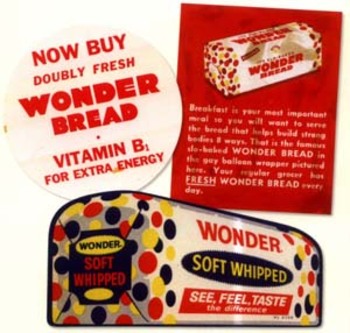
    Bread3

    Thanks to Emma Digh Ptak who gave me a book on the history of bread for Father’s Day!  Thanks, Buddy! 

    This expression has a bit of a scent of death, of corporate sameness, about it. Its tale is one of innovation, deceit, deception; of ridding independence and quality, of providing a gross replacement for quality in the name of mechanized progress. The progress came in the form of a continuous loop delivering exactly the same loaf of bread, endlessly, to be cut and bagged and delivered to consumers–brought to us at t he expense of 97% of all of the bakeries that have ever existed in this country.

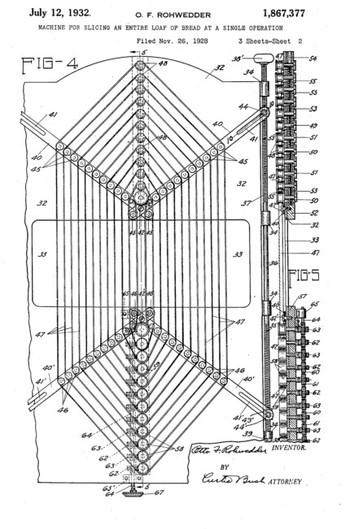
    The replacement of the small bakery began slowly, around 1850, proceeded with caution to the turn of the century, and was basically completed by 1940. In 1900 the small bakery outnumbered the corporate producers by 80:1. By 1939 the large company absorbed the practice of 95% of all dollars spent on baked goods. It was the continuous-belt bread baker that started of the replacement process in 1850 and 1866, sending the breadBread_patent_2 through long ovens on the endless feed. This was the start–it was in the high speed mixers that made the domination possible, thoroughly dispersing the yeast throughout the dough, making it possible to produce almost the exact same loaf of bread time and time again. It was then that the bread cutters–which had been around for some time but more or less perfected in 1928–could really do their job and finish production. The cutters would work exceptionally well so long as the stuff that they were cutting was the same–this done, multiple loaves could be cut every second, hundreds of times a minute, thanks to the mixer. Efficiency had reached high speed, and the cutters performed their revolutionary task.
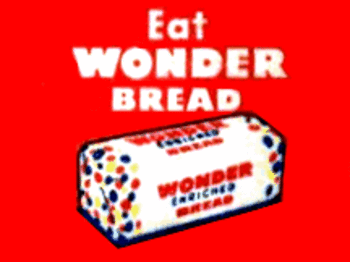
    By 1942 the show was over for the small bakery–their non-uniform, hand made, thickish, irregular products replaced by bread clones: white, spongy and terrifically porous, and something that, once squeezed, would return to its original shape.

    Bread2

    The masterwork on the coming of mechanization is by S. Gideon, and is called Mechanization Takes Command, published by Oxford, (New  York), in 1948.  It is a work of great beauty and insight.  

Recent Posts

Archives

Categories