A Daily History of Holes, Dots, Lines, Science, History, Math, Physics, Art, the Unintentional Absurd, Architecture, Maps, Data Visualization, Blank and Missing Things, and so on. |1.6 million words, 7500 images, 4.9 million hits| Press & appearances in The Times, Le Figaro, Mensa, The Economist, The Guardian, Discovery News, Slate, Le Monde, Sci American Blogs, Le Pont, and many other places… 5000+ total posts since 2008.

  • A Charming “First” Traveller’s Guide to Rome in Full Text, 1600

    JF Ptak Science Books  Quick Post

    Franzini 1
    I was very happy to find a full-text and nicely-navigable copy of this classic work online. Giorlamo Francini’s Le
    Cose maravigliose dell’alma citta di Roma, anfiteatro del mondo : con  le chiese, et antichita rapresentate in disegno / da Girolamo Francino ; con l’aggiunta del dottor Prospero Parisio (In Roma : Ad instanza di Gio. Antonio Franzini, & herede di Girolamo Franzini) was printed in 1600 and is considered an iconic work on travel writing, as well as one of the first sophisticated/modern “guide books” to the city of Rome. It was pocket-sized, and contained all manner of information about buildings and artists–useful info, if you had never been to the city before. It was also a distinct difference from books intended to the pilgrim; this book was definitely looking for a popular, general readership, looking to benefit in their stay in Rome by having a literary, artistic, and architectural key to the city. 

    The illustrations are charming and lovely–even though small (less than two inches square),  they provide just enough detail for you to unmistakeably identify the principle structures.   The full text (with illustrations) is located here.

    ·Posted by :

    ·in:

    — —
  • Ancient Myths Modern: the Other Statue of Liberty, ca. 1911.

    JF Ptak Science Books     Post 1887

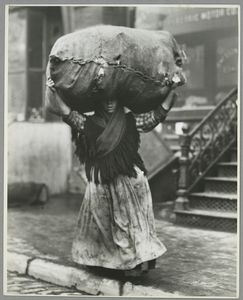
    In working on an alphabet of the occupations of children in 1910/1920 America based on the photographs of the immortal Lewis Hine (and found via looking at other materials on the excellent Retronaut website), I came across this extraordinary image:

    A tenement gleaner, New York C... Digital ID: 416509. New York Public Library

    The detail seems to show lip rings on what I think is a very young woman.  She is very slender (you can see very thin wrists), and is wearing a number of layers of clothes, not the least of which is a long white apron on top of which sit Civil-War-like shawls,  She is stepping into the street, caught mid-stride. It looks as though it is frosty, the sidewalk and steps seem to have a thin veneer of ice  It is cold. And she is carrying an ungainly, heavy burden, which might weigh half of her own weight. And she is young.  And she has no gloves.

    Where did she go?

    Hine--tenement gleaner detail

    It also that Hine–in his notes onthe back of the photograph– identifies her with kindness and grace as a “tenement gleaner”.  (In my notes I was less kind and called her a “ragpicker” I’m a little ashamed to say. Mr. Hine taught me a lesson.) Gleaner.

    Hine documented things that were part of everyday life that made cities like New York what they were, much of which went unnoticed, or scuttled by intentional indifference. People like this made the city run–then as now–and Hine was one of the early photographers in the United States who “discovered” these people and made their standing a cause of his life. 

    Like many other pioneers/artists/social observers, Hine (1874-1940) didn’t fare so well in his later life. After four decades of huge service in photography, people became disinterested in his past/present/future work, and Hine lost his resources. And his house. And then, in a few years, his life.  His personal collection of negatives and prints were given by a relative to the New York Photo League, but they were displaced when the League was dismantled in 1951.  Unsettled, they were offered out to places like the Museum of Modern Art, which rejected the collection. Ultiamtely, fortunately,  the George Eastman House in Rochester, New York, accepted the collection and saved it from the unknown.

    This image easily could have been Atlas, but Libertas seemed better.

    Source:  New York Public Library Digital Collection. “Photographs concerning labor, housing and social conditions in the United States. / L. W. Hine. ” 
     

  • On the Visual History of Silence, Chapter 17: Mapping the Silence of Housework in 1925

    JF Ptak Science Books  Post 1888 [An entry in the Museum of Impossible and Imaginary Things series.]

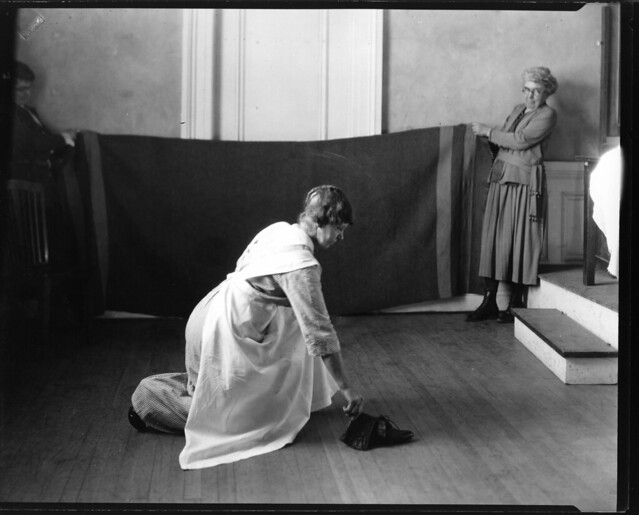
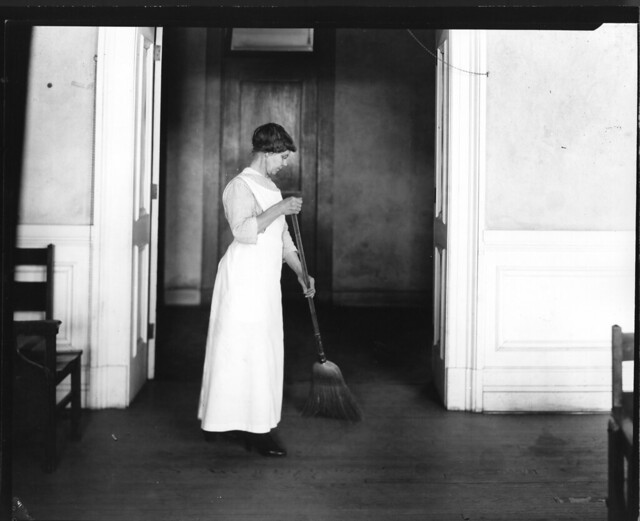
    I found this lovely series of images at the fantastic Public Domain Review blog–I was very and instantly taken by them, as they immediately suggested themselves to repurposing. (They were truly meant to illustrate the proper posture of the domestic worker; but now of course they are open to vast interpretation, creative speculation, and mild fantasy.)  To this observer their original insistence is gone, even at an historical micro-level (except for a history of housework):  they aren’t so much an illustration of housework and the postures by which a person would conduct them, but as a map of the silences encountered in the daily cleaning of a house.  It is all fiction of course, but the photographs do have an overwhelming sense of beckoning silence to them, even in their depiction of motion–even though they are a series on dealing with proper movement, they all seem strangely static, like marble.

    And so they become a geography of house-bound silence, made by silent geographers, capturing moments of silence in moments of near-silent work.  And if I was the one compiling these geographic interests (and I might as well be), I would want to position the five greatest house-silences so that they could be found once again.  And so:


    Location 60: back stairs, beyond kitchen.

    Sounds and silence: olympic kneeling done in pursuit of dusting invisible pollens from floor. A very quiet Shaker step waits in the background. It is mostly the silence of the whitewashed stair that commands this image, and not the diligence of the dust.


    Location 32: kitchen entry/semi-hall.

    Sounds and silence: Old uncovered wooden floor and oak-handled broom, well-polished leather boots with new heals.  The silence is that which comes after the light sweeping is finished is the elusive “great grandmother sound” of satisfied work being completed.


  • Cathedral of Dust of the “Wrong Arrested”–Vernacular Redemption, 1939.

    JF Ptak Science Books  Post 1890

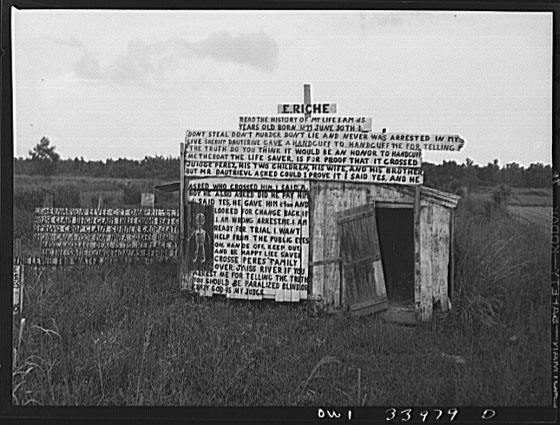
    This is an image of an engineered redemption, found in the mist of Placquemines Parish, Louisiana, in 1939.  There is no doubt in my mind that the author, Mr. E. Riche, was done with running from whatever it was that was chasing him–printing his truth would no doubt cut it down. “I am wrong arrested” Mr. Riche says, and wants “help from the public eye”. 

    Oh my g_d. If this isn’t a Mr. Cash song, I don’t know what is.

    FSA--signs--redemption_edited-1
    This is a photograph of fantastic humanity, of a person witnessing for themselves, stating their beleift, defending their honor, exploring the present, and staking a very visual land claim in reality.  And then–with all that said, all of this person’s dignity and belief displayed for everyone to see–the author lives in the sign he or she created. It is as though someone has engineered a three-dimensional public-philosophical house in which to live, and then actually lives there. 

    As a testament to a simple call to fairness and justice, this image is an extraordinary and powerful reminder to the power of spirit. For some reason I can feel this person’s letter down to the cellular level. 

  • Trademarks, Memory, Nazis, and Death Camps

    JF Ptak  Science Books  Post 1891

    In the world of identifying symbols–which I’ve been writing about a little over the past few days, but mainly on Renaissance and Baroque and Mannerist iconography–few are as distinctive and recognizable as modern trademarks.  There’s a lot of high-voltage connecting wires between modern advertising and memory devices and Renaissance emblemata, and as I was sorting out some of the nice compatables I was stopped in my tracks by one of the modern images, mainly because I had a recollection for an older and unmentioned iteration of the symbol.

    Sinoxid.  It was recorded in the registry of German trademarks for 16 November 1968 as being owned by Dynamit Nobel AG. 

    This is what the trademark looked like in 1968:

    http://img03.mar.cx/_images/CA317024

    The same trademark, a little earlier in its career, as it was being admired by a Nazi Brown Shirt S.A. member in 1933:

    Trademark758Dynamit Nobel A.G. is an old company. It is the German arm of the Swedish Nobel munitions firm (begun in 1864) by Emil and much-more famous (and longer-lived) brother Alfred.The German company was established in 1865 in Toursiburg so that the dangerous products produced by the firm wouldn’t have to travel as many miles if it was produced closer to the consumer.  The Nobel firm manufactured munitions–famously so with a nitrogylcerin compound known as “blasting oil” that was notoriously unstable, and which in a fit of instability  actually killed Alfred’s brother Emil in 1864. It also blew up parts of the German factory (on two occasions before 1870).  The stuff was beyond lethal.  But it didn’t stop Nobel from shipping their explosive goods worldwide in unmarked crates so as to not attract attention to a dangerous product. Three such cases were once sent to the Union Pacific company in San Francisco in 1866–two became unstable and blew up in the company’s headquarters, killing dozens. But no one was scared beforehand.

    Alfred Nobel left no heirs and so donated some percentage of his firm’s monies to the foundation we know today by his name. The company grew into the largest munitions producer in Europe. Beginning in the mid-1920’s it began a relationship of fusions and mergers and so on with the giant cartel I.G. Farben, among many others.

    I.G. Faben company produced Zyklon B. It operated its business with slave labor in concnetration camps. It sent tens of tens of thousands to their deaths working on Farben products. Zyklon B itself killed millions of human beings.
    This is what used canisters of Zklon B looked like after they had been used to murder Jews and other prisoners in the death camps:


    They have a design much like the tossed-away bodies of their victims.

    ·Posted by :

    ·in:

    —
  • Vernacular Found-Polygonism 2: Walker Evans on the Roof

    JF Ptak Science Books  Quick Post

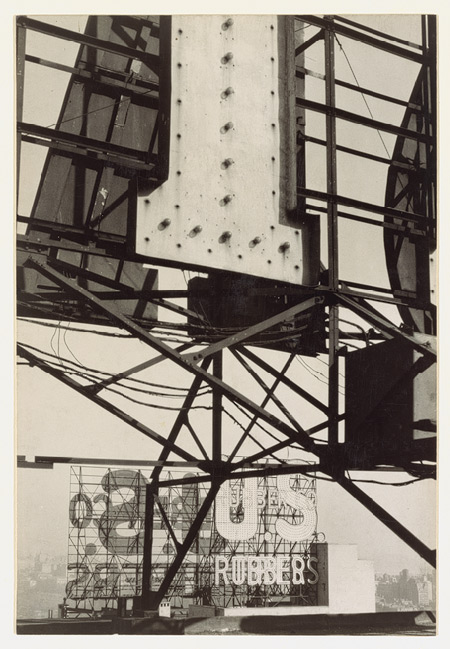
    Evans polygons

    How many polygons can you find? 

    “Walker Evans climbed to the roof of the Fisk Building on Central Park South to  photograph the web of steel struts and electric signs that were rapidly filling the skies over Manhattan. The electric signs in this photograph alternately  flashed the company’s name and the names of its two principal products. As there  were approximately a hundred million wheels rolling over America’s roads in  1928, the sale of tires quickly overtook that of rubber galoshes. The image  expresses Evans’ conviction that modern art could be timeless yet topical when  perfectly wrought of vernacular materials.”–Metropolitan Museum of Art

    This is one in a series of posts made on found geometries–here are a few others:

    Found Alphabets and Geometry in Stone.(here)

    Magritte-Like Disorienting Geometry in Found-Art Urban Design, 1925 (here)

    Sierpinski Triangles & the Empire State Building (here)


  • Walker Evans’ Indelible Images of The Great Depression

    JF Ptak Science Books   Post 1892

    Evans, walker  farmer tenemnt wife det


    Evans--alabamna tenant farmer wife The photographer Walker Evans (1903-1975) was an ultra-light and lyrical traveler, who didn’t leave a footprint in the country he moved through, though the impact of his work–the result of the travel–fastened a famously indelible image on American history–indelible, and fast, being recognized for his work with a commanding exhibition at the new Museum of Modern Art in 1938.  

    Evans possessed a crystaline lens which yielded both spectacular detail and subtle quietnesses. He could turn a tenement farmer’s rough-hewn wooden kitchen drawer filled with roustabout cutlery into a photographic masterpiece, and then photograph the face of that farmer or that farmer’s family and have it stand as an absolute testimonal to the expereince of the Great Depression in the American life. Evans made some of the core memories of that visual experience. He (along with some of the greatest photographers America has produced) worked for the government for a time during the Depression, answering to Roy Stryker at the Resettlement Administration and the Farm Security Administration, with the mission of taking photographs of America–which he did, establishing himself as one of the early and preeminent masters of documentary photography. 

    I was thinking of him earlier today, adn thought that I’m make a selection Walker’s photographs from the magnificent collection of Farm Security Administration images at the Library of Congress. (Also, see the Museum of Modern Art for a nice appraisal, here).

    Shoeshine stand detail, Southeastern U.S.  1936

    [Shoeshine stand detail, Southeastern U.S.]


  • History of Holes and Covering Them Up: Windows

    JF Ptak Science Books   Post 1893

    Holes  windows762
    The series of posts on this blog, The History of Holes, has generated several sub-series, including the History of Filling Holes Up, and of course The Great Efficacy of Deciding the Differences Between Hole and Circles.

    And now: Filling Holes Up.

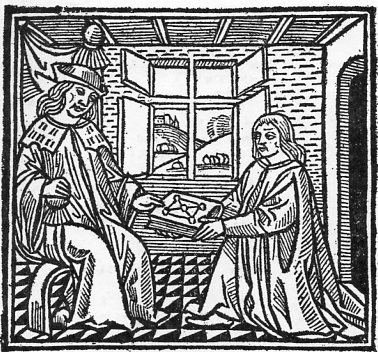
    This post really started as an exerecise in noticing invisible differences in old prints.  Unfortunately I’ve lost the reference for the woodcut I’m working with tonight (a terrible thing losing it to nothingness), though I’m sure it is a book illustration and early 16th century, and I suspect that it is German, and I believe it would have appeared on the title page or very soon thereafter, possibly in the dedication of the work.

    In the image we see the presentation of a book (the book, the book in which the image appears), a large volume, bound probably in tooled pigskin with brass or wooden tacks on the covers, there to protect the volume over long usage.  The scene itself probably depcits the book’s author presenting his work to his patron, or to the decicatee of the work, the person who made the printing and publication possible–hence the author kneeling, presenting the work with two hands; the receiver is seated, and with a hat and wide collar, accepting the book in a noble posture, nobly, with one hand.  (I wonder if the action is taking place in the bedroom, as would not be uncommon at the time–there is a tapestry pulled back and away from an enclosure to the left-rear of the patron.  It could be a bed. But it is definitely a private room, what with the ceiling not much higher than headroom of the doorframe.)

    What attracted my attention though were the windows and their double shutters.  The word “window” goes back a long, deep way, mainly in Scandanavian languages, and there coming to mean, mostly, “hole” or “opening” in the ceiling (for fireplace smoke and ventilation).  Noah Webster gives “window” a nice turn in the 1828 edition of his dictionary, defining the word as a “wind-door”, which is poetic but not very much in keeping with the word’s etymoloigcal history so far as I can tell.

    The coverings for windows are natually as old as the window, though sometimes it received some very fancy covering–in Rome, for instance, there are examples of glass windows, though there the glass is largely opaque. But here, in this image, in the high Renaissance, the window coverings were wooden, which is a long way home from hide or cloth or other such material. It is a little curious to see the shutters opening inwards–I’m no window/fenestration/architectural expert, but it seems now in cozy memory that these sort of shutters are not usual to my experience of Renaissance interiors.  (One quick source for looking at a number of these scenes is Jost Amman and Hans Sachs’ Standebuch (“The Book of Trades”), published in 1568. It shows people at work at their craft, mostly inside; and of these dozens of woodcuts, when the windows are shown with coverings they are depicted with glass. When not, there is simply nothing to see–but being merchants, and these places being “stores” of a sort, there were probably exterior shutters fixed either at the top to provide an awning when open, or at the sides. )

    In any event, it is always interesting to go back and look at familiar objects and images, and see what your brain comes up with with the newest iteration of recognition.  I’ve known this print on-and-off for a long time, but I don’t think I ‘ve ever thought of it in terms of holes. Until today. And then it became a new image. 

    ·Posted by :

    ·in:

  • Einstein at 10: School Photograph

    JF Ptak Science Books   Quick Post
    Follow Me on Pinterest


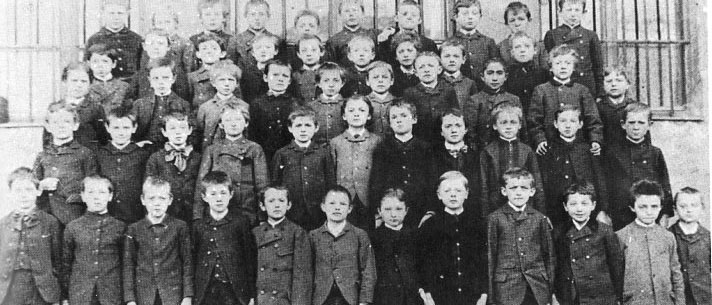
    There is a reminder on our refrigerator for class pictures being made for our younger daughter’s elementary school this Friday.  It never fails to remind me of simpler times for not-so-simple people, time that would soon be overtaken by the complex time of the rest-of-their-lives.  One of my favorite images of this impending wave of life is this:

    Instein class photo763
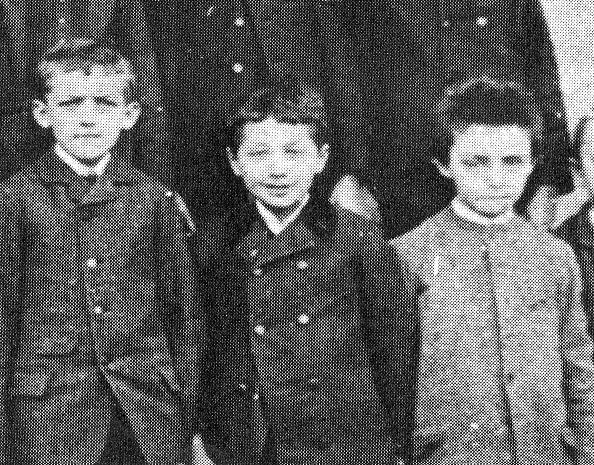
    This shows Albert Einstein in Munich at the Luitpold Gymnasium in 1889, when he was 10. (The source for his image, Ronald Clark’s illustrated biography of Einstein, says that it is from the 1890’s, which is just wrong. Einstein is third from right, front row. In many reproductions of this photographs the boy on the far right of the front row is usually lopped off–I’ve imagiend a rich life for him from time to time, excised as he was from one of the most famous schoolboy photographs of the last 125 years.)

    It was a fiction or fairy tale that Einstein was an average student when he was young–he was in fact a prodigy, and tested out so long as he was somewhat interested, tested out in all areas save one:  French.  Latin and Greek were good.  French, not so.  It was a main stumbling block for him throughout his young academic career.  And that’s a pity.  More so, really, when you consider the amount of interest French scientific publications gave to Einstein in the early years, 1905-1908; and conversely, how much time and effort Einstein gave to the French, which was very little, and almost no attention at all when the greatest mathematician of the day, Henri Poincare, especially whe the great man died (in 1911). It has little to do with the actual language part–but that’s another story.)

    Instein class photo764

     It was a time of big discovery for the little man, though not so much of that discovery took place in school, and the school itself was a trial. But at least right at this point, when this photo was made, he looked happy.

    ·Posted by :

    ·in:

    —
  • “This Enquiry Not Overcurious”: Huygens on the Laws of Extraterrestrials, 1698

    JF Ptak Science Books   Post 1894

    “…stars…Numerous, and every star perhaps a world Of destined habitations”–Milton, Paradise Lost (1668)

    In spite of a fairly long (if not light) and ancient history, it seems as though Christian Huygens might have thought more to the shaping of extraterrestrial life than any writer to his time.  [The idea of extraterrestrial life is very old, stretching far back into Hindu cosmology, and even deep into the (eighteen worlds) of the Talmud.  Thales, Anaximander, Democritus, Aristole, Ptolemy all thought about and agreed on the possibilities of life being lived on places other than the Earth–infintely more life, in the case of Epicurus. Bruno, Copernicus, Fontenelle, Henry More, and Cyrano de Bergerac.] In a way, in a Asimovian way of rules, Huygens may have laid out the first real template for describing what life-not-on-Earth might look like.  And in the long run, he finds that the possibilities for life Elsewhere are enormously high (and not in doubt in any way), and that it should in no way be any lesser life-formed than what we know here on Earth–and that includes “life” in all of its great complexities.

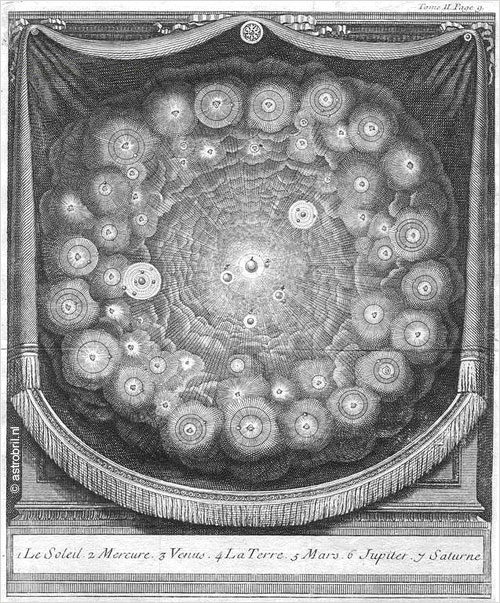
    [One of the few images made during this time or earlier on the possibilities of world systems outside our own appeared in Bernard le Bovier de Fontenelle–who almost but not quite gets there in his 1682 book Entretriens sur la pluralite des mondes, as follows, though it really has not much at all to do directly with Huygens:]

    Blog--plurality of world fontenelle

    Huygens (1629-1695) worked across many fields, including astronomy, biology, math and physics, and was extraordinarily productive, making numerous contributions in the physical and theoretical areas, as well as being a prolific author and correspondant.  But towards the end of his relatively short life (he died at age 56) Huygens embarked down the science fiction road in pre-science fiction days, writing a wonderful and provocative book entitled Cosmotheoros, The Celestial World Discover’d: or, Conjectures Concerning the Inhabitants, Plants and Productions of the Worlds in the Planets (available online in English here) where he establishes the groundwork of this extraterretrial life. (The book was nearly published during Huygens’ lifetime, but it didn’t quit ework out; left to his brother to published, he, too died before the book was finally in print in 1698. Shortly after the Latin edition of the Cosmotheoro was published by the The Hague publisher Adriaan Moetjens, translations appeared in English (1698) and in Dutch (1699). In the following years, translations also appeared in French (1702), German (1703), Russian (1717) and in Swedish (1774).)

    Hugens set out his description by arguing that extraterrestrial existence of life is perfectly in keeping with the Bible, and that his”conjectures are not useless” or “overcurious”, and that are justified in and of themselves as a useful pursuit because of the display of logic in his arguments.  He states that the inherent sinfulness and “villany” of man on Earth does not perclude life elsewhere, and these lifeforms coul dbe everywhere else, and no different from our own, with no differences in ability to reason and explore.  Lifeforms exist much like us, with at least five senses (and here Huygens makes an interesting play for more-than-give senses, though he doesn’t understand what they might be), and are capable of all of the supporting capacities for enjoying astronomy, and logic, mathematics, physik, arithmatic, and all of the rest, including all possible skills that could be called upon in the production of instruments of science necessary to pursue any endeavor, and all enjoyed in a society as expectently rich as any on Earth, enjoying all of their plants and animal lifeforms, all of their own creations and the rest of the creations of Nature, all while listening to a universe-wide application of music (“everywhere immutably the same”, which Huygens states beautifully here:)

    “It’s the same with Musick as with Geometry, it’s every where immutably the same, and always will be so. For all Harmony consists in Concord, and Concord is all the World over fixt according to the same invariable measure and proportion. So that in all Nations the difference and distance of Notes is the same, whether they be in a continued gradual progression, or the voice makes skips over one to the next. Nay very credible Authors report, that there’s a sort of Bird in America, that can plainly sing in order six musical Notes: whence it follows that the Laws of Musick are unchangeably fix’d by Nature, and therefore the same Reason holds valid for their Musick, as we even now proposed for their Geometry”–(page 86)

    Cosmotheoros’ pages are filled with such reasoned arguments–remarkably so for the end of the 17th century, barely 90 years after the great publication of Galileo and 40 aftre the work of Hooke (in exploring infinities at the other end of the optic scale).

    I’ve included some interesting parts from Book One of the Cosmotheoros; the subject/section headings are in red, and the page number (which usually appears mid-sentence) is related as [23]. Huygens occasionally referes to the other non-Earth life forms as “Planetarians”.  Here’s a sample:
  • Henry Darger and Campbell Soups Kids Playtime Schoolroom, 1955

    JF Ptak Science Books  Continuing Post 1081 from 2010

    Somewhere in the past I got the idea that the defining icon and supremely outsider-y artist, Henry Darger1, lived  his life twice.  One life he
    spent with the other people in his job as a quiet janitor; the other life he spent re-enacting his day in  miniature, a
    diorama of his workplace and his own
    apartment, reviewing his conversations real and supposed, revisiting shared-or-not visual clues, altering the day as it progressed with the possibilities of the actions-not-taken.

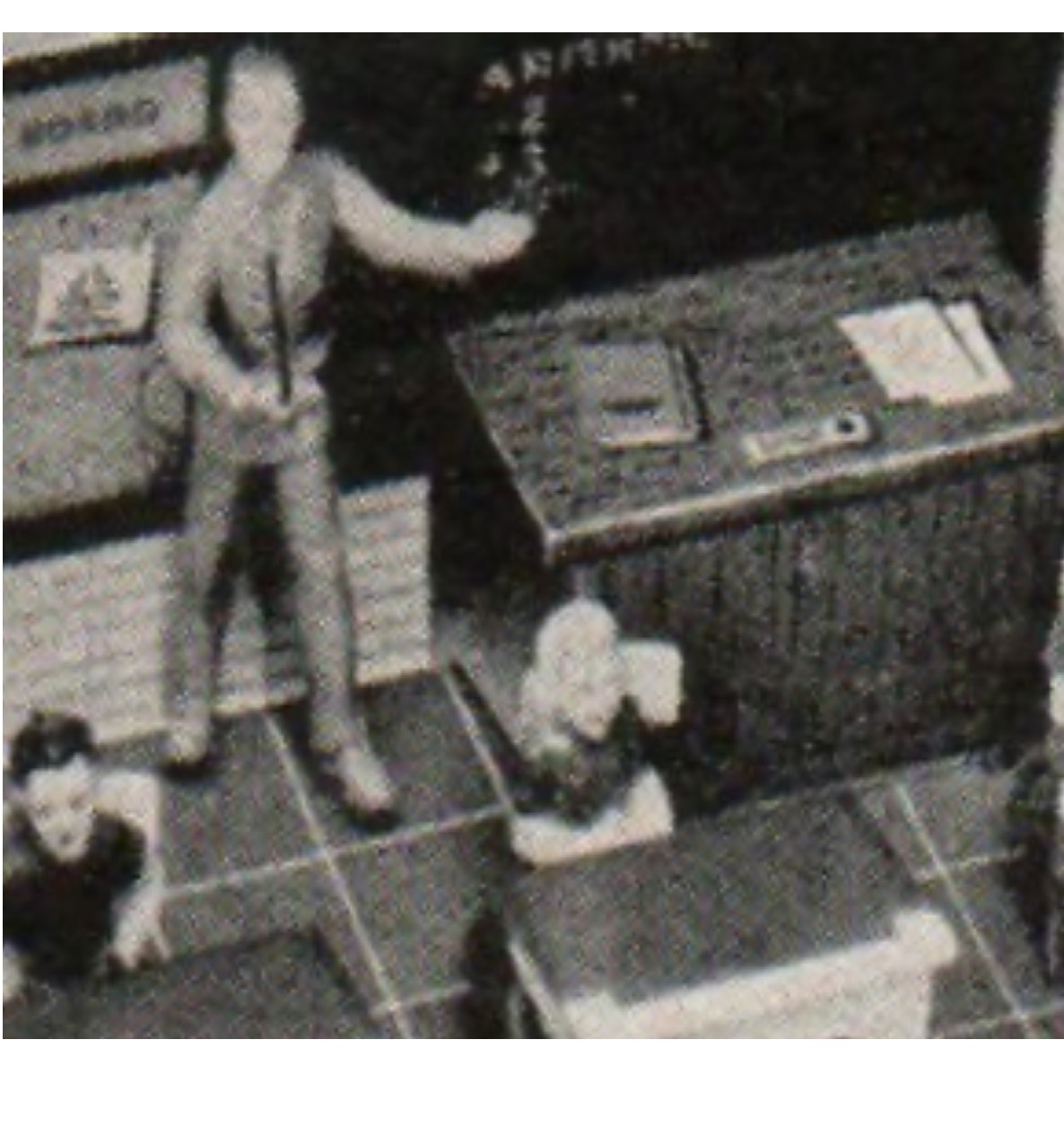
    Campbell det
    Maybe it is just this unshakable self-created image that colors the association of the Campbell Kids’ Miniature Play School Room that makes it  seem so dark and dangerous, especially since we now what is going to happen to the little girls in Darger’s red-tinged lexi-necessary art world. Here’s a molecular-level example of Darger’s fantastic output, featuring his Vivian Girls:

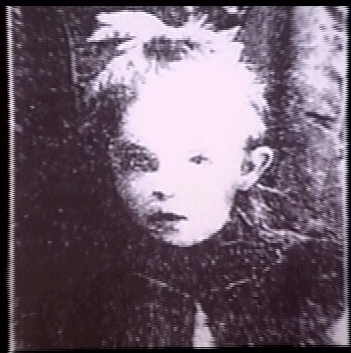
    Darger elsie(The picture at the lef is Miss Elsie Paroubek, a  5-year-old girl murdered in Chicago in 1911 and who may have been the sympathetic  impetus for Darger’s life work.)

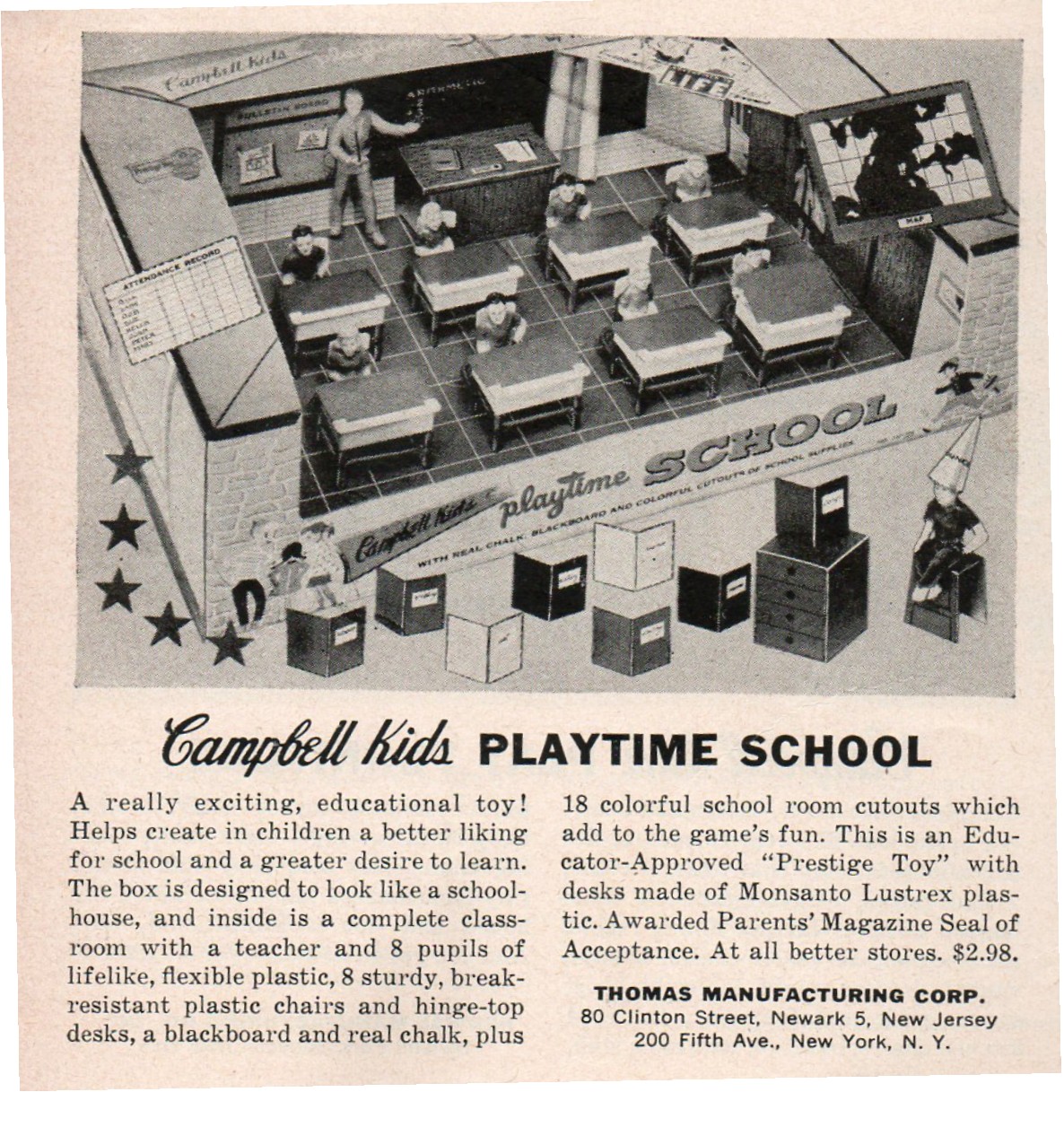
    And this is really just a child’s toy–a delightful one, too, filled with details of the school day:  movable desks, toy books, bouncey pony tails, and a teacher speaking at the back of the heads of the kids.  (He’s also carrying a stick by the way; maybe its just a pointer.)

    I suspect that the disturbed nature of this toy lives just in my head with its created Darger visions or repetitive living. Or maybe not–it does looked inescapably creepy, complete with a child in dunce’s hat.

    Campbell school169

    Notes:

    Darger 1. Henry Darger, 1892-1973, living form the Chicago World’s Fair to Watergate,  posthumously became perhaps the recognized standard model for outsider art, his magnum opus a 15,000 page and hyper-illustrated  work The Story of the Vivian Girls, in What is known as the Realms of the
    Unreal, of the Glandeco-Angelinnian War Storm, Caused by the Child
    Slave Rebellion
    being the base of the interest.  It has its own magnificence to be sure, and I can instantly recognize the enormous effort and creativity, but I always come back to the redded-up girl’s sexual organ additions, which are naturally upsetting, making the whole of the affair feel like a  monstrous mental health porn. And for as long as I’ve known about him, and which is also wholly
    unsupported by fact or reasonable supposition, I pictured Darger returning to his rooms at
    night after a day of cleaning, mopping, scrubbing, taking abuse for
    spills not cleaned, and then reliving the entire day at night in
    miniature.  In my own story, Darger created small figurines and puppets
    through which he re-enacted his day, complete with sets of the rooms in
    which he worked.  Perhaps he lost himself in these moments, finding a
    vindication in miniature stages in his second-story walk-up that he
    couldn’t in his daily life, allowing his creative, 20-million-word
    nighttime imagination to open up. Anyway, I’m pretty sure I made this imaginary life up.

Recent Posts

Archives

Categories