A Daily History of Holes, Dots, Lines, Science, History, Math, Physics, Art, the Unintentional Absurd, Architecture, Maps, Data Visualization, Blank and Missing Things, and so on. |1.6 million words, 7500 images, 4.9 million hits| Press & appearances in The Times, Le Figaro, Mensa, The Economist, The Guardian, Discovery News, Slate, Le Monde, Sci American Blogs, Le Pont, and many other places… 5000+ total posts since 2008.

  • Vernacular Landscape–Found-Religious Signs, 1936

    JF Ptak Science Books   Quick Post

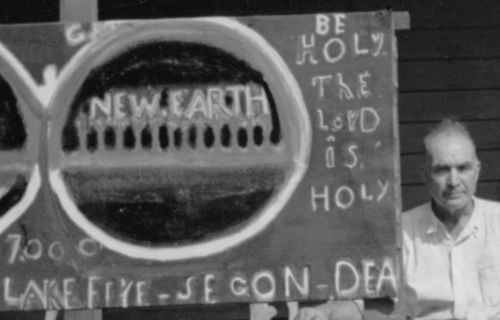
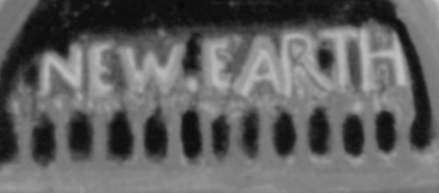
    New earth
    Which is a detail from:

    FSA--signs--religious detail

     Which itself is a detail from:

    FSA--signs--religious
    John Vachon; Religious Signs, Minnesota. 1936.

    Image, Source: digital file from intermediary roll film

     Vachon (1914-1975) was part (beginning in 1936) of one of the great groups of photographers in the history of American images: he worked for Roy Stryker in the FSA as part of the U.S. government’s attempt to record the good and ill of American poor.  That group included Esther Bubley, Marjory Collins, Mary Post Wolcott, Jack Delano, Arthur Rothstein, Walker Evans, Russell Lee, Gordon Parks, Charlotte Brooks, Carl Mydans, Dorothea Lange and Ben Shahn.  OF the many images recorded by Vachon, I liked the words in this one.


    ·Posted by :

    ·in:

    — — —
  • Mark Rothko, 1870: Unidentified Pre-Modern Found-Modernist Art

    JF Ptak Science Books   Post 1895

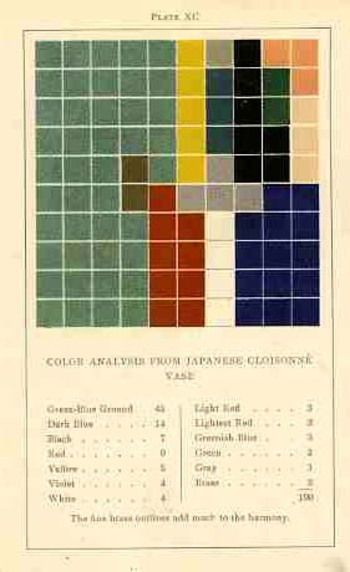
    This blog has long hosted a series of posts on “accidental” or “unintended” works of pre-modern modernist art found in displays of information and statistics in the sciences and mathematics, and even occasionally in art and design.  One such work–a 1904 triumph of accidental art issuing from an usunal work on color theory–belongs to an aesthetician named Emily Vanderpoel.  It is extraordinary in a narrower sense, and that extraordinary might not actually be positive for its original intent–the extra-intent of the book, what has come out of it for me, was something that was unintentionally accomplished by the author.  The images that she used to illustrate her color theory ideas–the basis of which are not really omprehensible to me–turn out to be artwork in themselves, a found art, the artistry of the images taking over the original intention for the arrangement of their color. She had introduced (though to no one, not really) a concept of beautifully arranged spatial color, artwork without a subject that could be recognized as any sort of natural object–non-representational art, finding publication several years before what is seen as the first inentional attempt at that genre, by Vassily Kandinsky in 1911. (Images below.) And when one strolls through the history of scientific illustration it becomes easier and easier to find such things, fabulous precursors to non-represnetational art, and Dadism, and Cubism and Surrealism. 

    Blogcolorvander_2poel_063These elements seem to be most populous in the illustrated sections of early encyclopediae, and dictionaries, and even encyclopedic dictionaries, where a number of different elements are displayed on the same page, different and generally unrelated images on the same engraved sheet, references for articles found in different parts of the book. 

    Here is a good example of that, with unintentional Surrealist images found in the image refernce pages of Horace Benedict de Saussure’s Voyages dans les Alpes….(published in Neuchatel in 1803):
    Unintentional surreal766
    [There are a number of other examples that I’ve written about on this blog:  here, for example, in “On the Paper Sculpting of Nothing”.]

    And then there are examples like Vanderpoel, where the entire image from one sheet is the pre-modernist image in question–to my experience this is the more uncommon occurrence. 

    Which brings us to today’s installment:  the infographic displays found in  Francis Walker’s  Statistical atlas of the United States based on the results of the ninth census 1870 with contributions from many eminent men of science and several departments of the government, which is the atlas of data to accompany the 9th Census of the United States, published in 1874.  This is a beautiful work, and a pioneering challenge.  Walker was one of the earliest to produce a statistical atlas, and was perhaps the earliest to display this huge and broad amount of data in so many different ways–it must have seemed a semi-miracle to see the information displayed so, like going froma  black & white television to color, or color to infared, and so on.  It may well have represented anentirely new way of looking at data.

     The first image (above) in this post is from the illustration showing proportions of the white/non-white population, and the following image shows a detail of that, offset against Mark Rothko’s 1959 Black on Maroon.

    Francis Walker’s statistical mapping, above, 1873; Mark Rotko,

    1959, below:  


     mark-rothko-black-on-maroon-1959

    [Black on Maroon (1959) by Mark Rothko, part of the Seagram mural series, via Tate Modern.]

    The first and third images are details from this full-page illustration:

    It is easy to see the similarities between the data display and the Rothko, though it would really not be within anyone’s power to identify the Walker diagrams as “art” in the modern sense for another five decades.  But it certainly seemed there, ready to be of influence and service, though I’m not aware offhand of artists being influence by these images as they were with, say etienne Marey’s photographs. I’m not sure that these statistics images ever came into the service of art in the beginning of the modern era.  And maybe that’s the biggest question here. 

    Sources:

    1. Guide to National Atlases: here.
    2. The Walker atlas for the 1870 census from the LC site: here.
    3. And an improvement on the Library of Congress presentation, by HandsomeAtlas (Brooklyn Brainery): here.


  • The Invisible Man, 1785

    JF Ptak Science Books   Quick Post   [Part of the Series on Blank, Empty and Missing Things]

    Bandages767

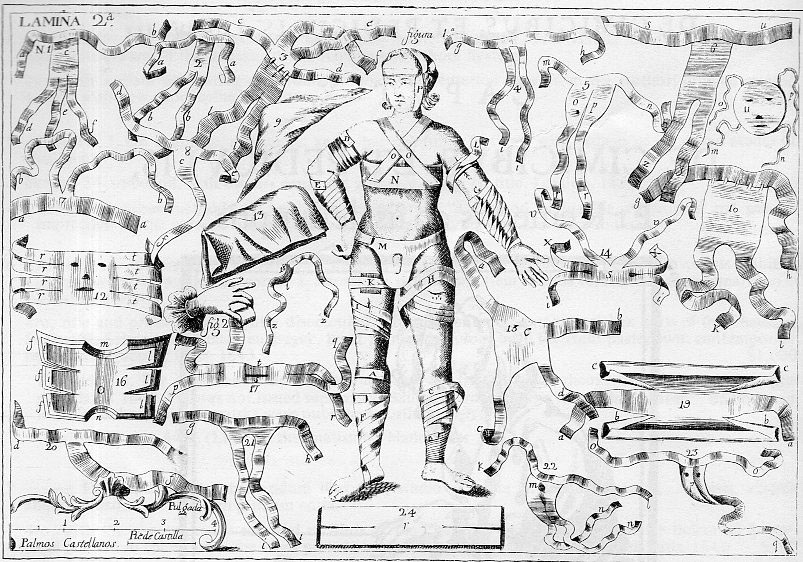
    What is mostly missing in this fantastic illustration from Tratado de vendages…. (Madrid, 1785) are people.  These multi-image plates of various dressings usually did not address people directly, and so looking at them out of context gives them a very heavy taste of the found-absurd. 

    For the time, of course, the book was an essential text on treating wounds, especially military ones. The author, Francisco Vila Canivell was born in 1721 in Barcelona.  By 1749 at only 28 years old, he had been educated in  France and received his medical education back in Spain at the Universtiy of Cervera, had fought in the Italian campaign (as a surgeon), became Surgeon Major of the regiment of Astiurias, and then on to keep charge of the Library of the Royal College of Surgeons in Cadiz. He was professor of osteology (and bandages!), as well as an obstetrician, ophthalmologist and midwife, until 1769 when he became Sugeon Major of the Army, and then proceeded on to other more esteemed positons, dying in 1797.


  • Opening the Doors to Trigonometric Heaven

    JF Ptak Science Books   Quick Post  

    Cavalieri767
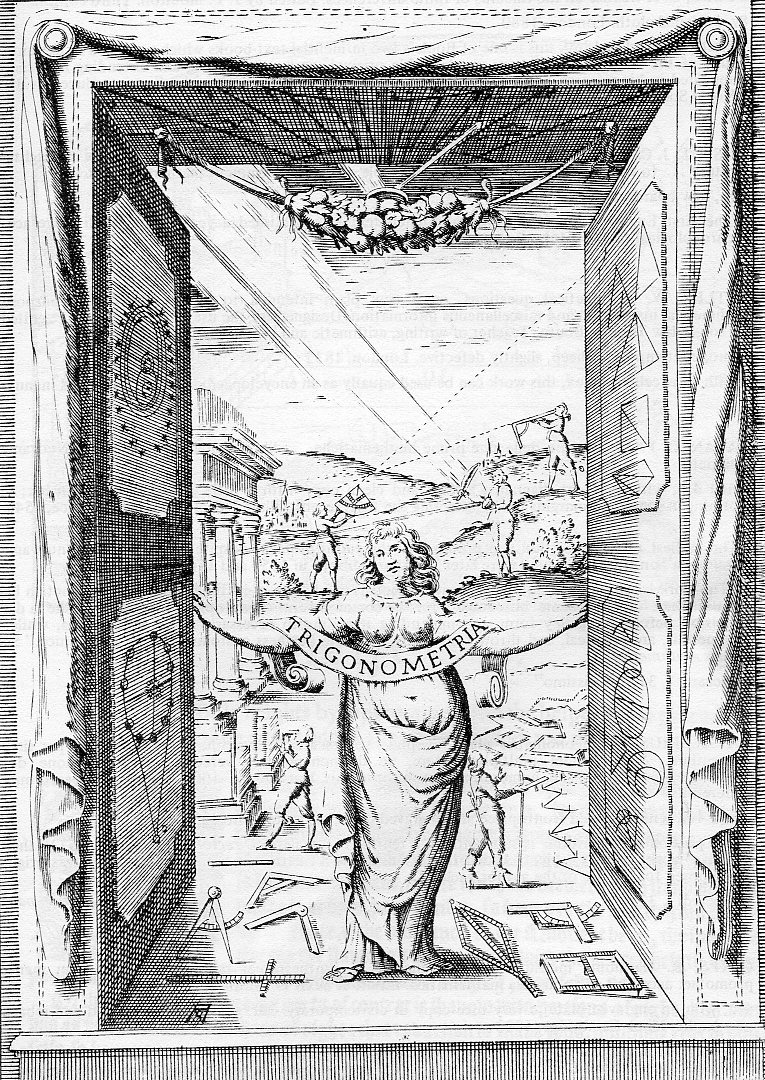
    There aren’t many other title pages in the history of mathematics that swing the doors of beauty and heaven and opportunity and logic and thought than the (appropriately-named) Bonaventura Francesco Cavalieri/Cavalerius.  A Milanese (1598-1647) who taught at Pisa and who published eleven books and worked in wide fields in mathematics as well as astronomy and physics, published his Trigonometria… in Bologna in 1643, and sent a fabulous image to his new readers right there on his very illustrated and augmented title page. 

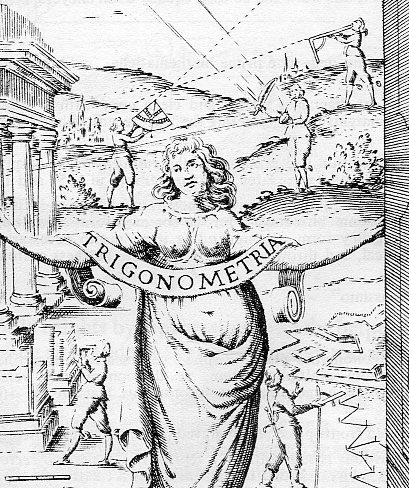
    Seldom have the doors of knwoledge been thrown open so wide and invitingly as this, with Trigonometria lightly awarding the reader with a new portal to fantastic opportunities–who wouldn’t want to walk on in?  The tools of trig are displayed on the ground at Trionometria’s feet (arranged and not by happenstance), while five figures employ these same tools in the background hills, which are being bathed in a pure holy light of some sort, an inspiration from the sky.  The doors are decorated with astronomical figures and light calculation, as well as polyons and geometrical drawings.  And just to make sure that the author meant what he intended, we can see above the full/thick wind-blown hair of Trigonometria (which in itself seems very unusual to me, such a carefree adn tossled attitude) a fruit-garland, a horn of plenty in its way.  Make no mistake–Cavalieri was making a king-sized offer to his reader to open their brains. 

    Cavalieri768

    I did leave out a major part of the title–the section dealing with logarithms, which is basically a reprint of Cavalieri’s early work (done in 1632), and which was the first work in Italian on that subject. 


  • Dosing out the Cures from “The Beast that no Existence Hath”–the Unicorn.

    JF Ptak Science Books   Post 1898
    Unicorn'770
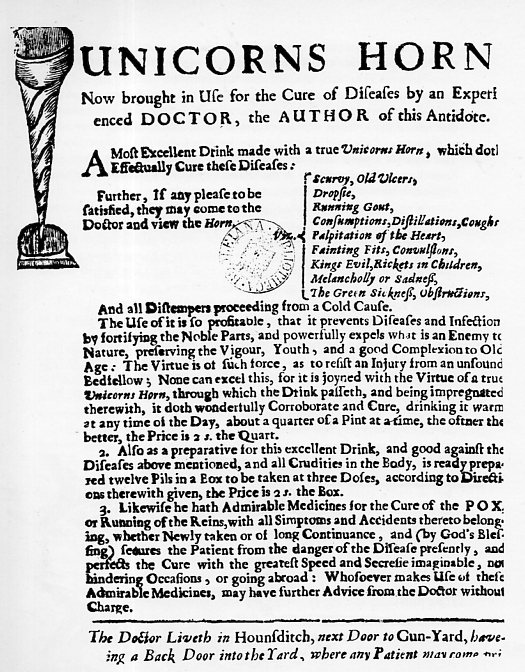
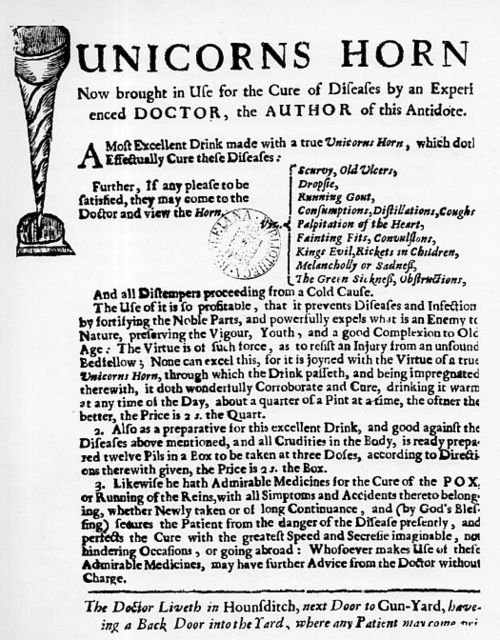
    Who could refuse to see a medical person advertising themselves as:

    “the Doctor Liveth in Houndsditch, next Door to Gun-Yard, having a Back Door into the Yard, where any Patient may come…”

    and especially one selling Unicorn horn curative extract?  The cure promises of  “the beast that no existence hath” (Rilke, Sonnets to Orpheus) sounded attractive, having the ability to dispense “scurvy, old Ulcers, Dropsie, Running Gout, Consumptions, Coughs, palpitations of the heart, Fainting Fits, Convulsions, King’s Evil, rickets in children, melancholy or sadness, the green sickness, and all distempers proceeding from a Cold Cause”  as well as “all crudities in the Body”.  But promises like this are almost always loyal only to that pretended self.
    Unicorn'769
    [Source for both images:  Rudiger Robert Beer, Unicron, Myth and Reality, Mason Oress, 1977.]

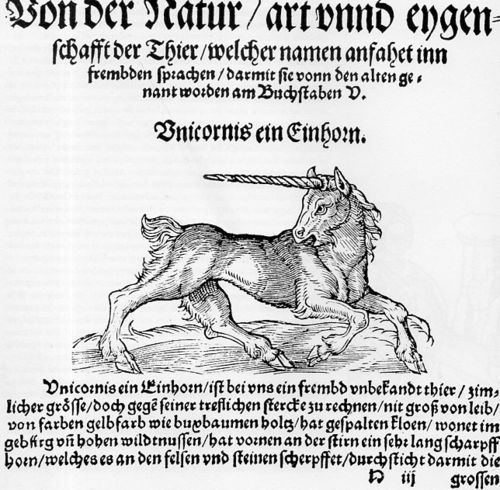
    In spite having a very long sales history over the milennia, pretty much the only place where unicorn horns have actually been seen were in apothecary shops selling narwal horns and in the constellation Monocaros (named so for the unicorn by Jacob Bartsch around 1624).  This great ground-up thing, one of the great mythic myths of all time, was a highly-inclined multi-purpose curative purgative suggestative ill-spoiler, capable of defeating nasty bodily nasties and enhancing things like our Noble Parts. For years it was worth more by weight than gold, though (depending on what it was that was being sold as unicron horn) ingested gold might have had about the same medicinal effect as a dose of unicron horn. 

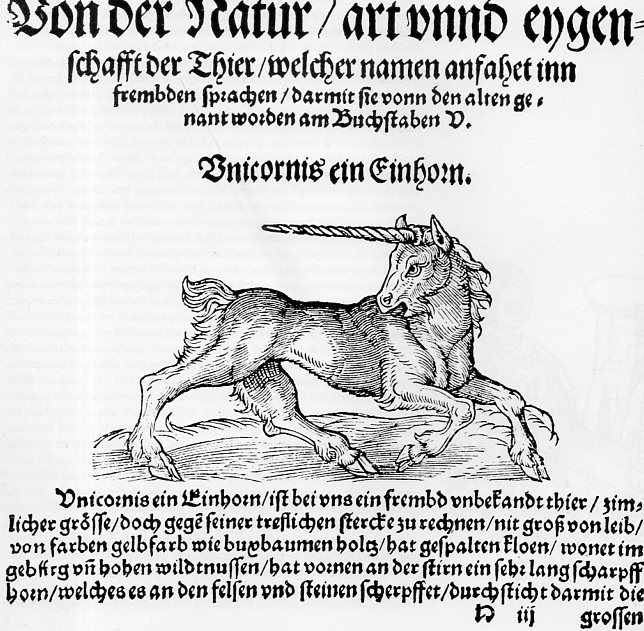
    This fabulous image of a unicorn, draped in Renaissance-y literary moudlings appears in The secrets of Albertus Magnus: of the vertues of herbs, stones, and certain beasts : whereunto is newly added, a short discourse of the seven planets, governing the nativities of children : also a book of the same author, of the marvellous things of the world and of certain things, caused of certain beasts   being a translation of  De virtutibus herbarum, lapidum, & animalium quorandam libellus, and his De mirabilibus mundi, ac de quibusdam effectibus causatis à quibusdam animalibus (1543). 

    Hope faded in the greatest degree for the unicorn only in the 18th century, replaced immediately by any other number of empassioned impossibles, like magnetisma and curative electricity.

    A few handy resources:

    http://www.storehousesoflearning.com/links.htm  Useful links for Medieval images and manuscripts

    http://bestiary.ca/beasts/beastalphashort.htm  Great Bestiary, with searchable index of creatures; once inside, there are references to the animal from some of the leading Medieval bestiaries (and their ancinet sources), including Herodotus, Strabo, Guilaaume le Clerc, Pliny, Isidore, John Mandeville, and others. 

    Medieval book of birds http://archive.org/stream/medievalbookofbi00hughuoft#page/n7/mode/2up
  • Inventing (1) Old Tone in New Violins & (2) New Tone in Old Violins. Patent Models.

    JF Ptak Science Books  Quick Post

    Finding old tone in the 19th was attempted in the following way, an interesting if not myopic attempt to put some play-time in a brand-new violin:

    First page clipping of GB 190303723 (A)

    Abstract of  GB 190303723  (A)

      Payne, R. H., and Broadbent, T. Feb. 17, 1903.

    In an instrument for reproducing sound, a resonating-chamber is used instead of a diaphragm and a trumpet. In the construction shown, the resonating-chamber consists of a violin body C mounted on an arm D extending from the instrument A. Fig. 2 shows means which may be employed for the mounting. The pin E passes through a hole in the neck C’, which is clamped by the nut E’. The pin E is mounted in the wooden block F journalled in the fork H on the swivelling-pin. Washers G, G<1> prevent the communication of vibrations to the arm D. The hole in the neck may be dispensed with, a screw or spring clamp being employed in place of the pin E. The reproducer K, Fig. 3, is cemented to the violin belly. The style K<1> is clamped in it by the screw K<2>. The violin has the usual sound post and f-holes in the belly and also holes C<2> in the back. Strings may be stretched across the resonator. When a violin body is used, the strings are stretched by the usual pegs in the neck. 

    This is not the most elegant invention for producing a more-interesting music from a stationary, non-human-played violin. 

    On the other hand, this is:

    The work is by Henry Konrad Sandell, and the patent was for a magnificent machine that produced 64 notes on the violin, and was accompanied by a 44-note piano, both played at the same time. It is a very impressive accomplishment, with several thousand of them produced over two dozen years by the Mills Novelty Company.

    Source, here. Mills Novelty, here  Henry Konrad Sandell,  and a photo of a restored and lovely Violinola, here with a sample of the music it produced (!)

    ·Posted by :

    ·in:

    —
  • The Devil’s (Gun) in the Detail (1489)

    JF Ptak Science Books  Quick Post

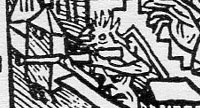
    Devil gun detail

    When I went to research this phrase, above, I was surprised to learn that it is about half as old as I. Playing on a slightly older  expression, “Le bon Dieu est dans le détail” (the good God is in the detail), commonly attributed to Gustave Flaubert (1821-1880), and of course “God in in the detail/s”, the “devil” part seems to be only from the mid/late 1970’s–a surprise.

    Nevertheless, we are still left with a surprise in this devilish detail from the incunabulum of St. Augustus, De civitate dei….(this printed in Basel by Johann Amerbach on 13 February 1489).  It shows it in its two panel woodcut the illustrious saint at top, working away at his desk; and at the bottom a battle between the cities of Babylon (founded by Abel) and Zion (“Syon”, by Cain).  In this battle Zion is defended by devils, and the devils are armed. 

    Devil gun772
    The angels of Babylon appear sympathetic but unresponsive to the devil-play, while an angel at top left seems to be blessing its devil enemy who seems to be scaring/screaming at her. In any event this is a lovely and complex image coming in the fourth decade of moveable type printing. 

    Now:  regarding Zion and Augustine, I really don’t know why the writer is putting devils in charge of the defense of “the city of the living god”. The many-times-mentioned Zion of the Old Testament,  “…Zion, the perfection of beauty, God shines forth” (Psalms 50:2), doesn’t seem to be calling for devils.  But then I don’t know this history of Jerusalem during the Byzantine period, 4th/5th century.  So far as wars and savages launched against Jerusalem, it was destroyed twice, attacked 52 times, captured/recaptured 44 times, and beseiged 23 times–perhaps this representation wasn’t too terribly much out of the ordinary. 

  • Great & Lost-in-the-Dust Books: Anti-Astrology (1523)

    JF Ptak Science Books  Quick Post

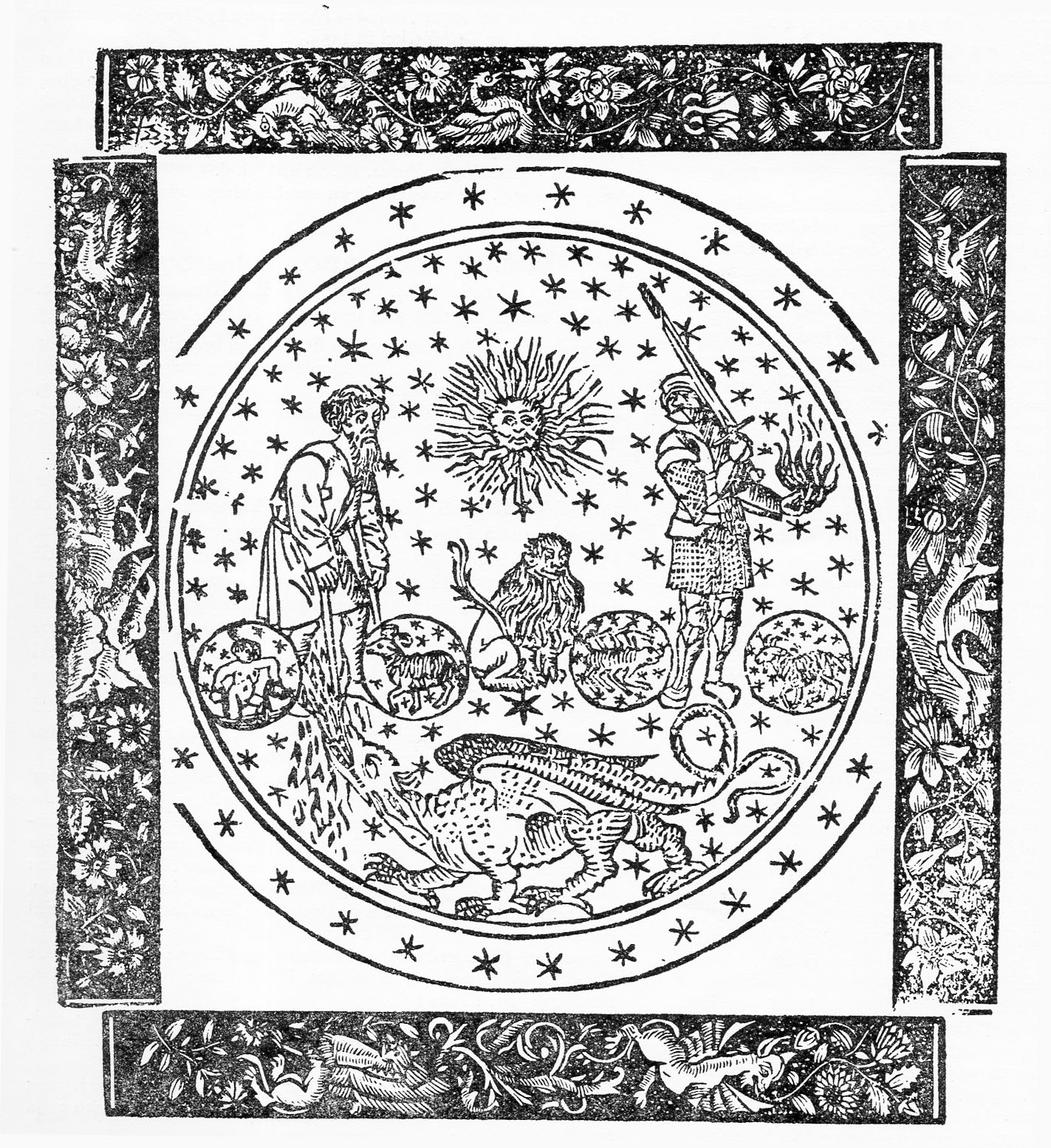
    Scepper anti astrology773
    Cornelius Duplicius Scepper (1500-1555) not only presented a beautiful book for publication in 1523–it was a work of deep scholarship, and it was edgy. Not skeptically-edgy, but a scientific-presentation-edgy, dismissive-via-the-facts-edgy. 

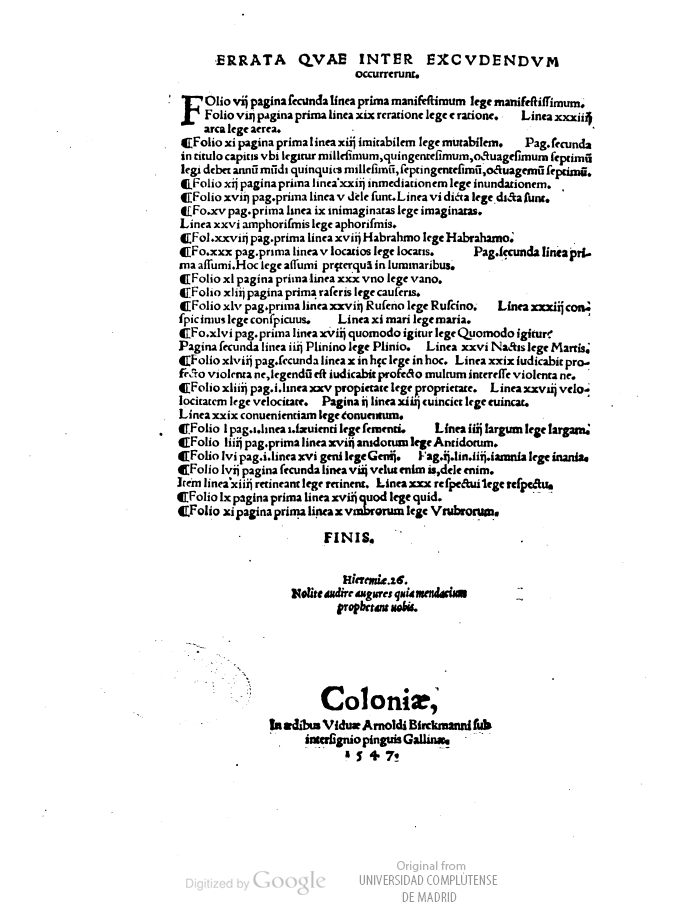
    The book (only two copies of which are found in libraries worldwide–at Brown and Oxford–though an online version is found here), Assertionis fidei adversus astrologos, sive signicationibus  coniunctionum superiorum planetarum anni millesimi quingentesimi vicesimi quarti, was published in Antwerp for Franc. Byrckman on  16 May 1523.  (The colophon at end describes the publication data so: “Symon Cocus, & Gerardus Nicolaus … excudebant. Anno salutis humanæ  MD.XXIII die xvi Maij. Impensis honesti viri Francisci Byrckmā …”)

    The book evidently takes great and scholarly pains to point out any number of errors in miscalculations by astrologers, the weight of which and the diligence in historical presentation amounted to the book being a refutation of the claims of astrology. Among his many refutations is one that is quite simple and elegant: Scepper figures out that the starry firmament is at least 65 million miles from Earth, which means that the great vault is deeper and bigger still, and so given the size and the distance and the number of elements involved, it would be asking quite a bit of common sense to believe that all of that was having an effect upon the individual lives of Earthlings.  Pretty good stuff for almost 500 years ago.

    And just for the fun of it, here’s a compilation video of tasty astrology debunkers, including Sagan, Dawkins, Tyson, Nye and Randi. Actually the James Randi part at about 4 minutes is absolutely priceless. 


    Notes:

    Scepper also wrote a biography/history of Charles V: Rerum á Carolo V. Caesare Avgvsto in Africa bello gestarum commentarij elegantissimis iconibus ad historiam accommodis illustrati. Authorum elenchum, è
    quorum monumentis hoc opus constat, sequens pagella indicabit in 1555.

    The colophon:

    Scepper colophon


  • Great & Lost-in-the-Dust Books: Love & Sex and the Freedom from Sin, 1549

    JF Ptak Science Books   Quick Post 

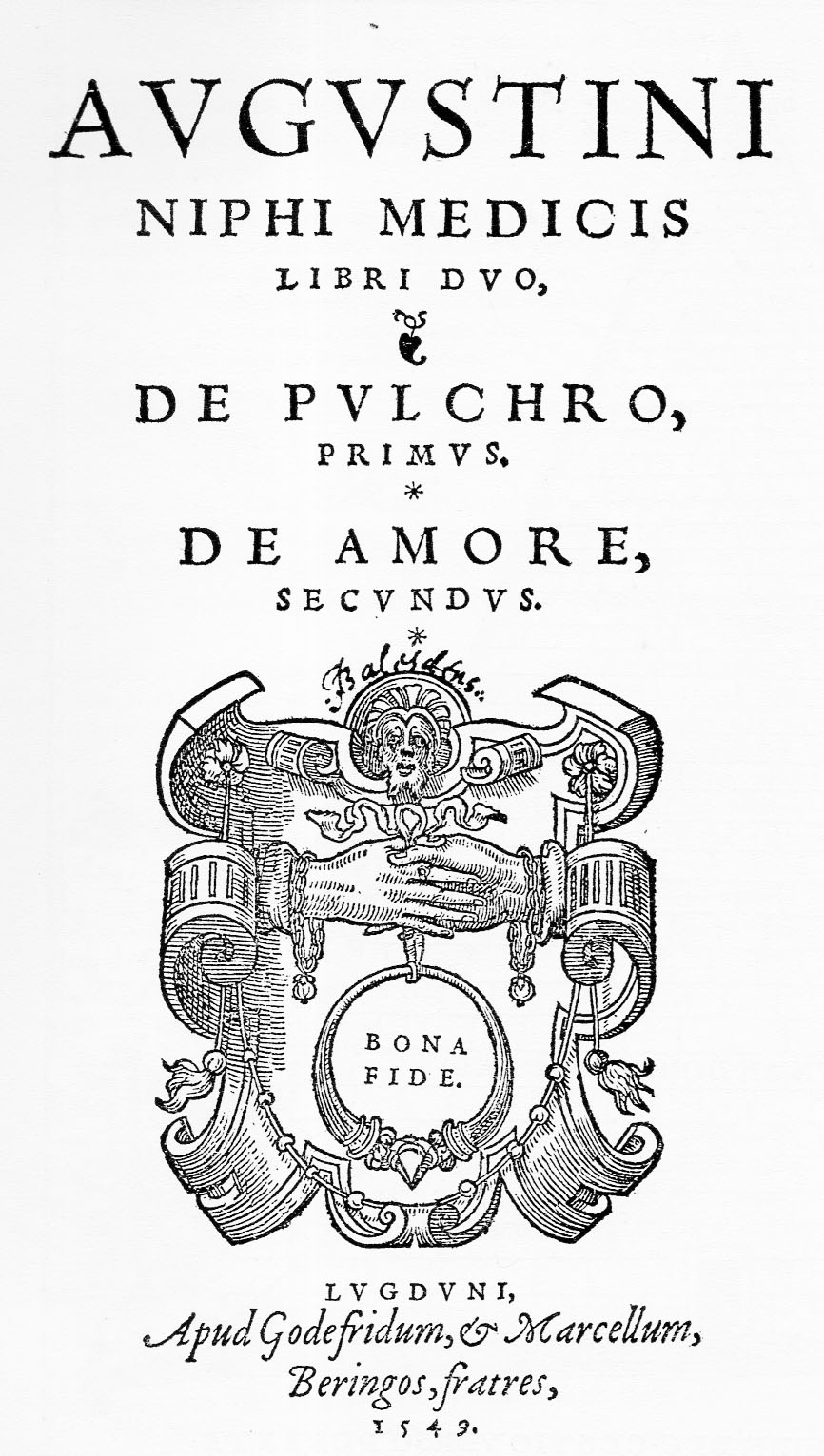
    In Agustus Niphus, Libri Duo de pulchro liber primus, de amore librer secundus, and printed in Lyon by Beringen in 1549, the scholar and Aritotelian Agostino Nifo of Sessa (1473-1546) wrote two significant treatises on the nature of beauty and love (liber primus and secundus, respectively).

    The amazing thing about this work is that Nifo analyzes the conditions of love and sexual expression as respondents to a  psychological basis, and since this was so, that love and sex are a product of the mind and not necessarily a simple undisclosed deire, that the act and thought coul dno tbe considered to be of siunful natures–basically, the two were as natural a thing as could be, and one does not condemn the acts of nature.

    Title pages bona fide775

  • Bus-Punk, 1934

    JF Ptak Science Books     Quick Post   [Also see an earlier post here on Air-Punk & Underwater 19th Century Cyborgs]

    Bus776

    This land-whale of a vehicle, a bus design for “Land Crusing De Luxe”, is left mostly to our imagination so far as specs and stats go.  It looks as though it would accommodate perhaps 14 people on a long haul.  There were two levels of living space as well as room for two (or four?) in sleeping quarters…perhaps a more luxurious class was seated downstairs.  In any event there were three attendants on the bus for its not-many passengers, including a chef, a seward and a driver. (Elsewhere in the article the driver is referred to as a “pilot”.)  

    I’m sure this would have been a beautiful thing–I picture is red on black, with an ultra-shine.  I’m also sur ethat it would have been a delsight.

    Source: Popular Mechanics, August, 1934.

  • Unusual Title Pages: Burning Metal, 1530

    JF Ptak Science Books   Quick Post

    Title pages burning metal774

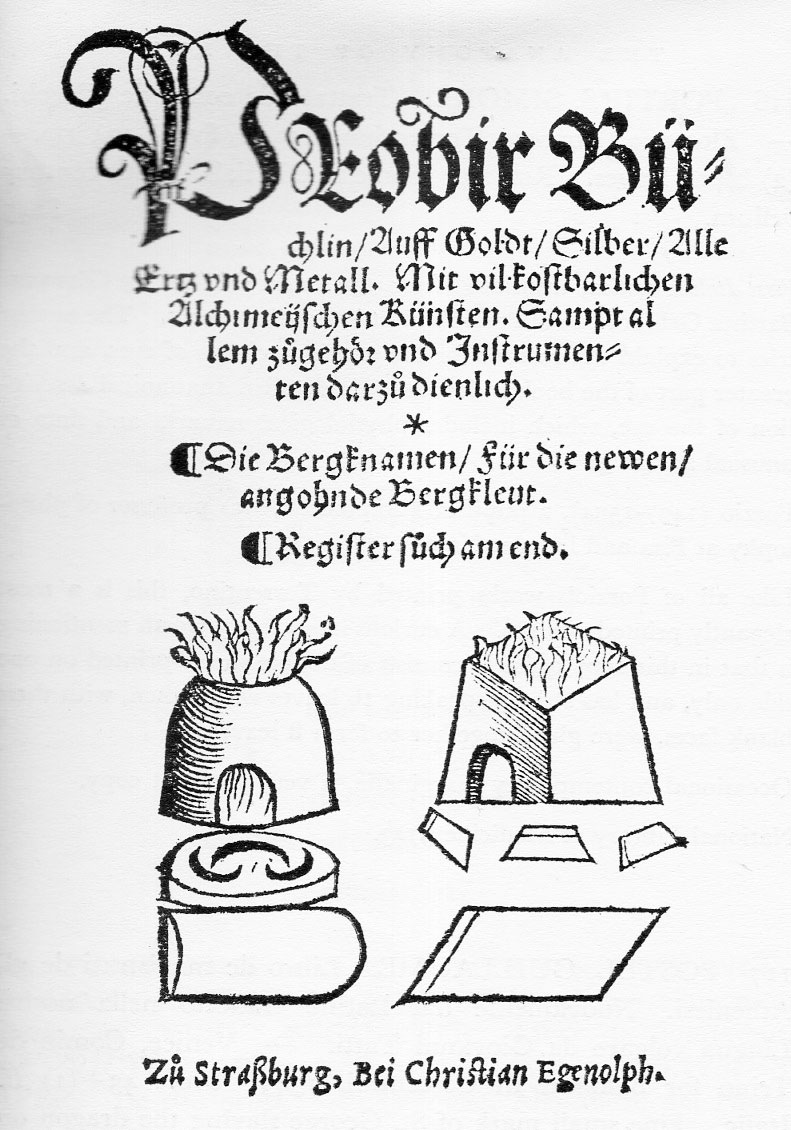
    The Probierbuchlein (Probir Buechlin/auff Goldt/SIlber/Alle ertz und Metall. Mit vil kostbarlichen Alechimeijischen Kunsten…) printed in Augsberg by Christian Egenolph in the autumn of 1530, was the first German book to deal with the significance of alchemy and metallurgy.  I think it usual to think of the work of Georgius Agricola (1495-1555)  and his justifiably famous  De Re Metallica, but the anonymous (?) Pribierbuchlein predates the work by at least 36 years. There’s not much else of a comparison between the two works save for the earliness of the Probierbuchlein, as it was 48 folio leaves and somewhat restricted–but first is first, and it may have made the way easier for Agricola, whose own efforts paved the way for the systematic study of the Earth   Agricola made fundamental contributions to mining geology and metallurgy, mineralogy, structural geology, and paleontology, and outlined them all beautifully in a book that was ten times the length of the Probierbuchlein, and also fabulously and sumptuously (and usefully) illustrated.

Recent Posts

Archives

Categories