A Daily History of Holes, Dots, Lines, Science, History, Math, Physics, Art, the Unintentional Absurd, Architecture, Maps, Data Visualization, Blank and Missing Things, and so on. |1.6 million words, 7500 images, 4.9 million hits| Press & appearances in The Times, Le Figaro, Mensa, The Economist, The Guardian, Discovery News, Slate, Le Monde, Sci American Blogs, Le Pont, and many other places… 5000+ total posts since 2008.

  • The “Gentle Pressures” of Adolph Hitler (1936)–the Viewpoint of a Nazi

    JF Ptak Science Books  Post 2349                                                                                        

    Poster soviet america375

    I came to this pamphlet from a design/composition point of view, finding in it a peculiar attractiveness in its gritty-typeface and loud speculation.  That said, the title is of little use to tell us of its contents, and so opening to page 37 (in deference to my wife Patti Digh who finds much significance in the number) I found on the opposite page the “it does not matter that the German people of the Reich have a different form of State from America”, and that the form of state so far as the Germans were concerned was “a matter of fate”.  

    Interesting, and, well, unfortunate, because the publication date of the work is 1936.  The author, Mr. A.T. Fredex, implores the reader to consider that there is “no more a liberty-loving people than the Germans”, and that they are a free and liberated people.  The German state of today was subject of certain internal “troubles” and that successions of leaders–for the good of the people–were forced to keep the nation together with “more or less gentle pressure”.

    And so the skeleton of the fleshy produce of the pamphlet is revealed.  “Already the sneers of the yellow and black races are haunting us”, writes Mr. Fredex, who continues in just the next paragraph that all that remains to happen would be for Socialist France to “mobilize her millions of Negroes” along with the help of “Bolshevist-Mongolian Russia” against Germany, which would be the last refuge of normalcy in Europe, the thing protecting the Western world from who-knows-what.  

    All of this is in three paragraphs of one page.  Then comes the race part, the Teutonic purity and excellence part, and the horrors of race-mixing and “mixed blood” that will wind up dooming America.

    I skipped ahead, or behind, to the end, where we are warned by Mr. Fredex to awaken our Nordic interests should Germany fail to hold back the assaulting races.

    This is really quite a story to unfold in just two of the pamphlet’s 56 pages–the rest of which I think need no further exploration.  

    The pamphlet cover, though, retains its interest, forensically speaking, and can only hint at the pamphlet’s evil and filthy contents.
     

    ·Posted by :

    ·in:

  • Composite Nothingness and the Archaeology of Visual Errors

    JF Ptak Science Books  Post 2350

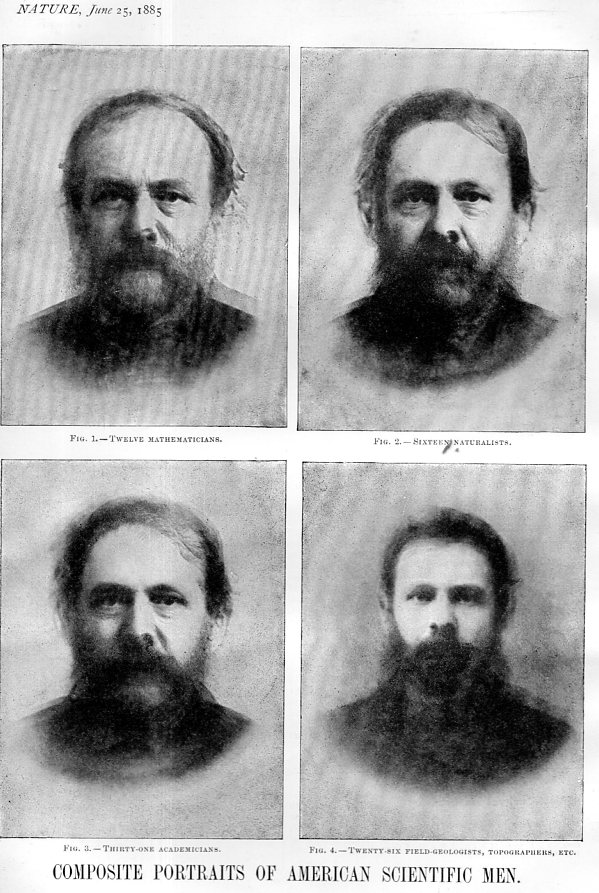
    Building on some reaching and questionable physical identification work of Sir Francis Galton, Raphael Pumpelly tried to make photographs of what scientists looked like. 

    At a scientific meeting of the National Academy of Science in Washington D.C. Pumpelly (along with Dr. (Thomas Mayo) Brewer and the Secretary of the Smithsonian Institution, (Spencer F.) Baird) undertook the experiment to determine whether or not there was a certain composite “type” in groups of academicians.  He employed the justly-named head of the photography department at the Smithsonian, Mr. (Thomas Mayo) Smillie, to make a series of 2-second exposures of the scientists upon a single glass plate.  Two seconds per portrait was not long enough to make a defined portrait for a single sitter, but if there 15 or 30 such exposures on the same plate it was seen that collectively there would be a strong impression.  The resulting portraits are interesting in their won way, but probably not without the backstory.

    Composite593

    ·Posted by :

    ·in:

  • Yesterday’s Future, Yesterday–the Solar Home Prefab (1944)

    JF Ptak Science Books                                                                                          Follow Me on Pinterest

    About a mile from my house is a sign for a small housing development called “Solar Vista”–interestingly the road that leads to it is called “Shadow Lane”.

    ++blog++solar house This interesting and somewhat futuro-paleo 1944 pamphlet combines two modern interests in one package:  Green’s Ready-Built Homes Present the Solar Home1 presented both a prefabricated, well-designed house that was also passive solar friendly. The former is a long-established architectural state of achievement; the later, not so–at least on a popular, let’s-have-everyone-own-one level.  The architect and engineer was George Fred Keck (1895-1980) , a true modernist, and designer of one of the twelve “Homes of the Future” for the Chicago “Century of Progress” World’s Fair of 1933–this effort (which is also the copyright deposit copy) was published in 1944.

     Soalr panels such as we have known them over the last few decades were not available back in 1944. The “solar home” that he offered here used seasonal variations and house location to regulate heating/cooling, glazing and siding, air movement, and the storage of thermal energy in building materials—mostly, there were lots and lots of transfer-friend++blog++solar house 001ly double-paned windows, all of which were forward-thinking ideas for 1944.  In addition the house was prefabricated, making construction easier, simpler, and quicker than any of the stick-built houses being constructed at that time.  There was also an impetus for quick, good construction given the housing shortage caused by the returning WWII veterans. The prefab idea was also a relatively new one in architecture—though there are instances of bits and pieces of prefab architecture reaching back hundreds of years, the first earnest attempts at providing such housing on a mass scale dates only to the 1920’s. In any event, the double-effort here was a fairly early effort at combining these two ideas–and certainly something that seems to have been about 60 years too early.    


    ·Posted by :

    ·in:

  • A Great Ad for the Comptometer, 1894

    JF Ptak Science Books   Quick Post

    Earlier in this blog I posted a magnificent illustration of the fabulous new comptometer adding/calculating machine, here.  I wanted to include this unusually designed ad for the machine somewhere on the blog before I lost it (again), and so here it is:

    Comptometer379In my experience the use of diagonal black-and-white lines like this for illustration or advertisements was really very uncommon.  

  • The Plane-Train and the Elimination of Curves, 1894

    JF Ptak Science Books   Quick Post

    Plane-train376

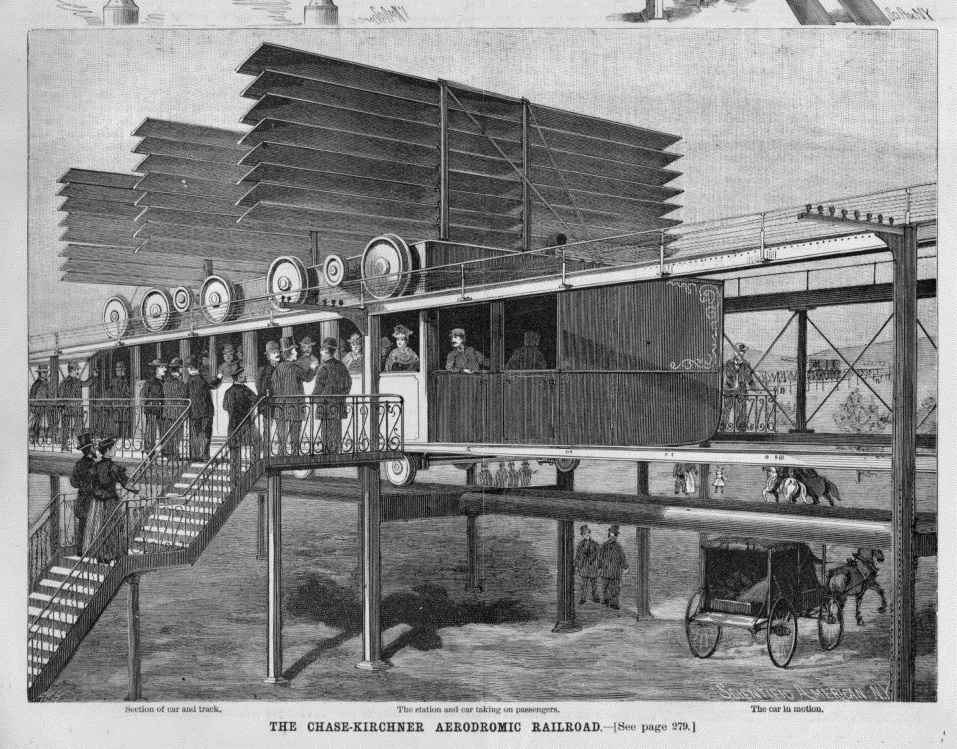
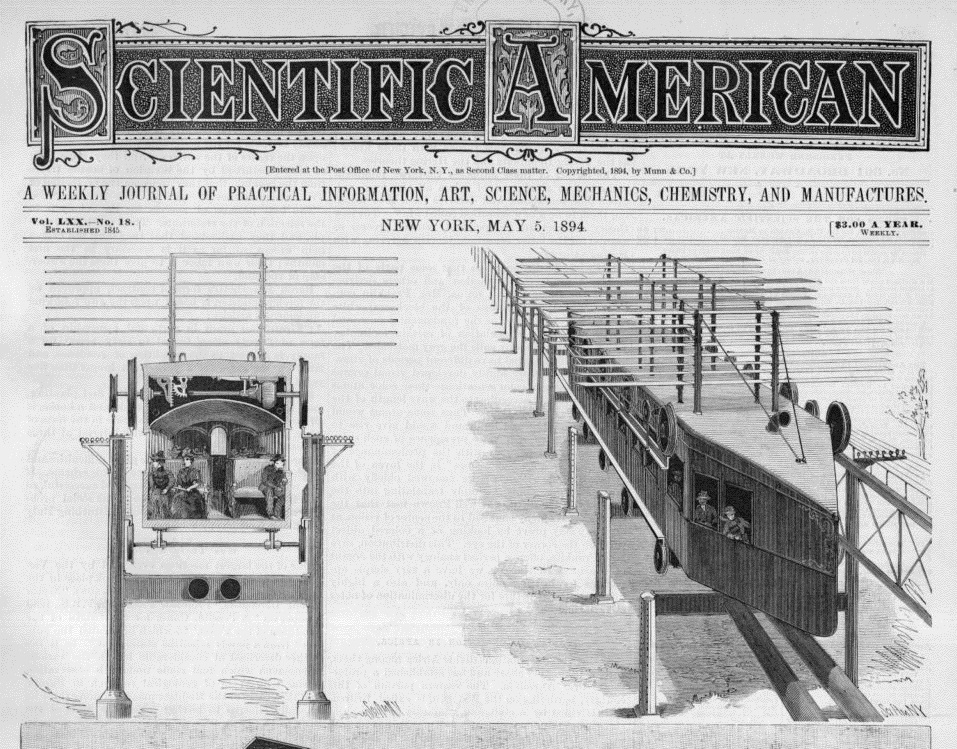
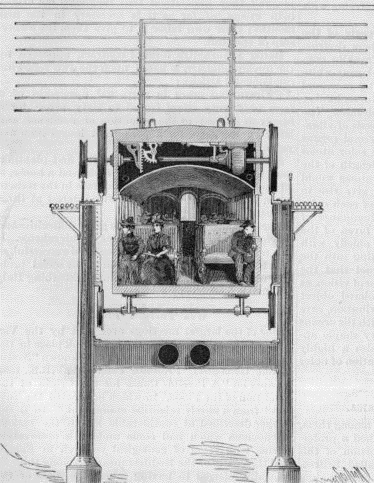
    In the history of transportation there haven’t been many marriages between trains and planes.  There have been proposals for Trains-Boats as we’ve seen in proposals for transporting ocean-going ships on a ganged series of railway cars and pulled  x-number of locomotives across the isthmus of Tehauntapec. I also recall a Balloon-Tramway-Train where hot air balloons were guided along a particular harnessed route 50 feet above the ground for miles and miles.  But the plane-train not found on the covers of Popular Mechanics in the 1930’s and 1940’s is a rare sight. I did spot a fantastic example of one though on the front page of the Scientific American for May 5, 1894. 

    Plane-train377

    It is a splendid beast–electric, under-powered, very heavy, and full of friction.  Somehow the engineers envisioned the train reaching speeds of over 130 mph, and with speeds this great it was essential that all curves be removed from the coast-to-coast rail line, making this a straight shot from coast-to-coast, literally.  (This would have just about doubled the land-speed record for sustained travel by rail, by steam.  I’m not sure what the record was for electric trains, though I’m pretty sure it is safe to assume it wasn’t close to the steam record.)

    The part about removing curves was mentioned twice in the article, so it was definitely not a typo.  The adjustable wings (here called “aeroplanes” which was the beginning of the terms that we now use to describe the whole aircraft) were added because it was felt that they would provide (some sort of) lift to the train. At the very least it was an interesting idea for 1894, and the wings would certainly have served a function of slowing the train down if they didn’t get ripped apart in the process.  

    Plane-train378

  • Babies, Gas, and War (1943)

    JF Ptak Science Books  Quick Post


    0 blog jan 12 baby gas380
    There’s nothing that shouts “WRONG” with greater voice than images like this.  Like pornography and art, things that are just plain wrong are instantly recognizable, and this is a fine example of that thinking. Anti-Gas Protective Helmet for Babies, Manual of Instructions was prepared for the Office of the Director of Civil Air Raid Precautions of Ottawa, Canada, and published in 1943.  I’m not sure that the image of the nurse in the gas mask isn’t as disturbing, but the two of them together is just too much.  

    I wasn’t aware of the gas attack preparations in Canada–the situation was entirely different in Britain, where everyone was required to own a gas mask, and by 1940 more than 38 million had been distributed to the population.  But the planning was underway in Ottawa in ’43 for the worst, as removed and distant from the war as just about any other place on earth–but the Air Raid Precautions people pulled no punches in their hearts and minds campaign, and I’m sure that it was very effective.  This little pamphlet certainly caught my attention. 

    And it wasn’t as though the United States, the United Kingdom, Japan, and Germany weren’t doing anything about poison/nerve gas during WWII–they were.  There was very little use of CW during the war, though the Japanese military did use it relatively widely against Chinese troop,s guerrillas and civilian populations during several years in the war between Japan and China leading up to the outbreak of WWII.  There were large stockpiles of CW in the U.S, Great Britain, and Germany, though the weapons were allocated for last-ditch doomsday operations should the opposing side start using them first.  

    0 blog jan 12 baby gas381

    ·Posted by :

    ·in:

    —
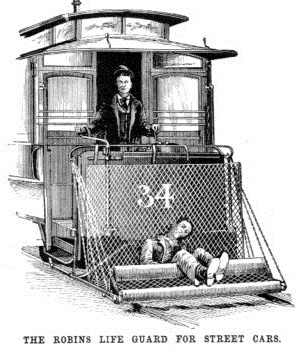
  • Tech Quiz: Oblivious/Careless Chaos-Catcher, 1894

    JF Ptak Science Books   Quick Post      Tech Quiz/What is It? series

    This is an addition to the infrequently-seen What is It? series of this blog…

    Okay, so I’ve given it away in the title–if not for that, this wouldn’t be a very obvious contraption, would it?  

    People catcher detail

    There must have been a lot of people who had a problem with street cars in the 19th and early 20th centuries because in my meanderings through the Scientific American I have seen quite a few suggestions for dealing with the pedestrian vs the heavy moving metal problem. Many of them have to do with the humanified locomotive cow-catcher–that is an apparatus that would somewhat safely scoop up the unfortunate pedestrian before they became very fatally unfortunate.  Here’s just one example, found in the February 3, 1894 issue:


    Pepople catcher380

    Neither the scoopee nor the scooper look pleased.  

    This problem is better illustrated by an early film of street traffic–it is amazing in a way that the orchestration of non-fatalities is so seemingly superb, the coercive element of the destruction of liminal space pretty well hidden in the seeming confusion. 

     [Via youtube, “From trolley, down Broadway and Union Square. Street scenes, stores, crowds, carriages.–Early 1900’s”]

  • A Painted Graffiti for the First Nuclear-Powered Electricity

    JF Ptak Science Books   Quick Post

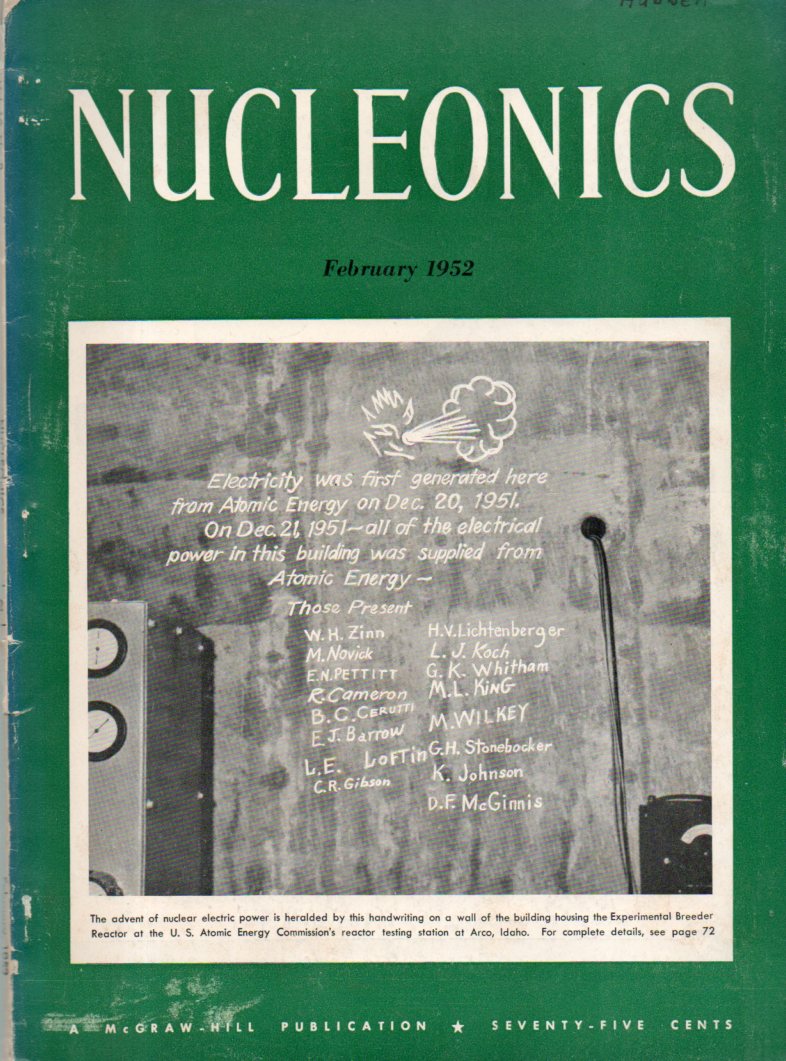
    This issue of Nucleonics (published by McGraw-Hill beginning in 1947) celebrates the very first production of electricity by nuclear power.  The simple and charming painted declaration on the side of the experimental breeder reactor (EBR-1) at the National Reactor Testing Station in Arco, Idaho (a National Laboratory) commemorates the occasion, which occurred two months earlier, on December 21, 1951.  This was research carried out to see if the breeder reactor was a feasible and workable possibility–and the team, lead by William H. Zinn who “signs” the document first, concludes that this was the case. This remained an experimental unit until it was deactivated in 1964–though it did suffer a partial meltdown in 1956.  In any event, I wanted to share this simple declaration of success for a major achievement. 

    Nucleonics382

    ·Posted by :

    ·in:

  • A Picture of Sound, 1923

    JF Ptak Science Books  Post 2350                                                                                              The What is It? series

    Talkie detail


    Talkie383

    [Source: author’s collection] 

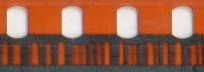
    This is a three-frame snippet from what is evidently among the first true talking motion pictures. It was engineered by Lee de Forest (1873-1961, inventor of the first triode vacuum tube, the Audion, in 1906, earning him the sobriquet of “the Father of radio”) and shown in NYC in December, 1923, which was nearly three years ahead of what is commonly thought to be the first ‘talkie”, the Al Jolson vehicle The Jazz Singer (1926).  Although not truly a first/first, The Jazz Singer was certainly the first mass-distributed talkie, and the first monetarily successful one.  The de Forest film was a sound-on-film motion picture, which represented the culmination of efforts to reproduce sound in the movies by many different practices, none nearly as successful as synching up the sound/film so that there was no displacement between the two.  Here wwe see the sound as the horizontal bars running along the left-side of the film, which in effect is the visualization of the medium of the movie industry to come. (The attempts at sound motion pictures are almost as old as the pictures themselves, the earliest version being simple recordings of the audio on a disk, then played along with the showing of the movie in two different systems.  Compared to nothing at all, these advances were very notable, especially if the timing between the two elements wasn’t off by very much.  These of course failed entirely in the face of the sound-on-film advancement.)  

    The breakthrough by de Forest turns out to be one of those stories where the inventor and brains behind the technological advance tries to implement and market the thing themselves, only to fail at the economic aspects of a great invention.  

    Film from the estate of Harold Sunde (1910-1991), who was responsible for the explanation and demonstration of the RCA “Photophone” invention–one of the earliest simultaneous sound-on-film recorders and projectors, and introduced the machine to England and Russia, where true sound-on- film motion pictures were seen for the first time.  

    ·Posted by :

    ·in:

    —
  • PowerPunk Locomotives, in Color (1942)

    JF PtakScience Books   Poster Series 

    Poster llotives

    [Image source: Library of Congress]

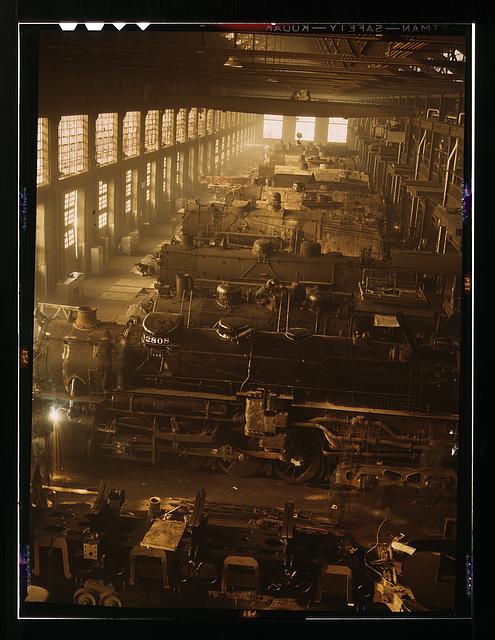
    This magnificent photograph was made by Jack Delano (1914-1997) while working for Roy Stryker at the Farm Security Administration agency (FSA).  It is called “C & NW RR, Locomotives in the Roundhouse at Proviso Yard, Chicago, Ill.”, and was made in December 1942.  This has long been one of my favorite images in the FSA color archives. 

    One of the great innovations in a sea of great things accomplished during the Franklin Roosevelt administrations was the formation of the Farm Security Administration, a division of the government established to help farmers through the devastating Dust Bowl and Great Depression.  A subset of the FSA was a photographic unit which was set up to document the progress made by the FSA (and provide, I am sure, for some much-needed good news, a hearts-and-minds campaign).  This division was headed by Roy Emerson Stryker, who wound up hiring a collection of dream-team photographers unlike any ever assembled for a single purpose.  Esther Bubley, Marjory Collins, Mary Post Wolcott, Arthur Rothstein, Walker Evans, Russell Lee, Jack Delano, Gordon Parks, Charlotte Brooks, John Vachon, Carl Mydans, Dorothea Lange and Ben Shahn were sent out all across the country and wound up with the greatest and most beautiful photographic history ever assembled in the United States.  There were about 77,000 images made, and I recall reading (somewhere) that the total budget for the Stryker group for the years 1936-1942 was about $100,000, meaning that each completed image cost just over a dollar apiece. So far as art funding by the government is concerned, that about the best it has done.

    (I can offer a print of this image as all o fhe work done for the FSA and Office of War Information and for the federal government in general are without copyright or personal ownership and are the property of the people of the United States. The blog offers a 13’x19″ poster of this, here.)

    And another view of the work area:

    Poster, locomotives

    ·Posted by :

    ·in:

  • Bombs of Fuel Delivery–the Future of War, 1974 (1958)

    JF Ptak Science Books  Quick Post

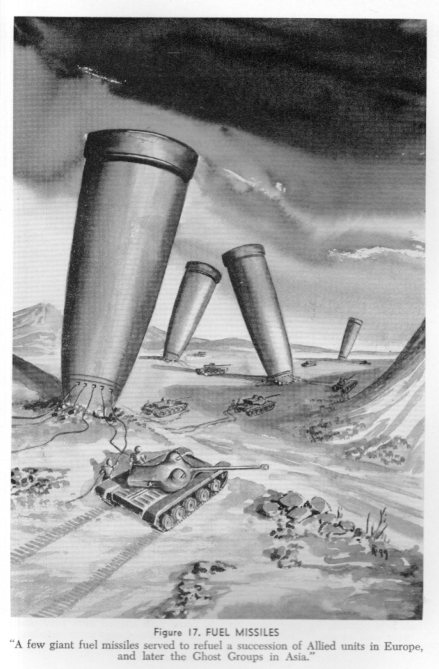
    This is one of hose books that I couldn’t possibly spend any time with, save for skimming the illustrations looking for something unusual. Generally popular books published by Certain Publishing Houses on the future of warfare tend to read like bad sci fi–having not read this one I can’t address that here, though this pic found at the end of the book may offer a little insight to the rest of the book’s content.  The author was a tank commander of high distinction, which might explain at least his hopes for the technological breakthrough of delivering fuel to motorized units in the front line–via “giant fuel missiles”. Evidently these enormous missiles (the width of a tank) and filled with fuel is somehow launched and the projectiles fall gently enough to stand precariously on their own with the top 5% of the length buried a slight bit but somehow enough to support the weight of the missile and the contents.  Remarkable.

    War 1974384

    ·Posted by :

    ·in:

    —

Recent Posts

Archives

Categories