A Daily History of Holes, Dots, Lines, Science, History, Math, Physics, Art, the Unintentional Absurd, Architecture, Maps, Data Visualization, Blank and Missing Things, and so on. |1.6 million words, 7500 images, 4.9 million hits| Press & appearances in The Times, Le Figaro, Mensa, The Economist, The Guardian, Discovery News, Slate, Le Monde, Sci American Blogs, Le Pont, and many other places… 5000+ total posts since 2008.

  • Motorheads: H-D Engine Overhaul, $47.50 (1948)

    JF Ptak Science Books   Quick Post

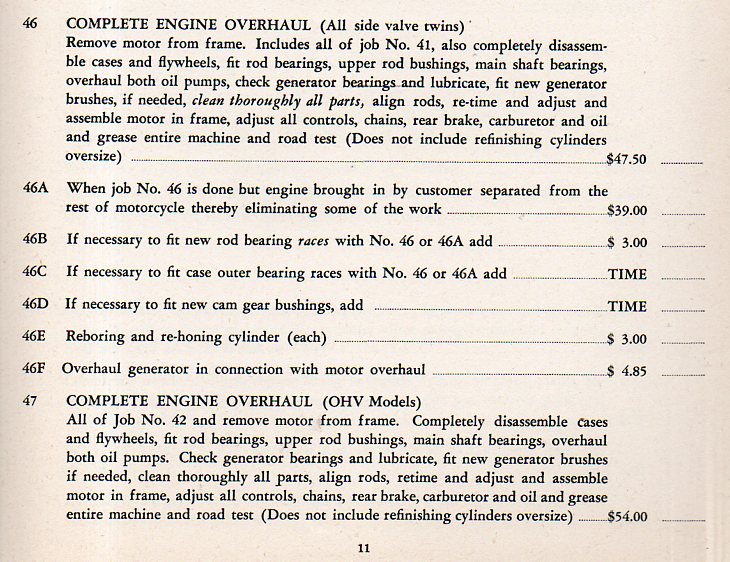
    Harley370Okay, so they were diferent times, and the money was different, and the different was different.  Still it is surprising to see in Floyd Clymer’s (of L.A.) Flat Rate Service Charge Manual for Harley-Davidson Motorcycles listing an off-the-shelf engine overhaul for $47.50–especially when Mr. Clymer’s paper manual of pricing suggestions cost two bucks, which was about 5% of the Harley engine work, parts and all.

    The average yearly salary in 1948 was about $3,600, or about $35k translated into today’s buying power–which means the overhaul was costing 1.5% of the yearly salary, or about half a week’s salary. Not bad. 

    Also: “rewire complete all big motors”, $10; “remove and install ignition coil”, $2.60; “remove transmission and clutch”, and clean and fix it, $16.50.  And on and on. There are 64 repairs and sub-repairs, and it all looks pretty remarkable to me.  


    Harley369

    ·Posted by :

    ·in:

  • The Physics and Non-physics of Catching a Baseball

    JF Ptak Science Books  Post 2348

    If I was a Nazi going back in time and given the opportunity to assassinate five allied leaders to change the direction of the war, I’m pretty sure that one of my choices would be Vannevar (that’s “van ee var” Bush (not related to you-know-who).1  He was the head of the Office of Scientific Research and Development (OSRD) for the U.S. for World War II, which is saying A LOT.  It was his responsibility to determine where and how to apply effort and brainpower and money for the best outcome to win the war–and he did a fabulous job.  Wasted effort/money/power/intelligence costs a lot, especially during wartime, and Bush did an absolutely superior job in performing this task. He was also a great engineer, a fine creator of analog calculators; he was a visionary and often is referred to as the grandfather of the internet; he was VP of MIT, and many other things, on and on.  

    However, in his grand opus one thing he wrote was that baseball was not a scientific game.

    I’m pretty sure he was joking around because the game is all angles of motion and repose (and a lot of the later), of effort and response, and in the immortal words of the Great Beakman (of TV science show for kids fame), “everything goes somewhere”.  

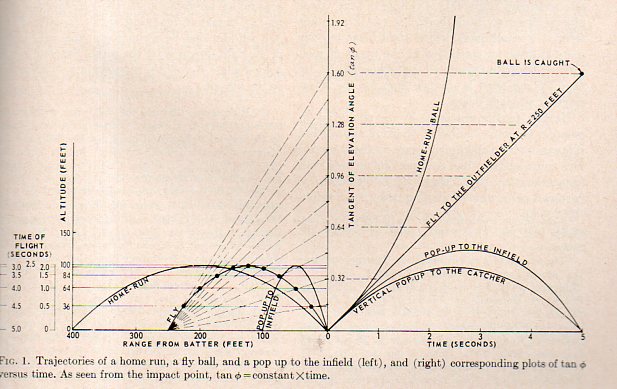
    Bush chose to leave a little mystery in the game when he wrote about it in Science is Not Enough, (1967) in the essay “When Bat Meets Ball”. The pitch, the crack of the bat,the flight of the ball, the outfielder turning instantly to get to the place where he thinks he needs to be, calculating all of this on the fly so that he can catch the ball, is in some sense like tracking enemy aircraft or an ABM.  The outfielder, running along, has sorta figured out the velocity of the pitch and the angle at which the ball leaves the bat, figuring out acceleration, elevation, and manipulates it all in his head to sand in a certain grassy spot to be in exact location to interfere with the ball’s response to all of the vertical and horizontal displacements and the work of gravity to return it to its initial altitude of 0 (+the distance of the glove to the ground).  Which is all pretty cool stuff, and it happens it the rain or wind or whatever conditions and perhaps with a hurt ankle, all of which get tossed into the equations.  

    This is all beautifully addressed in a short article called “Catching a Baseball”, by Seville Chapman of the Cornell Aeronautical Lab in the October 1968 issue of the American Journal of Physics.  Dr. Chapman also offers up the following figure, which is helpful and pretty, but which would have bounced off completely of the invisible shield of fielding mediocrity that enveloped the otherwise fantastically gifted Manny Ramierez (or Ted Williams or any other number of great hitters who were not so much interested in fielding because it wasn’t hitting).  

    Anyway, here’s the illustration from the Chapman article:  

    Baseball physics368

     Notes:

    1.  Some of the others would have ot be Churchill (probably my first choice, because he held everything together from 1940-1942 and created an effective war machine…without him the war may well have been lost, well before the U.S. would have become involved; also of course F.D.R., and probably Eisenhower for his superior handling of the Invasion  and for the push east.  I am not sure about who I might choose on the Soviet side.  I wouldn’t choose them in the first rank, but I’m not sure who I would choose first to do in between Montgomery and Patton–it is easy to neglect Montgomery for all of the obvious reasons, but when everything is said and done he was very effective and successful given his own plodding and unpleasant way)…

  • Old Electronic Brains: 1950

    JF Ptak Science Books   Post 2349

    Berkeley simon915

     
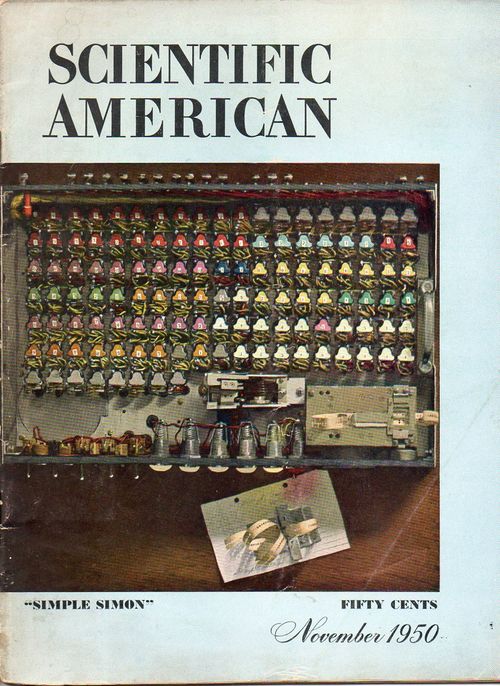
    The first exposure of the American public in general to a “personal computer” may have been in this issue1 of the Scientific American for November 1950–an article called “Simple Simon” by Edmund Berkeley.  ( Berkeley also wrote a book called Giant Brains, which seems to me to be the first mass-consumption book–written in terns for the general public–on how the computer works, and the design of “how a machine will think”.  Berkeley looks at the MIT Differential Analyzer #2, the Moore School ENIAC, Bell Labs’ General-Purpose Relay Calculator, and the IBM Automatic Sequence-Controlled Calculator.) 

    The Simon was a five-hole paper tape (which was its data entry and memory) 2-bit storage relay-based computer that could use numbers from 0 to 3.  It was extremely limited, but it worked, and it was real.  And affordable.  And a baseline for things to come.

    Berkeley introduced the idea for Simon in Giant Brains:

    “We shall now consider how we can design a very simple machine that will think.. Let us call it Simon, because of its predecessor, Simple Simon… Simon is so simple and so small in fact that it could be built to fill up less space than a grocery-store box; about four cubic feet….It may seem that a simple model of a mechanical brain like Simon is of no great practical use. On the contrary, Simon has the same use in instruction as a set of simple chemical experiments has: to stimulate thinking and understanding, and to produce training and skill. A training course on mechanical brains could very well include the construction of a simple model mechanical brain, as an exercise…”–Edmund Berkeley, in Giant Brains, 1949, p. 22 

    In the Scientific American paper Berkeley introduced the machine and how it functioned; he also described three  three outcomes for Simon:

    • First: “Simon itself can grow.  It possess all the essentials of a mechanical brain…”
    • Second: “It is likely to stimulate the building of other small mechanical brains.  Perhaps the simplicity and relatively low cost of such machines may make them attractive to amateurs as the radio set and the small telescope.”  [The “low cost” in 1951 was $600–equal to about $3000 today.]
    • Third:  “It may stimulate thought and discussion on the philosophical and social implications of machines that handle information…”

    Berkeley finishes the three-page article with the following paragraph, looking into the not-too-distant future:

    “Some day we may even have small computers in our homes, drawing their energy from electric-power lines like refrigerators or radios … They may recall facts for us that we would have trouble remembering. They may calculate accounts and income taxes. Schoolboys with homework may seek their help. They may even run through and list combinations of possibilities that we need to consider in making important decisions. We may find the future full of mechanical brains working about us.”

    Scientific American in that same year published another early computer effort of high marks: the great Claude Shannon’s “A Chess-Playing Machine.” This is the first (and popular) appearance of Shannon’s technical paper (which would appear a month later in the Philosophical Magazine), and it is the earliest appearance of an attempt to understand the necessities of a computer for playing a game of chess.

    “Since the mid-1940s, scientists had aimed to create a thinking machine, an apparatus that could compete with or even surpass the human brain in logical operations, pattern recognition, problem solving and even language. Chess was found to be a useful testing ground because of its combination of simple rules and mind-bending complexity… Shannon was fascinated by chess’ potential in the pursuit of what he called ‘mechanized thinking.’ But he became convinced that computer chess and other AI pursuits should not be modeled on human thought… Computers, at least as they were understood then, could calculate very quickly, following programmed instructions. This particular strength—and limitation—of computers suggested a different route for AI, a new sort of quasi-intelligence based on mathematical computation. Chess would be a central proving ground for this new type of intelligence. Theoretically, at least, the game could be fully converted into one long mathematical formula” –David Shenk, The Immortal Game of Chess, pp 201.

    This was another fantastic advance in thinking about computers and their applications at a very early stage of the computer game–perhaps more so with Berkeley than with Shannon, at least for the popular consumption end. In any event, they are both very interesting papers.  

    Notes

    1. Berkeley, E.C. (1950). “Simple Simon” in Scientific American No. 183, November 1950, pp. 40-43. 

    2. Shannon,  Claude E. “A Chess-Playing Machine.” New York:  Scientific American,  1950. Volume 182, No. 2, February 1950, pp 48-52.

  • An Obscure Reference to the Enigma Machine (1942)

    JF Ptak Science Books  Quick Post
     
     
    Books--hagelin


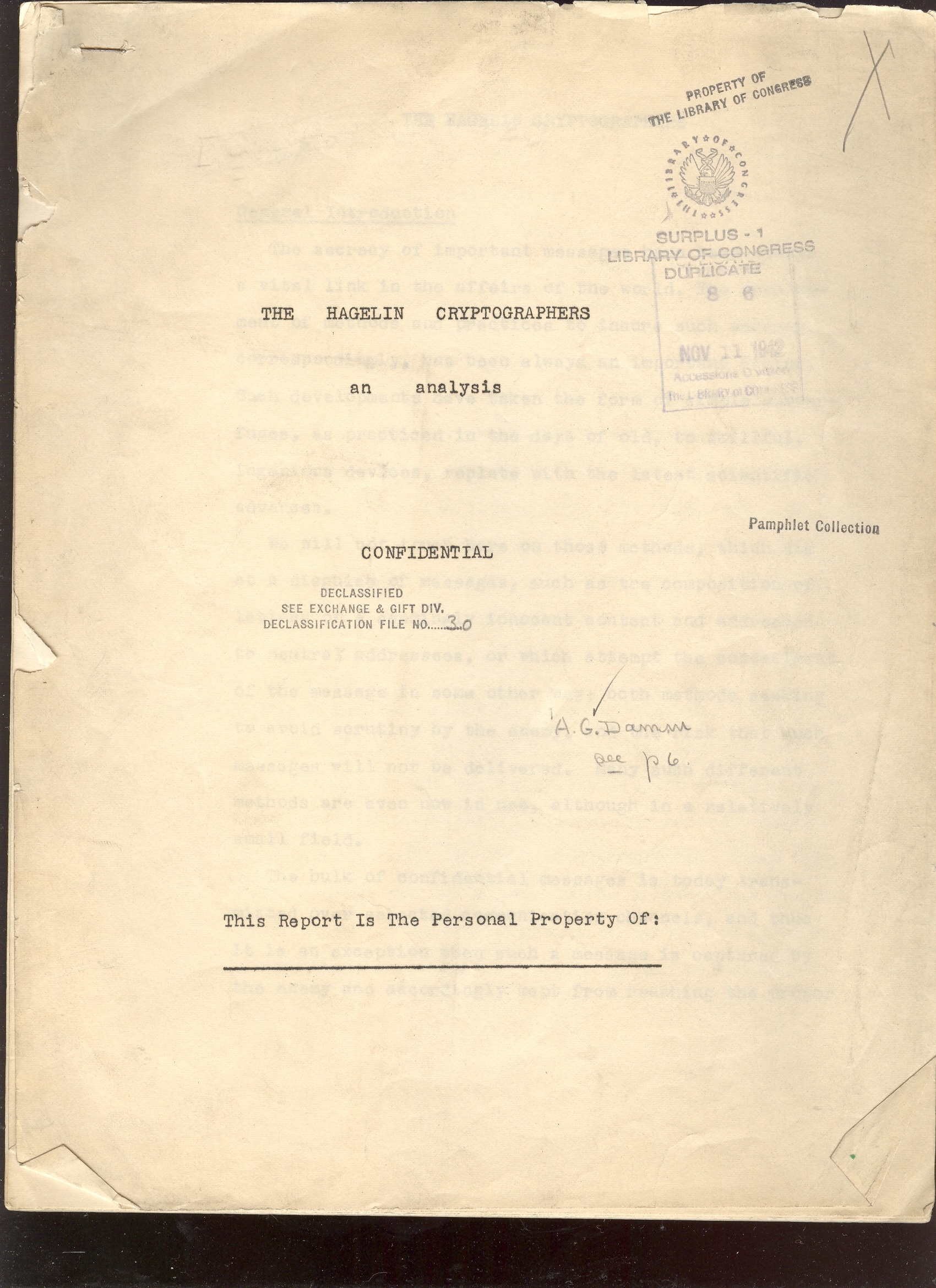
    This is a general report on the origin, development and status of the Hagelin “cryptographers”-a word used here to describe the physical machines used in encoding messages (rather than the people working on codes). It is an internal and “confidential”  report, slender and to the point. Its sections include “Models Built at Express Demand of the French Authorities”, “Evolution of Hand Cryptographer Type C-362”, “Hagelin Cryptographer Models” (BC-38 and C-362), “Methods of Operation”, “Superiority of Hagelin Cryptographers over Competing Makes”, and others, including “How to Sell Cryptographers”. Of particular interest to this post is the mention on page 14 of the “Enigma”, which is really just a very lonely statement, limited to mentioning that the machine is not sold outside of Germany. Of course we well know that the Enigma (which is one of a family of related electro-mechanical rotor cipher machines) was being used very heavily inside of Germany–and France, and the Soviet Union, and several other countries, though it was in fact being used by the Nazi military. It just feels odd and uncomfortable to see this ordinary commercial mention of the machine whose working and transmission was known to the Allies, a knowledge that may well have been one of the great turning elements of the war. And there it is, on page 14, in a restrictive distribution announcement.  

  • Bibliography of Bell’s Theorem

    JF Ptak Science Books   Reference Tools series.  

     Bibliography on Bell’s Theorem.

    This is simply a list of the bibliogrphy from the article on Bell’s Theorem by  Abner Shimony  as found in the (online) Stanford Encyclopedia of Philosophy. I found it useful to segregate the bibliography, and so I include it here.  Again, this is a simple copy-and-clean effort on my part–all of the intellectual work that went into creating this list is the work of Abner Shimony.  

    Aspect, A. [1983], Trois tests expérimentaux des inégalités de Bell par mesure de corrélation de polarization de photons, Orsay: Thèse d’Etat.

    Aspect, A. [1992], “Bell’s Theorem: the naïve view of an experimentalist,” in Quantum [Un]speakables,, R.A. Bertlmann and A. Zeilinger (eds.), Berlin-Heidelberg-New York: Springer, 119–153.

    ·Posted by :

    ·in:

  • Chess Shorthand

    JF Ptak Science Books Quick Post

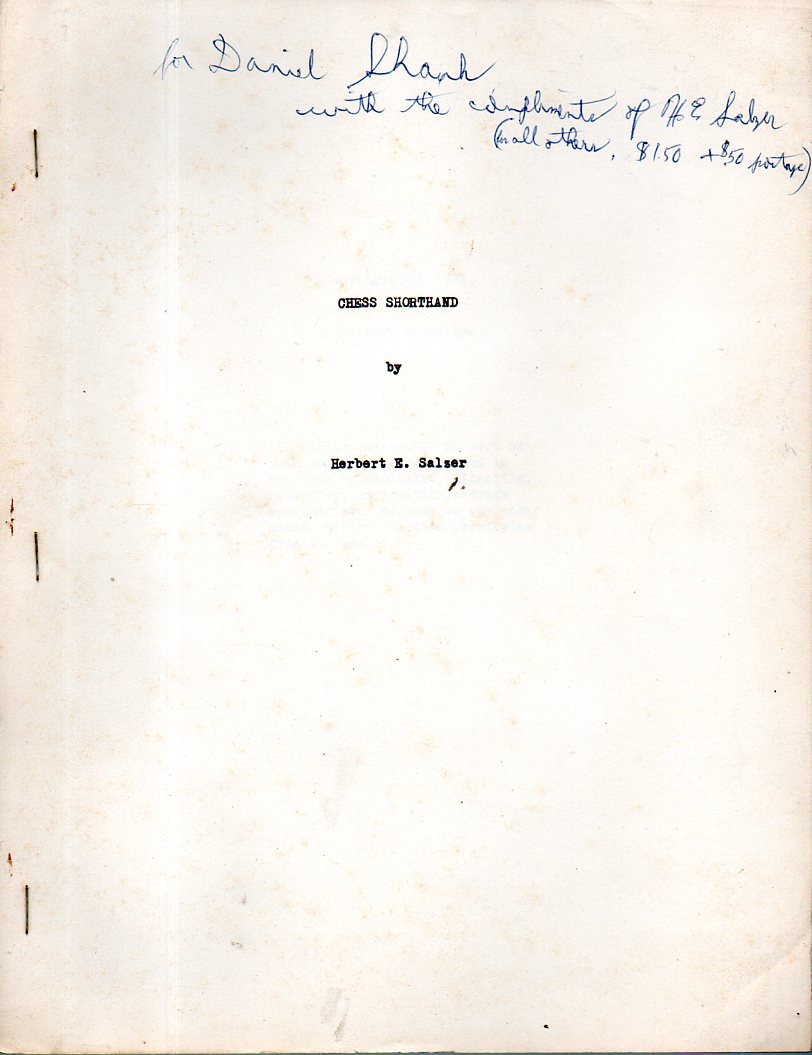
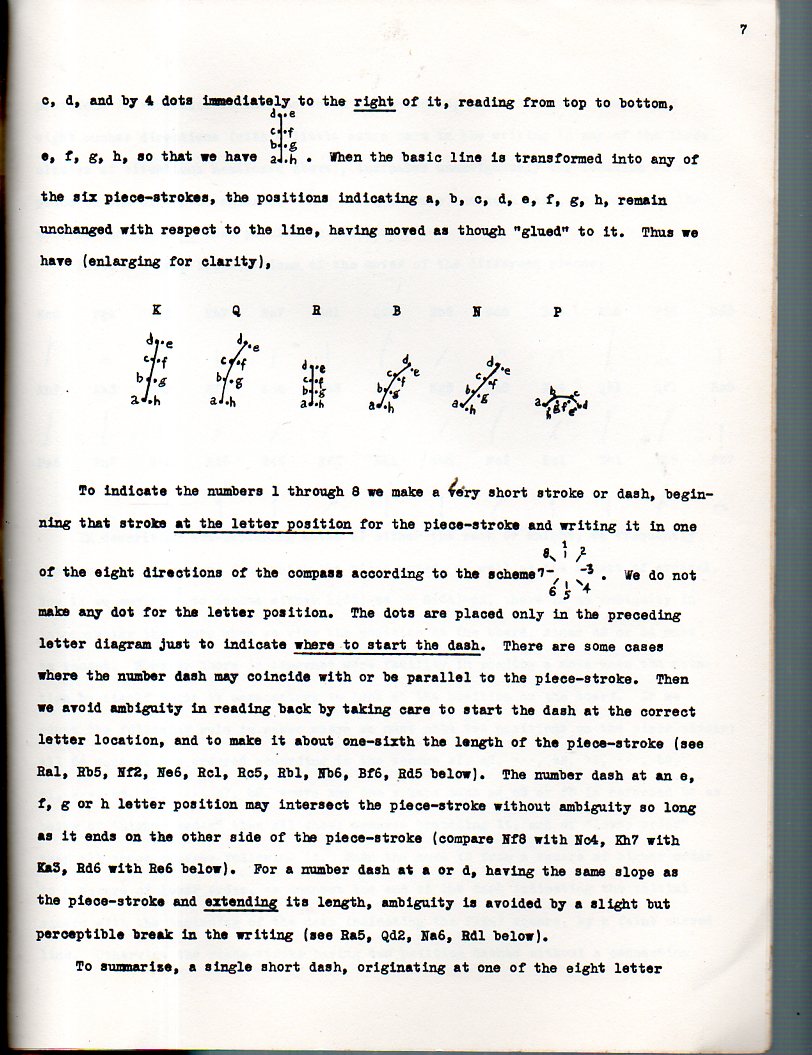
    Chess shorthand558In the occasionally speedy and occasionally not world of chess, it may sometimes be necessary to take speedy-or-not notes.  Chess notation–like algebraic notation (in different iterations), English notation, ICCF notation, and so on–=can reach back hundreds of years. Even the shorthand approach tried out here in mathematician Salzer’s short work dips back into the 19th century (‘Shorthand Notation” by M. Barnard, a short entry in  Chess Player’s Annual and Club Directory, 1893-94 by Mr and Mrs T.B. Rowland (London, 1893)). But the Salzer work is really pretty interesting, and so I thought to at least surface the work.  

    ·Posted by :

    ·in:

  • A Catechism of Communism, 1936

    JF Ptak Science Books   Quick Post

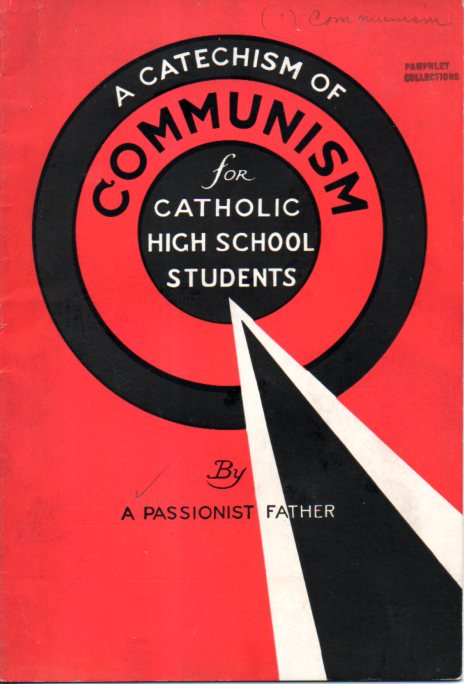
    This is a beautifully design object, and for a moment I thought that this might actually be a sympathetic-Communist pamphlet–something from the Paulist Press, for a Catholic high school system, and from 1936 when there were still plenty of Reds running around the U.S.–so I needed to look around the booklet a little bit. 

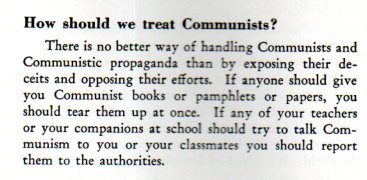
    Communism in catholic school009And of course I found out what it was really about just about instantly, and so there was no mistake about what the Passionate Father was really passionate about:

    Communism in catholic school text010

    This is pretty strong stuff considering that Communists weren’t terribly uncommon in the U.S. half-way through the Depression, though that can be mostly due to the absence of the real story about what was going on in the Soviet Union under mega-murderer Joseph Stalin.  But really it is more the Socialists who were more popular in the off-party politics in America in the mid-’30’s.  In any event the author hit the Communists pretty hard based on their anti-god and anti-Catholic positions, so, naturally, there was very room left at the table of philosophy for the Communists. 

    ·Posted by :

    ·in:

  • The Federal Minimum Wage–Past and Present (Present Passed)

    JF Ptak Science Books   (An extension of a post from 2010)
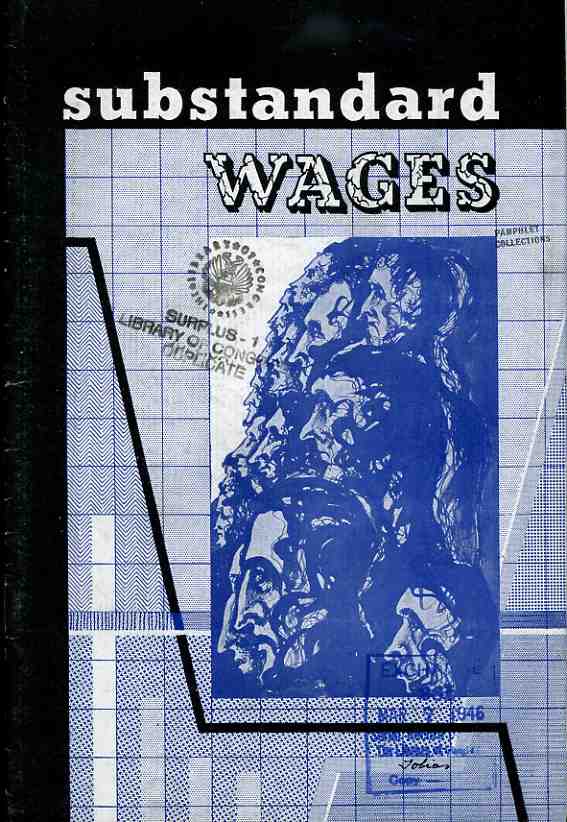
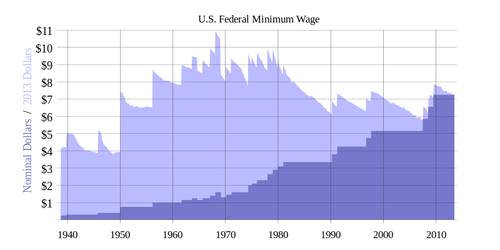
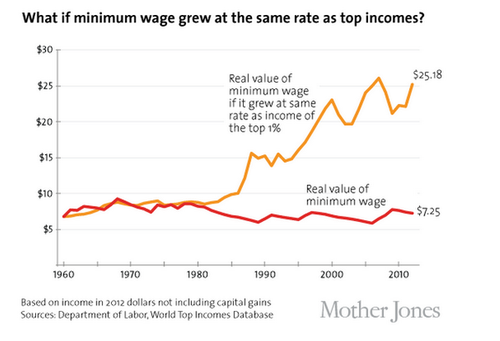
    0 blog jan 30 substandard489I’ve included this post in the Blank/Missing/Empty thread of this blog because the Federal minimum wage has been proportionally increased more so in th e last two years than at almost any time in its history, the increases really only get it up to what it niormally has been, maybe a little higher, with CPI-adjusted. This post is in response to an article in the New York Times today saying that the new minimum wage is equal to that of 1968, which is probably accurate.  The real point is that during the mid- Clinton years and the early Bush yeras the minimum wage languished during a time of tremendous growth for those who already had money–the poor for the years of 1992-2005  were left largely unprotected, unmolested by fortune.

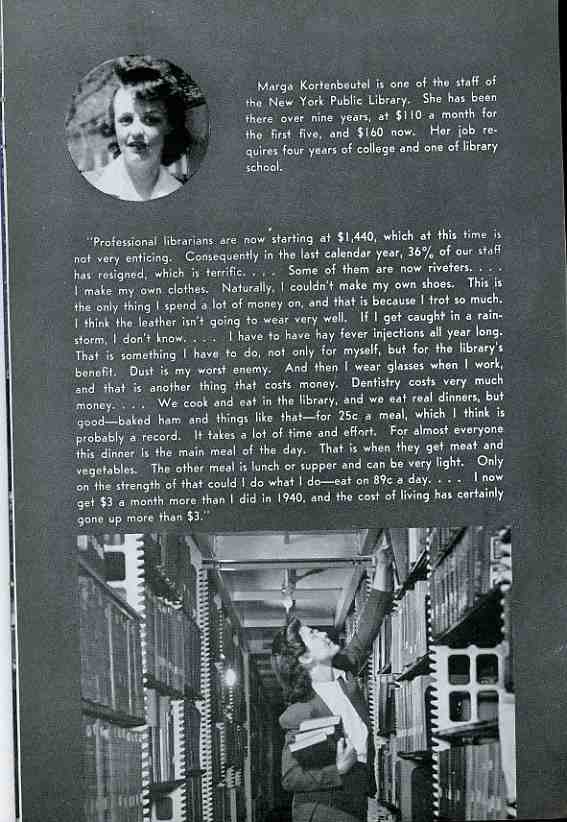
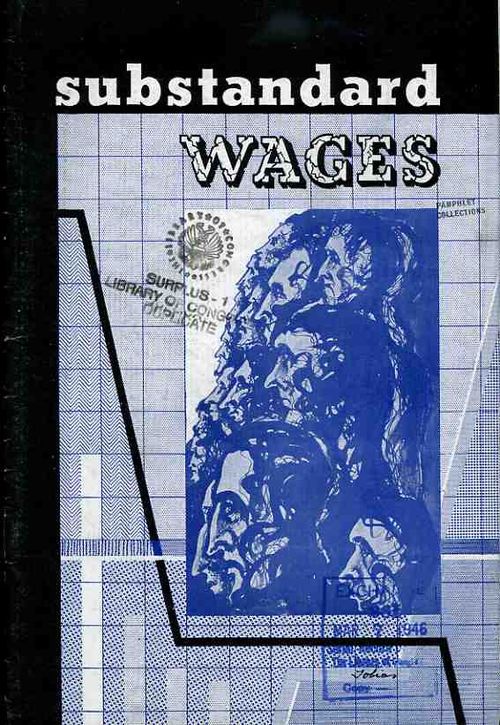
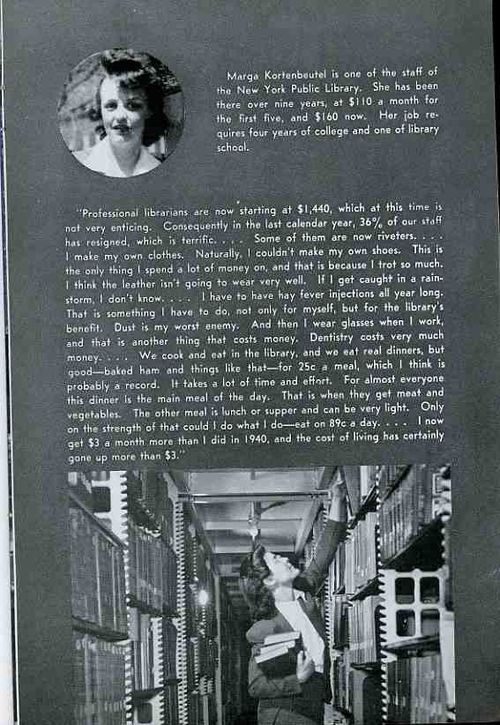
    Leafing my way through this interesting pamphlet, Substandard Wage, an Analysis of their Extent and Effect, and What Must be Done to Establish a Higher Wage Level, design “and presentation” by Abraham Joel Tobias for the Textile Workers Union of America, CIO, and for the Congress of Industrial Organizations, I found some very interesting bits.  First of all, the work was done to aid the working poor, people who were employed and making a wage, but the wage just wasn’t enough necessarily to being them out of poverty.  (The poverty line wasn’t invented as an economic bell weather until 1959.)  The first of the working poor that I read about was a librarian, Marga Kortenbeutel* (of the NYPL) who was working for $1,440.00 a year in 1945, which was just keeping her barely afloat, what with cutting out her 89-cent lunches and all.   That’s the equivalent (CPI adjusted) to about $17,500 a year in 2008 dollars.  Of course, the general economy was not doing well during the war, though it would rebound substantially by the late ‘40’s. The minimum wage, first established in 1938, was equal to about $3.50 2008n dollars in 1945. By 1950 this jumps to $6.25, and from there to about 1988 the minimum wage stays at at least that rate, with the period 1958-1978 soking aqt an average of about $8.hour.  From 1988 forward the minimum wage falls, winding up at about 5 dollars/hour in 2008, with the period 2003-2008 being the lowest level of real wages since World War II.0 blog jan 30 substandard490
    But what was this in terms of the rest of the population; what did these figures for minimum wages mean in the  society at large?  Was this a livable wage?  If we define “livable” as above what the government considered to be the “poverty level”, and “working” is a 40-hour work week and a 50-week working year, the answer is a quick “no”.  In 1959, when the poverty level was established, the minimum wage for the working person brought them to 67% of the income necessary to be “poor”; that left a gap of 33%, and that isn’t good.  That gap continued to close to 1968, when minimum wage go to within 10% of the poverty level, and then it began a slow and steady-ish decline.  The spiral down bottomed out for a bit in 1989, when it hit 52%,   building back up to just a touch over 60% in 1997.  From 1997 until the new minimum wage was instituted in 2006, the gap widened steadily, hitting 50%.  In 2008, with the new minimum wage in place , the gap is still at 41%, meaning that the new wage levels still only come to within 59% of what is supposed to be the poor line in the United States.  59% stops things from being a ridiculous slap in the face of American working poor, but not by much.  And it affects too few:  the minimum wage applied to a high of about 17% of the entire working population in the U.S. in 1979; today, the minimum wage which gets the working poor a little more than half-way to poor, applies to only 2.5% of the population. 

    *As it runs out, I found a little bit about Ms. Koretenbeutel; at the time of the publication of this pamphlet, Margathe was 35 years old.  She married someone named Voorhis in 1960, and died in 1971.  That’s all I’ve got.

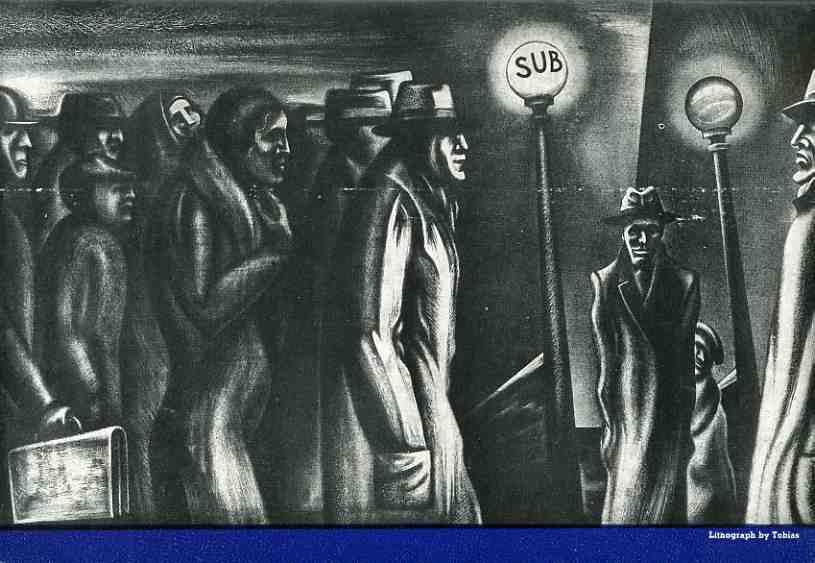
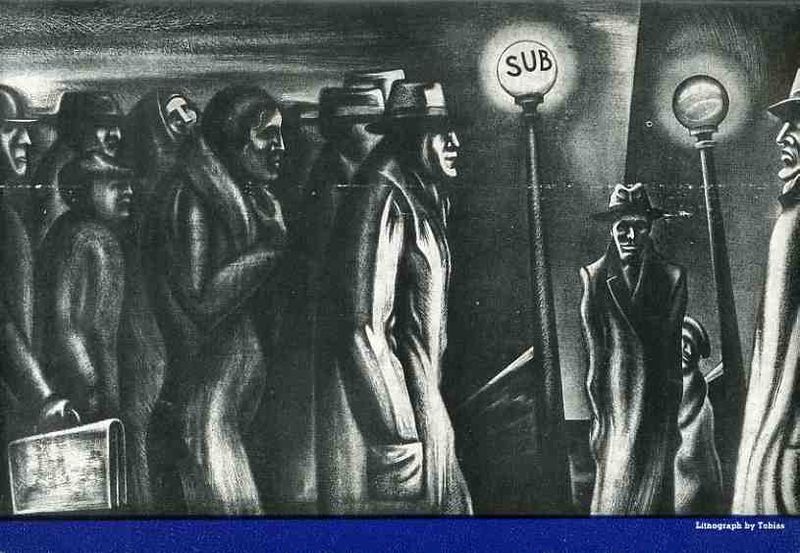
    The image below is from the back cover of the pamphlet, described as a “lithograph by Tobias”. 
    0 blog jan 30 substandard491


    A Timeline of Minimum Wage Levels, 1938-2009  (in continued reading section)
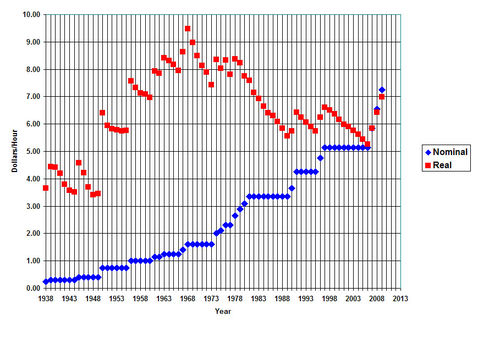
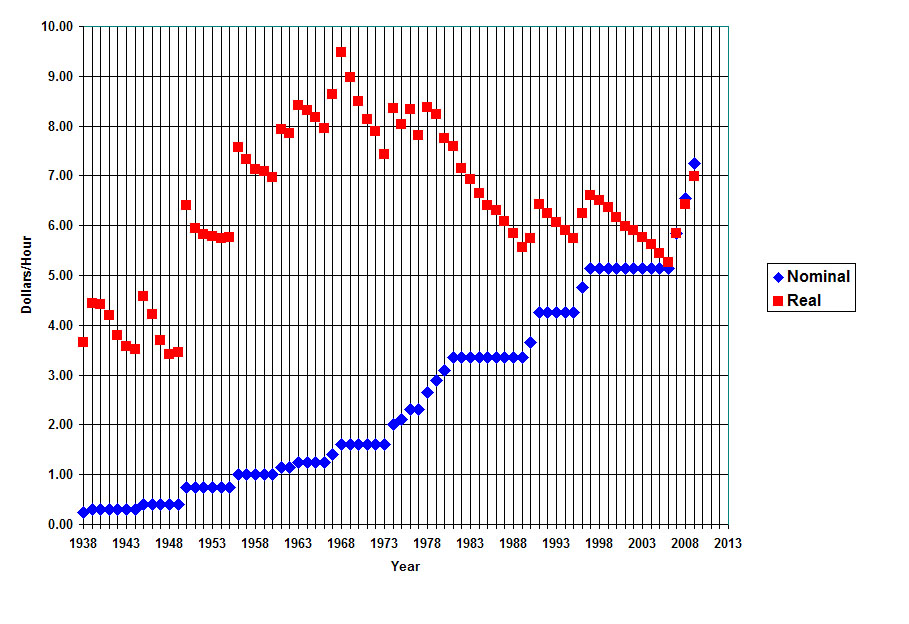
    Minwage The graph, above, is from Oregon State University website on the history of the minimum wage.  The accompanying text to it is also below.  The graph depicts “nominal” versus “real” minimum wages by year, the red dots (the nominal) showing what the original minimum wage translated to in 2008 dollars.

    A federal minimum wage was first set in 1938. The graph shows nominal (blue diamonds) and real (red squares) minimum wage values. Nominal values range from $0.25/hr in 1938 to $6.55/hr as of July 2008. The graph adjusts these wages to 2007 dollars (red squares) to show the real value of the minimum wage. Calculated in real 2007 dollars, the 1968 minimum wage was the highest at $9.47. The real dollar minimum wage (red squares) falls during periods Congress does not raise the minimum wage to keep up with inflation. The period 1997-2007, is the longest period during which the minimum wage has not been adjusted. The minimum wage increases in three $0.70 increments–to $5.85 in 2007, $6.55 in mid 2008, and to $7.25 in mid 2009. The real values after 2007 are projected for future decline in purchasing power. 
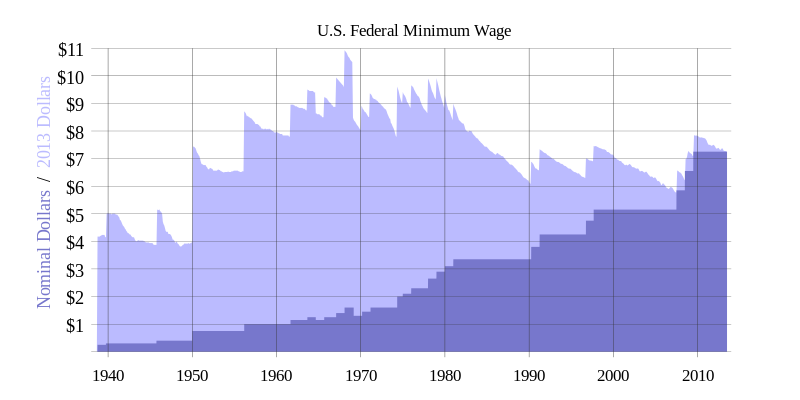
    Minimum wage History_of_US_federal_minimum_wage_increases


    [Graph from Wikipedia on the minimum wage, here]

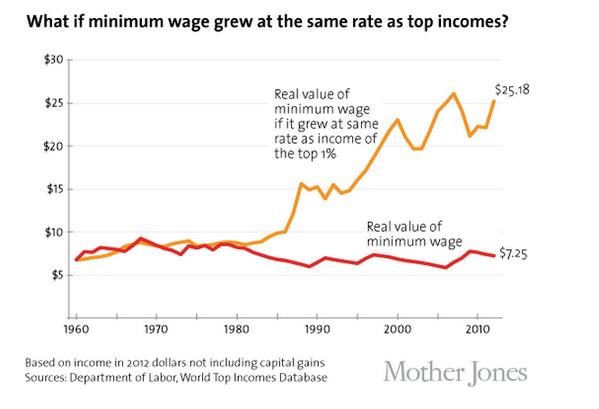
    And this interesting graph from MotherJones, showing what the minimum wage would look like if it had kept pace with the salary increases for the top one percent:

     

     Minimum wage top income

    ·Posted by :

    ·in:

  • Visionary and Imaginary Speed–and, of course, the Ice People

    JF Ptak Science Books                                                     

    The ‘twenties is know as the “speed” decade—everything was going faster, increasing its speed, expanding to the limit:  this was true for the ability to communicate via telephone, the appearance of commercial radio, the great increase in the speed of trains and planes and automobiles; the music was fast, the movies were talking. 

      Rocket german

    There are many iconic images relating speed and the roaring twenties—generally though this spectacular cover for Otto Willi Gail’s Mit Raketenkraft ins Weltenal…vom Feurerwagen zum Raumschiff (1928)is much less frequently seen, though it certainly does get the message across.  Otto Gail was a creative German science fact and science fiction writer with a strong background in following the scientific and technical accomplishment in rocketry of the age, especially the works of Max Valier1 and Hermann Oberth2. Raketenkraft was more a peek into the future and pop techy work for kids than a straight-out scifi novel like his The Moon Stone, which was a story that brought us Atlantis, space travel and hidden ancient culture in the underground Ice World.

    Gail, ott--stone moon

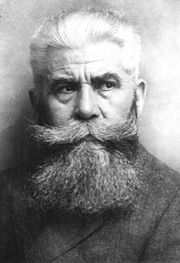
    It’s the unfortunate Ice World that attracts my attention around Gail, swimming around his interesting and tech-involved scifi world like a melting and failing Moon made of hundred-year NYC garbage scows, the idea of a good engineer-turned-trash cosmologist named Hans Horbiger, whose ideas wound up being whispered into the ears of many monsters. Horbiger had some sort of vision-dream about stuff in 1894 and spent the next 30+ years fleshing out the idea, which sounds bad from the very start when the author admits to finding “Newton wrong”.  Anyway without losing too many minutes thinking about this time-hole, Horbiger’s theory worked ice up to being the primary and primordial ingredient of all processes in the universe, with ice planets circled by ice moons, and some sort of gooey ice ether to make it all go ‘round. Oh yes: there were superior ice people living in the interior of the earth.  Horbiger died in 1931, but his many followers managed to work the theory into a presentable Jewish-baiting anti-relativity Deutsche Physik form for the new government of Adolph Hitler in 1933, and it was there that his ideas took hold in the cancerous Himmler and Hitler and others, a happy marriage at last, the ridiculous to the unspeakable. I’m not sure where the ice people are today, but I did saw some awful History Channel show that stated that Hitler never did die in the bunker and was removed by submarine to the interior ice people of earth, flying around the insides of our globe “in a UFO”.

    And so I associate poor Gail (1896-1956) with the Horbiger mess, and not his good work in science reporting and popularization.  So it goes.

    Gail, otto ice theory

    The other thing that you can say about Horbiger—he had a full-out behemothian mustache.  That’s about it.

    Notes

    1. Valier seems to have been the first person  killed in a rocket-related incident, blistered by his exploding rocket-car.

    2.  Oberth is another one of those Germans working at Peenemunde (along with Wernher von Braun and a great host of others)  trying to kill as many people in the UK as possible who wound up in Huntsville, working for our government.  It is all so problematic.  It is interesting that there is little in the Air and Space Museum (as part of the Smithsonian system)  that mentions von Braun.  He is burioed in a simple grave in a cemetery next door to a Jewish cemetery in Alexandria , Virginia.  I also remember going to some restaurant in the diamond district that, in very high bad taste, served up a beer called the Wernher von Brown–von Braun certainly had his hands covered in Jewish blood at least to the wrists, and to have a product so stupidly named as that in that place was just one of those impossible things that happen every day.

    ·Posted by :

    ·in:

  • Women Collegian Armed Confederates, 1903

    JF Ptak Science Books  Quick Post

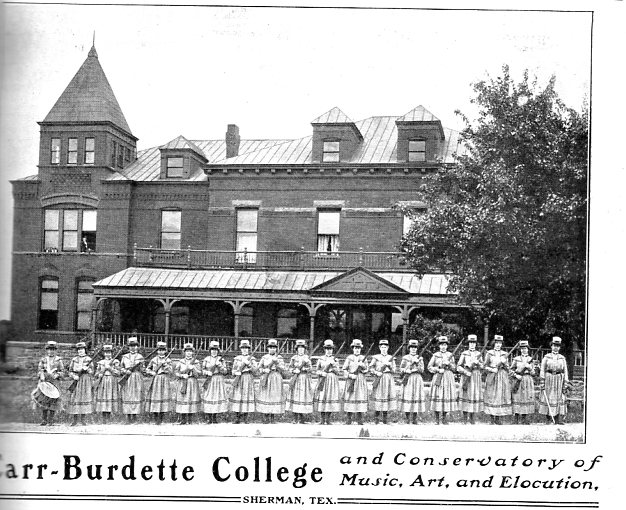
    Carr-Burdette College and Conservatory of Music, Art, and Eloqution (Oxford comma in the original), of Sherman, Texas, advertised themselves as the “Petit Wellesley of the South” in The Confederate Veteran for 1903.  I’m slightly surprised to hear of Texas as “Southern” or in the “South”, because in my head Texas always plays out as Texas, Confederate State or not.  Sherman is due west of Paris, way up north, north of Dallas, nearly in Oklahoma, jsut south of the Red River, and several turns and twists away from Archer City to the sotuh west. 

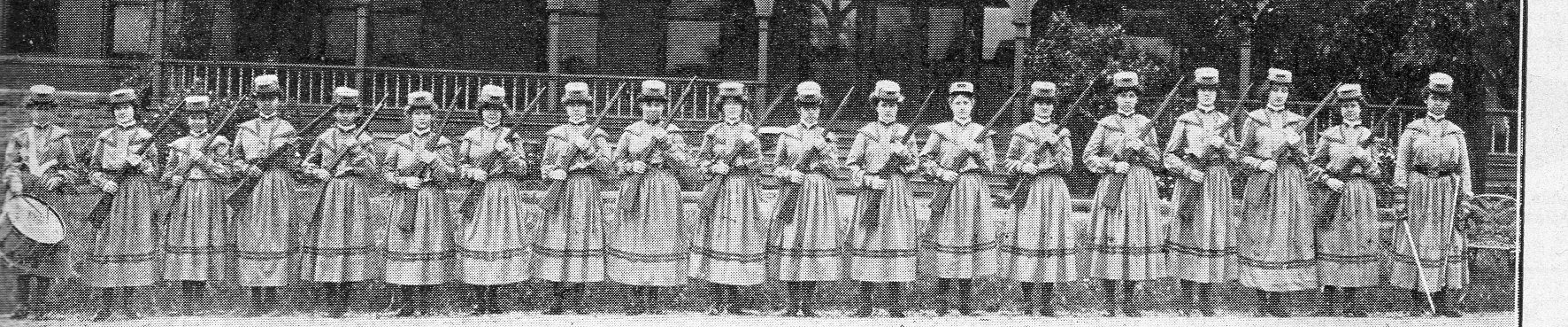
    It also advertised the Girls Military Company  (“the only one in the South”) “organized to give mental concentration and physical development”. And it isn’t just any military company, either: “the college furnishes the company with handsome Confederate uniforms, guns, drum, etc.”

    Confed vet women372

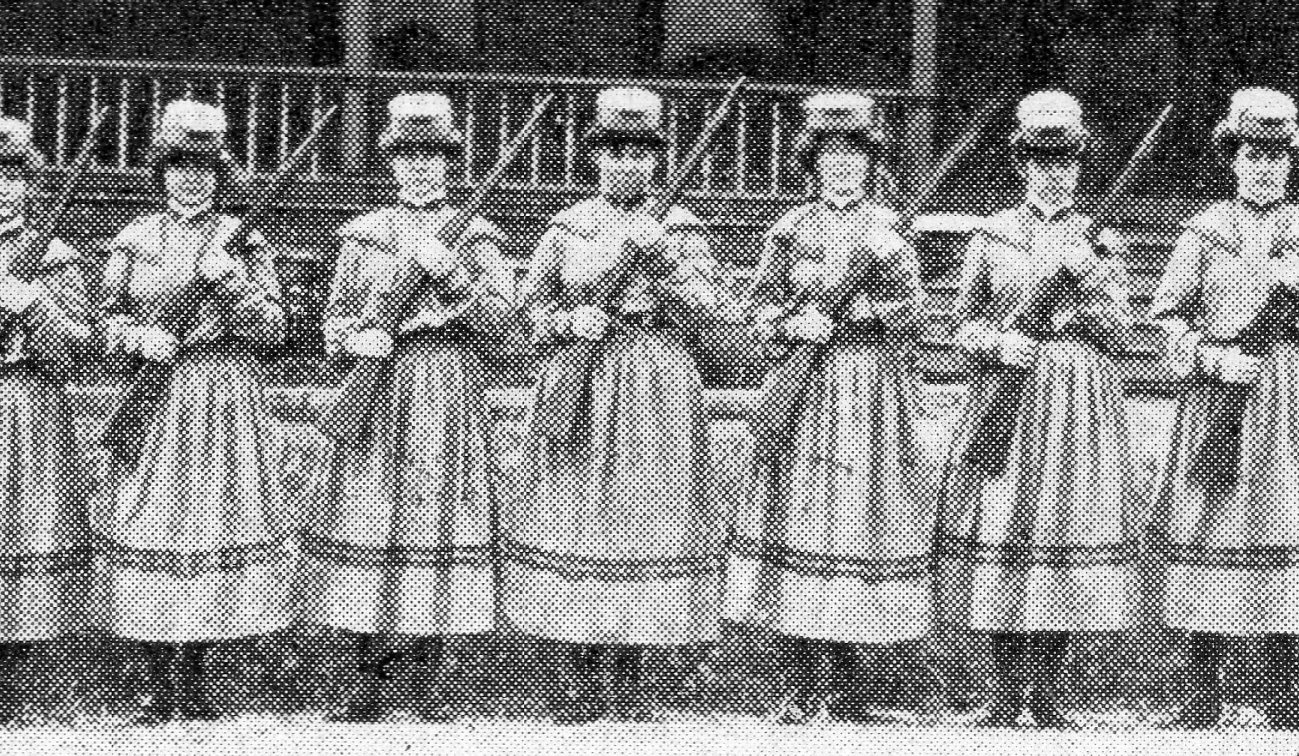
    In any event, Carr-Burdette lasted from 1894-1929, and their two brick buildings were razed after the property was sold in 1939.  I have no idea why the structures were taken down.  The photograph of the Girl Military Company sure is a handsome thing, though.  

    Confed vet women373

    Confed vet women371

    ·Posted by :

    ·in:

  • An Expose on Chicago Jails, 1947

    JF Ptak Science Books   Quick Post

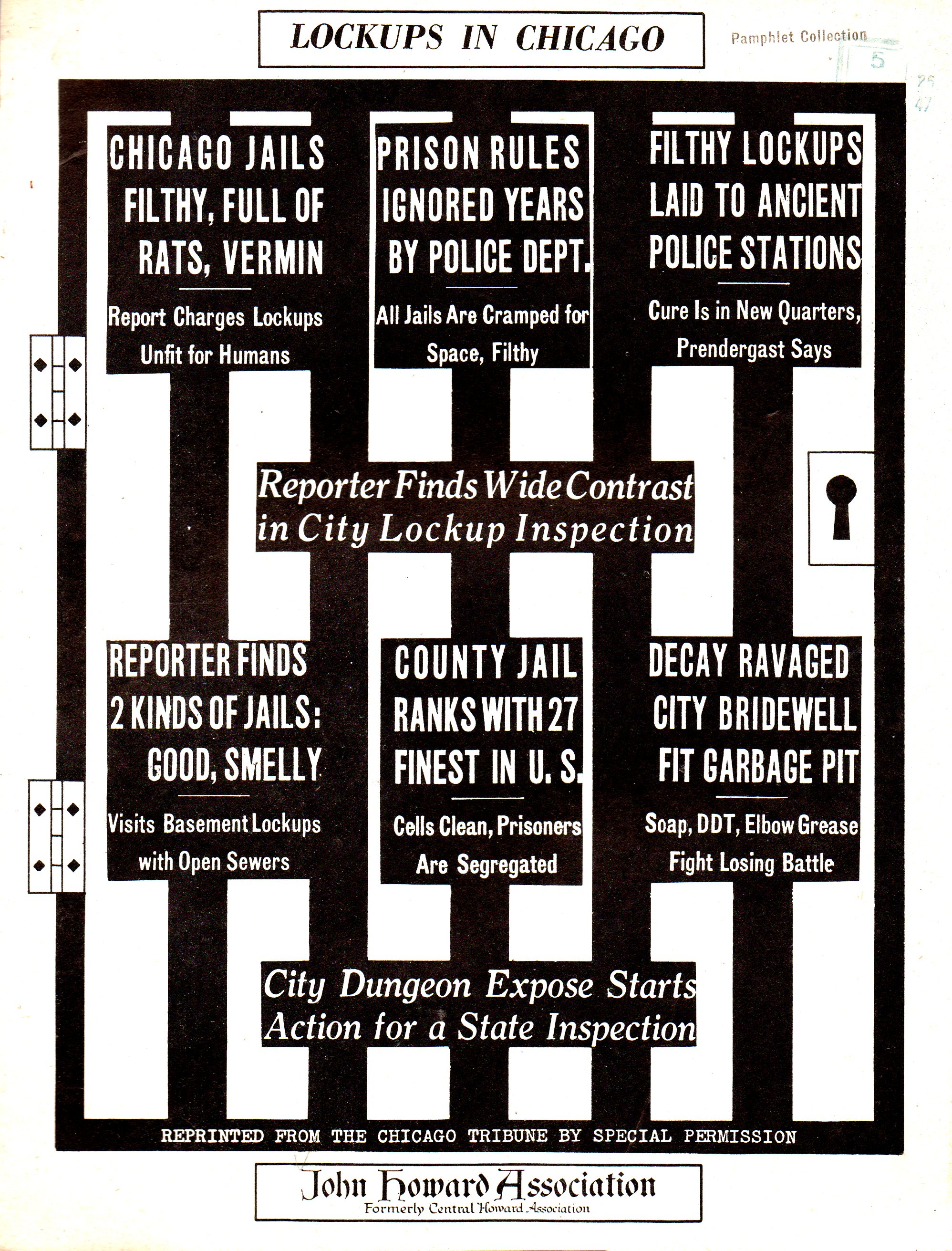
    Here’s a very striking (and please not “arresting”) pamphlet cover:

    Chicago jails374

    The appearance and tenor of this pamphlet is very deceptive–my initial reaction was an eyebrow-raising surprise, followed by a humorous deception, all aroused by the incredible, screaming cover design and the somewhat bizarre stories and headlines in the text.  How can one refuse an article like this (seen below)? The “funny” part of the pamphlet was stopped dead cold when I started to actually read  the  stories accompanying  the  sub-title malaprops.Blogaugust_20_chciago_jails_clip4_2

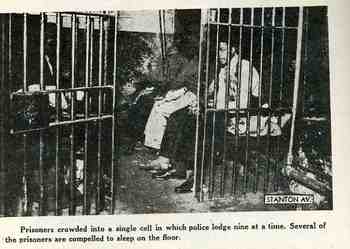
    The point underlying all of these design elements which seem so much sugar to my eyes was that the prisons in Chicago were horrific–especially for African Americans, a point which is not explicitly made but alluded to.  (Integration of jails and prisons was still a long way off–the Supreme Court would hear a case involving Alabama prisons and rule against their explicit segregation in March 1968.)  None of this seemed particularly surprising to me, except that there were just so many reports–the shear numbers of bad prison conditions was just staggering. 

    Blogaugust_20chciago_jails_photo420

    ·Posted by :

    ·in:

Recent Posts

Archives

Categories