JF Ptak Science Books Post 2277
“For my part I deem those blessed to whom, by favour of the gods, it has been granted either to do what is worth writing of, or to write what is worth reading; above measure blessed those on whom both gifts have been conferred”–Pliny the Elder
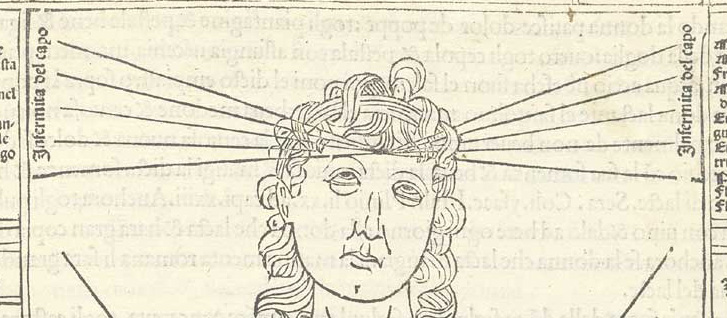
Johannes de Kehtam’s Fasciculus Medicine (printed in Venice in 1500) was the first anatomy to be printed with illustrations. Ketham was described as a German doctor living in Italy and may well have been Johann von Kerchheim, a German practicing surgery and medicine in Venice during he 1470′), and who wrote a series of tracts on various aspects of medicine which were then collected into this single bound volume. The illustrations are spectacular and to me have a very modern sensibility in their mid-Renaissance woodcut legacy–the look very clear and concise, are well proportioned, nicely labeled, and give plenty of free rein to open and blank spaces on the woodblock. The only time these images really “fail” is when they appear in color–a process that would’ve been undertaken privately, by the purchaser of the book, who would have contracted with an artisan to color the book. The images in almost all of the cases of coloring that I have seen just do not match the elegance and brilliance of the original with no color.
[Source for all images: NATIONAL LIBRARY OF MEDICINE, here.]
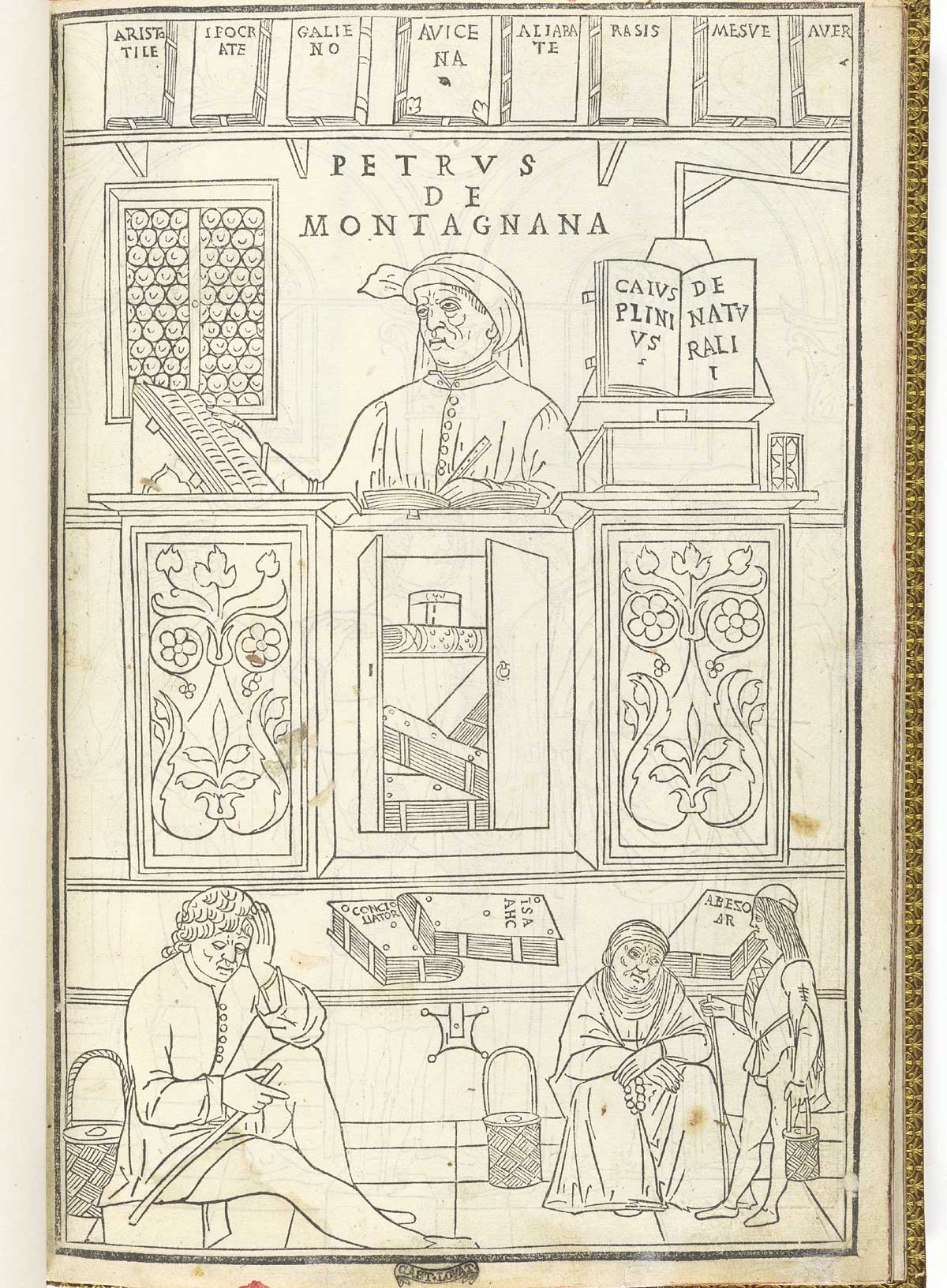
Its interesting to make a quick note on the books on display on the bookshelf behind the seated figure of Petrus de Montagnan (who is consulting classic texts in medicine as his three patients awaits his attention): the books include Aristotle, Hippocrates (“ippocrate”), Galieno (Galen), Avicenna (980-1037), Rasis (Ibn Sina, Rasis, Razi, Al-Razi, c.865-925), Mesue, Yuhanna bin Masawayh (c.777-857), and Averroes (1126-98), Abu el-Walid ibn Ruchd, Abu el-Walid ibn Ruchd. On the shelf to the right we see a copy of Naturalis Historia by Cais de Plnii (Gaius Plinius Seocndus, also known as Pliny the Elder, who lived from 23-79 A.C.E and who held forth on all knowledge from everywhere during the first century).
It is the anatomical illustration where the un-named artist is most brilliant–the lines are sharp and crisp, the spacing elegant, and the imagery very clear. It is just lovely work: