JF Ptak Science Books Post 2080
In 1771 Thomas Jefferson replied to a letter written to him by Robert Skipwith, the brother-in-law of Martha Wayles Skelton (who Jefferson would marry in the next year) outlining what he thought to be essential reading for the generally-cultured reader. Skipwith wrote for a list of books “suited to the capacity
of a common reader who understands but little of the classicks and who
has not leisure for any intricate or tedious study. Let them be
improving as well as amusing and among the rest let there be Hume’s
history of England, the new edition of Shakespear, the short Roman history you mentioned and all Sterne’s works.”
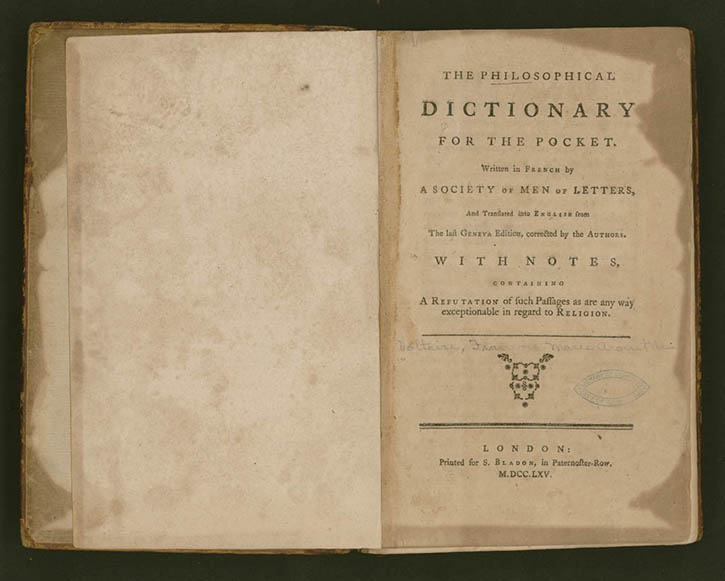 [Jefferson’s copy of Volataire’s Philosophical Dictionary–a thinker much in his mind.]
Jefferson responded with the following list, published at the very useful Monticello.org site (The same site offers an interesting reading list for Jefferson and his world, arranged by category, here.) It was a time of both big change and settling-in for Jefferson–aged 28, a newish lawyer, just coming into practice in 1767, just inheriting his father’s estate in 1764, just moving into newly-built Monticello in 1770, and marrying in the next year–and he gave the question a good strong thinking. His list is of course very interesting: the books are loosely arranged under a few broad categories, and are listed mostly by author and a bit of the title, followed usually by the size of the book (“8vo” is, basically, what we would think of as a standard-sized book; “12mo” is about the size of a paperback; “4to” is a taller, wider book; “fol” is a folio, sort of in the atlas-size), an occasional price, and also some occasional publishing data. The leading category of book by far is the “fine arts”, which occupies well more than half of the entire list.