JF Ptak Science Books Post 2081
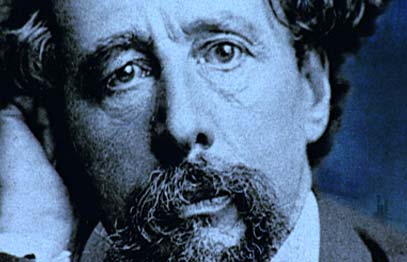 [Picture source: PBS.org.]
At the tender age of 21 Henry James was deeply in love with words. Sometimes he may have been in love with them for the sake of their sound and placement rather than their meaning, at least so when he was a young man…as he grew older, James became one of those few people who never wrote a bad sentence (according to Mr. McMurtry). However, in 1865, he wrote some lovely-sounding sentences that were mechanically semi-pure if not accurate in what they were saying, but certainly sounded pretty in their pettiness.
It was in The Nation on 21 December 1865 that James wrote what is a very good example of this beautiful nothingness when he brought out his pen and stabbed Charles Dickens in the heart.
He was reviewing Our Mutual Friend, but he managed at the very beginning to say that it was not simply that this novel was not good, but that everything Dickens had written in the previous ten years–back to when James was 11–was “poor with the poverty not of momentary embarrassment, but of permanent exhaustion”. It is true that Dickens at this point was slowing down a bit–at least compared to himself, as he had previously written twenty novels in 18 years–and he had only another five years to live, but the novels of exhaustion of those ten years that James was referring to included Little Dorrit, A Tale of Two Cities, Great Expectations, and Our Mutual Friend. Four novels, ten years, three great classics.
James writes that “…the word humanity strikes us as strangely discordant in the midst of these pages, for, let us boldly declare it, there is no humanity here…” This is a very strange thing to say, given that Dickens semi-discovered a majority of London life that really never quite made it into public display in newspapers and novels except for their crimes, giving a face of grace and courage to the poor and middle classes. And for all of that, Henry James tells us that Dickens may be a great humorist, but “he is nothing of a philosopher”.
Then there are these two low sentences: “But when he
introduces men and women whose interest is preconceived to lie not in
the poverty, the weakness, the drollery of their natures, but in their
complete and unconscious subjection to ordinary and healthy human
emotions, all his humor, all his fancy, will avail him nothing, if, out
of the fulness of his sympathy, he is unable to prosecute those
generalizations in which alone consists the real greatness of a work of
art. This may sound like very subtle talk about a very simple matter;
it is rather very simple talk about a very subtle matter.”
James continues, as he begins to wind up is review, with some very sniffy and long-nosed observations (bolding mine):
“Such scenes as this are useful in fixing the limits of Mr Dickens’s
insight. Insight is, perhaps, too strong a word; for we are convinced
that it is one of the chief conditions of his genius not to see beneath
the surface of things. If we might hazard a definition of his literary
character, we should, accordingly, call him the greatest of superficial
novelists. We are aware that this definition confines him to an inferior
rank in the department of letters which he adorns; but we accept this
consequence of our proposition. It were, in our opinion, an offence
against humanity to place Mr Dickens among the greatest novelists. For,
to repeat what we have already intimated, he has created nothing but
figure. He has added nothing to our understanding of human character. He
is master of but two alternatives: he reconciles us to what is
commonplace, and he reconciles us to what is odd.”
I really am not sure what was driving Mr. James to the place he drove for, but it certainly seems very weird to me–perhaps he needed to sharpen his young quill on the bones of a popular and legendary older writer. In any event, James seemed to be trying to rush a certain patina of aged reasonableness here, and all he managed was to shine an ugly brass.
The full review, here.
And just for the record, here’s a list of Dickens’ books, all written somehow by one man: