JF Ptak Science Books LLC Post 826 Blog Bookstore
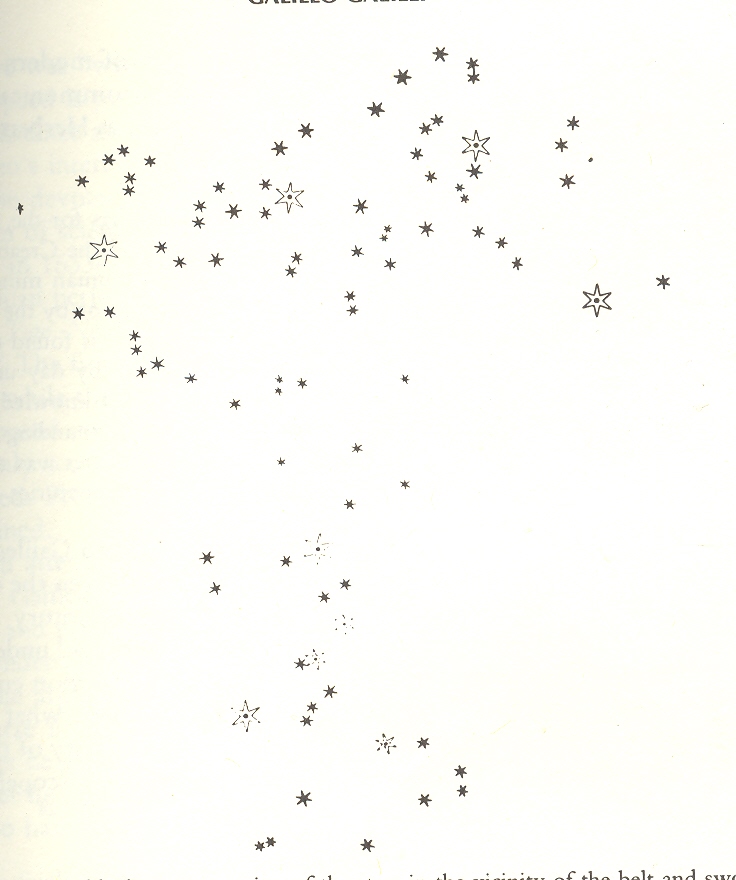
This installment of the continuing thread on the history of dots questions the sublime machinery of the primum mobile in the work of Galileo, particularly in his The Siderreal Messenger (Sidereus nuncius) of 1610. The reception of this extraordinary work was deep and profound, and the images of the “dots” were of extraordinary importance.
The perfection
of the Creator’s plan was being shown to be not-so-perfect in the late Renaissance, a major chink
showing up in the work of the dead Copernicus in 1543, which showed that the
Earth was not the center of the great cosmological eye. In the same year the body was also shown to
be not so much built in god’s image with its bitter working revealed in one of
the greatest anatomy books ever written, Vesalius’ revolutionary De Humani Corporis Fabrica .
Problematic bits
started showing up regularly wrapped in scientific proof: the existence of a vacuum, thought to be
impossible given the perfection of creation, was shown to exist in Otto von Guericke’s Experiemnta nova (ut vocantur) Magdeburgica de
vacuo spatio (
1672).
The
stupendous idea of additions to the night sky, which had been thought to be
immutable and unchanging, came into being with Tycho Brahe’s 1572 discovery of
a new star (Nova) in Cassiopeia and added to in 1602 by Kepler’s announcement
of another new star—both events showing that the night sky was not complete and
that it was actually changing.
When you
consider Galileo and his use of the newly-invented telescope it is usually a little
far down on the list of accomplishments that his explosion of the night sky is
considered. In addition to everything he
did (applying mathematics to the study of physics, understanding
the physics of motion, developing the telescope and the microscope and other
precision physical instruments and so on) Galileo pointed the
not-yet-astronomically-used telescope to the sky and expanded the size of the
universe by a factor of ten. It was so
utterly astonishing an idea I can hardly think how the not-prepared mind of
1610 would’ve reacted to the idea.
Certainly it was not a happy acknowledgment coming from the Holy
Father, though a simple defense could’ve been that this miracle was divinely
revealed ,and that it was there all of the time but just unknown to humans, and
so not threatening the orthodoxy of Christian belief. But that wasn’t the case, and Galileo would
soon enough be in trouble with the church and its inquisition in short order.
The dots in this image are the dots of never-before-seen stars, part of an
unobserved sky that was revealed only under magnification. The size and scope of the new bigness of the
universe was staggering, and of course opened the question immediately to the
possibilities of yet a larger universe revealed under yet more
magnification. I don’t know the answer to
this, and I wonder where Galileo might have publicly mused about how big the
universe might actually be, and if he ever dreamed about the possibilities of
telescopes that were 15 feet across rather than just two inches, and what those
beasts might reveal.