A Daily History of Holes, Dots, Lines, Science, History, Math, Physics, Art, the Unintentional Absurd, Architecture, Maps, Data Visualization, Blank and Missing Things, and so on. |1.6 million words, 7500 images, 4.9 million hits| Press & appearances in The Times, Le Figaro, Mensa, The Economist, The Guardian, Discovery News, Slate, Le Monde, Sci American Blogs, Le Pont, and many other places… 5000+ total posts since 2008.

  • First Beer in Manila Post War, 1945

    JF Ptak Science Books  2689

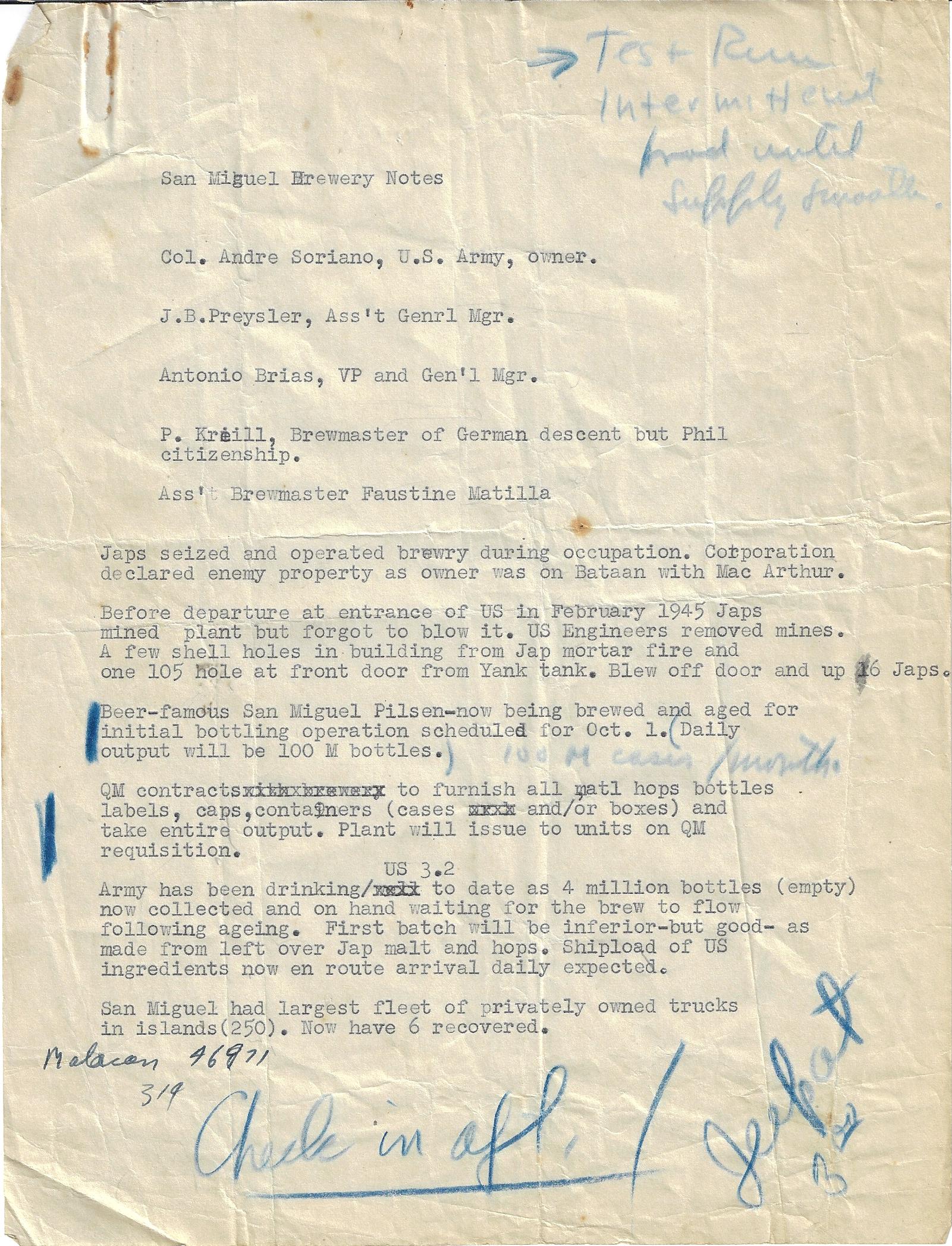
    Several years ago I purchased part of the papers of David Katcher, who was the founding editor of the journal Physics Today. Before that, several years before that, in 1945, David Katcher was Lt. Katcher, serving as a correspondent/writer in the public relations office of the U.S. Army Headquarters of the Western Pacific (GHQ USAFPAC), and seems to have worked closely with the U.S. Commissioner to the Philippines, Paul V. McNutt. There was a 6-inch stack of paper here of mimeographed offprints of the daily grind of running the PR department of the Army in the Philippines, which, taken as a whole, is pretty interesting, showing the concerns and trials of the Army in reestablishing the government and infrastructure of the country.  Some of the individual reports/publications are stand-alone, straight-up f interesting things, and so far as I can determine, have not been published anywhere else.  The item I’m about to describe is one of those stand-alones.

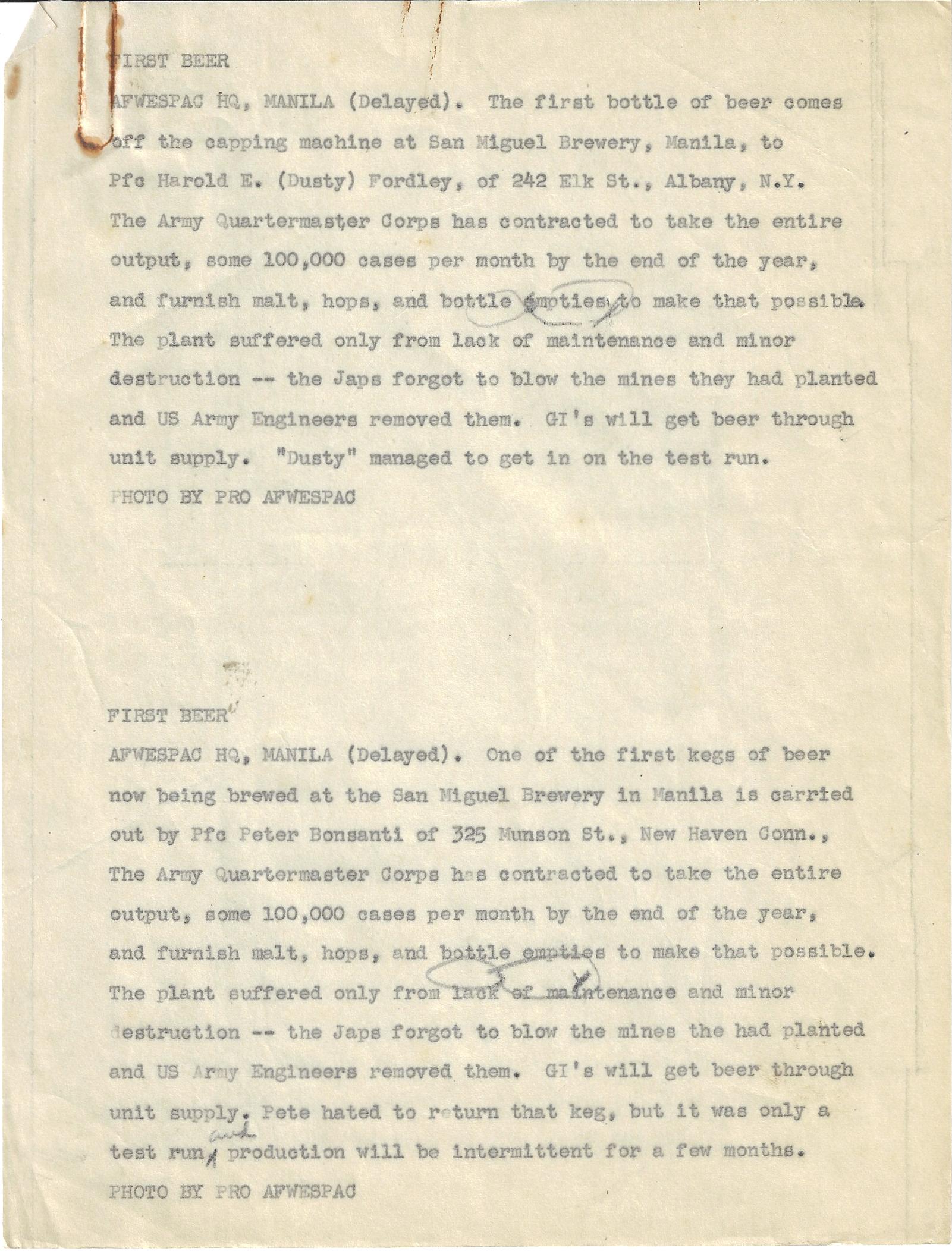
    This two-page document seems to have been the draft for a press release on re-starting the formerly Japanese occupied San Miguel Brewery in Manila. (I don’t need to say very much about how tremendously devastated Manila was after MacArthur came back and reclaimed the city, as I think that this is generally understood and a given. It was enormous amount of loss of life to Philippine civilians, with estimates of those killed in Japanese massacres at 100,000+, plus battle casualties, and of course a tremendous amount of destruction laid to the once-beautiful Manila that went along with that.) Putting the city back together again after the end of the war was obviously essential, and the movement with the brewery was evidently very quick. The brewery evidently suffered minor destruction (I suspect in the final fight as the Japanese occupied and ran the brewery during the war) and although the structures were lined with explosives, “the Japs forgot to blow the mines”.

    There were a million things to do in Manila in 1945, and the resurrection of the San Miguel Brewery was one small part of that. It is interesting to see this internal U.S. Army document to see how this was refitting was being transacted.  
     

    San Miguel _1_


    SAn Miguel 2_


    ·Posted by :

    ·in:

    —
  • Treating Mental Illness with Narcotic Enemas, Warm Baths, and Happy Opiates (1845)

    JF Ptak Science Books  Expanding a post (#153) from 2008
    Blogdrugs_crazy254

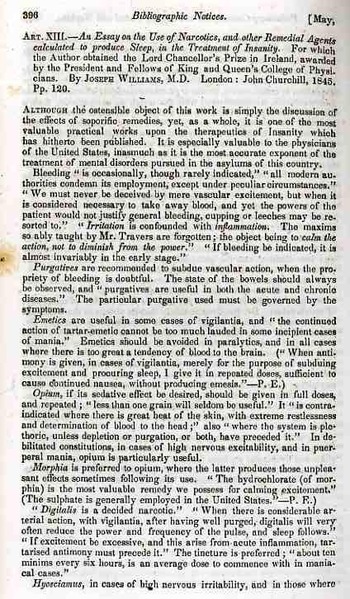
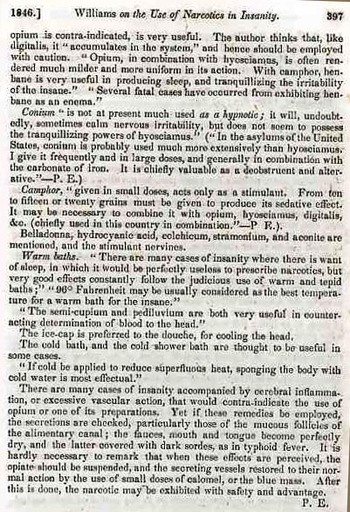
    This book review on the use of narcotics in treating the insane appeared in the New York Journal of Medicine for 1846.  The book, An Essay on the Use of Narcotics, and other remedial Agents calculated to produce Sleep in the Treatment of Insanity…., was by Joseph Williams, M.D., and was published in London in 1845.  The theory behind the sleep treatment was that the basic mechanism of insanity was “cerebral inflammation” or “excessive vascular action” in the brain—inducing deep sleep, evidently, was a good way to combat the over-active brain.

    The article itself comes at an odd time in the history of the treatment of the insane.  It came almost 40 years after the establishment of  McLean Hospital (first known as the “Asylum for the Insane,” a division of the Massachusetts General Hospital), which opened on Oct. 1, 1818, and was the first hospital dedicated to the treatment of the insane in the U.S.  It came 70 years after the great advances of Benjamin Rush, who elevated the “Mental Patient” from chains on the floor to the status of medical or nervous illness or disease.  The use of narcotics over this period seems to have surged and waned.  In 1879, in an article in the New York Times, the reputation of the Asylum for the Insane on Ward’s Island in NYC was considered—and one of the high points was that it had (largely) discontinued the use of narcotics. (There were still problems, of course, what with the asylum being overcrowded, housing 1100 in an institution meant to house 700, and where the chores and even nursing positions were staffed by the inmates, who were feed on 32 cents a day.)  As late as 1921, though, Jacob Alter Goldberg notes in his Social Aspects of the Treatment of the Insane, that there was a new, sharp increase in “toxic narcotic” treatments of the insane.  Of course, I guess one could replace “narcotic” with some sort of other misplaced treatment, like shock therapy, or Freudian mélanges, or something.  Each age must necessarily have their entry in the encyclopedia of embarrassments
    Blogdrugs_crazy255 . 

    In this article we find sleep assaulted by the use of the following:  purgatives (“to subdue vascular action when the propriety of bleeding is doubtful’), emetics, opium (to be used “in cases of high nervous excitability and in puerperal mania”), morphia (“the most valuable remedy for calming excitement”), hyosciamus (“to produce sleep, tranquilizing the irritability of the insane”).  It is weird to see that the last sentence in the description of hyosciamus reads “some fatal cases have occurred from exhibiting henbane as an enema”.  A narcotic enema?  Still to come in the review is conium (“I have used it frequently and in large doses…it is chiefly valuable as a deobstruent and alternative”, followed by camphor, Belladonna, hydrocyanic acid, colchirum, stramonium aconite, and others.  “Warm baths’ makes an appearance (“90 degrees may be considered to be the best temperature for a warm bath for the insane”), as do cold baths, and the applications of ice caps. 

    I’m not so sure about what to make of it all, the sleep treatment of insanity I mean—after all, Joseph Lister only makes his epochal pronouncements on cleanliness in the operating theatre 15 or so years after this paper, which seems today to be the most rudimentary thing that one could do in treatment in the surgical room, so treating extra blood in the brain through drug-induced sleep doesn’t seem all that far away from the realm of possibility back there in early Victorian England.

    I don’t think I’ll forget the toxic narcotic enema any time soon, though.  Or the word “deobstruent”. 

    ·Posted by :

    ·in:

  • A Beautiful Aviation Parts Supply Catalog (1946)

    JF Ptak Science Books  Quick Post

    Aviation catalog _1_

    [Images will become clearer when expanded]

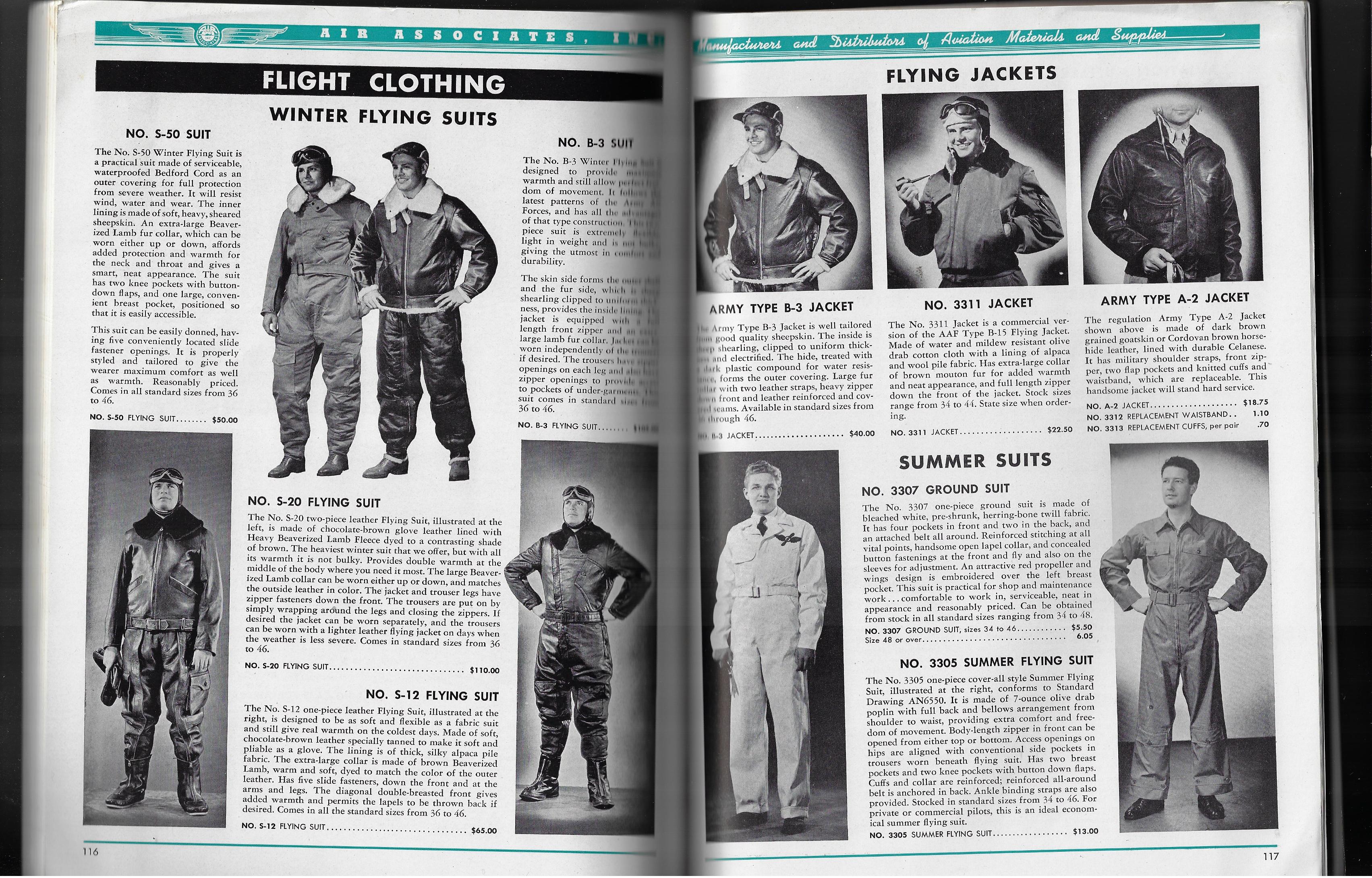
    I found this very fine aviation catalog today down in the studio–it seems to have everything you need to identify and replace or much of the small (and not so small +) bits in aircraft in 1946.  It comes to us from Air Associates, and is their Aviation Supply Catalog No. 19.  The first 66 pages or so are loaded with hardware, tubing, engine maintenance parts, and such. The there’s a highly illustrated section: aircraft windshields, “blind flying equipment”, “quick attachable parachutes”, aircraft seat cushions, safety belts, inflatable rubber boats, aircraft landing flares, propellers (6pp), runway delineators, windcones, aircraft instrumentation (9pp), radio accessories, tools (6pp), navigational computers, pilot logs, flight clothing (2pp), goggles (2pp), communication bits (2pp). It is a gorgeous work, and I think I need one of those flight suits. (This is available for purchase via the blog bookstore.)

    ·Posted by :

    ·in:

  • Comfort in Complicated Structure–Dense Title Page Design (1926)

    JF Ptak Science Books   Quick Post

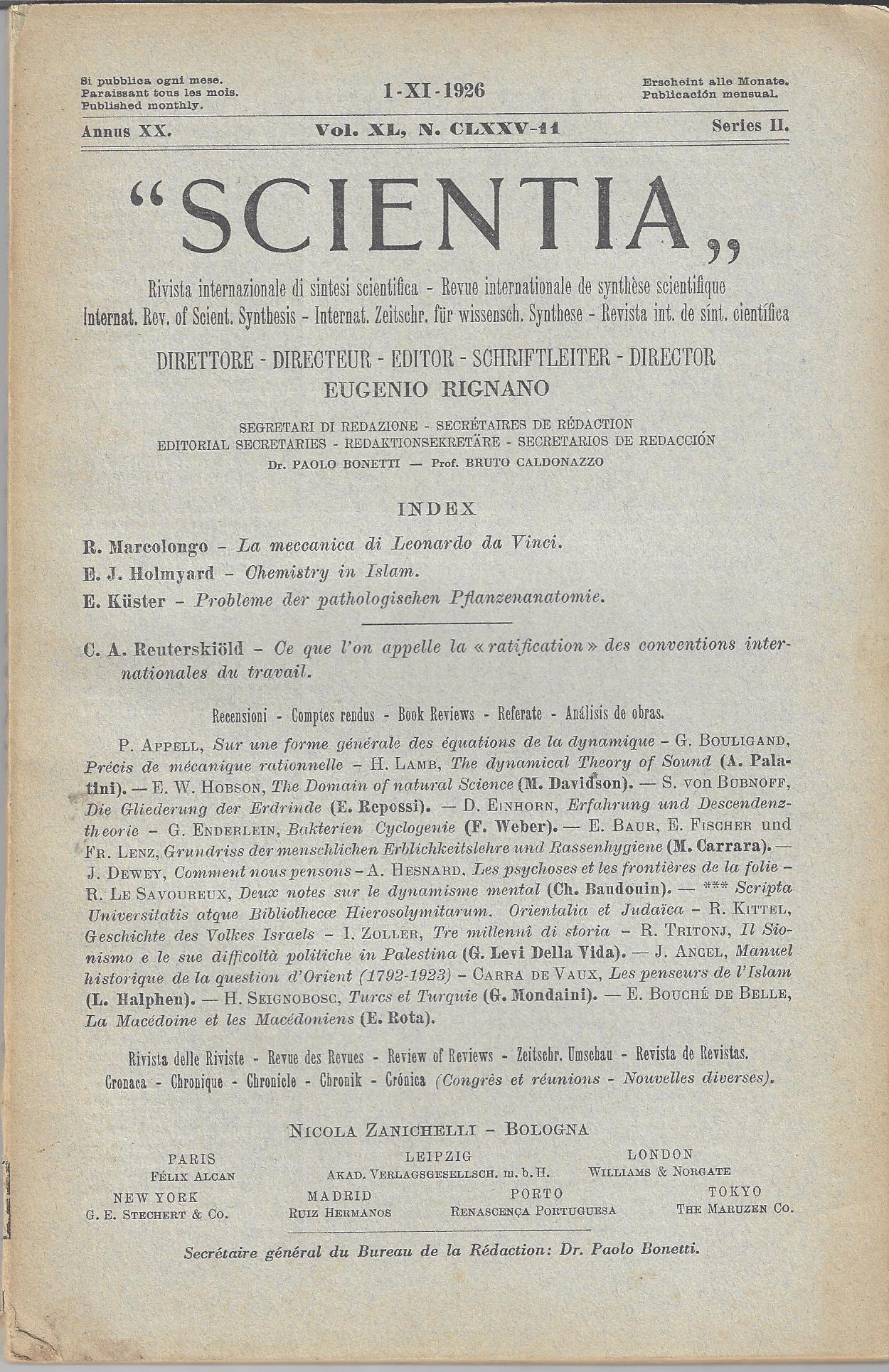
    ScientiaAt first blush this cover design doesn’t seem to be very involved or complex–after all, there is a lot of “blank” space even though there is a lot of text.  This is the front cover to Scientia, of Bologna, for 1926, and when you really look at it, the cover is impressively busy–even the volume/publication data is complex, or at least far more so than the vast majority of the journals that I have had experience with…for example, this issue for November 1, 1926 is “I-XI-1926 Annus XX, Series II, Vol XL, N. CLXXV-14”, which all makes sense, except that it seems a little dense.  Title pages can become very ornate and complex and highly illustrated as you go back farther into the printing past, and even non-illustrated titles can put a lot of ink on the page in forms of letters, what with 100-word titles and all…in this case, I just wanted to share this attractive example.  Oh yes–it is an interesting journal, as you can see by the contents…


    ·Posted by :

    ·in:

  • On the Job in 1874

    JF Ptak Science Books  Quick Post

    NYC arch lonesome cop

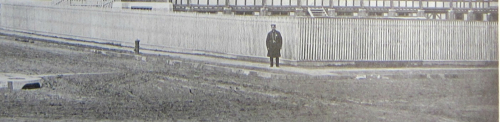
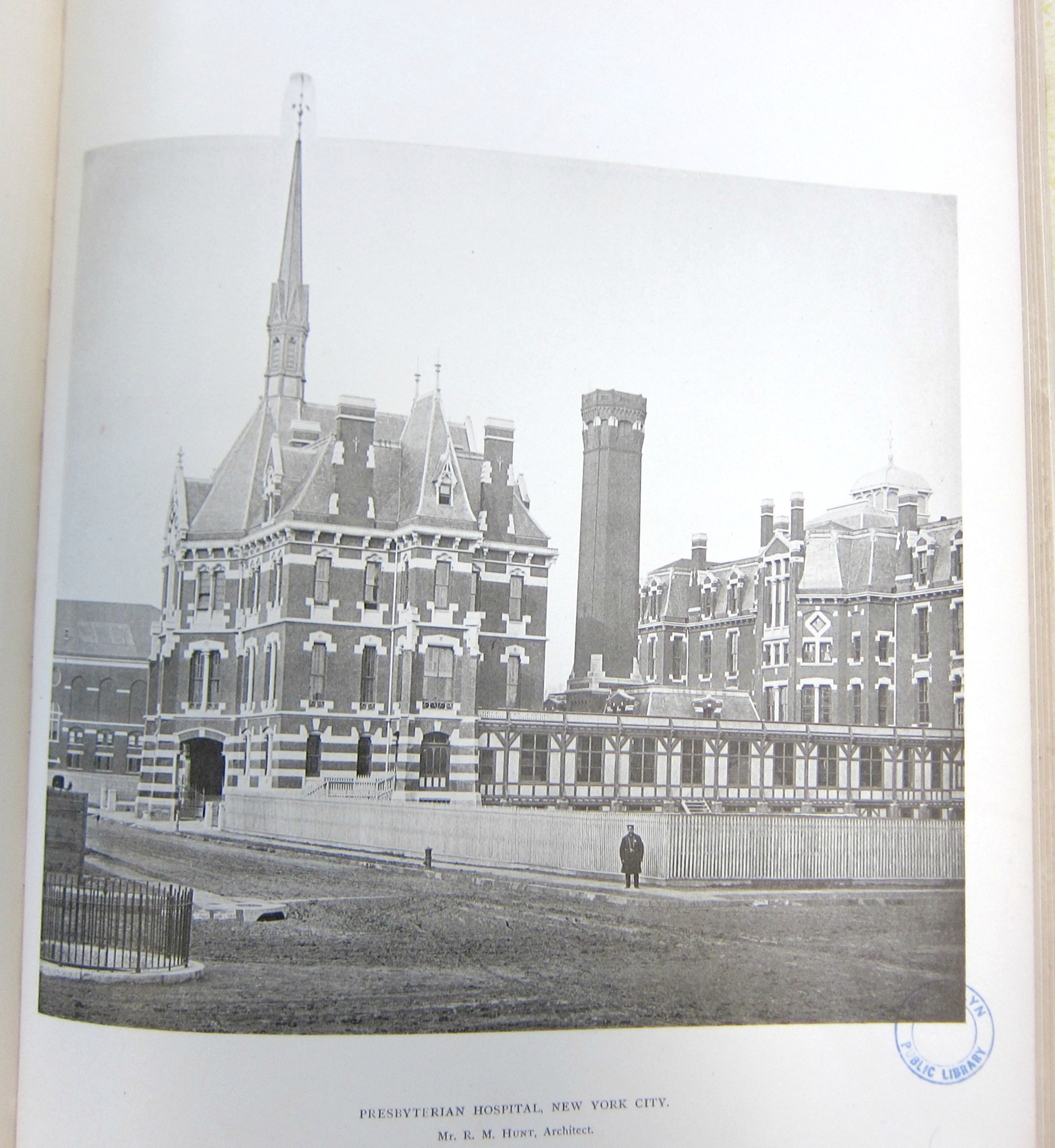
    This post really doesn’t have anything to do with anything–it is just an interesting image of a newly constructed building capturing a sense of  its solemn activity ornamented in heaviness, intersected by one guy (perhaps a watchman) who is standing there at the intersection of Nothing & Everything.  [Source: New York Sketchbook of Architecture, James Osgood, NY, 1874.]

    NYC architecture

  • Hate Movements: the German-American Bund (1936)

    JF Ptak Science Books   Post 2672

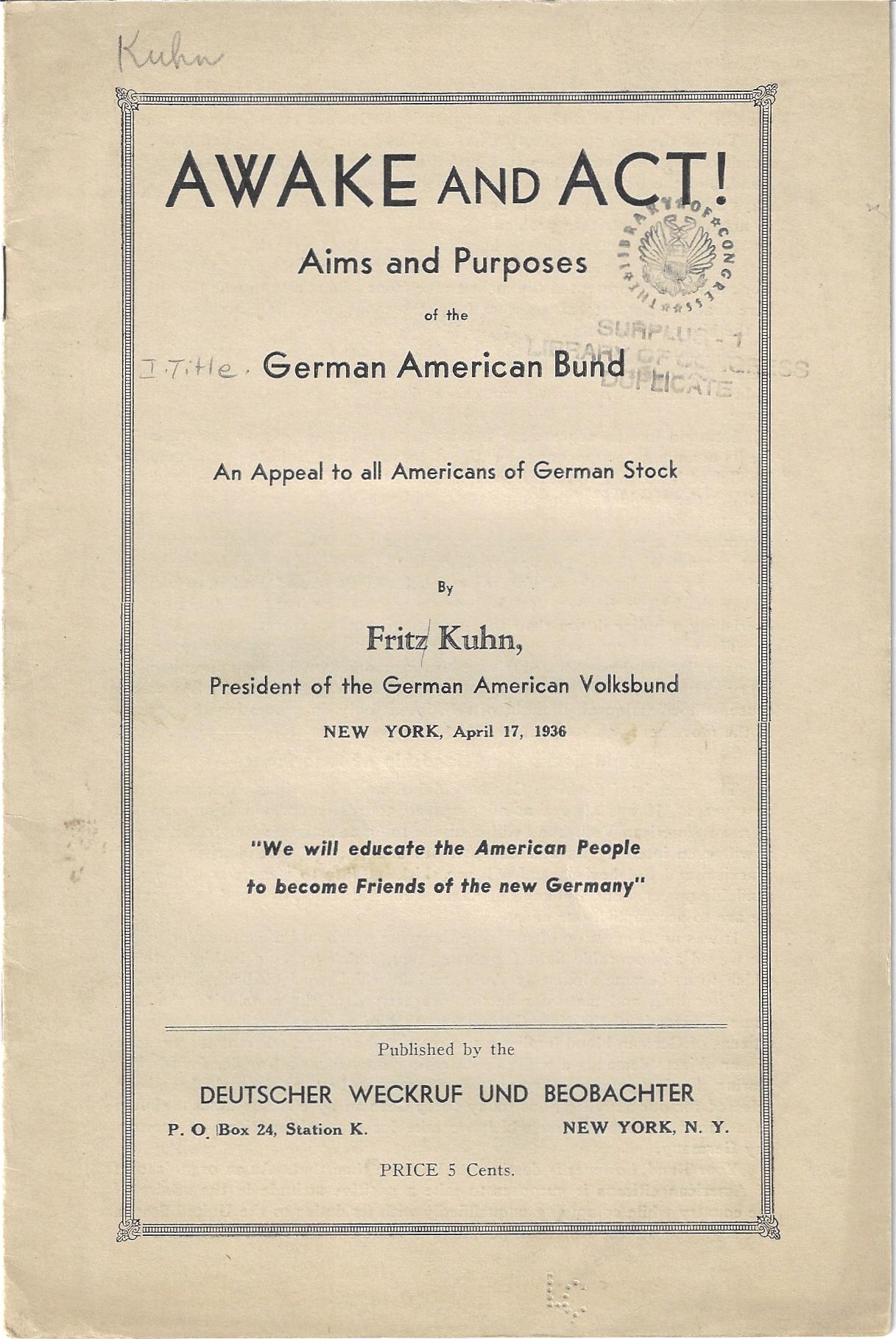
    WWII German American BundAwake and Act! Aims and Purposes of the German American Bund, an Appeal to all Americans of German Stock, Published in New York, N.Y.  by Deutscher Weckruf und Beobachter in 1936. 

    Fritz Julius Kuhn was president of the German American Volksbund and a nasty, hateful character who worked in service of National Socialism in the United States. He wound up in trouble and in jail for mishandling funds, and once the U.S. got into the war, he found himself arrested as an enemy alien and sent to spend time in the interment camp on Ellis Island. He was kicked out of the country, and then arrested again by U.S. Occupation Forces and sent to Dachau in 1947 as part of the Denazification effort of Gen. Lucius D. Clay. Of course Dachau wasn’t the Dachau of Kuhn’s idol, so he unfortunately did not experience the camp of his intentions. He died in 1951, and that was that. Provenance: the Library of Congress, the pamphlet being a gift from the Bund.

    In 1936 Kuhn wasn’t yet interested in taming the U.S. for the Nazis, though he was interested in protecting it from the greatest evil of mankind–Communism.. Actually, it turns out to be Bolshevism, but the controlling power to this is”the war battalions of the Jewish capitalists of the stock exchange” which was “the international (J)ewish attack of world Marxism”, which he said is what was attacking Germany, presently. There’s a lot more of this rhetoric in the pamphlet…actually, that is all there is in it, this sort of language, written by a non-native speaking chemist walking in Hitlerian glory and not all that smart. He was smart enough though in his rants, and tirades, and his anger was such that he was able to get 20,000 people to attend a rally at Madison Square Garden in 1939 where amidst his adjectival malignancies he ranted against “Franklin Delano Rosenfeld” and his “Jew Deal”, much like the language used in someone else’s beloved Ezra Pound’s traitorous broadcasts from Italy during the war. This was the straw that broke the stinking fascist’s back, though, terminally pissing off Mayor Laguardia who went after Kuhn’s taxes and found fraud and embezzlement. And so off he went.  But not before ruining the memories of those people who witnessed their friends become engorged by his wrath and hatred, a ruined man with ruinous ideas who ruined people. 

    • Specifics: 23x15cm, and 7pp.  Very surprisingly there are only two copies located in the WorldCat/OCLC, with one in the NYPL system and the other in the University of Texas system. I figured that there would be a lot of them–looking around now, there aren’t, so it seems.  

    ·Posted by :

    ·in:

  • Shooting an Eclipse in Turkey, 1894

    JF Ptak Science Books   Quick Post

    Astronomy shooting an eclipse

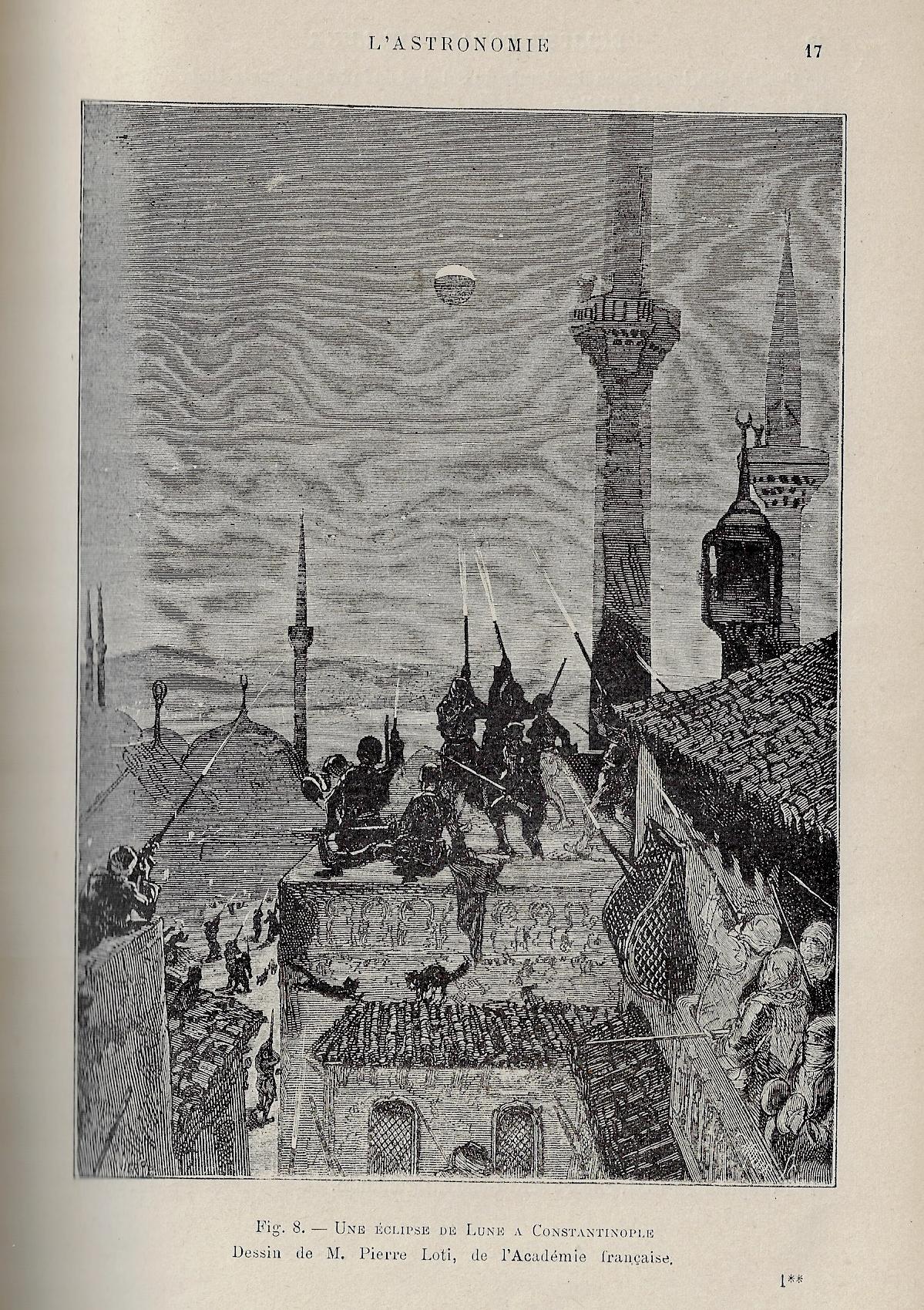
    I came across this interesting image in L’Astronomie, revue mensuelle d’Astronomie Populaire, published in Paris in 1894, and edited by the  profoundly busy Camille Flammarion. The description and image is credited to the French author/adventurer Pierre Loti, and it describes the Turks of Constantinople shooting at the Moon (” Les Turcs tirent des coups de feu sur notre satellite”) in observance of the the fight of light versus darkness exemplified no doubt by the constellation Draco, the dragon, or Ouroboros, or serpent consuming itself, or some such.  During an eclipse it was believed going into the dim past that Draco was consuming the sources of light, and that in order to stop it from doing so observers would make as much noise as possible to scare the thing away.  Loti notes that this practice probably  has been observed since the time of The Prophet, though it is probably older than that.

    I’ve never seen an image depicting people shooting at the Moon with rifles (there are some famous examples of this with the first motion picture version of Verne’s From the Earth to the Moon) and so I’m sharing it–perhaps someone out there will help with the deeper interpretation of what is going on.  

    • “L’une des dernières éclipses de Lune a été l objet d une observation d un genre spécial à Constantinople par M Pierre Loti l élégant auteur de Madame Chrysanthème, auquel nous devons le dessin fort original reproduit ici. Les Turcs tirent des coups de feu sur notre satellite pour le délivrer du Dragon qui le ronge antique dragon astrologique qui a laissé des vestiges dans les signes astronomiques modernes mêmes nœud période draconitique etc. La dernière éclipse a sans doute été l objet d une cérémonie du même genre chez les disciples de Mahomet….”–Populaire Astronomie, pg 17.


    ·Posted by :

    ·in:

  • You-Are-There View from Charleston Harbor, Fort Sumter, 1863

    JF Ptak Science Books   Quick Post

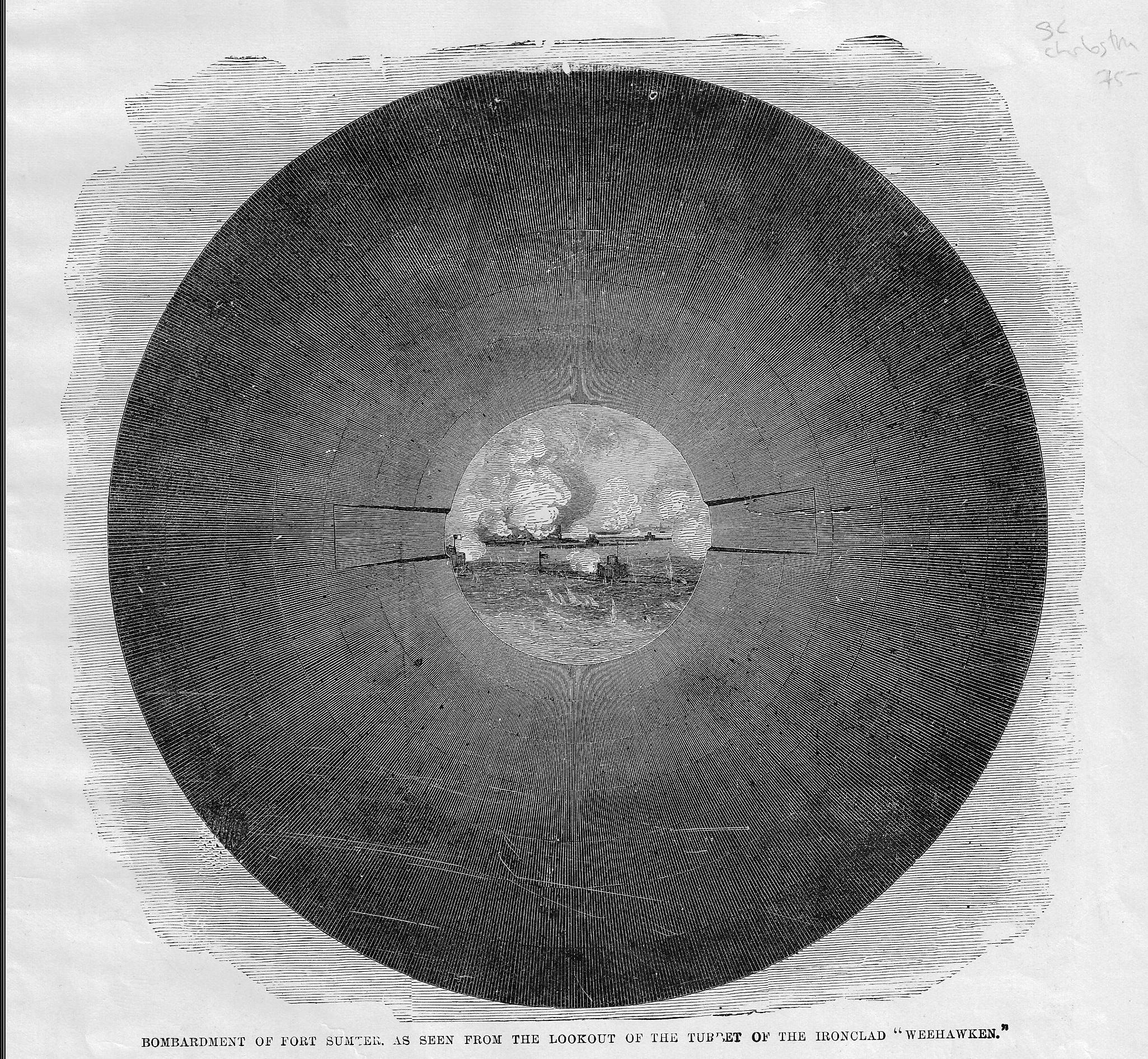
    Here’s an unusual and somewhat startling point of view from the Civil War–the target of Fort Sumter, Charleston Harbor, South Carolina, (probably for the attack of 7 April 1863).  I assume that this was first published in Harper’s Weekly, though my copy is found in The Soldier in Our Civil War, Volume II, page 173, (1878) which is spilling over with reprints from Harper’s.  There wasn’t very much of Ironclad Weehawken that was above the water, most of its 200′ and crew of about 70 being below the water line. This view is from an observation port on the turret of the ship, and  it looks like you’re looking down a well because the iron armor of the turret was 11″ thick.  The first attack that the Weehawken participated in was in April, 1863, though that was a pretty distinct failure; after repairs, the ship was in the Charleston theater for pretty much the rest of its career, which lasted until December 1864, when she sunk from what seems to be a problem developed by being overloaded with heavy ordnance. In any event, it is a very interesting you-are-there perspective, rare in my experience.

    Charleston Harbor Weehaken


    ·Posted by :

    ·in:

    — —
  • Map of Rivers and Waterfalls, 1851

    JF Ptak Science Books  

    Maps Rivers Waterfalls981

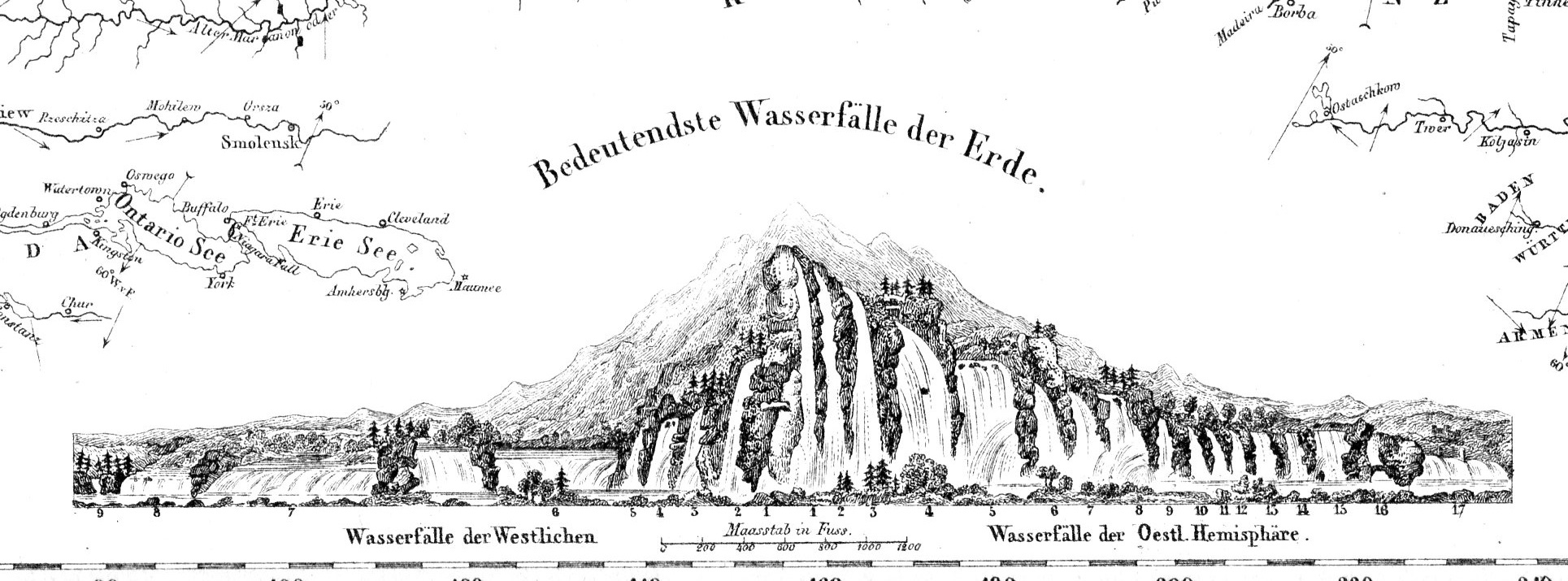
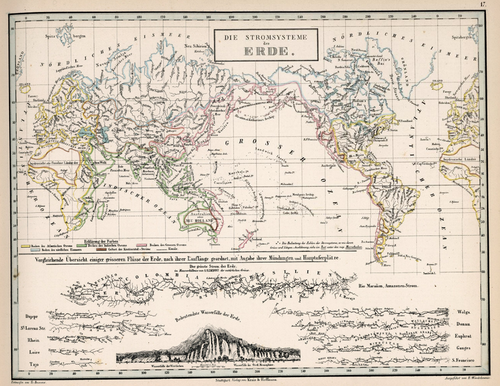
    • “Die Stromsysteme der Erde.”  In von Humboldt, Kosmos, 1851. 

    Before the Neil deGrasse Tyson version and update of Carl Sagan’s landmark television series, Cosmos, there was Alexander von Humboldt and his enormously influential book of the same title, printed in 1845-1862.  Well, von Humboldt’s (1769-18591) book was actually Kosmos when published in German, which is where it started its life (and which von Humboldt suffered mightily for in it English translation), and in which this map appears.  Von Humboldt was enormously studied and educated and of a high scientific mind over many subjects, one of those 19th century figures who seemed as though they could know everything, a polymath of high order (along the lines of Goethe and von Helmholtz and Thomas Young and others).  He was a meteorologist and biogeographer before those sciences existed; a naturalist, geographer, archaeologist, and explorer, a natural philosopher of magnitudes.

    Kosmos reflected his lifelong interest in order, and what he did was astonishing–he attempted to unifying the complexities of nature in one book (of five volumes), binding the various branches of science together in a cohesive whole, attempting to show how the laws of the universe acted here on Earth.  It was a very influential work, very progressive, a masterwork of scientific method.  Kosmos.

     Maps--River system

  • Varieties of Victory–Being Prepared for the Victor of the Philippine Presidential Election of 1946

    JF Ptak Science Books   Quick Post

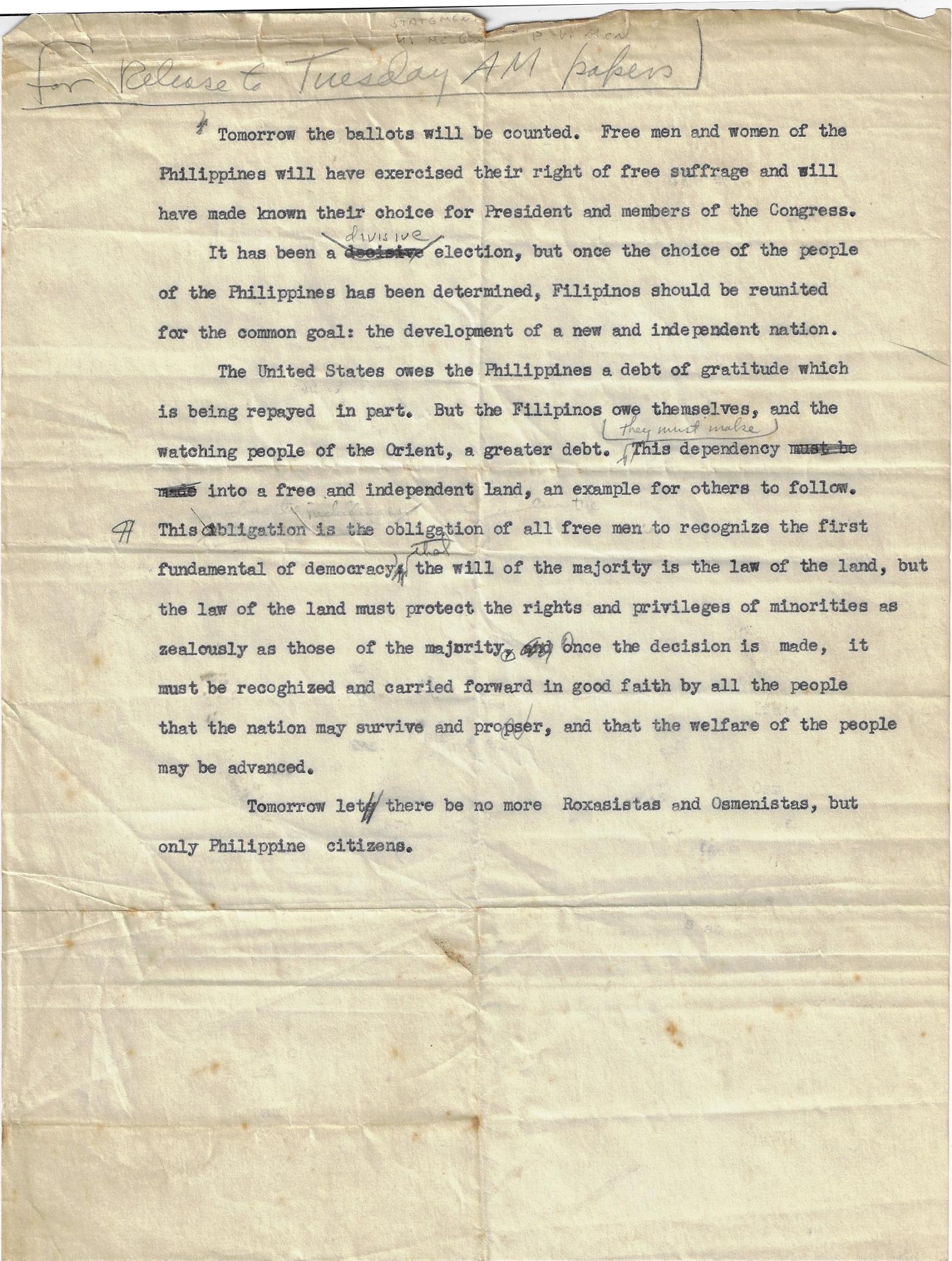
    Here we have two versions of a press release prepared for U.S. High Commission to the Philippines for congratulating the victor of the Philippine presidential election of April 23, 1946.  The first notes that Manuel Roxas (the actual winner) had conceded, while the second did the same for the incumbent Sergio Osmena, who served as the fourth president of the Philippines from 1944-1946. Each is one page long and contains numerous manuscript additions and corrections. “President Manuel Roxas was inaugurated as the 5th President of the Philippines and the first president of the Third Republic on July 4, 1946 at the Independence Grandstand (now Quirino Grandstand), Manila.”–wiki

    No doubt this was a sensible preparation.

    There is also a cover note for the day before the election “Tomorrow the ballots will be counted” and marked in pencil “for release Tuesday AM papers”. “Tomorrow there will be no more Roxasistas and Osmenistas”, it reads, “only Philippine citizens”.  


    • From the estate of David Katcher, who served as a Public Relations Assistant to High Commissioner Paul McNutt in Manila, Philippines during and just after WWII. He later went on to be the founding editor of the journal Physics Today and served as a senior policy analyst in the White House Office of Science and Technology.

    Philippine letter _1_

    ·Posted by :

    ·in:

  • Extreme Results of an Extremist Populist Presidential Candidate (1872)

    JF Ptak Science Books   Quick Post

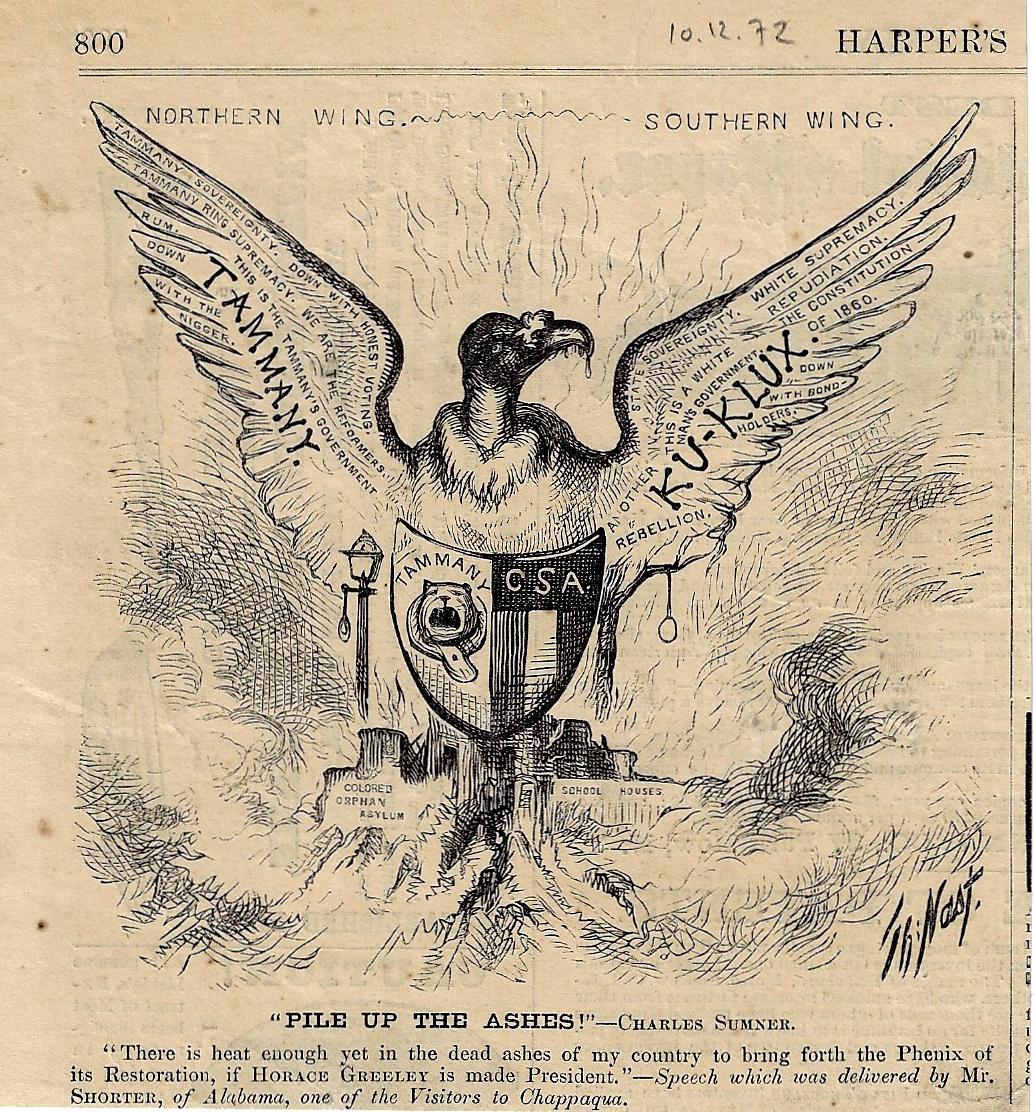
    So thought the great Thomas Nast, who in his enormous endeavors at Harper’s Weekly drew this political statement as a small corner-filler for the weekly issue of October 12, 1872. The fear for him was the resurrected Phoenix of Tammany Hall and the K.K.K. as a result of electing Horace Greeley to the presidency of the U.S., and he was no effort in making his statement with any nod to the subtle. We can clearly see the characteristics of each group emblazoned on the wings of the Phoenix–less visible in the background are the ruins of the “Colored orphan asylum” and “school houses”, targets of the despicable Klan. The election was only weeks away at this point, and Greeley was running as a splinter Liberal Republican, and was trounced by Ulysses Grant in the electoral college. As it turns out, Greeley would be dead three weeks later. 

    Nast 1872 CSA Tammany

    ·Posted by :

    ·in:

Recent Posts

Archives

Categories