A Daily History of Holes, Dots, Lines, Science, History, Math, Physics, Art, the Unintentional Absurd, Architecture, Maps, Data Visualization, Blank and Missing Things, and so on. |1.6 million words, 7500 images, 4.9 million hits| Press & appearances in The Times, Le Figaro, Mensa, The Economist, The Guardian, Discovery News, Slate, Le Monde, Sci American Blogs, Le Pont, and many other places… 5000+ total posts since 2008.

  • Human Powered Machines–Bockler’s Theatrum Novum, 1661

    JF Ptak Science Books   Post #83

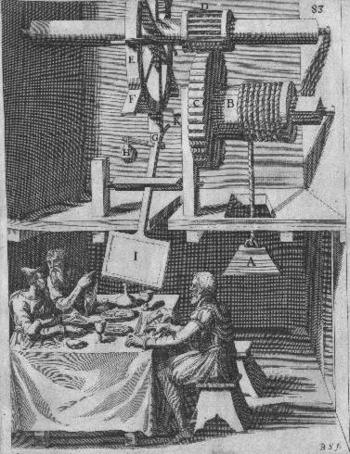
    This post started with this image from Georg Andreas Bockler Theatrum Machinarum Novum (published by Paulus Fuersen and printed by Christoff Gerhard in Nurenberg in 1661) showing to what our eyes in 2008 see as an extraordinary device to power a fan for a dining table.
    Blogbocklerfan

    The gears running what seems to be an escapement-like (clock) device are enormous, and the weight for the weight-driven power source must have been considerable. The result of all of this is that the housing for machine powering the fan necessitate lowering the ceiling in the dining chamber to less than five feet (as there is just enough headroom to get into and out of seat, with the bulk of the cubic space of the room dedicated to the cooling device, which ran like a pendulum, and which also demanded what looks to be like a 10-foot x 1 foot long opening in the ceiling. But if it was a hot humid day in Nurnberg in the summer of 1666, then that fan would feel pretty bloody good to you, as there would have been nothing like it in the city (save for a servant fanning you from not such a discrete distance).

     Bockler as it turns out was an extraordinary talent and very gifted thinker and engineer, designing all manner of instruments and machines over a wide range of fields. His principle interest though was hydraulics, as exhibited in his very popular Architectura Curiosa Nova (1664), which was a practical application of his knowledge of hydrodynamics and mechanics (in general), showing how to construct fountains for the garden and for public city life.
    Blogbocklerhuman_power
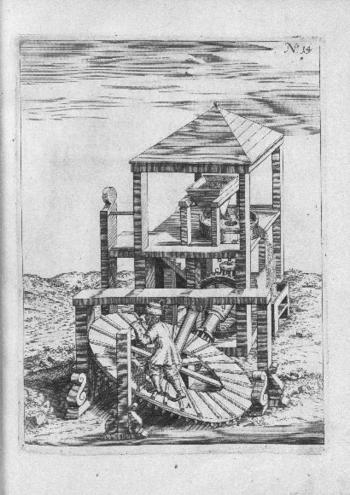
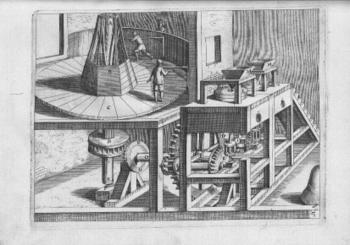
    Looking deeper into the beautifully illustrated Theatrum Machinarum though I was struck by how many of these big machines were powered by humans. And as it turns out Bockler was responding with smaller, more elegant human-power designs because of a problem in supply for the other power sources. The problem with running a furnace to power these machines was the fuel—wood and coal had become problematic on the continent and in Britain in the mid-17th century. The trees that would’ve supplied the wood for the furnaces were disappearing with the rapidly depleted forests. Coal was even a problem with the relatively shallow veins of the deposit giving out. In the meantime of the stagnant power supplies Bockler offered his readers (and parishioners) designs for machines that if all else failed could be powered by humans. Humans on treadmills, humans turning lathes, and so on.
    Blogbocklerhuman_power_3

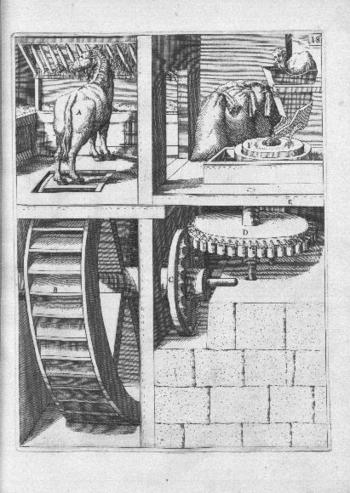
    I’ve included this last part for a horse-driven machine because of the very small window of exposure for the horse to the wheel it would turn. It looks as though it was elegant but I haven’t much of an idea if horses could get used to moving their hind legs without moving their front legs.
    Blogbocklerhorse

    You can see the entire Theatrum courtesy of Cornell University right HERE.
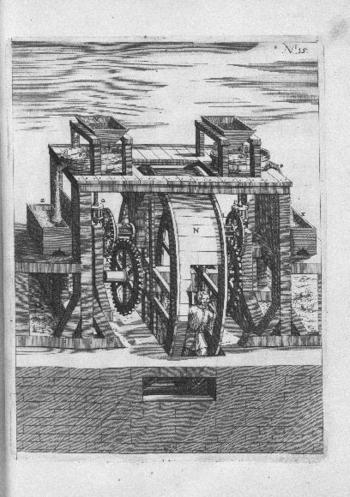
     

    Blogboclkerhuman_power  

    ·Posted by :

    ·in:

  • Human Power—Raw Images of the Middle Passage, the American Stain of Slavery. Wadstrom and the Slave Ship “Brookes”.

    JF Ptak Science Books   Post #84

    Blogslaverybrookes_full

    Having just finished a short post on human-powered machines (Georg Bockler in the mid 17th century) and with Juneteenth fast approaching, I thought about another sort of human power—slaves.  I wanted to make a short post on the conditions in which Africans were taken (sold and stolen) from their home continent to North America (and later just to the United States). 

    Slavery as an institution in the U.S. existed from 1619-1865, failing, ultimately, with the ratification of the 13th Amendment (the first proposed in 60 years) to the Constitution by the end of 1865. (The African slave trade—though not slavery itself—was outlawed in 1807, by a law passed jointly in the United States of America and the United Kingdom, with the  US law taking  effect on January 1, 1808.)  The amendment was ratified relatively quickly by the legislatures of the  necessary three-quarters (27) of the original 36 states in 1865—Mississippi, the last of the original states to ratify the amendment, did so in 1995, 135 years following its initial rejection. Though almost all of the states had ratified the amendment in January and February, it took until December 4th and 6th—months after the crushing failure of the Confederacy—for North Carolina and Georgia to vote for it.  (The remaining 9 states voted for the amendment as follows:  Oregon California and Florida in 1865; Iowa and New Jersey (which had initially rejected the matter in 1865) in 1866;   Texas in 1870; Delaware, the First State, in 1901; Kentucky in 1976; and Mississippi, somehow, in 1995
    Blogslaverycross_section
    .

    The Emancipation Proclamation was issued September 22, 1862, with a three-month long pillow until it took effect on  January 1, 1863 .  Juneteenth refers to the freeing of the slaves in Texas (at Galveston) with the reading of General Order No. 3, on 19th June 1865.  Texas was the last refuge of Southern Slavery, and it all ended on that day. 

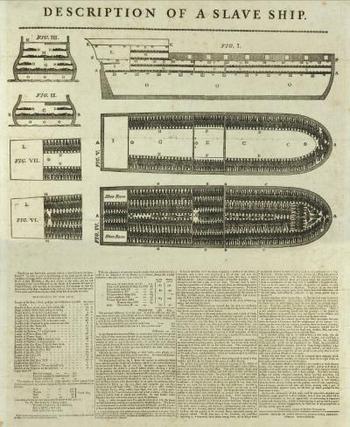
    The famous image above (of the British slave ship Brooke)  is taken from An Essay on Colonization, particularly applied to the Western Coast of Africa….by Carl Bernhard Wadstrom, printed in London in 1794.  Wadstrom (1746-1799) was devoted abolitionist and Swedenbourgian who planned, advocated and practiced (via his relationship with the Nordenskold brothers and the Philanthhropic Society a working agricultural colony on the West coast of Africa) the end of slavery and the return of removed slaves to Africa.
    Blogslavery_brookes1

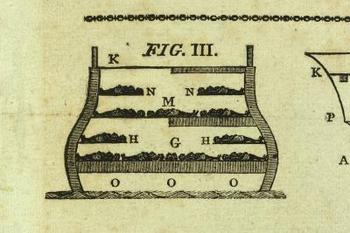
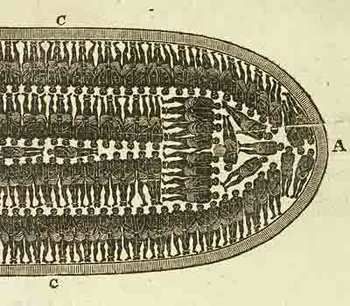
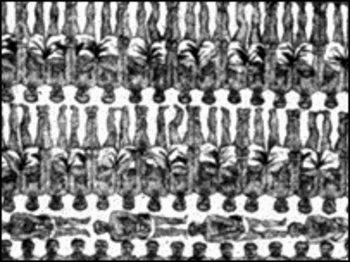
    The images pretty much speak for themselves. Though it should be pointed out that this engraving depicts about 480 slaves packed into the modified hold of the Brooke; in reality the Brooke carried between 500 and 650 slaves to America (meaning the conditions were even more crowded than depicted here), losing on average about 125 people to the insufferable and depraved conditions (dysentery, heat, malnutrition, lack of water, scurvy and so on).

    Blogslavery_brookes_2


  • Blank & Missing People—Pelerin, Schoen and Marey and Picturing Absent and Empty People for the Study of Perspective.

    JF Ptak Science Books  Post #85
    Blogmissing_people076

    In some of the elementary thinking on perspective in the history of art and science there is a certain amount of subtraction that must occur before addition and advancement can be made—these experiments have resulted in some very unusual-singular even—images, which when viewed apart from their proper context and considering the times in which the images were made make them seem revolutionarily modern. 
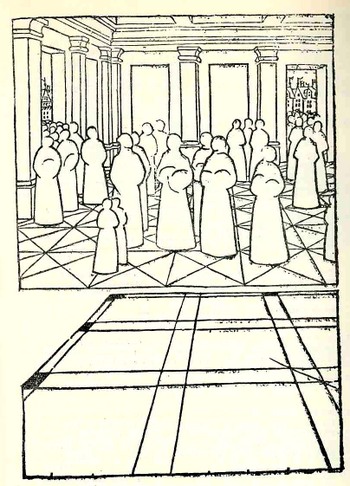
        Take for example the extraordinary work of Jean Pelerin (also called “Viator”) in his De artificiali perpectiva, a very rare woodcut-illustrated book printed n Nurenberg in 1509. In illustrating what he referred to as his “three point perspective” Pelerin removed much of the gothic-tradition bric-a-brac that is so heavily favored in these early books and replaced them with outlines from his rather astonishingly expressive notebooks, and replacing people, individual humans, with what may be the first “almost-entirely-absent” human forms. These roundish, ghost-like figures are just meant to hold the outlines of space, meant to function in the role of a simple comparative unit. This works quite well as an artistic technique—a solicitation tool which I think gives his reduced, “empty” humans an incredible, ethereal look unlike any other in the history of the first 60 or so years of printing.  It is difficult to imagine what the observer of these images back there in 1509 was thinking when they looked at these figures, and perhaps removed them from their textural context—it  would have been a unique visual experience for them
    .Blogmissing_peopl_2e077_2

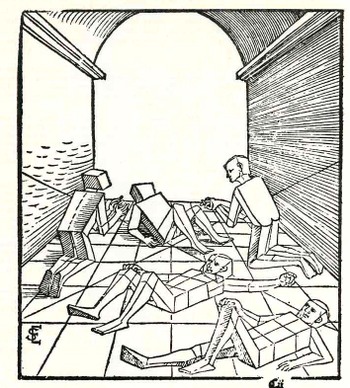
    Just a little while latter Erhard Schoen, in his Unnderweissung der proportzion und stellung der posssen liegent und dtehent, printed in Nurenberg (as well!) in 1538, presented another unique way of representing the human form in model for the sack f studying perspective.  He used simplified geometric form to stand in for the curvy humans, replacing them with proportional stacks of boxes which would more easily explain to the younger reader how to represent the human body n space and in proportion to other things.  Again like the Pelerin, I think that these were monumentally combative images showing humans in a radical, previously unknown way. 

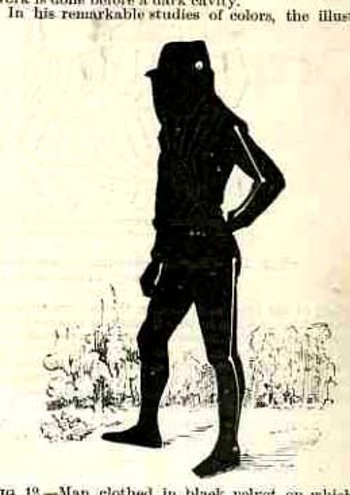
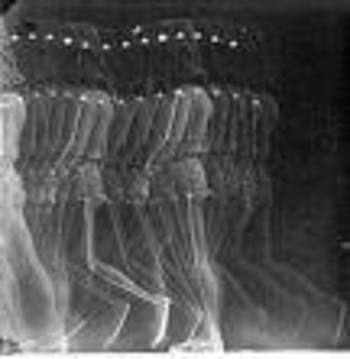
    Dashing into the 19th century we find another superb image of the empty man from Etienne Marey in his photographic and moving-photographic studies of motion.  This is actually a little odder, as the man in this image can be either completely empty or the convex, being completely filled up.

    Blogmissing_menmarey084
     

    Blogmssing_marey_2

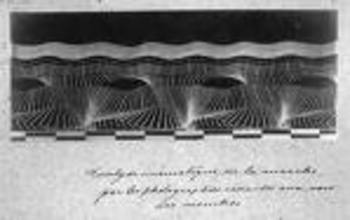
    Marey would fit sensors at moving/jointed parts of the human body, affixed to a black-cloth-wearing experimental helper.  The point was to collect simply *movement* images and not necessarily-at this point at least—the parts of the body responsible for the movement.  At this time Marey was interested in the effects of motion, and used his empty man to do just that.

    Blogmissingmarey_one
     

  • Making People Disappear Part 2-Conjurers, Blank People and Anti-Blank People. Orson Welles, Robert Heller and J.J. Thomson

    JF Ptak Science Books LLC  Post #87
    Blogorson
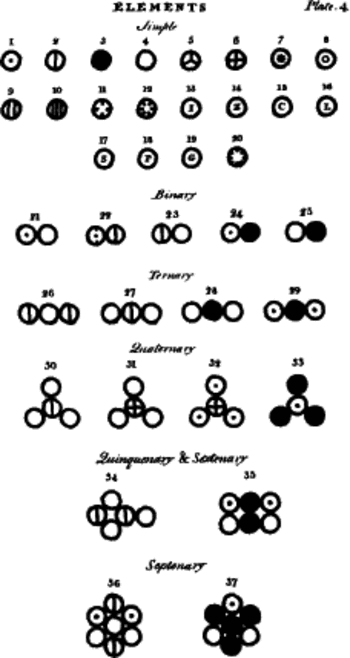
    Following up on an earlier post on disappearing people  (and making things disappear) is this slight abrasion on seeing things that aren’t there, and making other people see the same not-there things.  This is good and bad, depending on what seats you have in the theater and what kind of theater it is that holds these seats.  It is many times fabulous in the theater of science, where people like Democritus and Leucippus (5th century BCE Greek) proposed thinking of the world being composed of tiny, individual, non-solid and invisible elements—these elements were there, of course, because they reasoned that everything could not come from nothing, and thus they had to be so small as to seem to not exist at all.  This was the beginning of the atomic theory which would be added to and subtracted from over the next 2500 years, encountering atomists-in-extremis like John Dalton (1766-1844, with the first truly scientific/experimental/useful atomic theory) and JJ Thomson (who in 1897 actually discovered a constituent element of the invisible universe called the electron, and then on to Max Planck (who complicated things enormously and fabulously with the quantum theory in 1900,
    and Planck’s constant  h-bar =
    h/2p)and on and on.
    Dalton

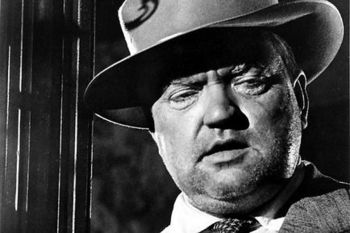
    In the theater that we expect to be shown nothing and believe in it, humans have been happily deceived for thousands of years.  Our gorgeous Orson Welles, for example, still semi young when he made his B-movie masterpiece Touch of Evil, transforms himself utterly with a little make up and a whole lot of acting, disappearing himself and producing Detective Hank Quinlan in his place.  In this movie, witch is perhaps one of the greatest black-and-white, sheerly, unstoppably black-and-white, with no grey tones and contrasts sharp enough top cut your pinkies on black-and-white, the most noire of flim noires, Orson manages to hide himself in the shadows and let Det. Quinlan take his disappeared place, right there in front of you.
    Blogdisappear_conjure092

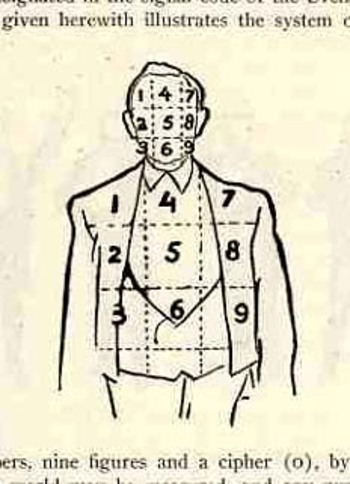
    Another wonderful illustration of empty, waiting-to-be-filled-up humans, human tabula rasa so to speak, was employed by the “second sight” conjurer Robert Heller. He abandoned his wig and his French accent, along with his piano, to become a conjurer, and became one of the “best” of his day. Heller (born Palmer, 1826-1878) took advantage of people’s lack of scientific background and inventive acuity, and their need to believe ion something mysterious and larger than themselves, in some sort of simple primordial goo that might hold together the vastly differentiated universe, to trick them into believing that he could somehow divine a manner of objects and thoughts with his razor/divination vision. 

    Unfortunately, all he was doing was working with confederates and employing a slightly elaborate signaling system to communicate his so-called deep vision. (For example in this manikin image, Heller woul dbe able to signal his  confederates the number he was “divining” by touching these parts of his body as he was setting the foundation for the trick.)   It was a smart idea, a two-beer idea, that he acted on and parlayed (along with a broad theatrical stage presence)into a significant bankroll.  He had other sorts of magical helpers and automata to push his sleight show forward, but mostly, it seems, it was his ability to “force” people to know something that they couldn’t, all worked with secret alphabets and hidden associates.  It was easy and a little feeble, and it worked for years until his will just gave out. He was a local to the vicinity of my old shop in Georgetown, and it is perhaps appropriate that his magic was worked and also gave out in Washington, D.C.

    To tidy things up, it was the scientists who found the things that are there but can’t be seen but couldn’t make the vast percentage of the population “see” the unseeable, while people like Heller and other magicians couldn’t find their unseen things anyway but could make people “see” their non-existent unseeables—all of which seems fairly paradoxical.

    (“I see”, Patti Digh just brightly said.)(Below I’ve attached the opening scene from Touch of Evil–it is one continuous single take, one of the greatest opening shots in film history I think.  And old Uncle Orson was able to do all of the magic on a buck-two-eighty.)


  • The History of Stopping Time #1: A.M. Worthington, Ernst Mach and Doc Edgerton

    JF Ptak Science Books LLC Post #88
    Blogstopping_thing_splash087
    This will be the first out-of-sequence post looking at the intervals of stopped time (random or not), and how people and cultures were able to stop or save time, and how they could arrange to segment and store time over thousands of years.

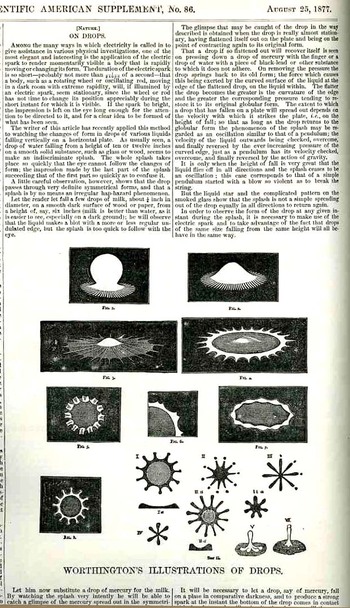
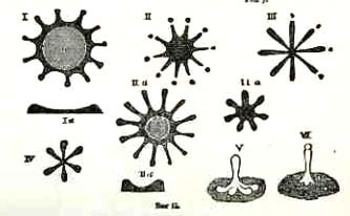
    The first entry is from the Scientific American from August 25, 1877 and records the experiments of A.M. Worthington. They are perhaps one of the first revelations on the quiet residence of energy in something as simple as a drop of water or mercury.  Much in the same way Robert Hooke revealed the microscopic universe to unsuspecting readers, so too did Worthington, in his way, reveal the explosive world of small, fast, and lost events. Worthington’s style is of course exceptionally restrained and free of exclamation, even while describing the first time any human has witnessed these events, like so: “…watching the changes of form of drops of various liquids falling vertically on a horizontal plane…the whole splash takes place so quickly that the eye cannot follow the changes of form…”   This report, “On Drops” follows Worthington’s own earlier effort of 1876 and 1877 “A Second Paper on The Forms Assumed by Drops of Liquids falling vertically on a Horizontal Plate” (Proceedings of the Royal Society, 174 and 177), chronicles his brilliant adventure in the newly discovered world of fast time—a world he was pretty much creating as he moved along.  (A particularly good description of the experiment as well as an image of the apparatus can be found on Martin Waugh’s lovely and arresting site—he is one of the leading modern practitioners making art in
    Blogstopping_thing_splash087_detail

    this genre of high-speed photography:  liquid sculpture calls it.)  )   It is particularly powerful to note that the illustrations here are drawings of the phenomena of his study of splashes—drawings, not photographs.  The photos by Worthington (On A Splash from a Drop of Milk) would not appear until 1894. (An entire book is dedicated to this subject by Worthington, who published, in 1904, the wonderful A study of Splashes.)  This means, I guess, like the heroic chroniclers of snowflake forms and such that he ran many, many experiments and painstakingly observe red different parts of the splashes and recorded them by hand.  Worthington wouldn’t be able to photographically record the images of his splashes until later after the application of inventions and advances by C.V. Boys and Lord Rayleigh.  Until that time his audience would have to depend upon his tenacious observational powers—or try the experiment themselves and make their own observations, as Worthington provided all the necessary data for his experiments to be replicated, of course.
    Blogstopping_thing_bullet_2gs086
     

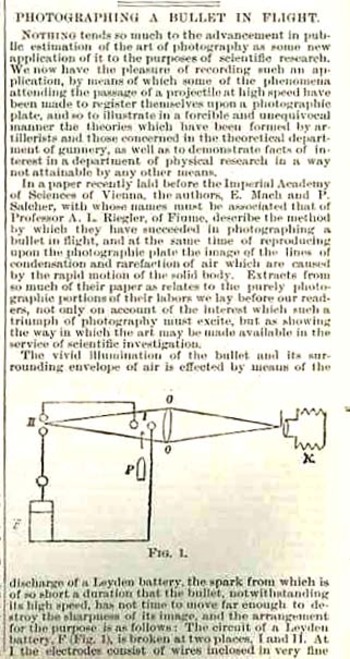
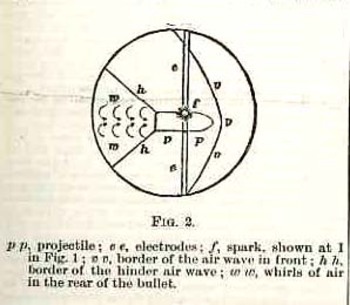
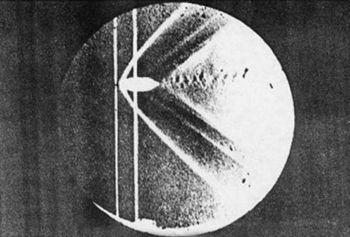
    The next paper relates the success of Ernst Mach and P. Salcher in creating an apparatus to illuminate and photograph a bullet in flight—this was again found in the Scientific American, but for 24 September 1887 (supplement 612).  Unfortunately, their results are rendered only by a drawing, even though the half-tone was available by this point to provide a high-quality reprint of a photograph, it took Scientific American another few years to start employing that breakthrough method.  (I’m not sure why this was so.)
    Blogstopping_things085_blluet_det_2

    The results were made available in the original Austria edition of his publication from which this article is drawn.  This paper “Photographische Fixierung der durch Projektile in der Luft eingeleiten Vorgange” presented to the Academy of Sciences in Vienna in 1887, was revolutionary in more ways than one, as it was really about the visualization of flow over objects, and in particular, the movement of media as a bullet traveled at supersonic speeds—and to which Mach would donate his name for the description of units of supersonic speed.  (The term was first publicized in 1929 when Swiss engineer Jakob Ackeret used Mach’s name for the first time in the description of these speeds.)
    Sudden_mach

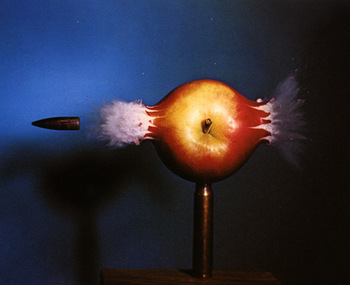
    This last photo is included just because of its sheer beauty—it is far in advance and way out of the continuum for a discussion like this, but this effort, produced by Harold Edgerton, just must stay.  This is the titanic blast of ingenuity that was the intellectual successor to the earlier works listed above, but the technical advancement is just so fabulously great that the earlier scientists could simply not imagine them.  This image was as much science fiction to them as their images were to scientists considering these ideas right there at the birth of photography in 1839.) Harold “Doc” Edgerton, 1893-1990, who would form EG&G and serve MIT for many years owned this field of photography for many years—time stopped for the venerable Edgerton right after he paid for his lunch at the faculty club at MIT. Failing life with a heart attack at  87.)
    Suddennessedgerton

    For an interesting look at videos of various sorts of splashes see the North Carolina School of Science and Math HERE.

  • Beautiful Title Pages 5: Chocolate, Morals and the Birth of the British Museum

    JF Ptak Science Books LLC   Post #89
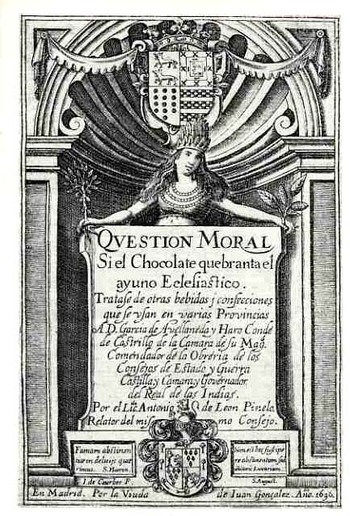
    Blogtpchocolate095

    This lovely title page is from the book Question Moral Si El Chocolate Quebranta El Ayuno Eclesiastico, (on the Moral Question of Chocolate…), printed in Madrid in 1636, and said to be the first book on American drinks.  León Pinelo. a Spanish-colonial historian (1589 – c. 1675), born in Cordova de Tucuman, (Argentina),  and educated in the College of the Jesuits of Lima (Peru), and then leaving for Spain by 1612, where he wrote this (and other) books.   HE was a significant scholar and an accomplished bibliographer, and compiled a very extensive dissertation upon the history, uses, preparation of chocolate, as well as other drinks in general of the Americas, touching on concoctions of Indians of New Spain, Peru, Nicaragua and Guatamala. 

    The title page is very dimensional, with the central figure, an Indian woman holding the scroll of the title, with a miniature coca tree in one hand and a four-leaved branch from the cocoa tree in the other. 

    Leon Pinelo in no way “created” the chocolate drink, but he was the first (and extensive reporter of it and certainly remained it most extensive annotator of the drink for centuries. Columbus was aware of the drink by his fourth voyage in 1502 but said relatively little about it.  The Aztecs had been using the cocoa been for a thousand years before that.  (It has been remarked that the drink was so extraordinary and special that it was served in one-serve golden goblets that were disposed of after the chocolate was consumed). 

    Perhaps the great King of Chocolate though was Sir Hans Sloane, who in addition to much else he did in his life traveled to Jamaica, where he assembled a fabulous plant collection for shipment back to England.  He also “discovered” chocolate there, improving the native presentation of the drink (which he evidently found to be nauseating) by perfecting a milky solution with it—and *that* it was brought great wealth to Sir Hans.  With that wealth Sloane continued to add to his extraordinary collection of natural artifacts, amassing one of the greatest cabinets of curiosity in England and the continent.  In addition to his own collecting and minor purchases Sloane used his chocolate money to purchase the fabulous collections of  William Courten (who, for example was an extremely wealthy Brit who financed the colonization of Barbadoes among other things before finally going bust), James Petiver, Nehemiah Grew, Leonard Plukenet, the Duchess of Beaufort, the rev. Adam Buddle, Paul Hermann, Franz Kiggelaer and Herman Boerhaave.  Death’s dance found Sloane in 1753, who left his entire collection to England, and it was this bequest that formed the opening, golden, sagacious nugget of the British Museum. 

  • Beautiful Title Pages 6: Losing Your Head—St. Denis and the Cephalophoric Title Page

    JF Ptak Science Books LLC   Post #90
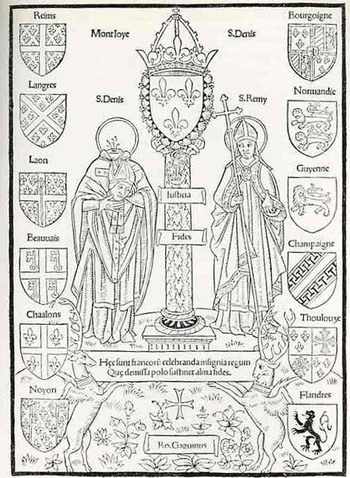
    Blogtphead_off096

    Robert Gaugin (1433-1501) produced this fabulous illustration for his Compendium de origine et gestis Francorum, a 180-leaf history of France, printed in Paris in the second week of 1500.  (This is actually the fourth edition of this work which first appeared in the year 1495, which would officially make it incunabula.)

    St. Denis and St. Remy are pictured here standing on either side of a column supporting the fleurs-de-lys, and surrounded by the coats of arms of various French cities and provinces. 
    Blogtphead_off096_det

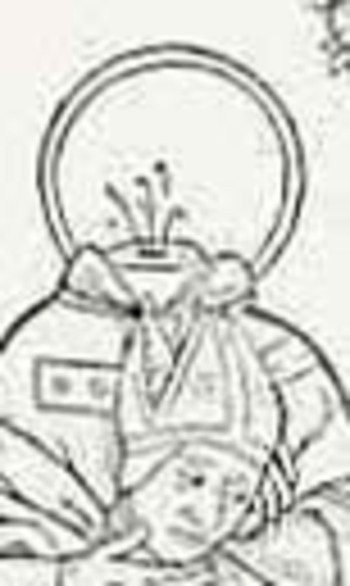
    So far as I can limitedly determine this is the first title page featuring a headless, or decapitated, human.  And that human is St. Denis of Paris, also called Dionysius, Dennis and Denys, the third century bishop of Paris who was martyred about the year 250.  It is said that after being beheaded by the Romans at the highest point in the city of Paris (now known as Montmarte, “mount of the martyr”), Denis picked up his head, held it in his hands, and walked two miles in this fashion, preaching all the way.

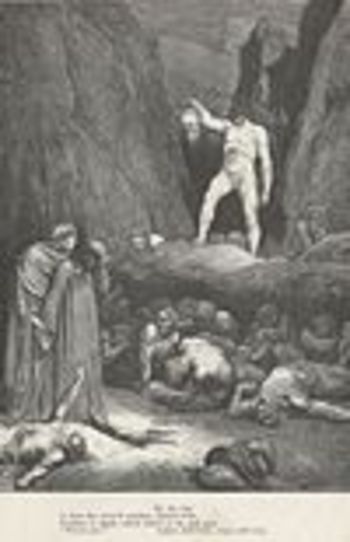
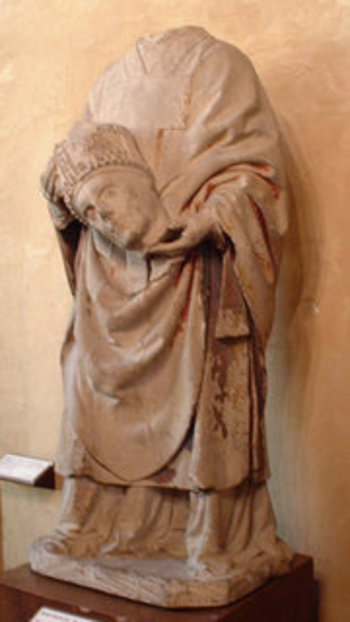
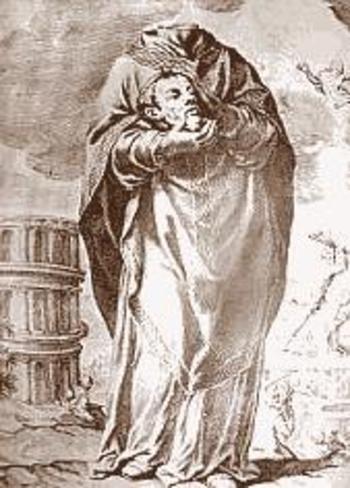
    St. Denis however was not the only beheaded person to carry his head, nor was he anywhere near being the only saint to do so. As a matter of fact there is an entire category of saints who carried their heads following beheading, called Cephalophores.  This special class of saints
    Denis_bertrand

    include Paul of Tarsus, Saint Ginés de la Jara, Saint Gemolo , Aphrodisius of Alexandria, (pictured below)  Nicasius of Rheims,  Cuthbert of Lindisfarne and Oswald of Northumbria, while others of this category though not saints include Lucian of Beauvais, Nectan, , Osyth, Quiteria, Winefride and Wyllow. Cephalophores also make many appearances in literature, most notably in Dante’s Inferno (8th Circle, Bertrand, pictured left) St_denis_2
    ) and in Sir Gawain and the Green Night. St_denisaphrosdius

    But none I think appear on a title page of a book earlier than this 1500 example of St. Denis.

    As a very occasional note, St. Denis is pictured here with one halo–sometimes he has two. 

    ·Posted by :

    ·in:

    — —
  • Color Music–Found Images and the Second Perfect Number.

    JF Ptak Science Books LLC  Post #93

    (Notes for a Future Post)
    Blogcolor_scales097
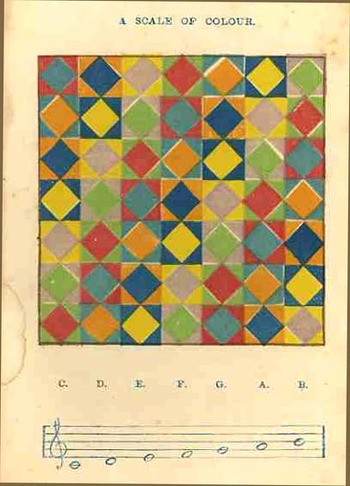
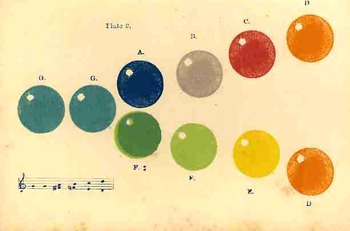
    I found these two beautiful lithographs a while ago—they are really quite gorgeous, and I don’t have a clue to their source.  They probably were printed in the 1860s or so, perhaps 1870s, which I thought—given their subject matter—would make their identification easier.  The subject matter is old, appearing hundreds of years before these images were published. For example, in 1690 the philosopher and constitutional muckrack John Locke reported on a blind synesthesiastic man “who…bragged one day that he now understood what scarlet signified … It was like the sound of a trumpet.” 

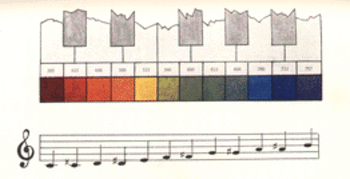
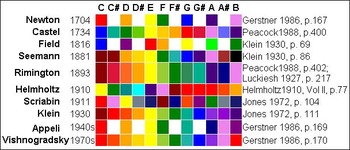
    Equating the frequency of sound waves with the corresponding wavelengths of light was a quest by Sir Isaac in 1704 (In the Opticks), while in 1742 the French mathematician Louis Bertrand Castel strengthened Newton’s proposal of a solid relationship between the seven colors and the seven units of the scale. Slightly later he  undertook the  construction of a clavecin oculaire–a light-organ–as a new musical instrument,. which would simultaneously produce both sound and the “correct” associated color for each note.  A century and a half later Bainbridge Bishop had constructed at least three color organs, while in 1893 Rimington had patented the name “color organ,” and had already toured with his own device, performing color tone presentations of the works of Chopin,
    Blogcolor_scales_bubbles098

    Bach, Wagner and Dvorak.  Experimentation of a new order took place in the early 20th century in the hands of Scriabin (who thought colors were associated with tonality, not with singular notes), Kandinsky, Schoenberg and Marc. 

    Now, getting back to the “scale of colour” illustration, we find our anonymous author equating the following scales thus, beginning with the first column, reading top to bottom, and looking first at the underlying color:
    C:  red, blue, orange, blue, yellow, violet and green.
    D:  orange, blue, yellow, violet, green, red indigo
    Blogcolo_rmusic_rimington
    E:  yellow, violet, green, red, indigo, orange, blue.
    F:  green, red, indigo, orange, blue, yellow, violet.

    And so on through the scales of G, A and B. 

    When you assign numerical values to each one of these colors (green=1, red 2, indigo=3, violet=4, red=5, green=6, yellow=7), the sum is 28. 
    28 is an interesting number in itself, being the
    Blogcolor_organ_bishop
    second perfect number (following the first perfect number which is 6)—a perfect number being the sum of its divisors, including unity but excluding itself (so 28= 1+2+4+7+14).

    The color systems proposed by Castel and Bainbrisge are as follows:

    Castel

    B (dark) violet Bb agate A violet Ab crimson G red F# orange
    F golden yellow E yellow Eb olive green D green C# pale green C blue

    Bainbridge
    B violet-red Bb violet A violet-blue G# blue G green-blue
    F# green F yellow-green E green-gold / yellow
    D# yellow-orange D orange C# orange-red C red

    Blogcolor_schemes

    The following chart is from the wonderful color/music siteVISUAL MUSIC.

    ·Posted by :

    ·in:

    — —
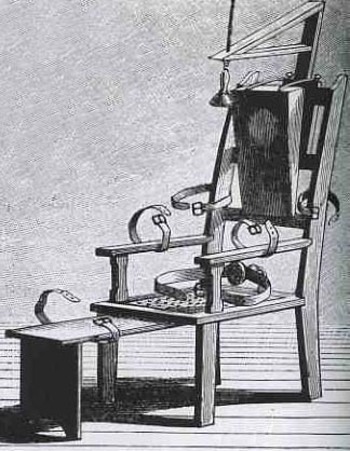
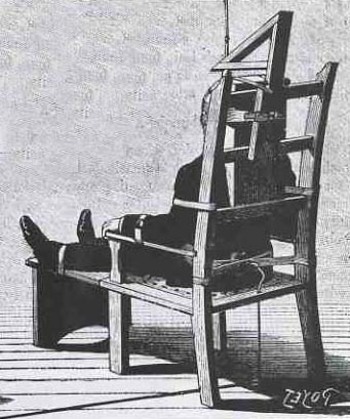
  • Electrocution, the Electric Chair, and the Evil, Spiteful Genius of Thomas Edison

    JF Ptak Science Books LLC    Post #94
    Blogelectrocution_chair_empty
    It is ironic that the spiritual investment necessary for the electric chair—the ultimate legal act of revenge—was itself the product of an act of vengeance. In 1888 Thomas Edison, innovative and creative genius and social miscreant (and deep old friend and camping buddy of a howling intellectual horror, the anti-Semitic and fascist appeaser Henry Ford) brought his enormous weight to bear to wrestle public opinion in favor of his (that is the Edison General Electric Company) mode of power distribution (direct current or DC) versus that of his direct competitor, George Westinghouse (alternating current, or AC). 

    Things were not going well for Thomas Alva.

    At nearly the same time the New York State legislature, under a mandate of 1886 and a law of 4 January 1888, was seeking new ways to kill prisoners, it having been determined that hanging people caused too much suffering (to the hanged).  It was determined that death be best and less painfully delivered via electrocuting them.  (Actually the procedures of the day for electrocution were less “sophisticated” than they would be by the turn of the century; the people killed in this manner in the first two decades of use of the electric chair were basically cooked from the inside out.)  The dangling issue was the technology top be used to deliver the electricity.
    Blogelectrocution_chair_filled

    And this is where Edison gets brilliantly, terrifically, ugly.  He proposed that the state use Westinghouse’s AC system for electrocutions, and set up tests with the AC system to prove its superior qualities in providing power to the electric chair over the C technology.  He did this so that the gross population would equate the Westinghouse system with electrocution, which Edison referred to as being “Westinghoused”, and choose Edison’s own DC technology, which wouldn’t theoretically kill the consumer in their own house.  The state chose the AC system; Westinghouse refused the state’s orders for his production; and then Edison stepped in and manufactured the AC system for the state’s use in electrocution over Westinghouse’s loud complaints.  Evil genius.

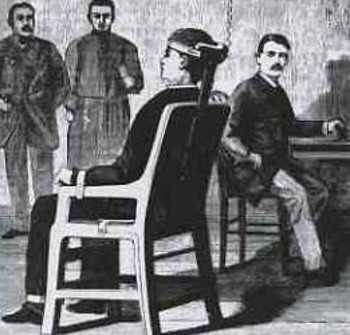
    This was also the start of Edison’s rather bizarre experience with filming electrocutions.  He made several films for the New York state officials showing how well the AC system worked—he did this by showing how well the Westinghouse system electrocuted the animals that he dropped on the electrified plate fed by the AC current.  Over and over again.  Edison also made a film of McKinley’s assassin, Czolgosz, being put to death by electrocution, in an early docudrama session, showing the condemned man fidgeting a little before coming to death.  Edison’s crowning achievement in electrocution films was his disgusting film of a circus elephant being put to death—I will not describe the film, and  say that only a monster would do and make such a thing.  Even in the present when we can see just about anything on the internet, watching this film is just impossible, it is just so horrific. (I do NOT recommend watching this,  not at all.  You will not be able to forget, try as you might and must.)
    Blogelectrocution_filled_another

    And if you couldn’t stand to watch something like this be done to an animal, why would it make sense to do this to a human?

    There is no doubt that some of the electrocutions of human beings removed the person relatively instantly and painlessly.  It would seem that this would be a minority.  When I was researching a piece about the Rosenbergs (yes they were guilty) in 1985 I happened to talk with the maintenance guy at Ossining State Prison who “cleaned up” after Julius was removed from the electric chair.  Quickly and quietly summarized, he said that his work with Julius’ remains were as gruesome as the execution.  “Was this, was Julius Rosenberg, a special case, was he treated differently?” I asked, a little naively.  “No”, he responded, “they were all like that”.

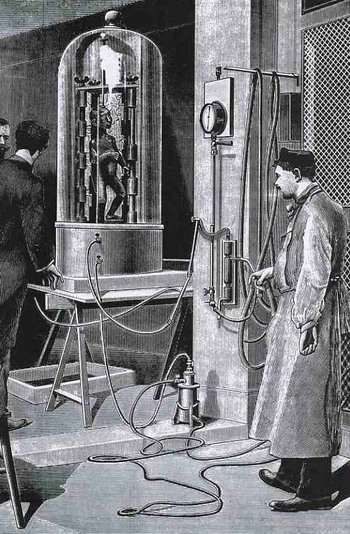
    And while we’re at it, let’s consider the work of Dr. Varlot (of the Paris Hospital) in electrocuting the dead.  Actually, what he proposed was another pretty gruesome use of electricity, only this time no one was hurt, as the receiver was already dead.  Varlot proposed to “metalize” the dead (as we see in this unsettling image of a child being electroplated) for, well, some purpose.  It just seems and seemed like a bad idea, al the way around.  The medical uses of an electroplated baby seem very limited, and I can’t imagine anyone wanting to do such a thing to a dead child of their own.  It is wrong on every level.
    Blogelectrocution103
     
    I know that electrocution is done and gone.  It replaced hanging, and hanging replaced beheading, and so on; but the effect is providing an incrementally less gruesome way of revenge—the point being that even though the next newest method is less grotesque, it is still, at base, grotesque.  Just less so. 

    ·Posted by :

    ·in:

    —
  • The Beauty and Iconography of Title Pages: Frau Mauro’s Sphaera volgare novamente (1537) and a Very Early Glimpse of America on a Globe

    JF Ptak Science Books   Post #95
    Blogtpamerica105
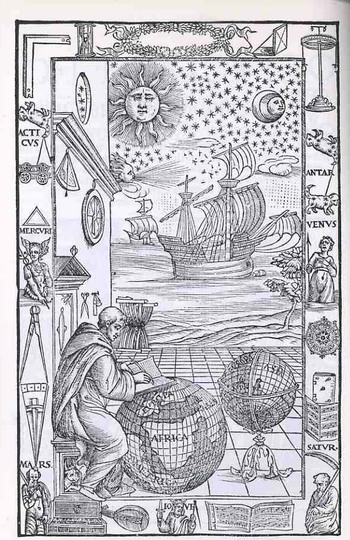
    This magnificent piece of tidy work was done for this new edition of Johannes de Sacrobosco’s Sphaera by Fra Mauro Fiorentino (1492-1556), and gives us all a chance to have a bit of fun reading late Renaissance iconography. The work is entitled Sphaera volgare novamente tradotta con molte notande additoni di geometria, cosmographia, arte navicatoria et stereometria (and so on), published in Venice in 1537, and as stated in the title this is an augmented edition of Sacrobosco with Mauro adding segments on geometry, cosmography, navigation and perspective.

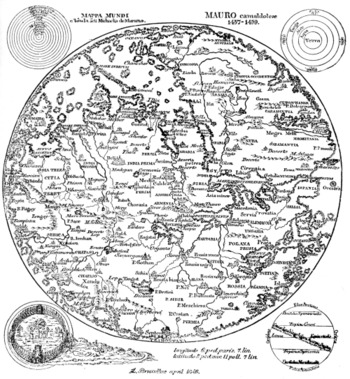
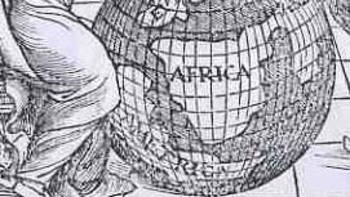
    The wood engraving is of particular interest because of the globe upon which Fra Mauro is writing—as you can more clearly see in the detail; shot (below) we can see a large continent labeled “America” just hundreds of miles off the coast of Africa.  The Americas still make only guest appearances on globes at this point, and seeing it here, as a bit of an afterthought, is a treat (considering how easy it is to overlook it).  There is another Fra Mauro, much more famous than our’s above, whose cartographic workshop produced a seminal, magnificent  map of the world in 1453, thus bringing the two Mauro’s together, if only slightly, via their maps (one great, the other incidental).
    Mauro_map

    Looking a little more closely at the elements of this image we find a number of interesting bits.  Working from the upper right hand corner across and down we find a right angle (for the architectural and building parts of the book), then a sand clock, a decorative laurel wreath with a pocket sundial (!) right next to it, ending with an object that looks as though it might be a physical sciences demonstration tool (I’m guessing).  Working down from the “what is it” we see the first cut of a three-times-repeated constellation that I think has nothing to do with the word “Antar” beneath it. 

    “Antar” probably refers to the famous Arab warrior-poet, subject of lots of attention over the centuries including two works by Bach and Rimsky-Korsikov (and also the name of Apollo as worshiped at Actium) Below Antar is an armed and clothed (?!) Venus, major domo goddess of love and beauty and for whom existed innumerable cults (witnessed by just some of the famous Venuses as Venus de Milo ,Venus de’ Medici, Capitoline Venus, Esquiline Venus, Venus Felix, Venus of Arles, Venus Anadyomene (also here), Venus, Pan and Eros, Venus Genetrix, Venus of Capua, Venus Kallipygos, Venus Pudica, and so on into the sweaty  night.)

    Blogtpamerica_detail

    Following Venus is, I think a complex compass rose, though it may also be a calendar—I can’t quite tell from the detail of the cut.  This is turn is followed by a heavily fortified book (actually this sort of bonding, meant for heavy use, was relatively common at this time)and a score of (5-line staff) music. 

    Returning to the right angle and moving down we se the same constellation under which hangs a very stable-appearing wagon, with a triangle beneath it , followed by a representation of Mercury, the messenger of the gods, who in turn is positioned over a large set of dividers.  On the wall over the head of Fra Mauro we see two precision instruments—a surveying tool and an astrolabe.  The two small tools near Mauro’s head seem to be a scale and a pair of scissors. 

    The central panel shows two caravans (approximately 100-footers?), being driven by a favorable wind to hospitable shores beneath a starry and benign firmament. 

    The bottom tier is the most emblematic of the set of images, as we see the related Saturn-Jove-Mars all together.  Saturn is also Kronos, which is why we see the old horned man caring the scythe of time’s reckoning; he is also the father of Zeus, also known as Jupiter (Juppiter Optimus Maximus Soter (Jupiter Best, Greatest, Savior)), also known as Jove, who stands here crowned and warning us with a sword and dividers.  Jove in turn was the father of Mars, who here doesn’t look terribly war-like at all.  Punctuating the spaces between these three are a keyboard instrument, a lute and a score of music.  I’m not sure that these lyrical/musical devices had anything to do with the three generations of super gods, but there you have it. 

    ·Posted by :

    ·in:

    —
  • Missing People–[Addition]. Joachim van Ringelberg, 1541.

    JF Ptak Science Books LLC  Addition to Post #88

    I’ve
    found another extraordinary image that would fit just perfectly in an an
    earlier post, Missing People—Pelerin, Schoen and Marey and Picturing Absent and
    Empty People for the Study of Perspective
    .

    Blogmissing_add107
    This
    wood engraving comes from the Flemish Joachim Sterck van Ringelberg’s (1499-1536
    or so) book Lucubrations, printed in Basel in 1541 Ringelberg was one of those famous wandering
    scholars from the first half of the 15th century, and the book was no doubt constructed for the use of his pupils. This is one of about 30 books that Ringelberg
    wrote–he intended to wrtie a thousand, but times being what they were, and
    living to only 37 or so, he fell short of the mark. He did produce quite a lot
    though given his youth, the hardship of travel, access to published works, and
    tools, and general annoyances of the 16th century traveler who was not a
    royal. It is really quite
    remarkable. Ringelberg taught a wide
    range of subjects belying his quest for M books–he was competent in astronomy,
    mathematics, literature, classics (of course) , and languages.

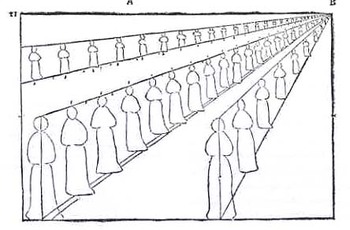
    This “missing people” image comes from a section of this book dealing
    with perspective. I’m just endlessly
    entertained trying to get inside the head of a 16th century student seeing
    these empty, missing, place-holder human forms for the very first time. As I’ve said earlier, these figures just
    don’t occur in Western art.   


    ·Posted by :

    ·in:

    —

Recent Posts

Archives

Categories