JF Ptak Science Books LLC Post #93
(Notes for a Future Post)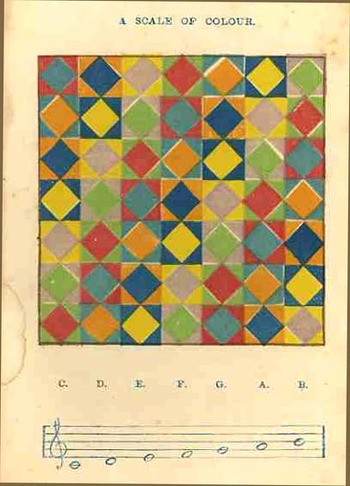
I found these two beautiful lithographs a while ago—they are really quite gorgeous, and I don’t have a clue to their source. They probably were printed in the 1860s or so, perhaps 1870s, which I thought—given their subject matter—would make their identification easier. The subject matter is old, appearing hundreds of years before these images were published. For example, in 1690 the philosopher and constitutional muckrack John Locke reported on a blind synesthesiastic man “who…bragged one day that he now understood what scarlet signified … It was like the sound of a trumpet.”
Equating the frequency of sound waves with the corresponding wavelengths of light was a quest by Sir Isaac in 1704 (In the Opticks), while in 1742 the French mathematician Louis Bertrand Castel strengthened Newton’s proposal of a solid relationship between the seven colors and the seven units of the scale. Slightly later he undertook the construction of a clavecin oculaire–a light-organ–as a new musical instrument,. which would simultaneously produce both sound and the “correct” associated color for each note. A century and a half later Bainbridge Bishop had constructed at least three color organs, while in 1893 Rimington had patented the name “color organ,” and had already toured with his own device, performing color tone presentations of the works of Chopin, 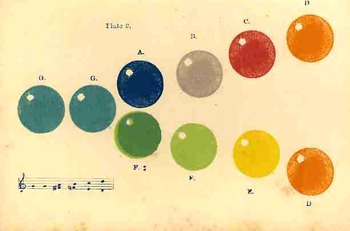
Bach, Wagner and Dvorak. Experimentation of a new order took place in the early 20th century in the hands of Scriabin (who thought colors were associated with tonality, not with singular notes), Kandinsky, Schoenberg and Marc.
Now, getting back to the “scale of colour” illustration, we find our anonymous author equating the following scales thus, beginning with the first column, reading top to bottom, and looking first at the underlying color:
C: red, blue, orange, blue, yellow, violet and green.
D: orange, blue, yellow, violet, green, red indigo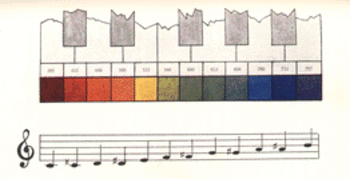
E: yellow, violet, green, red, indigo, orange, blue.
F: green, red, indigo, orange, blue, yellow, violet.
And so on through the scales of G, A and B.
When you assign numerical values to each one of these colors (green=1, red 2, indigo=3, violet=4, red=5, green=6, yellow=7), the sum is 28.
28 is an interesting number in itself, being the 
second perfect number (following the first perfect number which is 6)—a perfect number being the sum of its divisors, including unity but excluding itself (so 28= 1+2+4+7+14).
The color systems proposed by Castel and Bainbrisge are as follows:
Castel
B (dark) violet Bb agate A violet Ab crimson G red F# orange
F golden yellow E yellow Eb olive green D green C# pale green C blue
Bainbridge
B violet-red Bb violet A violet-blue G# blue G green-blue
F# green F yellow-green E green-gold / yellow
D# yellow-orange D orange C# orange-red C red
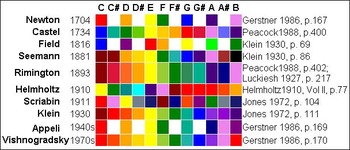
The following chart is from the wonderful color/music siteVISUAL MUSIC.