A Daily History of Holes, Dots, Lines, Science, History, Math, Physics, Art, the Unintentional Absurd, Architecture, Maps, Data Visualization, Blank and Missing Things, and so on. |1.6 million words, 7500 images, 4.9 million hits| Press & appearances in The Times, Le Figaro, Mensa, The Economist, The Guardian, Discovery News, Slate, Le Monde, Sci American Blogs, Le Pont, and many other places… 5000+ total posts since 2008.

  • Abbreviating Auschwitz: the Construction Contract for the Building of Auschwitz III

    JF Ptak Science Books 

                        1blogsept_23_astro_det641_2

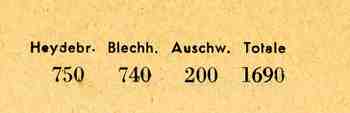
    This document of death, this pamphlet is the Auschwitz III Construction Contract between IG Farben and the Confederazione Fascista degli Industriali for Construction of the Buna Works at Auschwitz III, as well as construction at Heydebrek and Blechhammer, and was printed in 1942.  I’ve only been able to scan five pages as the document is fairly weak and I have a flat bed scanner–I just don’t think it would take much more abuse without falling out of its binding.  But I have scanned some of it, notably the participatory Italian companies and some of the allocation of workers to the different concentration camps.
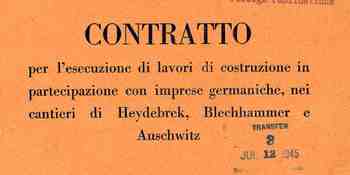
    1blogsept_23_astro_cvr_detail643

     
    The full title reads of the work reads:

    Contratto per l’escusione di lavori di construzione in partecipazione con imprese germaniche, nei cantieri di Heydebrek, Blechhammer e Auscwitz. It was printed by Tipografia del Gianicolo, in Rome, 1942, by the Confederzione Fascista degli Industriali, Federazione Nazionale Fascista Raggruppamento Germania.  The document measures a fragile 30.5 x 21 cm,  and is 29 pages long.  Like dozens of thousands of other things here at the store, this was formerly in the “Pamphlet Collection” of  the Library of Congress (which received the publication 12 July 1945) until we purchased the collection at the end of 1999.   
    Auschwitz_12map

    This is also probably the most awful thing I own.  Its like looking at those blueprints for the crematoria and the barracks–so precise, swimming in their blue pool, these concise, sure, white lines; designs for one of the worst things built in the 20th century–just drawings, lines on a long sheet of paper, for building something.  Completely removed from the breathing world, just cold logical constructions for someone else’s end.  That’s the feeling I get from handling this thing–the Italians and Germans figuring out where to put the thousands of workers, making sure that they get paid, providing for some sort of maintenance for the workers’ health, salaries, benefits, work schedules, breaks, vacations, incentives, mailing and the post, and so on.  All of the bits of the most mundane things that go into a large construction projects, like building a highrise, or a tunnel, or a highway, or a bridge to hell.  This contract could’ve been for just about anything at all.  But it isn’t.  Its for building a part of Auschwitz when anyone with any sense whatsoever knew what was already going on there.

    Of the many terible things in this document I was really bothered to see Heydebrek, Blechhammer and Auschwitz abbreviated at the top of some of these pages.    This is just so wrong. Wrong on every level, being an attribute of the nothingness, of the emptiness, of this document. 

    It is a simple, basic document on one of the least simple and basic things of the 20th century.  The contract detailed labor expectations, needs and regulations from both the German and laboring Italian sides for the construction of these three concentration and slave labor camps in 1942.   Subjects of interest in this document include salaries, housing, vacations, health care and insurance, as well as the application of German laws to the workers, qualifications, and classification of occupations.

    Perhaps the part of most interest is the short list—reprinted below—on pages 3 & 4 of the firms and engineers taking part in this agreement..

    ***

    The names that are attached to this document and signing off on the contract of this agreement (of 2 March 1942  which provided 8,636 Italian laborers for this construction) include:

    1)    for IG Farbenindustrie AG, Heydebreck, Heydebreck OS
    Adolf Mueller and (Hans) Deichmann

    Hans Deichmann served as (senior) legal representative for IG Farbenindustrie in Rome and Milan from 1942 to 1945 and in 1942 was responsible for recruiting Italian workers for construction in the above-named concentration camps.

    2)    for Oberschleische Hydrierwerke AG, Blechhammer, Kreis-Consei       
    Schlick

    3)    for IG Farbenindustrie AG Auschwitz, Auschwitz OS
    Adolf Mueller and (Hans) Deichmann

    The signatures representing Italian interests include:
    Aurelio Aureli
    Giacomo Milella

    Notes:
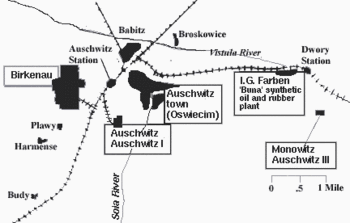
    –Blechhammer was a satellite camp of Auschwitz III (Monowitz)
    –Auschwitz III, also called Buna or Monowitz, was established in nearby Monowice to provide forced laborers for the Buna synthetic rubber works. The German conglomerate I.G. Farben established a factory in order to take advantage of cheap concentration camp labor and the nearby Silesian coalfields. It invested more than 700 million Reichsmarks (about 1.4 million U.S. dollars in 1942 terms) in Auschwitz III.

    On Italian labor being used at Nazi Concentration camps, as found in Vol  VIII, pg 749, 
    Nuremberg War Crime Tribunals:

    Q. Did you go to ter Meer* to get Italian workers — I am thinking of a prosecution exhibit, the one which was shown to ter Meer on cross examination.

    A. I was told at the time by an official source that Italian industry, after the collapse, would no longer produce because there was no coal, no current, or something. I was also told that since the Italian State obtained goods from Germany — buna, for example — the Italian State would be willing to enter into an agreement with Germany to make labor available, as was always the case from Italy. I said to him: “In case that is so” — neither ter Meer nor I knew whether that really would be the case — I said, “help the people at Auschwitz; help them to get workers if now” — I believe this was in 1944 — “the plants gradually go into operation.” For in these plants we wanted to have skilled workers — as I said yesterday, it is very important whether or not the man in charge has knowledge of the work he is doing.   –Vol  VIII, pg 749,  Nuremberg War Crime Tribunals. 

    *”Fritz ter Meer served on the IG Farben [Farben was Hitler and Hitler was Farben. (Senator Homer T. Bone to Senate Committee on Military Affairs, June 4, 1943.] board of directors from 1926 to 1945 and was the head officer directing the operations of the IG Farben factory at Auschwitz. The Nuremberg War Crimes Tribunal sentenced him to seven years in prison. He was released after serving only four years. Not long after, in 1956, Ter Meer was elevated to the chairman of the supervisory board at BAYER, a position he held for seven years. His grave in Krefeld has a meter-high wreath on it – donated by BAYER in recognition of his services.”
    ·Posted by :

    ·in:

  • History of the Future of the City: Tomorrow Department #4, Ebenezer Howard and the Garden City, 1898

    JF Ptak Science Books  Post 275
    Bloghoward_1

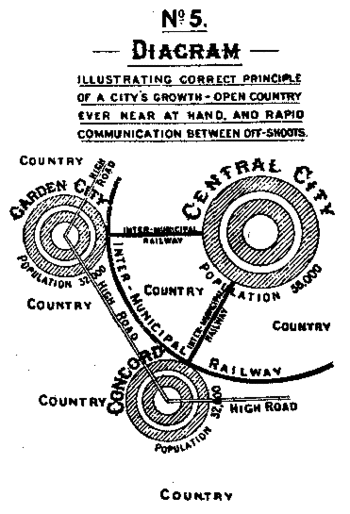
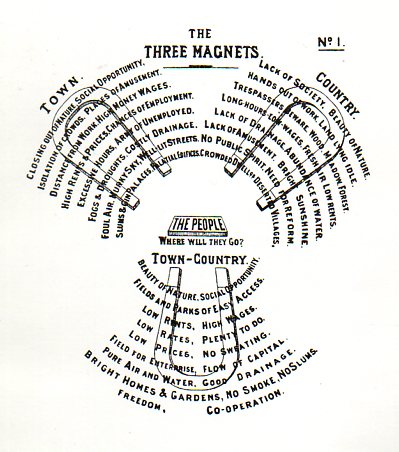
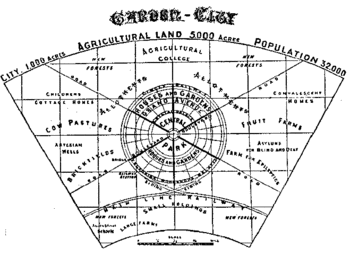
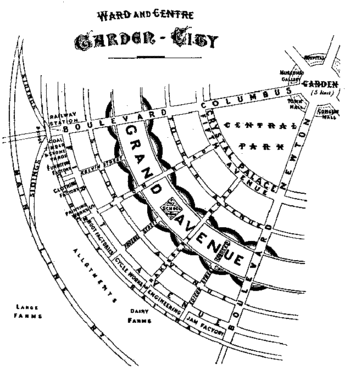
    Ebenezar Howard (1850-1928), London-born  failed Nebraskan farmer, Chicagoan stenographer, London Parliamentary reporter and non-obscure semi-visionary of town planning in The Future, drew some mighty pretty images of cities best reserved for random placement in the Encyclopedia of Difficult Imaginary Places.  Ideas about technically based Victorian wanderings on what to do with the laboring classes  must’ve been brewing in his head for some time before he self-published them in his Tomorrow, a Peaceful Path to Reform in 1898.  The ideas took shape in the for of Garden Cities—which, frankly, have a very industrial and technical look to them, which although brimming with forests and gardens and parks and green spaces galore still had a weird orthographic and predictable quality to them, making them look like green machines.   He hoped to start a revolution in city design, and his ideas proved popular enough to be forced into a new edition in 1902 in his Garden Cities of tomorrow, and then reprinted again in 1946 with a forward by none other than Lewis Mumford. Bloghoward_2

    I should say that I don’t “get” his design (which in all fairness, Howard provides a mea culpa for each of his drawings saying that the ideas really need to be implemented with an actual environmental footprint before they could be done) though I certainly do understand his idea. The garden city philosophy came to Howard after seeing the mess of Chicago following the great fire of 1871, and also by way of the writing of people like Edward Bellamy (Looking Backward) and John Ruskin, as well as utopian movements and things like the social “discovery” by Ed Booth and others of the miserable conditions of the million or so people in East London. The idea of people living in such an environmentally destitute area like East London must’ve seen appalling to him, and perhaps the thought of the industrialized and centralized urban landscape would’ve fallen into this same category as well. The best resource for curing such revolutionary societal ills for Howard was nature. , or rather wrapping nature around lesser urban centers and being far more attuned to the relationship between the earth and that the communities that we build, which is a fabulous idea, though I hardly think that Howard was

    Bloghoward_3

    the first to it. He was though the force behind the first planned garden city in England—Letchworth—so he certainly did have an impact on others who were thinking about the same sort of things. His own designs, though, seem distant and necessarily undoable to me.

    Architecture--ebenezer howard073

  • Odd-looking Technical Inventions: the Blohm and Voss “141” Surveillance Aircraft, 1942

    JF Ptak Science Books Post 276

    1ebay_sept_24_blohm_voss_141667


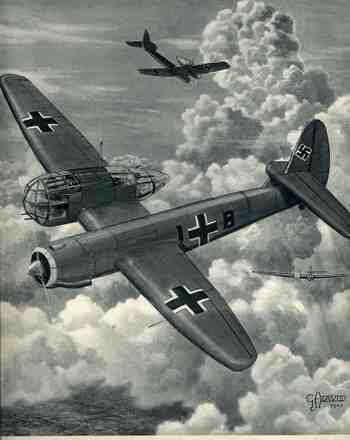
    Talk about an unusual-looking aircraft: during the Second World War the Blohm u. Voss “BV 141” may have defined that category.  This image appeared in The Illustrated London News for 23 May 1942,  drawn by the indomitable G.H. Davis, and gives an excellent view of what the editors called “a lop-sided freak”.  Perhaps the editors of the ILN wanted to educate its readers on the plane since it was supposed to be widely employed on the Russian Front, though it looks like only 38 were ever built (and none survive today). Actually, the plane, designed by Dr. Richard Vogt (1894-1979),  was a high-flying three-seater  surveillance aircraft capable of 220 mph at 17,000 feet, powered by a single 1000 hp Bramo Fafnir 9-cylinder radial engine.  The idea for the design was to give the pilot and co-pilot a very wide field of view–and by this, I’m guessing that the field of view most affected and aided by this would be straight down. The rear gunner also had an enormous field of view. 

    As it turns out Vogt survived the war and spent his Golden Years in the U.S., seven of them (1960-1966) with Boeing to evaluate hydrofoils and vertical liftoff systems:  he had built other odd planes during his career, and carried them with them into near-retirement, making this sort of design his metier.

  • Images of Scientific Breakthroughs: Astronomy–Gallucci, Galileo, Kepler

    JF Ptak Science Books Post 276

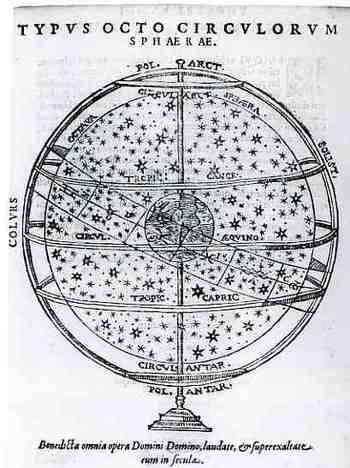
    A good heaping part of the vast beauty of printed scientific illustration over the last 500 years or so is occupied by luscious renderings of the constellations, night sky, and the general good works of the Primum Mobile. The woodcut to the left was published by Giovanni Paolo Gallucci in 1588, and is found in his Theatrum mundi. IT is a different sort of beautiful, not perhaps as beautiful as the earlier and more artistic efforts of other, but beautiful for being the first map of its kind to employ the use of stellar coordinates. Prior to this—and I mean for thousands of years—the imaging of the constellations was really an architecture of mnemonic devices, created so that there would be a memorable linkage and form, making the placement of the stars dependent on their connection/recognizable pattern to other stars.

    1blogsept_23_astro636

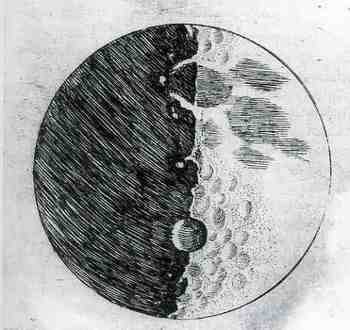
     The next two images really aren’t directly related to Gallucci and his predecessors, but there is a bit of slightly kindred spiritedness among them. The first image of the moon was really a sensation in the history of astronomy—it is the first published detailed map of the moon rendered by the use of the telescope, made by Galileo and published in his Siderius Nuncius in 1610. It was just a fantastic accomplishment—he even tried to show the relative heights of the mountains of the moon by giving them shadows of varying lengths.

    1ebay_sept_25_galileo_moon668 

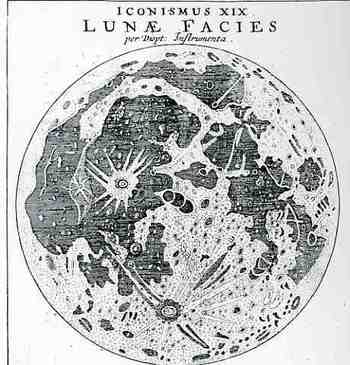
     In the very next year this monumental drawing was totally eclipsed by Johannes Kepler, who brought his own telescope to bear upon the moon and produced a map of prodigious detail, far surpassing the Galileo map. (I can only imagine how shocked people must’ve been when seeing this map, “Lunae Facies per Diopt Instrumenta” for the first time, which was found in Kepler’s Dioptrice of 1611.) The reason wasn’t that Kepler was a superior observer, but that he used convex lenses for the objective and eyepiece, giving him a far more dynamic, detailed and wider scope of field, resulting in this surprising modern map.

    1ebay_sept_25_galileo_moon_lunae669


    So these two sets of images really aren’t strongly connected, as I said, but they do show the significant, short-term effects of technical improvement and innovation in the illustrated depiction of the advancement of science. And of course they’re pretty.

  • Revealing the Worlds Inside of Prints: Finding Hidden Human Geography in Old Prints

    JF Ptak Science Books Post 278

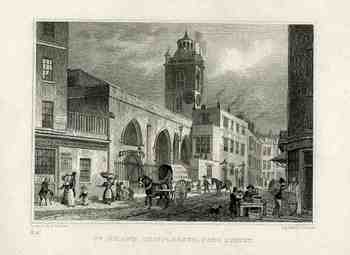
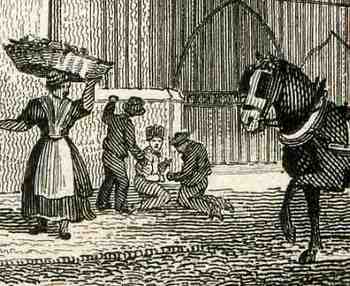
     1ebay_sept_25_deep_looking671St. Gile’s Cripplegate, Fore Street, London, is ostensibly the major subject of this engraving (printed in 1842 (?)), though there is a great amount of interest and art to be found in the incidental human characters sprinkled through this small (4 x 7 inch) print.  St. Giles Church (the center feature with the tower) was built in 1550 very near by old Roman ruins and basically upon the site of a Norman church.  St. Giles is an interesting guy–born, probably, in Greece, he wound up in a cave and a Saint in France, the patron of beggars breastfeeding  hermits, horses, the physically disabled and blacksmiths.The Cripplegate part has to do with, I think, the location of the church made for the ease of the physically disabled to attend.
    1ebay_sept_25_deep_looking_boys673

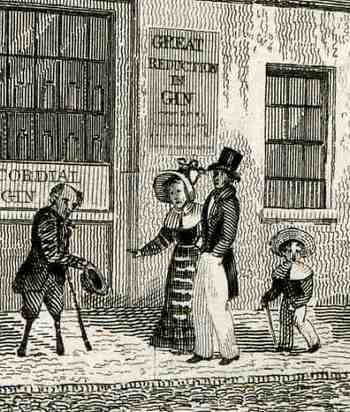
    And so it comes to pass that a double leg amputee is seen begging at lower left, hat in hand, who may or may not be getting a little relief from the approaching gentleman and lady.  They stand in front of a sign promising “Great Reduction in Gin”, which I take for sales advertisement. 

    Just behind this family we see a street vendor and behind her three boys who are, I hope, at play.

    In the bottom right corner is a fairly elaborate stand attended by a woman with three baskets of good which must be food, judging from the interest of the little black dog.

    1ebay_sept_25_deep_looking_peg_leg6

    All in all there’s quite a bit of unnecessary, superfluous, lovely and detailed action in the print, a geography of small human actions:  people at work, play, in idleness, with potted plants and billowing chimneys, and just a look of a city street being lived-in. This is the category of blog entry where I’ve wondered why the artist bothered himself with these tertiary characters of uncommon  and unusual stature (see HERE for example). The artist could’ve just left the street fairly bare and essential, with couples strolling and doing, well, nothing of observable interest.  Instead, time after time, the artist have included these little jewels of observation of common life, and we are lucky to have had them do so, coming perhaps as close to a pre-photography “snapshot” as can be.

    (**I’d just like to point out that the poet John Milton was laid to rest in St Giles in 1674, though (some contend)  his sleep was deeply, horribly disturbed about a hundred years later when his grave was robbed–the great poet lost a rib, had some teeth punch out, and was missing some of his hair.Undoubtedly the work of a critic. T.S. Eliot, no lover of Milton, was said to have cleaned his boots on a mat of Milton’s teeth.  Just kidding (about Eliot).)

  • History of the Future: Mammoth Flying Hotel Fueled by Seagram’s

    JF Ptak Science Books   Post 279

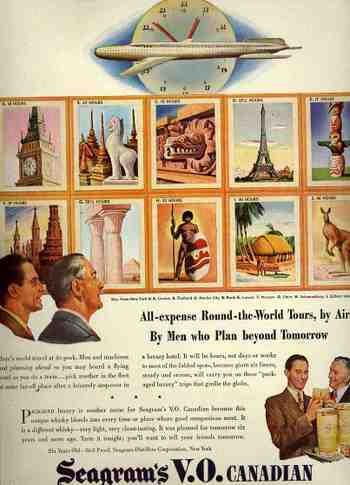
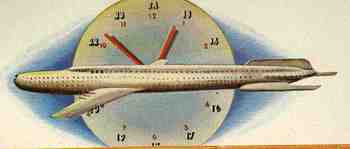
    Well, this jetliner which is actually a “flying hotel” really isn’t exactly “fueled” by six year old Seagram’s Canadian Whisky as is hinted in the advertisement, and truth be told the whisky has nothing at all to do with the plane, except for the in-kind use of the phrase “packaged luxury”.   Somehow the admen who came up with this bit for the October 1946 issue of LIFE equated the idea of flying hotels- ” steady and serene, will carry you to a ‘packaged luxury’ trip that girdles the world…”–and that “packaged luxury is another name for Seagram’s V.O.”

    It doesn’t quite compute that this modest beverage could achieve any heights, let alone make you feel as though you’ve been whisked away in a then-blistering record time to a remote vacation spot in a 800 foot long jet-sled-rocket.  Perhaps it depends on how much you drink. But I do like the plane–its twice as long as the width of its wings, very tall, and has no discernible power system, unless it has something stuffed into the stern. 

    Source:  LIFE Magazine, October 1946. 

    1ebay_sept_26_seagrams_plane_et682

    (Detail, above; full-page ad, below)

    1ebay_sept_26_seagrams_plane681


    ·Posted by :

    ·in:

  • The Prehistory of the Manhattan Project: the MAUD Committee, 1941

    JF Ptak Science Books Post 280

    (Note:  both the MAUD and Frisch-Peierls documents are reprinted in the continued reading section below)

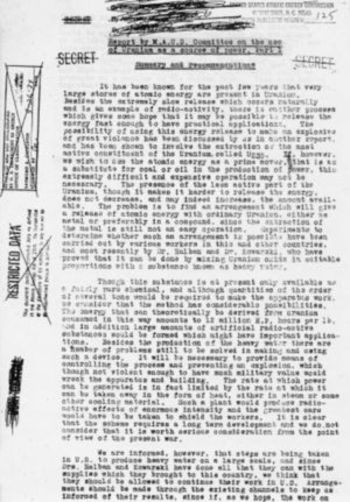
    As stated in the first paragraph of what once was a supremely-guarded secret, the British MAUD Committee (Britain’s initial steps towards the construction of an atomic weapon) :”Work(ed) to investigate the possibilities of utilizing the atomic energy of uranium for military purposes has been in progress since 1939, and a stage has now been reached when it seems desirable to report progress…”  There was quite allot of this work done between 1937 and 1939 (and even deep into 1940 the American physics journal Physical Review was still publishing papers they probably shouldn’t have on this subject), and the MAUD committee sought to get a handle on it all.

    Maud_report

    As stated in the first paragraph of what once was a supremely-guarded secret, the British MAUD Committee (Britain’s initial response to constructing an atomic weapon): “(w)ork(ed)  to investigate the possibilities of utilizing the atomic energy of uranium for military purposes has been in progress since 1939, and a stage has now been reached when it seems desirable to report progress…”  There was quite allot of this work done between 1937 and 1939 (and even deep into 1940 the American physics journal Physical Review was still publishing papers they probably shouldn’t have in the area). Then, coming out of UK’s Birmingham in February 1940, Otto Frisch and Rudolf Peierls, considered the possibility of fast fission in uranium-235. They estimated the likely effects of the bomb, possible methods of assembly and made estimates on how feasible it was to separate the uranium-235.

    The opening paragraphs of the 1940 Frisch-Peierls Memorandum. The text reads:

    Strictly Confidential. Memorandum on the properties of a radioactive “super-bomb”.The attached detailed report concerns the possibility of constructing a “super-bomb” which utilizes the energy stored in atomic nuclei as a source of energy. The energy liberated in the explosion of such a super-bomb is about the same as that produced by the explosion of 1000 tons of dynamite. This energy is liberated in a small volume, in which it will, for an instant, produce a temperature comparable to that in the interior of the sun. The blast from such an explosion would destroy life in a wide area. The size of this area is difficult to estimate, but it will probably cover the centre of a big city.

    In addition, some part of the energy set free by the bomb goes to produce radioactive substances, and these will emit very powerful and dangerous radiations. The effect of these radiations is greatest immediately after the explosion, but it decays only gradually and even for days after the explosion any person entering the affected area will be killed.

    Some of this radioactivity will be carried along with the wind and will spread the contamination; several miles downwind this may kill people.

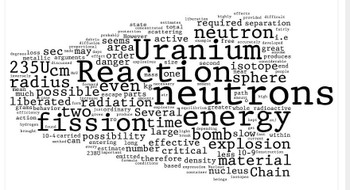
    Their work was summarized in what was to become known as the Friesch-Peierls memorandum (see below for a WORDLE/word map of the report), and sent on to Marcus Oliphant, who passed the document on to Henry Tizard, chairman of the Committee on the Scientific Survey of Air Defence. The Maud Committee–molded into existence by Tizard and consisting of Sir George Paget Thomson,  Chairman Marcus Oliphant, Patrick Blackett,  James Chadwick, Philip Moon and John Cockcroft.–first met on 10 April 1940 to consider Britain’s actions regarding the mass of possibilities swirling around the “uranium problem”, and

    The MAUD committee approved two reports (See below for the World word map of the report below) on 15 July 1941 and disbanded; the first report was on ‘Use of Uranium for a Bomb’, giving a technical description of the bomb with specs and cost estimates, concluding that the bomb was indeed feasible. The other was on ‘Use of Uranium as a Source of Power’ and discussed the implementation of the bomb as well as the peaceful uses for what we would call a reactor.  It was a penetrating discussion.

    Meanwhile, in the U.S., Arthur Compton and the National Academy of Sciences (prompted and urged by folks like E.O. Lawrence and Vannevar Bush) studied and then, on 17 May 1941, issued a report on nuclear energy, incorporating the MAUD findings (which had been received in the U.S. by March 1941) discussing the possibilities of a bomb though without entering into any detail about actually producing one.

    The Brits evidently felt that the U.S. needed to take a much more advanced and urgent look at the issue than what was being allowed.  The Americans were still not in the war (and Britain had been fighting for 1.5 years by that point) and were still 7 months out from Pearl Harbor.  Pursuing and building the bomb was a gargantuan undertaking unlike almost anything else, and the fire had still not been lighted that would ignite this fuse. The bomb also could be built probably nowhere else on earth given the manpower and raw material and electricity and knowledge demanded by the project–at the end of the day, the Nazis, I think, just didn’t have the raw stuff for the project and were still removed from the theoretical aspects.  Britain of course couldn’t afford the project what with actually fighting the war.  Japan just wasn’t in the realm of possibility.  It had to be the U.S.

    And so it came to pass that Sir Marcus ‘Mark’ Laurence Elwin Oliphant, a 42 year old Australian (who died only recently, in 2000), came to the US  in  to do a very hard sell on the Americans for bomb production.   Oliphant, who with the rest of the nuclear establishment of Britain was puzzled by the inaction of the U.S. on MAUD  meet  with Lyman Briggs, his American counterpart to whom the report had been sent.  Oliphant recalled:
    “the minutes and reports had been sent to Lyman Briggs, who was the Director of the Uranium Committee, and we were puzzled to receive virtually no comment. I called on Briggs in Washington, only to find out that this inarticulate and unimpressive man had put the reports in his safe and had not shown them to members of his committee. I was amazed and distressed.”  I should say so

    Oliphant moved up the ladder and met with his friends EO Lawrence, James Conant and Enrico Fermi about his “problem”, which was evidently instantly digested.  It was from this point that Lawrence got together with Compton and Bush (who at that time was chair of the National Defense Research Committee), and created the vaster and more encompassing Office of Scientific Research and Development–perhaps one of the smartest American moves of the entire war. (I should also point out that it was also under the leadership and guidance of Vannevar Bush that this organization functioned so well and produced the amount of work that it did, which as really astonishing.  Bush in my my is one of the truly great unsung heroes of the war.)   It was from the OSRD that the Manhattan Engineering District was born after Pearl Harbor.  And then everything else, um, happened.

    MAUD Wordle

    Wordlemaud


    Frisch Wordle


    Wordlefrisch

  • Humanitarian Propaganda–Hope for those at Home, September 1944.

    JF Ptak Science Books  Post 281

    War propaganda is distributed across all levels of society during a time of conflict.  I’ve made a number of posts concerning Nazi and Japanese propaganda but no so much on the Allies’ side.  These two pamphlets come from a small stash of mine relating to Red Cross activities and prisoners of war (POWs).

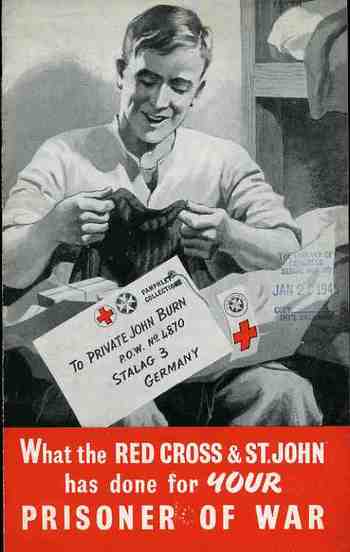
    1ebay_sept_27prisoner_of_war688

    The young man in the illustration seems extremely fulsome for being a POW–he’s healthy-looking, shaved, with good meat on his bones; he has a (white) shirt and an undershirt, and his bed has sheets, blanket and a pillow-cased pillow.  The item he has received is a big thick sweater,something I’m sure that the Nazis would allow their prisoner to have rather than one of their own soldiers. 

    It is very interesting to note that the closest thing that I can come to the “Stalag 3” on the package that was received by the fellow on the pamphlet cover is the famous Stalag Luft III–scene of the real-life Great Escape and about 100 miles from Berlin, where 55 Allied prisoners made it out in the escape, and 75 captured.  The order from Hitler itself was for all of the captured prisoners were to be executed; he lightened the edict some under the insistence of some of his inner circle, and decreed that “more than half” of the captured were to be executed and cremated.  The result was that 50 of these men were indeed executed.   Word of the atrocity reached the outside world and by July of 1944–three months before this pamphlet was printed–Anthony Eden called (from the floor of Parliament)  for those responsible for this crime (and violation of the Geneva Convention) to be brought to justice as war criminals.  With all of this so fresh in September 1944 I wonder if the use of the address in the package on the cover of this pamphlet was intended or not. 
    The camp came to hold 10,000 prisoners, was 52 acres in size and had a five-mile fence perimeter. A Stalag :Luft III website contained this interesting commentary about Red Cross packages:

     Food was always very close to a prisoner’s heart. Germany, involved in a total war, had difficulties enough feeding its own people. Feeding POWs was well down on the list of priorities. The German POW rations were insufficient to sustain health and failed to meet the requirements of the Geneva Convention. Had the International Red Cross not shipped food parcels to all Allied POW camps except to the Russians, serious malnutrition would have been common. The Red Cross offer to feed the Russian POWs was spurned by Stalin. The receipt of the Red Cross food parcels suffered from the uncertainties of the wartime rail service in Germany and the caprice of the Germans who would withhold delivery of the food as group punishment.

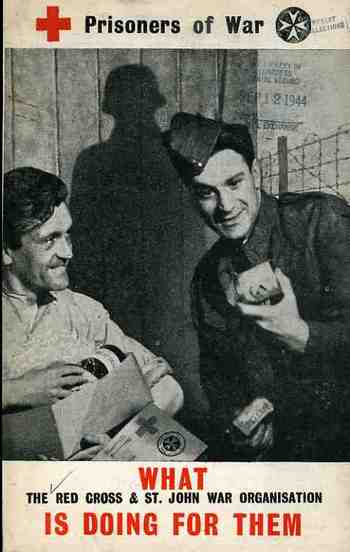
    1ebay_sept_27prisoner_of_war689

    The second pamphlet is still understated but far more menacing than the first, especially if you removed the pressed, smiling figure with the can of happiness in his hand, the image takes on a much darker tone.  The other prisoner is heavy lidded, sunken and unkempt, and sitting; there is of course the barbed wire, and the looming and large silhouette of the Nazi guard, who although obviously standing in front of these two men is not casting his shadow on them, just on the barracks.  There’s quite a a few suba rosa messages going on here, making the spiffy smiling POW seem almost like a ghost of chance and possibility compared to the reality of the sallow seated POW.

    This pamphlet was produced in April, 1943 and called for “next-of-kin” pamphlet which could include “additional (?) food, invalid comforts, warm clothing, educational facilities, indoor games and books, musical instruments and of course Braille and aural comforts”. It assures the relatives that every effort is made to deliver the packages, with “positive evidence that the packages are received in camps safely and in adequate quantities”. Not only that, but “every effort is made to maintain a reserve in Geneva which may be drawn upon in time of need”.  I guess that this would send a strong hint to everyone involved that the efforts were so successful that a surplus is maintained “just in case”. 

    A letter from a POW (“from a Prisoner’s letter”) is also included for good measure:  “My Red Cross Parcel is really a wonderful affair–all good, nourishing foodstuffs, and I am sure it will do a world of good”.   If this clean, utterly hopeful little pamphlet didn’t do the trick to ease the worst fears of relatives of POWs, I couldn’t imagine much else that would. 

  • Atomic Bomb Protection: Blast Briefcases and Anti-Heat Linen, 1950: What to Do When the Big Ones Come

    JF Ptak Science Books Post 282

     This anti-CYAG plump-piece comes to us by virtue of the helpful folks at LIFE magazine in their issue of 18 August 1950.  The article”Atomic Handbook is a Best-Seller/New Government manual tells what will happen and what to do if A-bombs fall on U.S. cities”.

    1ebay_sept_26_atomic_2676

    But what excellent material to work with when multi (multi) megatons come raining down from over the Pole. 

    Here are the helpful hints that were being sold to the American public in a family magazine:

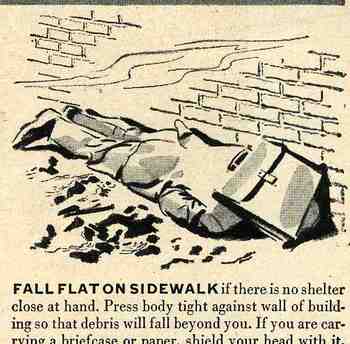
    1)  If there is nothing to hide in, put your face in the crack where the sidewalk and a building meet, and put your attache case over your head.  Too bad the case wasn’t bigger–like a few tons of lead and concrete. Make sure the metal clasp is facing out, rather than in, otherwise it will fuse with your skull, if there was any skull left.

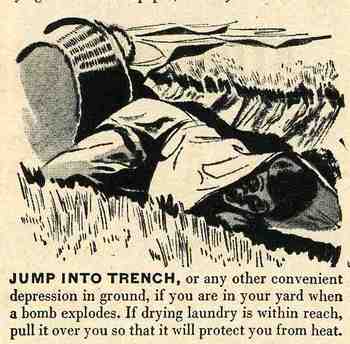
    2)  So, if you’re hanging up the laundry in the backyard when the bombs go off, get into a

    1ebay_sept_26_atomic_3677 trench (that just happens to be there in the middle of the yard) and cover your head with a sheet “to protect you from heat” (“if your drying laundry is within reach”).  I hope that its an Oxford double weave.
    3) (Illustrated below.)  Find a doorway to hide in, and hope that you’re not within two miles of the blast, otherwise you’re a part of the rubble.

    4)  (Illustrated  below.)  If you’re within two feet of a tree, hide behind it. Honestly  The warning is for two feet:  if you’re three feet away, you might be toast.  That’s the message.

    5) (Illustrated below.)  Crawl under a table and cover yourself with the table cloth to “ward off glass splinters”.  That was a real suggestion.  Somehow the cotton of tablecloths and linens and such had magical anti-glass and heat-reductive power brought on only during a nuclear holocaust. 

    The trick to all of this is to put yourself fifty years into the future and try to look back at whatever these LIFE images might be here in 2008. 

  • The Propaganda of Restricting Infomration: Dorothea Lange’s Photos at the Japanese “Relocation” Camp, Manzanar, 1942

    JF Ptak Science Books Post 283

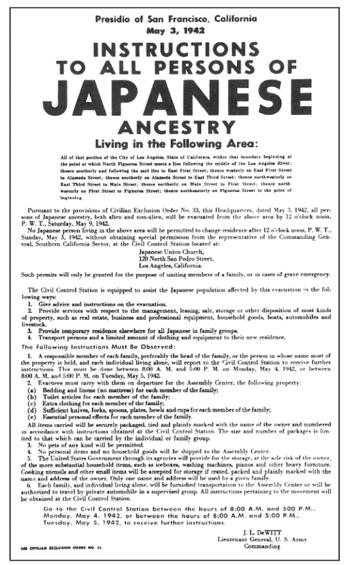
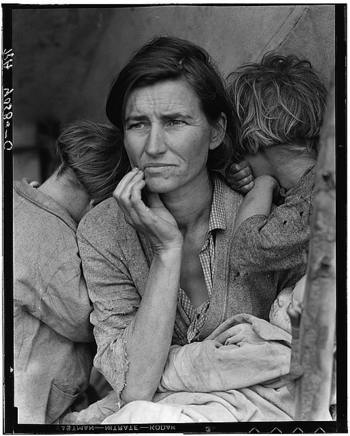
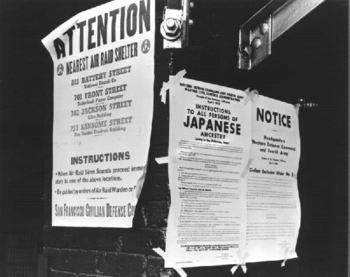
    Takenjap_poster After having written a number of pots dealing with overt propaganda issues—surrender leaflets, Nazi pamphlets on the impending invasion of Germany by Poland and Czechoslovakia, American reassurances about how to survive the coming nuclear holocaust by covering yourself with table linen, British home hearts and minds campaign about how well your loved one POWs are being treated by the Germans—I thought to write a little something on the other side of propaganda, which is simply to not publish information.  One case is that of the great social photographer and one of the dozen or so mainstays of perhaps the greatest American photographic collaborative ever—Historical Section of the Farm Security administrations*–Dorothea Lange.  Lange worked for the FSA—which had begun life as the ominously-named  Resettlement Administration, the photographic section of which was to document the good that the government was doing helping the drought and depression refugees find new life and hope elsewhere in the country outside of their own money-ravaged areas—taking mostly landscape and architectural pictures through the height of the Depression.  The time that she broke character (so to speak) and made portraits produced some of the most memorable or at least famous images from this period o American history, the most outstanding of which is the five-photo series of a female bean picker and her three children who were living out of the back of their wheel-less car in a potato-less potato field in California known as the Migrant Mother.  (The making of these extraordinary images is another story for another post—suffice to say that the narrative of the history of that photograph is exceptional.)  I’ve always felt that the Roosevelt administration viewed this image as being just a little too much reality than it wanted to exhibit.
    Blogmigrant_mother


    This was positively the case with Lange’s photographs of the Japanese at the Manzanar concentration camp (relocation camp) in   where more than 10,000 American citizens of Japanese heritage were forced to live between 1942 and 1945.  This was one of  camps that were established by virtue  Franklin Roosevelt’s  February 1942 Executive Order 9066** to imprison more than 100,000 American (70,000 of whom were U.S. citizens, including children) for the duration of the war (compared to a  few camps that were designated to hold white American citizen of the other countries that were fighting, mainly of German and Italian descent, 1,500 and 300 of whom were actually imprisoned, respectively). It was a grave, undistinguished, embarrassing  move brought on by the hyper hysteria in the months following Pearl Harbor.

     
    The Japanese at the Manzanar concentration camp were from the west coast who were bused away from their homes and lives and businesses with extremely limited notice, and who were forced to sell nearly all possessions (including lands and businesses) at what were less than fire sale prices.  They were made to board buses and trains and were shipped to locations (mainly in California) where they were processed and sent further and deeper into the trying hinterlands of the west for their final destinations until the war was won.  (One of the processing centers was the Santa Anita racetrack, where thousands of Japanese were sent to live for periods in converted, just-painted horse stalls.)  Manzanar itself is well enough out there—removed, trying, desolate, difficult.  Beautiful, too , if you weren’t in prison there.  It was a high desert plateau with the snow-capped sierras, ringing the place; no grass, barely a tree, with extreme temperatures and a tough wind that was freezing in the winter and blew hot in the summer…tough enough to make it hard to keep the tar paper on the roof and sides of the thinly constructed barracks that held these people.  While every other relocation camp had barbed wire and guard towers, Manzanar had none—its location was so remote and difficult that it made the construction of these inferior barriers unnecessary. 

    ManzanarlangeslauteManzanarlangeposter

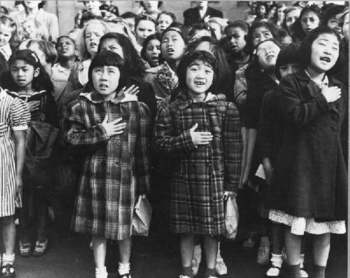
    As difficult was life was at Manzanar, and having being completely torn off of the American map and their way of life, the Japanese at the camp established irrigation systems and gardens, made their own furniture from bits and scraps, established a newspaper, created a government,  schools, police, and so on, making their life as orderly and hospitable as possible.  Dorothea Lange was allowed, after repeated requests to the US Army, to enter the facility and make a photographic record of what she saw.  And what she saw and photographed was the courage and dignity of the people that she find there in the mists of deprivation and devastation—her photos were remarkable for their sincerity and insight.

    And it was for precisely this reason that almost know of them were ever seen.  Bits and piece emerged here and there—four in Survey Graphic in 1942 (Vol. 31, No. 9, Sept. 1942), two others here, two others there—but they were almost entirely restricted.  As a matter of fact they were stamped “Impounded”, and relegated to the future.

    The FSA became the Office of War Information in 1942 as well, which might explain why this propagandistic move dismissing their existence for want of fairer reception of the American war effort at home..  It wasn’t until 1972 that 27 more of them were released and received a public showing at the Whitney in NYC in a show called Executive Order 9066, and which were reviewed in the NY Times by A.D. Coleman as  “documents of such a high order that they convey the feelings of the victims as well as the facts of the crime.”

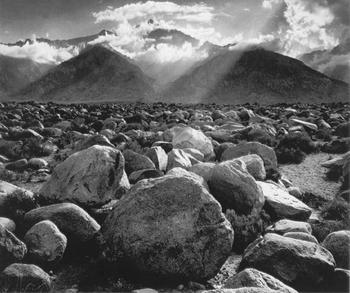
    Lange wasn’t the only big-name photographer zipping around Manzanar–Ansel Adams was there, too, as a friend of the camp administrator.  Adams had free access to the camp, and could basically come and go as he pleased, which didn’t sit well with Lange, who had a hard go of her permissions with the Army.  It was also something that she never let go of, either, as the Adams photos really didn’t get into the Being of the place like Lange’s did.  Actually, one of the great, iconic images made by Adams comes from this period, and as it turns out, its one of those odd sorts of photos that turns in the opposite direction of what the photographer was there “for”.  Mount Williamson is just a drop-dead shot to be sure.  It is also an image of what the Japanese in the concentration camp were looking out at.  Adams turns his camera around, around from the disgrace, and takes one of his greatest images. (I’ve listened to my wife Patti Digh, who is an (excellent) photographer, talk about photographers “making” photographs; I’m sure that before her I used “taking” and “making” photographs interchangeably.  But “making” it should be, as you’re not owning or lifting the image away.)   In this case, however, as monumental as Adams was or is, he definitely “took” this one.  Stole it. 

     An excellent book on these photos is found in Linda Gordon and Gary Okihiro, Impounded, Dorothea Lange and the Censored Images of Japanese American Internment (W.W. Norton, 2006). 

     Blogadams_manzanar


    *This incredible group included: Arthur Rothstein, Carl Mydans (up to the summer of 1936), Walker Evans (up to September 1937) Ben Shahn, Dorothea Lange (with interruptions up to 1942). Russell Lee, Marion Post Wolcott, John Vachon, Jack Delano, John Collier. This group produced upwards of 270,000 negatives, with 77,000 or so prints available at the Prints and Photographs room of the Library of Congress in a row of double-backed file cabinets.  Many thousands are available online at loc.gov  I am told by a reliable historian that I am wrong in thinking that Lange was fired because of her too-intolerably human photos, but for budgetary problems. 
    .
    **The following is the text of 9066, which basically authorized a 60-mile swath of the Pacific Coast as a military zone subject to national defense requirements, the principal object of which was to remove all Japanese residents from the area for fear of them being enemy agents and saboteurs.  To accompany this I mad a WORDLE text map of the document, just to see what popped up. 

    Wordleexecutive_9066 Executive Order No. 9066
    The President, Executive Order
    Authorizing the Secretary of War to Prescribe Military Areas

    Whereas the successful prosecution of the war requires every possible protection against espionage and against sabotage to national-defense material, national-defense premises, and national-defense utilities as defined in Section 4, Act of April 20, 1918, 40 Stat. 533, as amended by the Act of November 30, 1940, 54 Stat. 1220, and the Act of August 21, 1941, 55 Stat. 655 (U.S.C., Title 50, Sec. 104);

    Now, therefore, by virtue of the authority vested in me as President of the United States, and Commander in Chief of the Army and Navy, I hereby authorize and direct the Secretary of War, and the Military Commanders whom he may from time to time designate, whenever he or any designated Commander deems such action necessary or desirable, to prescribe military areas in such places and of such extent as he or the appropriate Military Commander may determine, from which any or all persons may be excluded, and with respect to which, the right of any person to enter, remain in, or leave shall be subject to whatever restrictions the Secretary of War or the appropriate Military Commander may impose in his discretion. The Secretary of War is hereby authorized to provide for residents of any such area who are excluded there from, such transportation, food, shelter, and other accommodations as may be necessary, in the judgment of the Secretary of War or the said Military Commander, and until other arrangements are made, to accomplish the purpose of this order. The designation of military areas in any region or locality shall supersede designations of prohibited and restricted areas by the Attorney General under the Proclamations of December 7 and 8, 1941, and shall supersede the responsibility and authority of the Attorney General under the said Proclamations in respect of such prohibited and restricted areas.

    I hereby further authorize and direct the Secretary of War and the said Military Commanders to take such other steps as he or the appropriate Military Commander may deem advisable to enforce compliance with the restrictions applicable to each Military area hereinabove authorized to be designated, including the use of Federal troops and other Federal Agencies, with authority to accept assistance of state and local agencies.
    I hereby further authorize and direct all Executive Departments, independent establishments and other Federal Agencies, to assist the Secretary of War or the said Military Commanders in carrying out this Executive Order, including the furnishing of medical aid, hospitalization, food, clothing, transportation, use of land, shelter, and other supplies, equipment, utilities, facilities, and services.

    This order shall not be construed as modifying or limiting in any way the authority heretofore granted under Executive Order No. 8972, dated December 12, 1941, nor shall it be construed as limiting or modifying the duty and responsibility of the Federal Bureau of Investigation, with respect to the investigation of alleged acts of sabotage or the duty and responsibility of the Attorney General and the Department of Justice under the Proclamations of December 7 and 8, 1941, prescribing regulations for the conduct and control of alien enemies, except as such duty and responsibility is superseded by the designation of military areas hereunder.

    Franklin D. Roosevelt
    The White House,
    February 19, 1942.

    ·Posted by :

    ·in:

    —
  • Women’s Rights and the Fight for Equality: Force-Fed Torture of Imprisoned Women, 1912

    JF Ptak Science Books  Post 284

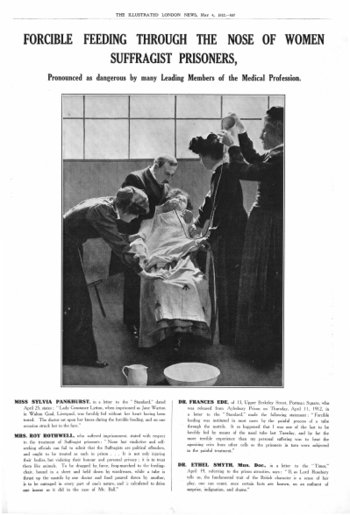
    Reprosuffragist_forced_fed_detail

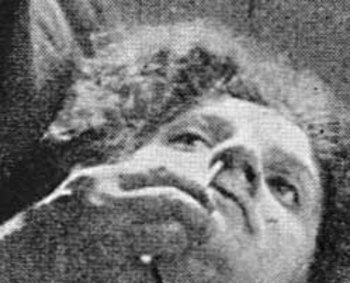
    Lady Lytton was an upper-class Englishwoman who became interested in the ideas of equality and in suffrage for women at the very early part of the 20th century. Her interest in suffrage (which was lost, taken away, from women there in 1832 and to be regained in 1918) led her to join the Women’s Social and Political Union (WSPU), and she became an avid, vocal, participating and socially visible member of the organization. She was arrested in 1909 following a demonstration at the House of Commons and was imprisoned, only to be released shortly thereafter after it was uncovered that she was the daughter of the former Viceroy of India–one cannot have the upper class in a common prison with the common people, so her imprisonment just wouldn’t do. Enraged by this treatment, Lady Lytton became an advocate for changing the penal code relating to the treatment of working class prisoners. After disguising herself as a working class woman with the name of Jane Wharton, Lady Lytton was again arrested and imprisoned following a suffrage rally and protest in 1910. In the prison’s effort to break her hunger strike, Jane Wharton endured the particularly heinous remedy of being fed through the nose. What happened is that a tube was forced into her nose and down into her stomach, with an assistant quickly forcing gruelly liquids through the tube via gravity into her stomach. She described the feeding as follows:

    Reprosuffragist_forced_fed

    “[The doctor] put down my throat a tube which seemed to me much too wide and was something like four feet in length. The irritation of the tube was excessive. I choked the moment it touched my throat until it had got down. Then the food was poured in quickly; it made me sick a few seconds after it was down and the action of the sickness made my body and legs double up, but the wardresses instantly pressed back my head and the doctor leant on my knees. 

    “The horror of it was more than I can describe. I was sick over the doctor and wardresses, and it seemed a long time before they took the tube out. As the doctor left me he gave me a slap on the cheek, not violently, but as it were, to express his contemptuous disapproval.”

    Another suffragette, Mary Leigh, describes the forced feeding spectacle as follows, following her own episode in September 1912:

     “The Wardresses forced me on to the bed and the two doctors came in with them, and while I was held down a nasal tube was inserted. It is two yards long with a funnel at the end – there is a glass junction in the middle to see if the liquid is passing.  The end is put up the nostril, one one day, and the other nostril, the other. Great pain is experienced during the process … the drums of the ear seem to be bursting, a horrible pain in the throat and the breast. The tube is pushed down 20 inches.  I have to lie on the bed, pinned down by Wardresses, one doctor stands up on a chair holding the funnel at arms length, so as to have the funnel end above the level, and then the other doctor, who is behind, forces the other end up the nostrils.”

    “The one holding the funnel end pours the liquid down; about a pint of milk, sometimes egg and milk are used…. Before and after use, they test my heart and make a lot of examination. The after-effects are a feeling of faintness, a sense of great pain in the chest, in the nose and the ears….”

    “I was very sick on the first occasion after the tube was withdrawn.”

    In any event, I had heard of such treatment, but I had never seen a contemporary image of the process; and I was very surprised to find this in the pages of the Illustrated London News for 1912. It was, after all, a pretty sniffy magazine not much given to social reporting of this sort; but this was a pretty strong condemnation of the practice, considering the source. 

Recent Posts

Archives

Categories