JF Ptak Science Books Post 276
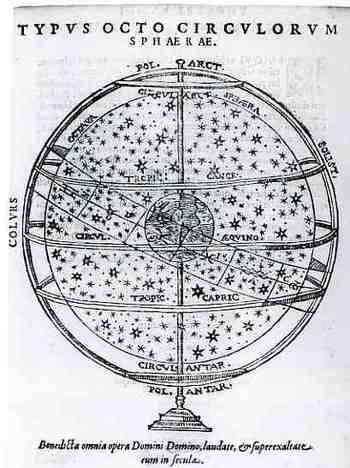
A good heaping part of the vast beauty of printed scientific illustration over the last 500 years or so is occupied by luscious renderings of the constellations, night sky, and the general good works of the Primum Mobile. The woodcut to the left was published by Giovanni Paolo Gallucci in 1588, and is found in his Theatrum mundi. IT is a different sort of beautiful, not perhaps as beautiful as the earlier and more artistic efforts of other, but beautiful for being the first map of its kind to employ the use of stellar coordinates. Prior to this—and I mean for thousands of years—the imaging of the constellations was really an architecture of mnemonic devices, created so that there would be a memorable linkage and form, making the placement of the stars dependent on their connection/recognizable pattern to other stars.
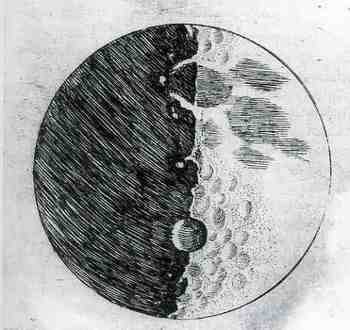
The next two images really aren’t directly related to Gallucci and his predecessors, but there is a bit of slightly kindred spiritedness among them. The first image of the moon was really a sensation in the history of astronomy—it is the first published detailed map of the moon rendered by the use of the telescope, made by Galileo and published in his Siderius Nuncius in 1610. It was just a fantastic accomplishment—he even tried to show the relative heights of the mountains of the moon by giving them shadows of varying lengths.
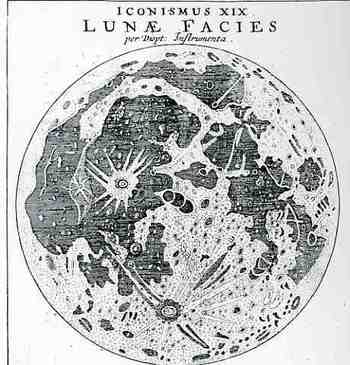
In the very next year this monumental drawing was totally eclipsed by Johannes Kepler, who brought his own telescope to bear upon the moon and produced a map of prodigious detail, far surpassing the Galileo map. (I can only imagine how shocked people must’ve been when seeing this map, “Lunae Facies per Diopt Instrumenta” for the first time, which was found in Kepler’s Dioptrice of 1611.) The reason wasn’t that Kepler was a superior observer, but that he used convex lenses for the objective and eyepiece, giving him a far more dynamic, detailed and wider scope of field, resulting in this surprising modern map.
So these two sets of images really aren’t strongly connected, as I said, but they do show the significant, short-term effects of technical improvement and innovation in the illustrated depiction of the advancement of science. And of course they’re pretty.