A Daily History of Holes, Dots, Lines, Science, History, Math, Physics, Art, the Unintentional Absurd, Architecture, Maps, Data Visualization, Blank and Missing Things, and so on. |1.6 million words, 7500 images, 4.9 million hits| Press & appearances in The Times, Le Figaro, Mensa, The Economist, The Guardian, Discovery News, Slate, Le Monde, Sci American Blogs, Le Pont, and many other places… 5000+ total posts since 2008.

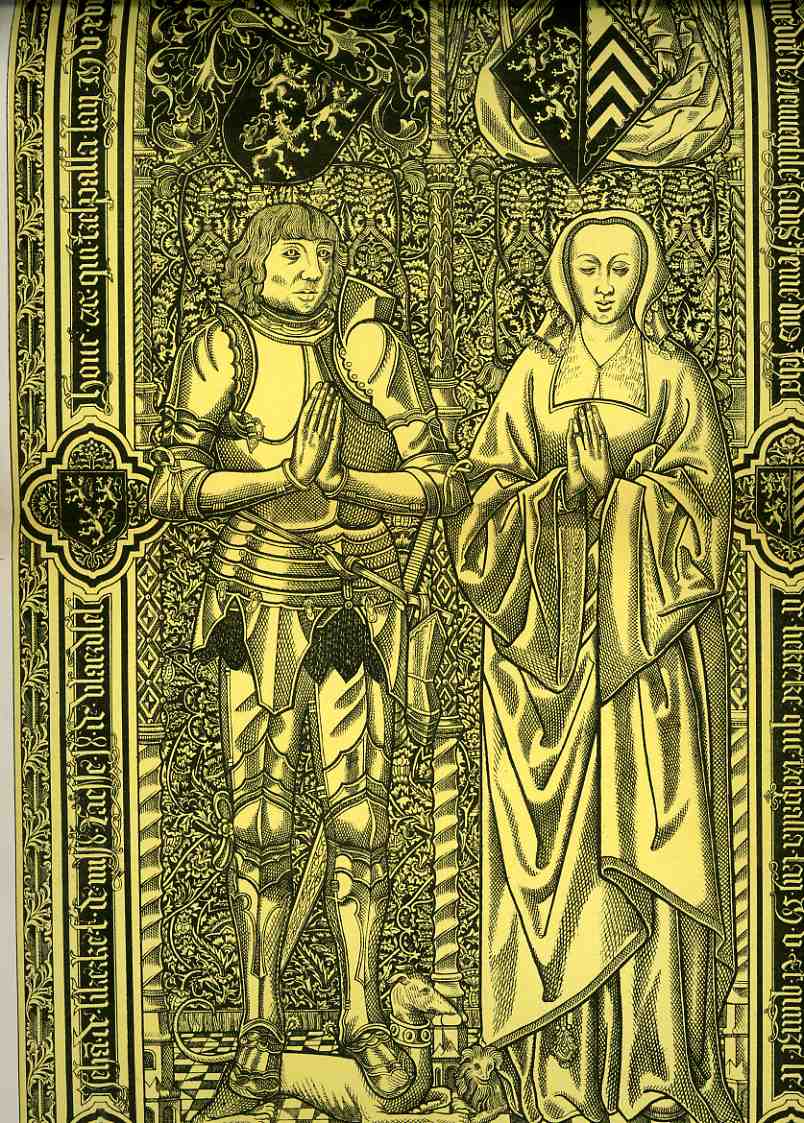
  • Standing on Dogs: Renaissance Knights in Armor vs. Small Dogs, #1

    JF Ptak Science Books    Post 403

    0--blog---Nov 29 dog standing154

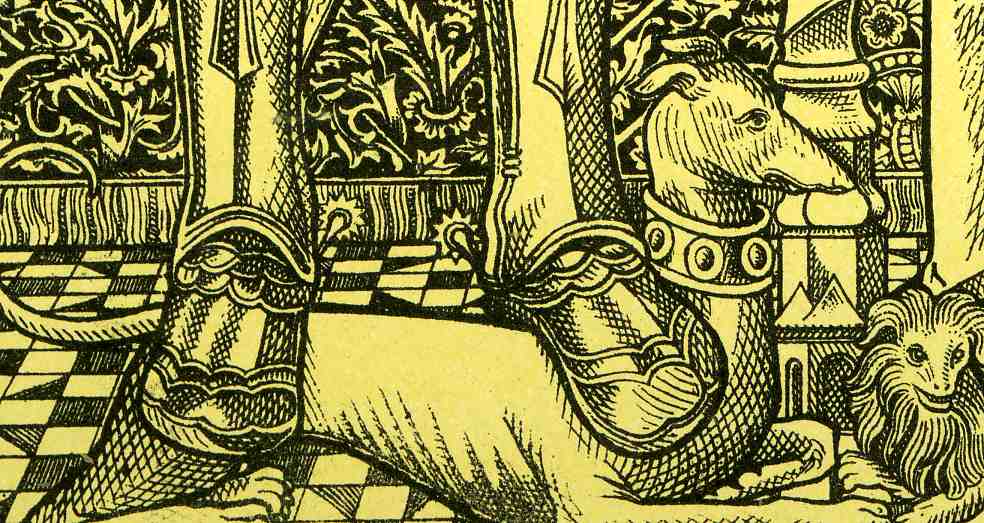
    Pictured here is Jean de Liekerke & Wife (“Jean de Liekerke et de sa Femme”), the largest element of a “dalle tumulaire”, or decorated burial slab, for the couple’s tomb, found in Brugge’s oldest church, the Cathedrale de St. Sauveur (built 12th-15th centuries).  It is a glorious chromolithograph, printed ca. 1858 or so, and is extremely detailed and complex.  I cannot unearth who the couple was, their names appearing three times in the image’s margins, twice spelled differently and partially abbreviated (“jeha de Likerke”).  Most of the print’s elements, as well as its subject, are not known to me, sorry to say:  I just stopped by to point out my completely not-understood vision of the noble Sir Jean/Jehan pictured standing on top of a greyhound.  The dog wears a large collar and also, perhaps, pants of some sort made of maille.  Generally the appearance of the dog in paintings from this era of the low renaissance signify fidelity; again, with most of the elements of this image, I do not know what the significance is of the heavily armored man standing on this small dog. 

    0--blog---Nov 29 dog standing155

  • A War by Many Other Names: the Japanese Invasion of China, 1931-1945; How to Trivialize 20 Million Killings Without Really Trying

    JF Ptak Science Books Post 404

    I have forced myself to contradict myself in order to avoid conforming to my own taste.
    –Marcel Duchamp

    0--blog---dec 2 china168

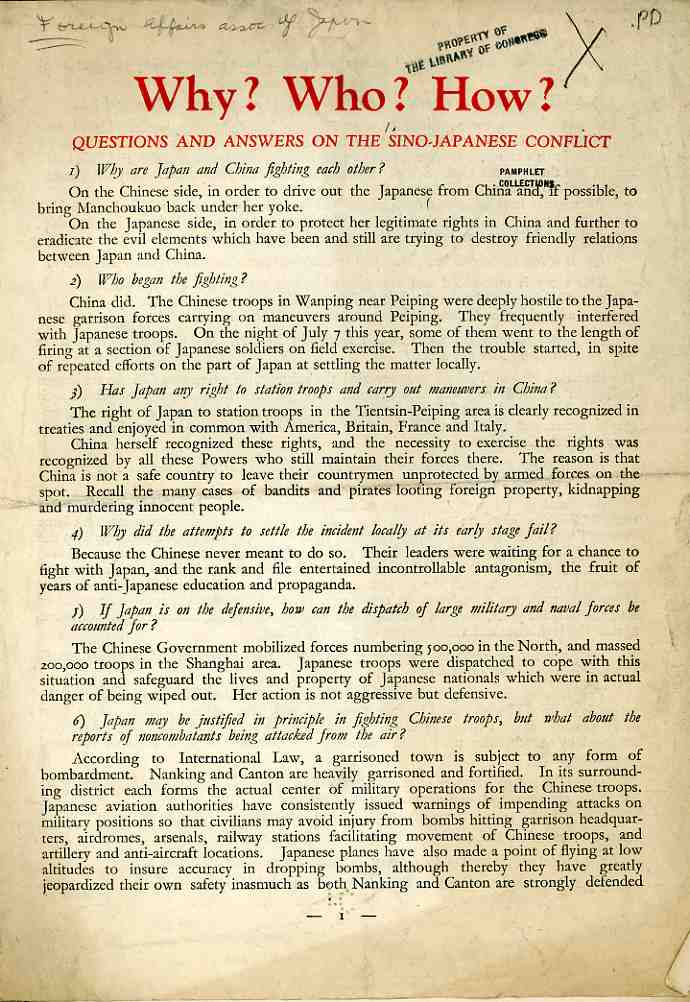
    I have a good number of English-language propaganda pieces published by such Hearts and Minds institutions as the Foreign Affairs Association of Japan describing, through the merriest and most defensive eyes, the Japanese viewpoint of exactly what it was that was going on in China between 1931 and 1945.  This leaflet, Why? Who? How? Questions and Answers on the Sino-Japanese Conflict (1937), is particularly worth noting because of how quickly and cleverish-cleanly the issue of the war and the fault of fighting was dispatched, and done with such astonishing condescending alacrity, and with such an enormous bodyguards of lies,as to be staggering.  I guess this is why the Duchamp quote came to me just now.  Old Marcel, the supremely gifted magician, certainly meant to be an enormous, itchy pain in the butt and a source of confusion, an artistic anarchist;  the thinking behind the quote served him well, and I think that it can be well-applied here.                             

    The first issue is in the subtitle:  the “Sino-Japanese Conflict” implies that the Chinese were at fault for having the Japanese invade Manchuria back in 1931; secondly,  the Chinese started a conflict and not a war. 

    Actually, the naming of the war there is quite an issue, and an issue still—and an issue at it most base level:  the word “war” is not generally used in Japan.  It wasn’t used in Japan during the war, or at least until the bombing of Pearl Harbor.  Until 1941, the millions of Chinese who were being killed by the Japanese armed forces were the result of a series of ”incidents”.  Even though there was a war raging from the beginning in 1931 to the start of total Japanese-Chinese war on 15 July 1937, the stuff that was happening from ’37 to ’42  was still an “incident” except for a period of 1940-ish to Pearl, when the idea of the Holy War (“Seisan”, eight corners of the world under one roof, etc.) was introduced by the Japanese Diet in 1940.  After that there was the occasional use of the “Great East Asian Conflict”, with the word “war” not being the part of any Japanese vocabulary.

    An interesting phrase that entered into the parlance though, if not “war”, was “Sanko Sakusen”, the “Three Alls”, as in KILL All, LOOT All, BURN All.  The Japanese wound up getting part of the Chinese All, eventually killing 20 million people or so in those 15 years.  But it wasn’t a war.

    This four-page document asks twenty questions, and answers them usually, emphatically, with simplicity, starkness, and with total complicity of innocence on the side of Japan.  For example, in discussing the “incident” in Beiging in 1937 which led to the total war between the two countries, asking the reader “why did the attempts to settle the incident locally at its early stage fail?,  we are told “Because the Chinese never meant to do so”.  Which of course is not the case.

    An incredible bit of thinking comes next, when the question “If Japan is on the defensive, how can the dispatch of large military and naval forces be accounted for?” Indeed!  Its hard to explain the invasion of another country as a purely defensive action. (We have seen this rather recently ourselves, the fictionalized account of terror-sponsorship in Iraq being about the only fuel necessary for a full-fledged defensive invasion and 2000-day long war.)  But the answer in 1937 was the Chinese defensive maneuver of massing troops for an impending invasion of China by Japan was then threatening Japanese interests in China, thus necessitating a defensive invasion of China which was mobilizing to defend itself from a Japanese offensive, which wouldn’t have come if the Chinese hadn’t adopted a defensive posture.  Basically, to paraphrase the immortal Mayor-for-Life of Washington, D.C, Marion S. Barry, “basically, the man dead”. (This was Barry’s response to reporters who were clamoring to find out what exactly had happened to a crazy man who climbed into a step van in a Buck Rogers suit and threatened to blow up the Washington Monument with a bucket of pee, an old rifle, and spray paint and then was shot about 200 times by cops of every shape and description. True story.)

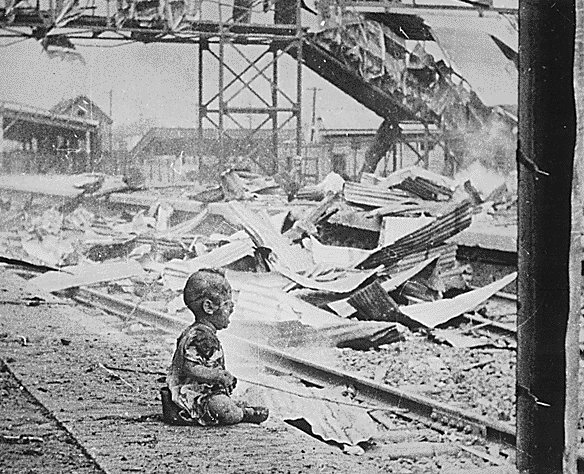
    War_shanghai-baby_Japan_bombing_shanghai_south_station_1937 (This is a picture of a baby survivor of a Japanese bombing “incident” at  South Station, Shanghai, 1937–sometimes it is better to see what something is than have someone define it for you..)

    We further find out that the attacks on the schools and hospitals in China were carried out, somehow, by Chinese troops; that a Chinese fishing fleet that was attacked and pulverized by Japanese submarines really wasn’t, and that they just disappeared; that Japan was protecting the rights of third party powers by “removing” Chinese troops occupying foreign-owned properties; that the Japanese fight against the “Sovietization” of China would “protect” foreign democracies, and so on.  The questions hardly matter, as the answers are all sort of the same.  Japan would “reach a settlement” (the word “peace” is not used anywhere here) however, if China “realized the error if her ways”. 

    Word do control mental images, and the further you get away from the situation described the more powerful the words become.  Somehow the Korean Conflict seems less so than a war because it wasn’t “legally” so; it was a “police action”.  And the Japan-China War isn’t a “war” in name in most Japanese histories of the period.  I think you can dissolve things with loose undefined language to such a point that the thing itself no longer exists; the only stuff that survives are the words used to hide it. 

    ·Posted by :

    ·in:

    — —
  • A Wartime Census of War Dogs: Verdun, 1916

    JF Ptak Science Books Post 405

    0--blog---dec 2 dog census172

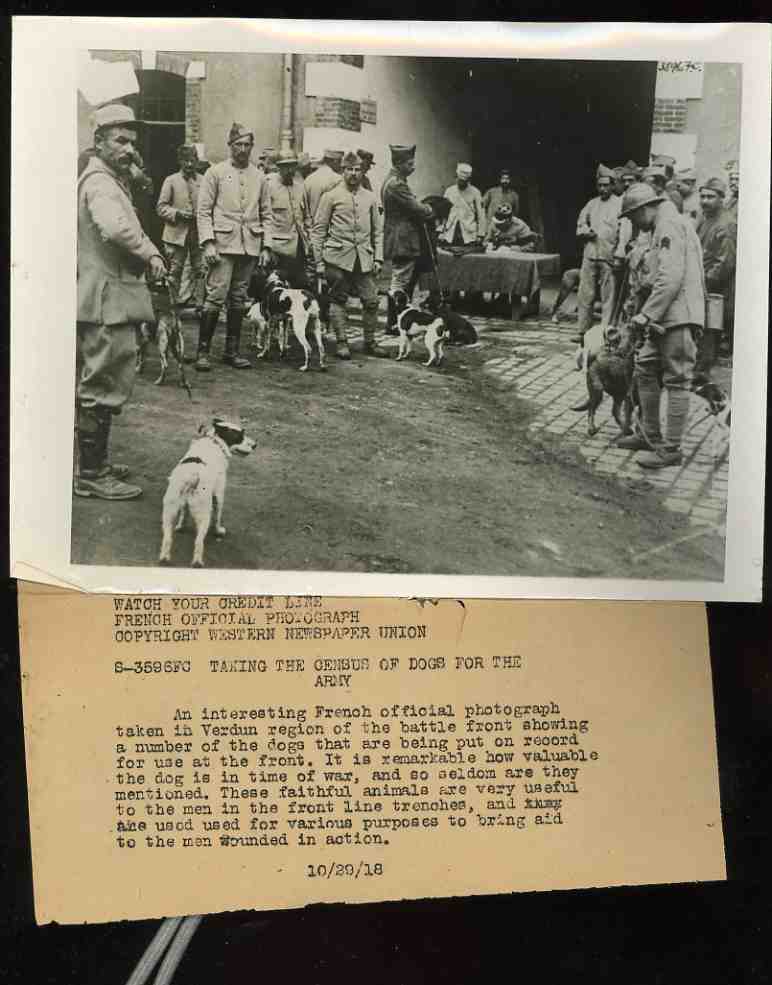
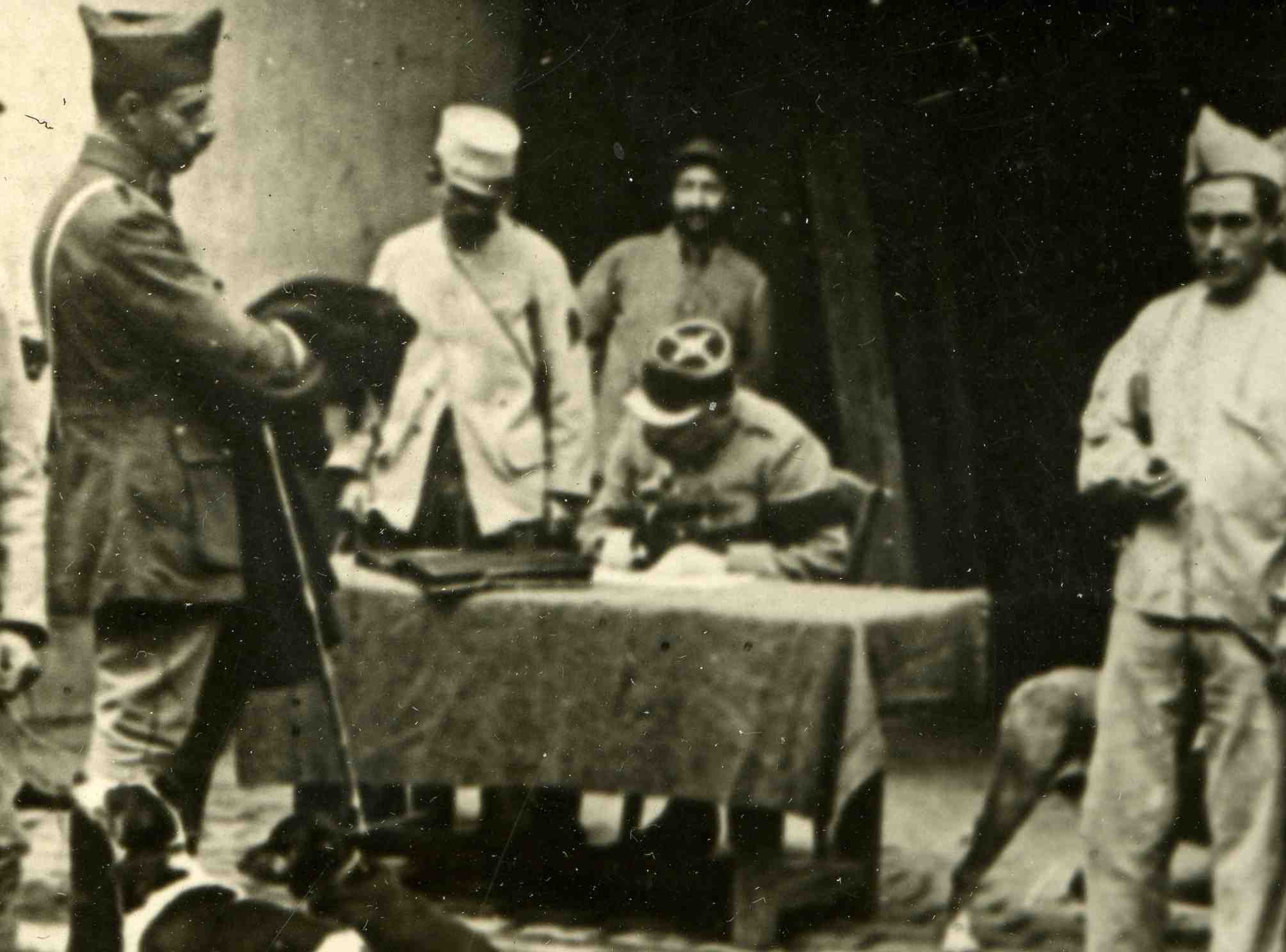
    I wonder what the French officer sitting behind the table at the center background thought about at night, after his day was done.  I wonder what it was that went through his head, his eyes fluttering, as he slipped into sleep?  As the accompanying caption of this photo states, this was a census of dogs, a census of army dogs in the French army, taken at “the battle front” of Verdun, and dated 10 October 1918.  Did he think of his duties expended throughout the day, and weeks and months?  Counting dogs as a war effort may have been a hard thing to consume.  Perhaps this officer had already seen his share of war, perhaps he had fought from 1914 and onwards, this position being relatively benign, a reward for years of impossibly difficult service in a bloody war. Or perhaps not.

    “Taking the Census of Dogs for the Army”, an official French war photograph and copyrighted and distributed by the Western Newspaper Union (a news photo service supplying photographic images for newspapers around the country), gives us a peek at what had been an largely untold story about digs in war.  As it turns out, the French started early on in the war training and using dogs to track and aid wounded soldiers on the battlefield; the Germans did so too, their dogs rescuing some 6,000 wounded soldiers by war’s end.  And this continued a story of dogs in wars that’s at least 2,000 years old.

    0--blog---dec 2 dog census173 .  The photograph, though dated 1918, was taken in 1916, during the horrific Battle of Verdun.  IT was yet another enormous battle at Verdun, which had seen more than its fair share of military action over the centuries, owing to the city’s strategic location on the Meuse River.  The men in the photo look worn, as well they should–evidently, owing to replacements and rotation, something like 70% of the entire French army fought in this battle, with 24 French divisions fighting there.  The French lost 161,000 men dead and 101,000 missing, with 216,000 wounded; the Germans lost about 142,000 dead and another 187,000 wounded.  That’s coming up close to 3/4-million men in one battle over several months in 1916, most of which were the victim of the 30 million rounds of artillery shells.

  • Skinny II: Morals, Class Warfare & Letting Someone Else Pick up your Dropped Fork

    JF Ptak Science Books Post 406

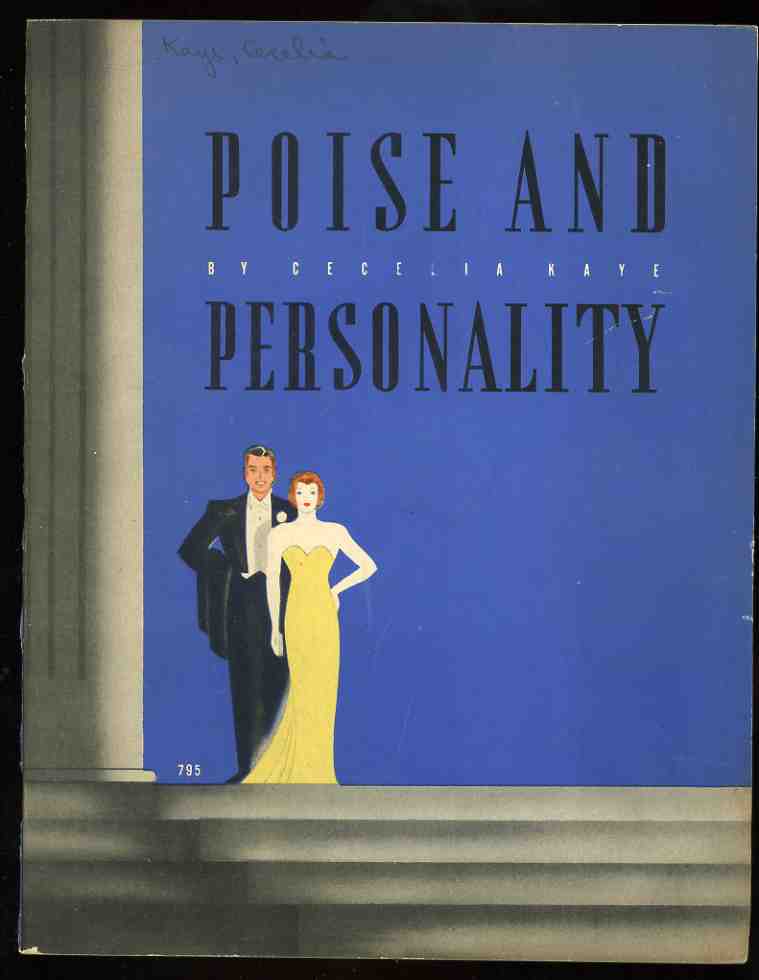
    Yes, these two pamphlets are beautifully designed, real works of production art, speaking elegantly and skinnily to their skinny, elegant times.  The World Behind the Telephone is a straightforward look at the stuff going on behind the scenes that made the telephone “go”–the woman holding the telephone is remarkably tall and angular, holding back the curtain of an even taller and skinnier doorway, beckoning the viewer into the unseen telephonic world.  Poise and Personality features more skinny people, and offers the skinny on some excruciatingly class-conscious tips on expected behavior and the division of the classes.

    0--blog---Nov 29 skinny156

    0--blog---Nov 29 skinny157

    “Social poise does not consist of a mere set of mannerisms” it reads, but beware:  “avoid careless and loose forms, which are in bad taste”.  There are all manner of pinkies-up logics and societal sniffing splayed throughout these pages, from the chapter improbably titled “Preccedence [sic] in Introductions”, to “Sensitivenesses” (“being sensitive is a luxury and the price runs high”), “Inferiority Complexes (“if you are afraid of people, talk to them with a smile…”), “Personality development” (“undoubtedly there is a native something that differs in each of us”), “Poise” (“…people are unhappy because they are nervously conscious of a lack of ability to mix with strangers….consequently they are unable to appear calm and balanced”. 

    Yes, it is a product of its time.

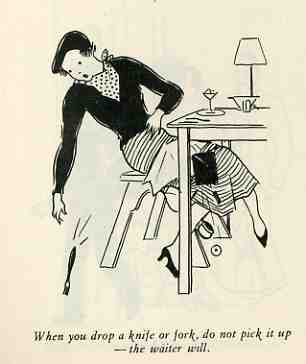
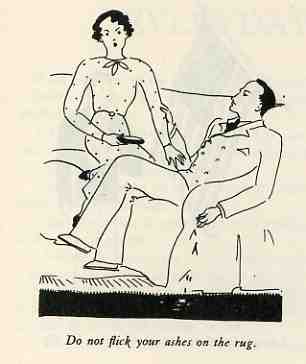
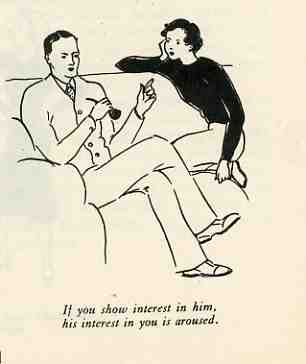
    There are some troubling and insensitive things in here as well, pamphlet being delivered of it times or not.  Letting the waiter pick up your fork is one; do not drop your ashes on the floor is another.  The more subversive ones though are on dating behavior and gender wars, the subjugation of women as it was in 1938 firmly on display.  “If you show interest in him, his interest in you is aroused.” Oh dear sweet creator, the woman is only of interest to the man if she reflects his interesting bits back to him.  Why not have the guy date a mirror?  That way nothing will be lost in all of that wasteful biological differentiation. 

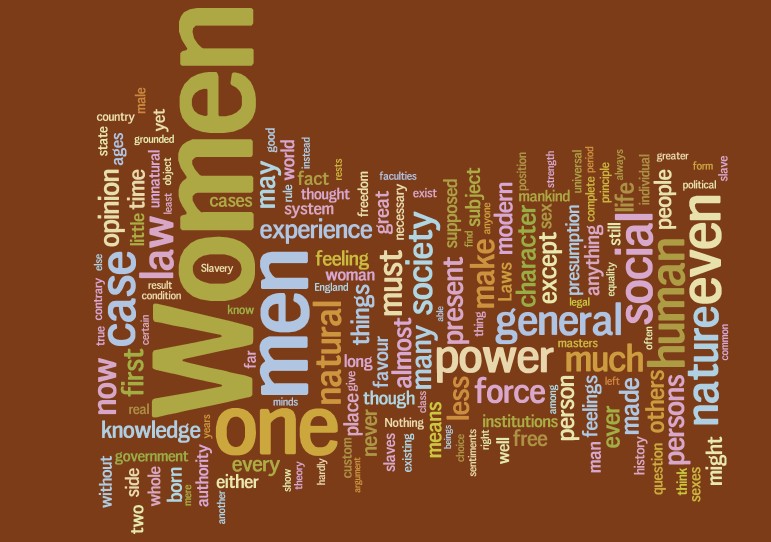
    Here’s an early classic on the subject:  John S. Mill’s On the Subjugation of Women, an oldie but still a goodie. 

    0--blog---Nov 29 skinny158 0--blog---Nov 29 skinny159

    0--blog---Nov 29 skinny160

    Just for good measure, and really not related to this post, I’ll throw in a word map generated by Wordle.net of Mill’s Subjugation of Women (I like how “slavery” happened to pop up in the middle of the “O” in “women”):

    Wordle--subjugationfixed

    ·Posted by :

    ·in:

    — —
  • The Future of Future Truisms: David Byrne’s Knee Plays vs the Fat Man Nuclear Warist, Herman Kahn

    JF Ptak Science Books   Post 407

    0-blog-dec 3 byrne David Byrne, former Talking Heads member, produced a series of twelve short pieces to be used in the Philip Glass (and Robert Wilson*) Opera CIVIL warS  in 1985. (“Opera” may not be the right word for this piece, as I think it was one only in so far as the composition needed an opera house to be performed in.)   The Byrne pieces, called ”Knee Plays”, were meant to fill in the spaces, the spaces in-between,  place holders, between the sections of the day-long multimedia production..  Glass had used this idea of inter-pieces to the whole earlier in 1976 in his at-the-edge Einstein on the Beach, in which the connective elements were meant to not only join the pieces of the production together, but were also meant to stand alone, as a cohesive unit, if removed from the opera.  (Glass said they were “short connecting pieces which appear throughout the work much as prelude, interludes and post-ludes. Taken together they form a play in themselves”)

    0-blog-Dec 3 David_Byrne1991

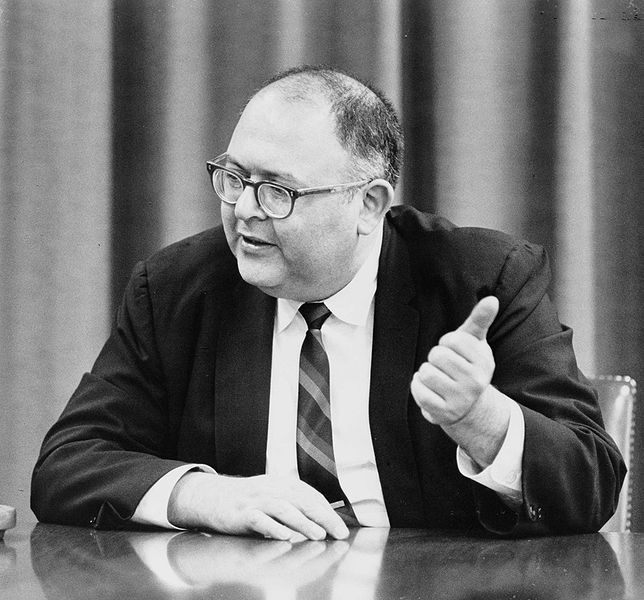
    One of the Knee Plays, “In the Future” (Knee Play Number 12) is a slippery, stacatto brass section accompanying Byrne’s 51 sophisms about life in the future.  About thirty years earlier, “futurist” and think-tank-filler (or maybe it was “Think Tub”?) Herman Kahn (1922-1983), occupying a lot of space at the RAND and Hudson Institutes  (he was also known in many circles as the “Fat Man”), diligently recorded his myopic views of the future. He is generally regarded as a systems theory and military strategy guy, and is most remembered for (as he claims, perhaps) introducing the term “Vietnamization” which described the ultra-failed de-escalation (?) process and withdrawal for the United States from Vietnam (attention Obama administration).  Superluminarily speaking though his contribution to thought on constructing and implementing thought regarding nuclear weapons exchange (pointless to refer to this as “war”) in two books, Thinking About the Unthinkable (1962) and, On Escalation (1965), where he famously put The Bomb on the table of use possibilities.  In addition to these books—which he is busily trying to forget out there in his afterlife, somewhere, maybe in a penitential place where you are forced to think endlessly about paths-to-bad-decisions) is that 1967 peek into the future, The Year 2000.  Petroleum and oil are not issues.  Computers are of minor societal importance.  And then other things of no importance happen.

    0-blog-dec bryne kahn When you take Byrne’s Knee Play  12 and place it next to Kahn and other mis-spent prognosticators, the musician looks positively brilliant.  Some of the stuff has come to pass, some hasn’t; some will, and some won’t.  Some are open to a little interpretation, and some, a lot.  Overall, though, if you think through these little future buillets a little carefully, David Bryne looks very good.  Byrne’s lyrics/list is below.

    *Robert Wilson is a phenomenal conceptualist and theatrical designer.  On the liner notes to CIVIL warS is found the interesting note on Wilson and Byrne:  “At first, Robert Wilson asked David to compose pieces for several sections of The CIVIL warS, but on account of David’s limited time, he composed only The Knee Plays part. The CIVIL warS was supposed to be played in its complete form at the Olympic Games in Los Angeles, but if one plays every part, it takes at least eight hours. There was also a financial problem for playing every part. So only some parts of it were staged there. David himself was very interested in composing for such a play and dance and this time again he enjoyed this work very much. Last time, for The Catherine Wheel, he used recorded tape, but this time he made musicians play on the stage.”

    IN THE FUTURE (KNEE PLAY 12)

    In the future everyone will have the same haircut and the same clothes
    In the future everyone will be very fat from the starchy diet
    In the future everyone will be very thin from not having enough to eat
    In the future it will be next to impossible to tell girls from boys, even in bed
    In the future men will be ‘super-masculine’ and women will be ‘ultra-feminine’
    In the future atomic fusion will enable us to build a skyscraper with
    the energy obtained from a grain of salt
    In the future through genetic surgery there will be a race of menial
    workers, studs, ‘whores’, TV personalities and politicians
    In the future half of us will be ‘mentally ill’
    In the future there will be no religion or spiritualism of any sort
    In the future the ‘psychic arts’ will be put to practical use
    In the future we will not think that nature is beautiful
    In the future the weather will always be the same (relative to the way it is now)
    In the future no one will fight with anyone else because anyone can
    be anything he or she want to be
    In the future there will be an atomic war that will reduce the survivors to savages
    In the future water will be expensive
    In the future all material items will be free
    In the future everyone’s house will be like a little fortress
    In the future everyone will think about love all the time
    In the future TV will be so good that the printed word will function as an artform only
    In the future people with boring jobs will take pills to relieve boredom
    In the future everyone but the wealthy will be very happy
    In the future everyone but the wealthy will be very filthy
    In the future everyone but the wealthy will be very wealthy
    In the future communication/distribution systems will be so good that no
    one will live in cities
    In the future farming will be managed through a nationwide computer hookup
    In the future there will be mini-wars going on everywhere
    In the future political and other decisions will be based completely on opinion polls
    In the future only the very wealthy will be able to travel or move out their houses
    In the future individuals with soldier inclinations will go out for ‘killer’ sports
    In the future there will be machines which will produce a religious
    experience in the user
    In the future there will be a classless society, no one richer than anyone else
    In the future people will constantly be having plastic surgery, altering
    their features many times during a lifetime
    In the future there will be many mass suicides
    In the future there will be groups of wild people, living in the wilderness,
    who will rob suburbanites
    In the future there will be only paper money which will be personalized
    In the future everyone will only get to go home once a year
    In the future everyone will stay home all the time
    In the future we will not have time for leisure activities
    In the future we will only ‘work’ one day a week
    In the future our bodies will be shrivelled up but healthy and our brains will be bigger
    In the future there will be starving people everywhere
    In the future no one will be able to afford TV or newspapers, resulting in
    no one knowing what’s going on
    In the future people will live in space
    In the future only the very wealthy will have pets
    In the future the poor will be regulated by the rich
    In the future the crippled, retarded, and helpless will be killed
    In the future everyone’s house will be a total entertainment centre, with
    video, pills, dancing, sex tools, holographic movies, and game machines
    In the future everyone will have his or hers own individual style of very way-out clothes
    In the future we will all eat our favorite foods, only they will all be synthetic
    In the future we will fuck anything, anytime, anywhere
    In the future there will be so much going on that no one will be able to keep track of it

  • Skinny III: Skinny Water. An Extremely Thin Shower Apparatus, 1888.

    JF  Ptak Science Books   Post 408
                                                                                                           
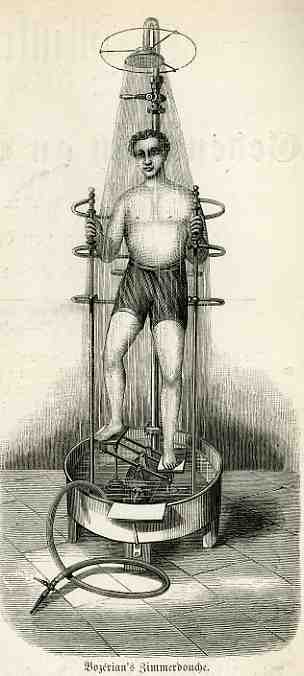
    0--blog---Nov 28 skinny shower141

    There’s nothing in this image that doesn’t make sense, right down to the water recycling part (from my read, anyway) and the effort that goes into making the shower happen.  You can work up a sweat while exercising and get rid of it at the same time, saving on laundry–like taking a vertical bath with only tiny water accumulation.  Also the water has been retro-electrified to minimize dripage and to make it “power fall” in a smooth, orderly, canonical fashion, as we see here.  (Just kidding about this last part.)  Seriously, though, this fashionably entrunked (?) man must have been really pumping away to get that much action from that big shower head. 

    The slightly odd thing here is that this image, made for the Illustrirte Zeitung in October 1878, is that plumbing–which had been introduced by this time–was not a factor here, nor was a shower curtain (which also had made an earlier appearance).  I’m guessing that this cold water shower machine was unusual for being foot powered.  The earlier showering devices, particularly those seen in America, were hand-driven shower benches. 

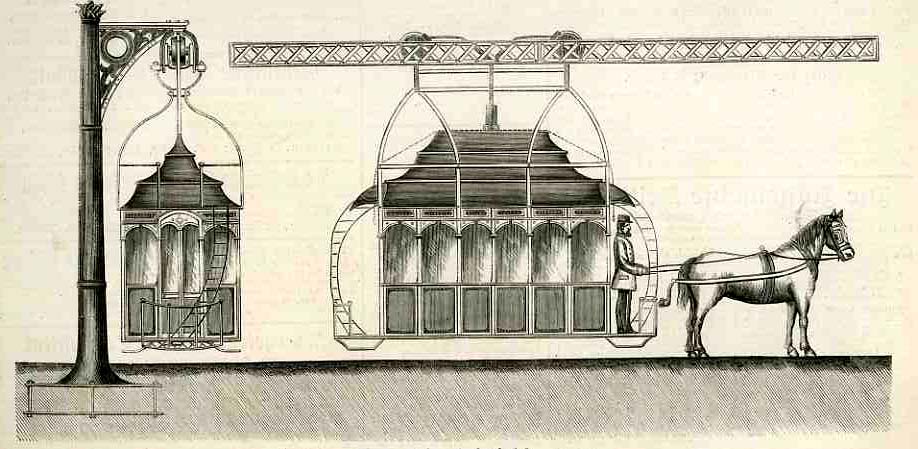
    The second image has nothing whatsoever to do with the first save that it, too, in its own way, is “skinny”.  The suspended monorail horse powered railway car, seen here in the 1878 September issue of The Scientific American. In its own secret way, it is a splendid idea, meant to pursue it own very heavily programmed way around the street of New York City.   It might have been a smoother ride for the passengers than being pulled over miles of macadamized roadway, and may have been easier for the horse, but it does seem as though there is an awful lot of metal to make these relatively minor advancements worthwhile. 

    Also, it really is a beautifully rendered image.

    0--blog---Nov 28 skinny shower142

    ·Posted by :

    ·in:

  • Meekness as a Quality of Woman, 1685: on Patriarchy and the Enslavement and Subjugation of Women

    JF Ptak Science Books LLC  Post 409

    “‘Love is strong as death,” and so is the obedience and reverence paid to the ashes of the dead, ruling husband”

    The Ladies Calling, in Two Parts by the Author of The Whole Duty of Man, The Causes of the Decay of Christian Piety, and The Gentlemans Calling, by Richard Allestree, printed in Oxford in its popular eight impression in 1685, was hardly a novel or unique approach to the coaching of the supplicating and correct behavior of women.

    Its eight printings in a dozen years (assuming that the print run was at least largish, this would qualify as a best-seller in today’s market) was a testament to its somewhat mirror-like expectation of the social visions of the time, also making it hardly alone in its challenges to the neo-individuality of the female sex. It was pretty much what was to be expected, a “normal” vision of the actions of women, including as ever the not-so-faint aroma of the codification of sexuality, or at least the value of women as sexual objects.  (It is true that well-married women did have a sort of power through the husband, but if the promise of children was broken or if there was something not quite right in the private life, the wife could be gotten rid of very easily, and her power by association would be gone)

    The titles of its eight chapters pretty much tell the whole story:   Of Modesty,  Of Meekness, Of Compassion, Of Affability, Of Piety, Of Virgins, Of Wives.Of Widows. The message, or, rather, the demand:  be compassionately meek, religious and observant, happy, virginal until wifely and then wifely until death, and then acting properly after the death of that  which gave you nearly purpose. Be true and faithful and genuflectorial and obedient to your god and husband, and not necessarily in that order at all times.  Ideally, the woman would obey the callings and creations of the church representing the whims of the creator; though there were some times when the husband would be needed for elucidation and guidance to even the teachings/programs of the religious authority.  The creation of patriarchy had been at least a 2000-year-old process in the 17th century, and this book was yet another in the subtle changes to the regulation of that wall. 

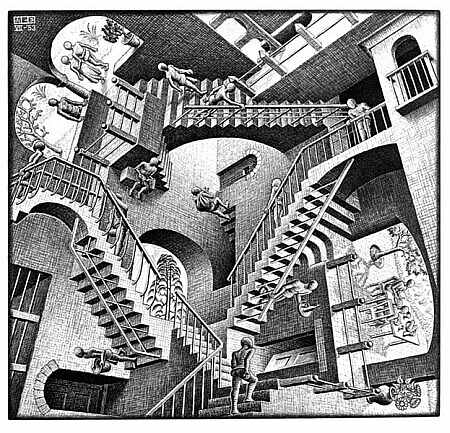
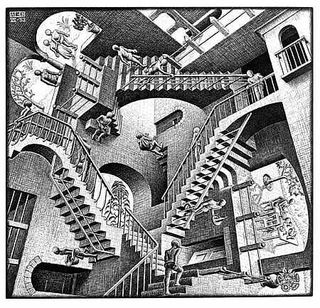
    The following two sections are pulled from the chapter on Meekness (and illustrated by an architect of Catch-22edness, M.C. Escher, on the inescapable logic of cohesive subjugation):
    Escher-mc-relativity-7400006

    “1. In the next place we may rank Meekness as a necessary feminine Vertu; this even nature seems to teach, which abhors monstrosities and disproportions, and therefore having allotted to women a more smooth and soft composition of body, infers thereby her intention, that the mind should correspond with it. For tho the adulterations of art, can represent in the same Face beauty in one position, and deformity in another, yet nature is more sincere, and never meant a serene and clear forhead, should be the frontispiece to a cloudy tempestuous heart. ‘Tis therefore to be wisht they would take the admonition, and whilst they consult their glasses, whether to applaud or improve their outward form, they would cast one look inwards, and examine what symmetry is there held with a fair outside; whether any storm of passion darken and overcast their interior beauty, and use at least an equal dilligence to rescu that; as they would to clear their face from any stain or blemish.”

    “3. And first for the Meekness of the Understanding, it consists in a
    pliableness to conviction, and is directly opposite to that sullen
    adherence observable in too many; who judg of tenets not by their
    conformity to truth and reason, but to their prepossessions and
    tenaciously retain’d opinions, only because they (or some in whom they
    confide) have once own’d them; and certainly such a temper is of all
    others the most obstructive to Wisdom.”

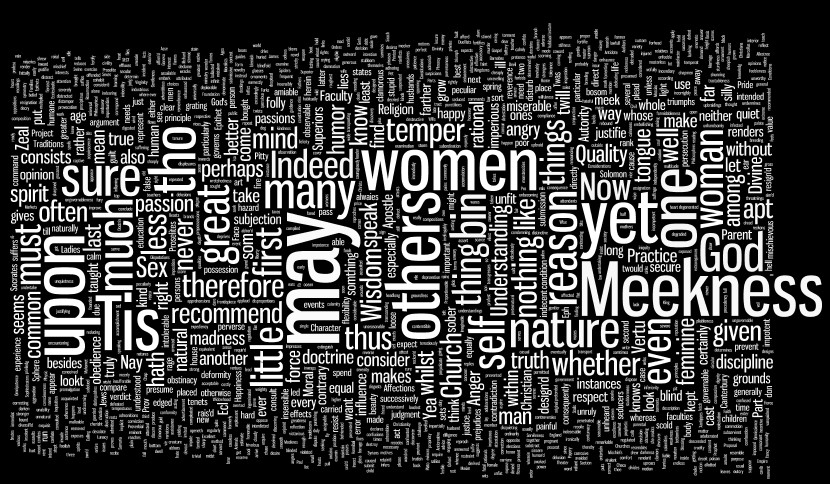
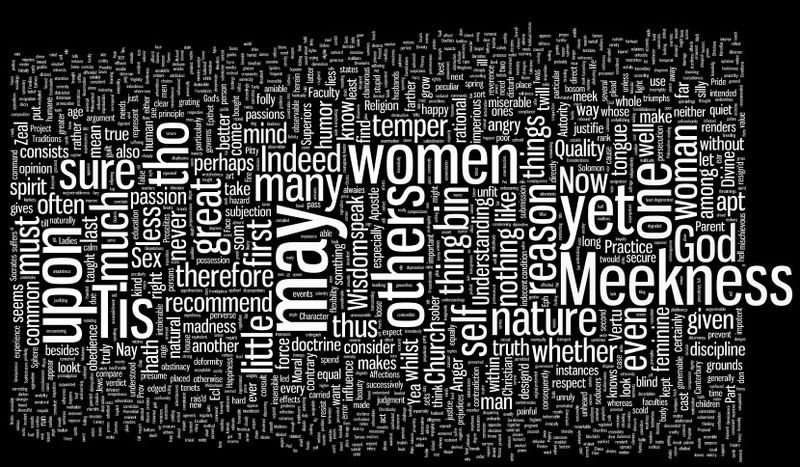
    The following is a Wordle Word Map of Meekness, featuring a vaguely three-dimensional 5,000-word
    word map of the contents, the words weighted, the most often occurring
    words appearing largest, and so on.  I’m not sure exactly what I’m learning from it, or learning more than I’d learn from reading two paragraphs of the chapter. 
    Wordle--meekness 5000

    Some further quotes from this work, including the seven remaining chapters:

    Of Modesty
    “That the Obligation to Moral & Christian Vertues is in it self universal, and not confin’d to any Sex or Person, is not to be denied: yet, as in human Constitutions there are often Precepts, which (tho not exclusive of any, do yet) more peculiarly and eminently level at som particular rank or order of Men; so in the laws of God and Nature, there appears the like distinction. That all-wise Creator, who hath put peculiar proprieties and inclinations into his Creatures, hath accordingly design’d their actuating and improving them: and altho in mankind, which differs nor in species but in gender, the variety may seem less; yet there is still enough to found som diversity, either in the kind or degree of duty”

    Of Compassion
    “But this is yet more unnatural in the female Sex, which being of softer mold, is more pliant and yielding to the impressions of pitty, and by the strength of fancy redoubles the horror of any sad object; yea so remarkable is this tenderness, that God, when he would most magnify his own compassion, illustrates it by that of women, as the highest human instance. Indeed such a propension have women to commiseration, that they are usually taxed with an excess in it; so that any imprudent lenity is Proverbially called, A womanish Pitty, and therefore it may be thought an impertinence to exhort them to that which they can scarce avoid.”

    Of Affability
    “But hitherto we consider Affability only in its ethnic dress, as it is a human ornament; ’twill appear yet more enamoring upon a second view, when we look on it as bearing the impress of the Sanctuary, as a divine Vertu. And that it is capable of being so, we have the autority of St. Paul, who inserts it in the number of those Christian Graces which he recommends to his Roman Proselites; condescend to them of low estate, Rom. 12. 16. and that we may the better discern its valu, ’tis observable that he links it with the most eminent Vertu of Humility; for it immediatly follows his Precept of be not high minded. Indeed ’tis not only joined with it as a Friend or Allie, but derived from it as its stock and Principle: and certainly a more divine extraction it cannot have, Humility being the Alpha and Omega of Vertues, that which laies the foundation, (without which the most towring Structure will but crush it self with its own weight) and that which perfects and consummates the building also, secures and crowns all other Graces; which when they are most verdant and flourishing, are like Jonas his gourd, that may afford some shadow and refreshment for a while, but are apt to breed that worm which will destroy them. When once they are smitten with Pride, they instantly fade and wither; so necessary is humility both for the acquiring and conserving, all that is good in us.”

    Of Piety
    “Piety is taken for our more immediate entercourse with God, in things purely divine, as Adorations, Praiers, Aspirations, and all pantings and breathings of the soul after him; and in this notion ’tis more particularly called Devotion. And this is comprehended it: the other, as a part in the whole; nay indeed, as an effect in its cause; for where Piety has not first formed and modelled the soul, there can be no true Devotion.”

    Of Virgins
    “Virginity is first in order of time, and if we wil take S. Pauls judgment in respect of excellence also, 1 Cor. 7. And indeed she that preserves her self in that state upon the account he mentions v. 33. that she may care for the things that are of the Lord, that she may be holy both in body and in Spirit, deserves a great deal of veneration, as making one of the nearest approaches to the Angelical State, And accordingly in the primitive time, such a Virginity was had in a singular estimation, and by the assignment of the Schoolmen, hath a particular coronet of glory belonging to it.”

    Of Wives
    “In that of a Wife her duty has several aspects, as it relates, first to his Person, secondly to his Reputation, thirdly to his Fortune.”

    Of Widowhood: 
    “THE next state which can succeed to that of Marriage is Widowhood, which tho it supersedes those duties which were terminated merely in the person of the husband, yet it endears those which may be paid to his ashes. Love is strong as death.”

    “Love is strong as death.”  So is obedience, or obedient love, or meekness rapped up in a quilt of obedient love in a field of affable, modest, pious modesty, commanded by the male even in death.

    I said earlier that the idea of patriarchy and the war on gender is a 2500-year-old process.  It is remarkable to think about the advances in equal rights for women in the last 115 years, especially in the light of the introduction of money into the equation.  Within the last 400 years or so the concept of private acummulation of property came along to the not-wealthy classes mostly (perhaps) as the standard practice of the transfer of dowry/property/children from the women to man via marriage. (I say “115” and not “100” years because, at Tahakopa, on 28 November 1893, New Zealand became the first country to grant voting rights to women on a national basis–hats off again to NZ for being first again in so many important categories.) That said, and with the extraordinary weight of money, the subjugation part was very well entrenched until relatively recent times.  As a matter of fact in the history of patriarchy this would represent only about 3% of the timeline of subjugation–1.5% if you were being honest about it. 

    So in the history of the enslavement of women,  and of all the billions of lives of women that have been lived during that time over 25 centuries, it is only within the lifetimes of living grandmothers that the true superior progress in achieving equality of rights for the sexes has been made.  If that sort of realization doesn’t illuminate the darkly myopic views of people who would want to continue ruling via exploiting differentiation, I don’t know what will.  That for 2500 years something was “normal” and acceptable; and then in the last 115 or so years, it became less so, and now in the last 50 years it is a recognized embarrassment and mistake to anyone with a brain.  Condensing backwards vision like this is an interesting practice, especially when you put it up alongside other, contemporary issues that smack of this sort of discrimination, like California’s Proposition 8.  I just hope that it won’t take a hundred years for the majority of the people living in this country to recognize that we were being stupid.  I trust that New Zealand won’t take nearly this long. 
    ·Posted by :

    ·in:

    —
  • Found Art: Naive, Never-Fractal Mathematical Art 1810 and a Dip into Steve Reich’s “Come Out”

      JF Ptak Science Books  Post 410

    0--ebay---dec 4 naive art181


    Perhaps the most exquisite art for me is that which is most unexpected, finding beauty without preconception, without warning; and sometimes, finding art without the reason to make it so.  And sometimes it is just the innate design, spacing, placing of elements in something that makes it beautiful, the use of unused, empty space establishing the elements of micro-perfections, the punctuations of the flow of visual chance. 

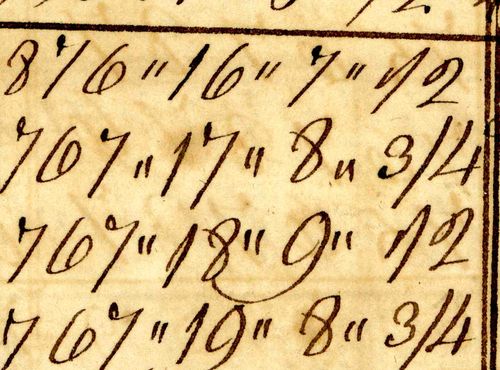
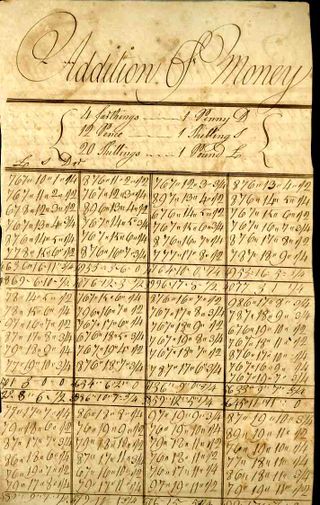
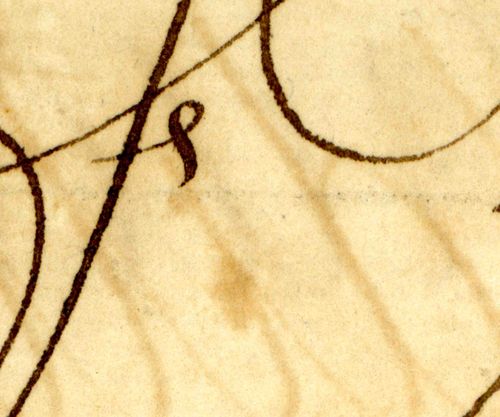
    “Additions of Money”, a page from a primer or mathematics workbook kept by a later-aged child in Pennsylvania in 1810 is filled with such found moments.  The columns of numbers are just gorgeous, and the empty spaces – gauzy with the iron from the ink that has eaten its way halfway through the paper from the other side – provide just enough found geometry to suggest mystery and depth in blank space.  Simple. Elegant. Unexpected. Beautiful.

    0--ebay---dec 4 naive art180


    Perhaps it is the aspect of self-non-similarity that is so appealing; perhaps for the fond naive art it is the rejection of sameness, of everything that something like mathematical/fractal art is not.  (A fractal just for the record is a geometric shape that can be split into  parts that is a smaller copy of the preceding whole.)
    These are images that stochastic synthesis of fractal noises is not: it is not the Peano curve, or Sierpinski gasket, or Hilbert curve, or Mandelbrot set, or Hausdorf domain, and on and on.  Perhaps it is the opposite of these things. 

    And this brings me to Steve Reich’s “Come Out” and a question:  is this music fractal? (Or Arnold Schoenberg for that matter?)  There is a panoply of repeated, self-repeating themes through the work of Reich, blending themselves into magnificent compositions.  But I wonder about what “Come Out’, an early work by Reich, is in the same category.  This composition simply uses the words “come out to show dem” (“I had to, like, open the bruise up and let some of the bruise blood come out to show them” ) in not-so-simple ways, repeating the phrase thousands of times, in the same time, but at different times, like a Zeno’s paradox of music, finding the cleverly hidden beauty in a simple phrase.  And precisely the opposite of our naive surreal mathematical art.


    0--ebay---dec 4 naive art182

  • One of the Worst Santa Claus Titles, Ever: St. Nick & Eraserhead.

    JF Ptak Science Books   Post 411

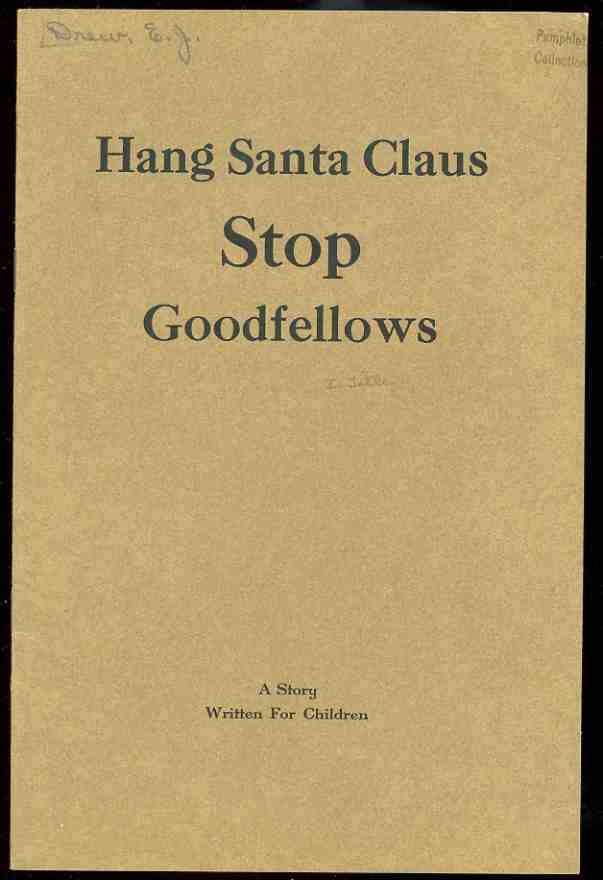
    0--ebay---dec 5 santa183 In the world of bizarrely entitled written works, this extreme effort, written by E.J. Drew (in 1937)   is a prime, glowing, poster-boarded champion.  When you throw Mr. Claus into the mix of bizarre, naive surreal and badly-titled Things Which Have Been Written by Humans, greatness is achieved.  Great badness–even after reading this, um, this written thing (and I’m not sure what category this might occupy but I am sure that whatever it was intended to be written as was written with words, and that’s about it, a Word Written Book, so to speak) I am not sure what it is about. 

    It was a “story written for children”, and such an un-tender Santa-related bad-inducement should certainly never find its way into any hands measuring less than four inches wide; or for that matter, more than four inches wide.

    But getting back to the “about” part–I really can’t tell.  Suffice to say that it involves some bad stories about being in the Dust Bowl, and about children so poor that they were FORGOTTEN by Santa. Then somehow Santa is beaten to a pulp by bad boys, rescued by newspaper boys (the “Goodfellows”), some other stuff, and then everyone winds up being judged by St. Peter as to where they would spend eternity. Santa replaces St. Pete, and then sends people like John Dillinger to the Bad Place. 

    David lynch
    Well.  If there is a moral in here I cannot find it; I can’t figure out the title, either.  The Goodfellows were good and weren’t “Goodfellas”, and the hanging and stopping I just don’t know.  The whole thing is a little disturbing, sort of like the feeling you get when you get your *first* disturbing feelings seeing David Lynch’s twisted/broken Eraserhead.  Pound-for-pound, Drew’s sweaty and nightmarish thing is as unpretty as Lynch’s third-worst. 

    As if one copy wasn’t enough. you can “get additional copies” of this work if you go back in time seven decades years and order them from E.J. Drew, 4034 West Warren Avenue, Detroit, Michigan. No price was listed.

    ·Posted by :

    ·in:

    —
  • Our Kind of Reader: a Library in the Fields of War, 1918

    JF Ptak Science Books LLC  Post 412

    “Tel fruit porte l’arbe de la guerre.”  Charles the Bold, (“Such are the fruits of war”, observing the town of Montdidier set ablaze by the Burgundians in 1472.

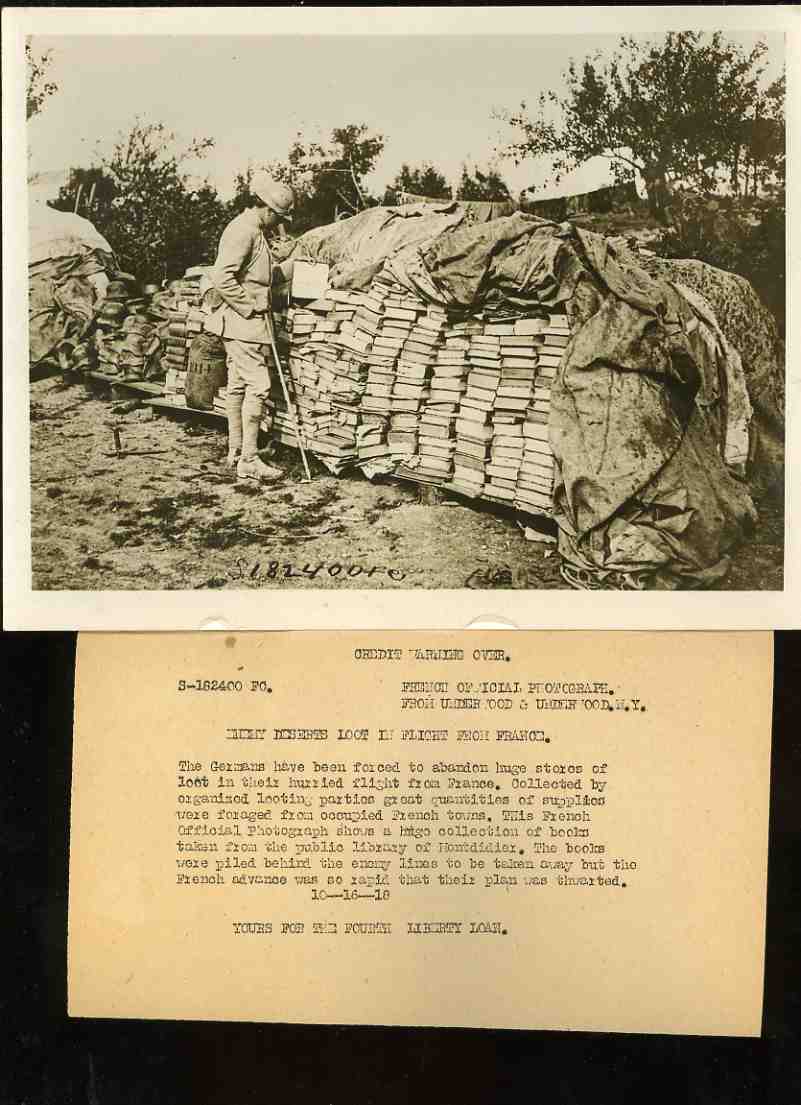
    This photograph, taken near the French town of Montdider in October 1918, reminded me straight away of a photo that my friend Andy Moursund had hanging for many years in his store, the Georgetown Bookshop (for many years one of the most literate, most-intelligently-stocked used/rare bookshops in the DC and Maryland region). Andy’s photo was of the interior of a British library, its roof lost to a Nazi V-2, with stacks of books in a smokey rubble, and with several men standing and reading atop the charred ruins.  His caption for it was “Our Kind of Reader”.  A voracious and terrific reader with tremendous insight, Andy (a Student Nonviolent Coordinating Committee vet (SNCC, perhaps the leading student civil rights organizations in the 1960’s)) really, truly meant and felt the sentiment.  (Or means its and feels it, I should say.)  and here I am surprised to see something similar–let

    0--ebay---dec 5 books185 me just say that images such as these were not very commonly made or published. Different war, same sentiment. 

    This time though the location of the books is outdoors and in France.  the books were looted by the “Huns” as the caption says, and taken from the library at Montdidier.  This is one of the many towns that suffered greatly during the First World War, and especially so during the first Battle of the Somme in 1916, and then again in the battle of Noyan-Mntdidier, in 1918.

    Montdidier is very old and has been deeply scarred by wars over the last 1200 years.  The town’s name comes from the Didier, who as King of the Franks was imprisoned in this community in 774, soon to celebrate the 1,235th anniversary of the event. And on and on.

    I’d be curious to know what was in those piles under the heavy sacking, and how many of those piles there were–we can see the beginning of another just to the left.  I don’t see any thin volumes of whispy poetry or skinny wanting limpnovels. Most of them look pretty stout, three of them together seemingly as big as the soldier’s head.  I am relieved to see that the books were raised off the ground on their pallets–there was a war going on and all of that, but someone took the time and effort to get the books up and off of the ground.  That’s my kind of reader.

    I should point out that this was a News Service Photograph, this one supplied by Underwood & Underwood.  The photo would be sent to newspapers/magazines that requested, say, a photo of a soldier reading; U&U would send it on along for publication, along with mandatory caption. 

  • A Bad Idea From Start to Finish: Ultra-Lux in Tiger Killing, Denigrating Even a Filthy Sport

    JF Ptak Science Books LLC  Post 413

    0--ebay---dec 6 tiger186

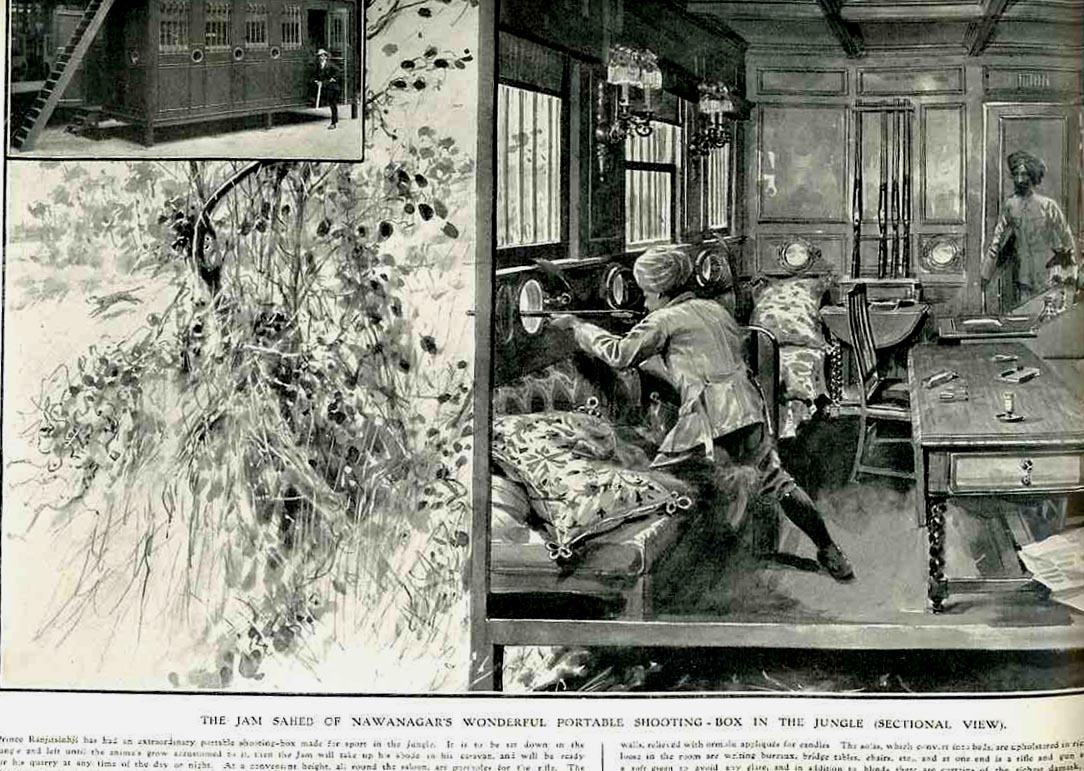
    The title of this lithograph–which appeared in the 27 October 1907 issue of The Illustrated London News–is “Tigers Shot While You Wait in Luxury, Ranji’s Latest Wonder”, and described transporting the Club Room into the wild for blood sport.   I don’t think I’ve ever encountered that phrase before, “tigers shot while you wait in luxury”.   The shooting was done from the portable luxo-car that we see in the upper left corner, which would’ve been transported, probably by a team of humans, into the depths of teh jungle, or at least deep enough for a tiger to be enticed in towards the hunting shed (with promises of meat scents and such?)
    The abomination was made for the sporting whims of Prince Ranjinisnhi (“the Jam Saheb of Nawanagar”).  The shed looks to be about 16x8x8 and had a kitchen, drawing room, and “bathroom and lavatory”, all “decorated in the Queen Anne style, with somewhat severe oak paneling on the walls, relieved with ormolu appliques…”, with nothing but the finest decorating everything else.  The boredom for the Prince was further relieved with portholes for shooting whatever, so that there needn’t be any cause for going outside. This is just wrong on every level.

    ·Posted by :

    ·in:

Recent Posts

Archives

Categories