JF Ptak Science Books Post 410
Perhaps the most exquisite art for me is that which is most unexpected, finding beauty without preconception, without warning; and sometimes, finding art without the reason to make it so. And sometimes it is just the innate design, spacing, placing of elements in something that makes it beautiful, the use of unused, empty space establishing the elements of micro-perfections, the punctuations of the flow of visual chance.
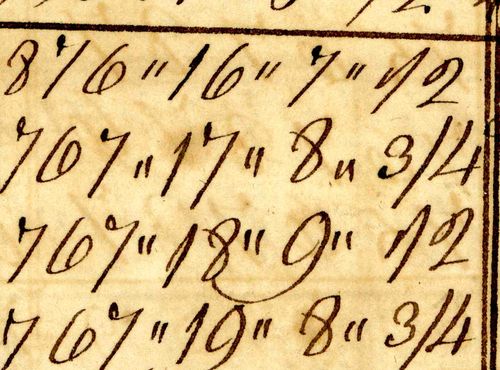
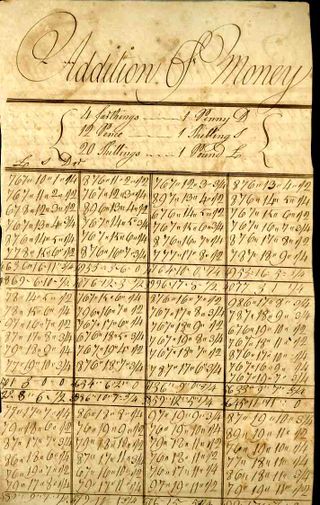
“Additions of Money”, a page from a primer or mathematics workbook kept by a later-aged child in Pennsylvania in 1810 is filled with such found moments. The columns of numbers are just gorgeous, and the empty spaces – gauzy with the iron from the ink that has eaten its way halfway through the paper from the other side – provide just enough found geometry to suggest mystery and depth in blank space. Simple. Elegant. Unexpected. Beautiful.
Perhaps it is the aspect of self-non-similarity that is so appealing; perhaps for the fond naive art it is the rejection of sameness, of everything that something like mathematical/fractal art is not. (A fractal just for the record is a geometric shape that can be split into parts that is a smaller copy of the preceding whole.)
These are images that stochastic synthesis of fractal noises is not: it is not the Peano curve, or Sierpinski gasket, or Hilbert curve, or Mandelbrot set, or Hausdorf domain, and on and on. Perhaps it is the opposite of these things.
And this brings me to Steve Reich’s “Come Out” and a question: is this music fractal? (Or Arnold Schoenberg for that matter?) There is a panoply of repeated, self-repeating themes through the work of Reich, blending themselves into magnificent compositions. But I wonder about what “Come Out’, an early work by Reich, is in the same category. This composition simply uses the words “come out to show dem” (“I had to, like, open the bruise up and let some of the bruise blood come out to show them” ) in not-so-simple ways, repeating the phrase thousands of times, in the same time, but at different times, like a Zeno’s paradox of music, finding the cleverly hidden beauty in a simple phrase. And precisely the opposite of our naive surreal mathematical art.