A Daily History of Holes, Dots, Lines, Science, History, Math, Physics, Art, the Unintentional Absurd, Architecture, Maps, Data Visualization, Blank and Missing Things, and so on. |1.6 million words, 7500 images, 4.9 million hits| Press & appearances in The Times, Le Figaro, Mensa, The Economist, The Guardian, Discovery News, Slate, Le Monde, Sci American Blogs, Le Pont, and many other places… 5000+ total posts since 2008.

  • The Staggering Beauty of Barber Shops: Naive Surreal Department #22

    JF Ptak Science Books LLC  Post 519
    0 blog feb 18 barber603
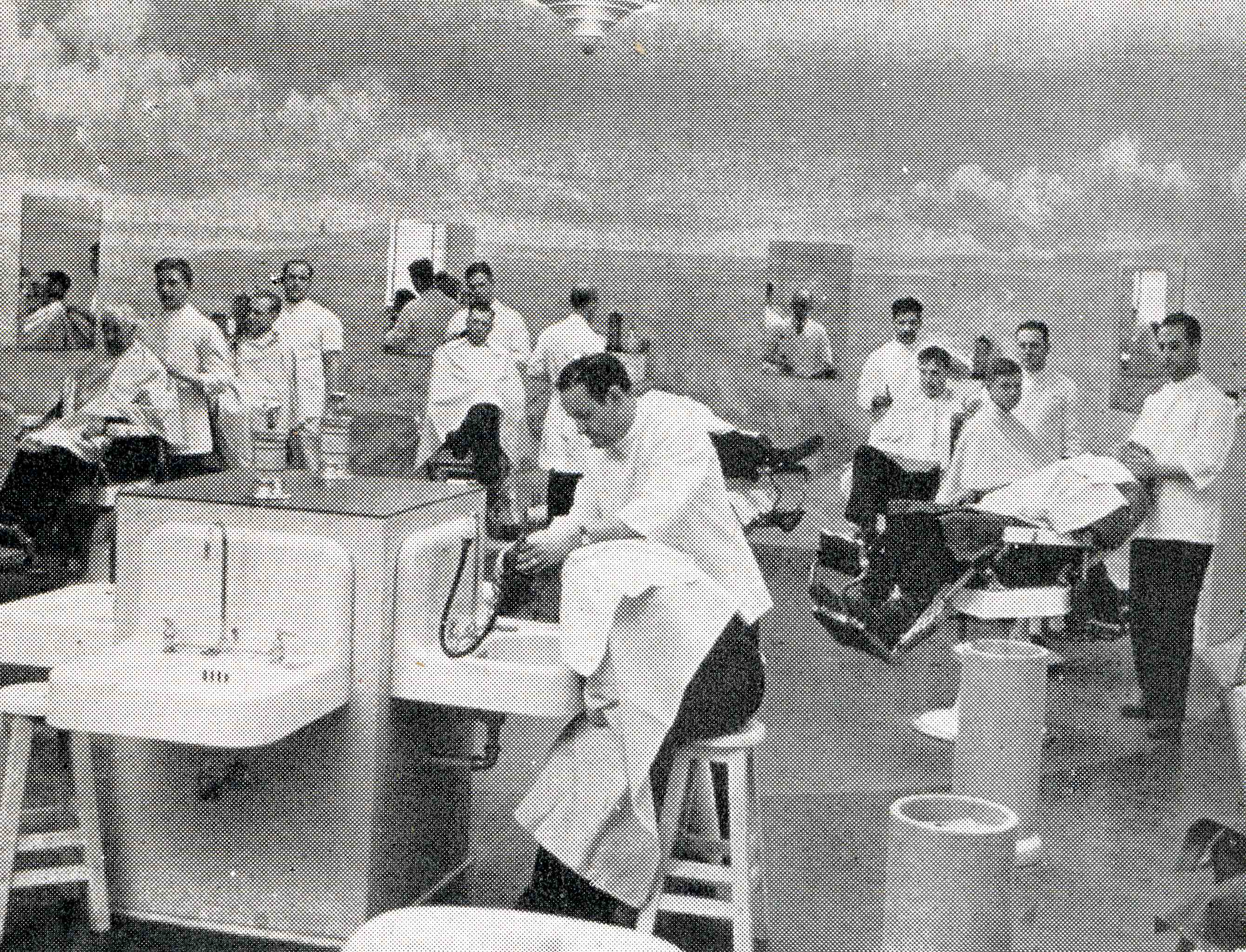
    If I didn’t already go to see Korean War Vet Mr. Jack for my (one) hair cut (and I really don’t mean “haircut”), I think that I could tear myself away from that wonderful experience to go back into time’s recent ankle-deep depths and go to this barbershop….or rather barber emporium.  The location or credit wasn’t given in the occupational pamphlet (The Canadian Census Classification Personal Service:  Barber) in which it appeared, which is altogether too bad.  I cannot recall (can you?) ever seeing such a Busby Berkeley arrangement of barber chairs, centered around a washing station, with clouds (!!) painted on the ceiling.  I would half expect to see Mr. Zero Mostel (oh well, not every did well at HUAC) lead them all in a dance routine where everyone finishes up very leggy and in a pool.  It may well be the case in this unnamed palace that we are seeing only half of the shop–evidence in my copy shows that there is the end of a chair in the foreground, meaning that there could be 15 chairs in there, making it one heck of a busy place, clouds on the ceiling or not.  (The clouds make sense, remembering that most men in 1946 would be going in to see the barber for a shave as he would a cut or trim–and why not look at something attractive when you’re on your back and someone is scraping your face with a very sharp tool?  Dentists should take heed…) 

    And while we’re at it, when exactly did womens beauty salons start to appear in earnest?  This pamphet states “But in 1913, when women took to “bobbed” hair, the barbers found a vast new market for their services.  In the last twenty-five years however a large part of this market has been lost to the hairdressers and beauty culture speciaists, most of whom are women.”  That would mean that–at least in Canada–men were doing this new “bobbed” styling  for their “vast” new clienetelle from 1913 to 1921. It would’ve been a very wide and languid hayride for barbers for those years, cutting the hair of both men and women.  I can imagine the shock of the first male barber seeing the first woman-operated beauty salon swing open its no-males doors–probably there on his street–and hear that glug glug glug sound of business being drained.  Bobbed hair giveth, and bobbed hair taketh away.  

    And now, speaking completely through my hat, I wonder about where women got their hair cut in the 19th century.  My guess:  they didn’t go “out” to have it cut; when they did cut it, they did so at home.  I cannot recall seeing any pre-WWI advertisements for hair cutting for women–as a matter of fact the overwhelming memory I have of women and hair going back into the mid 19th century is for hair care products showing women with enormously long hair adding balms and salves and lustreizers and so forth to it.  I can’t force a memory of an ad for anything having to do with cutting womens’ hair–not even an ad for shears.  Of course a very low percentage of women were in the workforce before WWI, and the women who were wealthier and could afford evening clothing could certainly afford to have someone come over and take care of their hair. Slipping back into the 18th century and slightly before, there was the issue of wigs and extenders–or whatever it was that society women would add to their hair to make it impossibly tall and full.  But that was a very restrictive percentage of women enjoying that privelege, and I’m not sure that it counts for my purposes here.

    My guess is that the money just wasn’t there.  Or it wasn’t there until women sorta started to work, and there was a shortish hairstyle that was not too complicated or time consuming to cut.   Again, I’m just guessing all of this out, but it does seem to make sense.  
  • From the Man who Brought you Betty Boop and Popeye: Max Fleischer and Albert Einstein

    JF Ptak Science Books  LLC  Post 521

    Max Felischer (1883-1972) a
    nice Galician boy from Brownsville and employee of the Brooklyn Daily Eagle, the patentee of the rotoscope and
    arts editor of Popular Science, was an inventor, artist and writer who brought
    into being such iconic American creations as Popeye and Betty Boop.  (Fleischer’s cartooning efforts could hardly be
    confused with his later nemesis, Walt Disney. 
    Fleischer’s cartoons were almost always edgier, darker, surreal, and
    slightly hidden to young eyes.  Betty
    Boop, for example, was quite a dish until censors toned her down, way down,
    into her faded obscurity; Popeye on the other hand survived magnificently but
    was always saying something not quite intelligible that sounded a little blue.)
    He also made the first full-length documentary film in 1923 explaining to the
    great mass Einstein’s theory of relativity, the general theory coming into
    being in 1916 and the special theory in 1905.  
    The public reception of Einstein’s theory, in 1923, was mixed:  it was hallowed, and Einstein was
    ultra-famous, but the theory by and large was not understood.  That really didn’t matter, because it was
    important and it was proven and it worked; the taxonomy of the thing didn’t
    come into play in the daily grind.  
    (After bleeding fallow for 16 years, and that would be the length of
    time from his four epochal papers of 1905 of which the special theory was but
    one, Einstein was finally “given” the Nobel prize for physics in 1921—this was
    actually  awarded for his work on the
    photo-electric effect, which is an obvious manifestation of the quantum theory
    of light, brought into being by Max Planck in 1899/1900. The politics of the
    non-giving non-award in the meantime is simply not a pretty story.)

    The reception of the theory was still problematic in 1923, and
    Max Fleischer decided to have a stab at the story.  The result is the following 18-minute
    presentation—it isn’t as inspired as it is of historical peeping interest,
    basically a cartoon for adults that is now 86 years old, and its interesting
    enough just to know that it was done.

    ·Posted by :

    ·in:

  • A Beautiful Book of Terrible Things: Artillery, 1623

    JF Ptak Science Books LLC  Post 522


    0 blog feb 16 rockets596
    0 blog feb 16 rocket detail

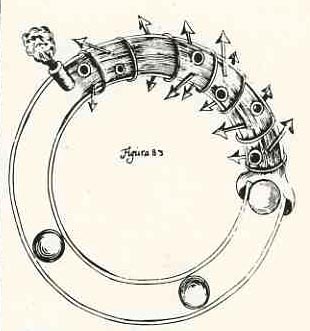
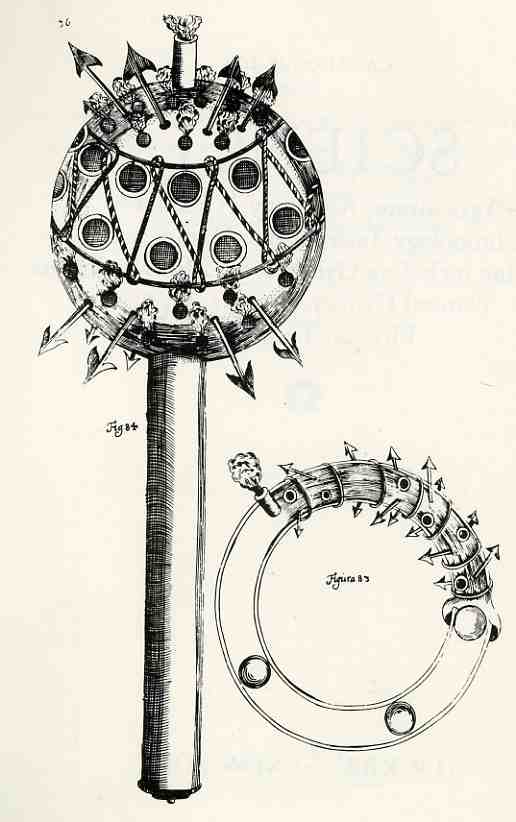
    Praxis Artolleriae Pyrotechnicae, printed in Osnabruck by Tilman
    Buchholtz for Johann Georg Schwaender, is one of those beautiful books
    of horrible things; beautifully designed and illustrated, with
    magnificent images of the horrifying necessaries that bind and tear
    nations and people.  Flying and land-based weapons o fall sorts filled
    these pages:  rocket, grenades, land mines, plus pyrotechnics and
    fireworks.  As jolly as this implement might seem, it is not a
    firework, at least not one for entertainment:  it was meant to
    dismember or kill.  Those “arrows” on the ring are not showing the
    direction of the flight of the module–they are spears.  This was a
    lethal weapon of the highest order–pretty, not-so-simple, and deadly.

    Some other beautiful terribles, published to about the year 1600, include: 

    Roberto VALTURIO 1472 Vérone De re militari

    Niccolo Fontana TARTAGLIA  1537  La Nova Scientia

    Vanoccio BIRINGUCCIO  1540 : De La Pirotechnia

    Conrad HAAS  1556 : Kunstbuch

    Girolamo CATANEO 1564 : Opera
    nuova di fortificare, offendere et difendere, et far gli alloggiamenti campali
    .

    Thomas DIGGES  1579 Arithmetical
    military treatise
    .

    Gabriello BUSCA 1584 Istruzione dei Bombardieri.   1585  Della espugnatione et
    difesa delle fortezze
    .  1606 :Della
    Architeltura militare
    .  

    Luys COLLADO 1586
    Practica manuale di artegliera.

    Jean BEAVIE 1591 Liège La
    pyrotechnie militaire

    Daniel DAVELOURT  1597 Briefve
    Instructions Sur Le Fait De L’artillerie de France
    .
    – 1606  L’Artillier.
    – 1608 : L’Arsenal et le magasin d’artillerie.
    – 1617  L’Art et la conduite des eaux sur le fait de l’Artillerie de 
    et ses dépendances

    Joseph BOILLOT.  1598 Modelles,
    artifices de feu et divers instrumens de guerre
     

    Gabriele BUSCA da Milano 1605 Della
    espugnatione et difesa delle fortezze
    .
    1598 Istruttione de’ bombardieri.
     

    Eugenio GENTILINI  1598 Instruttione
    di artglieri
    .

    David RIVAULT de FLURENCE 1605
    Les elemens de l’artillerie concernans tant la theorie que la pratique du
    canon
    .
    1608 L’invention description & demonstration d’une nouvelle artillerie
    qui ne se charge que d’air ou d’eau pure, & à neantmoins une incroiable
    force. Plus d’une nouvelle facon de pouldre a canon tres-violente qui se faict
    d’or, par un excellent & rare artifice non communiqué jusques à present.
    L’histoire du progrez & des premiers usages des armes à feu tant recentes
    qu’anciennes, est deduitte en l’avant-propos
    .  

    Leonhard ZUBLER 1608  Nova
    geometrica pyrobolia – Neuwe geometrische Büchsenmeisterery
    .

  • Crowds #5: Clarity and Confusion in Displays of Human Masses.

    JF Ptak Science Books LLC  Post 523

    0 abay feb 23 crowd617

    I do enjoy looking at pictures of crowds–big crowds.  Images of the crowd are much easier to find in the 19th century and onwards (and particularly in photographs), though big displays of human seas (such as they were) began to show up in the late 15th century, and then, more as a matter of course, in the early 16th century.  What is enjoyable for me are the numerous vignettes that make up the whole, discrete visions within the larger visual field, a sweep of smallnesses that can seemingly stand on their own had they been bigger. 

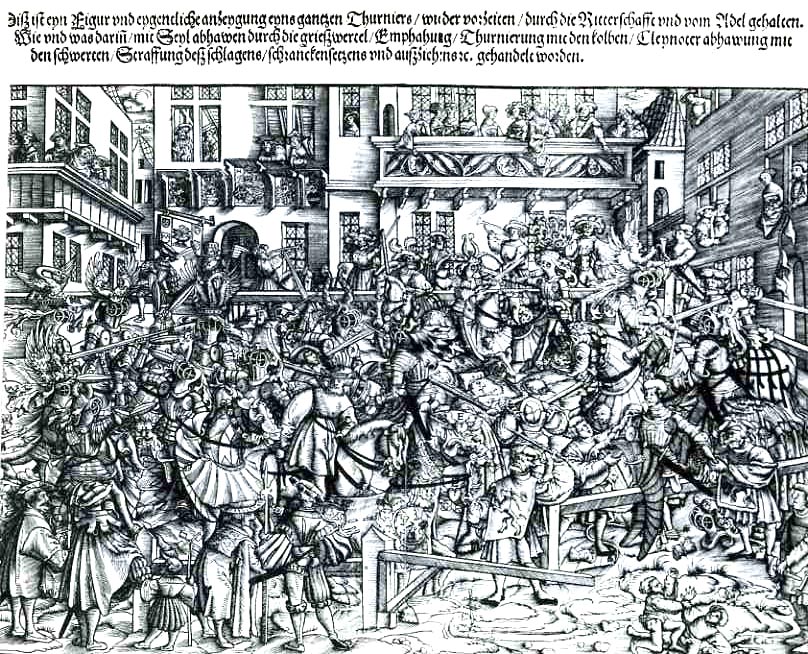
    Depicting crowds can be a chore successful and not–for example, the image to the left, an amalgamated porridge of controlled mock combat, a sweeping chaos with appreciative bystanders, is so busy, and has so many constituent parts, that there 

    0 abay feb 23 crowd618

    really isn’t a “whole”.  I can hardly see the thing, for crying out
    loud, for all of the disconnected action.  The artist who produced this
    remarkably good/bad image for Georg Ruexner’s fantastic Anfamg, Ursprung und Herkomen de Thirnirs in Teutscher Nation
    (published in 1530) clearly had interest only in the details of the
    action; and thus the overall image is a beautiful confusion of starts
    and fits, defiant in its general appeal to comprehension.  The impression to me is a miserably layered oneness of discordant activity, a sloppy relief of enormous detail, the whole worth far less than the sum of its parts. 
    The only place that your eye gets a chance to rest and focus is on the two dozen or so spectators who are in the windows and balconies overlooking the small square where the tournament was taking place–their appearance, and also that of the small assembly of musicians at center, offer a calming influence to the rest of the picture.
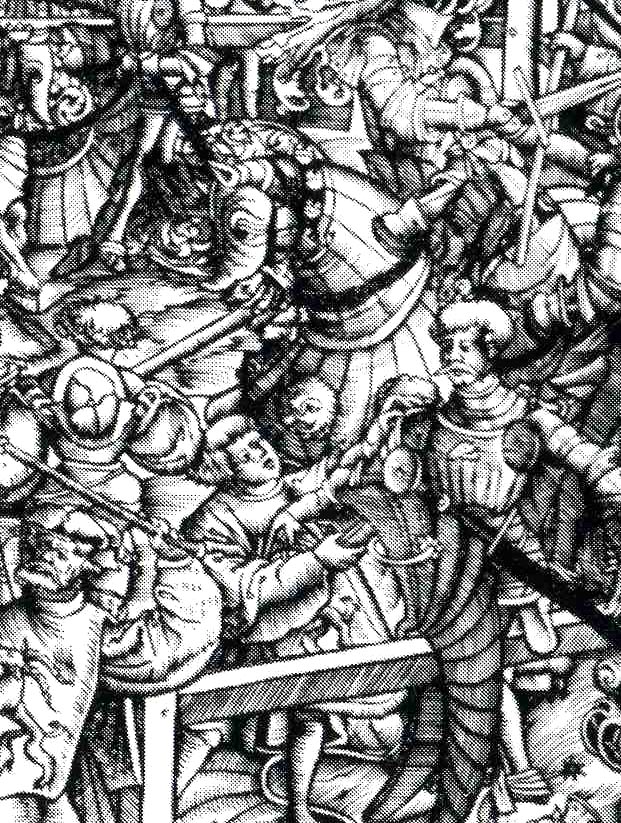
    One bit that leaps out at me, though, are the two small boys who seem to be having a fistfight, right there at the bottom-right of the image.  I can tell you that pictures of boys fighting finding their way into piece of renaissance art is a very rare thing.  Perhaps the artist was trying to send us a message, after all?

    (I know this is a pretty big complaint, particularly since the book is a monumental work on The Tournament, and it was done within the first 65 years or so of the invention of movable type printing, but I just found the thing so opitcally  corrosive that I wanted to surface it. )

    0 abay feb 23 crowd620

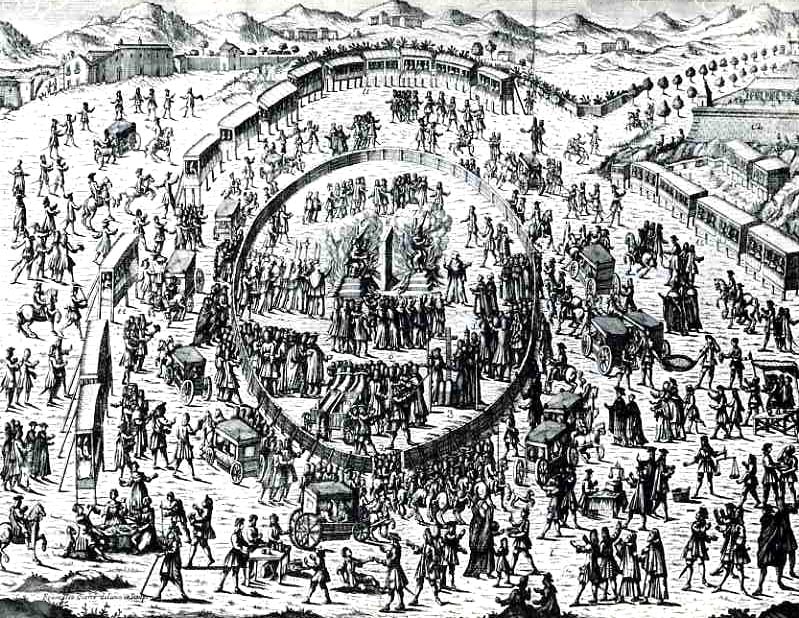
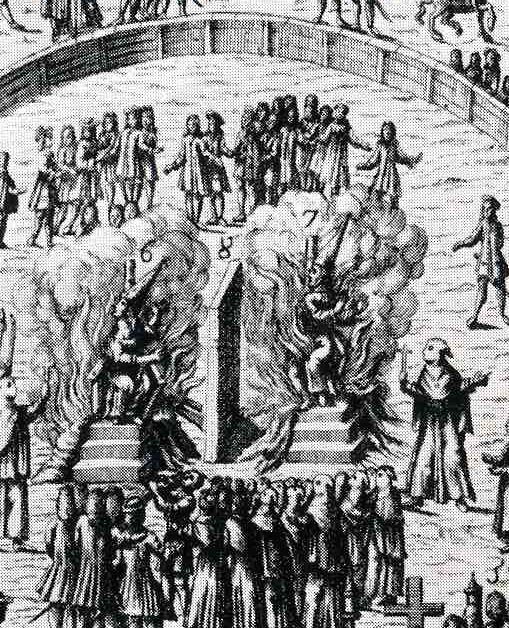
    The second example, coming to us from Antonio Mongitore (L’Atto Pubblico di Fede Solennemente Celebrato nella citta di Palermo, 1724) depicts an earlier scene, and one of complexity and order.  Unfortunately, the cohesion centers around the execution of two tried/convicted heretics–god knows what they did to deserve this cleansing sentence. It didn’t take all that much during the Inquisition to find yourself in deep black waters, as Mother Church seems to have been extraordinarily thin-skinned; the slightest abrasion to their slight slate of moral indignities could result in being hurt in foul way, and then burned alive at the stake. 

    But in looking closer at this image, I’m not sure sure that these two unfortunates were actually being burnt–it may be that they were being roasted alive.

    0 abay feb 23 crowd619

    They are seated, and the pyre seems to be only behind them–perhaps
    the flames hadn’t reached them yet; but people were in fact roasted,
    cooked alive, which may be even more girzzly than being consumed
    entirely by flames.  The two are being approached, or watched, or
    offered too-late benedictions by a line of clerics shielded by a
    crucifix–perhaps they were just reminding the condemned exactly who it
    was that they had pissed off. 

    There is no doubt that this was
    a popular diversion for those not in fear of being burnt at the stake,
    as there are probably hundreds of people in attendance, including those
    in a semi-circle of pre-modern “skybox” accommodations–undoubtedly the
    holier folks.  Piety of witnessing best in privacy and all that. 

  • Music, Math, and the Mathematical Piano: Pascal, 1645

    JF Ptak Science Books LLC   Post 524

    0 abay feb 23 pascal computer621

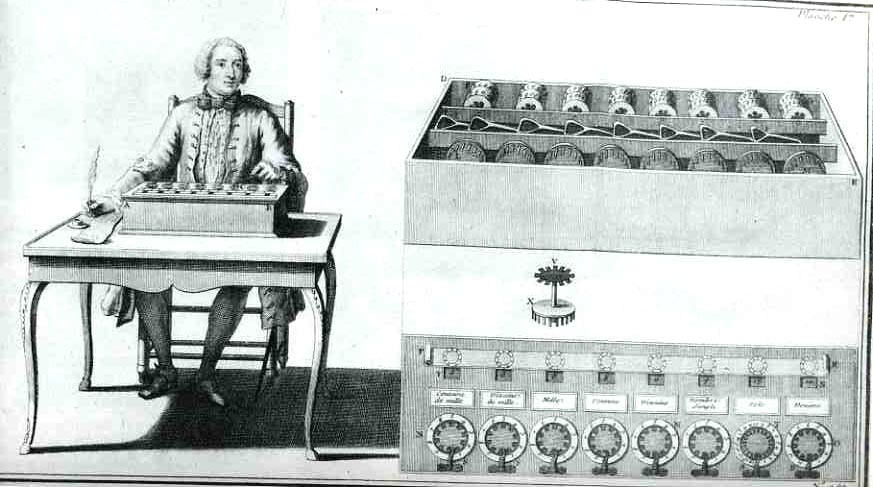
    Music is the pleasure of the human soul experiences from counting without
    being aware that it is counting. – Gottfried Leibniz

    Blaise Pascal (1623-1662), physicist and
    mathematician–rather, mathematician and physicist–and philosopher as well,
    invented the second mechanical calculator in 1645 (after that of Wilhelm
    Schickard (1592-1635) in 1623).  He had a
    phenomenal output in many different, difficult, and complex areas, all
    completed before he died at the improbable age of 39. (His predecessor in invention,
    Schickard, was dead at 43.)   We see him
    here, seated in front of his beautiful invention (called the Arithemtique, and
    the Pacalina), looking to be quite a bit older than his age at invention, which
    was 23.  He looked pretty content with
    himself, even though, I think, he didn’t care all that much for the machine–at
    least he didn’t care enough about it to perfect it, or to try to make real
    money on the thing.  But the picture of
    him here always looked to me as though he was playing an enharmomic harpsichord,
    or using some sort of musical instrument, or doing something more socially beautiful
    than the optical doing of arithmetic, though both were exhibitions of tuning
    the polyphonic sub-mysteries harmonies of nature.  His image seems to wed the millennial Pythagorian
    creation of the music of the spheres, and Leibniz’ scorn of Newton’s occult-y causes of nature’s
    phenomena, and of Augustine’s “distraction” of perfect creation—a polychord
    romance of science and music.

    Or, maybe, it was just a guy sitting behind a calculator.


  • A History of Dots 4: Durer, Viennese Kids, Dalton’s Chemistry Table, and Scrofula

    JF Ptak Science Books LLC  Post 525
    0 abay feb 25 dots scrofula627

    In a continuing series on the History of Dots I’d like to add the
    following, disconnected though they are, so I don’t lose them in the
    coming mix.  It is also one of my few chances to actually need to use
    the word “scrofula”–a lonely, ugly word, a word as unpretty as
    “Susquehanna” is pretty, a word that should be as timid, but isn’t, a
    word that really exercises all parts of your mouth when you say it out
    loud.  (Try it–there’s like five or six movements involved in getting
    that past your lips.)

     To be truthful about it, it isn’t so much about scrofula as it is about the “curing ” of the disease with special little pills:  the Popular Pill!  This woodcut appears in a short sales treatise, published in London in 1675 or so, by Humphrey Nendick, (the delightfully titled)  A Compendium of the Operations Vertues and Use of Dr. Nendicks Applauded Pill, against all Chronick Diseases,m curing by the cleansing of the blood, That most successful medicine, which is so deservedly called, the Popular Pill.  For its Spcial vertues, safety and success, against the Dangerous and our Nations Popular Disease, the Scurvy.  I’m not so sure about what

    0 abay feb 25 dots durer628

    Dr. Nendick was up to with the pill, but I do know that is was obtainable from grocers, bakers, cutlers, gunsmiths and barbers all over England at three shillings for forty tiny dots of possible joy.  Its imaginary Galenical powers were supposed to bear against the tedium and insolence of all manners of scurvies and popular complaints–much like its contemporary dot/pill rivals like Pilulae Anti-Scurbuticae (sold at the Carv’d Posts in Stonecutter Street between Shoe Lane and Fleet Ditch (!)). 

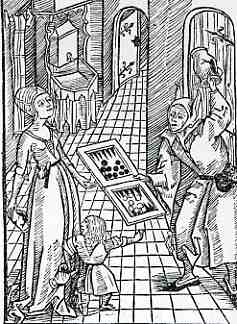
    Albrecht Durer doesn’t seem to have many dots at all in his works, though I did stumble upon this image from Sebastan Brant’s Navis Stultifera (Basle, 1497)–a fool interrupting a mother and daughter who were “discussing” their game of backgammon.

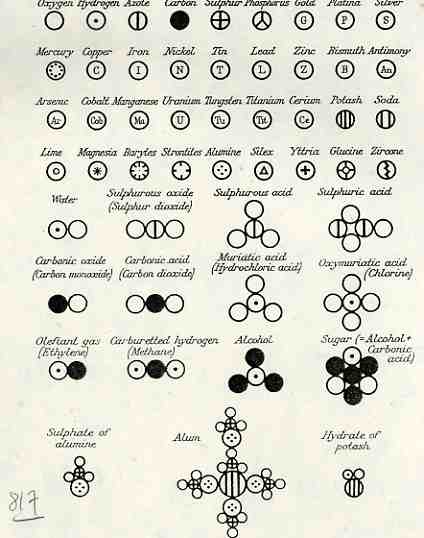
    On the other hand the history of the construction of the periodic table is necessarily filled with dots, as we see with the monarchical creation of John Dalton (1766-1844), in his New System of Chemical Philosophy (part II), and which was printed in 1810–these symbols were sued to visually represent the atomic structure of compounds, and were of vast importance and predictive powers, marking the true modernizing of chemistry.  It was in Part I of this work that Dalton first applied atomic theory to chemistry.

    0 abay feb 25 dots chem625

    0 abay feb 25 dots kids626

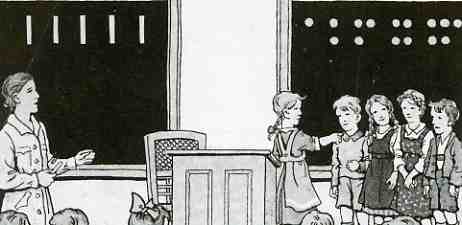
    This last element for this installment on dots simplifies things enormously, sort of, even though these dots represent the very building blocks of almost everything else.  They represent counting.  And they are beautifully present in this image from Franz Brauner’s Rechenbuch fuer osterreichische Volksschulen (published in 1953).  Funny that this “Rechenbuch” turns up again here in 1953–its been the major part of titles of books describing the laws of arithmetic for 450 years. 

    ·Posted by :

    ·in:

  • Word Balloons (continued): an Early Version in a Printed Book, 1523

    JF Ptak Science Books  Post 527

    0 blog feb 18 balloon599


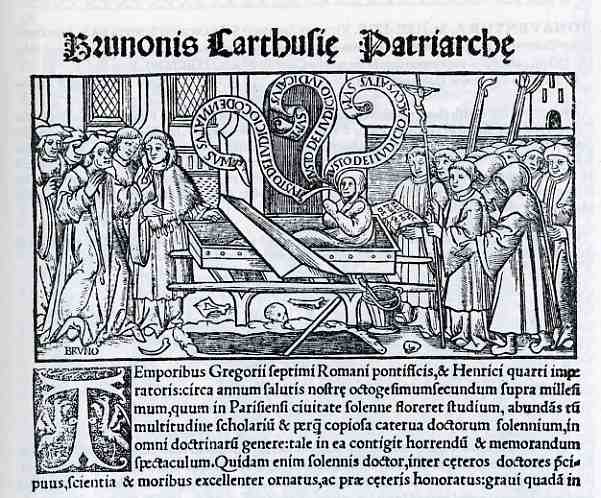
    Earlier in this blog I’ve touched on the history of the thought and/or speech balloon  (The X-Ray of the Imagination 2: Phrenology, Chinese Hell Scrolls, and the Beauty of the Thought Balloon–Internal Dialog, Demons, Humors, and Picturing the Stuff of Thought…) and I thought for sure that I had included some Renaissance examples of this very expressive additive to the medium, though it seems that I didn’t.  Everyone seems to be familiar with the idea, though perhaps it is a minority who know how old the idea is:  and it is old, the idea stretching back at least into Medieval times.  I know of at least one example from the 12th century:  an Evangeilstary from Lower Saxony, executed ca. 1190 (though the influences are Byzantine), where the Gospel texts are introduced with an illuminated page, at least two of which are further illuminated with speech banners.  (This was on display in the monumental exhibit called “1200”, shown at the Metropolitan Museum of Art in NYC in 1970 and pictured in the exhibition catalog.)

    0 blog feb 18 balloon598

    The idea must’ve been groundbreaking, though I wonder—as in the case of simultaneous sound-on-film talkies almost instantly replacing the silent film—if there were detractors who raised the issue of the device being a “cheat”, claiming that the art itself should be enough to convey the very thoughts or speech of it subject, which was now displayed in words right on the canvas. (Perhaps there was an implied threat to art itself?)    Is this the case with all new or different or revolutionary breakthroughs?  Were the minstrels threatened by the new professional theater?  Was the production of manuscripts put in jeopardy by movable type presses?  Was the Parisian water carrier, the purveyor of the coolest and freshest water threatened by municipal water systems? Radio by television; family cohesion by television; private thought by constant communication devices; symphony by recordings; telegraph by telephone; considered correspondence by email, and so on?  (I don’t think there was a “no” response to the above.) It seems as though the response is a time-compressed myoptically-evolutionary response.

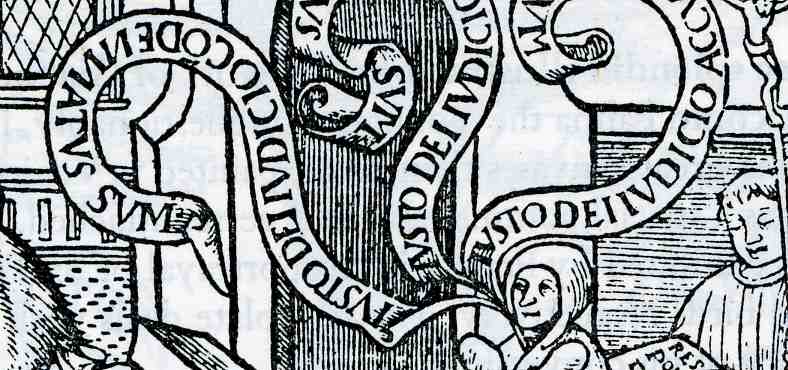
    This example, printed in Paris in 1523, is an illustration for the work of Bruno Carthisienni. St. Bruno (who lived ca. 1030 to 1101) born in Cologne and educated in Rheims, was an influential academic with a wide accumulation of knowledge and a wandering spirit he used to establish monasteries.  This woodcut is one of the earliest examples of word balloons in a printed book, while the book itself is a monument to typography and illustration.  The word balloons in this case are really quite lovely, and seem to almost life their speaker from his casket. 

  • Inside-Out Privacy: Hermits, St. Simeon, and Cellular Phones

    JF Ptak Science Books LLC  Post 528

    0 blog feb 18 hermit600

    “Language is just no damned good.”–Marcel Duchamp


    0 blog feb 18 hermit601 It seems to me that when cellular telephones first appeared, they were to deliver a certain amount of privilege, a promise of speed in communication that would allow for more personal time and privacy.  But that was many years ago, back when paying for cable television meant no commercials.  The promise, or possibility, of privacy as a result of using this Ponzi scheme of constant data streaming is a demolished and smoldering pile, missing the smolder and the pile.  There’s just nothing in that smoking promise-hole:  no smoke, and not even a hole. 

    What it is, I think, is privacy turned inside out:  everything on the inside is now on the outside, a great big visible and vocal outside. 

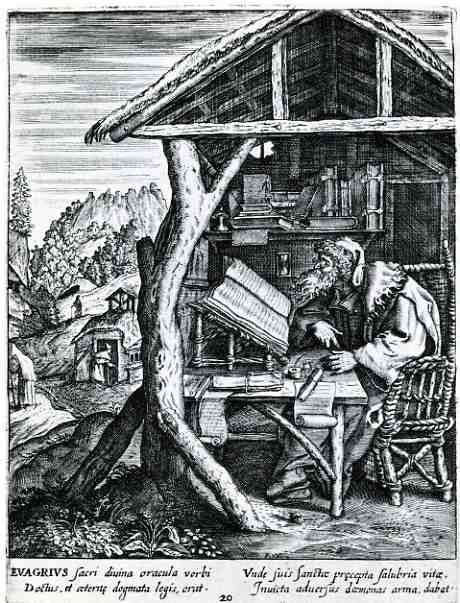
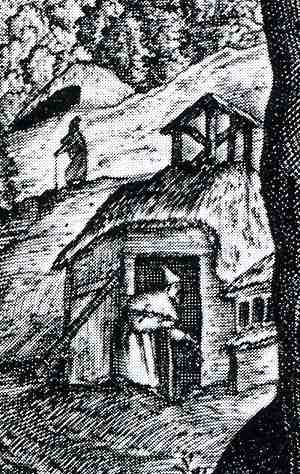
    Privacy, which means to me the promise of some time in which to do a little thinking, is much more in line, say, with the pursuit of a personal space:  not necessarily like that of the beautiful hermit in the image to the left here, but it at least represents the possibility of quiet, which represents a possibility of order and image-making, which in turn represents dreaming or thought or perhaps nothing at all.  It does mean something to the lead monk in this engraving, which belongs to the beautiful Illustrium Anachoretarum Elogia sive religiosi Viri Musaeum (“The Museum of Hermits”) of Giacomo Cavaccio (published in Venice in 1625).  This is a beautiful and remarkable book, with 32 full-page engravings punctuating 150 pages of text  surveying the literature and imagery of, yes, hermits.  Although living very simply, these hermits were all in order, living cleanly, with an impressive two-dozen or more books in their little huts.  St. Anthony, another very quiet thinker, lived in a similar fashion but without books and whose story was unknown until it came (post mortem by thirty years) to St. Augustine, appearing in his Confessions.

    On the other hand, in the history of quiet asceticism (athletae Dei, “athlete of god”),a hermit without the need of a hermitage, or quiet, or aloneness, a hermit who turned the concept of private thought inside out, was St. Simeon Stylites.  I’m sorry to say that he sounded to me like a person in desperate need to be seen being thoughtful and to display his quiet and dedication loudly.  Chained to an ever-heightening pillar, doing sit ups and reciting his conversations with the creator of the universe, Simeon made it into heaven as a saint after treading the earth as one.  Still he seems to have been the opposite of the expected.

    I wonder about this legacy of the invasion of the cell phone; I have little doubt that it is just the barest blink of future invasions of privacy to come, unstoppable and ultimately unwantable. M. Duchamp did say this about words–though he was talking about written and spoken, words–once they left the privacy of the brain, their meanings got all messed up. The interruption of privacy was what corrupted them and their meaning. (“I use it  (language) because I have to” Duchamp said.)  

    I can’t help but think about the speed of deliverables in the Brave New World.  It reminds me of an observation made by Mikhail Matyushin, in 1915: “Only motion cystallizes outward appearance into a single whole…a speeding train fuses the separatness of the cars into a compact mass…”  He goes on to say that “when at last we shall rush rapidly past objectness we shall probably see the totality of the whole world”, though I think that he got that part of it backwards, or perhaps inside out. 

  • God in Reverse: the First Painted View of Future Action (1912?)

    JF Ptak Science Books LLC  Post 529

    Jeff Donlan from Salida, Colorado, sparked this post with his comment from yesterday*.  I don’t think that Matyushin  really knew where he was going , either, even though he was writing in the years (1896-1916) when this issue of time and space and motion was being hammered on god’s holy anvil.  The thinking that the artist of this time were in some way responsible for shaping the social vessel necessary for the scientific development of these ideas has never been attractive to me.  Frankly this image wound up in the dead idea cemetery (along with the cemeteries of lost ideas, the cemeteries of blind ambitions, of fear, of lust-conquered-love and vice versa; the cemeteries of hollow illusion, near-achievement, and good will; the cemeteries of childhood despairs, of extra vowels, of dropped change, of the thoughts behind bad thoughts, and of ill-gotten gains.  There are no cemeteries evidently for incompetencies or mediocracies, as these things, in addition to being lifeless, cannot be killed.)

    This issue is strongly entertained by Linda Dalrymple Henderson in her Princeton-published doorstopper The Fourth Dimension and Non-Euclidean Geometry in Modern Art, where she prettily and exhaustively declares “nope” to the egg-chicken possibility of the space/time issue being born in art and nurtured-up in the sciences, which is fine with me. 

    That’s not to say that the art produced in the sciences to illustrate fourth- and nth-dimensional space weren’t without (great) artistic qualities.W.L. Stringham  (“Regular Fgures in n-Dimensional Space”, 1880), E. Jouffre  (Traite elementaire de geometrie a quatre dimensions, 1903), H.P. Manning (Geometry of Four Dimensions, 1914) are excellent and early examples of gorgeous illustration illuminating complex issues, and are also published many years before the works of Braque and Picasso and Metzinger and Gleizes and Le Fauconnier and of course Duchamp.  These artists are all producing their important work before 1912, but are also definitely coming after some of the major work in the history of the fourth dimension.  

    But getting back to Matyushin and to the title of this post:  I wondered when the first painted images depicting future action was painted. “God” comes into this because, I think, a case might be made for the depcition of future action via the depiction of the progression to life-after-death states (and marching towards heaven/hell.)  Removing god from the equation takes us,  maybe, to the backwards spelling of god:  “dog”.

    Blog--bella
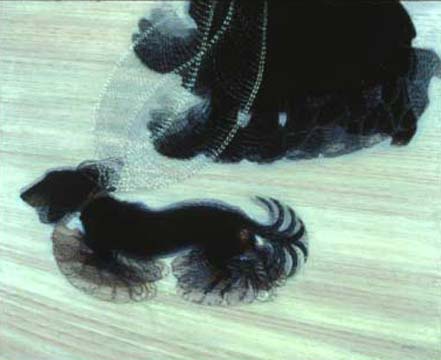
    Giacomo Bella’s  Dynamism of a Dog on a Leash (1912) may well be the god-reverser, the first painting of the future, with simultaneous views of space and time, wrapped up in the gift of speed.  Whether this is accurate or not I really don’t know–Duchamp’s Nude Descending was painted and almost and nearly exhibited in this same year (having been throw out of the art exhibition by friend and foe alike because his work was too risky)–I really like that this “first” involved the picture of a doggie, even though it is vastly inferior to the Duchamp and all.  

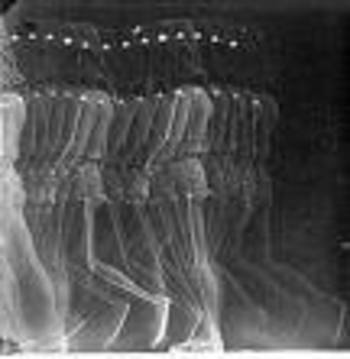
    This is a complex issue that I’m just passing quickly through–I’m not sure that this whole issue wasn’t dealt with first(artistically) in the comics, the space/time bit perhaps getting an early cover in places like Windsor McKay’s Little Nemo in Slumberland (1908) and Lyonel Feininger’s The Kin-der-Kids (1909).  Then there’s the issue of Etinne Marey’s beautiful studies of motion, which look a tremendous lot like the things to come in Duchamp et cie twenty years later, but that’s another story. But I think it highly poetic that this issue boils down to a stumpy dog, Little Nemo, a French polymath with a gun camera, and M. Duchamp (who didn’t take any of it seriously). 

    Blogmissingmarey_one

    __________

    * “Pictures
    like these are porn for the unhappy multitasker. What Matyushin could
    not know in 1915 is that when we rush fast enough, our left brain shuts
    down and the right brain takes over suffusing us with an intense
    feeling of oneness. We don’t really see the totality; we just feel we
    do. I don’t know that this is true, but I feel that it is as I rush
    through this so I can write my library column before I forget…”  This was said in response to the following: “
    Mikhail Matyushin, in 1915: “Only motion cystallizes outward appearance
    into a single whole…a speeding train fuses the separatness of the
    cars into a compact mass…”  He goes on to say that “when at last we
    shall rush rapidly past objectness we shall probably see the totality
    of the whole world”, though I think that he got that part of it
    backwards, or perhaps inside out.”

    ·Posted by :

    ·in:

    —
  • The History of the Future, Living Life Backwards, and a Wordle of Benjamin Button

    JF Ptak Science Books LLC  Post 451

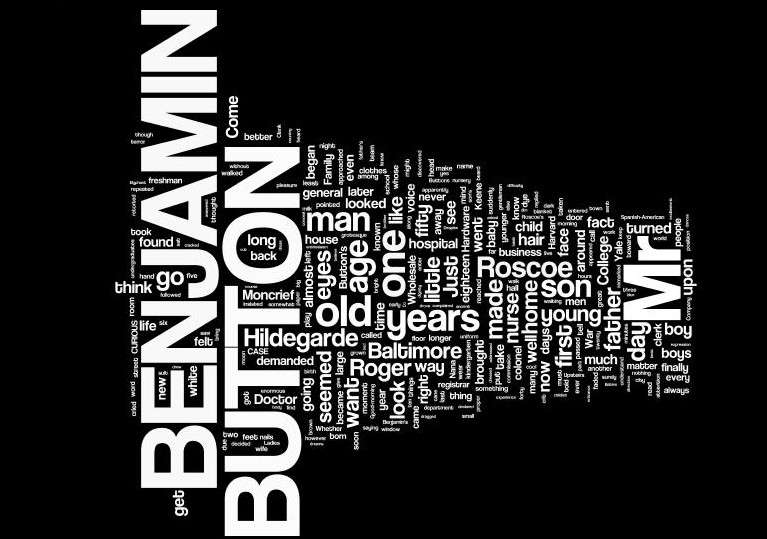
    Beginning life with the final kiss of a Shakespearean comedy is far more complex than it is interesting.  The ordeal of Benjamin Button, a current movie based on the 1922 short story by Scott Fitzgerald (found in his collection Tales of the Jazz Age), presents some very curious aspects of the physics of life–especially if it is more than just Mr. Button who gets to live their life out again in reverse.  It also isn’t a very wide genre of literature, so far as I know.  Another good example of a life lived backwards is the book Time’s Arrow, by Martin Amis, who tells the story of a problematic character named Tod T. Friendly. (“Tod T. Friendly” is also “Todt Friendly” or “death friendly, taking a piece of his name from German, which evidently Mr. Friendly was.)  On the other hand, the novel Stuart, a Life Lived Backwards doesn’t make the cut, as Stuart does live his life forwards.  Christopher Homm, (homme?) written by C.H. Sissons in 1965, tells the story of the title character backwards, though his life is lived forwards as well.

    Wordle--button

    (CLICK to enlarge.)

    The idea of the future, or the having of a future, seems like it should be an ancient idea, and it is–though it isn’t necessarily a universal idea.  Mesopotamians, Babylonians, Mayans embraced the idea of vast distances of time; early Christian faith, o the other hand, doesn’t necessarily have a great future, what with time ending at Judgment Day.  Hinduism and Buddhism have a sense of the future, though there is some very problematic circularity involved with it.  The true scientist bits about the concrete possibilities of vast amounts of time extending into the millennia are found in Charles Lyell (Principles of Geology) who in 1830 took up some earlier work and made it possible to think of the age of the earth in terms of millions of years.  Charles Darwin was also a cultivator of the past and possible future, as was Hermann von Helmholtz, who predicted the ultimate age of the sun, meaning that time’s arrow had the possibility of being hundreds of millions of years long.  These were startling, epochal ideas, and all came within a period of thirty years, creating for the world a fluidity of scientific thought such as had never been seen.  The future came to life in the hands of novelists like Jules Verne, H.G. Wells and Aldous Huxley, not to mention the fabulous worlds of Robert Heinlein (who launched his terrific series of articles on the history of the future in the March 1941 issue of Astounding Science Fiction–just a month after John W. Campbell had evidently coined the term in the same magazine.  I can’t leave this without mentioning Edward Bellamy, a great trailblazer in this area of thought, and his work Looking Backwards, which was a view of a socialist utopia live din the year 2000 by an 1887 man who had fallen into a 113-year-long sleep. 

    But the difficult part of multiple people living their lives backwards comes in the multiplicity of changes that would be caused by two actors adjusting their behavior for the “future” based on lives they had already “lived”.  I can’t imagine the implications of the “butterfly effect” when spread across a broader spectrum than just Mr. Button.

    I haven’t seen the movie, but I have now read the Fitzgerald story, and the idea is very disturbing, like coming out of Alzheimer’s to climb right back in again.  The worst of it seems t take place not at the end of the reverse life, but right before–Mr. Button enters Harvard as a genius sportsman with his years of expertise and learning already under his belt–four years later, though, as a senior, he is struggling, his brain and mind slipping away, his knowledge restricted to that of a 16-year old boy.  And it just gets worse from there, though his ability to distinguish his diminishing capacity grows dimmer and dimmer, thankfully, the closer he comes to his cradle grave.  Its a difficult story to read.

    (In a cursory look I don’t see anything interesti9ng with anything read backwards in Mr. Button’s story.)

    ·Posted by :

    ·in:

    — —
  • Private Smoe, Latrine Orderly, and a Sub-History of the Word “Latrine” in the Titles of Books in English

    JF Ptak Science Books LLC   Post 452

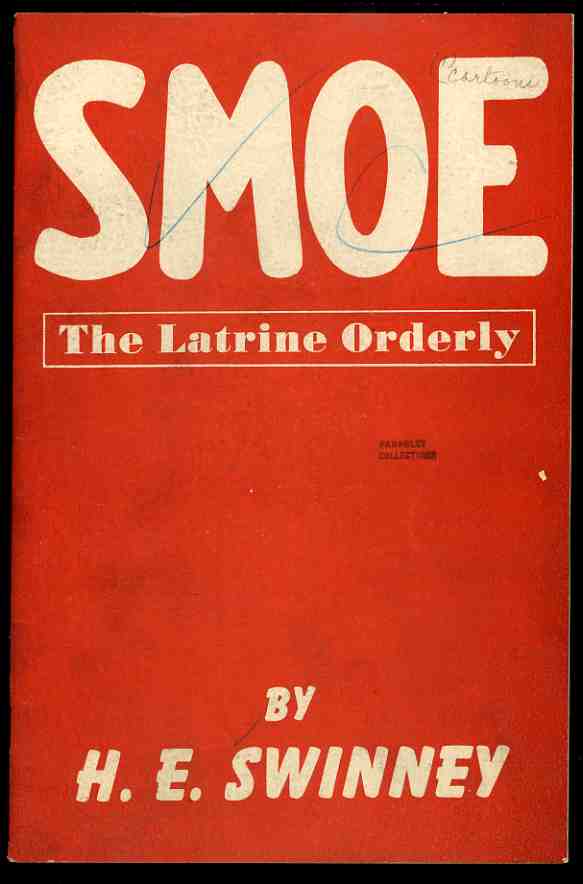
    0 blog dec 31 smoe334 Is it possible that James Steveson’s Paddington : report on the necessity of latrine accommodation for women in the Metropolis, published in 1879, is the first book published in English to use the word “latrine” in the title?! Well, in a lightly interesting and perhaps stupefying way, the answer is “yes”.  And this just to get to this very obscure graphic.cartoon book, Smoe, the Latrine Orderly, by H.E. Swinney, published by the Ledger Company in Fort Worth, Texas.  According to WorldCat/OCLC, the massive cataloging tool used by librarians everywhere, there aren’t any copies of this book in any library anywhere in the world.  I’m both surprised and underwhelmed.  The cartoons all appeared in the Fort Worth Army Air Field’s newspaper “Lone Star Scanner”, which is also a publication that doesn’t seem to have survived anywhere.  H.E. Swinney may be Sergeant H.E. Swinney, who was present at Pearl Harbor on 7 December and who fought his way through WWII, though I’m not sure.

    The pamphlet’s  jokes and cartoons I can appreciate as having been funny once upon a time, making people laugh as they snapped their newspapers over their eggs at the PX.  Maybe they made people laugh for a few years, but probably not much more.  It makes me think for just a little about the average age for how long jokes are “funny”.  I’d say that the Smoe funny lasted about 2 years 5 months and 5 days.  More or less.

    The word “latrine” is from the French and from the Latin before that, and appears fairly early in English (1642 according to my 1933 OED), but for whatever reason, it just doesn’t find its way into the title of any English books for more than two hundred years.

    The reason I’m spending any time at all on this little pamphlet is because its title is so entirely unexpected.  And that, as the man said, is all I have to say about that. 

Recent Posts

Archives

Categories